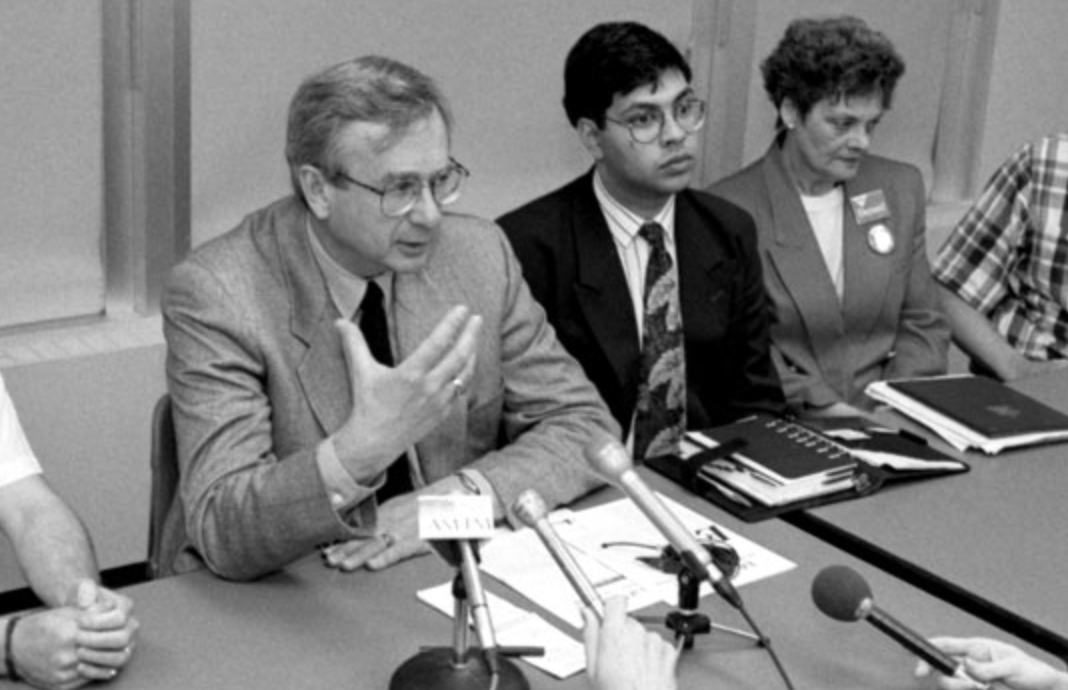
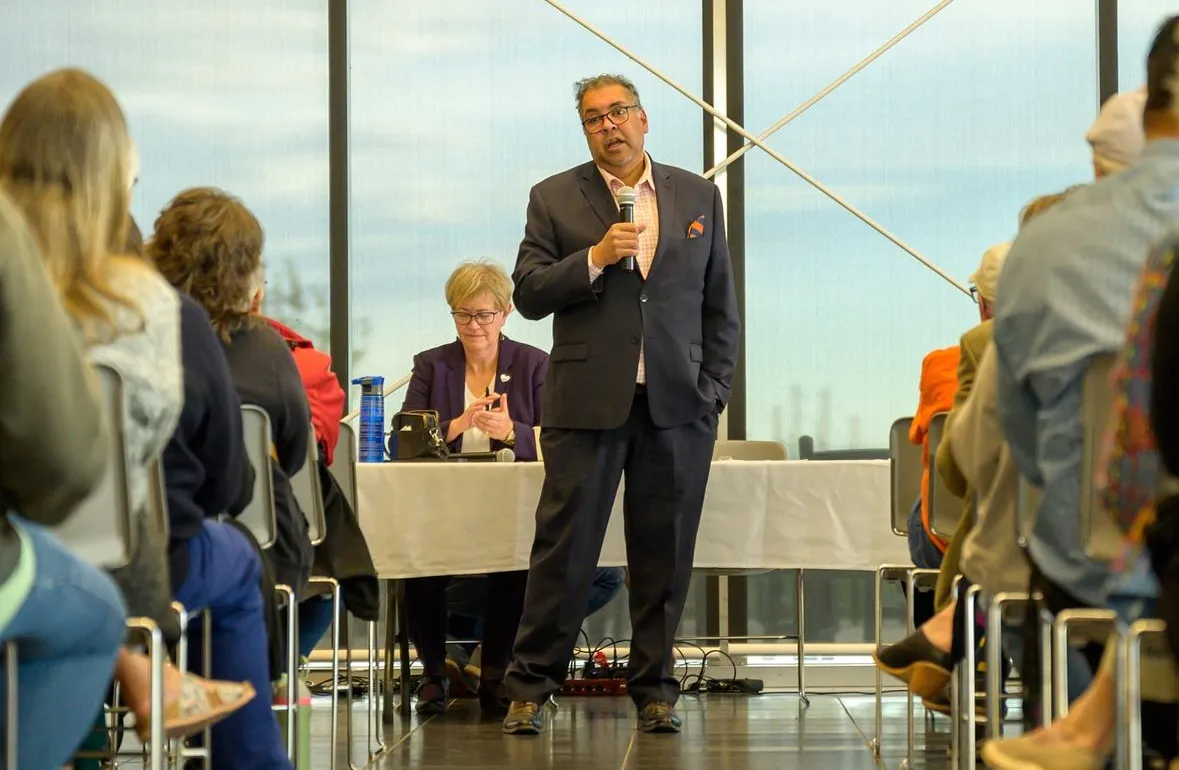
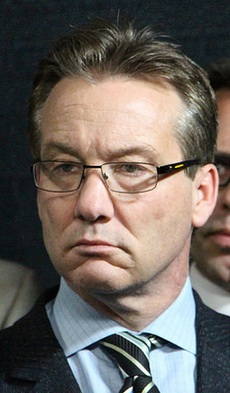
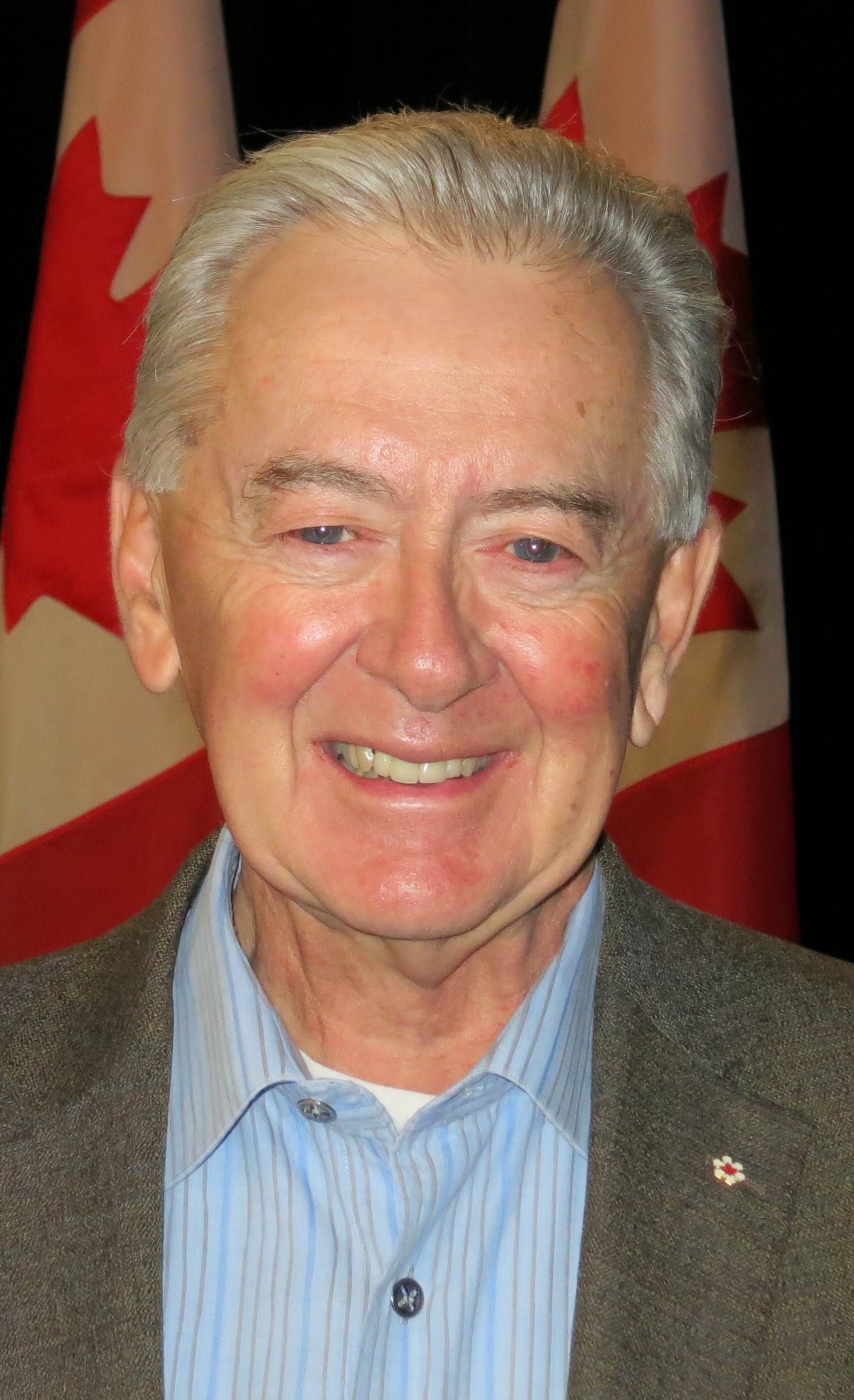
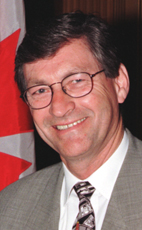
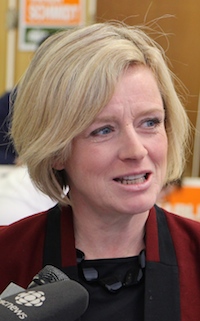
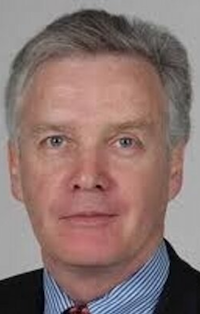
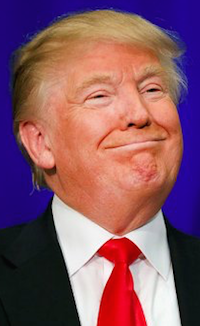
Liberal Party leader Laurence Decore at a press conference with University of Calgary Students’ Union President Naheed Nenshi in 1993 (source: Alberta Views Magazine)
It would be more than 50 years after William Aberhart repealled the recall law before more attempts were made to bring back recall in Alberta.
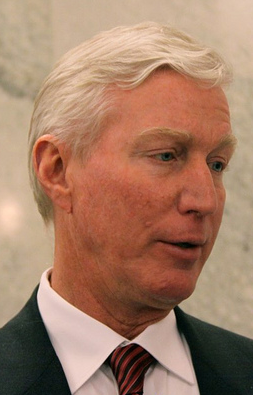
Riding the same wave of populism that Ernest’s son Preston Manning rode into Ottawa in the early 1990s, the Alberta Liberal Party led by Laurence Decore adopted recall as an official party policy in the 1993 election.
“Recall is vital for Albertans because it gives people an element of control over their politicians between elections,” Decore argued in the Edmonton Journal in June 1993. “It also gives MLAs the power to tell their leader they can’t vote for a bill because their constituents wouldn’t stand for it. This power will encourage more free votes in the house and loosen party discipline.”
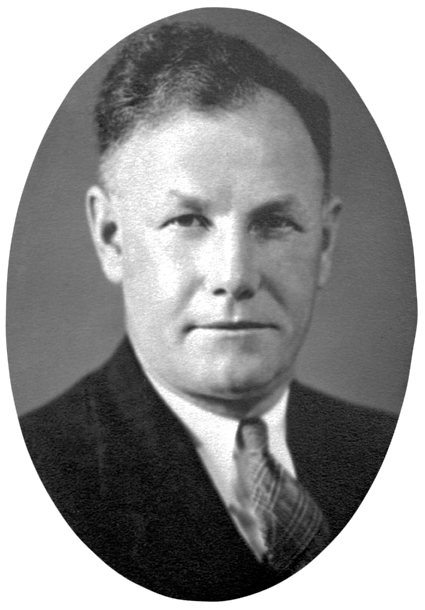
William Aberhart was Premier of Alberta from 1935 to 1943.
Social Credit’s recall law lasted 18 months on the books before it was repealed
A recent proliferation of MLA recall campaigns has fuelled speculation that Premier Danielle Smith’s United Conservative Party government could repeal the law, just like Premier William Aberhart did when his party’s MLAs faced recall campaigns 88 years ago.
Aberhart’s Social Credit government passed a recall law in April 1936 and then repealed it in October 1937 after the Premier was targeted by voters in his own riding.
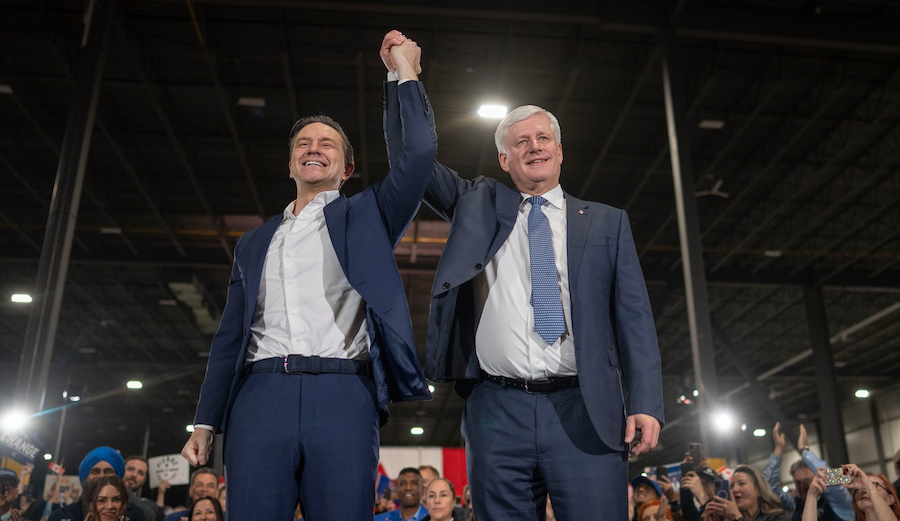
Conservative Party leader Pierre Poilievre and former Prime Minister Stephen Harper at an election rally in Edmonton on April 7, 2025 (source: Pierre Poilievre / Facebook)
It was Alberta Week in Canada’s federal election campaign
It was Alberta Week in the federal election campaign with the two party leaders who grew up in the western province returning to wave their party flags and rally supporters.
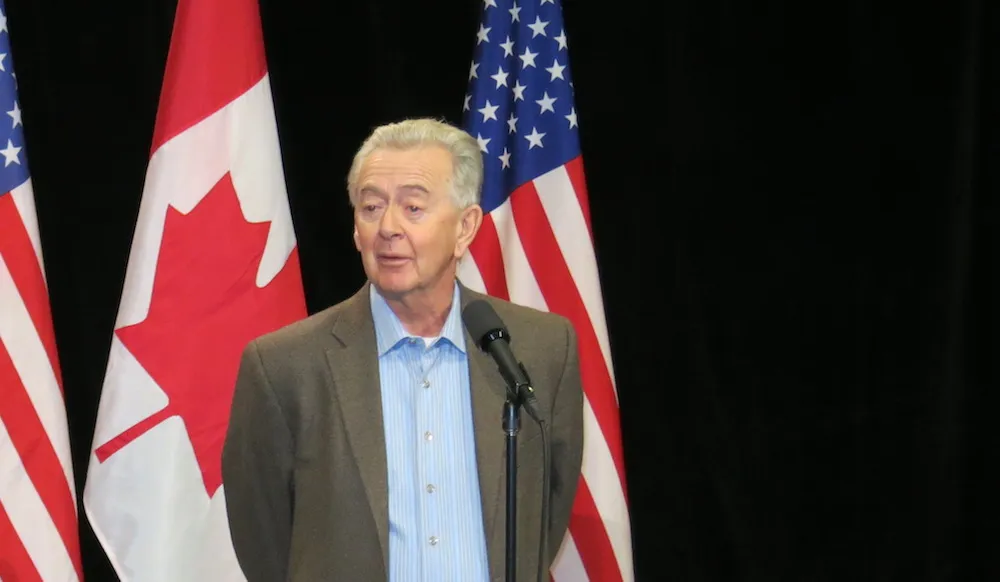
Manning Centre founder and former Reform Party Leader Preston Manning (Photo credit: David J. Climenhaga).
Conservative movement grandfather emerges from political retirement with grumpy separatist threats
Preston Manning emerged from political retirement to insert himself into the federal election mix by writing an op-ed in the Globe & Mail claiming that Liberal Party leader Mark Carney poses a threat to national unity. Manning’s argument triangulates with Premier Danielle Smith’s threats that a re-elected Liberal government would lead to an “unprecedented national unity crisis” – claims that are likely not very helpful for Pierre Poilievre’s Conservatives.
Manning is undoubtably frustrated by the Liberal Party’s resurgence in public support but threatening that the country will be torn apart if the Conservatives don’t win the election is a shameful bookend to his long and fascinating career in Albertan and Canadian politics.
But who’s Preston?
Manning is probably a familiar name to a lot of Daveberta readers but, now that he’s been out of elected office for more than two decades, there’s a good chance that even a few keen politician watchers in 2025 aren’t too familiar with him.
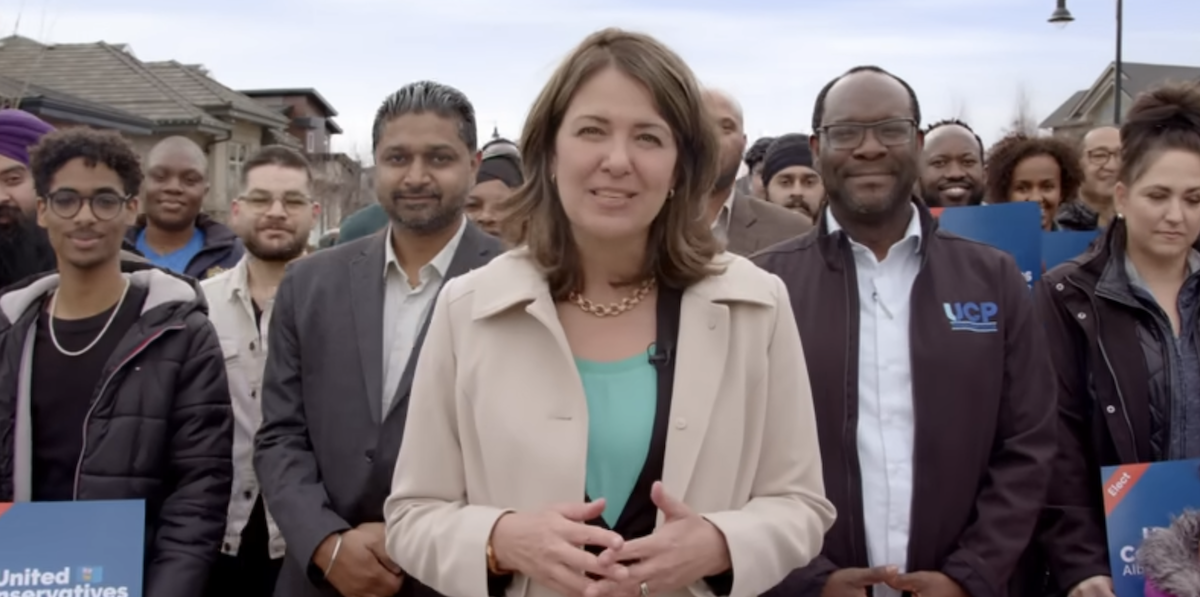
Premier Danielle Smith in an ad announcing the UCP’s “Public Health Guarantee” during the 2023 election (source: United Conservative Party / YouTube)
Carrie Tait’s bombshell exposé rocked Alberta politics this week
When I first sat down to start writing today’s column I was planning to write a follow up to my piece about Premier Danielle Smith’s reaction to American President Donald Trump’s tariff threat, but a week in politics can be an eternity and to say this has been a busy week in Alberta politics is an understatement.
If you read one news article this weekend, I strongly recommend it be intrepid Globe & Mail reporter Carrie Tait’s bombshell exposé about the United Conservative Party government firing Alberta Health Services CEO Athena Mentzelopoulos “two days before she was scheduled to meet with the province’s Auditor General to discuss her investigation into procurement contracts and deals for private surgical facilities.”
Nenshi’s 84% win with 62,746 votes means there is no doubt who the vast majority of the party’s membership wanted as leader. But meaningfully connecting with the people in the room this weekend will be Nenshi’s next big step.
Minister of Public Safety Mike Ellis and Premier Danielle Smith respond to questions about politicians accepting tickets to NHL playoff games (source: Screenshot from YourAlberta / YouTube)
Protected rights for the unvaccinated and tax cuts aimed at appeasing unruly UCP members ahead of November vote
Summer is normally a time when politics cools down and politicians hit the BBQ circuit, but there’s something smelly in the air and it’s not just the wildfire smoke that Albertans have become accustomed to being part of our increasingly hot summers.
A political scandal surrounding Premier Danielle Smith and senior United Conservative Party cabinet ministers accepting tickets to skybox seats during the Edmonton Oilers NHL playoff run has erupted. Globe & Mail journalist Carrie Tait first broke the story that Smith and some UCP cabinet ministers had accepted box seat tickets to NHL playoff hockey games from private corporations that have close connections to or are lobbying the Alberta government.
Potential NDP leadership contenders (clockwise): Nagwan Al-Guneid, Jodi Calahoo Stonehouse, Joe Ceci, Kathleen Ganley, Christina Gray, Sarah Hoffman, Janis Irwin, Samir Kayande, Rakhi Pancholi, Shannon Phillips, Irfan Sabir, and David Shepherd (source: Legislative Assembly of Alberta)
Choose wisely. Notley’s successor could be the next Premier of Alberta
Rachel Notley has been one of the Alberta NDP’sgreatest assets since she took up the reins of the party in 2014. Under Notley’s leadership, the NDP went from a small and scrappy opposition party to form government in 2015 and then solidify itself as a viable political force and the singular opposition to the United Conservative Party after 2019.
And after 9 years as the helm of the Alberta NDP she helped transform, it’s likely she will not lead them into the 2027 election.
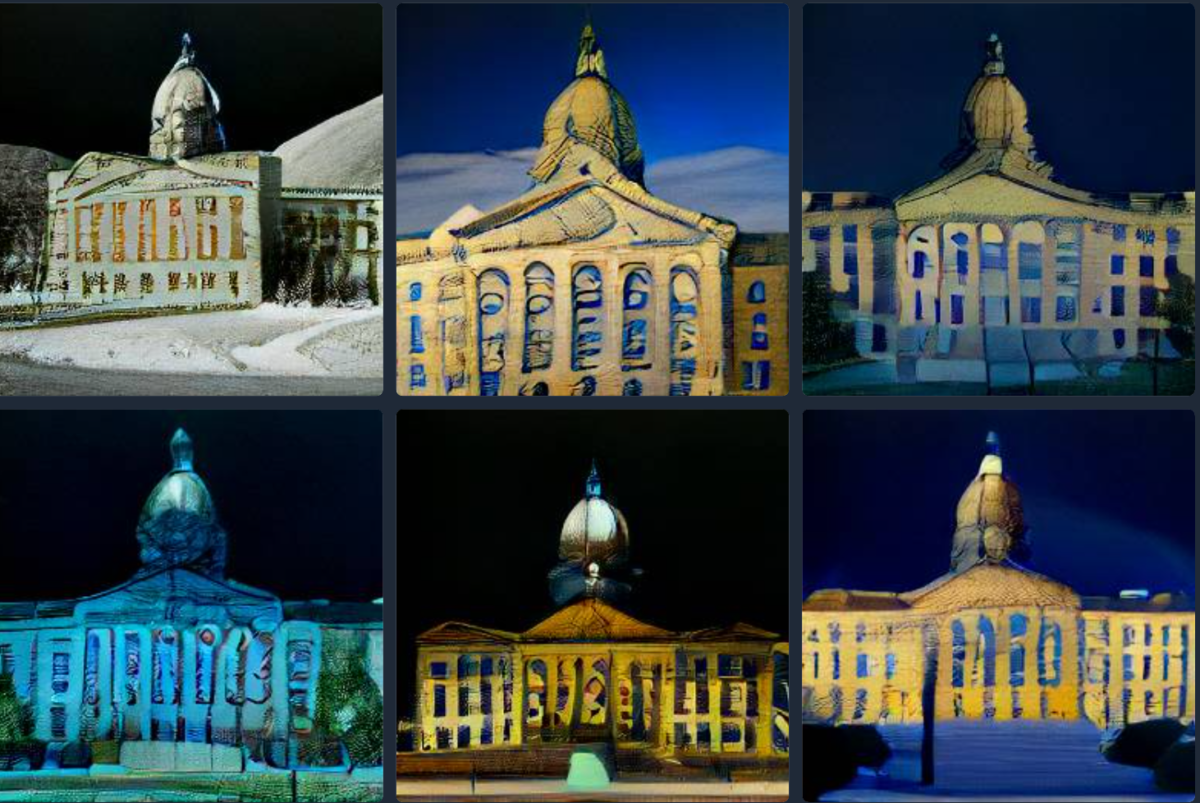
AI generated images of the “Alberta Legislature Building on the moon.” (source: DALL-E mini)
Kind of like Aunt Martha’s fruitcake. It keeps coming back at you year after year.
Over the summer months, while most Albertans were focusing on navigating wildfire smoke and intense heat, the provincial government released a steady stream of mandate letters from Premier Danielle Smith to her cabinet ministers.
The mandate letters are meant to provide direction from the Premier to the Ministers on where the departments they are responsible for fit in the government’s agenda.
Publicly releasing ministerial mandate letters provides a certain level of transparency on the surface but the stream of press releases, as conservative thinker KenBoessenkool mused last year, “turns an important governing process into a communications and stakeholder exercise.”
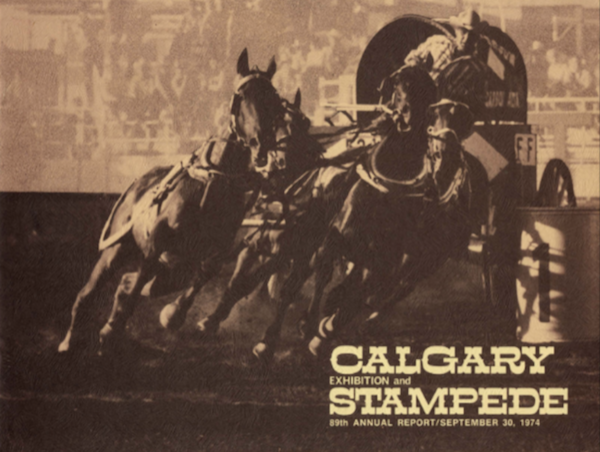
The cover of the 1974 Calgary Exhibition and Stampede annual report (source: Glenbow Museum)
Dust off your cowboy boots and hat. It’s that time of year again. It’s the Greatest Outdoor Show on Earth. It’s the Calgary Stampede.
The Stampede is a must attend event for politicians of all stripes. Aside from the actual rodeo (the Chuckwagon races are a must see), the free pancake breakfast and BBQ circuit is unparalleled and a huge opportunity for local, provincial and federal politicians to connect with Calgarians. Proper attire is key, as is the ability to wear it properly.
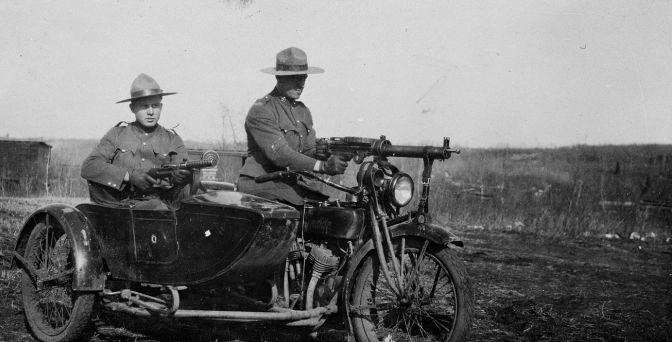
Alberta Provincial Police machine-gun equipped motor-cycle and side car during the Drumheller Coal Miners Strike (source: Alberta Culture)
While much of my undergraduate studies at the University of Alberta focused on Canadian politics, one of my favourite courses covered a topic far away from the prairies – the Habsburg Monarchy. It was a combination of an unfamiliar topic and a passionate professor that made this course memorable. So my interest was piqued when the words “South Tyrol” began circulating in Alberta political circles this week.
Angela Pitt (source: Facebook)
“Should Alberta be an autonomous Province? South Tyrol has” asked Airdrie-East MLA Angela Pitt in a Facebook post linking to a website showcasing facts about the autonomous province in northern Italy.
Much of South Tyrol’s status appears to be a result of it having a German-speaking majority population in a country where most people speak Italian. The former princely county of the Austro-Hungarian Empire was annexed by Italy after the First World War.
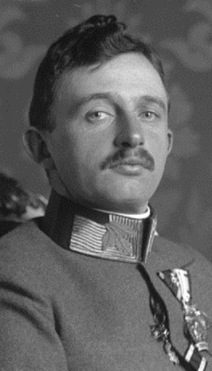
Charles I, the last Habsburg Emperor of Austria, King of Hungary and King of Bohemia.
I expect many German-speaking South Tyroleans would probably prefer to re-join their linguistic cousins in Austria than remain in Italy.
I am not sure which other province or region Alberta would join if we adopt what might be Pitt’s version of an autonomous-province. Perhaps Frederick Haultain’s dream of a Province of Buffalo could be finally be realized if Alberta merged with its smaller cousin to the east, Saskatchewan? Or maybe British Columbia’s Peace Country will finally be released to unite with its northwestern Alberta cousins?
But Red Deer-South UCP MLA Jason Stephan is certainly whittling down the number of possible candidates.
Stephan apologized to the Legislative Assembly this week after describing other Canadian provinces as “hostile, parasitic partners” in a speech about federal fiscal policies and equalization program.
The rookie MLA and sole UCP backbencher appointed to the powerful Treasury Board committee also claimed that “Alberta must liberate itself from this mess.”
While Alberta is not going to separate from Canada, the final report from the government-appointed Fair Deal Panel will include recommendations to increase provincial autonomy from Ottawa.
The panel and its open-mic town hall meetings were both a relief valve and a steering wheel meant to allow Albertans to vent their frustrations while allowing Kenney to attempt to keep control of the latest burst of separatist fervour. The separatist fervour from Alberta’s right-wing fringe, despite the media attention it generated, now appears to have mostly died out.
The panelists included former Reform Party leader Preston Manning, former Progressive Conservative MLA Donna Kennedy-Glans, Peter Lougheed‘s son Stephen, and perennially disgruntled UCP backbencher MLA Drew Barnes of Cypress-Medicine Hat and fellow backbenchers Miranda Rosin of Banff-Kananaskis and Tany Yao of Fort McMurray-Wood Buffalo. The panel was tasked with making recommendations on topics including withdrawing from the Canada Pension Plan, replacing the Canada Revenue Agency by establishing a provincial revenue agency, opting out of federal programs like pharmacare, forming an office of a Chief Firearms Officer, and forming a provincial police force.
The NWMP had been created in 1873 and was part of the federal government’s suppression of the North West Rebellion in 1885, but, by 1917, Ottawa’s attention was focused on the First World War and there was little federal interest in enforcing provincial prohibition laws that had been enacted in 1916.
The APP merged into the RCMP in 1932 following negotiations between the provincial and federal governments during the Great Depression. The agreement to offload the costs associated with policing to the RCMP stipulated that former provincial police officers who transferred to the federal police would maintain their seniority and be eligible to receive pensions in accordance with their years of service.
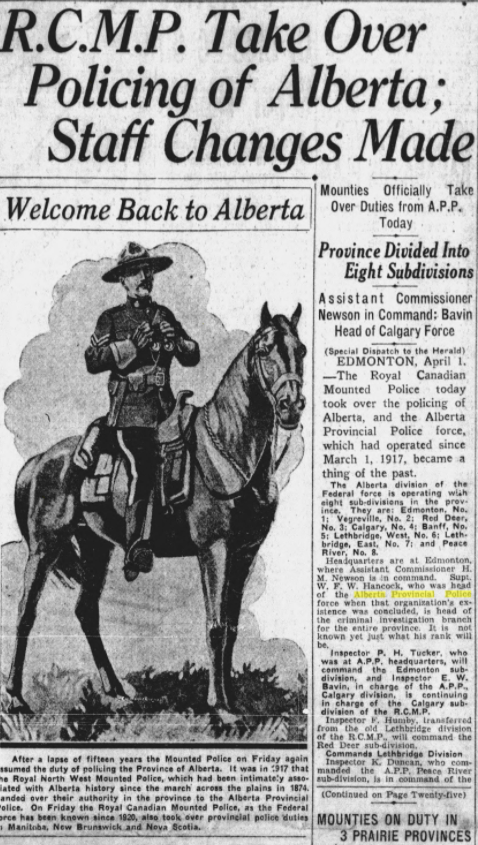
When officers hung up their blue APP uniforms on April 15, 1932, it was reported in the Calgary Daily Herald that it took more than a month for the red RCMP uniforms to arrive in Alberta. So during the short period following the return of the federal police, RCMP officers worked in civilian clothes or, for those who worked as police in Alberta before 1917, wore the uniforms of the old NWMP.
RCMP Take Over Policing of Alberta, Calgary Daily Herald, April 15, 1932
While Alberta politicians have generally expressed pleasure with contracting policing responsibilities to the federal government, there have been several attempts to reinstate a provincial police force.
The next notable attempt to reinstate the APP came in 1937 from Edson MLA Joseph Unwin, the Whip of the Social Credit government caucus. Unwin introduced a motion to abolish the RCMP in Alberta and replace it with an Alberta Provincial Police Force.
Unwin argued that it was preferable that “the police force in the province should be indisputably at the exclusive orders of the attorney general.” Given this comment and the context of the time, it is fairly safe to speculate that Unwin was hoping to create a police force that would enforce the Social Credit ideological and political agenda in Alberta.
Joseph Unwin
Unwin introduced the motion the same week he was arrested on charges of libel and counselling to murder in what would become known as the Bankers’ Toadies scandal.
Unwin and British Social Credit expert George Frederick Powell were arrested when police raided the party headquarters following the printing of a pamphlet advocating the “extermination” of nine prominent Edmontonians. The nine men, labelled as “Bankers’ Toadies,” included Conservative Party leader David Duggan and Senator and former mayor William Griesbach.
Unwin was sentenced to 3-months hard labour for the libel charge, which was later overturned on appeal. He did not resign as an MLA when he went to jail and his return to the Legislature was celebrated by Social Credit MLAs with a “snake dance” on the floor of the Assembly.
Various PC MLAs called for the creation of a provincial police force during the 1980s and early 1990s but most of those calls were quickly discredited because they were usually followed closely by racist comments about RCMP officers wearing turbans or speaking French.
Ted Morton
Anti-oil patch activist Wiebo Ludwig called for the creation of a provincial police force during his brief run for the Social Credit Party leadership in 2000 before having withdraw from the race after a judge refused to waive the conditions of his bail.
Motions recommending the creation of a regional police force or to make public studies conducted to assess the creation of a provincial police force were introduced by Wainwright MLA Doug Griffiths in 2003 and Lethbridge-East MLA Ken Nicol in 2004 were debated in the Legislature but gained no real traction.
In 2006, Morton, then a candidate for the leadership of the PC Party, called for the creation of a provincial police force, a proposal mocked by outgoing premier Ralph Klein. “We studied it and it was rejected,” Klein said. “Thus far, we’re getting a pretty good deal with the RCMP.”
Premier Ed Stelmach defeated Morton in the leadership race and signed a 20-year agreement with the federal Conservative government that would have the RCMP continue as Alberta’s police force until March 31, 2032.
Ed Stelmach
“This is wonderful news for the province and for Albertans,” Stelmach said in an August 2011 press release. “This agreement makes good financial sense for Alberta and strengthens a valuable relationship with a partner who continues to play a key role after more than a century keeping Alberta communities safe.”
In 2006, the Alberta Sheriffs Branch was created from the Courts and Prisoner Security branch.
The Fair Deal report will have to be publicly released before we know for sure what it recommends, but a move to create a new provincial police force in 2020 would face two powerful political factors
First, systematic racism and police violence against people of colour in the Canada and the United States has led to mounting calls to “defund the police.” Massive protests calling out systematic racism have taken place across the country, including a 15,000-strong rally outside the Legislature in Edmonton and similar rallies in Calgary and around the province. City councils and police commissions are now facing increased public pressure to reign in budgets and address systematic racism in the civilian police forces.
Second, Kenney has said that a great reckoning is coming for Alberta’s finances, which will likely mean more massive job cuts in the public sector across Alberta. If the Kenney is laying-off teachers and nurses, it will be difficult for him to explain to Albertans that he needs to spend money on creating a brand new police force. A lack of finances was the main reason why the provincial police were disbanded in 1932.
Creating a new provincial police force in this context would be incredibly tone deaf and completely unnecessary. But like many political decisions being made in Alberta lately, the world appears to be moving in one direction and our government moving in another. It kind of reminds me of those Habsburgs just over a century ago.
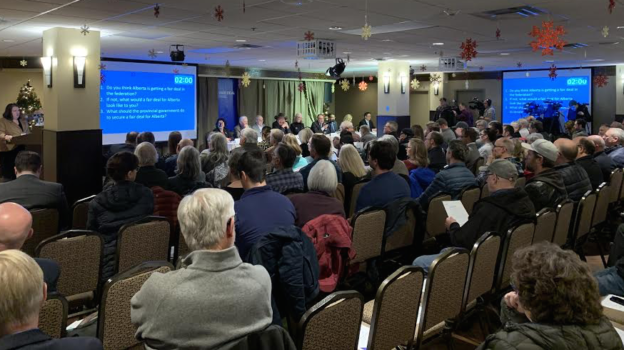
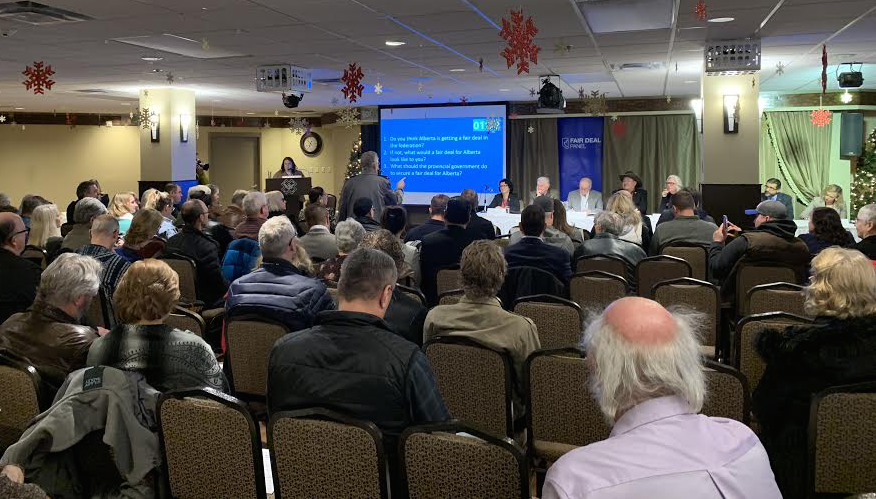
Dozens of speakers stepped up to to the mic to share their two-minutes worth of opinions at the first “Fair Deal” Panel town hall meeting in Edmonton last night. The event in the large meeting room at the St. Michael’s Heritage Hall was well-attended, but not overflowing with crowds of angry Albertans demanding separation from Canada.
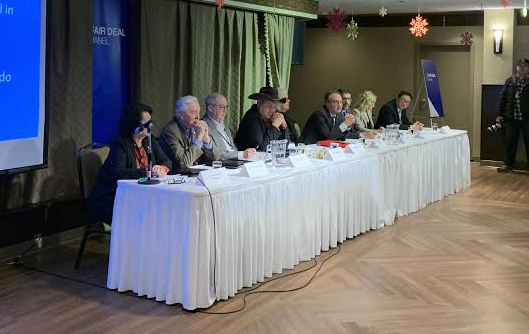
Fair Deal Panelists: Oryssia Lennie, Preston Manning, Stephen Lougheed, Jason Goodstriker, Donna Kennedy-Glans, Drew Barnes, Moin Yahya, Miranda Rosin, and Tany Yao.
The first speaker up to the mic told the panel that he was a separatist from Quebec when he moved to Alberta in the 1980s and feels Alberta is not getting a fair deal from Ottawa. The second speaker used his two-minutes at the mic to boisterously declare that Canada was broken and that his personal Christmas wish was for Premier Jason Kenney to hold a referendum on separation.
A few speakers criticized the government for stirring up separatist sentiment, expressed hope that Alberta could collaborate with other provinces, and said they wouldn’t trust the United Conservative Party government to manage a provincial pension plan (a statement which got some enthusiastic cheers from sections of the room). But many of the speakers tended to share separatist, or at least anti-federal Liberal sentiments, venting frustrations about federal environmental laws, delivering detailed plot summaries of Ayn Rand’s Atlas Shrugged, and offering their expertise on constitutional issues.
Chris Chang-Yen Phillips
In what was probably the most thoughtful two-minutes of the evening, Chris Chang-Yen Phillips, Edmonton’s former historian laureate and host of the Let’s Find Out Podcast, urged the panel to focus less on what we believe we are owed and more on taking care of each other.
Chang-Yen Phillips went on to explain that a fair deal in Confederation for him would be where every province does its part to lower carbon emissions, or transition away from fossil fuels. His comments might fall on deaf ears on the panel but it was a refreshing break from the separatist rhetoric that dominated the evening.
Who stood up at the mic was also telling. While not all of the speakers were white men who appeared to be older than 60 years old, it certainly skewed toward that demographic from my view in the room.
The panel was created following the Liberal Party‘s victory in the October 21, 2019 federal election, despite the Conservative Party earning 70 percent of the vote in Alberta, and was prescribed nine policy proposals that would ostensibly make Alberta more autonomous from the federal government in Ottawa. The proposals, ranging from creating a provincial police force to withdrawing from the Canada Pension Plan to barring municipal governments from making agreements with the federal government, are inspired by the Firewall Manifesto penned by a group of conservative luminaries in 2001.
The panel hears from a speaker at the town hall
Politically, the panel and its town hall meetings are both a relief valve and a steering wheel meant to allow Albertans to vent separatist sentiments while allowing Kenney to attempt to keep ahead of the crowd. Or at least that’s the plan.
During their time in opposition, the UCP was very eager to blame the credit downgrades on the New Democratic Party government’s “reckless” and “ideological” agenda, but it turns out that the credit rating downgrades have more to do with structural problems facing Alberta’s finances – like our unwavering over-dependence on oil and gas royalties to fund the day to day operations of the public service. That might have been a topic at a town hall interested in a fair deal for Albertans in Alberta, but this panel has a narrow political scope – and Kenney has Prime Minister Justin Trudeau is square in its sights.
There are plenty of articulate arguments to be made in favour and against pursuing the nine autonomy policies presented by the panel but they weren’t heard last night. The two-minute open mic format is a good way to let people vent and a poor way to collect meaningful information. If this is the format that is going to be used for the rest of the panel’s town hall meetings, it is difficult to believe they will gather much substantial feedback for their report to the government.
Independence Party of Alberta fires its President
Overshadowed by the media-darling Wexit group, the Independence Party of Alberta appears to be in a bit of internal turmoil.
The IPA, which recently changed its name from the Alberta Independence Party to the Independence Party of Alberta, released a statement on Nov. 1, 2019 announcing that interim president S. Todd Beasley had been removed from the position and his membership had been rescinded. The party then released another statement accusing Beasley and a group of former candidates of breaking internal party rules and being in possession of books of party membership forms.
Beasley is a controversial conservative activist who was believed to be the frontrunner for the UCP nomination in Brooks-Medicine Hat before he withdrew from the contest after making derogatory remarks about Muslims.
The Alberta Independence Party fielded 63 candidates in the April 2019 provincial election and earned a total of 0.71 per cent of the province-wide vote. Party leader Dave Bjorkman resigned shortly after the election and Wexit leader Peter Downing had announced plans to seek the leadership but his supporters appear to be continuing to collect signatures to form a separate Wexit Party.
Meanwhile, another group of separatists led by former Wildrose Party candidate Sharon Maclise, appears to be continuing its effort to collect signatures to register the Alberta Freedom Alliance as an official party in Alberta.
Deep cuts to the provincial budget are resulting in the cancellation of public services and job layoffs across the province, and the fallout from the federal election continues to dominate the political discussion. And crisis – organized crisis – reigns, as Premier Jason Kenney’s United Conservative Party government dramatically shifts the political narrative on an almost daily basis.
Preston Manning
But things got really weird last week when elected councillors of the County of Wheatland, a 8,700 person rural municipality east of Calgary, voted for a resolution calling for a possible Alberta independence vote. The councillor who introduced the motion is Jason Wilson, who according to his online biography also sits on the board of the local UCP association.
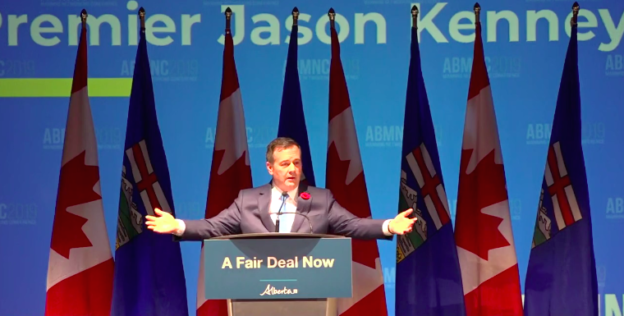
Yesterday, Kenney stood at the podium at the now one-day Manning Networking Conference in Red Deer to announce the creation of a “Fair Deal” panel that will look at ways to give the province more autonomy.
While some of the frustration felt by Albertans is legitimate, regional and partisan grievances are deeply intertwined in this province. With the UCP essentially operating as a provincial-wing of the federal Conservative Party, it is hard to believe that this panel would exist if Scheer had not snatched defeat from the jaws of victory on October 21.
The panel will be given a $650,000 budget to hold seven town hall meetings to consult with Albertans on a prescribed series of issues that have been bees in Conservative partisans’ bonnets for decades, including:
withdrawing from the Canada Pension Plan and creating an Alberta Pension Plan (something that was hinted last week and could have a big impact on the migration of interprovincial labour to Alberta),
replacing the Canada Revenue Agency by establishing a provincial revenue agency,
ending contracts with the RCMP and creating a provincial police force (the RCMP are currently investigating allegations of fraud in the UCP’s 2017 leadership contest),
opting out of federal programs like pharmacare,
forming an office of a Chief Firearms Officer (a Wildrose Party policy), and
creating an Alberta Constitution.
The panel’s mandate letter talks a lot about emulating Quebec, including implementing a rule that municipalities and school boards require the approval of the provincial government before they can enter into agreements with the federal government. This could be used by the Kenney government to cut off potential cooperation between municipalities and the federal government on projects like affordable housing, public infrastructure and climate change initiatives.
The panel and its town hall meetings are both a relief valve and a steering wheel meant to allow Albertans to vent their frustrations while allowing Kenney to attempt to keep ahead of the crowd. Or at least that’s probably the plan.
Ralph Klein
Kenney frequently boasts about the size of his electoral mandate, so it is notable that none of the autonomy polices to be considered by the panel were included in the UCP’s incredibly thorough election platform just six months ago.
The MLA committee was created in the wake of the infamous 2001 Firewall Letter, signed by right-wing luminaries Ted Morton, Tom Flanagan, Rainer Knopff, Andy Crooks, Ken Boessenkool, and future prime minster Stephen Harper, and in response to small but loud fringe groups like the Alberta Independence Party and the Separation Party of Alberta.
And, like many of the initiatives started in the final few years of Klein’s tenure as premier, it was a meant to create a distraction from what had largely become a rudderless government.
Ian McClelland
The mandate letter of the MLA committee was filled with much more flowery and hopeful language than the doom-and-gloom fear of separatism included in the mandate letter of Kenney’s panel. But the real mandate of the MLA committee was to travel the province to gauge support for the Firewall manifesto – a similar mandate of Kenney’s panel.
The MLA Committee on Strengthening Alberta’s Role in Confederation held 12 public hearings between January and March 2004 and here is what they recommended:
Pension Plan: “The Committee believes that withdrawing from the CPP and creating a separate Alberta pension plan is not in the best interests of Albertans. That is not to say that the CPP should not be improved for Albertans and all Canadians. The Committee further recommendsthat Alberta develop and advocate further CPP reforms that will end the intergenerational inequity, and move the CPP to a fully-funded foundation.” (Page 19)
Tax Collection: “Collecting our own personal income taxes would be a costly venture. One analysis suggests that set-up costs would be $30-40 million and that annual administrative costs could be between $70 and $160 million (including the costs of an additional 1,000-2,000 full time positions that might be required).By comparison, the administrative fee paid by Alberta under the TCA is less than $5 million annually. The Committee is also concerned that individual Albertans and businesses in the province would incur higher out-of-pocket costs in complying with two separate tax systems. This consideration alone makes the idea impractical. The Committee recommends that the Government of Alberta reach a new Tax Collection Agreement with the federal government that addresses Alberta’s concerns and provides increased tax policy flexibility.” (Page 21)
Mary Anne Jablonski
Police Force: “The Committee recommends that the Government of Alberta commission a detailed study of policing alternatives to the RCMP in advance of the 2007 cost review. This analysis should include a careful examination of costs, efficiencies, and levels of service. … The Committee further recommends that appropriate municipal stakeholders be consulted in the cost review negotiations in 2007, and that consideration be given to inclusion of such stakeholders on the Alberta negotiating team.” (Page 25)
Senate: “The Committee recommends that the Government of Alberta, through the Council of the Federation, encourage the Premiers to consider a process that would see the Prime Minister fill Senate vacancies from lists of provincial nominees. In Alberta’s case, the list should be generated by a Senatorial election.” (Page 29)
Intergovernmental Relations: “The Committee further recommends that the Government of Alberta re-establish an office in Ottawa. Close proximity to, and face-to-face contact with, federal decision-makers would improve relations between our governments and would help ensure Alberta interests are accurately and efficiently conveyed and addressed.” (Page 58)
Our Future: “The Committee also recommends that the Government of Alberta work towards fixing the underlying structural problems of our Canadian institutions that feed the flames of western alienation. The Committee further recommends that the Government of Alberta establish a fund for use in pursuing those legal challenges deemed to be necessary and desirable for safeguarding Alberta’s Constitutional jurisdiction.” (Page 59)
The MLA committee and its final report rejected the Firewall manifesto and was quickly forgotten after Paul Martin’s Liberals lost their majority in June 2004 and Klein’s PCs had their knuckles rapped in November 2004. But unlike Klein’s committee, which resulted in some fairly moderate and milquetoast recommendations, many of the panel members appointed by Kenney yesterday and the political environment they exist in are much more ideologically driven and politically divided.
This weird ride doesn’t look like it’s going to end anytime soon. There’s more crisis ahead.
Alberta to reopen office in Ottawa, again
In his speech to the Manning Centre, Kenney announced that the Alberta government will open offices in Ottawa, Quebec, and British Columbia. It is unusual and unclear why the Alberta government would need offices in other provincial capitals or in Ottawa, where Albertans just elected 34 Members of Parliament to represent their interests. But an office in the federal capital is not unprecedented.
The Alberta government opened an office in Ottawa in 1939. The Ottawa office was closed in 1996 and its last executive director, Gordon Olsen (brother of War Room CEO Tom Olsen), relocated to Calgary. A government review conducted in 2000 concluded that technology allows people to research information just as easily without a full-time office in Ottawa.
In 2004, Klein publicly mused about opening an Alberta government-funded office in Ottawa for the province’s elected Senate nominees, but the unpopular idea died quickly.
Premier Alison Redford reopened the office in 2013 and Calgary energy lawyer Alan Ross was hired as Alberta’s representative. Premier Jim Prentice closed the office again in 2015.
The NDP campaign has revolved around Notley, who is the party’s strongest asset, with signs showing her name and smiling face appearing as frequently as local candidate’s in electoral districts across Alberta.
While the 20 to 30 per cent province-wide lead that the United Conservative Party held months ago appears to have evaporated into a 6 to 10 per cent lead, most polls show the NDP are still in second place in Calgary. With the NDP appearing to hold a healthy lead in Edmonton and the UCP dominating in rural Alberta, the narrative in the final week of the campaign has become all about Calgary.
But the regional divide is only one part of the picture. As Jason Markusoff noted in his Maclean’s election newsletter, some polls suggest there is a significant divide in party support among men and women, with one poll showing the UCP leading among men by 16 points and the NDP leading among women by 1 point. The prominence of nasty social conservative comments raised in this campaign, like the ones made by UCP candidate Mark Smith from Drayton Valley-Devon, has likely contributed to this gender divide.
Scheer comes to Alberta
Federal Conservative Party leader Andrew Scheer will campaign with UCP leader Jason Kenney at a event in Calgary tomorrow, which is expected to include a big focus on the Notley, Justin Trudeau and the carbon tax.
Scheer’s appearance comes days after Kenney has threatened to enact legislation to shut off the flow of oil and gas to British Columbia if that province’s government opposes the construction of the Trans Mountain Pipeline. Such a move would almost certainly be unconstitutional, which is why the NDP passed but never proclaimed the law, and would likely foster more opposition to Alberta’s efforts than create support.
But back to Scheer… it is somewhat unusual to see a federal Conservative party leader campaigning in a provincial election in Alberta.
For most of the past three decades, there have been deep political divides between the various dominant provincial and federal Conservative parties in Alberta. Many political observers may have forgotten that even Progressive Conservative premier Ralph Klein personally campaigned for the federal PC Party candidate running against Reform Party leader Preston Manning in the 1993 federal election.
It is important to recognize that the merger of the PC and Wildrose parties in 2017 was just as much about uniting those two parties as it was creating a dominant provincial conservative party that would march in step with the Conservative Party in Ottawa. With this in mind, Kenney remains very much a national politician with ambitions beyond the Premier’s Office in Edmonton.
Scheer’s appearance on the campaign trail will come the day after it was revealed that his campaign chair, Hamish Marshall, allegedly threatened to sue the UCP over voting security during the party’s 2017 leadership race. CBC reported that email addresses fraudulently attached to party memberships were used to cast ballots in the party’s leadership race and there were virtually no safeguards against the practice.
In 1972, PC cabinet minister Dave Russellpublicly suggested that Alberta should annex parts of the North West and Yukon territories: “It makes sense in view of transportation and pipelines,” Russell told the Calgary Herald on April 19, 1972.
If the Alberta government could tax all the hot air at today’s anti-carbon tax rally in Calgary the deficit could be paid off.
Preston Manning
United Conservative Party Leader Jason Kenney and Ontario Premier Doug Ford will hold a joint “Scrap the Carbon Tax” rally in downtown Calgary this evening on the second leg of the Central Canadian Premier’s anti-carbon tax tour of Western Canada.
Kenney hopes to turn Alberta’s 2019 provincial election into a referendum on the NDP government’s carbon tax. And federal Conservative Party leader Andrew Scheer hopes to turn next October’s expected federal election into a referendum on Justin Trudeau’s carbon tax.
Even if you are a progressive, it is worth listening to Manning on this issue because he does make some good points. Here are Manning’s five pieces of advice from 2014 and my impressions on how the NDP and opposition conservatives have reacted:
Rachel Notley
1. Avoid using the word “tax” in conjunction with pricing pollution or greenhouse gas emissions.
The NDP government launched the program as a Carbon Levy, but it did not take long for conservative voices in the opposition and opinion pages of the province’s Postmedia-owned newspapers to rebrand it as a carbon tax. Alberta governments in the past have tried to brand new taxes with different names, such as the Health Care Premium introduced by Ralph Klein and the Health Care Levy proposed by Jim Prentice before the 2015 election.
2. Ask, “Out of whose mouth will our message be most credible?”
Manning raised the point that politicians, political staff and lobbyists typical rank at the very bottom of the public trust scale, so the government will need to find different voices to promote the program. The NDP did very well at the launch of the Climate Leadership Plan, uniting environmental and industry leaders in a way that no Alberta government has done before.
The NDP government earned a lot of praise for their Climate Leadership Plan from economists, environmental and industry leaders, and even a mention from former United States President Barack Obama in his speech to the Canadian House of Commons in 2016. But they did not necessarily do an effective job selling the program, especially the carbon levy, to Albertans.
Graham Thomson
As Graham Thomson explained in his new gig as a political columnist for CBC, the carbon tax is “the kind of thing opposition politicians can demonize in 10 seconds while the government needs five minutes worth of graphs and charts to explain.”
You can find lost of Albertans who are supportive of the carbon tax but will admit to being a little confused about how it actually works.
3. In selling an unfamiliar concept or policy solution, start where the public’s head is, not where yours is.
“In broaching climate change with the public, don’t start by making scientific declarations to people who rarely read or think about science,” Manning wrote in 2014. “Far better to start with the climate change effects our audience is already aware of, particularly in resource-producing areas, and then present the science to help explain. For example, start with British Columbia loggers’ awareness that winters are no longer cold enough to kill the pine beetle, or Alberta drill crews’ awareness that it’s taking longer for muskeg to freeze and allow drilling each fall.”
I believe there is broad recognition in Alberta that climate change needs to be addressed but the sharp downturn in the price of oil and the continued political wrangling over the expansion of the Trans Mountain Pipeline have distracted the public’s attention on energy and environmental issues. The opposition was successful in branding the carbon tax as damaging to the economy at a time when many Albertans had lost or were on the verge of losing their jobs, especially in Calgary and some rural areas.
Donald Trump
The NDP government also may have made a strategic error by arguing the Climate Leadership Plan would create the social license needed to convince British Columbians that a pipeline expansion is needed also knee-capped the carbon tax when the project stalled. Tying the carbon tax to the pipeline was a gamble, and it, so far, does not appear to have paid off.
We are also in the era of Donald Trump and conservative politicians across Canada have interpreted his success south of the 49th parallel as a license to engage in a similar angry populist tone. Conservative strategists in Alberta seem to believe that Ford’s victory in Ontario is the key to success and plan to embrace a similar campaign here in Alberta. Whether the abandonment of moderate conservatism in favour of populist rhetoric and climate change denial will lead to success in the long-term is yet to be seen.
4. Be honest about the ultimate costs to consumers.
Manning argued that “it’s possible to make environmental levies “revenue neutral” by reducing income taxes” and the initial argument from the NDP government that the cost of the carbon levy would be “revenue neutral” was confusing, unconvincing and quickly debunked.
A carbon tax does not need to be revenue neutral and the NDP bought into a naturally conservative idea by arguing so from the beginning. The NDP should have been up front about the cost while also reminding Albertans that we already pay some of the lowest taxes in Canada and our government is desperate for additional revenue to fund our public services.
Drew Barnes
After decades of rich oil and gas royalties pouring into public coffers, the Alberta government became over-dependent on oil and natural gas royalties to pay for a large portion of the daily operations of government.
5. Be balanced – Canadians love balance.
It may have been poorly communicated but I believe the Climate Leadership Plan is actually a fairly balanced and largely conservative initiative. By their very nature, carbon pricing is a free market idea and it was embraced by Conservative partisans until their opponents implemented these policies.
Despite being demonized as a leftist ideological wealth redistribution program, the plan listened to industry leaders in allowing for significant growth in the oil sands while providing incentives to decrease carbon footprint and increase energy efficiency.
Manning wrote in 2010 that “[t]here is no inherent reason why conservatives should be ambivalent on the environment, since conservation and conservatism come from the same root, since living within our means ecologically is a logical extension of living within our means fiscally, and since markets (in which conservatives strongly believe) can be effectively harnessed to environmental conservation.”
But today’s Conservatives not only have abandoned their support for carbon pricing and have used some of Manning’s advice as a manual to attack government action on climate change. Conservatives are united against the carbon tax, but remain silent on how or if they even have any ideas to address climate change.
We know that today’s Conservatives oppose the carbon tax, and many of them outright deny the existence of climate change. It is yet to be seen whether they will propose an alternative to the carbon tax that is more than angry politicians and hot air.