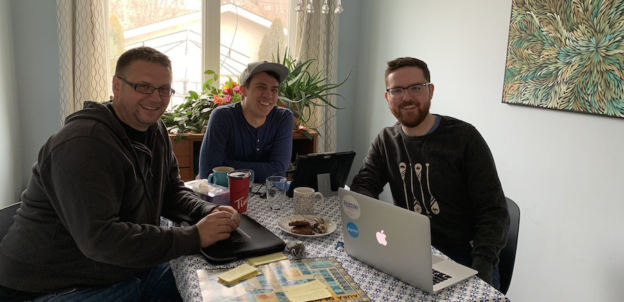
In this episode Dave and Ryan discuss the huge turnout at the advance polls, some of the key races to watch on election night, and recap of the final days of the campaign. We also dive into the mailbag to answer some great questions from our listeners. And because we couldn’t help ourselves, we talk about the return of Game of Thrones (no spoilers).
We always love to feedback from our listeners, so let us know what you think of this episode and leave a review where you download. You can also comment on the blog, Facebook or Twitter or send us an email at podcast@daveberta.ca.
And thanks again to our producer, Adam Rozenhart, for making us sound so good.
Thank you for listening and to everyone who sent in questions this week!
Watch the Alberta Election results on the big screen!
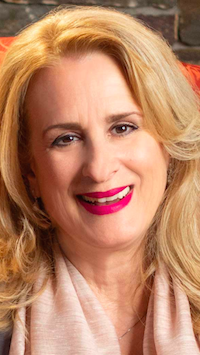
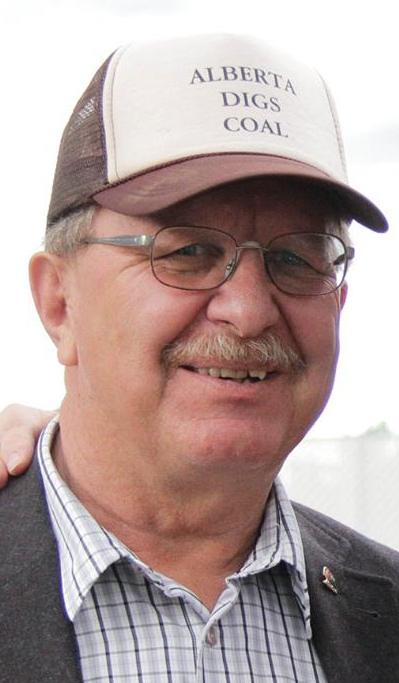
Dave is excited to be hosting an election night panel with past Daveberta Podcast guest co-hosts Natalie Pon and David Climenhaga on April 16 at the Metro Cinema (Garneau Theatre) in Edmonton (8712 109 Street). Doors open at 7:00 p.m. and the panel will start around 7:20 p.m. and go until the polls close at 8:00 p.m., then you can watch the election results stream in on the big movie screen. There is a bar. Admission is free. Hope to see you there!
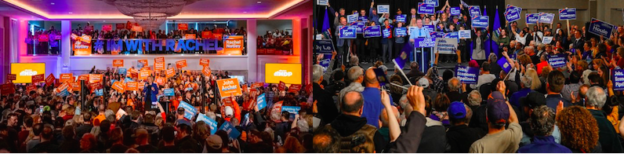
The NDP campaign has revolved around Notley, who is the party’s strongest asset, with signs showing her name and smiling face appearing as frequently as local candidate’s in electoral districts across Alberta.
While the 20 to 30 per cent province-wide lead that the United Conservative Party held months ago appears to have evaporated into a 6 to 10 per cent lead, most polls show the NDP are still in second place in Calgary. With the NDP appearing to hold a healthy lead in Edmonton and the UCP dominating in rural Alberta, the narrative in the final week of the campaign has become all about Calgary.
But the regional divide is only one part of the picture. As Jason Markusoff noted in his Maclean’s election newsletter, some polls suggest there is a significant divide in party support among men and women, with one poll showing the UCP leading among men by 16 points and the NDP leading among women by 1 point. The prominence of nasty social conservative comments raised in this campaign, like the ones made by UCP candidate Mark Smith from Drayton Valley-Devon, has likely contributed to this gender divide.
Scheer comes to Alberta
Federal Conservative Party leader Andrew Scheer will campaign with UCP leader Jason Kenney at a event in Calgary tomorrow, which is expected to include a big focus on the Notley, Justin Trudeau and the carbon tax.
Scheer’s appearance comes days after Kenney has threatened to enact legislation to shut off the flow of oil and gas to British Columbia if that province’s government opposes the construction of the Trans Mountain Pipeline. Such a move would almost certainly be unconstitutional, which is why the NDP passed but never proclaimed the law, and would likely foster more opposition to Alberta’s efforts than create support.
But back to Scheer… it is somewhat unusual to see a federal Conservative party leader campaigning in a provincial election in Alberta.
For most of the past three decades, there have been deep political divides between the various dominant provincial and federal Conservative parties in Alberta. Many political observers may have forgotten that even Progressive Conservative premier Ralph Klein personally campaigned for the federal PC Party candidate running against Reform Party leader Preston Manning in the 1993 federal election.
It is important to recognize that the merger of the PC and Wildrose parties in 2017 was just as much about uniting those two parties as it was creating a dominant provincial conservative party that would march in step with the Conservative Party in Ottawa. With this in mind, Kenney remains very much a national politician with ambitions beyond the Premier’s Office in Edmonton.
Scheer’s appearance on the campaign trail will come the day after it was revealed that his campaign chair, Hamish Marshall, allegedly threatened to sue the UCP over voting security during the party’s 2017 leadership race. CBC reported that email addresses fraudulently attached to party memberships were used to cast ballots in the party’s leadership race and there were virtually no safeguards against the practice.
In 1972, PC cabinet minister Dave Russellpublicly suggested that Alberta should annex parts of the North West and Yukon territories: “It makes sense in view of transportation and pipelines,” Russell told the Calgary Herald on April 19, 1972.
Anyone tuning in to watch Alberta’s leaders’ debate who might have hoped to watch a battle of the titans will have surely been disappointed. Tonight’s televised leaders’ debate was uninspiring and horribly boring.
A similar review can be given to Kenney, who spent much of his time attacking Notley and Prime Minister Justin Trudeau for supposedly stopping the construction of pipelines and destroying jobs in Alberta. Kenney focused on the same economic issues that have been his talking points on the campaign trail – jobs, the economy and pipelines – while skirting around questions about controversial social issues, delivering a similar response to the one he gave Alder.
Notley and Kenney are practiced debaters and parliamentarians, but they certainly did not show off the best of their skills in this debate. Their performances were satisfactory but underwhelming.
A shorter summary of the main two party leaders in this debate could be: Notley argued that Kenney will destroy Alberta if he is elected, and Kenney argued that Notley has already destroyed Alberta. Not exactly inspiring messages for Albertans.
Then, there were the leaders of two smaller parties that were invited to participate in the debate.
Alberta Party leader Stephen Mandel actually did okay. He focused on differentiating his party from the NDP and UCP, and had a few memorable lines during the debate about being the only business person on stage and chirping in that “this is sad” as his opponents argued.
But if he was looking to break away from the pack, Mandel was unable to channel the Gordon Wilson moment that was needed to give his party momentum going into April 16.
Liberal Party leader David Khan performed well but with his party on the verge of electoral oblivion he has little to lose. The Liberals are also only running candidates in 51 of Alberta’s 87 districts. The profile earned through his appearance in this debate could help Khan in his bid to hold on to the Liberal Party’s last remaining district, Calgary-Mountain View.
Missing from the stage was one of Alberta’s more colourful political actors, Derek Fildebrandt of the populist/libertarian Freedom Conservative Party. The former UCP MLA who is running for re-election in Chestermere-Strathmore was not invited and his party has only fielded 24 candidates across Alberta. While most Albertans watching would not have had the option to vote for Fildebrandt’s party, his presence in the debate may have helped to increase the entertainment value of the 90-minute program.
There were a lot of questions the leaders could have been challenged to answer, and the questions asked by the panel of journalists were good, but the free debate format encouraged the leaders to just talk over each other rather than actually debate the questions. There were points during the program where it was difficult to even figure out what was being said.
This year’s leaders’ debate was a sharp reminder that despite the exciting turning point that the debate played in the last election, most televised leaders’ debates are lacklustre and forgettable. This was one night that will not go down in the history books for any positive reason and it is unlikely it changed the minds of many voters in Alberta.
Alberta’s provincial election has been called and Albertans will be going to the polls on April 16. For the duration of the campaign, we’re going to be recording a new episode of the Daveberta Podcast each week.
We also spend some time focusing on a few races we are watching this week in Fort Saskatchewan-Vegreville, Calgary-Elbow, Edmonton-McClung, Red Deer-North and Red Deer-South, and Calgary-Mountain View.
We always love to feedback from our listeners, so let us know what you think of this episode and leave a review where you download. You can also comment on the blog, Facebook or Twitter or send us an email at podcast@daveberta.ca.
And a huge thanks to our excellent guest producer, Chris Chang-Yen Phillips, who kept us on track and made this episode sound so great.
Thank you for listening!
Note: During this episode we discussed Kenney’s voting record his time in Ottawa. Kenney voted twice against bills supporting Trans Rights and missed a third vote because he was not in the House of Commons at the time.
Rachel Notley at a rally in north east Calgary in 2019 (source: Twitter)
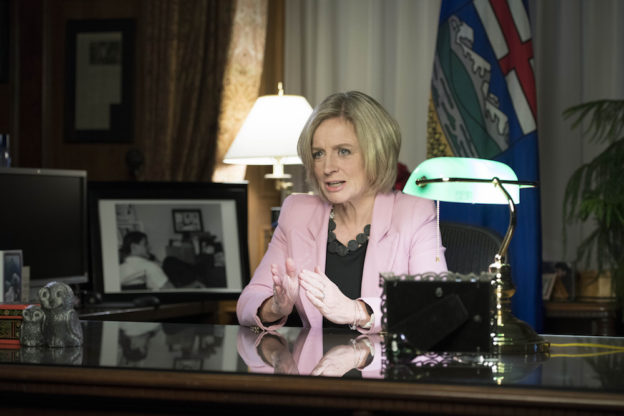
Photo: NDP leader Rachel Notley speaks at a rally in north east Calgary (source: Twitter).
With the first week of Alberta’s election campaign coming to an end, the biggest challenges facing many campaigns this weekend is figuring out how they will plant their lawn signs when the snow melts but the ground remains frozen solid.
But aside from these more practical concerns of campaigning, here is a quick look at what the parties and party leaders said this week.
The main thrust of the NDP’s campaign this week focused on United Conservative Party leader Jason Kenney and his past history of advocacy against LGBTQ rights. Sarah Hoffman, the NDP candidate in Edmonton-Glenora, held a press conference releasing a 10-minute documentary-style video detailing Kenney’s time spent in San Francisco in the late 1980’s.
The heart-wrenching video begins with Kenney touting his work with pro-life groups to successfully overturn a law giving hospital visitation rights to gay couples during the AIDS epidemic in San Francisco and includes interviews with the partners of some of the AIDS victims.
On the same topic, The Sprawl released the first part of its “The Young Zealot” investigative series focused on Kenney’s time in San Francisco. Kenney responded to the article through a letter on a UCP-sponsored website.
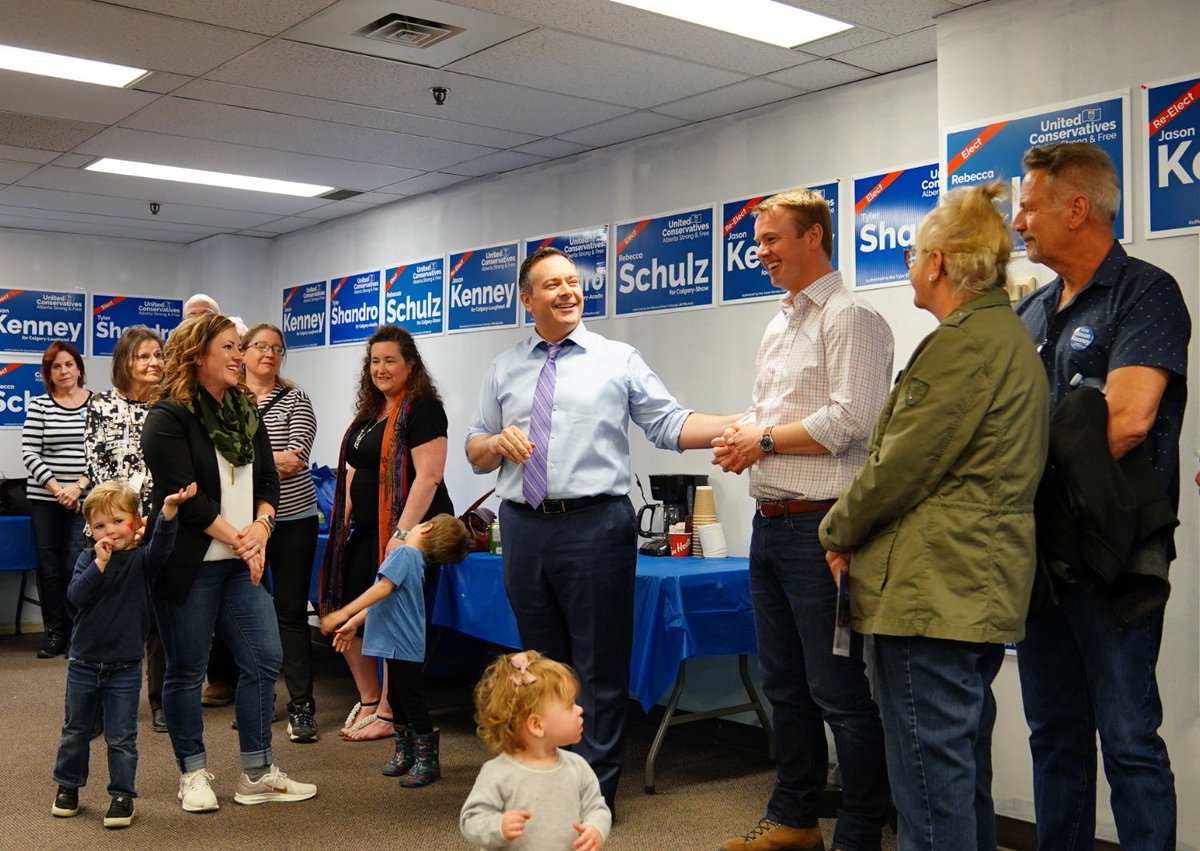
Jason Kenney at the opening of his campaign office in Calgary-Lougheed (source: Facebook)
Khan also released the Liberal Party’s Indigenous People’s policy with promises to introduce Indigenous Language immersion programs and Indigenous-led revisions to the curriculum, implement justice reform, and add six new seats to the Alberta Legislature for Indigenous Peoples MLA’s.
The Green Party came out in favour of a Guaranteed Annual Income to address growing economic inequality. “The GAI will be funded by increased taxes on higher incomes and the significant savings it creates by reducing bureaucracy and service duplication, lowering criminal justice expenses, and tackling poverty-related health care,” party leader Cheryle Chagnon-Greyeyes said in a press release.
Freedom Conservative Party leader Derek Fildebrandt released his party’s sovereigntist manifesto, demanding that the federal government end the Equalization Program and give the Alberta government control over immigration, tax collection, Employment Insurance and the Canada Pension Plan, and that Alberta withdraw from the Canada Revenue Agency.
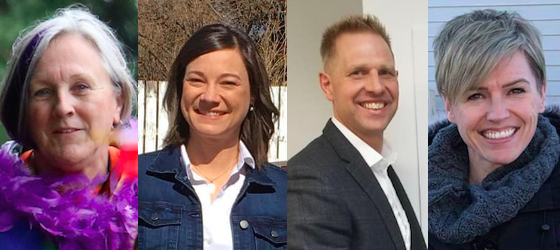
Photo: Lethbridge NDP candidates Maria Fitzpatrick and Shannon Phillips, and UCP candidates Nathan Neudorf and Karri Flatla.
Where the party leaders go during the first few days of the election campaign can sometimes give a good indication of where the parties are focusing their resources and what message they want to send to voters.
Alberta New Democratic Party leader Rachel Notley announced the election call in central Calgary, where the NDP hope to create a battleground in this election. Today, Notley started the second day of the election in Edmonton and later travelled to Red Deer to campaign with MLAs Kim Schreiner and Barb Miller, She finished her day in Lethbridge to speak at the Canadian Union of Public Employees provincial convention and will be in the city tomorrow to support MLAs Shannon Phillips and Maria Fitzpatrick.
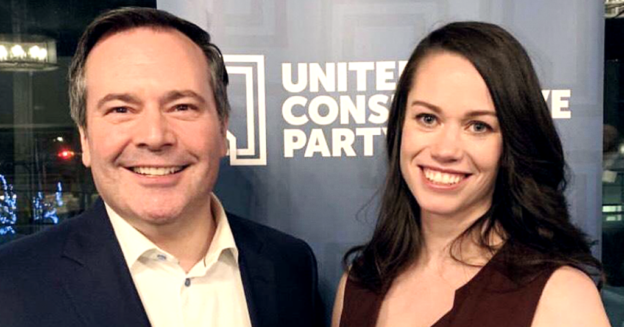
United Conservative Party leader Jason Kenny started the campaign in Leduc, south of Edmonton, and kicked off his party’s campaign at the office of Edmonton-City Centre candidate Lily Le. The UCP are hoping to make gains in Edmonton in this election. Today, Kenney also headed south to Lethbridge to support candidates Karri Flatla and Nathan Neudorf.
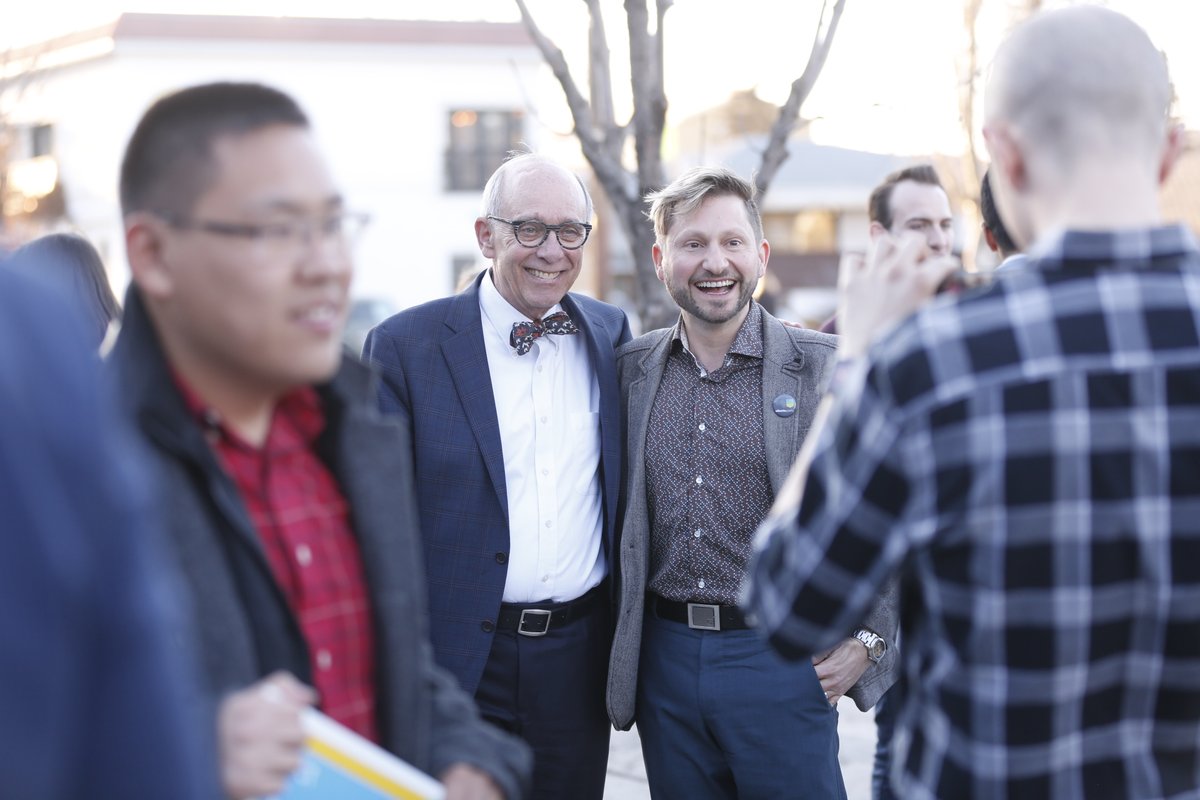
Alberta Party leader Stephen Mandel spent the first two days of the election in Edmonton, where his party hopes to capitalize on his name-recognition as mayor of the city from 2004 to 2013. And Liberal Party leader David Khan was in Calgary, where he is expected to focus on his race in Calgary-Mountain View.
That both Notley and Kenney visited Lethbridge in the first few days of the election signifies how much both parties feel how important and competitive the city’s two districts could be in this election.
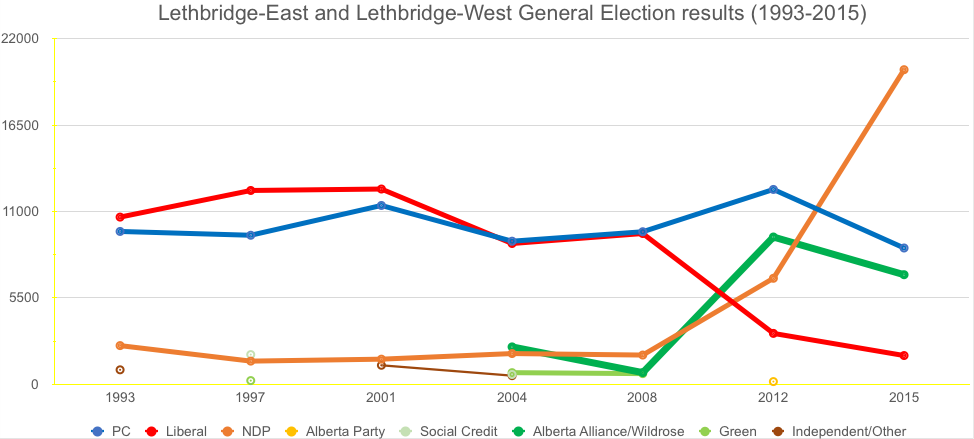
Lethbridge’s electoral history is more liberal-leaning than most of the surrounding region in southern Alberta, likely due to the influence of the University of Lethbridge and Lethbridge College and a large number of public sector workers in the city. Even during Ralph Klein’s time as premier, the Liberals either won a plurality of the votes or match the PC vote in the city’s, mostly due to the large margins of victory earned by Lethbridge-East MLAs Ken Nicol and Bridget Pastoor.
As the Liberal vote collapsed in 2012, Phillips came close to winning in Lethbridge-West in 2012,. The NDP swept both districts in 2015 with significant margins. As Minister of Environment and Parks, Shannon Phillips has been a key player in Notley’s cabinet and a strong advocate for the city in the Legislature. This makes Phillips a target for the UCP and the reason why Kenney travelled to Lethbridge to re-announce his plans to cancel climate change initiatives like the carbon tax.
Here is a look at the voting history of the two Lethbridge districts over the past 26 years.
The UCP announced that it has appointed Jeremy Wong as the UCP candidate in Calgary-Mountain View following the resignation of star candidate Caylan Ford earlier this week. Wong ran against Ford for the nomination in December 2018. He is a pastor with the Calgary Chinese Alliance Church and recently completed a Master of Public Administration at the University of Calgary.
The UCP now have three candidate vacancies remaining, with nominating meetings scheduled to take place in Edmonton-Highlands-Norwood on March 21, Edmonton-Ellerslie on March 23, and Edmonton-Mill Woods on March 24.
Alberta NDP leader Rachel Notley in 2019 (source: Facebook)
Standing in front of diverse group of supporters at the National Music Centre in Calgary, Premier Rachel Notley announced that Alberta’s next provincial general election will be held on Tuesday, April 16, 2019.
Notley’s campaign kick-off speech gave a good idea what the New Democratic Party’s narrative will be in this election campaign – creating a clear contrast in character, leadership and trust between Notley and United Conservative Party leader Jason Kenney.
“Jason Kenny isn’t working for you. He wants two Albertas – one for the wealthy and one for the rest of us. He wants two Alberta’s, divided over people’s rights,” Notley said.
“I want to build one Alberta. I say we stick together through this final stage – from adversity to recovery to shared prosperity – that we take care of each other,” she said.
As I have written before, campaigns always try to play to their strengths and downplay their weaknesses. This is why the NDP campaign will put Notley front-and-centre and the UCP will not be featuring Kenney logos on their election lawn signs.
The two main party leaders have divergent popularity among voters. While her party is behind in the polls, Notley has fairly respectably approval ratings, making her the NDP’s strongest asset. On the flip side, Kenney’s approval ratings fall far below support for his party, meaning that he is far from his party’s strongest asset in the minds of many voters.
The NDP’s decision to launch the election in Calgary was not a shock, as the party needs to maintain a hold on its seats in Alberta’s largest city if it wants to be re-elected on April 16. At this point, it is hard to believe the NDP will hold most of their seats in Calgary but the governing party is realistically expected to be competitive in 5 or 6 districts in the city.
Notley also spoke about her government’s commitment to education and health care, including the long-overdue construction of the new Calgary Cancer Centre, and the economy and oil pipelines.
Notley gained the support of a powerful electoral ally in that city today when Calgary Mayor Naheed Nenshistepped out of the municipal arena to criticize Kenney, saying the UCP leader is “not a person who is fit to lead this province.” Nenshi also accused Kenney of ‘pandering for votes‘ by opposing the Springbank dam, a critical part of flood mitigation plans for the city following the disastrous flood in 2013.
The Notley NDP still have an electoral math problem, with the UCP leading in the polls in Calgary and rural Alberta, but after this week’s internal UCP turmoil, the NDP are probably feeling as confident as they ever were going to be before the May 31 deadline to hold the provincial election.
Jason Kenney
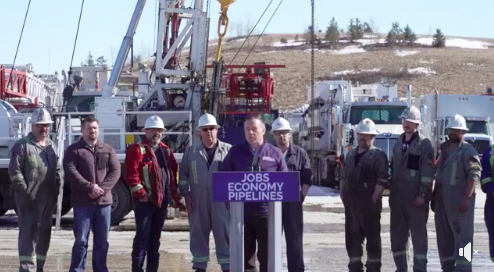
Speaking with a handful of tradesmen standing behind him at a job site in Leduc, Kenney launched his first press conference of the election campaign trying to steer the focus away from Ford’s resignation and the Kenney-Callaway collusion scandal. Kenney returned to his key messages around jobs, the economy and pipelines – and how he believed the NDP have failed in these areas.
Kenney’s message will resonate with a lot of Albertans who have felt unease and frustration with the drop in the international price of oil, high than usual unemployment levels, and delays in oil pipeline construction. And the UCP hopes this message will resonate in the Edmonton region, where the NDP swept almost every seat in the 2015 election.
So, as the election gets going, expect the Kenney to try to stick to these three key messages while the NDP focus on contrasting Notley with her main opponent. Let the games begin!
Elections Commissioner issues new fines for donations to Callaway leadership campaign
Maja McAllister and David Ruiz were issued letter of reprimand for donating $4,000 to Jeff Callaway, registered UCP leadership contestant, with funds given or furnished by another person.
Darcy McAllister was issued one administrative penalties of $4,000 for donating $4,000 to Callaway’s campaign with funds given or furnished by another person, and a second administrative penalty of $4,000 for furnishing $4,000 to Maja McAllister for the purpose of making contribution to Callaway’s campaign, according to the Election Commission website.
Writ Day Hot Take
I spoke with 630CHED host Ryan Jespersen this morning moments after Notley wrapped up her speech announcing the election. Here is my hot take:
Caylan Ford has resigned as the United Conservative Party candidate in Calgary-Mountain View following a report by Press Progress that alleges she sent text messages complaining that ‘white supremacist terrorists face a double-standard compared to Islamic terrorists.’
In a statement published on Facebook early on the morning of March 19, 2019, Ford announced her resignation and wrote that the “comments published by PressProgress are distortions and are not reflective of my views.”
Ford was widely considered a star candidate for the UCP in this district, which has been represented by retiring Liberal MLA David Swann since 2004. She is an international affairs specialist with a background in China and human rights and has worked as a senior policy advisor with Global Affairs Canada.
Her candidacy in this district was not without controversy. The nomination contest was contentious, with questions about the eligibility of Fordand former MLAMark Hlady in the contest. Ford’s candidacy was ultimately accepted by the UCP and she defeated Becca Polak and Jeremy Wong to win the nomination.
UCP leader Jason Kenney‘s Facebook page has recently been running advertisements in support of her candidacy in Calgary-Mountain View, suggesting that this was a priority district for the UCP in the upcoming election.
Photo: Debbie Jabbour (centre) with Premier Rachel Notley (left) at an announcement in the Peace River district in 2016.
Debbie Jabbour has been nominated as the New Democratic Party candidate in the sprawling northwest Alberta district of Peace River. Jabbour, who was first elected in 2015, fended off a nomination challenge from Justin Sharpe.
She was first elected in 2015, earning 39.3 per cent, and previous to that worked as a provisional psychologist. She has served as Deputy Speaker and Chair of Committees in the Legislative Assembly since her election.
Premier Rachel Notley will officially accept her party’s candidacy at a nomination meeting scheduled to take place on Sunday, March 17, 2019 in her Edmonton-Strathcona district. Notley was re-elected to serve a third-term as the MLA for this district in 2015 with 82 per cent of the vote. The meeting is expected to be more of a rally and campaign kick-off, with the Speech from the Throne taking place on March 18 and an election call expected shortly afterward.
The NDP have also nominated Holly Heffernan in Drumheller-Stettler, Robyn O’Brien in Innisfail-Sylvan Lake, Jeff Ible in Rimbey-Rocky Mountain House-Sundre, Doug Hart in Lacombe-Ponoka, and Esther Tailfeathers in Cardston-Siksika.
United Conservative Party
The UCP has acclaimed Kulshan Gill as that party’s candidate in Edmonton-Strathcona. Gill ran for the UCP nomination in the northeast district of Edmonton-Manning but was defeated by Harry Grewal. Real estate agent Jovita Mendita withdrew from the UCP contest in that district.
The UCP has scheduled a nomination contest in Edmonton-Highlands-Norwood on March 21, 2019. despite initially having four candidates registered as interested in seeking the nomination, only two candidates remain: Leila Houle and Atul Ranade.
Houle previously ran for the well-known-for-all-the-wrong-reasons UCP nomination in Edmonton-West Henday and was defeated by Nicole Williams. She previously ran as the federal Liberal candidate in the now-defunct Westlock-St. Paul district in 2008, finishing with 9.1 per cent in that vote. Renade registered intention to seek the UCP nomination in August 2018 after previously withdrawing from UCP nomination contests in Edmonton-Beverly-Clareview and Edmonton-South.
Del Shupenia’s candidacy was not accepted by the party and George Lam and Michael Kalyn have withdrawn from the contest.
Arundeep Sandhu broke his silence this week and spoke to CBC’s The Ledge podcast about his disappointment in Jason Kenney’s decision to appoint Len Rhodes as the UCP candidate in Edmonton-Meadows. Sandhu is considering running as an independent candidate or even for a different party. “I’m a conservative, but I don’t believe I can run for the UCP as long as this leadership and this leadership team is in there,” he told CBC.
Alberta Party
Three more Alberta Party candidates have had their 5-year bans on running as candidates waived by the Court of Queen’s Bench. Rachel Timmermans in Calgary-Lougheed, Tim Meech in Livingstone-Macleod, and Ali Haymour in Edmonton-Decore will appear on ballots in their respective districts in the upcoming election.
The court has not yet waived the ban placed on party leader and former Edmonton mayor Stephen Mandel, who had been planning to run in Edmonton-McClung. Elections Alberta ruled in early February that seven Alberta Party candidates were ineligible to run after being late to file financial statements from their nomination contests.
Danielle Klooster is the nominated Alberta Party candidate in Innisfail-Sylvan Lake. Klooster is a former town councillor from Penhold and ran for the Alberta Party in 2012 and 2015, earning 4.8 per cent and 6.1 per cent of the vote in those races.
Hazelyn Williams is the Alberta Party candidate in Edmonton-Ellerslie. Williams in the third candidate to be nominated by the Alberta Party in Ellerslie during this election cycle, replacing previously nominated candidate Yash Sharma, who was removed after appearing at a controversial rally, and Richard Corbin, who withdrew for unexplained reasons.
Green Party
Jenn Roach has been nominated as the Green Party candidate in Leduc-Beamont.
Freedom Conservative Party
The Freedom Conservative Party has nominated Sheyne Espey in Calgary-Peigan, Jeff Rout in Leduc-Beaumont, and Clayton Knutson in Innisfail-Sylvan Lake. Wade Woywitka and Matthew Powell are competing for the FCP nomination in Vermilion-Lloydminster-Wainwright.
Liberal Party
Former Grande Prairie city councillor Kevin McLean has been nominated as the Liberal Party candidate in St. Albert. McLean served on Grande Praire City Council from 2010 to 2017 and ran for the Liberal Party in Grande Prairie-Smoky in the 2012 and 2015 elections, earning 4.8 per cent of the vote in each of those races.
Independent/Alberta Independence Party
Two candidates affiliated with the unregistered Alberta Independence Party have filed papers to run as Independent candidates in the upcoming election: CW Alexander in Calgary-Klein and Monica Friesz in Calgary-Mountain View.
If you know any candidates who have announced their intentions to stand for party nominations, please send me an email at david.cournoyer@gmail.com. I will add them to the list. Thank you!
As mentioned in the latest episode of the Daveberta Podcast, some members of the local UCP board of directors are up in arms about Kenney’s claim that they were consulted with and asked for Rhodes to be appointed as the candidate. Some of the disgruntled board members are said to be collecting signatures for a letter disputing Kenney’s claims, and that more than a dozen local directors have signed the letter.
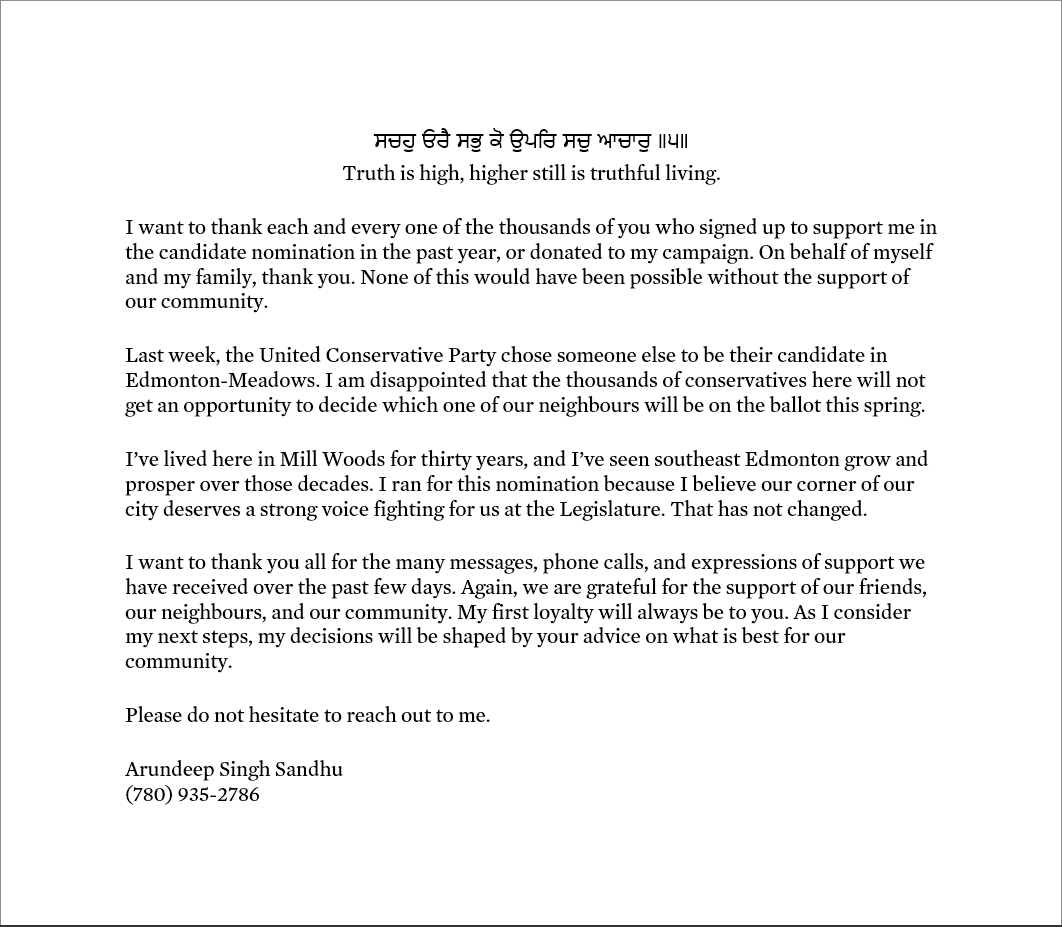
Letter from Arundeep Sandhu to UCP supporters Edmonton Meadows (Click to enlarge)
Rhodes’ surprise appointment last week eliminated three candidates – Arundeep Sandhu, Joel Mullen and Sant Sharma – who had been selling party memberships and door-knocking to compete for the UCP nomination for up to twelve months.
Arundeep Sandhu released a letter on social media today expressing his disappointment in the decision and thanking his supporters. It was a classy letter, but it certainly did not include the “let’s all get behind the appointed candidate” message that Kenney and Rhodes were likely looking for.
Meanwhile, more than 400 New Democratic Party members voted to choose Jasvir Deol as their candidate in Edmonton-Meadows. Deol defeated Chand Gul and MLA Denise Woollard, who had been elected to represent Edmonton-Mill Creek in 2015.
Jasvir Deol
Deol was the NDP candidate in the 2015 federal election in the Edmonton-Mill Woods district, where he earned 12.7 per cent of the vote in the contest against Liberal Amarjeet Sohi and Conservative Tim Uppal.
Former Taber town councillor and past president of the Alberta Library Trustees Association Laura Ross-Giroux has been nominated as the NDP candidate in the southern Alberta district of Taber-Warner.
Crown prosecutor Moira Vane is the NDP candidate in Strathcona-Sherwood Park.
An NDP nomination meeting in West Yellowhead that was originally scheduled for this past weekend appears to have been rescheduled to March 9, 2019.
Dr. Esther Tailfeathers is seeking the NDP nomination in Cardston-Siksika. Dr. Tailfeathers is a Physician at the Blood Tribe Clinic at Standoff and a Clinical Lecturer in the Faculty of Medicine and Dentistry at the University of Alberta.
Melissa Langmaid has announced plans to seek the NDP nomination in Chestermere-Strathmore. Langmaid is an Environmental Advisor with AltaLink and a unit coordinator with the United Utility Workers’ Association.
Holly Heffernan is seeking the NDP nomination in Drumheller-Stettler. Heffernan is a retired Registered Nurse and long-time NDP activist, having run numerous times for the NDP in both provincial and federal elections in Calgary.
UCP set Red Deer-South nomination vote for March 16
Buruma is Director of Community Relations forRed Deer Public School District and Executive Director of the Foundation for Red Deer Public Schools. Davidson is Chief of Emergency Medicine for Alberta Health Services’ Central Zone. Poratto is a decorator and event planner, and ran for the PC Party nomination in the district ahead of the 2008 election. Stephan is a lawyer and president of the Red Deer Taxpayers’ Association. And Wiebe was the Wildrose Party candidate in this district in the 2015 election, earning 24 percent of the vote behind NDP candidate Barb Miller and PC candidate Darcy Mykytyshyn.
Davidson’s wife, Pamela Davidson, sought the UCP Central Alberta Director election at the party’s 2018 annual general meeting and previously ran against Christine Moore in the Red Deer County Division 6 election in 2017. Moore ran unsuccessfully for the UCP nomination in Innisfail-Sylvan Lake ahead of the 2018 by-election and as the Progressive Conservative candidate in Red Deer-North in the 2015 election.
The UCP has also opened nomination contests in Edmonton-Ellerslie, Edmonton-Highlands-Norwood, and Edmonton-MIll Woods.
“After nearly seven years as an MLA shackled with Party-first priorities, it is clear that Alberta’s party system of government has stripped effective representation and across-the-board best interests from Alberta’s citizens,” wrote Strankman in a media release posted on this website. “Running for election and winning office as an Independent will enable me to restore the priorities of all Drumheller Stettler citizens to the front lines of the Legislature and advance their priorities for resurrecting Alberta’s prosperity.” he said.
Former MLA Ian Donovan is running as an Independent in the new Cardston-Siksika district. Donovan was first elected as a Wildrose MLA in Little Bow in 2012 and crossed the floor to the PC Party in 2014. He was narrowly defeated in the 2015 election, finishing 12 votes behind Wildrose candidate David Schneider.
With Schneider declining to seek re-election, Donovan supported past Christian Heritage candidate Marc Slingerland in the UCP nomination contest against eventual winner Joseph Schow. Donovan later announced he was quitting the UCP, citing a dictatorship-like control of the party by Kenney.
Mandel awaits fate as 2 Alberta Party candidates back on the ballot
The Court of Queen’s Bench has waived the 5-year ban on Alberta Party candidates Moe Rahall in Edmonton-Castle Downs and Diana Ly in Edmonton-Gold Bar, who will now be allowed to run in the 2019 election. Party leader Stephen Mandel and four other Alberta Party candidates still await their fate as the court has yet to remove their bans.
Swann staffer runs for the Green Party
Janice Fraser is running for the Green Party in Calgary-McCall. Fraser is currently the office manager for Calgary-Mountain View Liberal MLA David Swann, who is retiring after four-terms in the Legislature. Swann’s other constituency office staffer, Joshua Codd, is the nominated Liberal Party candidate in Calgary-Currie.
Jane Drummond is running for the Green Party in Rimbey-Rocky Mountain House-Sundre. Drummond is the editor of the Nordegg Squeek and has served as an Alberta Hiking Association member representing Terra Firma Nordegg Hiking.
Meanwhile, Chris Glassford has been nominated as the Alberta Advantage Party candidate in Sherwood Park and Mark Gregor has been nominated in Drayton Valley-Devon.
If you know any candidates who have announced their intentions to stand for party nominations, please send me an email at david.cournoyer@gmail.com. I will add them to the list. Thank you!
New Democratic Party MLA Nicole Goehring was nominated as her party’s candidate in Edmonton-Castle Downs, a district she has represented since 2015. Goehring won her first election with 64.5 percent of the vote, unseating four-term Progressive Conservative MLA and former deputy premier Thomas Lukaszuk. Since her election, Goehring has served as the Government of Alberta’s Liaison to the Canadian Armed Forces and as chairperson of the Standing Committee on Families and Communities.
Calgary-Bow – NDP MLA Deborah Drever is expected to be nominated as her party’s candidate at a selection meeting on January 26, 2019. Drever was first elected in 2015 and faced considerable backlash from her political opponents when it was discovered she had made controversial posts on social media. She redeemed herself as a well-spoken representative and shepherded her first private members’ bill – Bill 204 – to unanimous approval in the Legislature in 2015. She rejoined the NDP caucus shortly after that.
Calgary-Currie – Joshua Codd has been nominated as the Liberal Party candidate in this southwest Calgary district. Codd is currently a Constituency Assistant for Calgary-Mountain View Liberal MLA David Swann.
Calgary-Shaw – MLA Graham Sucha is expected to be nominated as the NDP candidate in this district on January 27, 2019. Sucha was elected as the MLA for this district in 2015, earning 31.3 percent of the vote ahead of PC MLA Jeff Wilsonwith 30.7 percent and Wildroser Brad Leishman with 30.4 percent.
Drayton Valley-Devon – Steve Goodman is seeking the Freedom Conservative Party nomination. Goodman is a Senior Community Peace Officer with Brazeau County.
Edmonton-Ellerslie – Richard Corbin and Todd Ross appear to have withdrawn from the Alberta Party nomination contest days after another candidate, Chuck McKenna, also withdrew. The Alberta Party briefly posted a tweet congratulating Corbin on becoming the party’s candidate in the district but that tweet appears to have been removed.
Highwood – Erik Overland is running for the NDP nomination in this district south of Calgary. Overland lives in Okotoks, is a Policy Studies student at Mount Royal University and a Governor of the Students’ Association of Mount Royal University. A nomination meeting is scheduled to take place on January 26, 2019.
Fort Saskatchewan-Vegreville – Rebecca Trotter is the Green Party candidate in this district east of Edmonton. Trotter is the President of RM Trotter Management Incorporated and a Sergeant at Arms for Rotary International
West Yellowhead – Zack Seizmagraff is the Liberal Party candidate in this district. Seizmagraff was the federal Liberal Party candidate in Yellowhead in the 2011 election, earning 2.87 percent of the vote.
Who is the mystery UCP star candidate in Red Deer-South?
Red Deer-South
To the chagrin of local members, the UCP announced in early December that the party was delaying the selection meeting in Red Deer-South until 2019 in order to give time for a “high profile individual” run join the contest. The local UCP association is organizing an all-candidates forum on January 31, 2019, and only the original four candidates contesting the nomination, the true identity of the unnamed star candidate remains a mystery.
The UCP has now scheduled nomination meetings in Lethbridge-East and Calgary-North to take place on February 9, 2019. I will post a preview of these contests next week.
If you know any candidates who have announced their intentions to stand for party nominations, please send me an email at david.cournoyer@gmail.com. I will add them to the list. Thank you!
Calgary-Currie – Joshua Codd is seeking the Liberal Party nomination. Codd is currently a Constituency Assistant for Calgary-Mountain View Liberal MLA David Swann. A candidate selection meeting has been scheduled for Jan. 23, 2019.
Calgary-Hays – Chris Nowell has been nominated as the Alberta Party candidate in this southeast Calgary district. The district is currently represented by UCP MLA Ric McIver, who was acclaimed as his party’s candidate on June 7, 2018.
Calgary-Peigan – Joseph Pimlott is seeking the NDP nomination in this south east Calgary district. Pimlott is a community liaison with Metis Calgary Family Services and the former executive director of the Aboriginal Friendship Centre of Calgary and provincial vice-president of the Metis Nation of Alberta. A candidate selection meeting is scheduled for January 19, 2019.
Highwood – Erik Overland is running for the NDP nomination in this district south of Calgary. Overland lives in Okotoks, is a Policy Studies student at Mount Royal University and a Governor of the Students’ Association of Mount Royal University. A nomination meeting is scheduled to take place on January 26, 2019.
If you know any candidates who have announced their intentions to stand for party nominations, please send me an email at david.cournoyer@gmail.com. I will add them to the list. Thank you!
Update: Controversy with NDP nomination in Calgary-North East
NDP members in the Calgary-North East district are calling for an investigation into alleged voter fraud at a nomination vote held in December 2018. Gurbachan Brar defeated Roop Rai to win the NDP nomination and now a member of Rai’s campaign says complaints about people from outside the riding voting fraudulently were not taken seriously by the party.
According to a report by the CBC, the complaints allege people voted using false addresses and documents, both ahead of the vote and on the day itself.
The First Minister’s Meeting, oil prices, and Premier Rachel Notley’s performance on the national stage are where we started the discussion in this episode. Dave and Ryan also delved into the latest nomination news and what 2019 holds for Alberta politics, including when the next provincial and federal elections could be called.
We also discuss our choices for theDaveberta Best of Alberta Politics 2018 Survey. Submissions will close on December 12, 2018 at 12:00pm and the top three choices in each category will be included in a round of voting starting on December 13, 2018. Voting will be open until December 19 and the winners will be announced on December 20, 2018.
You can listen and subscribe on Apple Podcasts, Google Play, Stitcher, or wherever you find podcasts online. We would love to hear what you think of this episode, so feel free to leave a positive review where you download, comment on the blog, Facebook or Twitter or send us an email at podcast@daveberta.ca.
Thanks to everyone who sent us questions for this episode. We had so many great questions that we have recorded a special episode dedicated to answering your questions that will be published for your listening pleasure on December 24, 2018.
And a huge thanks to our producer, Adam Rozenhart, who keeps us on track and makes each episode of the Daveberta Podcast sound so great.
This nomination contest was contentious, with questions about the eligibility of Fordand former MLAMark Hlady in the contest. Ford’s candidacy was ultimately accepted and Hlady, who represented his district as a Progressive Conservative MLA from 1993 to 2004 and as the PC Party candidate in 2015, was not approved by the UCP to run.
Defeated UCP nomination contestants in Calgary-East have levelled allegations of fraud, forgery, improper inducement and bribery in the race won by Peter Singh on November 3, 2018. A letter signed by Andre Chabot, Jamie Lall, Issa Moussa and Matthew Dirk sent to UCP Leader Jason Kenney and deputy leader Leela Aheer have asked for the results of the contest to be overturned.
According to Postmedia, one woman in Calgary-East “said she was solicited by Singh at his auto shop while getting her vehicle repaired last July, and soon after discovered her credit card number had been used to purchase a party membership.”
Calgary-Falconridge – Parmeet Singh was nominated as the NDP candidate in this northeast Calgary district.
Edmonton-South West – Kaycee Madu defeated Kevin Greco and former PC MLA Sohail Quadri to secure the UCP nomination on December 6, 2018.
Livingstone-Macleod – Roger Reid defeated Nathan Neudorf and Thomas Schneider to win the UCP nomination on December 8, 2018. Reid is the owner of Tim Hortons franchises in Nanton and Claresholm. He is the second Tim Horton’s franchaise owner to win a UCP nomination, along with Grande Prairie UCP candidate Tracy Allard.
Sherwood Park – Jordan Walker defeated Maureen Gough, Sean Kenny, and Len Thom to secure the UCP nomination in Sherwood Park. Walker is a conservative party activist and an Assessment Consultant in the Alberta Department of Labour.
Upcoming nomination meetings
With the end of the year approaching, Alberta’s political parties have begun winding down nomination meetings scheduled for this year. By the end of 2018, the UCP will have nominated candidates in 77 of Alberta’s 87 districts, the NDP will have nominated candidates in 33 districts, and the Alberta Party in around 50 districts. Here are the remaining nomination meetings being held in 2018:
December 12, 2018 – Richard Dempsey, Karri Flatla, and George Rigaux are seeking the UCP nomination in Lethbridge-West.
December 12, 2018 – Two NDP MLAs are challenging each other for their party’s nomination in the newly redrawn St. Albert district. Current Spruce Grove-St. Albert MLA Trevor Horne and current St. Albert MLA Marie Renaud are seeking the NDP candidacy. Both MLAs were first elected in 2015.
Renaud has been endorsed by eleven of her caucus colleagues, including Stony Plain MLA Erin Babcock, Calgary-Hawkwood MLA Michael Connolly, Calgary-Klein MLA Craig Coolahan, Calgary-Bow MLA Deborah Drever, Lethbridge-East MLA Maria Fitzpatrick, Edmonton-Castle Downs MLA Nicole Goehring, Edmonton-Ellerslie MLA Rod Loyola, Sherwood Park MLA Annie McKitrick, Athabasca-Sturgeon-Redwater MLA Colin Piquette, Edmonton-Centre MLA David Shepherd, and Edmonton-Whitemud MLA Bob Turner.
December 13, 2018 – NDP MLA Thomas Dang is expected to be nominated as his party’s candidate in Edmonton-South. Dang was first elected in 2015 in Edmonton-South West, where he earned 53 percent of the vote and unseated PC MLA Matt Jeneroux.
December 15, 2018 – Manwar Khan and Keli Tamaklo are seeking the Alberta Party nomination in Edmonton-Manning. Tamaklo is a former member of Edmonton Police Commission, Vice-Chair of the Africa Centre, and former Chief Administrative Officer for the Town of High Prairie. Khan is a Business Coordinator in the provincial Department of Community and Social Services and founded Do Not Be a Bystander, after witnessing and attempting to intervene to prevent a murder on Edmonton’s LRT.
December 15, 2018 – “Mulligan!” Shane Getson and Leah Wood are facing off in the second UCP nomination contest in Lac Ste. Anne-Parkland. A previous nomination contest held in August 2018 resulted in a win for Onoway business owner Dale Johnson, who was later disqualified after the UCP discovered he was alleged to have paid $5,584.60 to an employee he fired with whom he was in a romantic relationship. A former member of the UCP interim board of directors, Wood was widely seen as the establishment favourite in the first contest and is in a similar position in this second nomination contest.
December 16, 2018 – Gurbachan Brar and Roop Rai are seeking the NDP nomination in Calgary-North East. Brar is the former President of the Punjabi Likhari Sabha and is a former Broadcaster at RED FM 106.7. Rai is a constituency assistant to Calgary-McCall NDP MLA Irfan Sabir and was her party’s candidate in the 2016 by-election in Calgary-Greenway. In that contest she earned 20.17 percent of the vote in a competitive four-way race that saw PC candidate Prab Gill win with 27.7 percent.
If you know any candidates who have announced their intentions to stand for party nominations, please send me an email at david.cournoyer@gmail.com. I will add them to the list. Thank you!
Premier Rachel Notley rallies her NDP Caucus MLAs before the start of the fall legislative sitting on Oct. 30, 2017. (photo by Chris Schwarz/Government of Alberta Flickr)
What we know:
The last provincial General Election was held 3 years, 7 months, 2 days ago on May 5, 2015.
According to Section 38.1(2) of the Elections Act, a general election should be held between March 1 and May 31, and in the same three-month period in the fourth calendar year thereafter. This means that the next general election will likely be held between March 1 and May 31, 2019. This fixed election period was introduced in the Election Amendment Act passed on December 6, 2011.
Election campaign periods in Alberta last 28 days. Section 39 (d) of the Election Act states: “the 28th day after the date of the writ is the day on which voting is to take place, or if the 28th day is a holiday, the next following day not being a holiday.” There are a number of statutory and religious holidays that fall in this fixed election period when an election day would not be held: Good Friday is April 19, Easter Monday is April 22, and Victoria Day is May 20.
In accordance with our parliamentary system of government, the Elections Act also states that nothing in the law “affects the powers of the Lieutenant Governor, including the power to dissolve the Legislature, in Her Majesty’s name, when the Lieutenant Governor sees fit.” This means that Lieutenant Governor Lois Mitchell could issue a writ of election and dissolve the Legislative Assembly whenever she is asked to do so by Premier Rachel Notley. It would be highly irregular for a Lieutenant Governor to deny a Premier’s wish to issue a writ of election.
Speculation:
There are a number of factors that could impact when exactly the election is called.
One major indicator of a party’s readiness for an election is the number of candidates they have nominated. As of today, the New Democratic Party has nominated 31 candidates in 87 districts, meaning that party will need to nominate a majority of its candidates in the first few months of 2019 in order to be prepared for a spring election. The United Conservative Party currently has nominated 74 candidates in 87 districts and will have almost an entire slate of candidates nominated by the end of 2018.
Whether the NDP will recall the Legislative Assembly in the spring of 2019 to present a Throne Speech and introduce a budget before calling an election is unknown at this point. The recent session of the Assembly, which ended on Thursday, December 6, 2018, is widely considered to be the last session in which a serious legislative agenda would be implemented. But it is not uncommon for governments to call an election immediately after tabling or passing a budget, and then using that budget as a de-facto campaign platform.
In 2015, Premier Jim Prentice called an election twelve days after a 16 days session which ended with the tabling of a provincial budget. And Premier Alison Redford called the election five days after the MLAs voted to approve that year’s provincial budget.
Tabling a provincial budget before calling an election could be a double-edge sword for the NDP in 2019.
Using a budget as its re-election platform would allow the Notley government to highlight its continued investments in health care, education, and public transportation like Calgary’s Green Line and Edmonton’s west LRT expansion, and contrast its plan with the expected slash and burn budgets that would be introduced under a UCP government led by Jason Kenney. But unless there is a big change in Alberta’s economic situation (and the international price of oil), any budget presented by the NDP in 2019 would likely have a significant deficit. While both the NDP and UCP have said they would plan to run budget deficits for the next few years, it would draw unwanted attention to an issue that is not seen as the NDP’s strength.
But whether or not a budget is tabled before the election, Finance Minister Joe Ceci is still required by the Fiscal Planning and Transparency Act to publicly release a Fiscal Update and Economic Statement on or before February 28, 2019.
Elections Alberta will release the first quarter financial disclosures of fundraising by Alberta’s political parties in mid-April 2019. And if the UCP continues dominating in the fundraising field, the NDP may want to avoid a round of news coverage about how they have been out-fundraised by its main conservative opponent.
A shrewd calculation related to when the election is held could be related to when voters of certain demographics are likely to be in Alberta and have easy access of voting stations. Calling an early election could limit the ability of vacationing snowbirds to cast their ballots in the election. Polls have suggested that the UCP has a considerable lead over the NDP among voters over the age of 65.
On the other end of the demographic spectrum, calling an early election in 2019 would ensure that university and college campuses are in session when the election is held. Polls suggest that the NDP have stronger support among younger and university educated voters. Mobilizing the student vote could make a difference in a number of electoral districts currently represented by the NDP, including Calgary-Currie, Calgary-Mountain View, Calgary-Varsity, Edmonton-Centre, Edmonton-Riverview, and Lethbridge-West.
Delay the election to late 2019 or early 2020?
Notley said publicly in 2017 that she intends to follow both the spirit and letter of Alberta’s fixed-election-date legislation. But as we all know, circumstances sometimes change in politics.
There might be a backlash of public opinion, like the Progressive Conservative government faced when it called an election one year early in 2015, but the NDP do have the ability to wait until Spring 2020 to call the next provincial election. Alberta’s Election Act fixes the period to every four years, but the Charter of Rights and Freedoms says otherwise.
According to Section 4. (1) of the Charter of Rights and Freedoms, “No House of Commons and no legislative assembly shall continue for longer than five years from the date fixed for the return of the writs at a general election of its members.”
The decision to delay the next general election beyond Spring 2019 could have drastic electoral consequences for the NDP, but if the party already sees its chances of re-election as slim, as most polls suggest, it might be convinced to take the gamble. Waiting until late 2019 or early 2020 could mean the election could be held after the start of construction of the Trans Mountain Pipeline expansion and as the economy continues to recover from the drop in the international price of oil in 2014.
Delaying until 2020 would also give Notley an opportunity to campaign against Prime Minister Justin Trudeau in the expected October 2019 federal election. This would give Notley an opportunity to create some distance between herself and Trudeau, who had allies on the climate change file before their political relationship broke down over the Trans Mountain Pipeline expansion delays.
Delaying the election would have unclear consequences for Third Party Election Advertisers.
The Election Finances and Contributions Disclosure Act currently states these groups, commonly known as Political Action Committees, are limited to spending $150,000 province-wide on election-related advertising between December 1 in the year before an election and election day. This legislation was passed under the assumption that the fixed-election period would be honoured. If the election is delayed until past spring 2019 and the post-December 1 limits continue to be implemented, the ability of PACs to advertise during the election would be severely limited.