The first full day of the 2021 federal election has passed. I spoke with CBC Edmonton on Edmonton AM and RadioActive about some of the races to watch in Edmonton in the federal election. I will have a post expanding on this up in a few days, but, in the meantime, here are the latest candidate nominations in Alberta:
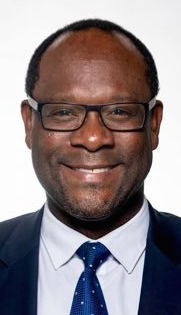
Khalid Ahmed is the NDP candidate in Calgary-Nose Hill, according to a report in the Calgary Herald. Ahmed was the NDP candidate in the 2017 by-election in Calgary-Heritage and 2015 and 2019 elections in Calgary-Signal Hill.
The Green Party has nominated Keiran Corrigall in Calgary-Signal Hill, Janna So in Calgary-Skyview, and Brian Deheer in Fort McMurray-Cold Lake. Deheer has run numerous times for the Green Party in federal and provincial elections and twice for the leadership of the Green Party of Alberta.
John Kuhn has withdrawn as the separatist Maverick Party candidate in Sherwood Park-Fort Saskatchewan. Kuhn served as Mayor of the Town of Bassano from 2007 to 2008.
The Christian Heritage Party has nominated Tom Lipp in Bow River and Larry Heather in Calgary-Heritage. Lipp was his party’s candidate in this district in 2019 and Heather is a perennial candidate who has run in too many elections to list in this post.
Calgary-Edgemont NDP candidate Julia Hayter (Source: Twitter)
Julia Hayter was nominated as the Alberta NDP candidate in Calgary-Edgemont at a meeting held last night.
Hayter was the NDP candidate in the northwest Calgary district in the 2019 election, where she earned 34 per cent of the vote to United Conservative Party candidate Prasad Panda’s 52 per cent. Panda currently serves as Minister of Infrastructure.
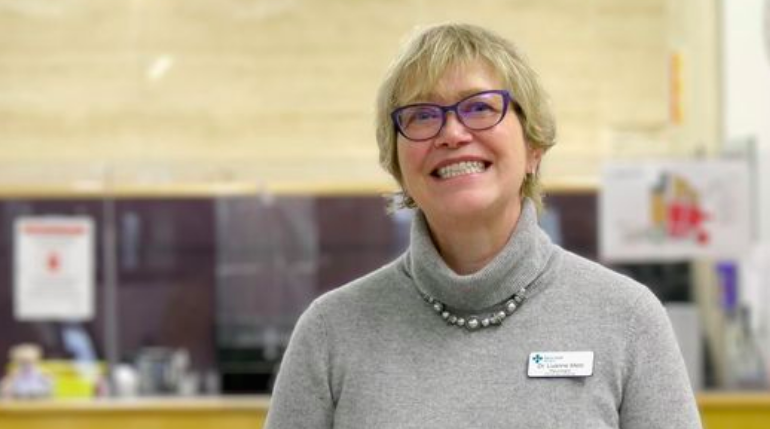
Hayter is the second NDP candidate nominated to run in the expected 2023 provincial election. Dr. Luanne Metz has been nominated to run in the neighbouring Calgary-Varisty.
Sayid Ahmed seeking UCP nomination in Edmonton-Decore
Sayid Ahmed has filed papers with Elections Alberta to seek the UCP nomination in Edmonton-Decore. Ahmed is a manager in the provincial Department of Health and is President of the UCP association in the neighbouring Edmonton-Manning district and Vice President of Policy for the Alberta Advisory Board of the Conservative Black Congress of Canada.
Edmonton-Decore has been represented by NDP MLA Chris Nielsen since 2015. Nielson was re-elected in 2019 with 47.5 per cent of the vote, ahead of UCP candidate Karen Principe (Principe is currently running for Edmonton City Council in Ward tastawiyiniwak). The third place candidate in that year’s race, Alberta Party candidate Ali Haymour, is running for city council in Edmonton’s Ward Anirniq.
The district is named after former MLA Laurence Decore, who served as MLA for the then-named Edmonton-Glengarry from 1989 to 1997 and as Mayor of Edmonton from 1983 to 1988. He was leader of the Alberta Liberal Party from 1988 to 1994.
Ahmed is the second prospective candidate to announce plans to seek a UCP nomination ahead of the 2023 election. Chantelle de Jonge has filed her papers to run for the UCP nomination in Chestermere-Strathmore.
Former Edmonton lawyer Randy Hogle running for Senate
Former Edmonton lawyer Randy Hogle has filed his papers to run as a candidate in the Senate Nominee election, which is being held on the same day as Alberta’s October 18 municipal elections.
Hogle had a successful legal career and, despite being legally blind, he excelled as an equestrian athlete. This is his second attempt at political office after a previous run for Edmonton City Council in 1992, during which one of his key platform points was the construction of bike lanes on Jasper Avenue.
Hogle is the son of former long-time CFRN news director Bruce Hogle and brother of former sports reporter and current Hockey Edmonton General Manager Steve Hogle.
Sorensen’s long record of public service includes terms as a trustee on the Canadian Rockies Public Schools from 1997 to 2001, as a Banff town councillor from 2004 to 2010 and as mayor from 2010 until her appointment to the Senate in 2021.
She will sit as an Independent member of Canada’s upper chamber.
UPDATE:
Mykhailo Martyniouk has submitted his papers with Elections Alberta to run in the Senate Nominee election. Martyniouk is the current president of the Canadian Ukrainian Free Trade Agreement Association.
In 2019, Martyniouk donated $1,155 to Edmonton-Beverly-Clareview UCP candidate David Egan and in 2018 he donated $300 to the UCP association in Edmonton-Beverly-Clareview. In 2020, he donated 1,600 to the Conservative Party of Canada association in Edmonton-Manning.
According to the returns, the NDP raised $1,515,419 and the UCP raised $769,847 between April 1 and June 30, 2021.
This marks the second quarter in a row that Rachel Notley’s NDP have out-fundraised the governing UCP. The NDP raised twice as much money as the UCP in the first three months of 2021.
Here is what all of Alberta’s registered political parties raised in the second quarter of 2021:
Alberta NDP: $1,515,419.87
United Conservative Party: $769,847.15
Pro-Life Political Association: $90,870.00
Alberta Party: $38,270.19
Wildrose Independence: $25,791.06
Alberta Liberal Party: $25,563.61
Green Party: $2,019.00
Independence Party of Alberta: $1,015.00
Alberta Advantage Party: $890.00
Communist Party: $200.00
Once again, Notley’s NDP are on a roll, leading in the polls and continuing to dominate in fundraising. The NDP have solidified a larger base of donors, many whom appear to be contributing larger amounts to the official opposition party. In this quarter, 49 per cent of individual donations received by the NDP in the first quarter were in denominations of less than $250, compared to 64 per cent in the previous quarter.
The governing UCP’s continued drop in fundraising continues to mirror plummeting political support for the party and its leader, Premier Jason Kenney. The UCP raised in total only slightly more than the NDP raised in small donations in the second quarter.
The Wildrose Independence Party is a product of a name-change that happened after the Freedom Conservative Party and the Wexit Alberta group united. The party itself has existed under various names since it was founded in 1999 as the Alberta First Party.
The Independence Party of Alberta is also searching for a new leader following Dave Bjorkman’s resignation after the 2019 election. Former Wexit leader Peter Downing, who left the Wexit group following its merger with the Freedom Conservative Party had registered to be a leadership candidate but withdrew his candidacy this week. The party’s director of communications, Vicky Bayford, is the only candidate remaining in the race.
Also searching for new permanent leaders are the Alberta Advantage Party, the Alberta Party, and the Alberta Liberal Party.
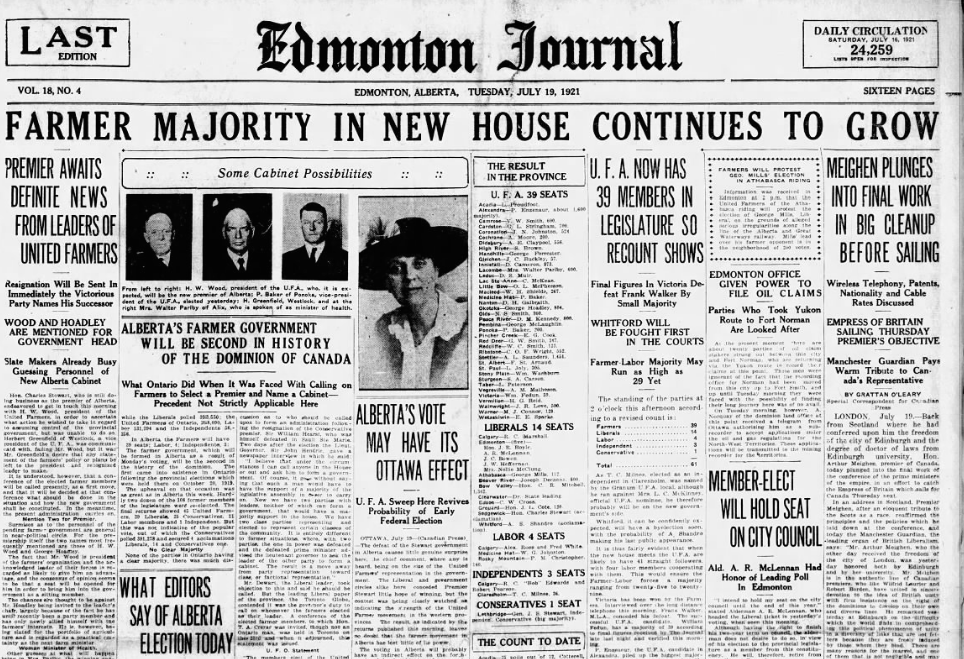
The front page of the Edmonton Journal (July 19, 1921)
“Farmers may not be ready to take over government, but they are going to do it anyway” – Henry Wise Wood, July 8, 1921
A lot of Albertans might recognize the United Farmers of Alberta as a farm-supply retail cooperative with gas stations, fertilizer plants and retail outlets scattered across Alberta, BC and Saskatchewan. But 100 years ago today, the UFA won its first election in Alberta and formed a majority government by shattering the Liberal Party and breaking the mould of provincial politics in the prairies.
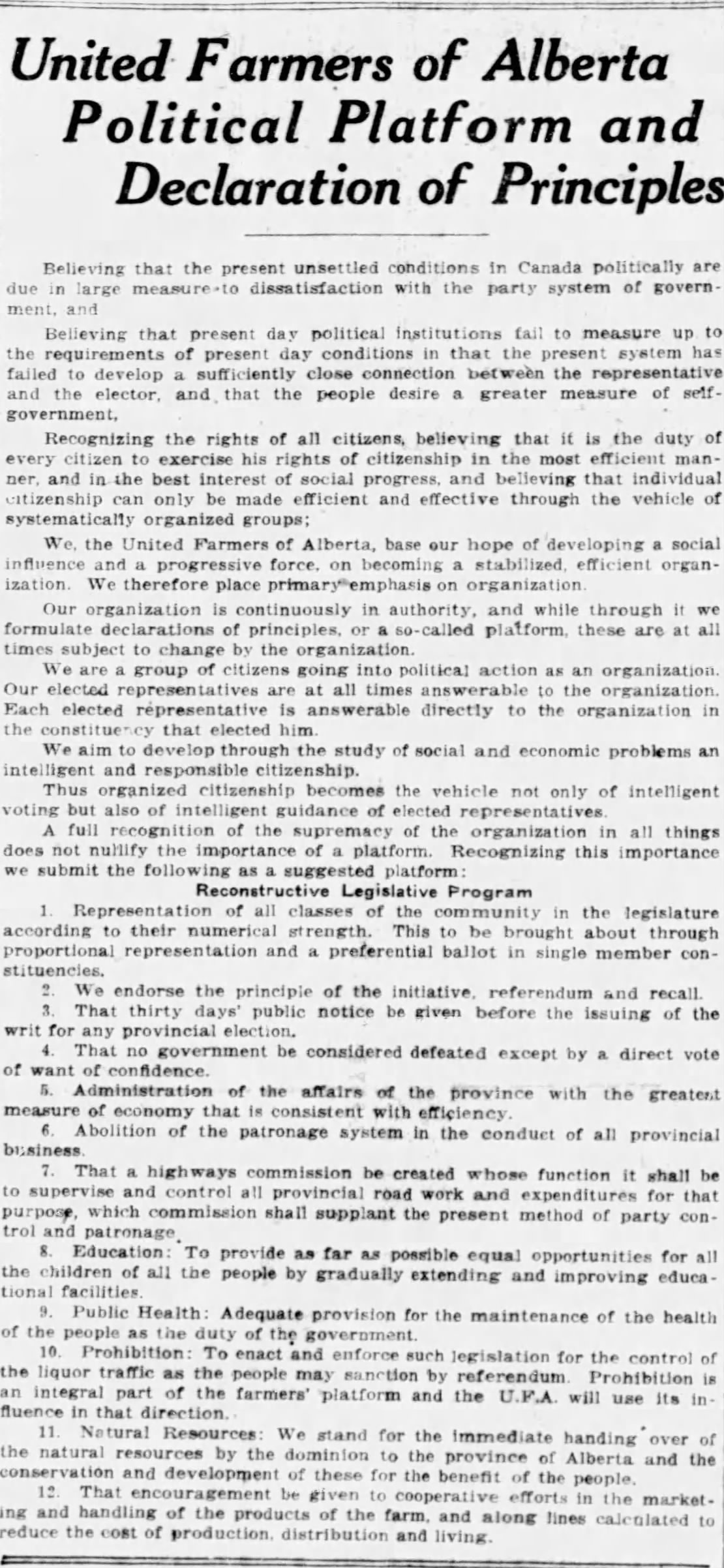
UFA Election Declaration
The 1921 election marked the first of only five times Albertans have voted to changes parties in government. The results of that election marked the start of Alberta becoming an electoral testing ground for anti-establishment ideologies and political projects.
It would not be until 1971 that a nationally-mainstream and nationally-affiliated party would again form government in Alberta.
Founded in 1909, the UFA was an influential farmers’ lobby group that reluctantly entered electoral politics after years of frustration with the establishment Liberal Party that had governed Alberta since the province was formed in 1905.
Part of a broader national progressive cooperative movement, the UFA was the first of the prairie farmers parties to break through and form government. The United Farmers of Manitoba would form government in 1922 and Saskatchewan would buck the trend until the election of Tommy Douglas‘ Cooperative Commonwealth Federation in 1944.
Until 1921, the Liberal Party had dominated elections in the three prairie provinces, with the Conservative Party only occasionally forming government. A 16-year old Alberta Liberal Party government already damaged by years of internal power struggles and still reeling from the conscription crisis was shocked to be swept out of office.
Thirty-eight UFA MLAs were elected, with 15 Liberal MLAs, 4 Dominion Labour MLAs, 3 Independents and 1 Conservative forming the opposition (one Dominion Labour MLA, Alex Ross, was invited to join the UFA cabinet and served as Minister of Public Works).
Despite the incumbent Liberals winning 34 per cent of the vote compared to 28 per cent for the UFA, the UFA won 38 seats compared to 15 for the Liberals. The lopsided popular vote was due to a new electoral system which gave voters in Calgary and Edmonton the ability to cast votes for five candidates and voters in Medicine Hat the ability to vote for two candidates. The UFA did not run any candidates in the two largest cities.
Being new to electoral politics, the UFA did not actually have an official party leader at the time they won the election (this would become a trend in Alberta politics, as neither did the Social Credit Party when it won in 1935).
Wanting to do politics differently, the newly elected UFA is said to have approached defeated Liberal Premier Charles Stewart to ask if he would remain in the job. Stewart, who had been a member and supporter of the UFA before they became his political opponent, declined.
UFA President Henry Wise Wood also declined, wanting to stay out of the partisan political side of the organization.
UFA Vice-President Percival Baker was next in line, but died one day after being elected as the MLA for Ponoka from injuries caused by a falling tree.
George Hoadley was considered a potential premier due to his previous experience as leader of the Conservative Party, but it was likely his pre-floor crossing connections that cost him the job.
Herbert Greenfield was named interim vice-president after Baker’s death and was selected by the UFA Caucus to become the next Premier. Without a seat in the Legislative Assembly, Greenfield ran in a December 1921 by-election to become the MLA for Peace River.
The UFA’s election also marked the beginning of a political wave that would sweep over Alberta and the prairies, with the UFA-allied Progressive Party electing 8 Members of Parliament in the December 1921 election and forming official opposition in Ottawa.
It’s record as government in Alberta was mixed. It ended prohibition, formed the Alberta Wheat Pool, founded the first provincial parks, and introduced elements of proportional representation into the provincial electoral system. But it was also responsible for the formation of the Alberta Eugenics Board, marking the start of a dark period in our province’s history.
The UFA’s political fortunes would also suffer from the Great Depression and number of high-profile sex scandals that would dog it until the party’s defeat in 1935 and subsequent retreat from politics.
I will be sharing more thoughts over the next few days about the election of the UFA in 1921 and how it reshaped politics in Alberta for decades to come.
Devon Hargreaves has been nominated as the Liberal Party of Canada candidate in the federal district of Lethbridge. He is the first Liberal candidate nominated in Alberta ahead of the next federal election.
Hargreaves was the Liberal candidate in Lethbridge-East in the 2019 provincial election. He is the past Chair of the Lethbridge PrideFest and, in 2018, launched an e-petition to ban conversion therapy.
Incumbent Member of Parliament Rachael Harder has been nominated as the Conservative Party of Canada candidate. She was first elected in 2015 and was re-elected in 2019 with 65.8 per cent of the vote.
Dr. Metz is a Professor and the Head of the Division of Neurology at the Hotchkiss Brain Institute at the University of Calgary. She is also a founder of Eyes Forward Alberta, an advocacy group created to support public health care and oppose the United Conservative Party government’s plans to privatize large swaths of the health care system.
“I want to contribute to fixing our health-care system,” Metz said in a media statement released last night.
“My way of dealing with the stress of recent policies that are the opposite of what evidence recommends is to do whatever I can to be part of the solution. UCP policies are hurting Albertans and will increase health care costs,” she said. “I want to continue championing the health and wellness of Albertans in the Legislature.”
According to the University of Calgary website, Metz is recognized globally as an expert in Multiple Sclerosis and, in 2015, was awarded the Alberta Medal of Distinguished Service – which recognizes physicians who have made an outstanding personal contribution to the medical profession and to the people of Alberta.
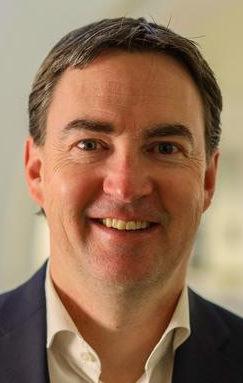
Jason Copping
If nominated as the NDP candidate, Metz could challenge current UCP MLA Jason Copping, now the Minister of Labour and Immigration, in the next election. Copping defeated NDP candidate Anne McGrath (now the National Director of the New Democratic Party of Canada) by 638 votes in the 2019 election.
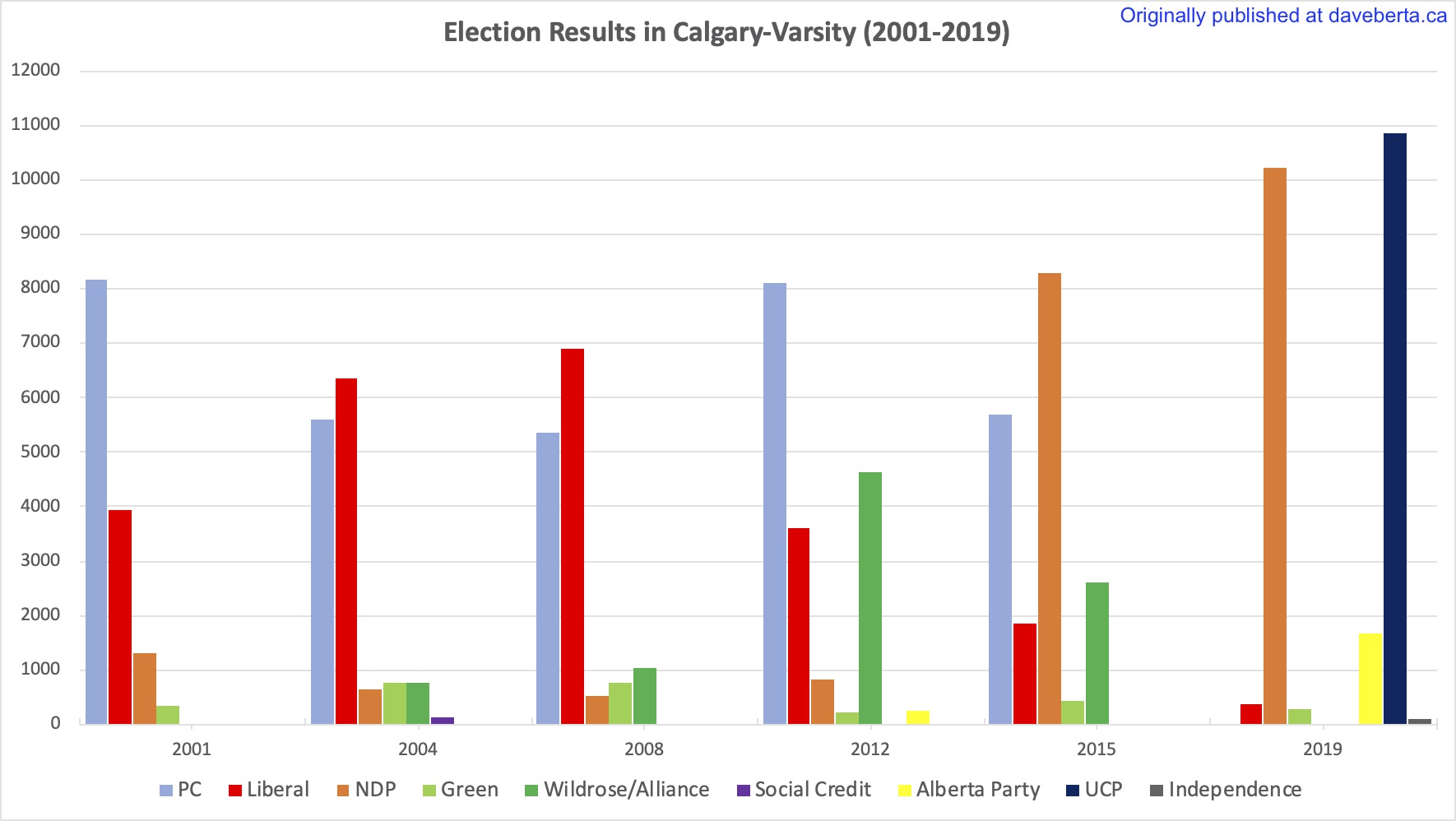
Calgary-Varsity has been a swing riding that has generally leaned away from the conservative parties since the mid-2000s, being represented by popular Liberal MLA Harry Chase from 2004 to 2012, Progressive Conservative and Independent MLA Donna Kennedy-Glans from 2012 to 2015, and NDP MLA Stephanie McLean from 2015 to 2019.
Election results in Calgary-Varsity from 2001 to 2019.
Scott has become well-known for keeping his cafe open in defiance of public health restrictions put in place to stop the spread of COVID-19.
He was arrested by RCMP at a rally to oppose the government’s public health restrictions held outside his cafe on May 8, 2021. He was released from police custody on May 12.
Lacombe-Ponoka is currently represented by UCP MLA Ron Orr, who, in a Facebook post defending Premier Jason Kenney last week, claimed that Kenney was raised by God to be the leader of his party.
The right-wing separatist party formerly known as the Freedom Conservative Party is currently in the process of selecting its first permanent leader.
Drew Barnes, at the Wildrose Caucus press conference in response to Premier Alison Redford's resignation in March 2014.
United Conservative Party MLAs voted to expel Cypress-Medicine Hat MLA Drew Barnes and Central Peace-Notley MLA Todd Loewen from the governing party’s caucus after an afternoon virtual caucus meeting that spilled into the evening.
The vote came more than two years after Barnes began his unofficial role as chief-caucus-thorn-in-Kenney’s-side. After being overlooked for a cabinet role when the UCP formed government in 2019, the third-term MLA representing the southeast corner of Alberta publicly toyed with separatism and climate change denial and became an open critic of the government’s response to COVID-19 (claiming the mild public health restrictions went too far).
Both were former Wildrose MLAs, with Barnes being the only original Wildroser from that party’s 2012 breakthrough still sitting in the Legislative Assembly.
Kenney had no choice but to appeal to his caucus to kick Loewen out after being directly challenged. Barnes was the icing on the cake for Kenney. (Noticeably missing from this list was Bonnyville-Cold Lake-St. Paul MLA David Hanson, who posted his support for Loewen’s letter on Facebook).
Nicholas Milliken
The vote to expel the two, which was live-tweeted from leaks funnelled to Derek Fildebrandt‘s Western Standard website, was not cast by secret ballot but by MLAs texting their yes or no votes to new interim caucus chair, Calgary-Currie MLA Nicholas Milliken.
For these two outspoken MLAs – and their new desk-mate, Lesser Slave Lake MLA Pat Rehn – there might be no shortage of options.
But this is a short-term solution to a bigger problem for the UCP.
One of the main problems is Kenney. He remains deeply unpopular with Albertans and conservatives, a reality reflected in dropping support in the polls and his party’s dismal fundraising returns over the last six months. His divisive style of politics has alienated many Albertans, including many influential people of communities who would otherwise be traditional supporters of the governing conservative party.
As Edmonton-based strategist Chris Henderson wrote of Kenney on Twitter, “[h]e is clearly a very exceptional political lieutenant, but doesn’t have the requisite skills/temperament to sustain leadership in a complex governing environment.”
“There’s no shame in that, some people are incredible college QBs and flame out in the NFL. It happens. Time to go.,” wrote Henderson, who managed many of Don Iveson‘s successful political campaigns in Edmonton.
Premier Jason Kenney
Kenney may have been successful in imposing caucus discipline today, but he still faces critics within his own party who are calling for his resignation.
In more normal times, this could just be argued away as growing pains for a relatively new political party, but the UCP includes some unruly groups of conservative activists who spent most of the last decade at each others throats. These ideological and regional divides are easier to mend when the party is high in the polls and flush with cash (or the price of oil is high), but when the party’s fortunes began to nosedive more than a year ago the ideological cracks instantly started to appear.
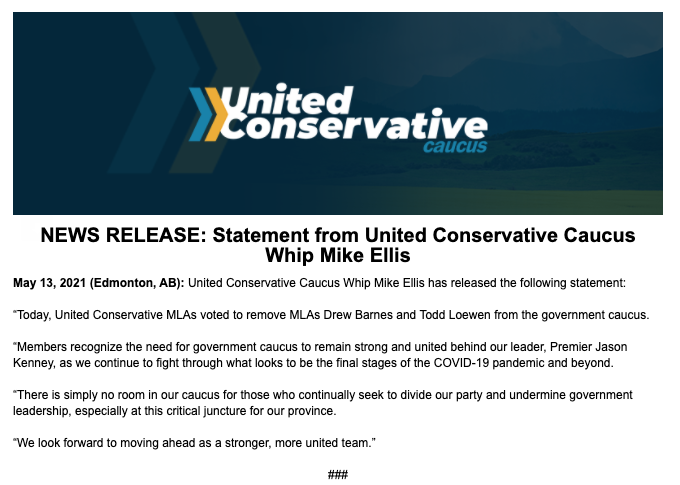
In a statement released after the meeting,, UCP Caucus Whip and Calgary-West MLA Mike Ellis said “There is simply no room in our caucus for those who continually seek to divide our party and undermine government leadership.” But that the breakdown of the vote wasn’t released suggests that it wasn’t near unanimous and that opposition to Kenney still exists inside the UCP Caucus.
Statement from the United Conservative Caucus (May 13, 2021)
The United Conservative Party already didn’t appear completely united, and now, with a growing number of former UCP MLAs sitting in the opposition benches, it appears even less united.
Kenney made an example of Barnes and Loewen by having them kicked out of the UCP Caucus, but when the other 59 UCP MLAs wake up tomorrow morning, the problems that led them to make this decision today will still remain.
Update: Drew Barnes issued a statement on social media following his eviction from the UCP Caucus.
Statement released by MLA Drew Barnes in response to his being removed from the UCP Caucus (May 13, 2021)
This marks the third quarter in the last year that Rachel Notley’s NDP have out-fundraised the governing UCP. Not only have Albertans been showing their unhappiness with Jason Kenney’s UCP in the polls, they are clearly showing it by voting with their pocketbooks and credit cards.
Here is what Alberta’s political parties raised during the first quarter of 2021:
NDP: $1,186,245
UCP: $591,597
Alberta Party: $48,194
Wildrose Independence Party: $36,883
Pro-Life Political Association: $33,261
Alberta Liberal Party: $31,798
Green Party: $5,010.00
Independence Party: $1,559.25
Notley’s NDP are on a roll, leading in the polls and continuing to dominate in fundraising. Despite losing government two years ago, the NDP appear to have solidified a larger base of donors who contribute donations in smaller amounts. Sixty-eight per cent of individual donations received by the NDP in the first quarter were in denominations of less than $250, compared to 39 per cent for the UCP.
At first glance, it would appear as though many of the UCP’s wealthier donors, who in previous years contributed a maximum annual donation in the first quarter, have not yet donated this year. This could be a big indication with a growing unhappiness in the direction of the UCP and Kenney’s leadership over the course of the past year.
The Pro-Life Political Association, which was known as the Social Credit Party before it was taken over by anti-abortion activists in 2016, went from raising nothing for the past few quarters to raising more than $33,261 in the last three months. It is unclear why the effectively dormant party that ran only one candidate in the last election and whose previous leader resigned to become a monk is now active.
The Alberta Advantage Party, Communist Party and the Reform Party raised no funds during this period.
The maximum annual donation to political parties was increased to $4,243 from $4.000 as of January 1, 2020.
Another MLA Recall bill has been introduced into the Alberta Legislative Assembly, and this one looks like it will actually pass and become law.
Kaycee Madu (Source: Twitter)
Justice Minister Kaycee Madu introduced Bill 52: Recall Act in the Assembly for first reading today. If it becomes law, the bill would allow for a by-election to be called in a provincial electoral district where the signatures of at least 40 percent of the eligible voters are collected. Unlike previous Recall efforts, Madu’s bill expands recall to municipal councillors and school board trustees.
Forty percent is likely a high enough threshold to avoid frivolous, or maybe any, actual Recall by-elections. While there are certainly some circumstances where constituents are united in unhappiness with their elected officials, this bill seems to be more of a signal that the United Conservative Party has checked off a box on its to-do list than actually create a mechanism to improve democracy in Alberta.
Instead of being fearful of a revolt by their own voters, it is more likely that MLAs will be concerned that well-funded special interest groups, like the the Canadian Taxpayers Federation, could swoop into their district with a legion of paid volunteers to rabble-rouse and cause trouble for local representatives.
It might be more proactive to limit recall, like they have in the United Kingdom, to politicians who are convicted of criminal offenses or providing false or misleading expenses claims while in office.
Our democratic institutions do need to be tinkered with and improved, but so much of the focus of efforts like MLA Recall are focused on punishing elected officials rather than empowering them to do a better job. So rather than finding new ways to fire politicians, which Albertans have done a fairly consistent job in the past two elections, we should be creating ways they can do better jobs for us.
Being a backbench MLA in a government caucus is not a glamorous job. They are told where to be and how to vote on most issues. Most rarely have the opportunity to demonstrate meaningful independence without facing the wrath of the Caucus Whip or the Leader’s Chief of Staff. And, when time comes for re-election, their nomination papers require the ultimate endorsement of the party leader.
One way that individual MLAs could empower themselves would be to change the standing orders to allow MLAs who are not in cabinet an increased opportunity to introduce private members bills. Right now MLAs earn the ability to introduce private members bills through a lottery, meaning that some MLAs will never have the chance to introduce a law into the Legislature.
And private members’ bills are only debated on Monday’s, severely limiting their ability to get attention and get passed into law.
Accountability of democratic officials is important, and that is why we have elections every four years. And as Albertans have enthusiastically demonstrated over the past two elections, they will not hesitate to dramatically unseat MLAs and governments if they feel the need.
It would be better for democracy in Alberta if we focused on ways to empower MLAs to better represent Albertans inside and outside the Assembly, rather than creating new ways to punish them.
History of Recall Legislation in Alberta
Madu’s Bill 52 marks the eleventh MLA Recall bill to be tabled in the Assembly since 1936.
1936: Bill No. 76 of 1936: A Bill Providing for the Recall of Members of the Legislative Assembly was introduced by the Social Credit government and passed after their surprising win in the 1935 election. The bill required 66.6 percent of voters to sign a petition to trigger a recall by-election.
1937: The law was repealed by the Social Credit government after a group of disgruntled Albertans was thought to have collected enough signatures to recall Premier William Aberhart in his Okotoks-High River constituency.
1993: Calgary-Buffalo Liberal MLA Gary Dickson introduced Bill 203: Recall Act, which would have trigged a recall by-election if 40 percent of eligible voters signed a petition demanding one. The bill was defeated in a 42-34 vote in the Legislature.
1995:Edmonton-Meadowlark Liberal MLA Karen Leibovici introduced Bill 224: Parliamentary Reform and Electoral Review Commission Act, which would have created a commission to study a handful of issues, including recall. The bill passed first reading but was never debated.
1996:Lethbridge-East Liberal MLA Ken Nicol introduced Bill 206: Recall Act, which would have trigged a recall by-election if 40 percent of eligible voters signed a petition demanding one. This bill was defeated in a 37-24 vote in the Legislature.
1997: Bill 216, Recall Act was introduced by Edmonton-Manning Liberal MLA Ed Gibbons but was never debated in the Legislature. If passed into law, the bill would have trigged a recall by-election if 40 percent of eligible voters signed a petition demanding one
2010: Calgary-Glenmore Wildrose MLA Paul Hinman introduced Bill 208: Recall Act, which would have trigged a recall by-election if 33 percent of eligible voters signed a petition demanding one. Reached second reading but was not debated further.
2015: Chestermere-Rockyview Wildrose MLA Leela Aheer introduces Bill 206: Recall Act, which would trigger a recall by-election if 20 percent of eligible voters signed a petition demanding one. The bill passed first reading and died on the order paper.
2016: Drayton Valley-Devon Wildrose MLA Mark Smith introduces Bill 201: Election Recall Act, which would trigger a recall by-election is 66 per cent of the electorate’s signatures from the previous general election was collected in 60 days on a sanctioned petition. The bill was defeated in second reading.
2019: Drayton Valley-Devon United Conservative Party MLA Mark Smith introduces Bill 204: Election Recall Act, which would allow Albertans to trigger a by-election in a riding where 40 per cent of registered voters have signed a petition recalling their MLA. The bill died on the order paper after it passed second reading.
We dive into our mailbag and answer some great questions sent in by Daveberta Podcast listeners. From the possibility of a United Conservative Party leadership review to Premier Jason Kenney’s new health care-friendly talking points to the Alberta Party leadership to the unpopularity of premiers Richard Reid and John Brownlee, you sent us a lot of great questions!
The Daveberta Podcast is a member of the Alberta Podcast Network: Locally grown. Community supported. The Alberta Podcast Network includes dozens of great made-in-Alberta podcasts.
You can listen and subscribe to the Daveberta Podcast on Apple Podcasts, Google Play, Spotify, Stitcher, or wherever you find podcasts online. We love feedback from our listeners, so let us know what you think of this episode and leave a review where you download.
Going into the last election there were five parties represented in Alberta’s Legislative Assembly, but on election night in April 2019 the two main political parties dominated and the smaller parties failed to elect any candidates. Since then Alberta’s smaller parties have been struggling for attention as they search for new people to lead them into the 2023 election.
The Green Party of Alberta was the first to choose a new leader, with Jordan Wilkie being selected in a March 2020 leadership vote. And it now looks like there will be at least two smaller parties holding leadership races and competing for attention in this very busy political year.
Alberta Party seeks new leader
The Alberta Party has announced its plans to kick off a leadership race on May 25, 2021. Candidate nominations will close August 31 and the Leadership will be held on October 23, 2021, one week after the municipal elections.
Interim leader Jacquie Fenske, a former Progressive Conservative MLA, has served in the role since Feb. 2020, filling the position vacated by former leader Stephen Mandel, also a former PC MLA, in June 2019. No candidates have yet to declare their plans to run for the party leadership.
The Alberta Party elected one MLA, Greg Clark in Calgary-Elbow, in 2015 and grew its caucus to 3 MLAs by 2019 after floor crossings from the Alberta NDP and United Conservative Party. The Alberta Party tripped its popular vote to 9 per cent in 2019 but failed to elect any candidates to the Legislative Assembly.
Liberal Party names interim leader
Lawyer and longtime party loyalist John Roggeveen has stepped up to fill the role of interim leader of the Alberta Liberal Party until the party can select a permanent leader at a future date.
John Roggeveen has served on the party’s executive and was a candidate in Calgary-Shaw in 2004, 2008 and 2012, Calgary-Elbow in 2015 and Calgary-Fish Creek in 2019.
Roggeveen fills the role made vacant after David Khan’s resignation in November 2020. Khan is now the Senior Staff Lawyer at EcoJustice.
The party has not yet announced the dates for a leadership race.
The Liberal Party formed Official Opposition in Alberta between 1993 and 2012. The 2019 election marked the first time since the 1982 election that the Liberals failed to elect an MLA to the Legislative Assembly.
Separatist parties seek new leaders
The separatist Wildrose Independent Party will open nominations for its leadership race on April 2 and kick off its leadership race on June 5. Voting for the party’s new leader will take place on Aug. 28, 2021.
Former Alberta Alliance leader and Wildrose MLA Paul Hinman has served as interim leader since last summer. Hinman served as MLA for Cardston-Taber-Warner from 2004 to 2008 and Calgary-Glenmore from 2009 to 2012.
No candidates have declared their plans to run as of yet, but at the party’s recent annual general meeting former Wildrose Party organizer Rick Northey was elected president, former PC Party candidate Gurcharan Garcha was selected as Edmonton Director, and former Conservative Member of Parliament Rob Anders was selected as a Director-at-Large.
Meanwhile, former Wexit spokesperson Peter Downing, who stepped down when that organization folded into the Freedom Conservative Party to form the Wildrose Independence Party in June 2020, now appears to have joined another separatist party. According to the Independence Party of Alberta website, Downing is now serving as its Public Safety Critic.
The Independence Party of Alberta is also currently without a permanent leader, as is the separatist Alberta Advantage Party.
This marks the second time in the last year that the opposition NDP have out-fundraised the governing UCP, suggesting Albertans are voting with their pocketbooks and credit cards.
Here is what Alberta’s political parties raised during the fourth quarter of 2020:
NDP $2,322,490.38
UCP $1,921,813.21
Alberta Party $50,738.66
Wildrose Independence Party $45,863.49
Liberal Party $44,746.87
Green Party $17,847.00
Alberta Advantage Party – $4,055.00
Independence Party – $2,990.40
Communist Party – $100.00
This marks the first time since the UCP was created that the NDP have fundraised more money over the course of a year. According to the Elections Alberta disclosures, the NDP raised $5,061,979.02 in 2020 with the UCP narrowly behind at $5,046,322.52.
The Alberta Party, Wildrose Independence Party, Liberal Party and Green Party also saw increases in their quarterly fundraising, though they remain significantly behind the two major parties.
The maximum annual donation to political parties was increased to $4,243 from $4.000 as of January 1, 2020.
RIP Uncle COVID Head (2019-2021) (source: CovidLoves.ca)
With 2020 on its way out here is quick look at what might await Alberta’s political parties in 2021:
United Conservative Party: The UCP will continue pushing through a legislative agenda and ideological project that includes mass privatization of public services and public land, and big job losses for public sector workers.
Jason Kenney (source: Flickr)
The UCP’s inability to pivot off its agenda has been demonstrated clearly during the COVID-19 pandemic as Health Minister Tyler Shandro continued his fight against Alberta doctors, planned layoffs of thousands of nurses and health care workers, and schemed to privatize large swaths of the public health care system.
Kenney’s inconsistent approach to the pandemic has likely alienated him from both Albertans who would like to see more serious public health measures taken and those who think being required to wear a face-mask in public spaces is too far.
A federal election in 2021 might distract Albertans from the UCP’s mismanaging of the COVID-19 pandemic, so expect the UCP to ramp up attacks on Prime Minister Justin Trudeau and the federal Liberals. Increasing attacks of the federal government and next year’s promised referendum on equalization and Senate nominee election could also serve as a distraction from poor economic growth and the cancellation of the Keystone XL Pipeline permit by incoming United States President Joe Biden.
Kenney’s approval ratings took a big hit in 2020 and the UCP has dropped considerably in the polls since 2019. If their leader looks like he has become a liability for re-election in 2023 then expect a change at the top. Conservative parties in Alberta are ruthless with leaders who stop looking like winners, just ask Don Getty, Ralph Klein, Ed Stelmach and Alison Redford.
The good news for Kenney is that he is only two years into his government’s four year term in office which leaves him with some time to turn around his political fortunes. But the clock is ticking and the tire-kickers could soon be kicking.
Alberta NDP: It is not often that political leaders in Canada are given a second chance, but despite losing the 2019 election Rachel Notley remains in firm control of her New Democratic Party.
Rachel Notley (source: Facebook)
Notley’s moderate NDP is leading or tied with the UCP is three of the four recent voter intention polls released during the second wave of the COVID-19 pandemic and has maintained competitive fundraising levels, but the next election is still more than two years away.
The potential for strikes by public sector workers in 2021 could test the NDP’s political coalition. The NDP’s opponents will inevitably try to use any major labour disputes as a wedge between the party’s union activist wing and its more moderate and centrist supporters.
The key to an NDP victory in 2023 will be a breakthrough in Calgary, smaller urban centres like Lethbridge and Red Deer, and a small handful of suburban and rural ridings scattered across Alberta. The NDP swept those regions in 2015 and Notley has already signalled through her constant visits and social media posts that her focus in 2021 will be Calgary, Calgary, and more Calgary.
Alberta Party: Finding a new permanent leader should be the top focus of this tiny moderate conservative party. The Alberta Party has become home to a small group of disenchanted former Progressive Conservatives unhappy the combative tone and social conservative politics of the UCP. The party lost all its seats in 2019 but continues to poll around 10 per cent support in most surveys. In a two-party political environment, the Alberta Party needs to give Albertans a reason to vote for it that is beyond just not being the UCP or NDP.
Alberta Liberal Party: The Liberals not only need to find a new leader, they need to find a reason to exist. After forming Official Opposition for 19 years, the Liberal vote collapsed in 2012, saw almost all of its supporters migrate to Notley’s NDP in 2015 and lost its only seat in the Assembly in 2019. With the NDP now comfortably occupying the space held by the Liberals in the 1990s and 2000s, the Liberals need a raison d’être in Alberta.
Green Party: Yes, Alberta has a Green Party. The Greens have been issuing a steady stream of press statements that plant the party firmly to the left of the moderate NDP on climate change, the environment and pipelines. It seems unlikely that the party will make any electoral breakthroughs in the near future, but they could put pressure on the NDP to remember that it still has a progressive wing.
Wildrose Independence Party: Also looking for a new leader in 2021, the child of a merger between the Freedom Conservative Party and the Wexit group in 2020 is now led by former Wildrose MLA Paul Hinman.
Drew Barnes
While separatist sentiment appears to be waining the further time passes from the last federal election, Hinman has clamped on to the anti-mask and anti-COVID restrictions groups as his focus, appearing at demonstrations in the two cities.
A number of UCP MLAs have expressed similar views, leading some political watchers to believe that one UCP MLA in particular – Drew Barnes – could be auditioning for Hinman’s job if his public comments become too much for the UCP.
The other fringe separatist parties: The Alberta Advantage Party and Independence Party of Alberta are also looking for new leaders. Advantage Party leader Marilyn Burns, a former Wildrose supporter, resigned in the fall amid a leadership challenge and has announced plans to run for the position again. Former Wildrose constituency president Lenard Biscope is now interim leader.
I spoke with CTV Edmonton about the bizarre development in Edmonton’s mayoral election between former City Councillor Michael Oshry and current Councillor Mike Nickel. Nickel tweeted a screenshot of a private message sent to him by Oshry saying he was “likely in” as a candidate for the mayoral race and asking Nickel if he would support him. Nickel’s tweet was sent to generate attention to his own campaign for mayor, but also serves as a warning to anyone planning to send him an email or private message – it might not stay private for long.
Diana Steele has announced her plans to run for mayor. Steele is the President of the Crestwood Community League and Coordinator, Volunteer Services and Communications for the Pilgrims Hospice Society.
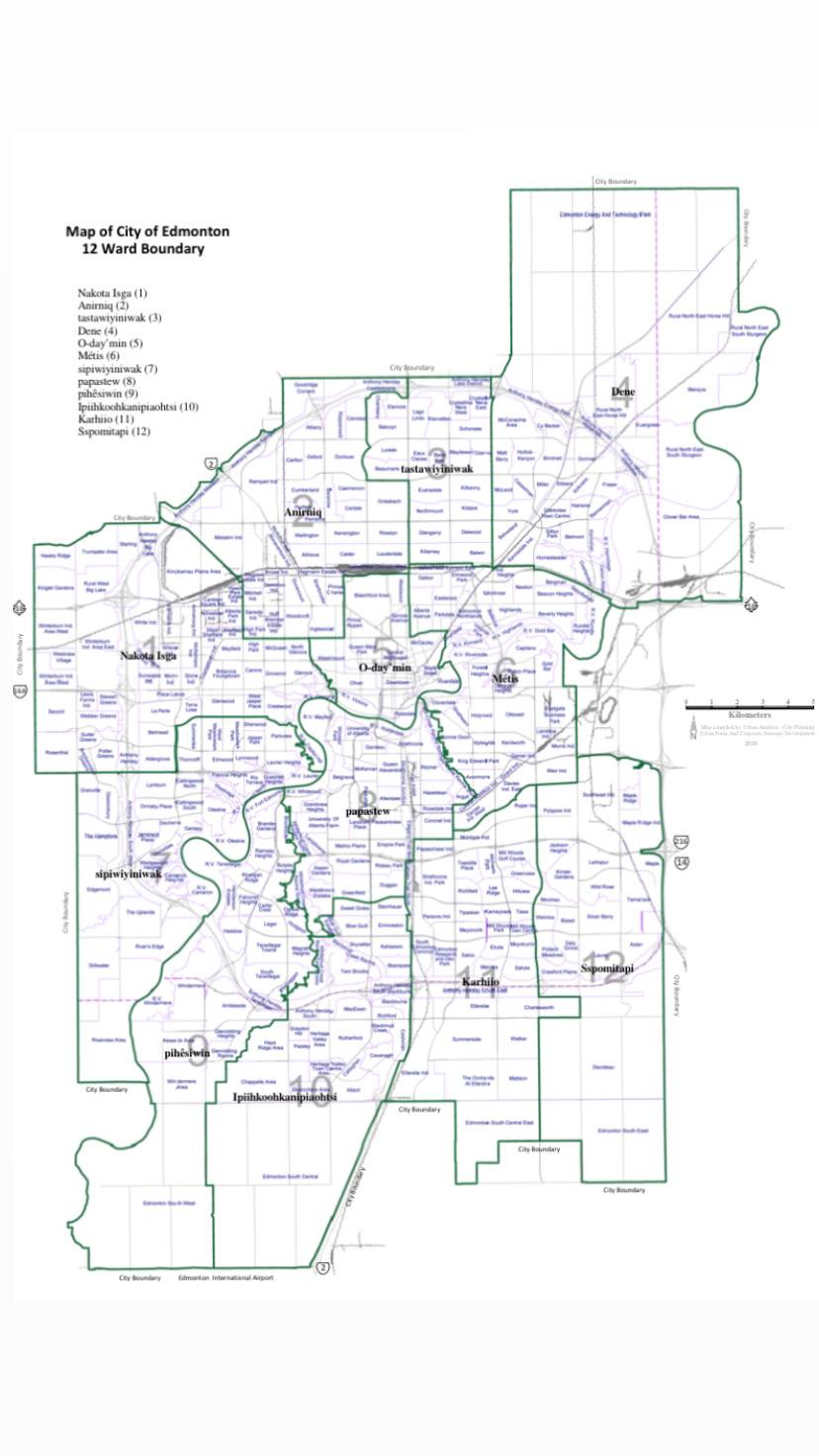
There have also been a number of candidates who have announced their plans to run for Edmonton City Council in the newly redrawn and renamed Wards:
Edmonton City Council’s new Ward boundaries with new Indigenous names.
Dene: Youth, Child and Refugee Advocate Gerard Mutabazi Amani is running in this north east Edmonton ward.
Ipiihkoohkanipiaohtsi: Haruun J. Ali and Rhiannon Hoyle have launched their campaigns in this south Edmonton ward.
Ali is a political science student at the University of Victoria who, according to his website, volunteered on Edmonton-South NDP MLA Thomas Dang‘s re-election campaign in 2019.
Hoyle is the past president of the Alberta Party and the former president of the Heritage Point Community League, which includes the Rutherford and MacEwan neighbourhoods.
Glynnis Lieb announced her plans to run in this ward last month.
Townsend is the President of the Parkdale-Cromdale Community League and owner of The Briefing Room. He was the provincial Liberal Party candidate in Lesser Slave Lake in the 2012 election and in Edmonton-Whitemud in the 2015 election.
Kosowan is a high school Social Studies teacher and placed third in Ward 8 in the 2017 municipal election.
pihêsiwin: First-term councillor Tim Cartmell announced his plans to run for re-election in this newly redrawn ward. Cartmell made the announcement on his constituent email list.
sipiwiyiniwak: Giselle General announced on Facebook that she plans to run in this new south west ward. General is the Volunteer and Communications Coordinator with the Edmonton Community Legal Centre and the author of the FlipinaYEG blog.
Sspomitapi: Rashpal Sehmby is planning to run in this south east Edmonton ward. Sehmby is a postal worker and currently the Health & Safety officer for C.U.P.W. Edmonton Local 730.
I am once again tracking candidates who have announced their plans to run for Mayor, City Council and School Board in Edmonton. If I am missing anyone on the list, please send me an email at david.cournoyer@gmail.com or post a comment and let me know. Thanks!