But the threat is on the radar of some municipal elected officials in Edmonton.
The City of Edmonton’s 2025 Corporate Strategic Risks analysis identified misinformation and disinformation and the adverse impact of artificial intelligence as “risks that can shift public opinion and erode trust in authority.”
Edmonton City Councillor Michael Janz referred to the volume of online misinformation and disinformation on social media as “manufactured rage-baiting” when asked about it after last fall’s municipal elections in Edmonton.
“I think this actually represents a bigger question of how much of what we saw was manufactured rage-baiting,” Janz told Edmonton Journal reporter Eric Bowling in October 2025. “I think we have a real problem with misinformation being spread through social media posts.”
Social media platforms and the echo-chambers their algorithms create not only amplify controversial and divisive topics but they can distort and corrupt the information environment.
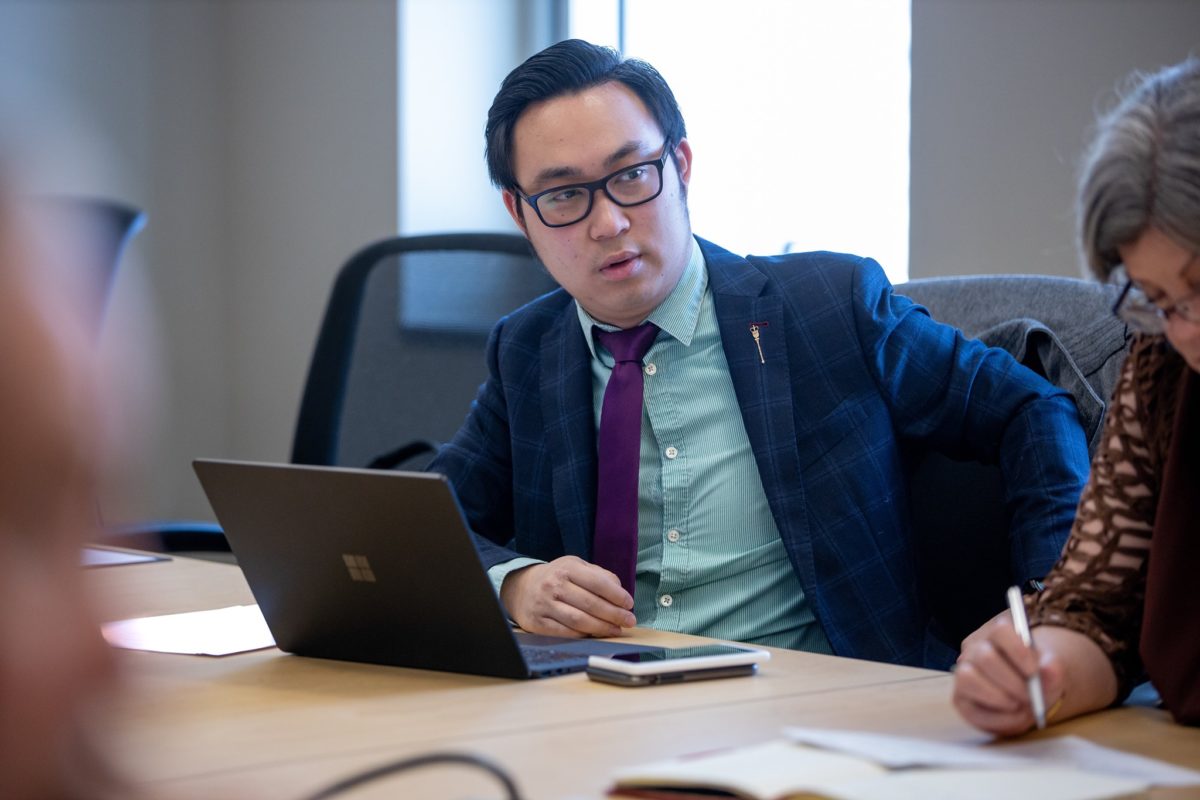
Alberta NDP leader Rachel Notleyannounced today that Edmonton-South MLA Thomas Dang has temporarily left the NDP Official Opposition Caucus to sit as an Independent MLA after the RCMP executed a search warrant at his house this morning.
While none of the details are clear, Notley said she believed the search was related to a Department of Health data breach that Dang reported to the government in Sept. 2021.
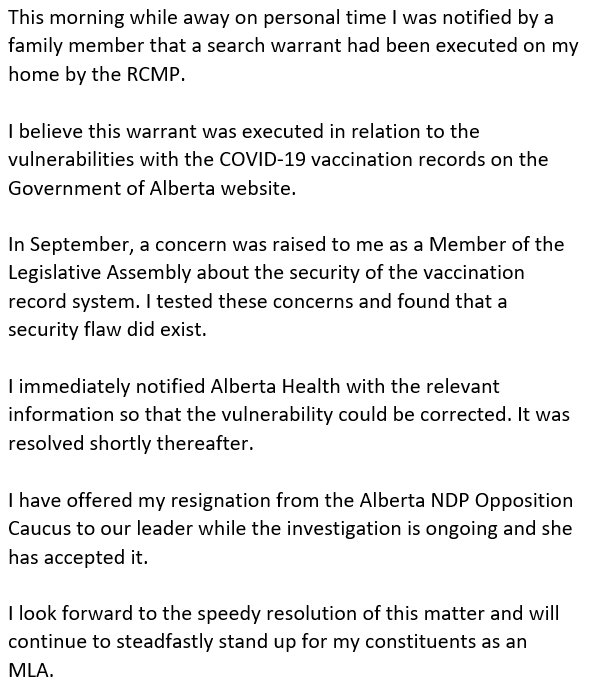
MLA Thomas Dang’s statement on Dec. 21, 2021.
Dang issued a statement in response in which he reiterated Notley’s comments, saying that he believed the warrant was executed in relation to vulnerabilities of the government’s COVID-19 vaccination records website.
“In September, a concern was raised to me as a Member of the Legislative Assembly about the security of the vaccination record system,” Dang wrote. “I tested these concerns and found a security flaw did exist.
“I immediately notified Alberta Health with the relevant information so that the vulnerability could be corrected. It was resolved shortly thereafter,” wrote Dang, who studied Computing Sciences at the University of Alberta before his election as MLA in 2015.
Notley said that Dang, who was in the mountains skiing, voluntarily left the NDP Caucus until the police investigation was complete. Dang is the Official Opposition critic for Democracy and Ethics.
First elected as the NDP MLA for Edmonton-South West in 2015 and ran for re-election in the redistributed Edmonton-South in 2019.
Carol Vowk running for UCP nomination in Drayton Valley-Devon
Carol Vowk
Carol Vowk has filed papers with Elections Alberta signalling her intention to run for the UCP nomination in Drayton Valley-Devon. Vowk is Treasurer of the Drayton Valley Health Foundation and has volunteered with the Drayton Valley Air Cadets, Brazeau Snowmobile Club, and Drayton Valley Soccer.
But perhaps most notable under the current political circumstances, she is the President of the UCP Association in Drayton Valley-Devon and was a signatory of the letter from 22 UCP CA presidents requesting the party move Premier Jason Kenney’s leadership review before March 1, 2022. The party executive denied the request and will be holding the leadership review at a meeting in Red Deer on April 9, 2022 instead.
The central Alberta riding is currently represented by Mark Smith, who was first elected as a Wildrose MLA in 2015. Smith was the centre of controversy during the 2019 election with the release of an audio recording of a church sermon he delivered which included some gross comments about “homosexual love.”
Smith was re-elected in 2019 with 71.1 per cent of the vote. He has not publicly announced whether he plans to run for re-election in 2023.
Brian Jean *is* the UCP candidate in Fort McMurray-Lac La Biche
Former Wildrose Party leader and Kenney-rival Brian Jeanis officially the endorsed UCP candidate in Fort McMurray-Lac La Biche. Both Kenney and the UCP have been completely silent on the results of the nomination meeting, in which Jean defeated Kenney-backed candidate Joshua Gogo. A by-election must be called in the riding by February 15, 2022.
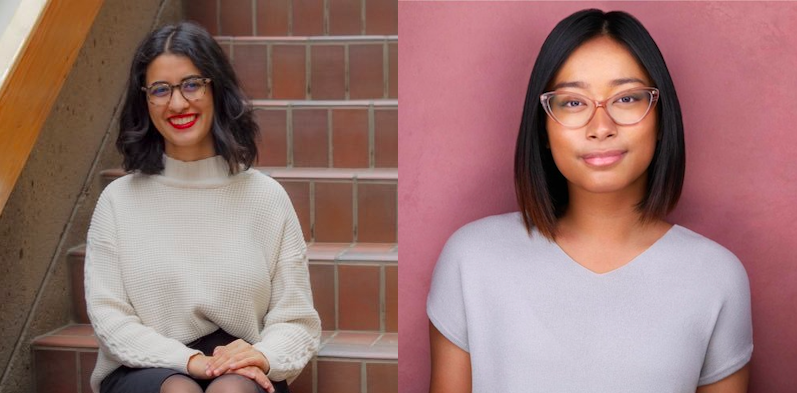
Harnoor Kochar and Rajah Maggay join the Daveberta Podcast to talk about Edmonton’s recent municipal election, the historic wins that came out of it, and what comes next for Alberta’s capital city.
Harnoor Kochar was the Director of Field Operations and Get Out the Vote co-chair on the successful Amarjeet Sohi for Mayor campaign. She is also a fifth-year Political Science student at the University of Alberta.
Rajah Maggay is a research and policy advisor for City Councillor Andrew Knack, Vice-Chair of Research at ParityYeg, and co-founder of Political Divas.
The Daveberta Podcast is a member of the Alberta Podcast Network: Locally grown. Community supported.
You can listen and subscribe to the Daveberta Podcast on Apple Podcasts, Google Play, Spotify, Stitcher, or wherever you find podcasts online. We love feedback from our listeners, so let us know what you think of this episode and leave a review where you download.
University of Alberta political scientist Dr. Jared Wesley joins Dave Cournoyer on the Daveberta Podcast for a deep dive into Alberta’s October 18 Equalization Referendum, why it is being held, what Premier Jason Kenney hopes to accomplish (and why he’s been absent on the campaign trail), and what the ramifications of the vote could be for Alberta and Canada.
We also answer some great listener questions about Equalization and dive into the history of Alberta’s low-key Senate Nominee Elections and more.
The Daveberta Podcast is produced by the talented Adam Rozenhart.
The Daveberta Podcast is a member of the Alberta Podcast Network: Locally grown. Community supported.
You can listen and subscribe to the Daveberta Podcast on Apple Podcasts, Google Play, Spotify, Stitcher, or wherever you find podcasts online. We love feedback from our listeners, so let us know what you think of this episode and leave a review where you download.
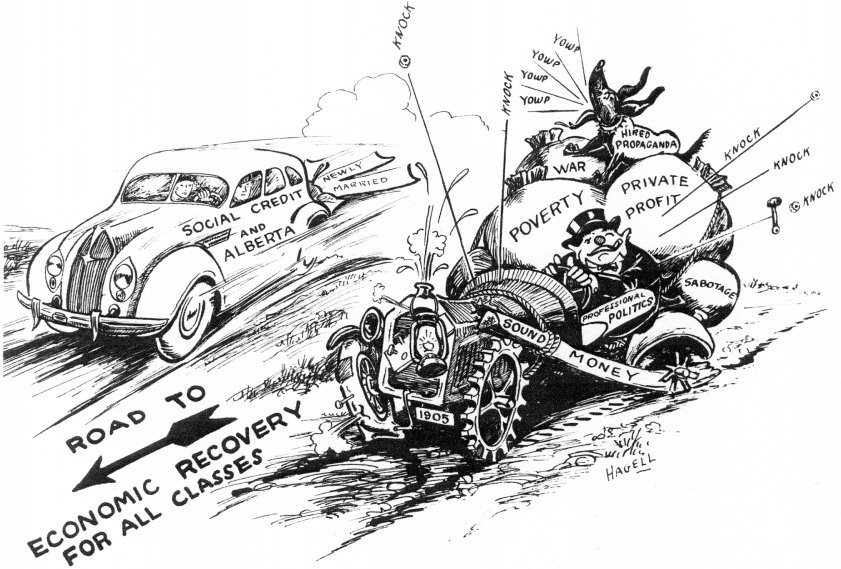
Andrea Hasenbank joins the Daveberta Podcast to discuss radical politics and propaganda in 1930s Alberta, one of Dave Cournoyer’s favourite periods in Alberta politics. From the rise of Communist organizations and publications to the election of William Aberhart‘s Social Credit Party, the 1930s was a wild period in Alberta politics as our province became a testing ground for radical political, social and economic theories.
Andrea Hasenbank
Andrea Hasenbank holds a PhD in English from the University of Alberta, focusing on the circulation of print and the reading publics that formed the leftist pamphleteering culture of 1930s Canada. Between 2015 and 2019, she worked as a political advisor within the Notley government in Alberta. She teaches courses on media history and the news and consults on learning design. Her new research continues to examine the intersection of print, readers, propaganda, and the state in interwar Canada.
The Daveberta Podcast is a member of the Alberta Podcast Network: Locally grown. Community supported.
You can listen and subscribe to the Daveberta Podcast on Apple Podcasts, Google Play, Spotify, Stitcher, or wherever you find podcasts online. We love feedback from our listeners, so let us know what you think of this episode and leave a review where you download.
This is our last podcast of the season, so we will be taking a break over the next few months to enjoy the Alberta summer. We may pop in with an odd episode or two if there are any big developments over the summer, but otherwise we will return to our regular podcast schedule in the fall.
Dr. Jared Wesley joins Dave Cournoyer on the Daveberta Podcast to discuss Jason Kenney’s leadership of the United Conservative Party, Rachel Notley’s focus on health care during the pandemic, the Alberta Party and Wildrose Independence Party leadership races, and the equalization referendum and Senate nominee elections that will coincide with the October municipal elections.
The Daveberta Podcast is a member of the Alberta Podcast Network: Locally grown. Community supported. The Alberta Podcast Network includes dozens of great made-in-Alberta podcasts.
You can listen and subscribe to the Daveberta Podcast on Apple Podcasts, Google Play, Spotify, Stitcher, or wherever you find podcasts online. We love feedback from our listeners, so let us know what you think of this episode and leave a review where you download.
Education Minister Adriana LaGrange and Premier Jason Kenney in 2019 (Source: Government of Alberta)
“Never let a good crisis go to waste” is a quote sometimes attributed to former British prime minister Winston Churchill though widely believed to be an example of Churchillian Drift.
The quote could certainly be inspiring Alberta Jason Kenney as his United Conservative Party government continues to implement a five-month old fiscal agenda that is in no way reflective of a rapidly changing world of COVID-19 and $5 a barrel oil.
In a heartless move, Education Minister Adriana LaGrange announced in a surprise 1:00 p.m. press release on Saturday that funding would be cut for school boards across the province, resulting in 25,000 education workers and education assistants losing their jobs.
This announcement came only 13 days after LaGrange publicly reaffirmed that school boards would receive their full allotment of funding for the 2019/2020 school year.
This may turn out to be one of the largest mass layoffs in Alberta’s history.
LaGrange’s press release stated that the now jobless Albertans could look to a new employment insurance program offered by the federal government to support them, which is certainly one way for a provincial government to shift costs to Ottawa. Alberta also appears to be the only province making mass layoffs in the middle of this crisis.
The press release stated that the cost savings will be directed towards the fight against COVID-19, which is a spurious claim at best. The UCP government even listed the layoffs as one of the key ways they are providing economic support during the COVID-19 pandemic, which is ridiculous.
These are not the only public sector workers being laid off. It was announced this month that more than 1,000 staff at the University of Alberta would lose their jobs because of UCP budget cuts. And it would appear that the government is pushing forward with its plans to begin restructuring the public service on April 1.
Under normal circumstances, in a pre-COVID-19 world, these kind of mass layoffs would result in large and loud protests outside the Legislature Building and MLA offices. But gatherings of more than 15 people are now banned in order to stop the spread of COVID-19.
Dr. Elaine Hyshka, assistant professor at the University of Alberta School of Public Health, joins Dave Cournoyer to discuss supervised consumption clinics in Alberta and the flaws in the United Conservative Party government’s recent review of the facilities on the latest episode of the Daveberta Podcast.
Elaine shares her insights into the history of harm reduction and recovery efforts in Alberta, how these programs help Albertans, and what the future of supervised consumption clinics might be in Alberta.
The Daveberta Podcast is a member of the Alberta Podcast Network, powered by ATB. The Alberta Podcast Network includes more than 30 great made-in-Alberta podcasts.
You can listen and subscribe to the Daveberta Podcast on Apple Podcasts, Google Play, Spotify, Stitcher, or wherever you find podcasts online. We love feedback from our listeners, so let us know what you think of this episode and leave a review where you download.
As always, a big thank you to our producer Adam Rozenhart for all his hard work in making the show sound so great.
Find us on Twitter, Instagram, Facebook, or you can email us at podcast@daveberta.ca. Thanks for listening!
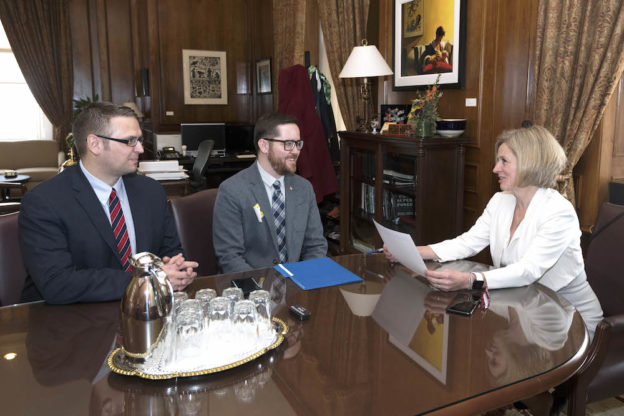
Interviewing Premier Rachel Notley for the Daveberta Podcast in April 2018 (photography by Chris Schwarz/Government of Alberta)
It is remarkable how quickly time flies by. Fifteen years ago I was probably sitting on my couch in the living room of my heavily-subsidized and very run-down University of Alberta-owned residence in north Garneau when I first clicked the publish button on my brand new blogspot.com website. That was probably how Daveberta was born.
Dave Cournoyer at a political event in 2011 (photo by Earl J. Woods)
I was in the fourth year studying an undergraduate degree in Political Science that would be drawn out for a not insignificant number of more years as I threw myself into student union politics and activism, and then provincial politics.
I had no idea that 15 years later this website would still exist, and that it would also spin off into a podcast and lead to hundreds of media interviews, conference panels and speaking engagements, because at the time blogging was a novelty and something that a lot of people were just trying out.
Maybe I am just one of the few who had staying power?
The name Daveberta was inspired, somewhat mockingly, in response to Paulberta t-shirts donned by Paul Martin delegates attending the 2003 Liberal Party of Canada leadership convention in Toronto (which I was among at the time). I figured Daveberta both sounded better and was more authentic (I am a third-generation Albertan and Martin was not).
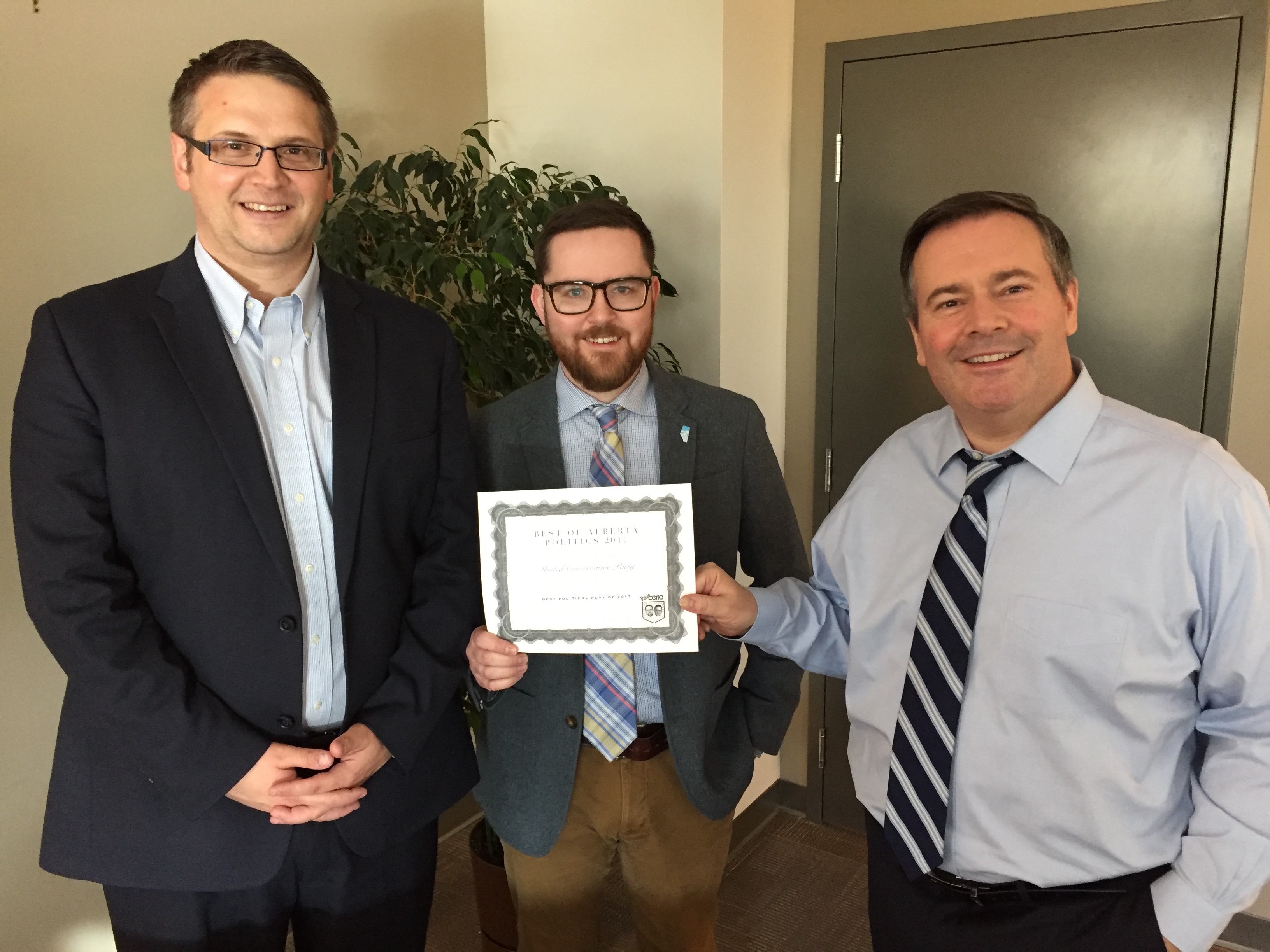
Presenting Jason Kenney with a Best of Alberta Politics Award in 2018.
A lot has changed in politics over the past fifteen years, for myself and Alberta.
Fifteen years ago I was heavily involved in student politics at the U of A and in Liberal Party politics, mostly at the provincial level. This website certainly had a partisan inclination when it was launched and along with CalgaryGrit.ca and AlbertaDiary.ca (now AlbertaPolitics.ca) became one of the go-to blogs focusing on Alberta politics.
Back then I was a proud a partisan and largely depended on blog aggregators, links from other blogs, and keyword searches to generate website traffic.
Today, I enthusiastically hold no party membership (my political inclinations have also significantly shifted) and depend much more on Facebook and Twitter to reach my readers.
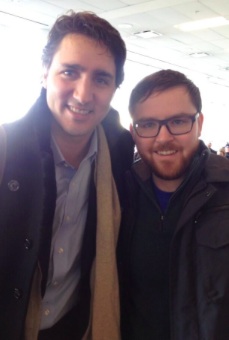
Dave Cournoyer and Justin Trudeau in 2014.
Alberta politics used to be boring, or so I am told, but the past fifteen years have been anything but boring. The political landscape has witnessed a number of political upheavals, and might be a little confusing to someone from 2005. Here’s a quick look at a few of the things that have changed in Alberta politics since Daveberta.ca was launched fifteen years ago:
Now: The United Conservative Party forms a majority government with 63 MLAs, and the NDP forms Official Opposition with 24 MLAs. Nathan Cooper is the Speaker.
“…Dave Cournoyer isn’t some obscure fat frat boy with a sticky-up haircut.” – Neil Waugh, Edmonton Sun (January 2008)
Premier of Alberta
Then: Ralph Klein was in what would soon be seen as the dying days of his premiership. Klein led the PC Party to win a reduced majority government in the November 2004 election, which was dubbed the “Kleinfeld” campaign because of the lack of central narrative of the PC Party campaign. Klein would be unceremoniously dumped by PC Party members at a leadership review in 2006, and he would resign from office months later and fade into obscurity after hosting a short-lived TV gameshow in Calgary.
Now: Former Member of Parliament Jason Kenney leads a UCP majority government, after successfully staging the merger of the membership of the PC Party and Wildrose Party, and leading the party to victory in the 2019 election. Like Klein, Kenney is hell bent on dismantling the high-quality public services that Albertans depend on each day. But unlike Klein, Kenney appears to committed to a much more ideologically-driven free market agenda.
Leader of the Official Opposition
Then: Kevin Taft had just led the Liberal Party from what appeared to be the brink of oblivion to more than triple the party’s number of MLAs. The Liberals regained most of the seats it lost in the disastrous 2001 election and made a major breakthrough in Calgary, electing three MLAs in Alberta’s largest city.
Now: Rachel Notley became leader of the official opposition after four years as Premier of Alberta. She becomes the first official opposition leader in 48 years to have previously served as premier. Notley announced in December 2019 that she plans to lead the NDP into the next election, expected to be held in 2023.
The Four Daves of Alberta politics. blogger David Climenhaga, NDP MLA David Eggen, Liberal MLA David Swann, and blogger Dave Cournoyer. (2013)
Now: Fringe politicians rally around the separatist flavour of the week, now known as Wexit, and a former respected newspaper owner and a defeated Toronto politician spoke in favour of separatism at a conservative conference in Calgary. Plus ça change, plus c’est la même chose…
It continues to be a wild ride, and a pleasure to share my thoughts on Alberta politics on this website and on the Daveberta Podcast.
Dave Cournoyer on CTV Alberta Primetime with Duane Bratt and Don Braid. (2013)
There are a few people who I would like to recognize and thank for inspiring and supporting me along the way (this is by no means a comprehensive list and there are many people I am thankful for who helped me a long the way):
My family, and my beautiful wife Kyla in particular, have been incredibly understanding and tolerant of this hobby and my indulgences into Alberta politics.
My former boss at the Liberal Party, Kieran Leblanc, who is a dear-friend and someone who I definitely need to make time to meet for lunch with more often.
Adam Rozenhart and Ryan Hastman for helping start the Daveberta Podcast more than two years ago. The podcast continues to be a highlight for me, and a medium that I have enjoying focusing on over the past few years. (The Daveberta Podcast has been nominated in the Outstanding News & Current Affairs Series category in this year’s The Canadian Podcast Awards).
And a sincere thank you to everyone who keeps on reading this website and listening to the podcast. I may not still be writing on this website fifteen years from now, but regardless of how much longer it lasts, it has been a great experience.
Daveberta Podcast host Dave Cournoyer teamed up with AlbertaPolitics.ca writer David Climenhaga at the annual Parkland Institute Conference at the University of Alberta last weekend to share what we know and what we speculate might happen with the Canadian Energy Centre Ltd. (a.k.a. the War Room) and the Public Inquiry into anti-Alberta Energy Campaigns.
Thank you to our producer Adam Rozenhart for doing a great job improving the audio quality of this episode (it was recorded on Dave’s iPhone).
The Daveberta Podcast is a member of the Alberta Podcast Network, powered by ATB. The Alberta Podcast Network includes more than 30 great made-in-Alberta podcasts.
You can listen and subscribe to the Daveberta Podcast on Apple Podcasts, Google Play, Spotify, Stitcher, or wherever you find podcasts online. We always love to feedback from our listeners, so let us know what you think of this episode and leave a review where you download.
Send us your feedback, or ask us any questions you have for our next episode. You contact us on Twitter, Instagram, the Daveberta Facebook page, or you can email us at podcast@daveberta.ca.
Thanks for listening!
(Photo: David Climenhaga and Dave Cournoyer, source: Dave Cournoyer)
David Climenhaga from AlbertaPolitics.ca joins Dave and Adam on this episode of the Daveberta Podcast to discuss the cuts in Alberta’s provincial budget and the United Conservative Party’s growing list of public enemies, the federal election fallout in Alberta, and how the mainstream media is reporting on the Wexit group and Alberta separatism.
The Daveberta Podcast is a member of the Alberta Podcast Network, powered by ATB. The Alberta Podcast Network includes more than 30 great made-in-Alberta podcasts,
You can listen and subscribe to the Daveberta Podcast on Apple Podcasts, Google Play, Spotify, Stitcher, or wherever you find podcasts online. We always love to feedback from our listeners, so let us know what you think of this episode and leave a review where you download.
Send us your feedback, or ask us any questions you have for our next episode. You contact us on Twitter, Instagram, the Daveberta Facebook page, or you can email us at podcast@daveberta.ca.
Albertans risk political isolation on climate change urgency
Jason Kenney
While politicians like Alberta Premier Jason Kenney and Energy Minister Sonya Savagedoubling down in defence of the oil and gas industry and abandoning provincial climate change initiatives, attitudes toward climate change in most of the rest of Canada could lead to Alberta to become increasingly politically isolated on this critical issue.
Two surveys released over the summer suggest there could be a deep divide between Albertans and most of the rest of Canada on the urgency of climate change crisis.
According to a survey conducted by Abacus Data in July 2019, only 27 per cent of Albertan surveyed believed that climate change is now an emergency, compared to 59 per cent in Quebec, 42 per cent in British Columbia, 39 per cent in Atlantic Canada, and 38 per cent in Ontario.
When asked about the threat of climate change, only 32 per cent of Albertans surveyed by Angus-Reid in August 2019 said that it is a very serious threat and 24 per cent said it is not really a threat at all. This is big difference from the 49 per cent in British Columbia and Quebec and 50 per cent in Ontario who told Angus-Reid that climate change is a very serious threat.
Sonya Savage
The overwhelming presence and influence that oil and gas companies hold over political discourse and media coverage in Alberta, especially over issues like oil pipelines and climate change, is not a surprise.
When asked in the Angus-Reid survey what they believe should be the bigger priority overall for Canada for the next five to ten years, 60 per cent of Albertans said the oil and gas sector, and 31 per cent said climate change. Nationally, 52 per cent chose climate change and 34 per cent chose the oil and gas sector.
Seth Klein, who commissioned the Abacus poll, wrote on rabble.ca that “we see the highest level of support for bold action is in Quebec, while the lowest levels of support are in Alberta. Most of the country falls somewhere in between the two provinces.“
Depending on the results of the October 21 federal election, just how out of step Albertans attitudes are about climate change may become an increasing focal point of provincial and federal politics. And as along as the oil sands remain the fastest growing source of carbon emissions in Canada, national attitudes toward climate change will have an increasing impact on our province.
Public School Board grants academic amnesty to Climate Strikers
Students from the Edmonton Public School Board are being granted academic amnesty if they have parental consent to attend the student-led global climate strikes on Friday, September 27, 2019. The strikes have been held over the past week in protest of climate change and the lack of action being taken against it by institutions and governments.
The motion to support the strike was tabled by trustee Michael Janz, who said in a statement that “Public education is the cornerstone of our democratic system and exists to create an engaged and educated electorate. Now, in the midst of a federal election, our young people are trying to urge us into action on a life-or-death issue deciding our future. As adults, we need to make sure that we get out of the way, and not get in the way of their engagement in real-life education.”
Education Minister Adriana LaGrange, a former Catholic School Trustee from Red Deer, took issue with the motion and denounced Janz as an “activist school board trustee.”
Students and supporters will march from MacEwan University, the University of Alberta, and Churchill Square to the main rally outside Alberta’s Legislature Building, which is set to begin at 1:30 p.m. on September 27.
Edmonton City Council declared a climate emergency
A majority of City Councillors endorsed a motion introduced by Councillor Aaron Paquette. Paquette’s motion called for the City of Edmonton declare a climate emergency and for the City administration to “provide quarterly memorandums to Council and the public, beginning in 2020, on the City of Edmonton’s climate action progress and future actions directed by Edmonton’s Energy Transition Strategy.”
Declaring a climate emergency is a political statement that serves a few purposes:
1. These motions add to the growing list of governments and organizations building a critical mass in support of taking action against climate change by making bold statements. Hundreds of municipalities and big cities, including Vancouver, Ottawa, Halifax and London (and soon, Toronto), have declared a climate emergency. Some city councils have taken further steps to investigate the potential for lawsuits against large fossil fuel corporations in response to climate change.
2.These motions act as a public declaration that cities can hold themselves accountable. The quarterly reports on the City’s climate action progress will be an important reminder of this commitment. It will be up to Councillors to ensure that the required action is being taken and that this is not simply incrementalism or bureaucratic lip-service to a critical challenge.
Note about the surveys referenced in this post:
The Abacus survey was conducted online with 2,000 Canadians aged 18 and over from July 16 to 19, 2019. The margin of error for a comparable probability-based random sample of the same size is +/- 2.1%, 19 times out of 20.
The Angus Reid survey was conducted online from August 21 – 26 among a representative randomized sample of 1,534 Canadian adults who are members of Angus Reid Forum. For comparison purposes only, a probability sample of this size would carry a margin of error of +/- 2.5 percentage points, 19 times out of 20.
The New Democratic Party and the Liberal Party now appear to have full slates of 34 candidates in Alberta. The two parties have scrambled to nominate candidates in Calgary and parts of rural Alberta, with both parties dropping parachute candidates into many rural ridings in the province.
The dominance of the Conservative Party in rural areas, as well as the palpable hostility toward Prime Minister Justin Trudeau and the federal NDP over the issue of oil pipelines (even though the Trudeau Government purchased and saved the Trans Mountain Pipeline project) is likely the biggest reason why the two parties have had such a difficult time fielding local candidates.
Battle River-Crowfoot: Dianne Clarke has been nominated as the Liberal Party candidate.
Bow River: Margaret Rhemtulla has been nominated as the Liberal Party candidate. Rhemtulla is the Policy Chair for the Alberta-wing of the Liberal Party of Canada.
Calgary-Midnapore: Brian Aalto has been nominated as the Liberal Party candidate.
Calgary-Skyview: Rafih Bari has been nominated as the Libertarian Party candidate.
Edmonton-Centre: Donovan Eckstrom is the Rhinoceros Party candidate. Eckstrom ran for the Rhino Party in Edmonton-Strathcona in the 2015 federal election. Perennial candidate Adil Pirbhai is running as an Independent.
Edmonton-Griesbach: Andrzej Gudanowski is running as an Independent candidate. Gudanowski recently ran as an Independent candidate in Edmonton-Beverly-Clareview in the 2019 provincial election and in Edmonton’s 2017 municipal election in Ward 7.
Edmonton—Wetaskiwin: Emily Drzymala is the Green Party candidate. Drzymala is a social worker and the former president of the Alberta College of Social Workers. She was the NDP candidate in Calgary-North Hill in the 1989 provincial election.
Foothills: Cheryl Moller has been nominated as the Liberal Party candidate. Moller is a retired teacher and president of the Liberal Party association in Calgary-Rocky Ridge. She was a volunteer for Kara Levis’ campaign for the leadership of the Alberta Party in 2018.
Grande Prairie-Mackenzie: Ken Munro has been nominated as the Liberal Party candidate. Munro is a professor emeritus of history at the University of Alberta. He is a longtime Liberal Party supporter in Edmonton, having served as president of the Liberal Party’s Alberta-wing and candidate in Edmonton-South in the 1984 election.
Lakeland: Mark Watson has been nominated as the Liberal Party candidate. Watson is a former Smoky Lake town councillor and director with the Smoky Lake & District Agricultural Society. He is also president of the Liberal Party association in this riding.
University of Alberta political science student Jeffrey Swanson has been nominated as the NDP candidate. Swanson is Vice President of the U of A Campus New Democrat club.
Kira Brunner has replaced Elke Crosson as the Green Party candidate.
Medicine Hat-Cardston-Warner: Harris Kirshenbaum has been nominated as the Liberal Party candidate. Kirshenbaum was campaign manager for former Liberal MLA David Swann in Calgary Mountain-View.
Red Deer-Lacombe: Tiffany Rose has been nominated as the Liberal Party candidate. Rose is a PTSD Yoga educator and facilitator and owner of LacOMbe Yoga. Sarah Palmer has replaced Desmond Bull as the Green Party candidate.
Red Deer-Mountain View: Gary Tremblay has been nominated as the Liberal Party candidate. Tremblay is the Chair of the Liberal Party association in Calgary-Shepard.
St. Albert-Edmonton: Jason J. Brodeur is the Rhinoceros Party candidate.
Sturgeon River-Parkland: Heather Wood is the Rhinoceros Party candidate.
Please contact me at david.cournoyer@gmail.com for additions or updates related to candidate nominations in Alberta and I will add them to the list. Thank you!
PHOTO: MAGALIE L’ABBE, CREATIVE COMMONS
If you’re a conservative lawyer or energy company CEO in Alberta, you should check your email. There’s a good chance you might have been appointed to a public agency, board or commission last week.
A large number of political appointments made last Friday morning included new board chairpersons and directors at eleven post-secondary institutions, including the University of Alberta, University of Calgary, MacEwan University and Mount Royal University, as well as Alberta Health Services, the Workers’ Compensation Board, and the Alberta Gaming, Liquor and Cannabis commission. The UCP appointees replaced a number of high-profile NDP-appointees, including U of A board chairperson Michael Phair, NAIT board chairperson Ray Martin, AHS board chairperson Linda Hughes, and WCB chairperson Grace Thostenson.
The list of appointees is flush with business insiders, corporate executives, and United Conservative Party donors. While partisan and political appointments are expected after any change in government (an occurrence we are just starting to become familiar with in Alberta – and hopefully will continue to be familiar with), this list might even make the old Progressive Conservative establishment blush.
As reported by David Climenhaga at AlbertaPolitics.ca, “At least 18 of the new UCP appointees were donors of significant sums to the party or UCP-friendly PACs set up to skirt election-financing laws.” Progress Alberta is expected to publish a more detailed report soon, but a scan of financing disclosures by executive director Duncan Kinney showed 16 donors who together contributed more than $100,000 to various conservative political causes were among the appointees.
Included in the flurry of appointments are a handful of former conservative politicians, activists, and officials with ties to the UCP, the federal Conservative Party, and right-wing lobby groups and think-tanks:
Also appointed to the AGLC are Elan Harper, the chief financial officer for the Calgary-Varsity UCP association, and Gerard Curran, the owner of the James Joyce Pub in Calgary and former chairman of Canadian Restaurant and Food Services Association (now known as the UCP-friendly Restaurants Canada).
Former Progressive Conservative MLA Janice Sarich was appointed to the board of MacEwan University, former MLA and associate cabinet minister Donna Kennedy-Glans was appointed to the board of the Banff Centre, and former Member of Parliament James Rajotte is now on the University of Alberta Board of Governors.
Former APPEGA president Kim Farwell, appointed to the board of governors of Keyano College in Fort McMurray, was campaign manager to Conservative MP David Yurdiga and president of the local Conservative Party association.
Lydell Torgerson, appointed as a public member of the Board of Directors of Grande Prairie Regional College has acted as the official agent for Conservative MP Chris Warkentin‘s election campaign.
Andy Crooks, the former chairman of the Canadian Taxpayers Federation during Jason Kenney‘s time as its spokesperson, is now a member of the Municipal Government Board, and Moin Yahya, a U of A law professor and senior fellow with the Fraser Institute, is now a member of the Alberta Human Rights Commission.
Grafton Asset Management, the company run by newly appointed University of Calgary board chairperson Geeta Sankappanavar, donated $25,000 to the Shaping Alberta’s Future political action committee which purchased front-page pro-UCP ads in Alberta’s Postmedia newspapers.
Alex Pourbaix, president and CEO of Cenovus Energy and newly appointed chairman of the Mount Royal University board of directors, donated $4,000 to the UCP in 2019.
The biggest outlier when it comes to political donations might be new AHS board chairman David Weyant, the outgoing chairman of the Banff Centre of the Arts, who has donated $1,775 to the Alberta NDP since 2016, including a $550 donation in 2019.
Overall, the appointments send two messages:
The Tory patronage machine is back, and it’s a deep well. While the NDP embraced the oil and gas sector and appointed corporate executives to public boards during their five years in government, Premier Rachel Notley‘s party never had a large political establishment to draw upon for appointees. The NDP also attempted to to professionalize the selection process but holding interviews and expanding the application process to allow a broader cross-section of Albertans to serve on some public boards. The long list of UCP appointees employed as corporate executives and lawyers, as well as the lack of representation from civil society groups, signals a return to something more similar to the old PC Party regime. It also serves as a reminder of the deep well of patronage appointees from the conservative establishment in this province that have made themselves available to the UCP.
Resistance is futile (at least that’s what they want you to think). Serious political resistance at the board level to what are expected to be significant funding cuts to post-secondary education and public agencies like Alberta Health Services is now less likely to be successful. With significant budget cuts expected to be recommended in the “Blue Ribbon” panel report prepared by history professor and former Saskatchewan cabinet minister Janice McKinnon, it is likely that the UCP government wanted to install appointees who would be eager to enact the government’s austerity and privatization agenda when the provincial budget is tabled in the fall.
While it is difficult to criticize the qualifications of some of the appointees, some who are highly qualified for the positions they have been appointed to, it is expected that their experience was weighed closely with how compliant they will be with Kenney’s political agenda.
NDP MLAs stood behind by-election candidate Bob Turner at a campaign event in Sept. 2014. Left to right: David Eggen, Rachel Notley, Bob Turner, and Brian Mason.
Turner’s victory in 2015 was not an anomaly in Edmonton, as the New Democratic Party swept every seat in the city and region, but it was his strong second place finish in the October 27, 2014 by-election that foreshadowed the rise of the NDP in Edmonton. The by-election was held after long-time PC MLA and former deputy premier Dave Hancock was abruptly shown the door when Jim Prentice became premier in 2014.
In a statement released earlier this week, Turner described his main goals and achievements since becoming an MLA. “From the beginning, I spoke about the need to move forward in building Nellie Carlson School, with upgrading the Misericordia Hospital and eliminating flavoured tobacco,” Turner wrote.“I’ve been proud to see all of these goals accomplished.”
A respected hematologist and oncologist at the University of Alberta Hospital and Cross Cancer Institute and Professor of Medicine and Oncology at the University of Alberta, Turner was the perfect fit for this district, which includes some of Edmonton’s most affluent neighbourhoods. His departure is not shocking, as Turner turned 70 years old this year, but his retirement does mean this could be one battleground district to watch in next year’s election.
Michael Janz
Rakhi Pancholi, a lawyer with McLennan Ross LLP, plans to seek the NDP nomination to run in Edmonton-Whitemud in the next election. Pancholi’s legal experience includes working as the staff lawyer for the Alberta School Boards Association and as a Solicitor with the Government of Alberta before joining McLennan Ross, which is known in the world of labour relations as an employer-friendly law firm.
Pancholi is the former director and adoptions coordinator for the Humane Animal Rescue Team and has volunteered with the Edmonton Community Legal Centre and the Treatment Action Campaign in Cape Town, South Africa. Find more exclusive content on legal advice here.
Pancholi already has the support of a popular progressive elected official representing the area, Edmonton Public School Board trustee Michael Janz. It was rumoured that the NDP were courting Janz to run for the provincial nomination following his landslide re-election in October 2017. But he is now expected to endorse Pancholi in her bid to become the NDP candidate in Edmonton-Whitemud.
A date for the NDP nomination meeting has not yet been announced.
With an election expected to be called in spring 2019, the NDP have begun to announce what is expected to be a flurry of nomination meetings to be held in the first few months of 2019.
NDP members will select candidates in Maskwacis-Wetaskiwin on January 8, 2019, Morinville-St. Albert, Spruce Grove-Stony Plain, and Sherwood Park on January 10, 2019, Calgary-Cross on January 17, 2019, Calgary-Peigan on January 19, 2019, Edmonton-Castle Downs on January 23, 2019, Calgary-Bow, Calgary-Shaw and Highwood on January 26, 2019, Airdrie-Cochrane on January 31, 2019, Camrose and Fort Saskatchewan-Vegreville on February 2, 2019, and Cypress-Medicine Hat on February 9, 2019.