Categories
Alberta Politics

Kenney declares victory but the pipeline fight is nowhere close to over

The 1358th chapter of the ongoing saga of the Trans Mountain Pipeline expansion project ended today as the Federal Court of Appeal unanimously ruled to dismiss four challenges by First Nations in British Columbia.

Speaking in Montreal today, Premier Jason Kenney lauded Prime Minister Justin Trudeau, telling reporters that “I have my disagreements with Prime Minister Trudeau on a number of issues … but I think they did realize there has to be at least one project that gets Canadian energy to global markets so we can get a fair price.

3000 kilometres away from Alberta is probably a safe distance for Kenney to effuse some praise for Trudeau, something he likely wouldn’t be caught dead doing back home. But praising Trudeau for a pipeline that is deeply unpopular in Quebec while he is in that province’s largest city is a shrewd piece of political theatre on Kenney’s part.

Since he jumped into provincial politics in 2017, Kenney has used the pipeline as a cudgel against his political opponents, tarring Trudeau and former premier Rachel Notley as opponents of a project they spent incredible amounts of political capital to see completed.

Nationwide support for the Trans Mountain Pipeline expansion dropped by 11 per cent since 2018, according to a poll released by Angus-Reid last month. Urgency about climate change has become a more front and centre issue since then, most effectively demonstrated by tens of thousands of Canadians participating in climate strike marches across Canada, including more than 10,000 people in Edmonton. And since Kenney’s United Conservative Party formed government in April 2019, his government has taken a hyper-aggressive approach to responding to opponents to oil industry expansion, which may have had an impact on national opinion. 

The creation of the publicly funded Canadian Energy Centre (aka The Energy War Room), a government-sponsored public relations company run by failed UCP candidate Tom Olsen and boasting a $30-million annual budget, has been front and centre in the government’s new approach.

The CEC largely duplicates public relations work typically done by industry associations like the Canadian Association of Petroleum Producers, and had a rough first few months as it was forced to replace a plagiarized logo and tell its staff not to identify themselves as reporters when writing content for the War Room’s blog.

The Canadian Energy Centre, the Public Inquiry into Anti-Alberta Energy Campaigns (which has been dogged by an alleged conflict of interest scandal), the pledge to open Alberta government offices in provincial capitals across Canada, and Kenney’s steady schedule of international travel, are part of what the UCP government calls it’s “Fight Back” plan.

The court ruled that First Nations have no veto and cannot refuse to compromise or insist a project be cancelled, and found that the federal government made genuine effort to consult and accommodated concerns raised by First Nations communities.

While this decision is expected to be appealed by First Nations groups at the Supreme Court, and will likely have political implications if UNDRIP is implemented in Canada, it is likely that the next round of opposition to the pipeline project will come in the form of civil disobedience and direct action.

This isn’t over yet.

UCP releases radical health care report, and look! Jason Kenney is leaving the country, again!

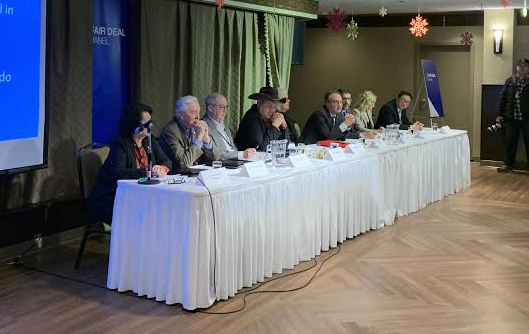
Tyler Shandro, Dr. Verna Yiu, and John Bethel (Source: YouTube)

Perhaps it is just a coincidence, but it seems pretty darn convenient that Premier Kenney was on a plane to Quebec when Health Minister  Tyler Shandro shared a stage with Alberta Health Services CEO Dr. Verna Yiu and Ernst & Young spokesperson John Bethel (who attentive readers will remember as the 2004 federal Liberal candidate in Edmonton-East) in announcing the release of the international management corporation’s $2-million report on Alberta Health Services.

The report is big and bristling with the kind of ideological and predictable recommendations that you would expect from the right-wing Fraser Institute, which was cited a few times in the report. Privatization of services ranging from long-term care to security, gutting of collective agreements and salary rollbacks, and closure of rural hospitals were among the many recommendations included in the report.

While Shandro was clear that he would not risk further alienating his party’s rural base by closing rural hospitals, despite the report’s recommendations, the report did deliver the UCP with a powerful talking point – $1.9 billion in potential savings.

The report suggests that if all its recommendations were implemented, the government could potentially save $1.9 billion in costs to the health care system (of course, many of those costs could be transferred to patients). It might be unlikely that all of the recommendations will be implemented, but expect to hear Shandro repeat that $1.9 billion number, a lot.

Meanwhile, Kenney will soon leave Quebec for meetings in Washington D.C.

Kenney’s office stops releasing public travel itineraries

The Premier’s Office under Kenney appears to have stopped publicly releasing the Premier’s itinerary ahead of inter provincial or international trips. Previous premiers commonly released a brief daily itinerary that listed who or which organizations the Premier and their staff were scheduled to meet with.

A lack of publicly released itinerary meant that Albertans discovered on Twitter that Kenney’s trip to New York City in September 2019 included a speech at a reception hosted by the right-wing Manhattan Institute. It was also revealed by the Alberta Today newsletter through Freedom of Information requests that Kenney also held court at a historic speakeasy in midtown Manhattan, an event that was not listed in the standard government press release announcing his trip.

Kenney’s office also did not release an itinerary for his December 2019 trip to London, UK, citing concerns that individuals he was meeting with could be targeted by climate change advocacy groups.

With no journalists from Alberta accompanying Kenney on his international trips, the release of public itineraries is an important way to ensure some basic accountability and transparency when the Premier is travelling out of province on the public dime.

Note: Past requests for public itineraries of Premier Kenney’s international trips have gone unanswered by the Premier’s Office.

Categories
Alberta Politics

A look at political party fundraising in 2019 and the state of the parties in 2020

Political party fundraising totals from 2019 were released last month and show that Alberta’s two main provincial parties raised record amounts of money last year.

The United Conservative Party raised $7.37 million as the party continues to demonstrate its fundraising strength. The now official opposition New Democratic Party also raised an impressive $5.5 million.

The total amount of donations raised by the two main parties is significant, especially when you consider how much Alberta’s political parties were raising five years previous. In 2014, the formerly governing Progressive Conservative Party raised $3,387,585.83, and the then fourth place NDP marked a record fundraising year with $482,085.

Political Party Fundraising in Alberta from 2016 to 2019, following the ban on corporate and union donations. Click to enlarge.

Both the NDP and the UCP’s successor predecessor party, the Wildrose Party, spent years cultivating strong bases of individual donors, which meant they were well positioned when corporate and union donations were banned in 2015.

The disclosures suggest that despite losing the election, the NDP remained a financially viable political party in the second half of 2019. The annual fundraising totals for the NDP in 2020 will provide some evidence as to whether the now official opposition party can sustain its fundraising levels outside of government.

Likely to help the NDP’s fundraising efforts in 2020 is Rachel Notley’s decision to lead the party into the next provincial election.

Notley would become the first former Alberta premier to lead their party into an election after they lost government. With Alberta’s long history of political dynasties, there are only a few premiers who had led their parties to lose an election – Charles Stewart, Richard Reid, Harry Strom, and Jim Prentice all resigned following their party’s election defeats.

Not having led a dynastic party, and arguably remaining her party’s strongest asset, Notley is in a different position than some other former premiers. She remains personally popular, and some early polls would suggest her party could remain an electoral force if a vote were held today.

The NDP faces a number of significant challenges, one being its lack of organizational strength in much of rural Alberta and Calgary. The NDP elected 24 MLAs in 2019, but none from rural Alberta and the party lost considerable ground in Calgary, where it had a breakthrough in 2015.

A positive note for the provincial NDP is that attempts to connect Notley to the federal NDP, which has been demonized in Alberta for its opposition to oil pipeline projects, does not appear to have hurt its fundraising bottom line.

But while the lack of federal party presence in Alberta is a mixed blessing for the NDP, it is a strength of the UCP, which shares considerable resources with its federal cousins in the Conservative Party of Canada. The upcoming federal Conservative leadership campaign could also introduce an interesting dynamic into this relationship (more on this comings soon).

The Other Parties

Alberta’s smaller political parties raised considerably less that the big two parties in 2019, with the Alberta Party raising $317,470, the Liberal Party raising $130,519, the Green Party raising $27,999, and the Freedom Conservative Party raising $24,783.

The Alberta Party remains leaderless following Stephen Mandel’s resignation shortly after his defeat in the 2019 election. It is suspected that the party will open a leadership race in the spring, after the UCP government is expected to make significant amendments to Alberta’s electoral finance laws, including rules for leadership races.

Mandel and his predecessor Greg Clark have been appointed to positions by the UCP government. Mandel now serves on the board of directors of Alberta Health Services and Clark is now chair of the province’s balancing pool.

David Khan‘s leadership was “overwhelmingly endorsed” by delegates attending last year’s Liberal Party convention, despite 2019 marking the first time since before 1986 that the party failed to elect any MLAs to the Legislative Assembly.

Delegates to the convention heard from a party committee that was convened to offer recommendations for how the Liberals should move forward in Alberta. The report was not made public.

Green Party members will vote for a new leader on March 28, 2020, following the resignation of Cheryle Chagnon-Greyeyes in 2019. Brian Deheer and Jordan Wilkie have declared their candidacies. This will be the party’s third leadership race since 2017. 

The Green Party also announced plans to adopt a co-leader system in which two individuals will share leadership responsibilities. This is the first party in Alberta to use a system similar to Green parties in other countries and Quebec solidaire in Quebec.

Alberta’s separatist fringe gets fringier

And there continues to be a flurry of activity on the separatist fringe.

Former UCP nomination candidate Dave Campbell has replaced former UCP nomination candidate Todd Beasley as President of the Independence Party of Alberta. The party currently does not have a leader.

Meanwhile, Kathy Flett, who is styled as the former interim leader of the Wexit Alberta separatist group, has joined the board of directors of the right-wing Freedom Conservative Party, which was founded in 1999 as the Alberta First Party and has at various times changed its name to the Separation Party of Alberta, the Western Freedom Party, and again to the Alberta First Party.

It could be that the Freedom Conservative Party is about to change its name once again, this time to the Wexit Alberta Party, or maybe the fringe separatists are continuing to fraction?

According to the Western Standard, a conservative website rebooted by former Freedom Conservative Party leader Derek Fildebrandt after his defeat in the 2019 election, current federal Wexit leader Peter Downing claimed he fired Flett for attempting “to steal our trademark.”

Categories
Alberta Politics Daveberta Podcast

Episode 47: If you ain’t oil, you ain’t much. A deep dive into Alberta’s oil well liability crisis.

Oil well liability became a big issue in Alberta politics this month when rural municipal politicians raised giant red flags about the estimated $173 million in unpaid municipal taxes as a result of some oil and gas companies nearing insolvency and many more companies just believing paying taxes is voluntary.

Tina Faiz and Regan Boychuk joined Dave Cournoyer on this episode of the Daveberta Podcast to discuss the growing issue of oil well liability, and the political and policy repercussions created in its wake.

Tina Faiz is a communications consultant and political strategist based in Edmonton and Regan Boychuk is the lead researcher and oilfield liability expert with the Alberta Liabilities Disclosure Project.

The Daveberta Podcast is a member of the Alberta Podcast Network, powered by ATB. The Alberta Podcast Network includes more than 30 great made-in-Alberta podcasts.

You can listen and subscribe to the Daveberta Podcast on Apple PodcastsGoogle PlaySpotifyStitcher, or wherever you find podcasts online. We love feedback from our listeners, so let us know what you think of this episode and leave a review where you download.

Find us on TwitterInstagram, Facebook, or you can email us at podcast@daveberta.ca. Thanks for listening!

Recommended Reading

Categories
Alberta Politics

15 years ago I started a blog about Alberta politics

It is remarkable how quickly time flies by. Fifteen years ago I was probably sitting on my couch in the living room of my heavily-subsidized and very run-down University of Alberta-owned residence in north Garneau when I first clicked the publish button on my brand new blogspot.com website. That was probably how Daveberta was born.

Dave Cournoyer in 2011 (photo by Earl J. Woods)
Dave Cournoyer at a political event in 2011 (photo by Earl J. Woods)

I was in the fourth year studying an undergraduate degree in Political Science that would be drawn out for a not insignificant number of more years as I threw myself into student union politics and activism, and then provincial politics.

I had no idea that 15 years later this website would still exist, and that it would also spin off into a podcast and lead to hundreds of media interviews, conference panels and speaking engagements, because at the time blogging was a novelty and something that a lot of people were just trying out.

Maybe I am just one of the few who had staying power?

The name Daveberta was inspired, somewhat mockingly, in response to Paulberta t-shirts donned by Paul Martin delegates attending the 2003 Liberal Party of Canada leadership convention in Toronto (which I was among at the time). I figured Daveberta both sounded better and was more authentic (I am a third-generation Albertan and Martin was not).

Presenting Jason Kenney with a Best of Alberta Politics Award in 2018.

A lot has changed in politics over the past fifteen years, for myself and Alberta.

Fifteen years ago I was heavily involved in student politics at the U of A and in Liberal Party politics, mostly at the provincial level. This website certainly had a partisan inclination when it was launched and along with CalgaryGrit.ca and AlbertaDiary.ca (now AlbertaPolitics.ca) became one of the go-to blogs focusing on Alberta politics.

Back then I was a proud a partisan and largely depended on blog aggregators, links from other blogs, and keyword searches to generate website traffic.

Today, I enthusiastically hold no party membership (my political inclinations have also significantly shifted) and depend much more on Facebook and Twitter to reach my readers.

Dave Cournoyer Justin Trudeau
Dave Cournoyer and Justin Trudeau in 2014.

Alberta politics used to be boring, or so I am told, but the past fifteen years have been anything but boring. The political landscape has witnessed a number of political upheavals, and might be a little confusing to someone from 2005. Here’s a quick look at a few of the things that have changed in Alberta politics since Daveberta.ca was launched fifteen years ago:

Alberta Legislature

Then: The Progressive Conservative Party formed a majority government with 61 MLAs, the Liberal Party formed the Official Opposition with 17 MLAs, the New Democratic Party had 4 MLAs, and the Alberta Alliance had 1 MLA. Ken Kowalski was the Speaker and serving his 26th year as an MLA.

Now: The United Conservative Party forms a majority government with 63 MLAs, and the NDP forms Official Opposition with 24 MLAs. Nathan Cooper is the Speaker.

"...Dave Cournoyer isn't some obscure fat frat boy with a sticky-up haircut." - Neil Waugh, Edmonton Sun (January 2008)
“…Dave Cournoyer isn’t some obscure fat frat boy with a sticky-up haircut.” – Neil Waugh, Edmonton Sun (January 2008)

Premier of Alberta

Then: Ralph Klein was in what would soon be seen as the dying days of his premiership. Klein led the PC Party to win a reduced majority government in the November 2004 election, which was dubbed the “Kleinfeld” campaign because of the lack of central narrative of the PC Party campaign. Klein would be unceremoniously dumped by PC Party members at a leadership review in 2006, and he would resign from office months later and fade into obscurity after hosting a short-lived TV gameshow in Calgary.

Now: Former Member of Parliament Jason Kenney leads a UCP majority government, after successfully staging the merger of the membership of the PC Party and Wildrose Party, and leading the party to victory in the 2019 election. Like Klein, Kenney is hell bent on dismantling the high-quality public services that Albertans depend on each day. But unlike Klein, Kenney appears to committed to a much more ideologically-driven free market agenda.

Leader of the Official Opposition

Then: Kevin Taft had just led the Liberal Party from what appeared to be the brink of oblivion to more than triple the party’s number of MLAs. The Liberals regained most of the seats it lost in the disastrous 2001 election and made a major breakthrough in Calgary, electing three MLAs in Alberta’s largest city.

Now: Rachel Notley became leader of the official opposition after four years as Premier of Alberta. She becomes the first official opposition leader in 48 years to have previously served as premier. Notley announced in December 2019 that she plans to lead the NDP into the next election, expected to be held in 2023.

The Four Daves of Alberta politics. blogger David Climenhaga, NDP MLA David Eggen, Liberal MLA David Swann, and blogger Dave Cournoyer. (2013)

Alberta separatism

Then: The week that I launched Daveberta.ca, former Western Canada Concept leader Doug Christie was traveling through Alberta trying to start another western separatist party. The Western Block Party was unable to elect any MPs and was dissolved in 2014.

Now: Fringe politicians rally around the separatist flavour of the week, now known as Wexit, and a former respected newspaper owner and a defeated Toronto politician spoke in favour of separatism at a conservative conference in Calgary. Plus ça change, plus c’est la même chose…

It continues to be a wild ride, and a pleasure to share my thoughts on Alberta politics on this website and on the Daveberta Podcast.

Dave Cournoyer on CTV Alberta Primetime with Duane Bratt and Don Braid. (2013)

There are a few people who I would like to recognize and thank for inspiring and supporting me along the way (this is by no means a comprehensive list and there are many people I am thankful for who helped me a long the way):

  • My family, and my beautiful wife Kyla in particular, have been incredibly understanding and tolerant of this hobby and my indulgences into Alberta politics.
  • My friend Chris Henderson, whose advice and friendship helped me navigate a number of politically challenging times.
  • My former boss at the Liberal Party, Kieran Leblanc, who is a dear-friend and someone who I definitely need to make time to meet for lunch with more often.
  • Adam Rozenhart and Ryan Hastman for helping start the Daveberta Podcast more than two years ago. The podcast continues to be a highlight for me, and a medium that I have enjoying focusing on over the past few years. (The Daveberta Podcast has been nominated in the Outstanding News & Current Affairs Series category in this year’s The Canadian Podcast Awards).

And a sincere thank you to everyone who keeps on reading this website and listening to the podcast. I may not still be writing on this website fifteen years from now, but regardless of how much longer it lasts, it has been a great experience.

Categories
Daveberta Podcast

Episode 46: Best of Alberta Politics in 2019

With a provincial election, a change in government, a federal election, and much more in between, 2019 was a big year in Alberta politics. Tina Faiz and Natalie Pon join Dave Cournoyer on this episode of the Daveberta Podcast to discuss the year in Alberta politics and their hopes and wishes for 2020. 

Tina Faiz is a communications consultant and served as a press secretary and acting chief of staff for the Alberta NDP government. Natalie Pon is a conservative activist and former member of the United Conservative Party interim joint board.

And with more than 2,000 votes cast, they also discuss the results of the Best of Alberta Politics 2019 survey and their picks in each category.

Thanks to everyone who voted and congratulations to the winners of the Best of Alberta Politics 2019 survey:

Best Alberta MLA: Rachel Notley, MLA Edmonton-Strathcona
Best Cabinet Minister: Sarah Hoffman, Deputy Premier, Minister of Health & MLA for Edmonton-Glenora
Best Opposition MLA: Rachel Notley, MLA Edmonton-Strathcona
MLA to Watch in 2020: Janis Irwin, MLA Edmonton-Highlands-Norwood
Best candidate who didn’t win in the 2019 election: Danielle Larivee, NDP candidate in Lesser Slave Lake
Biggest political issue in 2019: Budget cuts

And a huge thanks to our talented producer, Adam Rozenhart, who always makes the podcast sound so good.

The Daveberta Podcast is a member of the Alberta Podcast Network, powered by ATB. The Alberta Podcast Network includes more than 30 great made-in-Alberta podcasts.

You can listen and subscribe to the Daveberta Podcast on Apple PodcastsGoogle PlaySpotifyStitcher, or wherever you find podcasts online. We always love to feedback from our listeners, so let us know what you think of this episode and leave a review where you download.

Send us your feedback, or ask us any questions you have for our next episode. You contact us on TwitterInstagram, Facebook, or you can email us at podcast@daveberta.ca.

Thank you for listening and see you in 2020!

Recommended Reading

Categories
Alberta Politics

Kenney is the closest thing the Conservatives have to a “Svengali-like genius”

Six weeks after the federal election, Andrew Scheer has resigned as leader of the Conservative Party of Canada, raising instant speculation about who might enter the contest to replace him.

Rona Ambrose
Rona Ambrose

While there does not appear to be an obvious heir apparent, Alberta Premier Jason Kenney‘s name immediately comes to mind as a potential successor. But is appears as though Kenny could just be a visitor in Ottawa for the foreseeable future.

Kenney told Postmedia columnist Don Braid yesterday he had “absolutely no intention” of running for the leadership and offered what appears to be an early endorsement of former interim party leader Rona Ambrose.

In response to rumours of his federal ambitions, Kenney told Postmedia’s  Stuart Thomson that “I should be flattered that they think I’m some kind of Svengali-like genius.” The thing is, Kenney is probably the closest thing to a Svengali the Conservatives have. Whether you believe he a brilliant political operator with good intentions or a sinister political beast plotting to smash his growing list of enemies likely depends on whether you are his ally or opponent (ask Rachel Notley and Brian Jean). But there is no doubt he is a skilled career politician.

He also checks a whole bunch of boxes on the list of Conservative constituency groups.

Kenney started his political career as a social conservative anti-abortion activist at a private Roman Catholic university in San Francisco. He returned to Canada to become a founder of the anti-tax Canadian Taxpayers Federation. He spent 19 years in Ottawa as a Member of Parliament and, after briefly losing some favour with the party during Stockwell Day‘s disastrous time as leader of the Canadian Alliance, proved to be a loyal solider to Stephen Harper and worked his way into a senior cabinet role. And he has deep connections to conservative think-tanks like the Atlantic Institute for Market Studies (recently merged with the Fraser Institute) and New York City-based Manhattan Institute.

In less than two years, Kenney commandeered Alberta’s Progressive Conservative Party and merged its membership with its decade-old bitter enemy, the Wildrose Party, by winning the United Conservative Party leadership. He then led the party to win the 2019 election. Plus, he, or his closest advisors, were not above testing the limits of what was acceptable in order to win. And since entering the Premier’s Office, he has been a master of sowing chaos and creating crisis in order to implement his political program.

Kenney is respected by Conservative partisans and, as long as he can keep up his winning streak, will remain one of the most prominent leaders of the Conservative movement in Canada.

Or maybe I’m just giving him too much credit.

Winning as a Conservative in Alberta is a much easier task than winning in other parts of Canada, including populous regions like Vancouver, Montreal, and Toronto. Kenney’s whistle-stop tour through Ontario during the federal election resulted in dismal returns for Conservative candidates, and a recent poll shows his approval ratings in Alberta have plummeted by 15-points since his government tabled an unpopular provincial budget, which serves as a reminder that while he is a skilled politician, he is not invincible.

Which is why he might be reluctant to jump back into federal politics.

Being premier of a large province is certainly a more influential office, at least it is in 2019, and comes with more prestige than being leader of the official Opposition in Ottawa. But staying in Alberta means he is not one-step away from becoming Prime Minister of Canada, which many people still speculate is his goal.

Categories
Alberta Politics

Vote for the Best of Alberta Politics in 2019 – The Top 3

Photos: Leela Aheer, John Archer, Greg Clark, Devin Dreeshen, Sarah Hoffman, Danielle Larivee, Rachel Notley, Janis Irwin, Rakhi Pancholi, Shannon Phillips (source: Legislative Assembly of Alberta website)

With more than 500 submissions made to the Best of Alberta Politics 2019 survey, your choices have been sorted and you can now vote in each category. Voting is open until Dec. 14, 2019 at 11:59 pm and the winners will be announced on the special year-end episode of the Daveberta Podcast on Dec. 16, 2019.

Here are the top three choices in every category:

Who was the best Alberta MLA of 2019? – Vote

  • Devin Dreeshan, MLA for Innisfail-Sylvan Lake
  • Janis Irwin, MLA for Edmonton-Highlands-Norwood
  • Rachel Notley, MLA for Edmonton-Strathcona

An honourable mention to Shannon Phillips, MLA for Lethbridge-West who placed a strong fourth in total submissions. Notley was last year’s winner in this category.

Who was the best Alberta cabinet minister of 2019? – Vote

  • Leela Aheer, Minister of Culture, Multiculturalism and Status of Women
  • Sarah Hoffman, Deputy Premier and Minister of Health
  • Shannon Phillips, Minister of Environment and Parks

Honourable mentions to Minister of Agriculture and Forestry Devin Dreeshen and Minister of Finance Travis Toews, who placed a close forth and fifth in this category. Former Municipal Affairs Minister Shaye Anderson was last year’s winner in this category.

Who was the best opposition MLA of 2019? – Vote

  • Janis Irwin, MLA for Edmonton-Highlands-Norwood
  • Rachel Notley, MLA for Edmonton-Strathcona
  • Shannon Phillips, MLA for Lethbridge-West

Former Calgary-Elbow MLA Greg Clark was last year’s winner in this category.

Who is the up and coming MLA to watch in 2020? – Vote

  • Devin Dreeshen, MLA for Innisfail-Sylvan Lake
  • Janis Irwin, MLA for Edmonton-Highlands-Norwood
  • Rakhi Pancholi, MLA for Edmonton-Whitemud

An honourable mention to Edmonton-South MLA Thomas Dang, who placed a strong fourth in the first round of voting. Jessica Littlewood, former MLA for Fort Saskatchewan-Vegreville, was last year’s winner in this category..

Who was the best candidate who didn’t win in the 2019 Alberta election? – Vote

  • John Archer, NDP candidate in Edmonton-South West
  • Greg Clark, Alberta Party candidate in Calgary-Elbow
  • Danielle Larivee, NDP candidate in Lesser Slave Lake

An honourable mention to Fort Saskatchewan-Vegreville NDP candidate Jessica Littlewood, and Leduc-Beaumont NDP candidate Shaye Anderson, who tied for fourth place in this category..

What was the biggest political issue of 2019 in Alberta? – Vote

  • Budget cuts
  • Economy and jobs
  • Firing the Elections Commissioner
  • Turkey farm hostage taking

There were a lot of submissions in this category, so we decided to give you a chance to vote on the top four in this category.

What was the biggest political play of 2019 in Alberta?

Lorne Gibson Alberta Election Commissioner
Lorne Gibson

This category is usually a dog’s breakfast, but this year your choice was clear. So we have declared the biggest political play of 2019 in Alberta was the United Conservative Party government firing of Election Commissioner Lorne Gibson. The UCP government’s omnibus Bill 22 dissolved the Office of the Election Commissioner, who was in the midst of investigating and issuing fines for violations of Alberta’s elections laws during the UCP leadership race in 2017.

Government watch-dog Democracy Watch has called on the RCMP to investigate the firing of the Election Commissioner and wants a special prosecutor appointed to oversee the investigation to ensure there is no political interference.

Categories
Alberta Politics Daveberta Podcast

Episode 45: Class(room) Warfare and how the UCP Budget impacts Public Education in Alberta

Public education advocate and school trustee Michael Janz joins Dave Cournoyer on this episode of the Daveberta Podcast to discuss the state of public education in Alberta and how cuts in the United Conservative Party‘s first provincial budget will impact the education system in our province. We also discuss what is behind the UCP’s drive to expand private and charter schools, and why the New Democratic Party did not cut the 70% subsidy for private schools in Alberta while they were in government.

Michael Janz Edmonton Public School Board trustee education advocate
Michael Janz (source: EPSB)

We also opened the mailbag to answer some of the great Alberta politics questions sent in by our listeners, and announce the launch of the Best of Alberta Politics 2019 survey which starts later this week.

A huge thanks to our producer, Adam Rozenhart, who tried to keep us on track during this episode.

The Daveberta Podcast is a member of the Alberta Podcast Network, powered by ATB. The Alberta Podcast Network includes more than 30 great made-in-Alberta podcasts.

You can listen and subscribe to the Daveberta Podcast on Apple PodcastsGoogle PlaySpotifyStitcher, or wherever you find podcasts online. We always love to feedback from our listeners, so let us know what you think of this episode and leave a review where you download.

Send us your feedback, or ask us any questions you have for our next episode. You contact us on TwitterInstagram, Facebook, or you can email us at podcast@daveberta.ca.

Thanks for listening!

Recommended Reading/Watching:

Categories
Alberta Politics

Black Friday gets new meaning in Alberta as UCP plans to sack thousands of frontline public sector workers

As conservative partisans gather at the Westin Hotel near the Calgary International Airport tonight for the United Conservative Party annual general meeting, thousands of public sector workers are wondering whether they will have a job next year.

Despite promising during the election not to cut front-line services, it appears that today was the day that Premier Jason Kenney chose to break that promise, giving a new meaning to Black Friday for many Alberta workers.

Beginning on April 20, 2020, the Alberta government and its agencies will begin laying-off an estimated 750 Registered Nurses and Registered Psychiatric Nurses represented by United Nurses of Alberta, more than 1,000 health care workers represented by the Health Sciences Association of Alberta, and the elimination of more than 5,600 full time equivalent positions held by workers represented by the Alberta Union of Provincial Employees.

This does not include layoffs of teachers by school boards reacting to lower than expected education funding in the provincial budget. The Calgary Board of Education announced last week that it expects to layoff 300 teachers as a results of the UCP budget. And about 90 government lawyers are expected to be laid-off by the Department of Justice, representing about 37 per cent of the lawyers working in the government’s Legal Services branch.

From hospitals to lab services to schools, these kind of layoffs will undoubtably impact frontline workers and the delivery of the excellent public services that Albertans depend upon every day.

The layoffs are expected to take place over the next three years, but this latest development comes one week after the government seized control of public sector pension funds and moved to rollback wages of public sector workers.

Unlike some previous conservative leaders in Alberta, who saw a positive role for government and public services in society, Kenney and the team of advisors surrounding him are committed to an ideological project that is bigger than just balancing the provincial budget. They want to reshape Alberta in a more free-market and individualist image that includes increased privatization of all government services and a much more combative relationship with public sector workers and the unions that represent them.

But, as I have written before, the free market might actually be one of the UCP government’s worst enemies.

Business leaders at an exclusive Lake Louise conference today warned that ‘a declining and outdated industry, a lack of innovation and a fascination with separation’ is hurting Alberta’s image. Mary Moran, CEO of Calgary Economic Development, told the meeting that ongoing environmental criticism, delays in building oil pipelines and a surge of separatist sentiment recently led a major technology company to decide not to relocate its office to Calgary.

Kenney responded that he had not heard such criticism when he met with business owners in Houston last week. The list of people Kenney met with while he was in Texas has not been released to the public, but it is likely they are aware of the growing list of investment banks and pension funds that are divesting from the oil and gas because of that industry’s contribution to climate change.

But do not expect that to stop the UCP government, which continues to move at a breakneck speed implementing its political programme. Kenney may still have a lot of political capital to spend, but many Alberta workers will remember this Black Friday, when they discovered that his promises to them weren’t worth much more than the coroplast sign he made them on.

Categories
Alberta Politics

How much Alberta’s political parties spent in the 2019 election

Elections Alberta has released the initial financial disclosures showing how much money Alberta’s political parties spent and raised during the 2019 provincial general election campaign period spanning from February 1, 2019 to June 16, 2019.

This was the first election under the new election finance rules implemented by the New Democratic Party during their term in government. The NDP made a number of significant changes to how Alberta’s elections were financed, including banning donations to political parties by corporations and unions, and introducing a spending limit of $2,000,000 for political parties and $50,000 for candidate campaigns, but at the financial returns show, what the spending limits apply to are limited.

The $2,000,000 and $50,000 spending limits only apply to the actual 28-day election period from the time the election is called until Election Day. So the limit does not apply to the broader campaign period, which according to Section 38.1(2) of the Election Act, begins on February 1 in the year of the fixed-election date and ends ends 2 months after Election Day.

The Election Finances and Contributions Disclosure Act also creates exceptions to the spending limit on expenses categorized as “election expenses.” The expense limit during the 28-day election period does not apply to a candidate’s travel expenses related to the election, including meals and accommodation, a candidate’s child care expenses, expenses related to the provision of care for a person with a physical or mental incapacity for who the candidate normally provides such care, etc.

What the parties spent

Initial Financial Disclosures from Alberta's provincial political parties from the 2019 general election. The Alberta Advantage Party and Freedom Conservative Party returns have not been posted online (source: Elections Alberta)
Initial Financial Disclosures from Alberta’s provincial political parties from the 2019 general election. The Alberta Advantage Party and Freedom Conservative Party returns have not been posted online (source: Elections Alberta)

The United Conservative Party spent $4,561,362.10 while raising $3,889,582.70 during the campaign period, ending the campaign with a deficit of $671,779.40.

$1,909,116.43 of the UCP’s expenses were spent on items that fall under the provincial limit, including $1,202,965.43 spent on advertising, posters, pamphlets and promotional materials. $2,619,471.83 was spent on expenses that was exempt from the spending limit.

The NDP spent $5,363,029.30 and raised $3,706,785.66, ending the campaign with a deficit of $1,656,043.64.

Of the NDP’s campaign expenses, $1,977,367.65 were spent on items that fall under the provincial limit, including $1,363,029.74 for advertising, posters, pamphlets and promotional material. $2,200,131.09 was spent on expenses that was exempt from the spending limit.

The Alberta Party raised $206,597 and spent $199,935 during the campaign period. $118,960 of the Alberta Party’s expenses fell under the provincial limit rules, including $21,932 spent on advertising, posters, pamphlets and promotional. Of the party’s total expenses, $74,975 was exempt from the limit.

The Alberta Liberal Party raised $101,233 and spent $130,063, ending the campaign with a deficit of $28,830. The Green Party raised $14,894.40 and spent $41,702.22, earning a deficit of $26,807.82.

Some candidates spent a lot during the campaign period

The campaigns of a number of UCP candidates spent considerable amount during the course of the broader campaign period. Here is a snapshot of some of the higher candidate campaign expenses:

  • Doug Schweitzer, UCP candidate in Calgary-Elbow: spent $309,597.22, of which $268,166.23 did not fall under the spending limit.
  • Tyler Shandro, UCP candidate in Calgary-Acadia: spent $122,170.91, with $77,463.88 not falling under the spending limit.
  • Kaycee Madu, UCP candidate in Edmonton-South West: spent $101,098, with $55,527 exempt from the spending limit.
  • Dan Williams, UCP candidate in Peace River: spent $92,268, with $52,750 exempt from the spending limit.
  • Jason Luan, UCP candidate in Calgary-Foothills: spent $92,268, with $52,750 exempt from the spending limit.

No NDP candidate candidate campaign spent anywhere near the amount of the big spenders on the UCP slate, but a number of candidates did exceed the $50,000 limit:

  • Rachel Notley, running for re-election in Edmonton-Strathcona: spent $73,297, with $39,798 exempt from the spending limit.
  • Christina Gray, NDP candidate in Edmonton-Mill Woods: spent $73,576, with $27,742 exempt from the spending limit.
  • Lorne Dach, NDP candidate in Edmonton-McClung: spent $64,282, with $27,396 exempt from the spending limit.

And the campaign of Caylan Ford, the UCP star candidate in Calgary-Mountain View who withdrew from the election before the nomination deadline, was recorded to have spent $83,100,50 during the campaign period that began on February 1, 2019, with $32,676.94 of these expenses being exempt from the spending limit.

Chief Elections Officer recommends changes

Glen Resler Chief Elections Officer Alberta
Glen Resler (Source: Elections Alberta)

Chief Elections Officer Glen Resler recommended in his office’s recently released annual report that the spending limits be placed on the entire campaign period, rather than just the election period. He argued in the report that this change would “reduce the administrative burden and provide clarity for Chief Financial Officers of parties, constituency associations and candidates with respect to apportioning expenses between election and campaign periods.

Resler recommended that Election Finances and Contributions Disclosure Act and the Election Act be “combined into one coherent statute to make the legislation more accessible to participants and electors and provide a much-needed opportunity to renumber the legislation.” Currently, eight other provinces and territories have one piece of legislation governing provincial elections.

The report also recommends that political entities be expressly prohibited from contributing to third party advertisers, which seems to be a reaction to the decision by the now defunct Wildrose Party association in Airdrie to donate $16,000 to a political action committee.

CBC reports that the UCP government is expected to make major changes to Alberta’s election finance laws in the spring 2020 session of the Legislature. It is suspected that some changes could removing the limits of third-party advertisers to spend funds during the election and campaign periods, and raising the amount that individuals can donate to political parties. Changes are also expected to include moves to limit the ability of unions to fund third-party groups and to advocate for their members on political and policy issues.

Categories
Alberta Politics

Alberta is getting an MLA Recall Law. Here is what it could mean for Alberta politics.

Photo: Mark Smith, UCP MLA for Drayton Valley-Devon (source: Facebook)

A private members’ bill introduced by Drayton Valley-Devon MLA Mark Smith would, if passed, create a law to allow Albertans to trigger a by-election in a riding where 40 per cent of registered voters have signed a petition recalling their MLA.

William Aberhart
William Aberhart

This is the second time Smith has introduced a private members’ bill calling for what is known as MLA recall. The first recall bill introduced by Smith, then a Wildrose Party MLA, was defeated in second reading in April 2016. His latest attempt, Bill 204: Election Recall Act, passed second reading today and stands a strong chance of passing third reading and becoming law. 

MLA recall was included in the United Conservative Party’s election platform, and allowing Smith deliver on this promise through a private members’ bill may his consolation prize after he was excluded from the cabinet after his gross comments about “homosexual love” surfaced during the provincial election.

MLA Recall is nothing new in Alberta. Bill 204 marks the eighth time since 1993 that Alberta MLAs have debated recall in the Legislature, and Alberta even briefly had an MLA recall law in the 1930s.

An law passed in 1936 by the newly elected Social Credit government of Premier William Aberhart required 66.6 percent of voters to sign a petition to trigger a recall by-election. The law was repealed by the government in 1937 when a recall campaign in Aberhart’s Okotoks-High River was gaining momentum and expected to trigger a by-election.

Leela Aheer ALberta MLA
Leela Aheer (Source: Twitter)

Smith’s bill would create a threshold of 40 per cent of eligible voters needed to trigger a recall by-election, which is significantly higher than previous versions of the bill, including one introduced in 2015 by Chestermere-Rockyview Wildrose MLA Leela Aheer that set the bar at a low 20 per cent of eligible voters.

Mark Smith’s bill has a number of concerning weaknesses

Removing a democratically-elected MLA from office through recall is a very serious action, and one that should be done only in certain serious circumstances.

Bill 204 places limits on when recall can take place, starting 18 months following a provincial election, but it does not place limits why it can be triggered.

Recall legislation proclaimed in the United Kingdom in 2015 states specific circumstances in which a recall petition can be triggered against a sitting Member of Parliament:

  • A custodial prison sentence of a year or less—longer sentences automatically disqualify MPs without need for a petition;
  • Suspension from the House of least 10 sitting days or 14 calendar days, following a report by the Committee on Standards;
  • A conviction for providing false or misleading expenses claims.
Shannon Phillips
Shannon Phillips

If there is going to be a recall law in Alberta, it should be fair and should only be allowed to be triggered under certain circumstances, otherwise it could be used to punish MLAs who make unpopular decisions or break from their party on high-profile political issues.

Because Bill 204 appears to be silent on how political parties and third-party political groups, widely known as political action committees, can engage in the recall process, it seems possible that they could play a role in collecting petition signatures through coordinated campaigns.

Bill 204 does not appear to address the role of political parties in funding, supporting, or organizing recall petitions, meaning that the UCP, New Democratic Party, or another political party might be able to actively support a recall campaign against its political opponents.

While political parties and third-party political groups would still be required to report their financial disclosures, it is not clear how their activities or interference during the recall process would be monitored.

Kaycee Madu Edmonton South West
Kaycee Madu (Source: Twitter)

It is not far-fetched to believe that third-party groups, of both conservative and progressive persuasions, could start collecting signatures to trigger recall elections in ridings where MLAs were elected by narrow margins in 2019, like NDP MLAs Shannon Phillips in Lethbridge-West and Jon Carson in Edmonton-West Henday or UCP MLAs Nicholas Milliken in Calgary-Currie and Kaycee Madu in Edmonton-South West.

Empower MLAs rather than punish them

Being a backbench MLA in a government caucus is not a glamorous job. They are told where to be and how to vote on most issues, and rarely have the opportunity to demonstrate meaningful independence without facing admonishment from the Caucus Whip.

In many ways, the Legislative Assembly has become subservient to the Premier’s Office, and serves as a body that exists to pass government legislation introduced by cabinet, rather than debate legislation introduced by individual MLAs. This is not unique to Alberta and it is a problem that plagues legislative bodies across Canada (and likely the world).

One way that individual MLAs could empower themselves would be to change the standing orders to allow MLAs who are not in cabinet an increased opportunity to introduce private members bills. Right now MLAs earn the ability to introduce private members bills through a lottery, meaning that some MLAs will never have the chance to introduce a law into the Legislature. And private members’ bills are only debated on Monday afternoons, severely limiting their ability to get attention and get passed into law. 

Accountability of democratic officials is important, and that is why we have elections every four years. And as Albertans have demonstrated over the past two elections, they will not hesitate to dramatically unseat MLAs and governments.

It would be better for democracy in Alberta if we focused on ways to empower MLAs to better represent Albertans in the Legislative Assembly, rather than creating new ways to punish them.

UPDATE: Smith’s private members’ bill did not pass third reading and died on the Order Paper when the 2019/2020 session of the Alberta Legislature ended. It is expected a Government Bill on MLA Recall could be introduced in Spring 2021.

Categories
Alberta Politics

Firing the Election Commissioner is bad for democracy and bad for Alberta

In an unusual but not unheard of piece of political theatre, New Democratic Party leader Rachel Notley was removed from the Legislative Assembly today when she refused to apologize for accusing the UCP government of obstruction of justice as it dissolves the independent Office of the Election Commissioner.

Rachel Notley Alberta Premier NDP
Rachel Notley (Source: Facebook)

Notley knew what she was doing, and did not take it lightly, as she was willing to be thrown out of the Assembly for a day in order to make her point. This is the first time in recent memory that a leader of the official opposition has been removed from the Assembly.

Meanwhile, Premier Jason Kenney was on a plane to Texas safely avoiding controversy when his United Conservative Party government introduced the omnibus bill.

Bill 22: Reform of Agencies, Boards and Commissions and Government Enterprise Act, a 174-page omnibus bill, is packed with legislative changes, including major changes to Alberta’s public sector pension plans, cuts to historical and sports groups, and dissolves the Office of the Election Commissioner. That last move in effect fires Commissioner Lorne Gibson and likely shuts down his years-long investigation into the UCP’s 2017 leadership campaign that has already led to more than $200,000 in fines.

The Election Commissioner’s investigation is related to illegal or irregular donations to the so-called Kamakaze campaign of Jeff Callaway, the former Wildrose Party president whose brief run for the UCP leadership is considered to have been a stalking-horse for front-runner Kenney. The RCMP are conducting a separate on-going investigation into the UCP leadership campaign.

Jason Kenney Alberta Politics
Jason Kenney (Source: Daveberta.ca)

Kenney’s campaign closely collaborated with Callaway’s campaign, and Matt Wolf, now the Premier’s Executive Director of Issues Management, played an intimate role. But that’s not the shady backroom business that is being investigated by the Commissioner or the RCMP.

The Office of the Election Commissioner was created in 2017 because it was determined that the Chief Elections Officer did not have the resources or political independence to launch thorough investigations into violations of Alberta’s election finance laws.

Wildrose MLAs argued against the creation of his office and UCP supporters have both despised and dismissed Gibson’s investigations, but it is the timing and brazenness of the firing that was shocking.

Before it was tabled for First Reading in the Assembly, Government House Leader Jason Nixon moved to fast-track Bill 22 by severely limiting debate to one hour at each stage in the Legislative process.

Finance Minister Travis Toews has framed dissolving the Office of the Election Commissioner, with its $1 million annual budget, as a money saving decision. But at the same time, the UCP government is spending $2.5 million on a public inquiry to intimidate its political opponents and is providing a $30 million public relations subsidy to the oil and gas industry through the creation of Canadian Energy Centre Ltd.

The UCP are changing the rules because people involved in the party broke the rules and were starting to get caught. Kenney knew that firing the Election Commissioner would be unpopular, but he is clearly willing to spend significant political capital to end the investigations into the Kamikaze campaign. It is a cynical move that is bad for democracy and bad for Alberta.

Notley asks LG to not give Royal Assent to Bill 22

Lois Mitchell
Lois Mitchell (Source: LG website)

Notley has asked Lieutenant Governor Lois Mitchell to not sign Bill 22 when it passes third reading.

It is clear that the best interests of Albertans would be served by allowing the Office of the Election Commissioner to continue its investigations into violations of Alberta’s elections laws, an unlikely outcome if Bill 22 passes, but it is both a serious request and a risky and potentially ineffective political move to ask the Lieutenant Governor to intervene (as she is likely to decline, or worse, simply not respond to the request). 

That said, the Lieutenant Governor does have a power known as reservation, which has rarely been exercised over Canadian history, and probably for good reason. The powers exist in Section 55 of the Constitution Act, and explained plainly, it means the Lieutenant Governor may adopt one of three courses of action in regard to any legislation passed by the Assembly: they may assent, they may “withhold” assent, or they may reserve their assent for “the Signification of the Queen’s Pleasure.”.

I am aware of two examples in recent history in which a Lieutenant Governor opted to withhold Royal Assent to a bill passed by a provincial legislature.

John C Bowen Alberta Lieutenant Governor
John C. Bowen

In 1937, Lieutenant Governor John Bowen refused to give Royal Assent to three bills passed by Premier William Aberhart’s Social Credit government, including the Accurate News and Information Act, which would have forced newspapers to hand over the names and addresses of their sources to the government, and to print government rebuttals to stories the provincial cabinet objected to. The unconstitutionality of the three bills was later confirmed by the Supreme Court of Canada.

In 1961, Saskatchewan Lieutenant Governor Frank Bastedo opted to withhold Royal Assent for a mineral rights bill, which was later approved through an order-in-council passed by the federal cabinet in Ottawa.

There have been two recent cases in Alberta’s history where Lieutenant Governor’s have publicly mused about withholding assent.

Ralph Steinhauer Alberta Lieutenant Governor
Ralph Steinhauer (Source: Alberta Lieutenant Governor on Flickr)

In 1977, Lieutenant Governor Ralph Steinhauer, the first person of Aboriginal heritage to be appointed to the post, considered withholding Royal Assent and publicly spoke against Bill 29:The Land Titles Amendment Act.

The bill introduced by Premier Peter Lougheed’s PC government was designed to prevent Aboriginal land claims in the northern Alberta, including the oilsands producing areas.

And in 2000, Lieutenant Governor Lois Hole publicly suggested she might have a long talk with Premier Ralph Klein before granting Royal Assent to Bill 11, a controversial health care bill.

And in one of the most odd-ball political plays including the  Lieutenant Governor: the Kudatah. Opponents of Notley’s NDP government collected signatures for a petition to present to the Lieutenant Governor to hold a a plebiscite on the carbon tax and Farm safety laws or else they would enact a secret clause in the Elections Act to overturn the results of the May 2015 election (or something like that). With everything else that is going on lately, I don’t think Albertans need or want a repeat of that.

Categories
Alberta Politics

Albertans might need a public inquiry into the Public Inquiry into anti-Alberta Energy Campaigns

It was not a banner week for Alberta’s public inquiry into anti-Alberta energy campaigns.

It was supposed to look into the alleged foreign funding of “anti-Alberta energy campaigns,” but the $2.5 million public inquiry created by Premier Jason Kenney’s United Conservative Party government found itself in a credibility crisis this week after it was revealed that inquiry commissioner Steve Allan awarded the Calgary law firm Dentons a $905,000 sole-source contract for legal advice.

Allan’s son is a partner at Dentons’ Calgary office and Justice Minister Doug Schweitzer was a lawyer at that firm before he was elected to the Legislative Assembly. Schweitzer said he severed his connections to the firm earlier this year, but Allan’s son’s employment status at the firm raises some serious questions about conflict of interest.

New Democratic Party MLA Heather Sweet wrote to the Ethics Commissioner this week asking for an investigation into the sole-source contract. The Ethics Commissioner responded that she has no jurisdiction to investigate the inquiry’s contract with Dentons.

The inquiry’s business is shrouded in secrecy and it was designed by the government to be exempt from Freedom of Information requests that would allow a certain degree of transparency. For example, the inquiry website states that Allan intended to travel to Vancouver and Washington, DC in September 2019, and the North Coast of BC and Toronto in October 2019, but because the inquiry is exempt from FOIP requests, it is unclear who he met with during his travels.

But that has not stopped the media from digging, and the leaks from leaking.

Allen is being paid $291,000 for his one-year contract, according to information gathered by Alberta Today’s Allison Smith, and will be paid up to $800 per day to provide testimony following the completion of the inquiry’s investigation. The Edmonton Journal reported that the inquiry is hiring a part-time executive director for $108,123.

CBC also reported that Allan donated $1,000 Schweitzer’s campaign for the UCP leadership in 2017, which raises questions about the nature of his appointment as the inquiry’s commissioner.

Much of the basis of the inquiry’s investigation, that foreign-funded organizations like the Rockefeller Brothers Fund are responsible for secretly financing anti-pipeline and anti-oil groups in Canada, appears to have been discredited by investigative research done by the National Observer’s Sandy Garossino.

Garossino analyzed data on international charitable granting and found that international foundations, mostly American, have granted around $2 billion to Canadian groups over the last decade, but only 2 per cent of those funds (around $40 million) has gone towards pipeline opposition.

Of that $2 billion total in international funds, about 33 per cent came from the United States government. The second largest funder is the Bill and Melinda Gates Foundation, contributed $537 million. The Rockefeller Brothers Fund environmental grants, which have been demonized in Alberta’s political and media circles, amounted to “just two dollars per thousand in Canadian foreign grants.”

The Muttart Foundation, a non-profit foundation with a storied history in Edmonton, released a stinging criticism of the inquiry in its 174-page submission to the inquiry.

The Foundation’s submission included a report showing that funding from outside Canada represented 0.85% of total funding received by Canadian charities, and 0.26% of total funding received by charities based in Alberta.

The Foundation harshly criticized the rhetoric, fear-mongering, and false statements used to justify the inquiry and the government orders authorizing its creation.

To even imply that support of the energy industry or even agreement with government could become a criterion for determining whether an organization receives funding comes, we suggest, dangerously close to government direction of speech and thought. Leaving aside the legality of such an action, one could suggest that such a course of action would be contrary to the very principles of democracy.”

The inquiry is due to submit a final report to the Alberta government no later than July 2, 2020. In terms of the public inquiry’s credibility crisis and the damage it and the secrecy surrounding it could cause for our province’s reputation, Albertans might eventually need a public inquiry into the Public Inquiry into anti-Alberta Energy Campaigns.

International banks continue to divest from fossil fuels

While Steve Allan’s public inquiry is focused on anti-Alberta energy campaigns, the biggest threat to the oil and gas industry in Alberta might be the free market.

Sweden’s central bank announced this week that it no longer hold bonds issued by local authorities in Canada and Australia with high carbon-dioxide emissions. Bloomberg reported that the Riksbank said it had sold its holdings of securities from Alberta, where greenhouse gas emissions per capita are three times higher than in Ontario and Quebec.

The European Investment Bank, the EU’s financing department, also announced it will bar funding for most fossil fuel projects.

Premier Kenney’s principal secretary, David Knight-Legg, faced criticism this week after it was revealed that the senior political staffer stayed in upscale five-star hotels while travelling to London on Alberta government business. According to financial disclosures, Knight-Legg spent more than $45,000 on travel, including four trips to the British capital since the UCP formed government in April 2019.

The nature of Knight-Legg’s trips to London are not entirely clear, with the Premier’s office saying that he was there to fight defamation of Alberta’s oil and gas sector. The NDP is asking the Auditor General to investigate.

Meanwhile, the private corporation created by the Alberta government to fight defamation of the oil and gas sector has been running on silent. Not a peep has been heard from the $30 million War Room, now renamed the Canadian Energy Centre, since former reporter and defeated UCP candidate Tom Olsen was appointed as its managing director last month.

The War Room is also exempt from Freedom of Information requests.

(Photo source: Government of Alberta)

Categories
Alberta Politics

Kenney’s Alberta Autonomy Panel given questions answered 15 years ago by Klein’s Strengthening Alberta’s Role in Confederation Committee

Things are getting pretty weird in Alberta.

Deep cuts to the provincial budget are resulting in the cancellation of public services and job layoffs across the province, and the fallout from the federal election continues to dominate the political discussion. And crisis – organized crisis – reigns, as Premier Jason Kenney’s United Conservative Party government dramatically shifts the political narrative on an almost daily basis.

Preston Manning
Preston Manning

But things got really weird last week when elected councillors of the County of Wheatland, a 8,700 person rural municipality east of Calgary, voted for a resolution calling for a possible Alberta independence vote. The councillor who introduced the motion is Jason Wilson, who according to his online biography also sits on the board of the local UCP association.

Yesterday, Kenney stood at the podium at the now one-day Manning Networking Conference in Red Deer to announce the creation of a “Fair Deal” panel that will look at ways to give the province more autonomy.

Kenney’s panel is both a continuation of his personal political campaign against Prime Minister Justin Trudeau, who’s Liberal Party was re-elected with a large minority government, and a reaction to the frustration felt by many of the 70 per cent of Albertans who voted for Andrew Scheer’s Conservative Party.

While some of the frustration felt by Albertans is legitimate, regional and partisan grievances are deeply intertwined in this province. With the UCP essentially operating as a provincial-wing of the federal Conservative Party, it is hard to believe that this panel would exist if Scheer had not snatched defeat from the jaws of victory on October 21.

Panel members include former Reform Party leader Preston Manning (who has openly warned about separatism), former one-term Progressive Conservative MLA Donna Kennedy-Glans (who recently wrote a blog post asking if Trudeau has committed treason), current UCP MLAs Drew Barnes, Miranda Rosin, and Tany Yao, Fraser Institute senior fellow and University of Alberta academic Moin Yahya, Canada West Foundation board chair Oryssia Lennie, former Alberta Regional Chief for the Assembly of First Nations Jason Goodstriker, and Peter Lougheed’s son Stephen Lougheed.

Donna Kennedy Glans MLA Calgary Varsity
Donna Kennedy-Glans

The panel will be given a $650,000 budget to hold seven town hall meetings to consult with Albertans on a prescribed series of issues that have been bees in Conservative partisans’ bonnets for decades, including:

  • withdrawing from the Canada Pension Plan and creating an Alberta Pension Plan (something that was hinted last week and could have a big impact on the migration of interprovincial labour to Alberta),
  • replacing the Canada Revenue Agency by establishing a provincial revenue agency,
  • ending contracts with the RCMP and creating a provincial police force (the RCMP are currently investigating allegations of fraud in the UCP’s 2017 leadership contest),
  • opting out of federal programs like pharmacare,
  • forming an office of a Chief Firearms Officer (a Wildrose Party policy), and
  • creating an Alberta Constitution.

The panel’s mandate letter talks a lot about emulating Quebec, including implementing a rule that municipalities and school boards require the approval of the provincial government before they can enter into agreements with the federal government. This could be used by the Kenney government to cut off potential cooperation between municipalities and the federal government on projects like affordable housing, public infrastructure and climate change initiatives.

The panel and its town hall meetings are both a relief valve and a steering wheel meant to allow Albertans to vent their frustrations while allowing Kenney to attempt to keep ahead of the crowd. Or at least that’s probably the plan.

Premier Ralph Klein
Ralph Klein

Kenney frequently boasts about the size of his electoral mandate, so it is notable that none of the autonomy polices to be considered by the panel were included in the UCP’s incredibly thorough election platform just six months ago.

The panel’s mandate and the questions it is being tasked with asking are remarkably similar to the questions asked by the MLA Committee on Strengthening Alberta’s Role in Confederation created by premier Ralph Klein in November 2003.

Chaired by Edmonton-Rutherford MLA Ian McClelland (a former Reform Party Member of Parliament) and co-chaired by Red Deer-North MLA Mary Anne Jablonski, members of the committee included Calgary-Fort MLA Wayne Cao, Lac La Biche-St. Paul MLA Ray Danyluk, Wainwright MLA Doug Griffiths, Calgary-Currie MLA Jon Lord, Calgary-North Hill MLA Richard Magnus, St. Albert MLA Mary O’Neill, and Banff-Cochrane MLA Janis Tarchuk.

The MLA committee was created in the wake of the infamous 2001 Firewall Letter, signed by right-wing luminaries Ted Morton, Tom Flanagan, Rainer Knopff, Andy Crooks, Ken Boessenkool, and future prime minster Stephen Harper, and in response to small but loud fringe groups like the Alberta Independence Party and the Separation Party of Alberta.

And, like many of the initiatives started in the final few years of Klein’s tenure as premier, it was a meant to create a distraction from what had largely become a rudderless government. 

Ian McClelland

The mandate letter of the MLA committee was filled with much more flowery and hopeful language than the doom-and-gloom fear of separatism included in the mandate letter of Kenney’s panel. But the real mandate of the MLA committee was to travel the province to gauge support for the Firewall manifesto – a similar mandate of Kenney’s panel.

The MLA Committee on Strengthening Alberta’s Role in Confederation held 12 public hearings between January and March 2004 and here is what they recommended:

Pension Plan: “The Committee believes that withdrawing from the CPP and creating a separate Alberta pension plan is not in the best interests of Albertans. That is not to say that the CPP should not be improved for Albertans and all Canadians. The Committee further recommends that Alberta develop and advocate further CPP reforms that will end the intergenerational inequity, and move the CPP to a fully-funded foundation.” (Page 19)

Tax Collection: “Collecting our own personal income taxes would be a costly venture. One analysis suggests that set-up costs would be $30-40 million and that annual administrative costs could be between $70 and $160 million (including the costs of an additional 1,000-2,000 full time positions that might be required). By comparison, the administrative fee paid by Alberta under the TCA is less than $5 million annually. The Committee is also concerned that individual Albertans and businesses in the province would incur higher out-of-pocket costs in complying with two separate tax systems. This consideration alone makes the idea impractical. The Committee recommends that the Government of Alberta reach a new Tax Collection Agreement with the federal government that addresses Alberta’s concerns and provides increased tax policy flexibility.” (Page 21)

Mary Anne Jablonski

Police Force: The Committee recommends that the Government of Alberta commission a detailed study of policing alternatives to the RCMP in advance of the 2007 cost review. This analysis should include a careful examination of costs, efficiencies, and levels of service. … The Committee further recommends that appropriate municipal stakeholders be consulted in the cost review negotiations in 2007, and that consideration be given to inclusion of such stakeholders on the Alberta negotiating team.” (Page 25)

Senate: “The Committee recommends that the Government of Alberta, through the Council of the Federation, encourage the Premiers to consider a process that would see the Prime Minister fill Senate vacancies from lists of provincial nominees. In Alberta’s case, the list should be generated by a Senatorial election.” (Page 29)

Intergovernmental Relations: “The Committee further recommends that the Government of Alberta re-establish an office in Ottawa. Close proximity to, and face-to-face contact with, federal decision-makers would improve relations between our governments and would help ensure Alberta interests are accurately and efficiently conveyed and addressed.” (Page 58)

Our Future:The Committee also recommends that the Government of Alberta work towards fixing the underlying structural problems of our Canadian institutions that feed the flames of western alienation. The Committee further recommends that the Government of Alberta establish a fund for use in pursuing those legal challenges deemed to be necessary and desirable for safeguarding Alberta’s Constitutional jurisdiction.” (Page 59)

The MLA committee and its final report rejected the Firewall manifesto and was quickly forgotten after Paul Martin’s Liberals lost their majority in June 2004 and Klein’s PCs had their knuckles rapped in November 2004. But unlike Klein’s committee, which resulted in some fairly moderate and milquetoast recommendations, many of the panel members appointed by Kenney yesterday and the political environment they exist in are much more ideologically driven and politically divided.

This weird ride doesn’t look like it’s going to end anytime soon. There’s more crisis ahead.


Alberta to reopen office in Ottawa, again

In his speech to the Manning Centre, Kenney announced that the Alberta government will open offices in Ottawa, Quebec, and British Columbia. It is unusual and unclear why the Alberta government would need offices in other provincial capitals or in Ottawa, where Albertans just elected 34 Members of Parliament to represent their interests. But an office in the federal capital is not unprecedented.

The Alberta government opened an office in Ottawa in 1939. The Ottawa office was closed in 1996 and its last executive director, Gordon Olsen (brother of War Room CEO Tom Olsen), relocated to Calgary. A government review conducted in 2000 concluded that technology allows people to research information just as easily without a full-time office in Ottawa.

In 2004, Klein publicly mused about opening an Alberta government-funded office in Ottawa for the province’s elected Senate nominees, but the unpopular idea died quickly.

Premier Alison Redford reopened the office in 2013 and Calgary energy lawyer Alan Ross was hired as Alberta’s representative. Premier Jim Prentice closed the office again in 2015.

(Photo source: Facebook)

Categories
Daveberta Podcast

Episode 43: The UCP’s pick-a-fight budget

David Climenhaga from AlbertaPolitics.ca joins Dave and Adam on this episode of the Daveberta Podcast to discuss the cuts in Alberta’s provincial budget and the United Conservative Party’s growing list of public enemies, the federal election fallout in Alberta, and how the mainstream media is reporting on the Wexit group and Alberta separatism.

The Daveberta Podcast is a member of the Alberta Podcast Network, powered by ATB. The Alberta Podcast Network includes more than 30 great made-in-Alberta podcasts,

You can listen and subscribe to the Daveberta Podcast on Apple PodcastsGoogle PlaySpotifyStitcher, or wherever you find podcasts online. We always love to feedback from our listeners, so let us know what you think of this episode and leave a review where you download.

Send us your feedback, or ask us any questions you have for our next episode. You contact us on TwitterInstagram, the Daveberta Facebook page, or you can email us at podcast@daveberta.ca.

Thanks for listening!