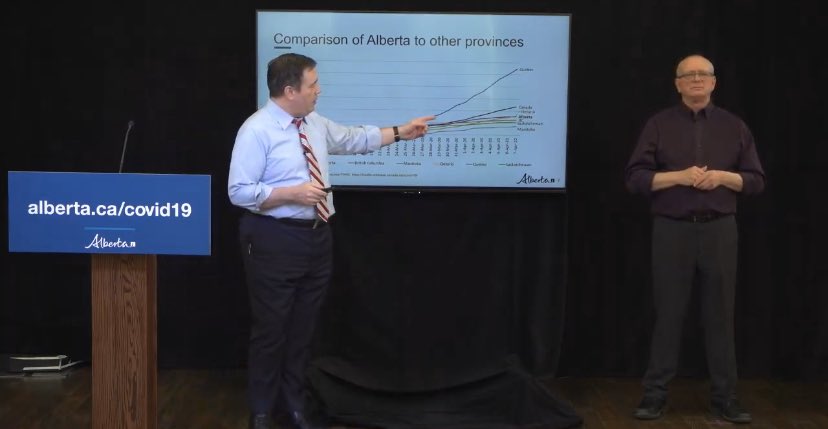
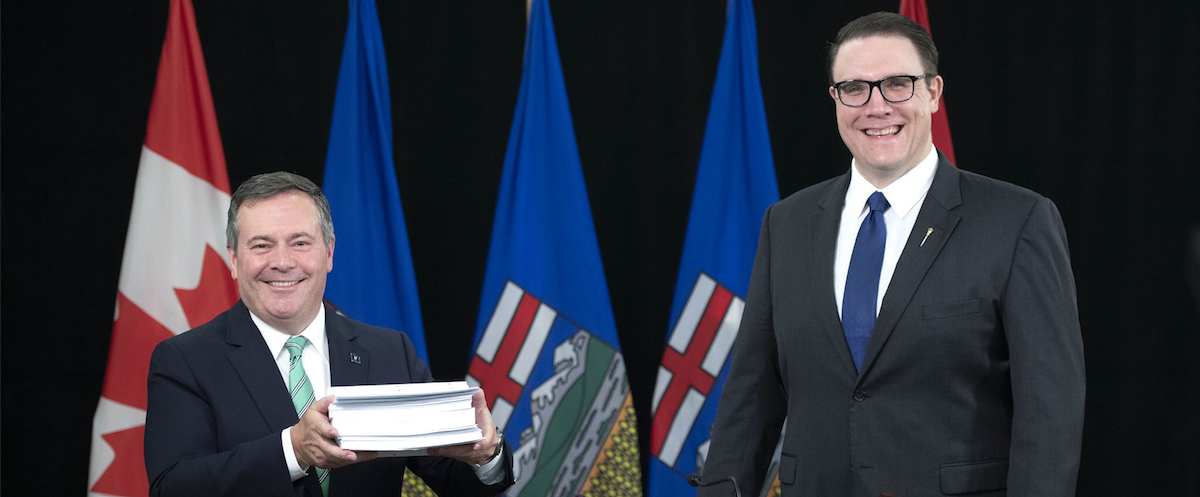
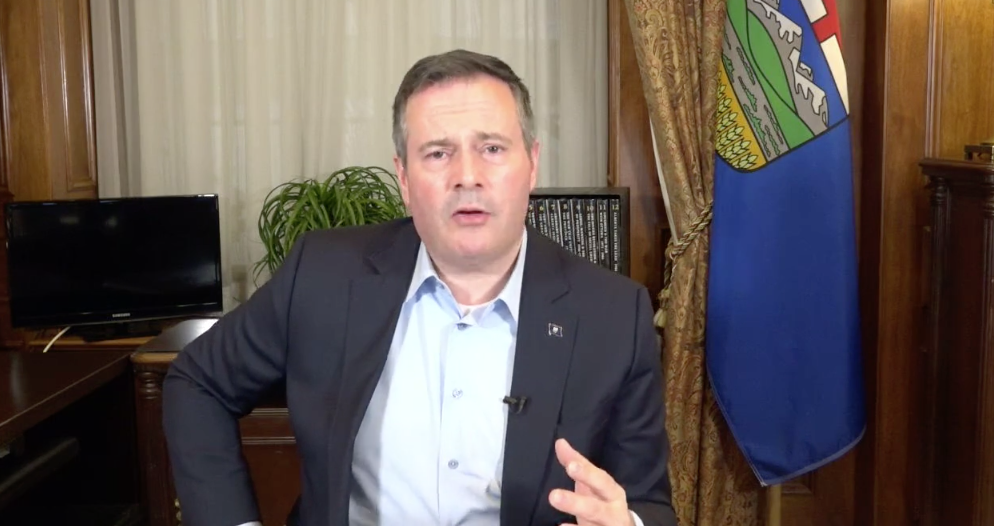
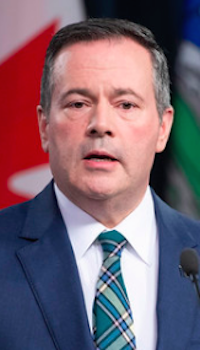
Premier Kenney presented a 54-minute long PowerPoint presentation to the press on April 8, 2020.
When the first wave of the COVID-19 pandemic first hit Alberta many months ago, Premier Jason Kenney was front-and-centre.
Ever the Anglophile, Kenney quoted Winston Churchill and compared the pandemic to the Battle of Britain. Under Kenney’s leadership we were going to fight COVID on the beaches, on the landing grounds, in the fields and in the streets.
He delivered a bleak televised address to Albertans, presented an awkward to watch 54-minute powerpoint display in an attempt to explain Alberta’s pandemic modelling, and elbowed his way to the front of Chief Medical Officer of Health Dr. Deena Hinshaw’s press conferences on a weekly basis. It was clear that he wanted Albertans to know he was their Commander-in-Chief in the war against the pandemic.
Dr. Deena Hinshaw and Premier Jason Kenney at a March 15 press conference about COVID-19. (Source: Government of Alberta)
In one of his more notable comments, Kenney compared Albertans to a herd of buffalo that “move closely together and go into the storm head on, coming out of it faster, stronger, and united.”
But at some point over the summer, as new cases of COVID dropped into the teens and single digits, Kenney shifted gears. He stopped showing up at Dr. Hinshaw’s press conferences and his government ostensibly shifted toward an economic recovery message. But in reality the UCP government began a game of catch-up after the pandemic delayed the United Conservative Party‘s political agenda by five-months – a political agenda designed for a pre-pandemic Alberta.
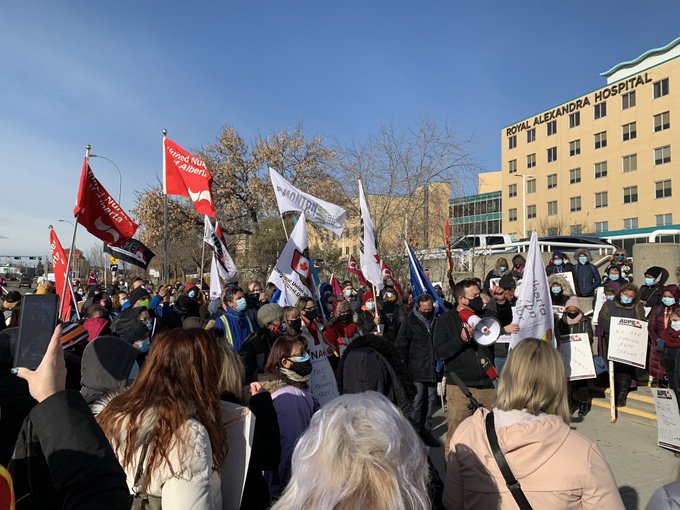
Health support workers on a wildcat strike outside the Royal Alexandra Hospital in Edmonton.
The glorious battle was over and it was time for Kenney’s government to resume its multi-front war with nurses, doctors and health care workers.
Health Minister Tyler Shandro announced plans to privatize large swaths of the public health care system and lay-off more than 11,000 nurses and health support workers. As a result, many physicians have indicated their plans to leave Alberta and health support workers represented by the Alberta Union of Provincial Employees walked off the job at more than 40 hospitals and health centres in a one-day wildcat strike last week.
A sensible political leader would appreciate that picking a very public fight with health care workers in the middle of a global pandemic is a bad way to run a government. But despite his falling approval ratings, Kenney appears to be moving forward as if everything has returned to normal. It clearly hasn’t.
Now the second wave of COVID-19 has hit Alberta. Dr. Hinshaw reported 800 new cases today, shattering previous records. The public health care system is showing signs of strain as nurses and health care workers are over-worked and understaffed, and COVID outbreaks are being reported at hospitals around the province.
The beaches are being stormed, but, unlike eight months ago, Kenney is no longer showing up at Dr. Hinshaw’s press conferences, confidently quoting Churchill or comparing Albertans to buffalo stampeding together through a thunder storm.
The province’s two major political parties were nearly tied in fundraising between July and September, with the United Conservative Party raising $1,199,941.32 and the New Democratic Party raising $1,126,580.38.
This is a rebound for the UCP, which raised only $642,677 in the second quarter of 2020, compared to $1,032,796.85 for the NDP in that period. The UCP responded to last quarter’s fundraising totals by explaining that they had dialled back their fundraising pitches during the beginning of the pandemic.
The UCP continues to rely more heavily on larger donations, with 80 per cent of this quarter’s contributions coming in sums larger than $250. The NDP continue to collect a large number of donations in smaller sums, with 47 per cent of donations is sums smaller than $250.
These results suggest that Alberta’s two major political parties remain financially viable and competitive.
Here is what the political parties raised during the third quarter of 2020:
UCP $1,199,941.32
NDP $1,126,580.38
Alberta Party $35,654.25
Wildrose Independence Party $28,717.00
Liberal Party $17,026.78
Green Party $1,505.00
Independence Party – $1,215.00
Alberta Advantage Party – $907.00
The Communist Party, Pro-Life Alberta Political Association, and Reform Party of Alberta reported no donations during this period.
The maximum annual donation to political parties was increased to $4,243 from $4.000 as of January 1, 2020.
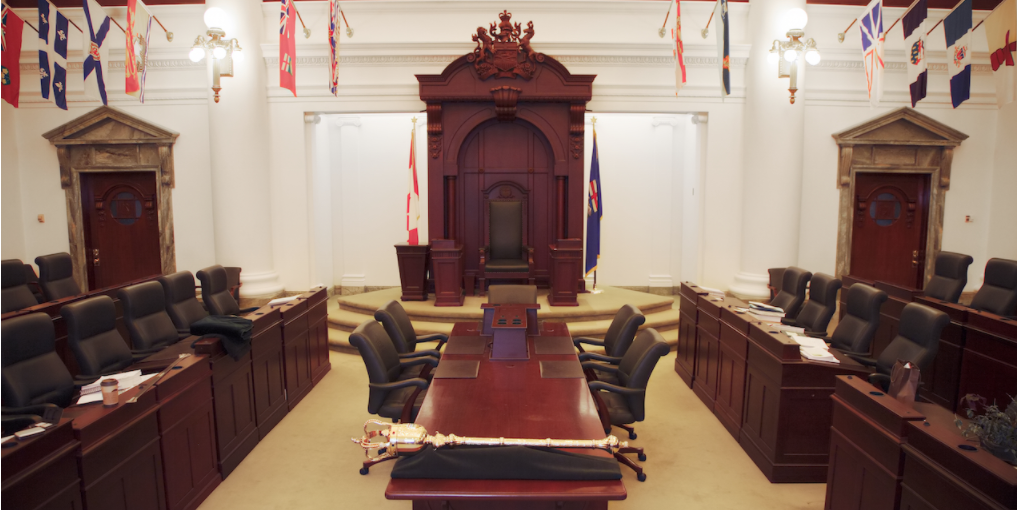
Alberta's Legislative Assembly chamber. (Photo source: Edmonton City as Museum Project)
With Alberta’s Legislative Assembly back in session until the beginning of December, there is good chance that Albertans will hear the term “emergency debate” used a lot.
With a global pandemic, a struggling economy and the United Conservative Party government implementing drastic overhauls and layoffs, MLAs from the opposition New Democratic Party will likely invoke legislative mechanisms to force emergency debates in the Assembly.
According to the rules that govern how the Assembly operates, the Standing Orders, there are two ways for MLAs to trigger emergency debates in the Legislature:
1. Standing Order 30: After the daily routine and before the Orders of the Day, any MLA can request to delay the scheduled business of the Assembly in order to discuss a matter of urgent public importance. After the MLA is given an opportunity to state their arguments, the Speaker can allow a debate on the question of urgency of debate and decide whether the call for a debate is needed.
If the Speaker agrees that debate is needed and there are any objections, then a standing vote of those in favour takes place. If 15 MLAs rise in favour in the standing vote, then the debate can happen with 10 minutes allocated to any MLA who wishes to speak on the matter.
Under SO 30, the MLA proposing the emergency debate must give the Speaker written notice at least 2 hours ahead of time.
2. Standing Order 42: This standing order allows MLAs to delay the regular business the Assembly to deal with matters of “urgent and pressing necessity” and can be invoked anytime without advance notice having been given to the Speaker.
This order requires unanimous consent of the Assembly to proceed. If no MLA objects then each MLA is given 20 minutes to debate the motion.
The government typically opposes this kind of motion.
Heather Sweet (source: Facebook)
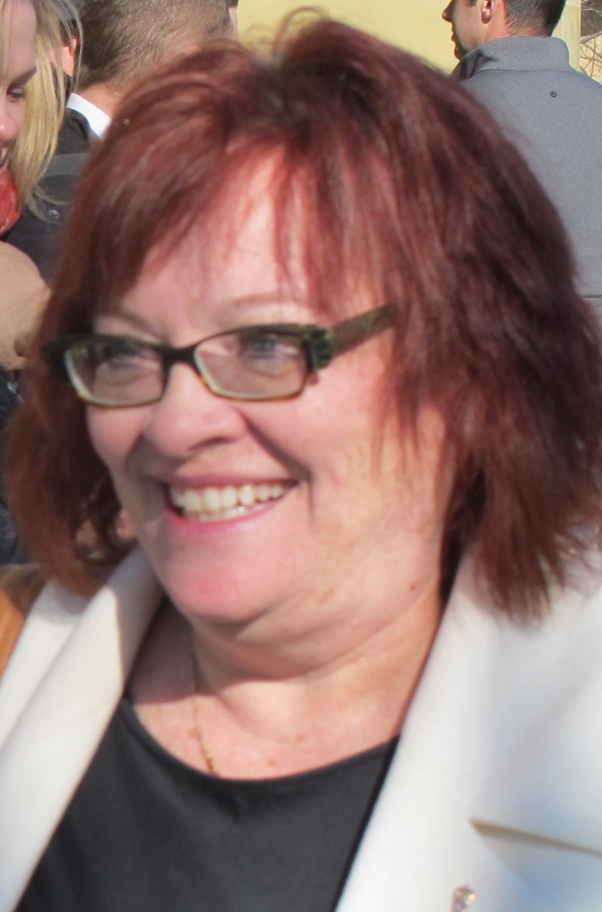
This afternoon, Edmonton-Manning NDP MLA and Opposition House Leader Heather Sweet introduced a motion for emergency debate on the economic crisis under Standing Order 30.
Sweet’s motion was declined by Speaker Nathan Cooper because he determined a motion on a similar topic had already been introduced to the Order Paper by Rimbey-Rocky Mountain House-Sundre UCP MLA and Government House Leader Jason Nixon.
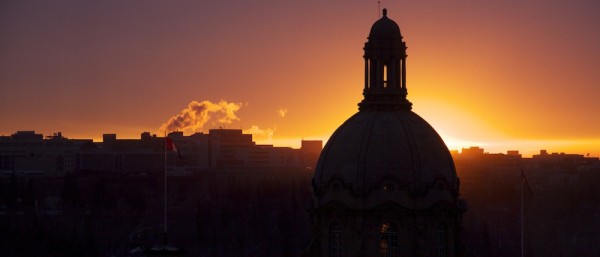
Sunset at the Alberta Legislature (source: Dave Cournoyer)
The recent mini-cabinet shuffle is being followed by a series of staffing changes among the senior ministerial ranks of the United Conservative Party government.
Announced during last week’s shuffle that saw Kaycee Madu appointed Justice Minister, Doug Schweitzer put in charge of a newly rebranded economic ministry and Tracy Allard promoted to Municipal Affairs, was the departure of Premier Jason Kenney’s Principal Secretary Howard Anglin, who is being replaced by Larry Kaumeyer.
Other changes announced today include the departure of the Premier’s Director of Community Relations Ariella Kimmel, who will now take the role of Chief of Staff to Schweitzer. Kimmel replaces current Chief of Staff Kris Barker, who will now become a Senior Policy Advisor in the office of Infrastructure Minister Prasad Panda.
More changes in Room 307 include, Julia Bareman leaving Finance Minister Travis Toews office to join the Premier’s office as a Policy Advisor and Manager of Stakeholder Relations Siobain Quinton and Executive Assistant Clancy Bouwman moving to part-time roles as they pursue post-secondary studies.
Staffing changes in ministerial offices include:
Brock Harrison has been appointed as Executive Director of the UCP Caucus, moving on from his role as Chief of Staff to the Minster of Children’s Services. Harrison is a long-time political staffer, having served as Communication Director of the Wildrose Caucus and in the Office of the Leader of the Official Opposition in Ottawa.
Current press secretary to the Minister of Children’s Services Lauren Armstrong will become the new Chief of Staff. Alberta Proud spokesperson Becca Polak will take over as Press Secretary in this office. Polak was a candidate for the UCP nomination in Calgary-Mountain View ahead of the 2019 election.
At the UCP Caucus, Harrison replaces Robyn Henwood, who will take over as Chief of Staff to Community and Social Services Miniser Rajan Sawhney. Current Chief of Staff Ryan Hastman will move into a new role which has yet to be announced.
Current Indigenous Relations Press Secretary Ted Bauer has been promoted to Chief of Staff in Minster Rick Wilson’s office and UCP Caucus Director of Communications Joseph Dow will take over as Press Secretary in this office.
Riley Braun, the current Chief of Staff in Indigenous Affairs, will become a senior advisor in the office of the Minister of Justice and Solicitor General.
Jonah Mozeson has been promoted from Press Secretary to Chief of Staff in the office of the Minister of Justice and Solicitor General. Mozeson is married to Jamie Mozeson, who is currently the Chief of Staff to Minister of Service Alberta Nate Glubish.
Long-time Kenney ally, Blaise Boehmer has been appointed as Senior Press Secretary in the Office of the Minister of Justice and Solicitor General, moving over from his role as Special Advisor to Agriculture & Forestry Minister Devin Dreeshen. Bohemer was director of communications for Kenney’s UCP leadership campaign and the manager of communications and engagement for the UCP caucus from 2017 to 2018. He previously worked as director of research and operations for the Saskatchewan Party Caucus in Regina.
Kalee Kent has been appointed a Legislative Assistant in the office of Minster of Environment & Parks Jason Nixon, moving from her current role as Ministerial Assistant in the Office of the Municipal Affairs Minister. Kent was Constituency Development Director for the UCP from 2016 to 2019 and previously worked for the Saskatchewan Party and Regina-Coronation Park MLA Mark Docherty.
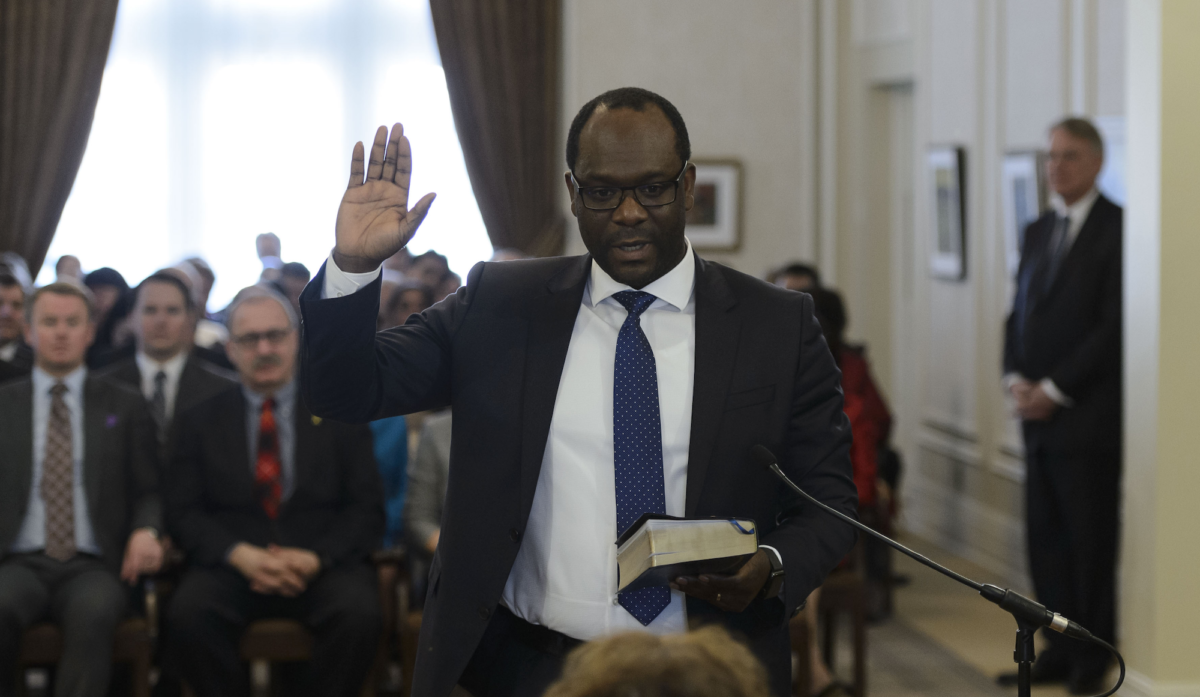
Kaycee Madu is sworn-in as Alberta's Minister of Municipal Affairs (source: Flickr)
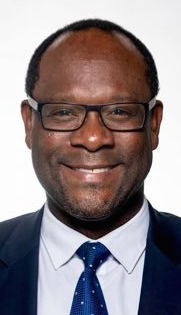
Edmonton’s lone United Conservative Party MLA got a big promotion today in a mini-cabinet shuffle. After a year as Minister of Municipal Affairs, Edmonton-South West MLA Kaycee Madu has been appointed as Solicitor General and Minister of Justice.
Madu replaces Doug Schweitzer, who is the new Minister of Jobs, Economy and Innovation, a rebranded Economic Development, Trade and Tourism department. Current EDTT Minister Tanya Fir moves to the backbenches and Grande Prairie MLA Tracy Allard is the new Municipal Affairs Minister.
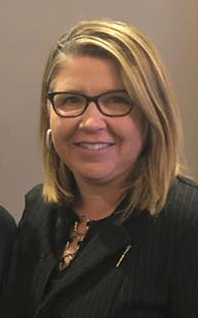
Tracy Allard (source: Facebook)
The mini-cabinet shuffle, the first since the UCP formed government in April 2019, is a minor readjustment and not nearly what many had expected, with controversial Health Minister Tyler Shandro and Education Minister Adriana LaGrange retaining their cabinet posts.
It was the uproar in rural Alberta that most likely lead to Madu being shuffled. Dozens of rural municipalities have spoken out against the government exemptions for municipal oil and gas taxes.
Rural governments that were already having a difficult time collecting taxes from oil and gas companies said the new changes imposed by the UCP government force them to hike property and business taxes in their counties. And rural MLAs, who make up the majority of the UCP caucus, have been receiving an earful from normally supportive local leaders over the tax changes.
Doug Schweitzer
Madu may have spent a year burning bridges with municipalities but he is the only UCP from inside Edmonton city limits and a loyal party soldier, a geographic fact and trait that has now earned him a senior cabinet role. Control of the UCP cabinet and caucus is so firmly held by Premier Jason Kenney and his inner circle of political staff that unflinching loyalty is the key to promotion.
Madu is now expected to oversee changes to the Police Act, and provincial election finance laws proposed by the Select Special Democratic Accountability Committee. He will also oversee the implementation of MLA recall legislation and the Fair Deal report recommendations, the government’s never-ending fight against the federal government over the carbon tax, and the expected referendum on equalization in October 2021.
The public inquiry, which has been conducted in complete privacy, is over-budget and behind schedule and has had its mandate changed twice since it was formed, suggesting that the one-man commission is having troubling completing its goal of rooting out the alleged global conspiracy against Alberta.
Tanya Fir
Schweitzer’s move signals that the UCP is desperate to recover the “jobs and economy” part of their election slogan that has been sideswiped by the collapse in the international price of oil and economic shutdown in response to COVID-19 pandemic. Schweitzer will be responsible for the new Invest Alberta crown corporation.
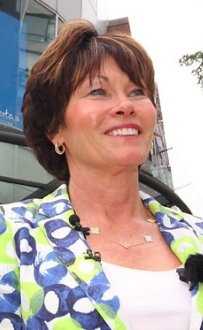
Tracy Allard: The first-term MLA from Grande Prairie and owner of Tim Hortons restaurant franchises in Prince Rupert, British Columbia, and in Grande Prairie is now the ninth Minister of Municipal Affairs since 2010. Her first order of business will likely be trying to repair some of the many relationships damaged by Madu during his short tenure, and, as Kenney announced in today’s press conference, oversee the creation of a spending report card for municipal governments in Alberta.
Tanya Fir: It is unclear what led to Fir’s demotion to the backbenches. The first-term UCP MLA from Calgary-Peigan appeared to be well-spoken and had not caused much public drama for the government. Fir appears to have avoided controversy but her election campaign manager, long-time conservative activist Craig Chanlder, has never shied from controversy and was recently a featured speaker at a separatist rally.
Who was left out: Not making it into cabinet in this mini-shuffle are a number of UCP MLAs who are rumoured to be cabinet contenders: UCP Caucus chairperson Todd Loewen, Fort McMurray-Wood Buffalo MLA Tany Yao, Calgary-West MLA Mike Ellis, Drumheller-Stettler MLA Nate Horner, and Brooks-Medicine Hat MLA Michaela Glasgo.
Also missing from the shuffle is former UCP finance critic Drew Barnes, now the third-term MLA for Cypress-Medicine Hat, who was left out of cabinet when the party formed government last year. Barnes recently made comments in support of separation if Alberta fails to get Ottawa’s attention regarding issues brought forward from the Fair Deal Panel.
The Battle of Alberta is a term usually reserved for competitions on the hockey rink or football field, but the rivalry between Calgary and Edmonton probably predates our professional sports clubs. While the animosity felt by some sports fans might not be felt the same way among voters, the politics and political divides between the two cities have helped defined Alberta politics since the province was created in 1905. From the decision of where to place Alberta’s capital city to where the province’s first university should be located, the roles played by the two major cities have been a periodic point of tension in provincial politics.
There are many reasons that explain the current political differences between the two cities, from the backgrounds of the settlers who founded the cities to the most recent round of economic convulsions.
As a friend of mine once put it, Calgary is where business decisions get made, Edmonton is where government decisions get made.
Calgary sees itself as the business capital, heavily influenced by connections to the American oil industry in Texas and the home of the braintrust of the federal Conservative movement. Edmonton is the government capital, heavily influenced by a combination of public servants and University employees as well as a base of blue-collar and trades workers with connections to Fort McMurray and northern Alberta.
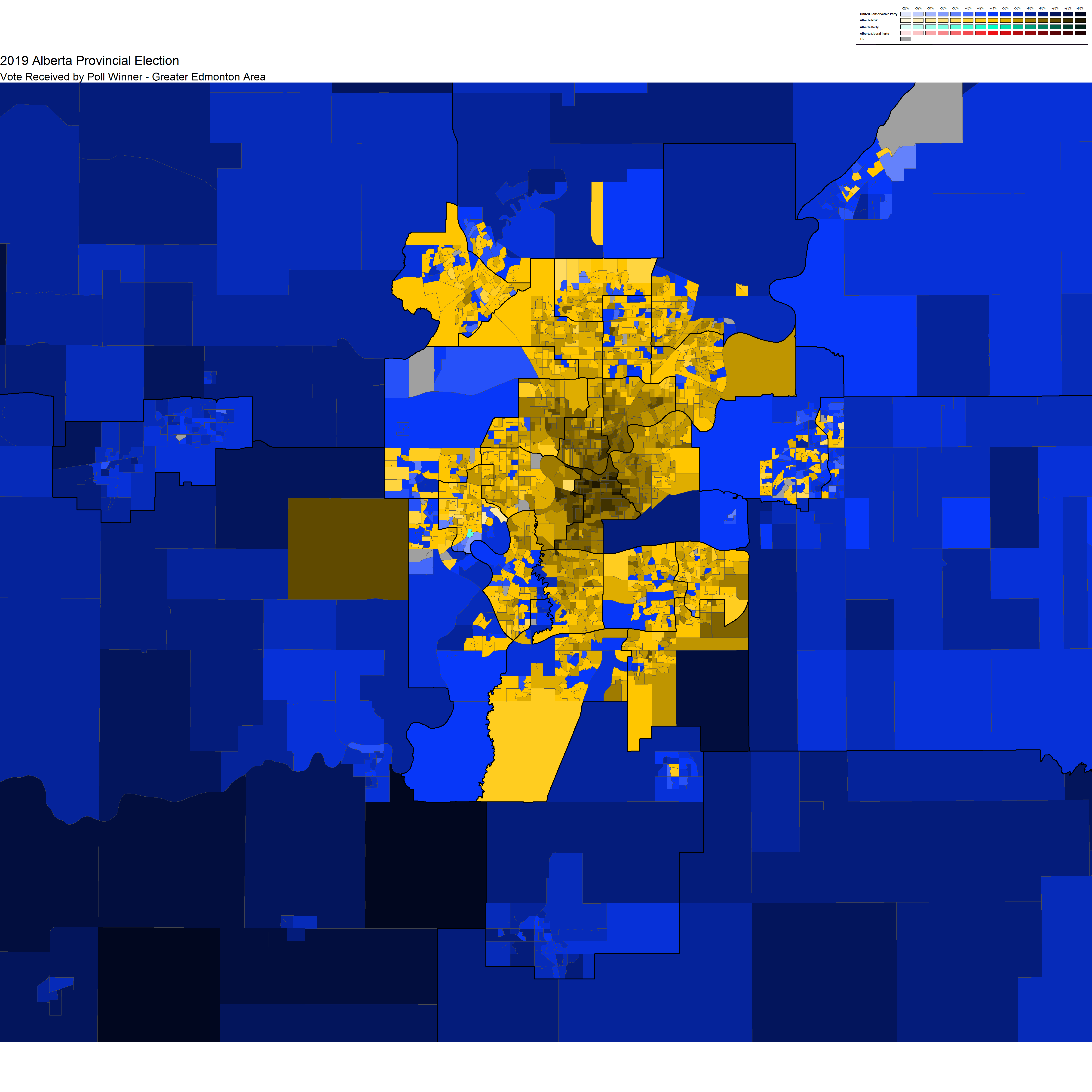
Poll by poll results in Edmonton from the 2019 Alberta provincial general election. (Map by Shane Smith)
These are obviously big generalizations that don’t reflect the diversity and complexity of the two cities but it does help explain some of the political differences between the two municipalities.
While I think the political differences between two two cities can sometimes be overstated, a troubling political narrative that has developed over the past six years has been that because Calgary is perceived to have felt the brunt of the economic fallout caused by the drop in the international price of oil, it is now Edmonton’s turn to feel the economic pain (translation: public sector wage rollbacks and job cuts).
There is an old saying in Alberta politics that a party has to win most of the seats in two of the three political regions of the province in order to form government – Calgary, Edmonton or rural Alberta. The “rural Alberta” in this calculation includes the small and medium size cities, which, with the exception of Lethbridge, have in the past four decades mostly voted in sync with the rest of rural Alberta – conservative.
But the calculation is generally correct. With a combined 46 seats in the Legislature, the two large cities represent the majority of Alberta voters (I hope to write more about voting patterns in “rural Alberta” in a future article).
This year marks one year since the United Conservative Party won the 2019 election and five years since the New Democratic Party won the 2015 election, undeniably two of the most important elections in Alberta’s recent political history. The two votes marked the first changes in government in Alberta since 1971, and both highlighted the political differences between Calgary and Edmonton.
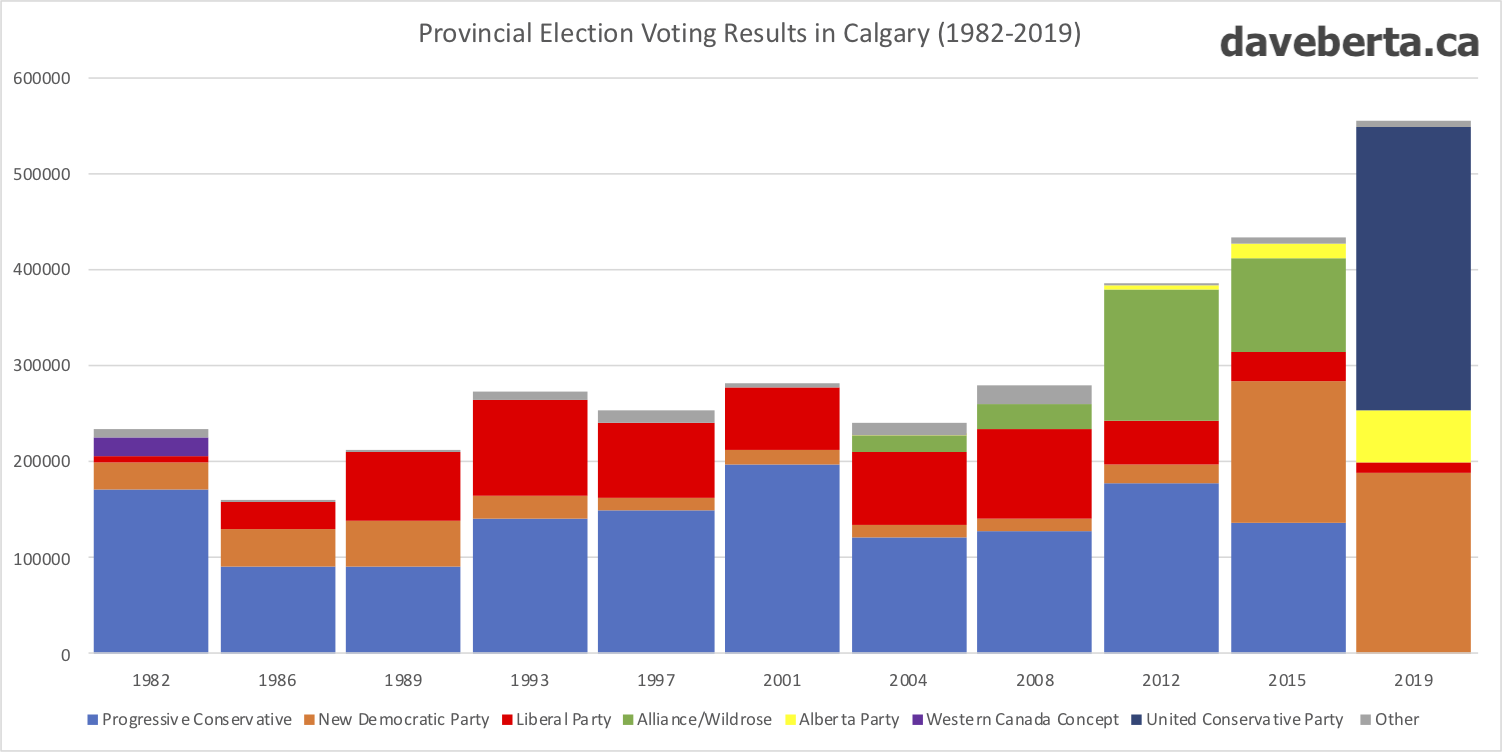
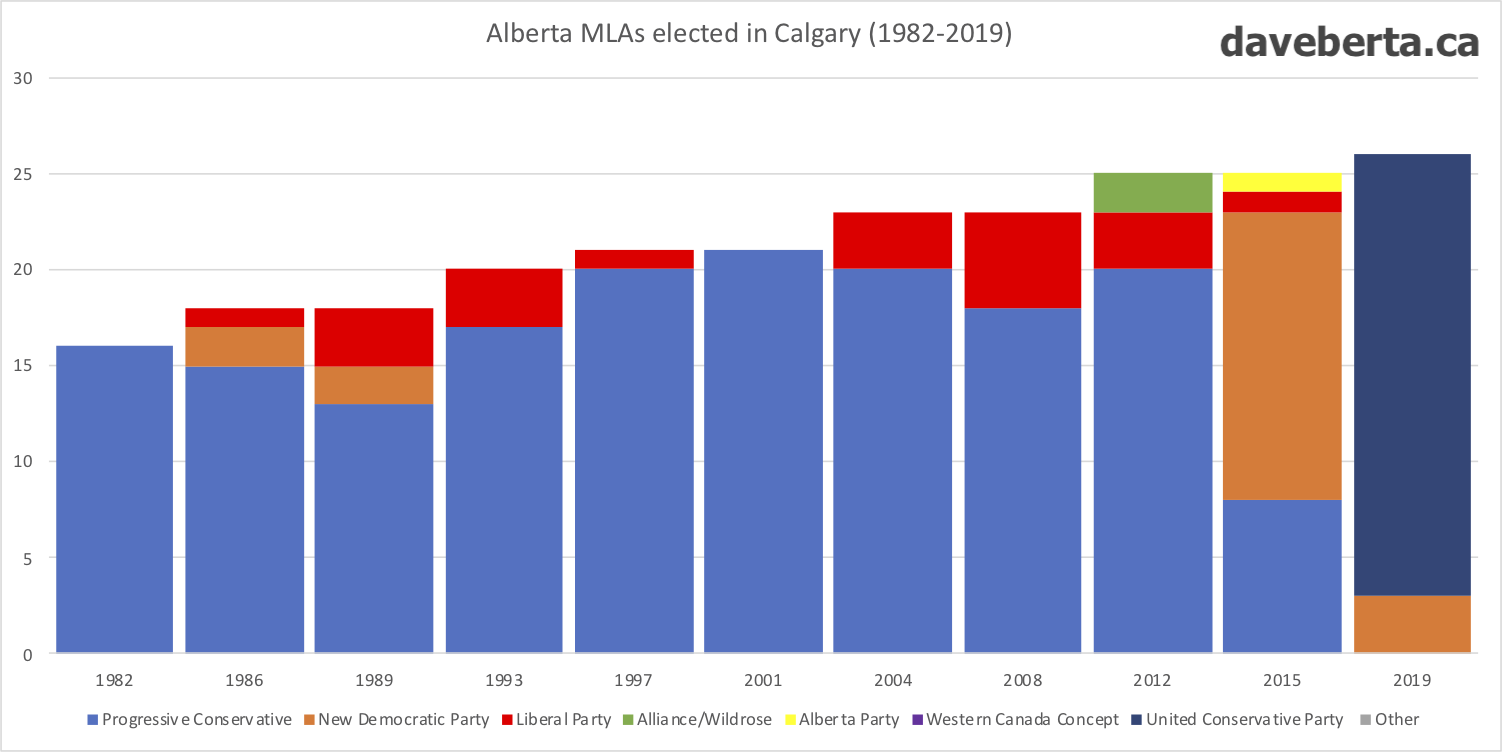
The Progressive Conservatives had dominated Calgary since 1971 but in 2015 a combination of a surge of votes and the first-past-the-post electoral system allowed the NDP to elect 15 MLAs with 34 percent of the vote. The PCs earned 31 percent and the Wildrose placed third with 23 percent in Alberta’s largest city.
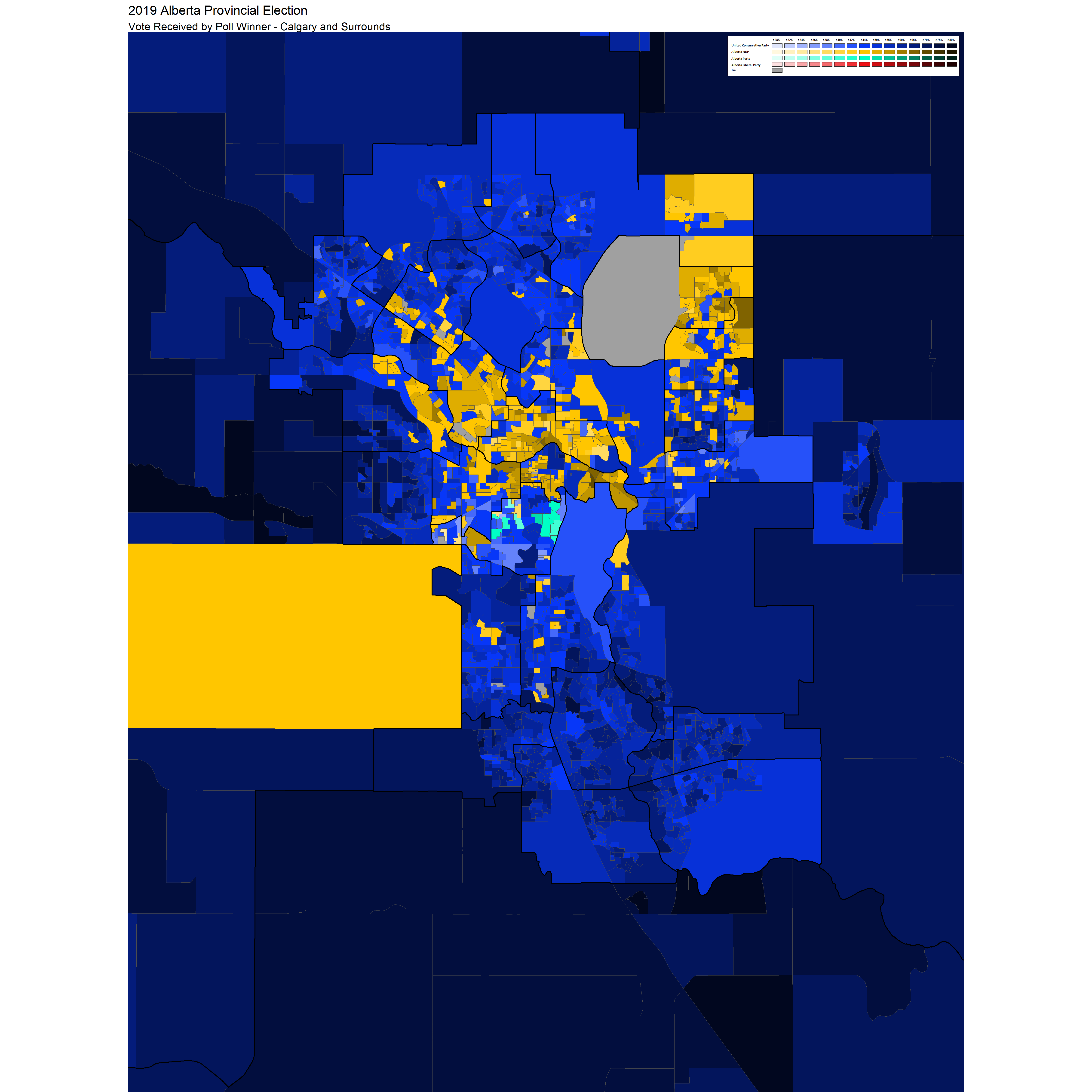
Poll by poll results in Calgary from the 2019 Alberta provincial general election. (Map by Shane Smith)
The 2015 election marked the first time since 1989 that the NDP had elected an MLA in Calgary and the first time since 1967 that a party other than the PCs won a majority of seats in the city.
While many prominent conservative pundits and politicians claimed the NDP breakthrough in Calgary, and much of the rest of Alberta, was a result of a vote-split on the political right, a closer look at that election would support the argument that the vote split was actually between the NDP and Wildrose among voters unhappy with the 43-year governing PC Party dynasty.
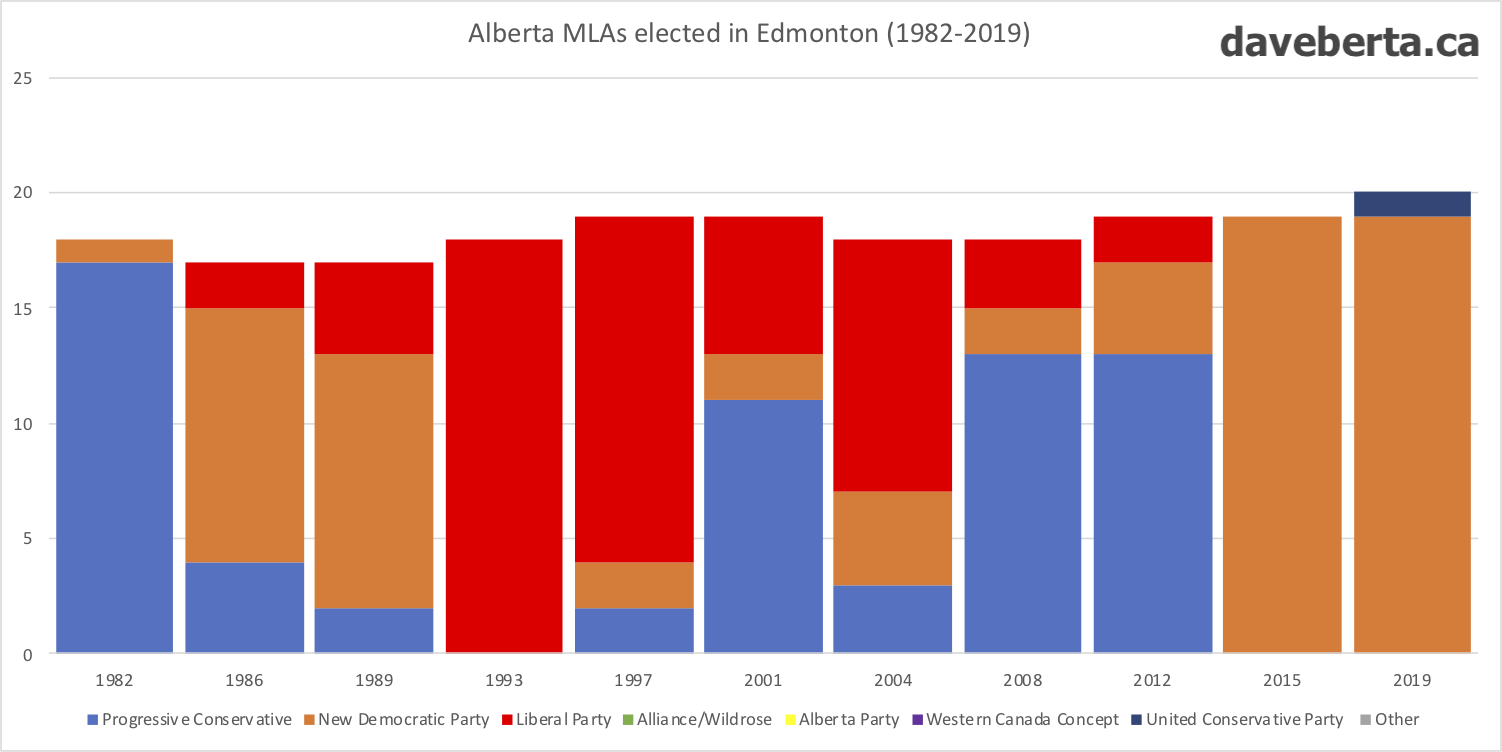
Edmonton has earned the nickname Redmonton for its reputation for electing more Liberals and NDP MLAs than anywhere else in the province. But despite the nickname, the capital city is historically more electorally competitive than it is an opposition bastion. Voters in the capital city have swung between parties more frequently than any other region in Alberta, making it one of the few consistently competitive areas of the province.
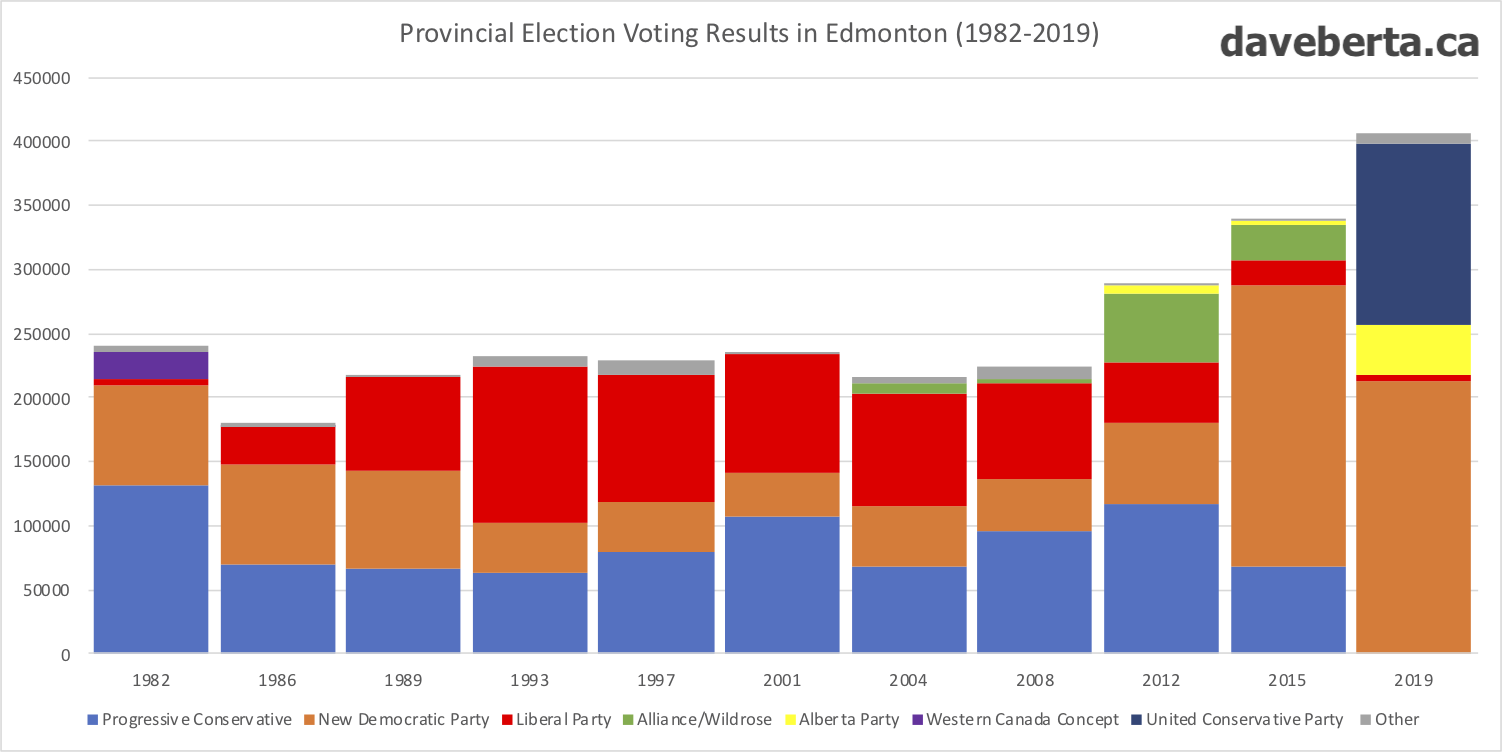
Led by Edmonton-Strathcona MLA Rachel Notley, the NDP swept the city in 2015, earning 65 percent of the total vote and winning every seat. The PCs earned 20 percent and the Wildrose finished with 8 percent in the capital city.
As one local PC Party campaign manager described to me after the 2015 election, their candidate faced “a giant impenetrable wall of orange.”
Provincial voting results in Edmonton from 1982 to 2019.
Four years later in 2019, the NDP maintained its vote share in Calgary but were only able to elect three MLAs as the UCP succeeded in consolidating the large base of PC and Wildrose voters, though a number of UCP candidates earned below the combined totals from the previous election. The NDP earned 34 percent of the vote and the UCP, led by Calgary-Lougheed MLA Jason Kenney, amassed 53 percent and elected 23 MLAs.
The seats won by Calgary NDP MLAs in the 2019 election have a tradition of electing non-conservative MLAs. Calgary-Buffalo and Calgary-Mountain View elected Liberals and NDP MLAs in the 1980s and 1990s, and Calgary-McCall swung to the Liberals in the 2000s.
Although the NDP lost all but one of the suburban surrounding the city, the party maintained its dominance in Edmonton in 2019, winning 53 percent of the vote and holding all but one seat. The UCP elected 1 MLA and earned 35 percent of the vote in the capital city.
Provincial voting results in Calgary from 1982 to 2019.
The only viable third party in the 2019 election, the Alberta Party, earned 10 percent of the vote in both cities but failed to elect any MLAs. Party leader Stephen Mandel was unsuccessful in his bid for election in Edmonton-McClung and its two Calgary incumbents were defeated.
Past elections in the two cities
The results of these two elections, and how they have shaped Alberta politics in the most recent two election prompted me to take a broader look at voting results in Calgary and Edmonton over the past four decades.
Alberta MLAs elected in Edmonton from 1982 to 2019.
1986: The departure of Peter Lougheed as Premier of Alberta in 1985 clearly had a big impact on Alberta politics, as the economic recession that followed allowed NDP led by Edmonton-Norwood MLA Ray Martin breakthrough in the capital city in the 1986 election.
Calgary remained a PC Party stronghold following Lougheed’s departure, with the NDP and Liberals electing a handful of MLAs between 1986 and 1997, and 2004 and 2012.
The election of Liberal Sheldon Chumir in Calgary-Buffalo in 1986 marked the beginning of a long-line of non-conservative MLAs representing that district. Non-conservative candidates would win in Calgary-Buffalo in nine of the next eleven elections (the district is currently represented by NDP MLA Joe Ceci).
Edmonton became the competitive hotbed of Alberta politics and a deep rivalry developed between Liberal Party and NDP partisans in the capital city.
The competition between the Liberals and NDP in Edmonton during this period generated much discussion around a “unite the left” movement to defeat the PCs, though this perennial debate largely became mute when the NDP formed government in 2015.
Alberta MLAs elected in Calgary from 1982 to 2019.
1993: In 1993, Premier Ralph Klein further consolidated his party’s electoral grip on Calgary while the Liberals led by former mayor Laurence Decore executed a clean sweep of the capital city. The Liberals were the beneficiaries of a collapsing NDP vote and also a burgeoning group of Reform Party voters wanting change on the provincial and federal levels.
The Liberals would again dominate Edmonton in the 1997 and 2004 elections, though the party began to resemble a group of independents more than the cohesive political organization created by Decore.
Competition between Decore’s Liberals and former Calgary mayor Klein’s PCs led to obvious descriptions of provincial politics as the battle of Alberta.
2001: The 2001 election marked a turn back toward the PC Party in Edmonton, which would then lose most of its seats when the Liberals and NDP rebounded in 2004 before regaining ground in the city in 2008 and 2012. This period marked the beginning of a decline of the Liberal Party in Edmonton after almost two decades as the official opposition party.
The 2001 election also marked the first time since 1982 that the PCs won every seat in Calgary.
2004: The 2004 election marked a breakthrough for the opposition Liberals in Calgary where the party elected three MLAs, the most since 1993. The Liberals would expand its voter base in Calgary and elect four MLAs in 2008 as the party’s fortunes in Edmonton sharply declined after it regained much of its seats in the 2004 election.
2012: The 2012 election marked a significant shift in the political environment in Alberta with the two large cities coalescing behind the PC Party. The opposition Wildrose Party swept much of rural Alberta, forming the first rural based official opposition party since the Social Credit Party in the 1970s. This trend would continue in the 2015 election as the Wildrose Party regained most of its seats following the 2014 floor-crossings.
(Note: Thank you to Shane Smith for sharing the poll level election maps. You can follow Shane on Twitter at @Smith80D).
Premier Jason Kenney and Environment & Parks Minister Jason Nixon (source: Twitter)
When the COVID-19 pandemic first hit Alberta five months ago, our Legislative Assembly was one of only a handful of provincial assemblies that continued with a mostly regular sitting schedule. Premier Jason Kenney and his ministers frequently quoted Winston Churchill and compared the current pandemic to the Nazi blitz of the United Kingdom during World War II. But the narrative of fighting on the beaches and uniting Albertans did not stick around for long.
United Conservative Party MLAs were eager to continue the regular business of the Legislature and Kenney barely skipped a beat in continuing to implement a political agenda aimed at dismantling government regulation and imposing swift changes to health care, education and labour laws.
While the UCP enjoys a big majority in the Legislature, and the continued support of enough Albertans to probably form another majority government (albeit likely smaller) if an election were held tomorrow, the government’s decision to move forward with a business as usual approach further entrenched some political divides that grew more conciliatory in other provinces. While other premiers were pulling their provinces together, and enjoying popularity bumps as a result, Alberta’s premier actively pushed people apart.
Politics as usual meant that unlike other provinces, where government and opposition parties generally worked together or at least put partisan politics on hold, in Alberta, politics remained heated and partisan.
Along with a flurry of attacks on provincial parks and public sector unions, and pushing for increased autonomy from Ottawa at the same time as the provincial government was increasingly relying on federal funding, the UCP, usually led by Environment and Parks Minister Jason Nixon used every opportunity to attack the New Democratic Party opposition. Rachel Notley and the NDP responded in kind.
If someone out there was keeping a political scorecard of Alberta’s MLAs, here is look at a few individuals who stood out during this session:
Tyler Shandro
Not: Health Minister Tyler Shandro (MLA Calgary-Acadia): Appointed to oversee a major overhaul and dismantling of Alberta’s public health care system, Shandro’s combative and confrontational approach has undermined much of the good will generated by the government’s initial response to the COVID-19 pandemic.
Shandro’s ongoing dispute with the Alberta Medical Association, including a temper-tantrum in the driveway outside a physician’s house, has poisoned the relationship between the government and doctors in the middle of a pandemic. The threat of doctors leaving rural Alberta practices has created an uncomfortable divide in the UCP Caucus between rural MLAs worried about the impact of losing doctors in their communities and Calgary MLAs not wanting to back down from a fight.
Pincher Creek Mayor Don Anderberg announced this week that the town’s council had to step in to convince doctors to not withdraw their services from that community’s hospital. Anderberg condemned Shandro and accused him of not being honest about the impact that doctors leaving the hospital could have on the community.
Adriana LaGrange
Not: Education Minister Adriana LaGrange (MLA Red Deer-North): The soft-spoken former Catholic school trustee from central Alberta spent much of her first year in office battling with school boards and the Alberta Teachers’ Association, leaving her with few allies when schools were forced online at the beginning of the pandemic.
Now, with a return to school plan that appears woefully inadequate, LaGrange faces opposition and a lot of unanswered questions from parents, teachers and students who will be returning to school as normal in September.
Hot: Janis Irwin (MLA Edmonton-Highlands-Norwood), Rakhi Pancholi (MLA Edmonton-Whitemud), and David Shepherd (MLA Edmonton-City Centre): These three NDP MLAs stood out to me as some of the most effective voices and sharpest critics in the opposition benches during this session.
Rakhi Pancholi
Not: Finance Minister Travis Toews (MLA Grande Prairie-Wapiti): The provincial budget was barely tabled when the international price of oil plunged once again, putting the Alberta government’s optimistic projected natural resource royalty revenues in the realm of fantasy for the foreseeable future. The drop in oil prices and the COVID-19 pandemic changed Alberta’s reality, but that did not stop Toews from shepherding an outdated budget through the legislative approval process.
With its revenues in the tank, the government continues to refuse to consider options to diversify its revenue streams, meaning Toews, who usually fills the roll of the adult in the room, will likely be announcing big cuts and layoffs when the Legislature returns for a one-day fiscal update debate on August 27.
Hot: Mike Ellis (MLA Calgary-West): Ellis’ role as chair of the Standing Committee on Private Bills and Private Members’ Public Bills will be unnoticed by most Albertans, but he has succeeded in fairly navigating some contentious issues that have arisen at committee hearings on private members’ bills this session. The expanded committee process for private members bills is new and is a very procedural and important part of how laws are made in Alberta.
Many rural municipalities have spoken out about oil and gas companies that are either unable or refusing to pay their municipal taxes and now tax structure changes implemented by the province threaten to strip oil and gas tax revenue from those same rural municipalities.
According to a statement from Camrose County: “Council and administration are extremely concerned about the serious impacts of this decision because it will mean an increase in property tax, reduction of services, or combination of both to make up for this lost revenue.
While the stated intention of this decision is to increase the competitiveness of oil and gas companies in this hard time, these changes will disproportionately benefit large oil and gas companies and harm smaller local firms.”
Sonya Savage
Not: Energy Minister Sonya Savage (MLA Calgary-North West): It is a pretty grim time to be an Energy Minister in Alberta. Former pipeline lobbyist Sonya Savage had some success in negotiating funding from the federal government to clean up orphan and abandoned well sites, but her brave rhetoric has not matched the reality of the world’s energy market. Big oil companies like Total are pulling out of Alberta and barely a week goes by without a major investment house or bank divesting its funds from Alberta’s oil sands.
The much-lauded “Fightback” strategy touted by Savage and Kenney, which features a scandal-plagued Canadian Energy Centre and a $3.5 million secret public inquiry, seems to amount to the minister accusing companies like Total and financial institutions like Deutsche Bank of being “highly-hypocritical.” The world is moving away from Alberta’s oil sands and the government is either unable or unwilling to face that challenge.
Marlin Schimdt
Not: Shane Getson (MLA Lac Ste. Anne-Parkland): Getson’s adolescent behavior – telling the NDP that they have a special VIP section reserved in Hell and allegedly making inappropriate gestures toward opposition MLAs – are unbecoming of an elected representative. Grow up, Shane.
Hot: Speaker Nathan Cooper (MLA Olds-Didsbury-Three Hills): An effort to demystify the Legislative Assembly, Cooper’s weekly videos highlighting different parts of the Legislature Building and functions of the Assembly has been entertaining and educating. Cooper and his staff should be commended for recognizing the opportunity to open the Legislature to Albertans through social media.
You sent us your questions and we answered! In this edition of the annual Alberta politics Q&A episode, Daveberta Podcast host Dave Cournoyer and producer Adam Rozenhart dive into the mailbag to answer listener questions about provincial parks, the Heritage Savings Trust Fund, the reopening of schools in September, political party fundraising, how previous governments might have handled the COVID-19 pandemic differently, how the government could do a better job convincing more Albertans to wear face masks in public, and much more.
The Daveberta Podcast is a member of the Alberta Podcast Network: Locally grown. Community supported. The Alberta Podcast Network includes dozens of great made-in-Alberta podcasts.
You can listen and subscribe to the Daveberta Podcast on Apple Podcasts, Google Play, Spotify, Stitcher, or wherever you find podcasts online. We love feedback from our listeners, so let us know what you think of this episode and leave a review where you download.
Find us on Twitter, Instagram, Facebook, or you can email us at podcast@daveberta.ca. Thanks for listening.
The NDP raised $1,032,796.85 between April and June 2020, almost twice as much as the governing UCP, which raised $642,677 in the second quarter of 2020.
This is almost the opposite of the first quarter of 2020, in which the UCP raised $1.2 million and the NDP trailed with $582,130.
Alberta’s political parties largely stopped in-person fundraising events since the COVID-19 pandemic began but they all continued with their traditional aggressive email and social media appeals.
The NDP held a number of Zoom fundraisers featuring musical acts and guest speakers during the pandemic but it is the actions of the UCP that likely helped boost the NDP’s cash flow.
While the UCP would still likely be re-elected if an election were held tomorrow, public opinion polls show that Albertans do not approve of the government’s handling of health care, education and post-secondary education issues.
The size of the donations received by the parties is also worth noting. More than half of the donations to the NDP were in amounts of $250 or less, while almost two-thirds of donations to the UCP were in denominations over $250.
One of the big successes of the UCP’s predecessor party, the Wildrose Party, was its ability to cultivate a large base of small donors, something that the UCP appears to have trended away from (the UCP received nearly 90 individual donations of $4,000 in the first quarter of 2020).
I am told that the NDP raised around $10,000 in small donations during an impromptu social media campaign encouraging supporters to donate to the NDP to celebrate Premier Jason Kenney‘s birthday on May 30.
While the UCP will likely recover their fundraising advantage or at least become more competitive with the NDP in future quarters, it does show that Kenney’s party faces some significant internal financial problems. And for the NDP, it shows that despite losing last year’s election the party under Rachel Notley‘s leadership has continued to maintain a strong base of donors during its first year as official opposition, and, presumably, as government-in-waiting.
Here is what the political parties raised during the second quarter of 2020:
The maximum annual donation to political parties was increased to $4,243 from $4,000 as of January 1, 2020.
Parties move to virtual conventions
The UCP and the Alberta Party have both announced plans to forgo their annual in-person conventions, opting to hold the meetings online this year.
The UCP’s virtual AGM will be held on October 16, 17 and 24 and will feature policy debates, board and executive elections and the traditional MLA bear-pit session.
The Alberta Party’s virtual annual general meeting is scheduled to be held on August 29 and will include board elections and likely discussion around the process to select a new leader.
Jacquie Fenske
Former Progressive Conservative MLA Jacquie Fenske stepped up to become interim leader of the Alberta Party in February 2020, replacing former PC MLA Stephen Mandel who resigned after failing to win a seat in the 2019 election. Fenske previously served as MLA for Fort Saskatchewan-Vegreville from 2012 to 2015 and as a Councillor in Strathcona Country from 1995 to 1998 and 2004 to 2012.
Meanwhile, the UCP has scheduled its first major COVID-era in-person fundraiser on August 14, which will take the form of a horse race derby at a race track outside Lacombe.
Tickets to watch Kenney and UCP MLAs compete in a horse race, including a T-Rex race that will feature MLAs racing in “their t-rex dinosaur costumes,” start at $100 for the “MLA Cheer Team” and go as high as $3000 for the “Ralph Klein VIP Suite.”
“This Alberta is a meritocracy” – Jason Kenney (April 30, 2019)
It was first reported this week by the CBC that John Weissenberger has been hired as the Alberta Energy Regulator’s new vice president of its science and innovation branch. Weissenberger is a former adjunct professor at the University of Alberta and manager of geological services with Husky, but it is his deep political connections that raised eyes this week.
Weissenberger is a long-time conservative activist going back to the early days of the Reform Party and was Jason Kenney’s campaign manager during his successful bids for the the Progressive Conservative and United Conservative Party leadership campaigns in 2017. He was also director of the Alberta Victory Fund, the political action committee created to support Kenney’s campaign for the UCP leadership, and has been described as former prime minister Stephen Harper’s best friend.
It has also been reported that Weissenberger is a self-proclaimed ‘climate change skeptic,’ something that is unlikely to help the government’s bid to attract international investment and companies to move to Alberta.
Weissenberger’s wife, Angela Tu Weissenberger, was appointed by the UCP to the board of the Alberta Gaming, Liquor and Cannabis Commission in November 2019.
“Sherpa Dave” is Kenney’s Man in Texas
Dave Rodney
Congenial former Progressive Conservative MLA Dave Rodney has been appointed as Alberta’s Agent General in Houston, Texas. Rodney served as the PC MLA for Calgary-Lougheed from 2004 until 2017 when he resigned to allow Kenney to run in a by-election.
Rodney’s reward for stepping down, it would appear, is a pseudo-diplomatic post with a $250,000 annual salary. The former MLA served as a backbencher for all but two of his thirteen years in the Legislature. He served as Associate Minister of Wellness from 2012 to 2014.
And as anyone who has paid close attention to Alberta politics will know, Rodney is the first Canadian to have reached the summit of Mount Everest, twice.
Rodney’s appointment is reminiscent of former Stettler MLA Brian Downey‘s appointment as chairman of the Alberta Grain Commission when he resigned his seat in 1989 to allow Premier Don Getty to return to the Assembly (Getty had lost his Edmonton-Whitemud seat to Liberal Percy Wickman in the 1989 general election).
Rodney’s appointment marks the return of the Agent General title, a term that was widely used by Alberta’s out-of-country representatives until 1996, when the Agent-General Act was repealed and the Managing Director job title was adopted.
At the time the Agent General title was abolished, it had become associated with partisan patronage following a long string of appointments that included former PC MLA Mary LeMessurier to a post in London, former MLA Fred Peacock as the Asia-Pacific Agent General, a political aide in Getty’s office as Agent General in Hong Kong, and Getty’s wife’s cousin’s husband as Agent General in Tokyo.
Tory Patronage Machine Humming
Like the engine of a blue Dodge Ram, the UCP patronage machine has revved up since the party formed government in April 2019. counting donors, which would expand the list substantially, here is a quick list of individuals with connections to Kenney, the UCP and the conservative movement who have been appointed to various agency, board and commission positions:
Len Rhodes was appointed as Chair of the board of directors of the Alberta Gaming, Liquor, and Cannabis Commission. He was the UCP candidate in Edmonton-Meadows in 2019.
Janice Sarich was appointed to the board of governors of MacEwan University. Sarich was the UCP candidate in Edmonton-Decore in 2019 and represented the district as a PC MLA from 2008 to 2015.
Lily Le was appointed to board of governors of Norquest College. Le was the UCP candidate in Edmonton-City Centre in 2019.
Laurie Mozeson was appointed to the Municipal Government Board. Mozeson was the UCP candidate in Edmonton-McClung in 2019.
Karri Flatla was appointed to the Board of Governors of Lethbridge College. She was the UCP candidate in Lethbridge-West in 2019.
Tom Olsen was hired as CEO of the Canadian Energy Centre. He was the UCP candidate in Calgary-Buffalo in 2019.
Bettina Pierre-Gilles was appointed to board of Bow Valley College. Pierre-Gilles ran for the UCP nomination in Calgary-Currie ahead of the 2019 election.
Donna Kennedy-Glans appointed to board of governors of Banff Centre. Kennedy-Glans was the PC MLA for Calgary-Varsity from 2012 to 2015 and briefly ran for the party leadership in 2017. She was also appointed to the Fair Deal Panel.
Janice Harrington was appointed as Alberta’s Health Advocate and Mental Health Patient Advocate. Harrington was executive director of the PC Party and UCP from 2017 to 2019 and was previously involved in PC Party campaigns.
Shelley Beck was appointed to the board of governors of Medicine Hat College. Beck has worked as a constituency assistant to Cypress-Medicine Hat UCP MLA Drew Barnes.
Wayne Drysdale was appointed to the Municipal Government Board. Drysdale served as the PC and UCP MLA for Grande Prairie-Wapiti from 2008 to 2019. He was Minister of Transportation from 2014 to 2015.
Heather Forsyth was appointed to the Alberta Review Board. Forsyth served as the PC and Wildrose MLA for Calgary-Fish Creek from 1993 to 2015. She served as Solicitor General from 2001 to 2004 and Minister of Children’s Services from 2004 to 2006.
Lloyd Snelgrove was appointed to the Board of Governors of Lakeland College. Snelgrove served as the PC MLA for Vermilion-Lloydminster from 2001 to 2012. He served as Minister of Finance and Enterprise from January 2011 to October 2011.
Bill Smith was appointed as member and vice-chair of the Public Health Appeal Board. Smith is the former president of the PC Party and was a candidate for Mayor of Calgary in 2017.
Andy Crooks was appointed to Municipal Government Board. Crooks was chairman of the Canadian Taxpayers Federation during Jason Kenney‘s time as its spokesperson in the 1990s.
Richard Casson was appointed to the Board of Governors of the University of Lethbridge. Casson served as the Member of Parliament for Lethbridge from 1997 to 2011.
James Rajotte was appointed to the Board of Governors of the University of Alberta. Rajotte served as the MP for Edmonton-South West and Edmonton-Leduc from 2000 to 2015.
Diane Ablonczy was appointed as a member of the Council of the Alberta Order of Excellence. Ablonczy served as the MP for Calgary-North and Calgary-Nose Hill from 1993 to 2015.
Ted Menzies was appointed to the Board of Governors of Olds College. Menzies served as MP for Macleod from 2004 to 2015.
Janice MacKinnon was appointed to the Board of Governors of The University of Alberta. MacKinnon chaired the UCP government’s Panel on Alberta’s Finances in 2019.
Editor’s Note: Thank you to Brent Wittmeier for the inspiration for the title of this post.
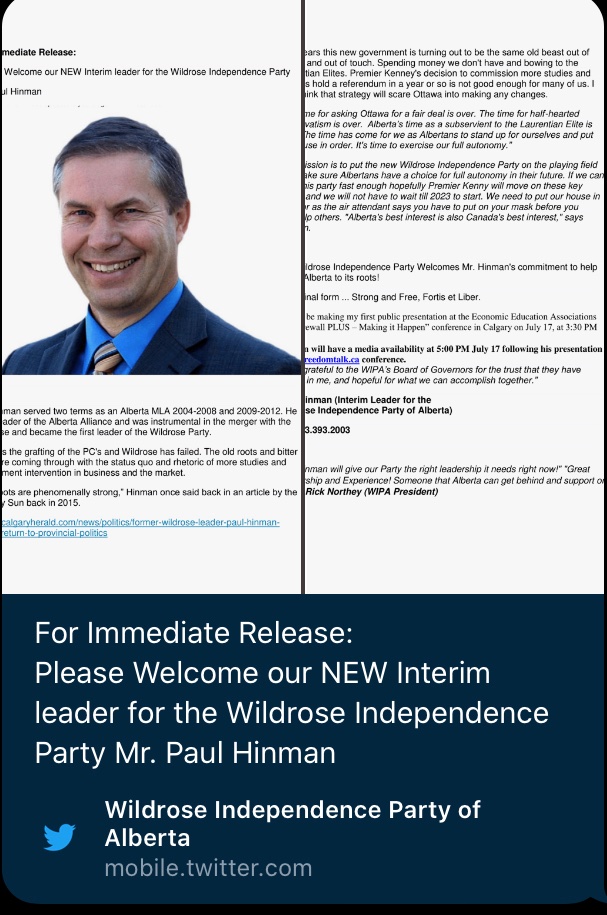
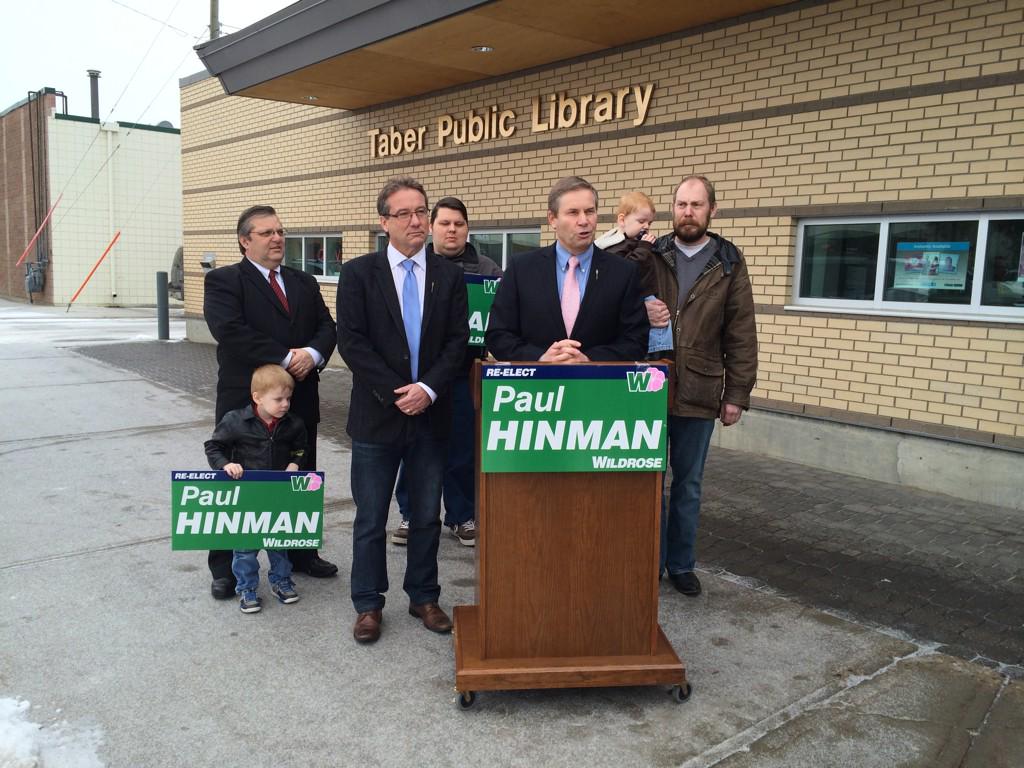
Former Wildrose Alliance Party leader Paul Hinman is expected to maybe become interim leader of the new separatist Wildrose Independence Party.
Alberta’s oldest newly rebranded separatist party has a new interim leader, maybe.
The tweet from the Wildrose Independence Party announcing Paul Hinman as its interim leader.
A now deleted tweet from the newly renamed Wildrose Independence Party announced that former Wildrose Alliance leader Paul Hinman is the new interim leader of the party. Unless the party’s account was hacked, it would appear that Hinman is launching another attempt at a political comeback.
The press release included with the now deleted tweet said that Hinman would speak to his new role at this week’s Freedom Talk “Firewall Plus” conference, a pro-separatist event organized by former Wildrose candidate and right-wing online radio show host Danny Hozak that features speakers including former arch-Conservative MP Rob Anders, conservative lawyer John Carpay, Postmedia columnist John Robson, and federal Conservative leadership candidate Derek Sloan.
The name change does not appear to have been approved by Elections Alberta, which still lists the party under its most recent previous name on its official website. But it was reported last week that former Wildrose activist and FCP candidate Rick Northey was the party’s new president. Former Social Credit leader James Albers is also on the party’s executive.
The oldest newest separatist party on Alberta’s right-wing fringe should not be confused with the also recently renamed Independence Party of Alberta (formerly known as the Alberta Independence Party and now led by past UCP nomination candidate Dave Campbell), the Alberta Advantage Party (led by former Alberta Alliance Party president Marilyn Burns), and the unregistered Alberta Freedom Alliance (led by former Wildrose Party candidate Sharon Maclise).
Edgar Hinman
The United Independence Party name was also recently reserved with Elections Alberta, presumably by another former Wildrose candidate trying to start another new separatist party.
But back to the new interim leader of the new separatist Wildrose party…
The grandson of former Social Credit MLA and cabinet minister Edgar Hinman, Paul Hinman’s first foray into provincial electoral politics saw him elected in Cardston-Taber-Warner as the lone Alberta Alliance MLA in the 2004 election. Hinman inherited the leadership of the tiny right-wing party when Randy Thorsteinson (who had previously helped found the Alberta First Party) failed to win his election in Innisfail-Sylvan Lake. He endorsed Progressive Conservative leadership candidate Ted Morton in 2006 and led the party through an eventual split and re-merger with a faction branding itself as the Wildrose Party – and thus the Wildrose Alliance was formed.
Hinman lost his seat in the 2008 election in a rematch with former PC MLA Broyce Jacobs. He announced plans to step down as leader shortly afterward and then surprised political watchers when he won a 2009 by-election in posh Calgary-Glenmore, pumping some momentum behind Danielle Smith when she won the party’s leadership race a few months later.
Danielle Smith with Wildrose MLA’s Paul Hinman, Heather Forsyth, and Rob Anderson in 2010.
In 2010, Hinman was joined by floor crossing PC MLAs Heather Forsyth, Guy Boutilier, and Rob Anderson (who four years later crossed the floor back to the PC Party and now hosts a Facebook video show where he promotes Alberta separatism), but, despite the party’s electoral breakthrough in 2012, Hinman was again unable to get re-elected.
Drew Barnes stands at Paul Hinman’s side as he announced his bid to once again run for the Wildrose nomination in Cardston-Taber-Warner in 2015.
More recently, Hinman launched a brief bid for the UCP leadership in 2017, announcing a campaign focused on parental rights and conscience rights, but when the Sept 2017 deadline to deposit the $57,500 candidate fee passed, he did not make the cut. Hinman later endorsed Jason Kenney‘s candidacy.
Paul Hinman endorsed Jason Kenney in the 2017 UCP leadership contest.
Now he might be taking over the interim leadership of the fledgeling fringe separatist party at a time when public opinion polls show that Albertans’ appetite for leaving Canada is cooling as memory of the 2019 federal election fades. If historic trends hold, then the desire for separatism will drop if it looks like the next federal Conservative Party leader can form a government in Ottawa.
Separatism is ever-present on the fringes of Alberta politics and is more of a situational tendency than a real political movement with legs but a half-organized separatist party could syphon votes away from the UCP in the next provincial election.
And with next October’s Senate nominee election likely to be a showdown between candidates aligned with the federal Conservative Party led by whoever wins this summer’s leadership race and the federal Wexit Party led by former Conservative MP Jay Hill, expect the UCP to be paying a lot of attention to these fringe separatist groups sniping at its right-flank.
If he actually does become the leader of the oldest newest separatist party, Hinman will provide some profile and credibility in political circles where conservatives are perpetually disgruntled with New Democratic Party leader Rachel Notley and Prime Minister Justin Trudeau, and newly disgruntled with Premier Kenney, presumably for not pushing hard enough for Alberta’s separation from Canada.
Kaycee Madu is sworn-in as Alberta's Minister of Municipal Affairs (source: Flickr)
Albertans could soon be given more opportunities to cast their ballots but with much less transparency about and accountability for who is spending money to influence their votes.
The United Conservative Party government continued to unwrap its electoral reform package this week with the introduction of:
Bill 26: Constitutional Referendum Amendment Act: introduced by Justice Minister Doug Schweitzer, the bill amends the Constitutional Referendum Act law to allow for province-wide referendums to be held on non-constitutional issues
These bills are part of a series of election bills that are expected to also include future bills allowing for the recall of MLAs, municipal politicians and school trustees, citizen initiated referendums, and major changes to provincial election laws.
Doug Schweitzer
The three bills introduced this week provide more opportunities for Albertans to vote for candidates and on issues, but they also claw back important transparency and accountability rules implemented by the previous New Democratic Party government less than two years ago.
It has almost been 50 years since the last time a province-wide plebiscite was initiated by the Alberta government. Bill 26 would allow the provincial government to hold referendums on non-constitutional issues, like creating an Alberta Pension Plan or deciding if we should remain on Daylight Saving Time. Providing an opportunity for Albertans to cast ballots on important issues can be a powerful tool to engage voters, but the timing and wording of such votes can also be intentionally manipulative.
The bill allows third-party groups, colloquially known as political action committees, to spend up to $500,000 on advertising up from the current $150,000 limit. Third-party groups that spend less than $350,000 on advertising during a referendum would not be required to file financial statements with Elections Alberta.
Schweitzer did not hold a press conference to announce the bill, so it is unclear why he chose to include such a massive gap in transparency.
Changes to municipal election laws included in Bill 29 are being framed by Madu as helping “level the playing field” for new candidates running for municipal councils and school boards by not allowing incumbents to carry over campaign war chests between elections and increasing the amount candidates can spend ahead of the election period from $2,000 to $5,000.
Bill 29 raises the election period donation limit from $4,000 back up to $5,000 and allows candidates to self-finance their campaign up to $10,000, reversing a number of changes made by the NDP government in 2018 that have not had a chance to be tested in a municipal election campaign.
Madu’s bill would also make it legal for wealthy individuals to donate up to $5,000 each to as many candidates as they want in any municipal or school board election across the province, effectively removing the cap on individual donations.
Eliminating the ability of incumbents to store campaign surpluses in war chests for future elections might lower the amount of cash on hand at the beginning of an election campaign. But in Edmonton at least, only two city councillors – Sarah Hamilton and Ben Henderson – reported having surpluses of more than $10,000 at the end of the 2017 election, suggesting that war chests are not necessarily a significant issues in the capital city.
Raising the donation limit could strengthen the advantage of incumbents with name recognition and developed political networks running against challengers who may be seeking political office for the first time.
The advantage of name recognition that helps incumbents get re-elected in large numbers at the municipal level is a feature that predates any of the changes to municipal election finance laws introduced by the previous NDP and Progressive Conservative governments over the past decade. The incumbent advantage even existed when there were no donation limits.
Bill 29 removes the requirement that candidates disclose their donors ahead of election day, which allows voters to see who is financially supporting candidates before they head to the ballot box.
The bill also removes spending limits for third-party groups before the start of the election period, allowing groups like Calgary’s infamous Sprawl Cabal of land developers free reign to spend unlimited amounts of money on advertising before May 1, 2021.
Madu’s Bill 29 introduces big money back into municipal elections under the guise of fairness and without creating any of the structural changes required to design a real competitive electoral environment at the municipal level.
Bill 29 also removes all references to the Election Commissioner, a housekeeping item necessitated by the controversial firing of the Commissioner by the UCP government in November 2019. In its place, the bill creates a Registrar of Third Parties, though it is unclear if the person holding this title would have the legal investigative authority of the now defunct Election Commissioner.
In past elections many municipalities simply did not have the resources available to enforce municipal election finance rules, so in some cases complaints were simply left uninvestigated.
Some of these changes were expected and were included in the UCP’s 2019 election platform, others were necessitated by inconsistencies in the changes made by the NDP in 2018, and some have come completely out of left-field.
Alberta’s election laws should be dynamic and designed to encourage and facilitate participation by voters and candidates, not to hide the identities of those who would spend money influencing election campaigns.
Overall, these bills could probably be summed up as one step forward for democracy and two steps back for transparency and accountability.
Changes coming to provincial election laws
Joseph Schow
These changes are likely a taste of what is to come from the recently appointed Select Special Democratic Accountability Committee. Chaired by Cardston-Siksika UCP MLA Joseph Schow, the committee will review Alberta’s Election Act and the Election Finances and Contributions Disclosure Act within the next six months and has be tasked with answering a series of questions submitted by Schweitzer within four months.
Along with Schow, the committee membership includes Drumheller-Stettler MLA Nate Horner, Grande Prairie MLA Tracy Allard, Calgary-Buffalo MLA Joe Ceci, Edmonton-South MLA Thomas Dang, Fort McMurray-Lac La Biche MLA Laila Goodridge, Calgary-Klein MLA Jeremy Nixon, Edmonton-Whitemud MLA Rakhi Pancholi, Highwood MLA R.J. Sigurdson, Drayton Valley-Devon MLA Mark Smith and Edmonton-Manning MLA Heather Sweet.
A reaction to a threat from the right: The appointment of the Fair Deal Panel was a direct response to a perceived threat to the United Conservative Party from the political right and fringe separatists following the re-election of Prime Minister Justin Trudeau’s federal Liberal government in October 2019.
The panel, which was announced by Premier Jason Kenney at the Manning Networking Conference in Red Deer, was a relief value to give frustrated Conservatives an opportunity to express their anger at the Liberals and a steering wheel to allow the Premier to control the political narrative around Alberta’s political relationship with Ottawa.
Kenney played a major role in the federal Conservative Party’s campaign against the Trudeau Liberals, with the premier even traveling to Ontario and Manitoba to campaign during the election, but despite all the bluster it appeared to have little impact on voters in those provinces on Election Day. The Conservatives did very well in Alberta, earning 69% of the vote, but saw their support decline in almost every riding Kenney campaigned in.
A federal Conservative landslide in Alberta is nothing new, it literally happens every four years. But the latest electoral division reflects an increasing feeling inside Alberta that the rest of Canada does not support the province’s energy industry and a growing feeling outside of Alberta that the province is a laggard on climate change and reducing carbon emissions.
Alienation and anger at Ottawa is omnipresent in Alberta politics, but the separatist threat that spooked Kenney seven months ago has largely evaporated and the crash in the international price of oil and the COVID-19 pandemic has reinforced the importance of the provinces being able to work with a federal government for financial relief.
Fair Deal Panel meant to distract from the UCPs job cuts agenda: Creating external enemies and manufacturing crises is something that Kenney excels at. The focus on the Fair Deal report and its recommendations are meant to distract Albertans from the UCP’s political agenda closer to home.
Despite claiming to be obsessed with creating jobs, Kenney’s government has done the opposite by cutting tens of thousands of jobs in Alberta’s public service, schools, colleges and universities. A high-profile dispute with Alberta’s doctors, which included an incident where Health Minister Tyler Shandroyelled at a physician at the driveway of his home, has mired the government’s response to the COVID-19 pandemic. The UCP is also moving forward with plans to close and privatize Alberta’s provincial parks.
And it is expected that the Kenney government could soon introduce anti-union legislation and a $2/hour rollback of the $15/hour general minimum wage, directly targeting many of the low income service workers who have been praised as “heroes” during the pandemic.
Police and pension plans: There is little in the final report that the UCP government wasn’t already prepared to pursue or consider. Kenney has said that the government plans to implement or study 23 of the 25 recommendations in the panel’s final report.
Despite public opinion polls showing Albertans do not support replacing the Canada Pension Plan with an Alberta Pension Plan and replacing the RCMP with an Alberta police service, Kenney’s response to the panel report indicated the government was planning to study the two proposals. Both ideas are expensive and likely within provincial jurisdiction to implement, but the creation of an Alberta Pension Plan contradicts other proposals in the report meant to break down trade barriers and increase labour mobility with other provinces.
Equalization referendum: Kenney has spent much of the past year threatening to hold a referendum to remove the equalization article from the Constitution of Canada, so it was unsurprising to see the panel recommend it as well. The threat originated with frustration around delays with the expansion of the Trans Mountain Pipeline and the federal government’s purchase of the pipeline did not convince Kenney to abandon the pledge.
In its report, the panel admits that a provincial referendum will not have the power to force the federal government or other provinces to reopen the Constitution or renegotiate the equalization formula.
There is probably no scenario where Alberta, a province that is wealthier than most other Canadian provinces even during an economic downtown, will receive funds from a national equalization program. But the unfairness of equalization is a talking point engrained in mainstream Alberta that is not based in fact and is not going away anytime soon.
The panel suggests holding a referendum on equalization would “morally obligate” the federal government and provinces to negotiate amendments to the Constitution. The same argument has worked unsuccessfully for thirty-years on the issue of Senate reform, which the panel report also recommends the province continue to pursue through provincial Senate Nominee elections.
Hijacking the 2021 Municipal Elections: As I first wrote more than a year ago, it is no coincidence that the proposed referendum and the rebooted Senate Nominee election will take place on the same day as the municipal elections across Alberta, October 18, 2021. The timing of these two votes will be used to increase turnout by conservative voters in the municipal and school board elections in an effort to boost support for candidates aligned with the UCP.
Although they dominate in federal and provincial elections, Conservatives have less success at the municipal level where candidates campaign as individuals and mayors offices, town councils and school boards have been more likely to be populated with Albertans more closely aligned with the NDP or Liberals.
Candidates in Alberta’s previous Senate Nominee elections ran under provincial party banners or as Independents. Changes introduced in the Senate Election Act in 2019 (which the report incorrectly refers to as the Senatorial Selection Act, which expired in 2016), will allow candidates to be marked on as a ballot as affiliated with federal political parties.
Injecting a federal party like the Conservative Party of Canada and its resources into a provincial vote being held during a municipal election will muddy the waters during the municipal election, forcing equalization and federal issues into local campaigns that usually focus on local issues. With the federals Liberals having abandoned their Senate caucus and the New Democratic Party continuing to call for Senate abolition, it is unlikely that the those parties will have any interest in participating in the Senate election, leaving the Conservatives to collect voter data and drive conservative voters to the polls.
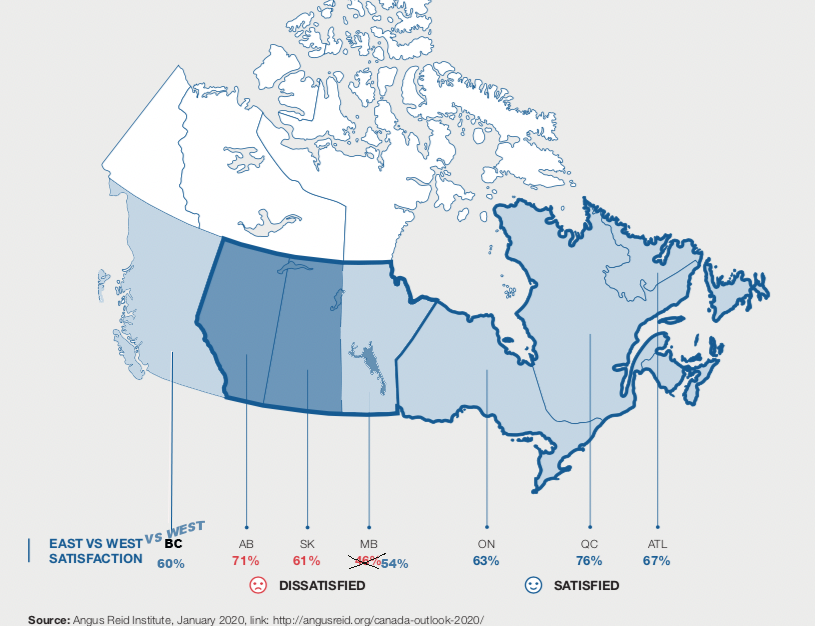
Perhaps the best example of how the Fair Deal report is a partisan political document and not a serious effort in public engagement is this map found on page 52 of the report.
The map on page 52 of the Fair Deal Panel final report.
Framed as an East versus West political crisis over satisfaction with Canada, the map excludes British Columbia, where 60% of respondents to the Angus Reid Institute survey in January 2020 said they were satisfied with “the way things are going in Canada.”
The map also wedges Manitoba into the western bloc by listing that province’s dissatisfied number when the survey showed that 54% of Manitobans were satisfied.
So I fixed the map.
An edited version of the map on page 52 of the Fair Deal Panel final report.
The only two provinces where a majority of survey respondents were unsatisfied are Alberta and Saskatchewan, which also happen to be the only two provinces where a majority of voters supported the Conservative Party of Canada…
Premier Kenney presented a 54-minute long PowerPoint presentation to the press on April 8, 2020.
Alberta is used to being a political outlier. And in the first six months of 2020, when governments and opposition parties in most provinces put aside their political differences to face the COVID-19 pandemic and economic shutdown, Alberta remained an outlier as neither the United Conservative Party government nor the New Democratic Party opposition put aside their differences to rally around the flag. Here are a few reasons why:
Jason Kenney (source: Flickr)
1. Jason Kenney is unpopular. This is not new and has been a problem that has dogged him and his party since he jumped into provincial politics in 2017. Pulling off a coup by taking over the Progressive Conservative Party and merging it with the Wildrose Party to form the UCP may have solidified his popularity among conservative partisans, but most polls have shown his approval and performance ratings dragging far below the high-water mark of UCP support in the 2019 election.
2.The United Conservative Party government is using the pandemic and economic crisis as cloud cover to continue to implement a divisive political agenda. The UCP campaigned on the slogan of “jobs, economy and pipelines,” but during the pandemic the government has barely skipped a beat in continuing its fight with rural and small town doctors, cutting funding that led to 25,000 education workers losing their jobs and thousands of layoffs at Alberta’s technical colleges and universities, and pushing the privatization and closure of Alberta’s provincial parks. And plans to layoff nurses and health care workers? That has only been delayed.
Barely a day goes by where the UCP does not release a meme or video on social media attacking its opponents. Long gone are the days when the old PC Party government would focus on governing and pretend the opposition parties didn’t exist.
It is perhaps not a surprise that the UCP is now trying to paint the NDP with the same “Team Angry” moniker that the PC Party slapped onto the Wildrose Party a decade ago. But the political landscape in Alberta is drastically different as both parties now exist in a competitive environment where Albertans have a taste for electoral change.
With former premier Rachel Notley at its helm and a front bench of former cabinet ministers in its caucus, the NDP are the first official opposition in decades that can legitimately call itself a government-in-waiting. But in a big way, the NDP needs to start acting like a government-in-waiting and talking confidently about what new ideas it will implement and bad UCP ideas it will repeal if or when it forms government again in 2023.
4. Nothing is actually getting done for Albertans who now face record unemployment levels and a very uncertain economic future.
Annalise is co-founder of Champion Communications & PR. She previously worked as a press secretary for Justice Minister Kathleen Ganley, and before that she was a journalist at the Calgary Herald.
The Daveberta Podcast is a member of the Alberta Podcast Network, powered by ATB. The Alberta Podcast Network includes dozens of great made-in-Alberta podcasts.
You can listen and subscribe to the Daveberta Podcast on Apple Podcasts, Google Play, Spotify, Stitcher, or wherever you find podcasts online. We love feedback from our listeners, so let us know what you think of this episode and leave a review where you download.
Find us on Twitter, Instagram, Facebook, or you can email us at podcast@daveberta.ca. Thanks for listening.