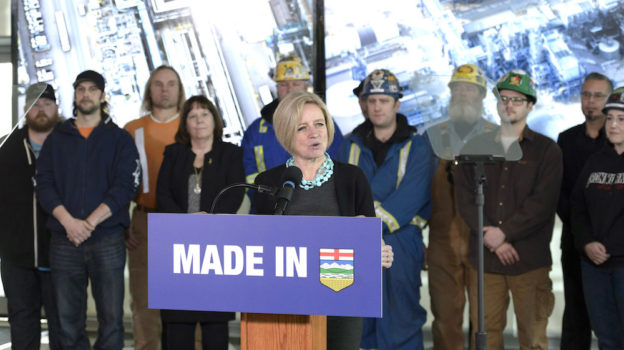
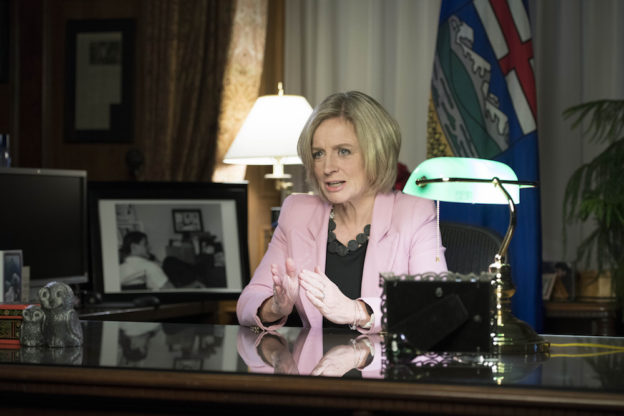
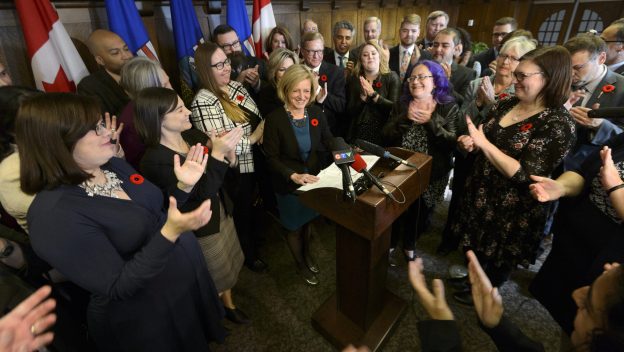
Premier Rachel Notley announced on December 11, 2018 that the government is issuing a Request for Expression of Interest to determine business cases for investing in a new refinery in Alberta or tied to Alberta production. (photography by Chris Schwarz/Government of Alberta)
You can listen and subscribe on Apple Podcasts, Google Play, Stitcher, or wherever you find podcasts online. We would love to hear what you think of this episode, so feel free to leave a positive review where you download, comment on the blog, Facebook or Twitter or send us an email at podcast@daveberta.ca.
And a huge thanks to our producer, Adam Rozenhart, who keeps us on track and makes each episode of the Daveberta Podcast sound so great.
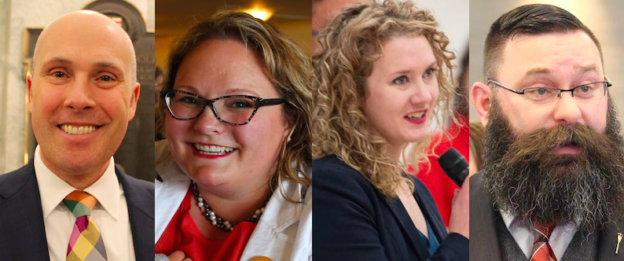
– Wetaskiwin-Camrose MLA Bruce Hinkley is seeking the New Democratic Party nomination in the new Maskwacis-Wetaskiwin district. A retired teacher, Hinkley was first elected in 2015 and is a veteran NDP candidate, having run for the party in Wetaskiwin-Leduc in 1989, and his current district in 1993, 2012 and 2015, and for the party leadership in 1994. He was a candidate for the short-lived Forum Party of Alberta in Wetaskiwin-Camrose in the 1997 election.
Hinkley was elected in 2015 with 43.7 percent of the vote, defeating two-term Progressive Conservative MLA and Minister of Agriculture Verlyn Olson by 1,578 votes. A nomination meeting has been scheduled in Maskwacis-Wetaskiwin for January 8, 2018.
Morgan Bamford is seeking the NDP nomination in the new Camrose district, which includes the eastern portions of the Wetaskiwin-Camrose district. A nomination meeting in this district is scheduled to take place on February 2, 2019.
Pincott served on Calgary City Council from 2007 to 2017 and was nominated as a the NDP candidate in this district on October 25, 2018 and was seen as a star candidate to replace outgoing NDP MLA Brandy Payne.
– Former St. Albert city councillor Neil Korotash is seeking the Alberta Party nomination in the new Moriville-St. Albert district. Korotash teaches Biology and Urban Agriculture at Morinville Community High School and he sought the PC Party nomination in Spruce Grove-St. Albert ahead of the 2015 election. In 2001, Korotash became the youngest city councillor in St. Albert history when he was elected at age 21 in that year’s municipal elections.
The Alberta Party has scheduled a nomination meeting in Morinville-St. Albert for January 19, 2019.
– Tariq Chaudhry has withdrawn from the United Conservative Party nomination contest in Edmonton-Mill Woods and is claiming in an affidavit that Jason Kenney and the UCP cost him more than $25,000. Chaudhry claims Kenney encouraged him to run and asked him to sign up and pay for the $10-membership fee for 1,200 new members. Chaudhry claims he spent $6,000 on memberships and that Kenney’s campaign asked him to organize Eid Mubarak events in 2017 and 2018, on which he spent $20,000, “so Mr. Kenney could be seen speaking to the Edmonton Muslim Community.” Chaudhry is the owner of the Maharaja Banquet Hall.
– Chris Alders has been nominated as the Green Party candidate in Edmonton-City Centre. Alders is a long-time Green Party organizer and ran for the Nova Scotia Green Party in the 2006 and 2009 provincial elections in that province.
– Will Carnegie is seeking the Green Party nomination in Calgary-East. Carnegie is the president of the Forest Lawn Community Association.
– The NDP have now scheduled 20 nomination meetings in January and February, in what is expected to be a flurry of candidacy selection activity ahead of the next election. Along with the 15 meetings mentioned in my previous update, meetings will be held in Bonnyville-Cold Lake-St. Paul, Calgary-Edgemont and Calgary-Hays on February 2, 2019, and in Calgary-Beddington and Calgary-Glenmore on Feb. 3, 2019.
– The UCP have nominated candidates in 79 of Alberta’s 87 electoral districts. The eight remaining nomination contests to be held for the UCP will take place in Calgary-North, Edmonton-Ellerslie, Edmonton-Highlands-Norwood, Edmonton-Meadows, Edmonton-Mill Woods, Edmonton-Strathcona, Lethridge-East, and Red Deer-South. Dates for these nomination meetings have not yet been scheduled.
McLean resigns as MLA
Stephanie McLean
Former cabinet minister Stephanie McLean has resigned as the NDP MLA for Calgary-Varsity. McLean resignation takes place less than two months before Alberta’s fixed election period begins on March 1, 2019. McLean was appointed to cabinet as Minister of Service Alberta in February 2016 and removed from cabinet in June 2018 following her announcement that she did would not run for re-election in 2019.
McLean’s resignation comes as no surprise as it has been rumoured for months that she was unhappy about her current status in the NDP caucus and looking for leave politics before the next election. McLean did not attend the session of the Legislative Assembly in fall 2018.
McLean was first elected in 2015, securing 43.9 percent of the vote. Long-time NDP stalwart Anne McGrath has been nominated to run for the in this district when the next election is called.
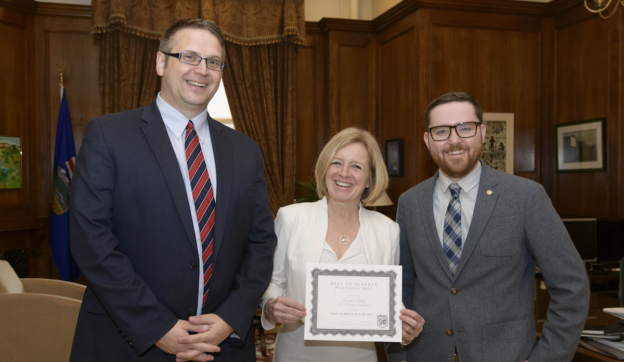
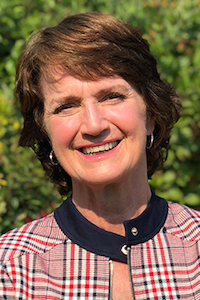
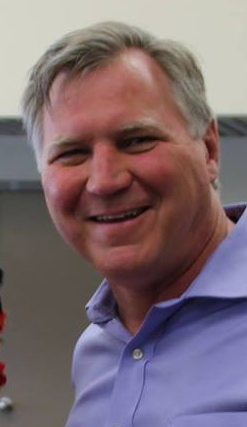
Photo: Premier Rachel Notley, Janet Hinkley, and Wetaskiwin-Camrose MLA Bruce Hinkley (source: Facebook)
We asked listeners to send us their Alberta politics questions and we dedicated our final episode of 2018 to answering them!
We kicked off this episode with a game of “is it more likely,” where we discuss different potential scenarios in Alberta politics in 2019 and then we dove into the mailbag to answer questions on topics including Alberta separatism, political polarization and public policy, the state of opinion in the mainstream media, and whether Twitter is an effective way to discuss politics.
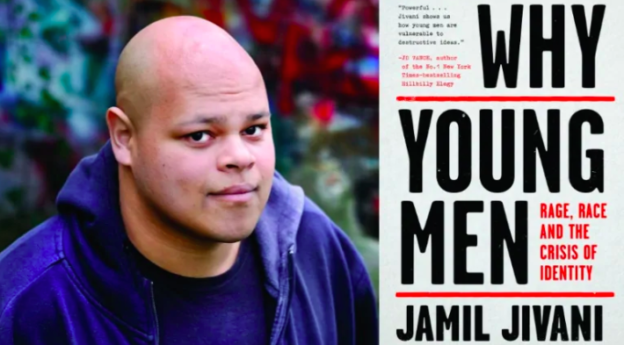
As this is our last episode of 2018, our first season, we want to thank everyone who has listened, downloaded and subscribed to the Daveberta Podcast over the past year. We also want to thank all of our special guest co-hosts who joined us on the podcast in 2018 – Kyla Fisher, Lianne Bell, Janelle Morin, Kate Kerber, Erika Barootes, Janis Irwin, Natasha Soles, Jamil Jivani and Kristin Raworth– we loved having you on the pod!
We really appreciate all of your feedback and and questions and we are looking forward to recording new episodes with some great guests in 2019. With a provincial and federal election expected within the next 10 months, it will be a busy year ahead!
And as always, we owe a huge thanks to our producer, Adam Rozenhart, who keeps us on track and makes each episode of the Daveberta Podcast sound so great.
Thank you for listening. Merry Christmas and Happy New Year!
Reading the pages of the Postmedia newspapers or the #ableg hashtag on Twitter you might believe that Albertans from roughneck Fort McMurray to trendy Kensington are calling for Independence and rising up in arms against their political overlords in Ottawa.
Nope.
A flurry of recent opinion-editorials and columns in the pages of Canada’s Postmedia newspapers have been fanning the flames of discontent and frustration in Alberta. The discontent and perennial alienation from Ottawa is mostly a result of the economic slump and a delay in the expansion of the Trans Mountain Pipeline, but it is difficult to believe that there is any real appetite for Albertans to leave Canada, and the consequences that would follow.
University of Calgary economist Jack Mintz wrote in the Financial Post newspapers this week that an “Albexit” could draw inspiration from the United Kingdom’s disastrous “Brexit” from the European Union. Mintz drew inspiration from another European dumpster fire in 2015 when he penned another cringeworthy Financial Post op-ed predicting that “Alberta is not yet Greece, but it’s heading along that path.”
Three years later, Alberta is not Greece and probably should not be looking to Brexit for inspiration.
The arguments for Alberta’s separation from Canada are so weak and the concept of forming an Alberta Republic is so ridiculous that even the thought of writing this article made me cringe. It is the political equivalent of a toddler’s temper tantrum. But because I am a sucker for punishment, here I go.
Among the many of the disastrous consequences of Alberta leaving Canada would be that it would become virtually impossible to get any new pipelines constructed to the deep water ports that pipeline proponents argue the province’s oil industry needs.
If you believe it has already been acrimonious to get the Trans Mountain Pipeline expansion built in two provinces, just imagine how difficult it would be to negotiate a pipeline project with a suddenly hostile foreign government, whether it be the prime minister of Canada in Ottawa or the president of the Pacific Republic of British Columbia in Victoria. Not to mention the inconvenient fact that the Government of Canada actually owns said pipeline and its expansion project.
Some will argue that the United States of America would open its borders to Alberta or even welcome it as the 51st State, but it seems unlikely that the American government would want to antagonize Ottawa by dealing with a landlocked rogue nation and cause trouble on it’s northern borders.
American corporations already dominate our economy, which saves the US government the messy business of having to govern us. And the likelihood that most Albertans would be inclined to vote for the Democratic Party would also make the statehood route less appealing for many in America’s political establishment.
The Canadian Government saved Trans Mountain by purchasing the pipeline and the expansion project just as Texas-based Kinder Morgan Inc. was preparing to withdraw their application for expansion. The government of Liberal Prime Minister Justin Trudeau paid $4.5 billion for the pipeline and project, and it is expected Ottawa could spend another $7 billion on the project after it meets the necessary conditions set by the Federal Court of Appeal.
The Federal Court of Appeal ordered a stop to the project in August 2018 after the National Energy Board and federal government failed to conduct a proper environmental impact assessment of the increase of marine traffic and failed to properly consult First Nations communities along the route in the final phase of the approval process.
While Trudeau clearly sees the pipeline expansion as a national priority worth spending serious political and real financial capital on, it is unlikely to bring him positive electoral returns in Alberta in 2019. Despite purchasing the pipeline, ensuring it will be built, and announcing $1.6 billion in loans and financial support to the oil and gas industry, support for Trudeau in Alberta has dropped like a lead balloon.
“We didn’t ask for the opportunity to go further into debt as a means of addressing this problem,” Alberta Premier Rachel Notley said in response to the federal government’s bailout package.
It is unclear what Alberta’s politicians want to be done in the meantime. Many are calling the pipeline the only solution to Alberta’s economic problems. The big problem with that argument, if you believe pipelines are the solution, is that even if the Trans Mountain expansion project meets the conditions set by the Federal Court of Appeal in 2019 it might not actually be finished construction until 2022 or 2023. And even if other failed pipeline projects are resurrected, they might take even longer to complete.
That a Prime Minister named Trudeau is not popular in Alberta is no shock. The ingrained hatred for Trudeau and his father in the minds of many Albertans ensures that no matter what the Liberal government in Ottawa does to support our province, it will be seen as either a failure or a hostile attack.
While separatist sentiments bubble up in Alberta politics every decade or so, the last serious political push happened more than 35 years ago, when Western Canada Concept candidate Gordon Kesler won a February 17, 1982 by-election in the former Social Credit fortress of Olds-Didsbury.
The separatist MLA said at his swearing-in ceremony that he had “a lot of responsibility to those who believe in freedom and free enterprise,” but then spent the next few months in the Assembly railing against the metric system and official bilingualism. He and his party were crushed by Peter Lougheed’s Progressive Conservative juggernaut in the November 1982 general election.
Other separatist parties have come and gone since, but they have all faded in the right-wing fringes of Alberta politics.
Meanwhile, outside of the margins of conservative opinion writers and anonymous twitter accounts, two recent polls show that while Albertans might be a little angrier, support for separation remains consistently low.
A recent poll conducted by the research company Ipsos found that “Albertans are a little angrier at the moment, but across the west there is little interest in separation and most measures of connection to Canada are consistent with prior polls taken conducted as long ago as 1997.”
“The level of support for the idea of an independent Alberta is roughly the same as it was in surveys conducted in 2014 and 2016,” said Mario Canseco, President of Research Co. “Four years ago, with a Progressive Conservative government in Edmonton and a Conservative government in Ottawa, the findings were similar to what is observed in 2018.”
The vast majority of Albertans remain proud Canadians regardless of which party has been elected to run the government in Ottawa. The frustration felt by many Albertans towards Ottawa over pipelines construction delays and the low international price of oil should not be ignored, but let’s not pretend that separating from Canada is a viable solution to our economic problems, because it’s not.
Daveberta Best of Alberta Politics 2018 Survey Winners: Rachel Notley, Greg Clark, Shaye Anderson, Jessica Littlewood, and Janis Irwin
With more than 2,100 votes cast in two rounds of voting, we are proud to announce the results of the Daveberta Best of Alberta Politics 2018 Survey. Over the past two weeks, more than 2,100 readers of this website and listeners of the Daveberta Podcast submitted their choices for the survey and voted for the top submissions in each category.
Here are the winners in the Daveberta Best of Alberta Politics 2018 Survey:
Best Alberta MLA of 2018: Rachel Notley, Premier of Alberta and NDP MLA for Edmonton-Strathcona
For a second year in a row, Rachel Notley was vote Best Alberta MLA. Notley earned 50.7% of the total votes cast, placing her ahead of Leduc-Beaumont NDP MLA Shaye Anderson, with 25.5 percent, and Calgary-Elbow Alberta Party MLA Greg Clark, with 23.7 percent.
Best Cabinet Minister of 2018: Shaye Anderson, Minister of Municipal Affairs
In a four-way contest, Shaye Anderson edged ahead with 31.8 percent. Health Minister and Deputy Premier Sarah Hoffman earned 26.4 percent, Children’s Services Minister Danielle Larivee earned 21.5 percent, and Education Minister David Eggen, last year’s winner, earned 20.1 percent of the total votes cast.
Best Opposition MLA of 2018: Greg Clark, Alberta Party MLA for Calgary-Elbow
For a second year in a row, Greg Clark has been voted Alberta’s Best Opposition MLA. With 54.1 percent of the vote, Clark placed ahead of Freedom Conservative Party leader and Strathmore-BrooksMLA Derek Fildebrandt, with 34.4 percent, and United Conservative Party leader and Calgary-Lougheed MLA Jason Kenney, with 11.4 percent.
Up and coming MLA to watch in 2019: Jessica Littlewood, NDP MLA for Fort Saskatchewan-Vegreville
Jessica Littlewood, the NDP MLA for Fort Saskatchewan-Vegreville, won with category with 42.3 percent of the vote. Littlewood beat out last year’s winner, Edmonton-Centre NDP MLA David Shepherd, with 37.1 percent, and Fort McMurray-Conklin UCP MLA Laila Goodridge with 20.5 percent.
New candidate to watch in the 2019 election: Janis Irwin, NDP candidate in Edmonton-Highlands-Norwood
This was a new category we introduced this year to recognize some of the new candidates running in next year’s expected provincial general election. Janis Irwin, the NDP candidate in Edmonton-Highlands Norwood, won in this category with 45.9 percent of the vote. Irwin was followed by Calgary-Elbow NDP candidate Janet Eremenko with 29.6 percent and Calgary-Varsity NDP candidate Anne McGrath with 24.4 percent.
Congratulations to the winners and thank you to everyone who submitted your choices and who voted in this year’s Best of Alberta Politics 2018 Survey.
Daveberta Podcast back on Christmas Eve
Tune in on December 24, 2018 for a special episode of the Daveberta Podcast where we answer questions we have collected from listeners over the past few weeks. Listen and subscribe on Apple Podcasts, Google Play, or wherever you find podcasts online.
We’d love to hear what you think of the Daveberta Podcast, so feel free to leave a positive review and share the podcast with your friends and family. Also feel free to leave a comment on this blog, Facebook or Twitter or send us an email at podcast@daveberta.ca.
Best of Alberta Politics 2018 Greg Clark Sarah Hoffman Laila Goodridge Shaye Anderson
In our most recent episode of The Daveberta Podcast, Dave and Ryan asked you to vote in the Best of Alberta Politics 2018 Survey.
More than 500 of you responded to the survey over the last week with your choices for the biggest political players and defining political issues of 2018. We tallied all the responses from that survey and we are now asking you to vote on the top 3 choices in each category.
The top three choices in each category are now open for you to vote on until 12:00 p.m. on Wednesday, December 19, 2018 and the winners will be announced on Thursday, December 20, 2018.
Premier Rachel Notley, NDP MLA for Edmonton-Strathcona
Greg Clark, Alberta Party MLA for Calgary-Elbow
Shaye Anderson, NDP MLA for Leduc-Beaumont
An honourable mention to Danielle Larivee, NDP MLA for Lesser Slave Lake, and Jason Kenney, UCP leader and MLA for Calgary-Lougheed, who placed a strong fourth and fifth in total submissions. Notley was last year’s winner in this category.
Who was the best Alberta cabinet minister of 2018? – Vote
Sarah Hoffman, Deputy Premier and Minister of Health and Seniors
Shaye Anderson, Minister of Municipal Affairs
David Eggen, Minister of Education
Danielle Larivee, Minister of Children’s Services and Minster of Status of Women
Ministers David Eggen and Danielle Larivee were tied for third place, so they are both included in the voting round in this category. Eggen was last year’s winner in this category.
Jason Kenney, UCP leader and MLA for Calgary-Lougheed
Derek Fildebrandt, Freedom Conservative Party MLA for Strathmore-Brooks
Honourable mentions to Richard Starke, the Independent PC MLA for Vermilion-Lloydminster, and David Swann, the Liberal MLA for Calgary-Mountain View, who placed a strong fourth and fifth place.Clark was last year’s winner in this category.
Jessica Littlewood, NDP MLA for Fort Saskatchewan-Vegreville
Laila Goodridge, UCP MLA for Fort McMurray-Conklin
David Shepherd, NDP MLA for Edmonton-Centre
An honourable mention to Nathan Cooper, UCP MLA for Olds-Didsbury-Three Hills, who placed a strong fourth in the first round of voting. Shepherd was last year’s winner in this category.
Who is the new candidate to watch in the 2019 election? – Vote
Janis Irwin, NDP candidate in Edmonton-Highlands-Norwood
Janet Eremenko, NDP candidate in Calgary-Elbow
Anne McGrath, NDP candidate in Calgary-Varsity
What was the biggest political issue in 2018 in Alberta politics? – Voting Closed
Not surprisingly, pipelines, oil, and the economy were by far the biggest political issue identified in this survey. More than 85 percent of you chose these as the biggest political issue in 2018 in Alberta.
What was the biggest political play of 2018 in Alberta politics? – Voting Closed
This category was a dog’s breakfast. Around 90 percent of the submissions were related in some way to pipelines and the oil industry, but most were difficult to group. Around 30 percent of you chose Premier Notley’s decision to curtail the production of oil as the Best Political Play of 2018, which was the clearest single choice in this category. The wide variety of submissions makes it difficult to choose any top three choices for this round of voting, so I am calling it a draw.
Photo: Greg Clark, Sarah Hoffman, Laila Goodridge, and Shaye Anderson.
The First Minister’s Meeting, oil prices, and Premier Rachel Notley’s performance on the national stage are where we started the discussion in this episode. Dave and Ryan also delved into the latest nomination news and what 2019 holds for Alberta politics, including when the next provincial and federal elections could be called.
We also discuss our choices for theDaveberta Best of Alberta Politics 2018 Survey. Submissions will close on December 12, 2018 at 12:00pm and the top three choices in each category will be included in a round of voting starting on December 13, 2018. Voting will be open until December 19 and the winners will be announced on December 20, 2018.
You can listen and subscribe on Apple Podcasts, Google Play, Stitcher, or wherever you find podcasts online. We would love to hear what you think of this episode, so feel free to leave a positive review where you download, comment on the blog, Facebook or Twitter or send us an email at podcast@daveberta.ca.
Thanks to everyone who sent us questions for this episode. We had so many great questions that we have recorded a special episode dedicated to answering your questions that will be published for your listening pleasure on December 24, 2018.
And a huge thanks to our producer, Adam Rozenhart, who keeps us on track and makes each episode of the Daveberta Podcast sound so great.
Premier Rachel Notley rallies her NDP Caucus MLAs before the start of the fall legislative sitting on Oct. 30, 2017. (photo by Chris Schwarz/Government of Alberta Flickr)
What we know:
The last provincial General Election was held 3 years, 7 months, 2 days ago on May 5, 2015.
According to Section 38.1(2) of the Elections Act, a general election should be held between March 1 and May 31, and in the same three-month period in the fourth calendar year thereafter. This means that the next general election will likely be held between March 1 and May 31, 2019. This fixed election period was introduced in the Election Amendment Act passed on December 6, 2011.
Election campaign periods in Alberta last 28 days. Section 39 (d) of the Election Act states: “the 28th day after the date of the writ is the day on which voting is to take place, or if the 28th day is a holiday, the next following day not being a holiday.” There are a number of statutory and religious holidays that fall in this fixed election period when an election day would not be held: Good Friday is April 19, Easter Monday is April 22, and Victoria Day is May 20.
In accordance with our parliamentary system of government, the Elections Act also states that nothing in the law “affects the powers of the Lieutenant Governor, including the power to dissolve the Legislature, in Her Majesty’s name, when the Lieutenant Governor sees fit.” This means that Lieutenant Governor Lois Mitchell could issue a writ of election and dissolve the Legislative Assembly whenever she is asked to do so by Premier Rachel Notley. It would be highly irregular for a Lieutenant Governor to deny a Premier’s wish to issue a writ of election.
Speculation:
There are a number of factors that could impact when exactly the election is called.
One major indicator of a party’s readiness for an election is the number of candidates they have nominated. As of today, the New Democratic Party has nominated 31 candidates in 87 districts, meaning that party will need to nominate a majority of its candidates in the first few months of 2019 in order to be prepared for a spring election. The United Conservative Party currently has nominated 74 candidates in 87 districts and will have almost an entire slate of candidates nominated by the end of 2018.
Whether the NDP will recall the Legislative Assembly in the spring of 2019 to present a Throne Speech and introduce a budget before calling an election is unknown at this point. The recent session of the Assembly, which ended on Thursday, December 6, 2018, is widely considered to be the last session in which a serious legislative agenda would be implemented. But it is not uncommon for governments to call an election immediately after tabling or passing a budget, and then using that budget as a de-facto campaign platform.
In 2015, Premier Jim Prentice called an election twelve days after a 16 days session which ended with the tabling of a provincial budget. And Premier Alison Redford called the election five days after the MLAs voted to approve that year’s provincial budget.
Tabling a provincial budget before calling an election could be a double-edge sword for the NDP in 2019.
Using a budget as its re-election platform would allow the Notley government to highlight its continued investments in health care, education, and public transportation like Calgary’s Green Line and Edmonton’s west LRT expansion, and contrast its plan with the expected slash and burn budgets that would be introduced under a UCP government led by Jason Kenney. But unless there is a big change in Alberta’s economic situation (and the international price of oil), any budget presented by the NDP in 2019 would likely have a significant deficit. While both the NDP and UCP have said they would plan to run budget deficits for the next few years, it would draw unwanted attention to an issue that is not seen as the NDP’s strength.
But whether or not a budget is tabled before the election, Finance Minister Joe Ceci is still required by the Fiscal Planning and Transparency Act to publicly release a Fiscal Update and Economic Statement on or before February 28, 2019.
Elections Alberta will release the first quarter financial disclosures of fundraising by Alberta’s political parties in mid-April 2019. And if the UCP continues dominating in the fundraising field, the NDP may want to avoid a round of news coverage about how they have been out-fundraised by its main conservative opponent.
A shrewd calculation related to when the election is held could be related to when voters of certain demographics are likely to be in Alberta and have easy access of voting stations. Calling an early election could limit the ability of vacationing snowbirds to cast their ballots in the election. Polls have suggested that the UCP has a considerable lead over the NDP among voters over the age of 65.
On the other end of the demographic spectrum, calling an early election in 2019 would ensure that university and college campuses are in session when the election is held. Polls suggest that the NDP have stronger support among younger and university educated voters. Mobilizing the student vote could make a difference in a number of electoral districts currently represented by the NDP, including Calgary-Currie, Calgary-Mountain View, Calgary-Varsity, Edmonton-Centre, Edmonton-Riverview, and Lethbridge-West.
Delay the election to late 2019 or early 2020?
Notley said publicly in 2017 that she intends to follow both the spirit and letter of Alberta’s fixed-election-date legislation. But as we all know, circumstances sometimes change in politics.
There might be a backlash of public opinion, like the Progressive Conservative government faced when it called an election one year early in 2015, but the NDP do have the ability to wait until Spring 2020 to call the next provincial election. Alberta’s Election Act fixes the period to every four years, but the Charter of Rights and Freedoms says otherwise.
According to Section 4. (1) of the Charter of Rights and Freedoms, “No House of Commons and no legislative assembly shall continue for longer than five years from the date fixed for the return of the writs at a general election of its members.”
The decision to delay the next general election beyond Spring 2019 could have drastic electoral consequences for the NDP, but if the party already sees its chances of re-election as slim, as most polls suggest, it might be convinced to take the gamble. Waiting until late 2019 or early 2020 could mean the election could be held after the start of construction of the Trans Mountain Pipeline expansion and as the economy continues to recover from the drop in the international price of oil in 2014.
Delaying until 2020 would also give Notley an opportunity to campaign against Prime Minister Justin Trudeau in the expected October 2019 federal election. This would give Notley an opportunity to create some distance between herself and Trudeau, who had allies on the climate change file before their political relationship broke down over the Trans Mountain Pipeline expansion delays.
Delaying the election would have unclear consequences for Third Party Election Advertisers.
The Election Finances and Contributions Disclosure Act currently states these groups, commonly known as Political Action Committees, are limited to spending $150,000 province-wide on election-related advertising between December 1 in the year before an election and election day. This legislation was passed under the assumption that the fixed-election period would be honoured. If the election is delayed until past spring 2019 and the post-December 1 limits continue to be implemented, the ability of PACs to advertise during the election would be severely limited.
Ryan Hastman, Rachel Notley and Dave Cournoyer (photography by Chris Schwarz/Government of Alberta)
Photo: Ryan Hastman, Rachel Notley and Dave Cournoyer. With more than 1,200 votes cast, Premier Rachel Notley was chosen as the Best Alberta MLA of 2017 in the Best of Alberta Politics 2017 survey. (photography by Chris Schwarz/Government of Alberta)
Back by popular demand, the Daveberta Podcast is pleased to launch the Best of Alberta Politics 2018 survey. We want to hear from you about the big political players and issues of 2018. Submit your choices for the seven categories below.
Who was the best Alberta cabinet minister of 2018?
Who was the best opposition critic of 2018?
Who is the up and coming MLA to watch in 2019?
Who is the new candidate to watch in the 2019 election?
Submissions will close on December 12, 2018 at 12:00pm and the top three choices in each category will be included in a round of voting starting on December 13, 2018. Voting will be open until December 19 and the winners will be announced on December 20, 2018.
Paige Gorsak is running for the federal NDP nomination in Edmonton-Strathcona.
For the past ten years, Edmonton-Strathcona has been an orange island in a sea of blue. Now with three-term Member of Parliament Linda Duncan choosing to retire when the next federal election is called, members of the New Democratic Party in Edmonton-Strathcona will be gathering on November 26, 2018 to select a new candidate to carry their party’s banner in the only district held by the federal NDP in Alberta.
Two candidates have stepped forward to seek the party’s nomination.
Heather McPherson has progressive credentials as the executive director of the Alberta Council for Global Cooperation and volunteer team leader with Médecins Sans Frontières. She is the former president of the local NDP association and has the endorsement of big names in the NDP establishment, including Duncan and former MLA and provincial party leader Raj Pannu.
Paige Gorsak, a 26-year old community organizer, University of Alberta graduate student and library assistant with Edmonton’s Public Library, is McPherson’s only challenger. Gorsak is running a unabashedly democratic socialist campaign that focuses on social justice issues that push beyond the centre-leftish territory many NDP politicians have staked out in recent years.
Gorsak has been featured in a series of powerful videos on social media and is advocating for change on a wide-range of issues including transition to a 100% renewable energy economy, the elimination of post-secondary tuition and student debt, the creation of free universal childcare and a universal single-payer pharmacare program, and full Indigenous sovereignty and self-determination for First Nations, including a guarantee of treaty rights to education, the full implementation of UNDRIP and the full implementation of Truth and Reconciliation Calls to Action. The list goes on.
Despite the federal district overlapping an area represented by five NDP MLAs, including Premier Rachel Notley, Transportation Minister Brian Mason, Advanced Education Minister Marlin Schmidt, and Housing Minister Lori Sigurdson, Duncan’s provincial counterparts have been publicly quiet about the selection of her successor. But their silence should not be taken as an indication they do not have strong feelings about who should win.
The tension between the federal and provincial NDP in Alberta, especially over the issue of oil development and pipeline construction, has been palpable. Federal NDP leader Jagmeet Singh has taken a position against the expansion of the federal government-owned Trans Mountain Pipeline, a project Notley had spent an incredible amount of political capital trying to get done.
Gorsak’s call for a transition away from non-renewable energy economy has also made her a target of United Conservative Party leader Jason Kenney on social media. But her campaign has responded to Kenney’s attacks with ease and humour, demonstrating that when it comes to issues like climate change, she is not afraid to stake ground outside the provincial NDP’s comfort zone.
Holding on to Edmonton-Strathcona in 2019 will be a tough battle for the NDP, but if the 2015 federal election is any indication, the federal NDP will not find success by tacking to the political centre and mirroring the path traditionally taken by the Liberal Party. The federal NDP should push the limits and provide an exciting and compelling argument for progressive social change. If there is anywhere in Alberta where that kind of message will resonate, it will be in Edmonton-Strathcona.
And Paige Gorsak looks like she could be up to that challenge.
Other parties yet to nominate in Edmonton-Strathcona
The other parties are also in the process of nominating their candidates in this district.Julia Bareman and Sam Lilly are seeking the Conservative Party nomination and Eleanor Olszewski is seeking the Liberal Party nomination. Olszewski earned 20.7 percent of the vote as the Liberal Party candidate in the 2015 federal election.
We would love to hear what you think of this episode, so feel free to leave a review where you download, comment on the blog, Facebook or Twitter or send us an email at podcast@daveberta.ca.
And a huge thanks to our producer, Adam Rozenhart, who keeps us on track and makes each episode of the Daveberta Podcast sound so great.
Last weekend, Justice Centre for Constitutional Freedoms president John Carpay told a crowd at a gathering of conservative activists in Calgary:“How do we defeat today’s totalitarianism? Again, you’ve got to think about the common characteristics. It doesn’t matter whether it’s a hammer and sickle for communism, or whether it’s the swastika for Nazi Germany or whether it’s a rainbow flag, the underlying thing is a hostility towards individual freedoms.”
Carpay quickly apologized for the comments, but drawing the connection between the rainbow pride flag, a symbol of lesbian, gay, bisexual and transgender pride and LGBTQ social movements, and the hammer and sickle and swastika flags, symbols of oppressive and totalitarian regimes, was a step too far.
Postmedia columnist Don Braid wrote in the Calgary Herald that Carpay’s comments were “disgusting, demeaning and dangerous.”
This is notthe first bozo-eruption to dog the UCP leader, but it appears to be the first made by someone with strong political ties to Kenney. The UCP leader spoke at a JCCF event in 2017 where he is reported to have compared Carpay’s work to that of civil-rights activist Rosa Parks.
Carpay and Kenney are social conservative activists from Calgary and have been in the same political circles for decades. Carpay is known for staking out controversial positions popular among social conservatives, whether it be in opposition to abortion or gay rights or, more recently, to student-led anti-bullying clubs known as Gay-Straight Alliances in Alberta schools.
As a delegate at the UCP’s policy conference earlier this year he spoke in support of a policy that would allow teachers to inform parents when students participate in GSAs, a policy that would out some students to their parents. “This is about parental rights. The only societies and governments that trample on parental rights are totalitarian ones,” Carpay was reported to have said at the May 2018 UCP policy meeting.
This most recent bozo-eruption comes on the heels of Kenney announcing that the UCP will build a database to track and purge political extremists from the party’s membership. Kenney announced the creation of the extremists database after spending a week dodging questions about former campaign worker Adam Strashok, who is alleged to have ties to white nationalist and anti-Semitic groups online.
Kenney was quick to pounce on Strashok, declaring that he had ordered party officials to cancel his membership. But Kenney appears to be less eager to dish out a similar fate to Carpay.
The UCP leader’s soft-peddling in response to Carpay is puzzling to many UCP supporters, including some who attended today’s sold-out Edmonton Chamber of Commerce luncheon, where Kenney spoke to a packed ballroom. Speaking to attendees before and after Kenney’s speech, I have the impression that while the UCP’s economic message resonated with the crowd there was an unease and discomfort with Kenney’s social conservative baggage.
Attendees to today’s luncheon may not be alone in their unease. A recent survey released by Abacus Data shows Kenney’s approval ratings are far below support for the party he leads, suggesting that many Albertans like the idea of a UCP government much more than they like the idea of Premier Jason Kenney.
Kenney’s slow response to the most recent bozo-eruption is likely because social conservative activists, like those who support anti-abortion groups Right Now and the Wilberforce Project, anti-GSA Parents for Choice in Education, and Carpay’s JCCF, are key players in the political coalition that Kenney has built during his almost three decades in politics.
Kenney has never hesitated to take hard-line stances against opponents like Premier Rachel Notley, Prime Minster Justin Trudeau, environmentalists Tzeporah Berman and David Suzuki, and even actor Jane Fonda. It is now time for Kenney to prove to Albertans that he can also take an equally hard-line against the social conservative forces that are embarrassing his own party.
Calgary-East MLA Robyn Luff and Premier Rachel Notley at a roundtable on education affordability in 2017 (photography by Chris Schwarz/Government of Alberta)
Photo: Calgary-East MLA Robyn Luff and Premier Rachel Notley at a roundtable on education affordability in 2017 (photography by Chris Schwarz/Government of Alberta)
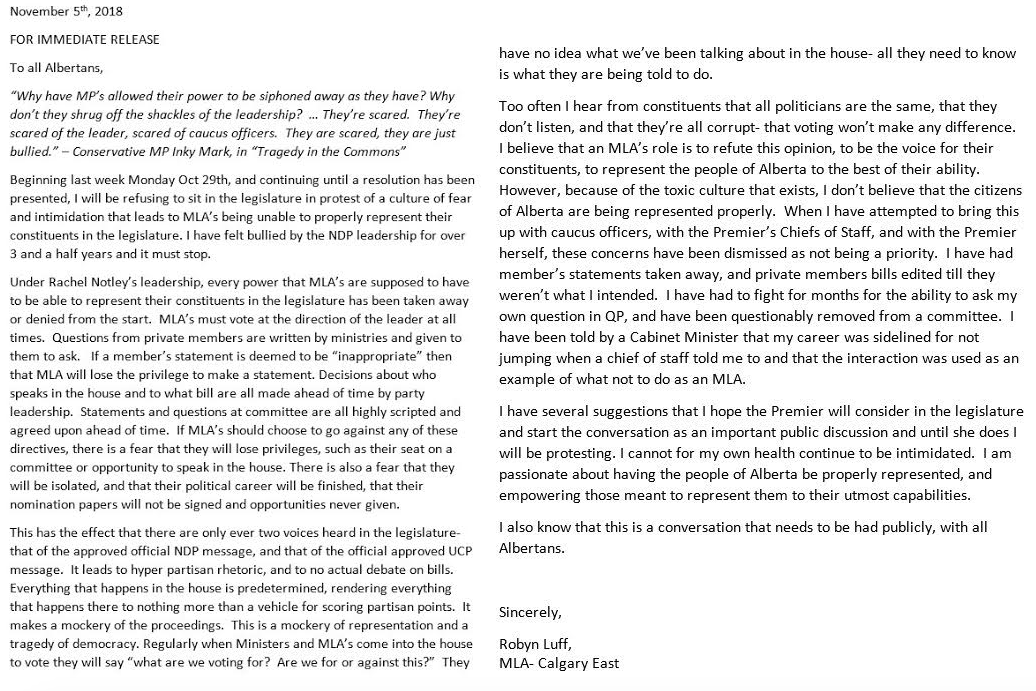
Calgary-East MLA Robyn Luff has been removed from the New Democratic Party Caucus after releasing a public letter announcing she would not sit in the Legislative Assembly “in protest of a culture of fear and intimidation that leads to MLA’s being unable to properly represent their constituents in the legislature.”
Writing that she “felt bullied by the NDP leadership for over 3 and a half years” and faced “a culture of fear and intimidation,” Luff’s letter details the grievances she feels as a backbencher in the government caucus, which include whipped votes and reading scripted questions and private members statements in the Assembly.
Luff wrote in the letter that she would not return to the Assembly “until a resolution has been presented.” It is now likely that when she does return it will be as an Independent MLA.
MLA Robyn Luff’s letter on November 5, 2018
Luff is correct that many of the prepared statements and questions that backbenchers are frequently required to read in the Assembly are scripted, and sometimes comically so. Many provinces do not provide time for government backbench MLAs to ask questions in Question Period, and anyone who has watched an episode of QP will likely see why. Known colloquially as “puffballs,” the scripted questions asked by backbench MLAs are rarely challenging and exist to provide cabinet ministers with an opportunity to read government talking points into Hansard.
“People are permitted to speak their minds, and they have an opportunity to do that,” said Government House leader Brian Mason in response to Luff’s letter. “Everybody in a caucus, especially large caucuses, is frustrated from time to time.”
A statement released by the NDP Caucus late on November 5, 2018, stated that “NDP MLAs have lost confidence in her ability to participate as a productive and trustworthy member of the government caucus.”
Despite her family roots in the Alberta NDP (her grandfather Alan Bush was an Anglican minister who stood in the federal NDP in northern Alberta in the 1965 and 1967 federal elections and ran against Grant Notley for the leadership of the NDP in 1968) a breach of caucus solidarity this large was not going be treated lightly.
There is no doubt Premier Rachel Notley runs a tight ship and because of it the NDP have imposed an impressive level of caucus discipline since forming government in 2015. Since their election victory, the NDP have largely avoided the types of bozo-eruptions and embarrassing scandals that have sometimes become weekly occurrences in the Wildrose-turned-United Conservative Party Caucus.
Caucus discipline is nothing new. It is a characteristic of most functional parliamentary democracies. But the level of control exerted on individual MLAs by party leaders and their staffers is something that could feel incredibly stifling for some backbench MLAs, especially those who might feel more naturally inclined to sit in the opposition benches.
Backbenchers who do not feel they are being valued or given an opportunity to speak up and advocate for the issues they or their constituents feel are important can create resentment towards the political leadership. Providing some sort of relief valve to deal with backbencher frustration is important.
In the mid-1990s, rookie backbench Progressive Conservative MLAs Jon Havelock, Mark Hlady, Lyle Oberg, Murray Smith, Ed Stelmach, and Lorne Taylor formed “the Deep Six” by attempting to drive an agenda of cuts to spending and government services, or at least that is the political narrative that was created.
Aside from being allowed to play minor theatrical roles as the internal opposition to government, most backbench MLAs were largely compliant during the PC Party’s 43-year reign. The caucus and party revolt that ended Alison Redford’s political career in 2014 was a notable exception, but the most significant actual rebellion by backbench MLAs in Alberta’s history was the Social Credit backbenchers revolt of 1937, which nearly toppled Premier William Aberhart’s nascent government.
It is not uncommon for disgruntled MLAs to leave their caucus to sit as Independent MLAs or join other parties, like Sandra Jansen did in 2016 and Rick Fraser and Karen McPherson did in 2017, but Luff’s decision to refuse to take her seat in the Assembly is not a tenable long-term strategy.
Without knowing more, it is not clear that anything Luff wrote she has experienced is new or unique to the NDP Caucus in Alberta, or if she is alone in feeling this way. It is also unclear what Luff’s political future outside the NDP Caucus will hold over the next five months until the 2019 election is called.
Whether publishing that letter was politically smart or political suicide, it took courage for Luff to speak up. And speaking truth to power is something that we should encourage our elected officials to do more regularly.
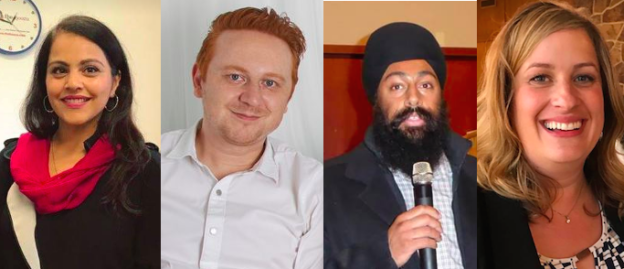
United Conservative Party candidates Rajan Sawhney, Mickey Amery, Jasraj Singh Hallan, and Elisabeth Hughes
Photo: United Conservative Party candidates Rajan Sawhney, Mickey Amery, Jasraj Singh Hallan, and Elisabeth Hughes.
Good evening, here is the latest update of nomination races and candidates preparing to run in Alberta’s next provincial election. As of this evening, the United Conservative Party has nominated candidates in 58 of 87 districts, the Alberta Party has nominated 42 candidates, the New Democratic Party has nominated 24 candidates, the Liberal Party has nominated 5 candidates, and the Green Party has nominated 3 candidates.
The UCP held five candidate selection meetings over the past week.
Mickey Amery defeated Roshan Chumber, Sherrisa Celis and Emile Gabriel to secure the UCP nomination in Calgary-Cross. Amery is the son of former Progressive Conservative MLA Moe Amery, who represented Calgary-East from 1993 to 2015 and ran in east Calgary in every provincial election between 1986 and 2015.
Jasraj Singh Hallan defeated Amarjit Banwait, Usman Mahmood, and Jangbahadur Sidhu to win the UCP nomination in Calgary-McCall. McCall is currently represented by New Democratic Party MLA and cabinet minister Irfan Sabir and was represented by Liberal MLA Darshan Kang from 2008 to 2015.
There are three scheduled nomination meetings being held this week:
November 5, 2018 – 2015 Wildrose Party candidate Terry Devries, Amoriza Gunnink, Nicholas Milliken, past federal Conservative nomination candidate Dan Morrison, and Bettina Pierre-Gilles are seeking the UCP nomination in Calgary-Currie. Anthony Parker’s candidacy was not accepted by the UCP. Gunnink has been endorsed by Airdrie-East MLA Angela Pitt and Pierre-Gilles has been endorsed by Rimbey-Rocky Mountain House-Sundre MLA Jason Nixon.
November 6 & 7, 2018 – Former Morinville town councillor and 2015 Wildrose Party candidate Joe Gosselin, Legal town councillor Trina Jones, Dale Nally, and former Sturgeon County mayor and 2015 Wildrose nomination candidate Don Rigney are seeking the UCP nomination in Morinville-St. Albert.Gibbons town councillor Amber Harris withdrew her candidacy for the nomination on November 2, 2018. Rigney’s endorsements page on his website appears to have been reused from his 2013 mayoral re-election campaign, including a testimonial from now deceased former Social Credit MLA Keith Everitt.
November 8, 2018 – NDP MLA Barb Miller is expected to be acclaimed for her party’s nomination in Red Deer-South. Miller was elected in 2015 with 35.9 percent of the vote in a three-way race.
Calgary-Falconridge – Raman Gill is seeking the UCP nomination. Happy Mann’s candidacy appears to have been rejected by the UCP. Mann was alleged to have been involved in a incident where a local reporter was assaulted. Mann was the Wildrose Party candidate in Calgary-McCall in the 2015 election and Calgary-Cross in the 2012 election.
Calgary-Mountain View – Long-time radio journalist Angela Kokott has been nominated as the Alberta Party candidate. Many Calgarians will know Kokott as the host of Calgary Today on NewsTalk 770. She is the third 770 host to jump into provincial politics in recent history, following Dave Taylor, who served as the MLA for Calgary-Currie from 2004 to 2008 (as a Liberal, then an Independent and Alberta Party MLA), and Mike Blanchard, who ran for the Wildrose Party in Calgary-Buffalo in 2012.
Calgary-North – Melanie Wen has withdrawn her candidacy for the Alberta Party in this district. She had been nominated on October 4, 2018.
Edmonton-Manning – Keli Tamaklo is seeking the Alberta Party nomination.
Edmonton-North West– Emerson Mayers is seeking the Alberta Party nomination. Mayers was recently a candidate for City Council in Ward 4. He ran for the Progressive Conservative Party in Edmonton-Strathcona in the 2012 election and previously sought the Liberal Party nomination in Edmonton-Manning in 1997, the PC nomination in Edmonton-Manning in 2008, the PC nomination in Edmonton-Highlands-Norwood in 2012, and the PC nomination in Edmonton-Beverly-Clareview in 2015.
Richard Feehan
Edmonton-Rutherford – Richard Feehan is seeking the NDP nomination for re-election in 2019. Feehan was first elected in 2015, earning 63.9 percent of the vote. He now serves as Minister of Indigenous Relations and Deputy Government House Leader.
Edmonton-Strathcona – It was never in doubt, but Premier Rachel Notley has officially announced her plans to seek re-election in the district she has represented since 2008. Notley was re-elected with 82.4 percent of the vote in 2015. With the exception of one-term from 1993 to 1997, this district has been represented by the NDP since 1986.
Grande Prairie – Grant Bergis seeking the Alberta Party nomination. Berg is the owner of Grant Berg Gallery and the former general manager of Big Country FM and 2Day Fm.
Red Deer-South – Haley Wile has withdrawn from the UCP nomination contest after it was revealed she accepted an illegal campaign contribution from the Red Deer Motors car dealership. Corporate donations to political candidates were prohibited in 2015.
If you know any candidates who have announced their intentions to stand for party nominations, please send me an email at david.cournoyer@gmail.com. I will add them to the list. Thank you!
We had such a good conversation with Jamil that we didn’t get to our mailbag this week. Thank you to everyone who sent us questions, we will answer them in an extra long mailbag segment in our next episode.
We would love to hear what you think of this episode, so feel free to leave a review where you download, comment on the blog, Facebook or Twitter or send us an email at podcast@daveberta.ca.
And a big thanks to our producer, Adam Rozenhart, who keeps us on track and makes each episode of the Daveberta Podcast sound so great.