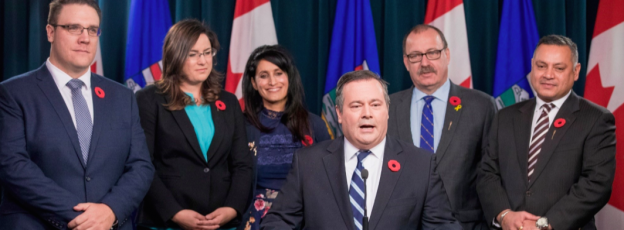
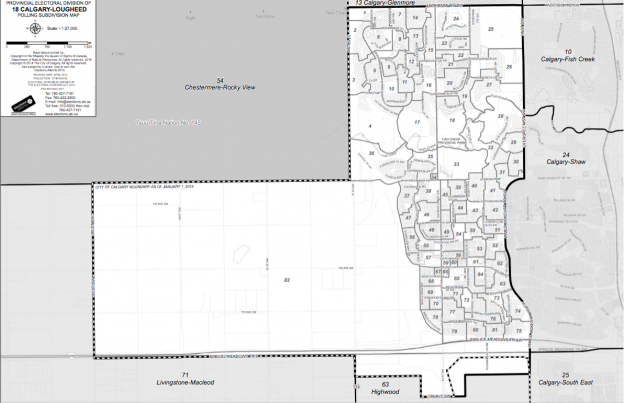
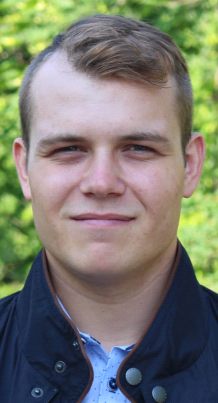
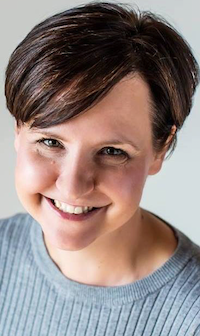
The Calgary-Lougheed by-election, the Alberta Party leadership race, a new ThinkHQ poll, Rachel Notley as Canada’s Pipeline Paladin, and changing electoral boundaries are just some of the topics covered in the latest episode of The Daveberta Podcast with Dave Cournoyer and Ryan Hastman (recorded on Sunday, Nov. 26, 2017).
We’d love to hear what you think of the podcast, so feel free to leave a review where you download it, leave a comment on this blog, Facebook or Twitter or send us an email at podcast@daveberta.ca.
We’d also like to send a special thanks to our producer, Adam Rozenhart, for his help in making this podcast a reality (and making us sound so good!).
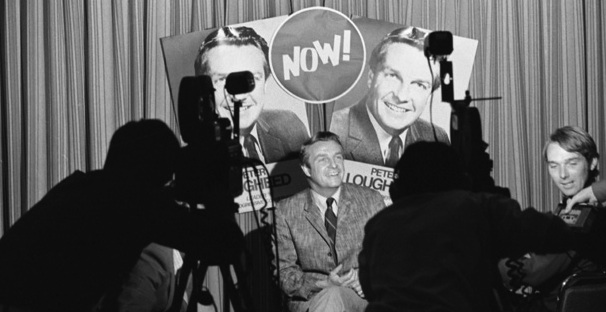
“This is a sale of a depleting resource that’s owned by the people. Once a barrel of oil goes down the pipeline it’s gone forever. It’s like a farmer selling off his topsoil,” former Premier Peter Lougheed once said.
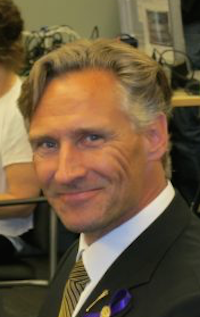
Photo: Former Alberta Premier Peter Lougheed. The Calgary-Lougheed electoral district is named after Lougheed.
It has been one week since the Calgary-Lougheed by-election was called. The by-election is being held on Dec. 14, 2017, but voters in this district also have the option of voting in advance polls on Dec. 6, 7, 8 and 9, 2017.
This is the third by-election since the general election of 2017 that swept the New Democratic Party into government. And like the previous two by-elections, this one will be held in a district where voters elected a Progressive Conservative MLA in 2015.
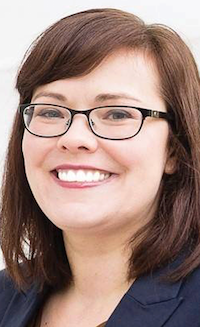
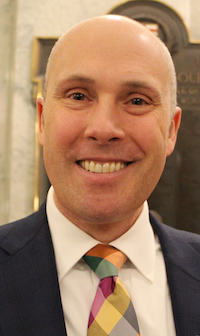
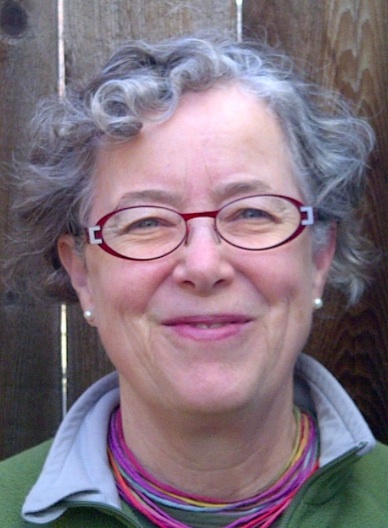
Four candidates have so far been nominated to stand in the by-election:
This will be a tough election for the NDP, as this area of southwest Calgary is considered bedrock conservative territory. In the recent Calgary mayoral election, voters in this part of Calgary supported conservative Bill Smith over progressive Naheed Nenshi.
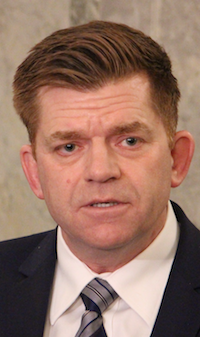
Jason Kenney, United Conservative Party
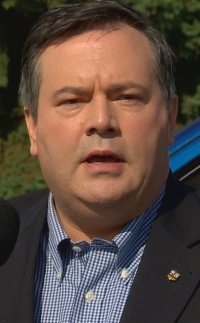
UCP candidate Jason Kenney drew a big crowd of supporters when he opened his campaign office on Nov 19, 2017. The recently elected UCP leader is almost universally considered the favourite to win this by-election.
Kenney and his supporters have started to claim that Albertans’ home heating bills will increase by 75 percent because of the province’s Carbon Levy. Environment and Parks Minister Shannon Phillips denied Kenney’s claims, describing them as ‘patently false,’ but the UCP has capitalized on confusion about the provincial and federal carbon taxes in order to draw connections between the Notley NDP and the Trudeau Liberals.
The claims are reminiscent of Kenney’s rhetoric and photo-op from December 31, 2016, when he insinuated the same Carbon Levy would lead to a spike in automobile gas prices. That didn’t happen. With constant predictions that the sky is falling on the issue of a carbon tax and rampant truthiness on other issues, Kenney is sounding more and more like Chicken Little.
This will be Khan’s third election attempt since 2014 and his first since becoming leader earlier this year.
He first ran as his party’s candidate the 2014 Calgary-West by-election, where he placed 3rd with 8.5 percent of the vote. In the 2015 general election he ran in Calgary-Buffalo, where he placed 3rd with 24.7 percent of the vote (the constituency was represented by Kent Hehr from 2008 to 2015).
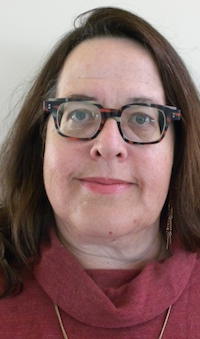
Tittel was selected as the party’s leader at a November 5, 2017 meeting in Red Deer. She previously ran for the federal Green Party in the 2015 general election in Foothills, where she placed 4th with 3.25 percent of the vote.
This is the second consecutive by-election in which the party’s has declined to run a candidate. In a Feb. 29, 2016 media release about the Calgary-Greenway by-election, party leader Greg Clark said “Running in this byelection is not the best use of our resources as we build towards 2019.”
Sitting out this by-election presents a missed opportunity for the Alberta Party to debut itself following its revival last weekend in Red Deer. But having their candidate get clobbered by Kenney would take a bite out of their narrative that they are a growing home for moderate conservative voters. By not running a candidate, the Alberta Party saves themselves the embarrassment of placing third, fourth or fifth in this by-election.
The by-election was necessitated by the resignation of United Conservative Party MLA Dave Rodney on October 30, 2017 to allow his party’s new leader, Jason Kenney, to seek a seat in the Legislative Assembly. Kenney was officially nominated as his party’s candidate earlier this week and is widely seen as the favourite to win the by-election.
“In this by-election, Calgary-Lougheed voters can tell the NDP to stop their job-killing policies, stop quadrupling the province’s debt and stop raising our taxes,” Kenney said in a press release, setting a curmudgeonly tone for the by-election campaign.
Along with a strong party organization in this fairly safe Conservative voting electoral district, Kenney will have the support of various Conservative political action committees.
The New Democratic Party will nominate physician Phillip van der Merwe as their candidate on Saturday, November 18, 2017. van der Merwe practices medicine at a Family Practice and Vasectomy Clinic in Calgary’s Mission neighbourhood. He was the co-chair of the PCN Physician Leads Executive when Health Minister Sarah Hoffman announced a new agreement with the province’s doctors to overhaul the primary care network system.
van der Merwe is also openly gay and married, which could create some interesting politics because of Kenney’s opposition to the recently passed Bill 24, which prevents teachers from outing students who join Gay-Straight Alliances to their parents.
According to Elections Alberta financial disclosures, van der Merwe donated $1,500 to Alberta Party leader Greg Clark‘s campaigns in the 2014 by-election and 2015 general election in Calgary-Elbow.
van der Merwe told Postmedia’s Don Braid that he was running for the NDP “because I don’t believe the NDP is anything but a good centrist alternative for all Albertans … an inclusive and welcoming party.”
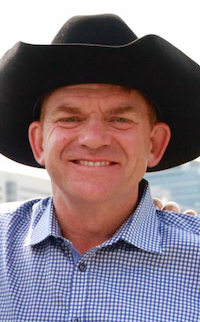
The other parties have yet to announce their candidates, though there is speculation that new party leaders David Khan of the Liberal Party and Romy Tittel of the Green Party will join the race. The Alberta Party is also expected to run a candidate in this by-election.
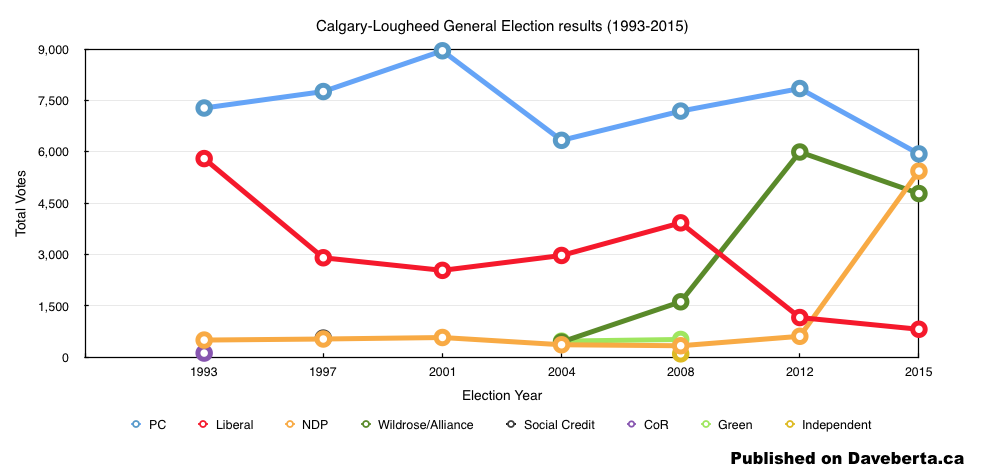
Here is a look at election results from Calgary-Lougheed for the General Elections from 1993 to 2015:
The Alberta Association of Municipal Districts and Counties approved a resolution opposing the recommendations included in the final report of the Electoral Boundaries Commission this week at their annual meeting in Edmonton. The organization representing municipal districts and counties opposes the dissolution of three rural districts and is calling for an amendment to Section 13 of the Electoral Boundaries Commission Act.
A press release issued by the AAMDC states the organization has no issue with the creation of new urban seats to support the significant growth in the urban centres, but feels strongly these seats should not be created at the expense of rural Alberta.
“To suggest that effective representation will be achieved by decreasing the number of long-standing rural seats will disservice rural Alberta greatly,” AAMDC president Al Kemmere said in the news release. “Rural communities are an intrinsic part of Alberta and as such, deserve to have a voice in our democratic institutions.”
Section 13 of the Electoral Boundaries Commission Act limits the number of districts represented in Alberta’s Legislative Assembly to 87. Presumably, the AAMDC would like to see an increase to the total number of MLAs in order to offset the loss of rural representation in the Assembly.
In 2010, then-Justice Minister Alison Redford introduced Bill 28: Electoral Division Act, which increased the total number of electoral districts represented in the Legislature from 83 to 87. It was widely believed that this increase was an attempt to quell political opposition to any decrease in rural representation by the large caucus of rural Progressive Conservative MLAs.
The Commission’s final report recommends the creation of three new urban districts to reflect significant population growth in urban municipalities such as Airdrie, Calgary, Chestermere, Cochrane, Edmonton and Spruce Grove. The report’s recommendations also reflect the considerable growth of suburban and acreage communities in counties surrounding these urban areas.
While most areas of the province have experienced some level of population growth since the last time electoral boundaries were redrawn in 2011, some rural areas east of Red Deer and in east central Alberta have experience a decline in population.
The elimination of rural districts will result in geographically larger rural districts. This will pose increased challenges to MLAs who will need to represent more sprawling and geographically diverse constituencies, but the elimination of rural districts is inevitable unless their populations increase at a rate larger than the growing urban areas.
Rural Alberta has experienced a significant decline in electoral representation over the past fifty years, partly due to population growth in the urban centres but mostly due to the gradual elimination of intentional political gerrymandering of electoral districts, which created a lopsided over-representation of rural MLAs in the Assembly.
In the 1967 election, rural Albertans were 31 percent of the population but rural areas represented 44 of 63 electoral districts in the province. That rural overrepresentation declined only slightly in the 1971 election, when rural Albertans represented 27 percent of the population and 42 of 75 electoral districts.
The blatant overrepresentation of rural areas over the province’s growing urban areas continued under the old PC government until at least the mid-1990s. Rural gerrymandering was once a hallmark of Alberta’s political history, but recent Electoral Boundary Commissions worked to equalize representation of rural and urban areas in the Assembly.
Politics and Rural Representation
When the Commission’s final report is introduced for debate in the Assembly, which could happen in the coming weeks, we can expect the United Conservative Party caucus to oppose many of the recommended changes. While there are legitimate concerns with some of the boundary changes impacting rural areas, the UCP will use the report’s recommendations to attack the urban-based New Democratic Party, which is already unpopular in rural Alberta.
Unlike the PC caucus in 2010 and the UCP caucus in 2017, the governing NDP caucus is largely composed of MLAs representing urban districts in Calgary, Edmonton, Red Deer and Lethbridge. The relatively small rural NDP caucus, which includes Children’s Services Minister Danielle Larivee, Energy Minister Marg McCuaig-Boyd, Municipal Affairs Minister Shaye Anderson, Agriculture Minister Oneil Carlier and Economic Development Associate Minister Jessica Littlewood, does not have the numerical leverage over their colleagues that rural caucuses have had in the past.
The decreasing influence of rural MLAs in Alberta governments since 2012, when the Wildrose Party swept into opposition, led the AAMDC to find itself sitting on the outside of political power for the first time in decades.
For many years, the AAMDC was known in political circles as the PC Party’s “farm team,” because many rural politicians had used the organization as a springboard in attempts to win PC candidate nominations (including current president Al Kemmere and former county reeves Jack Hayden, Ray Danyluk and Ed Stelmach).
The PCs under Redford’s leadership struggled to communicate rural interests in government and it is unclear if the current NDP government even has much of a rural agenda.
This week’s announcement from Shaye Anderson that the government will provide a tax credit for uncollectible education property taxes on defunct oil and gas properties, known as orphan wells, should be popular among rural municipal leaders. But previous transgressions, like the fumbled passage of Bill 6 and the phase-out of coal-fired power plants early in the NDP’s term in government created significant resentment in rural areas. These issues will pose a major challenge for NDP MLAs seeking re-election in rural districts in the 2019 election.
A Greg Clark self with his supporters on the campaign trail in Calgary-Elbow.
Photo: Alberta Party leader Greg Clark on the campaign trail in Calgary-Elbow in 2014. Source: Twitter.
In the latest shakeup in Alberta politics, Greg Clark announced last Friday that he would resign as leader of the Alberta Party at the party’s upcoming annual general meeting on November 18, 2017. Clark has served as party leader since 2013 and became the party’s first elected MLA in 2015 when he unseated Progressive Conservative cabinet minister Gordon Dirks in Calgary-Elbow.
Karen McPherson
With the floor-crossing of former New Democratic Party MLA Karen McPherson earlier this month, Clark had succeeded in helping double his party’s caucus. But despite generating an impressive share of media attention, Clark has been unable to raise the amounts of money the Alberta Party would need to be competitive in the next election. And even though there has been increased interest in the party’s membership since the PC Party became defunct under Jason Kenney’s leadership, the Alberta Party has not seen growth in the public opinion polls.
With the increasing influence of the Alberta Together political action committee, formed by former PC Party officials including Stephen Mandel, rumours had been circulating for months that Clark’s leadership could come to an end before the party’s annual meeting.
Over the course of its three decades in existence, the Alberta Party has become sort of a rotating door for politcos without a home, starting with western separatists in the early 1980s and disaffected Greens, Liberals, New Democrats and moderate Tories in the late 2000s. Clark was a former Liberal, having worked as a staffer at the Legislature during Laurence Decore‘s time as party leader (Clark’s father, Gilbert Clark, was 823 votes away from ending Ralph Klein‘s political career when the former mayor first ran for provincial office in Calgary-Elbow in 1989).
Now it appears the party is a new home for moderate Tories unhappy with the hard right-ward turn of the UCP under Kenney’s leadership.
Katherine O’Neill
As I wrote in June 2017, the Alberta Party is a blank slate with a great name, but whether or not this latest group to wander over will translate that name into electoral success is yet to be determined.
According to the Globe & Mail, the party could lean on the Alberta Together PAC for fundraising support to help offset the costs of the leadership race. This is concerning because PACs like Alberta Together fall outside of the province’s Election Finances and. Contributions Disclosure Act, which raises legitimate concerns about transparency and accountability of political fundraising and spending.
With less than 15 months until a potential election call, the urgency surrounding the leadership and the role of Alberta Together could be a reaction to signals from Premier Rachel Notley that the NDP government plans to tighten rules governing PACs before the next election.
Now that Clark has made his announcement, it is unclear if he or the Alberta Together group have a chosen candidate waiting in the wings to run for the party leadership.
Doug Griffiths
McPherson has said she does not intend to run and neither does Alberta Together CEO Katherine O’Neill. It is also unclear whether Clark will re-contest the leadership he is about to resign from.
Had Clark resigned four months ago, it might not be surprising to see municipal politicians like Nenshi, Edmonton mayor Don Iveson and Grande Prairie mayor Bill Given consider throwing their name in the race. But with the municipal elections having only been held on October 16, it would be difficult politically for any current municipal mayor or councillor to justify running for the leadership.
Former PC MLAs Thomas Lukaszuk, Doug Griffiths, Teresa Woo-Paw, and Stephen Khan and current Independent PC MLA Richard Starke have been mentioned as potential candidates, though bringing in former politicians associated with an unpopular old government might not be the best strategy for the newly rebranded party.
Ryan Jespersen
Popular 630CHED radio host Ryan Jespersen is a compelling name on the list of rumoured leadership candidates named by Postmedia columnist Don Braid. Jespersen is well-known in Edmonton and northern Alberta, well-spoken on a wide-range of issues and is not a former PC MLA – which would be an asset if he did decide to run. (He would not be the first of his family to enter Alberta politics. His great-uncle, Ralph Jespersen, served as the Social Credit MLA for Stony Plain from 1967 to 1971).
As some conservatives will meet under Preston Manning’s banner at Red Deer College, former PC supporters and the Alberta Together group will meet across town at the Radisson Hotel to consolidate their position inside the Alberta Party. A dozen notable former PC officials are running to fill the 12 positions on the party’s board of directors:
Sumita Anand served as the PC Party’s west Calgary regional director until she resigned on May 24, 2017. She had served as president of the PC association in Calgary-Foothills during and immediately following Jim Prentice’s tenure as party leader.
Denise Brunner served as the PC Party’s vice president organization. She stepped down in January 2017 after being accused of bias by Kenney’s supporters during the PC leadership race. According to Elections Alberta financial disclosures, she was Chief Financial Officer for the Edmonton-Castle Downs PC association in 2006 and currently serves as the president of Alberta Party association in Edmonton-Castle Downs.
Cole Harbin served as Executive Vice President of the PC Youth of Alberta until 2016 and as a Vice President of the PC constituency association in Lethbridge-West until 2017. He previously worked as a constituency assistant for former MLAs Doug Griffiths and former Lethbridge-West PC MLA Greg Weadick.
Jackie Clayton was recently re-elected to serve a second term on Grande Prairie City Council and is the former Peace Country regional director for the PC Party.
Brian Heidecker is a big name in the former PC Party establishment. He served as Chair of University of Alberta Board of Governors, and was appointed to the boards of the Alberta Treasury Branches Board and the Alberta Securities Commission. He served as a PC Party Vice-President and Chief Financial Officer for Doug Griffiths’ 2011 campaign for the PC Party leadership.
Blake Pedersen was elected in 2012 as the Wildrose Party MLA for Medicine Hat and crossed the floor to the PC caucus in 2014. He was defeated by NDP candidate Bob Wanner in 2015 and currently serves as president of the Alberta Party association in Cypress-Medicine Hat.
Shawn Pickett served as president of the PC association in Red Deer-North and Central North regional director until resigning in July 2017, referring to Kenney’s leadership bid as a “hostile takeover” of the PC Party.
Stephanie Shostak is the former north Edmonton regional director for the PC Party. Shostak now serves as the president of the Alberta Party association in Edmonton-Beverly-Clareview.
Patty Wickstrom served as the PC Party’s Board Secretary until she resigned in July 2017. According to Elections Alberta financial disclosures, she previously served as president of the PC association in Calgary-Currie from 2008 to 2010.
Lorna Wolodko previously served as St. Albert regional director with the PC Party and worked as a constituency manager for Stony Plain PC MLAs Fred Lindsey and Ken Lemke before working in the Office of the Premier. Wolodko ran for the PC Party nomination in Stony Plain ahead of the 2015 election.
Despite pledging to build a big tent conservative party, Jason Kenney and his United Conservative Party MLAs appear to be doing their best this week to define themselves as the voice of social conservatism in Alberta. While I was convinced this new Conservative party would be disciplined enough to avoid being caught in the trap they found themselves in 2014 and again earlier this year, their actions this week suggest otherwise.
Mike Ellis
UCP opposition to Bill 24: An Act to Support Gay-Straight Alliances, has caught the party on the wrong side of public opinion and on the wrong side of history. The bill would protect the privacy of students who decide to participate in a student-organized Gay-Straight Alliance and prevent those students to be outed to their parents by teachers or school administrators.
While introducing an amendment to Bill 24, Calgary-West UCP MLA Mike Ellis suggested GSAs could be a cover for the teaching of a covert sexual education curriculum. Ellis told the Assembly that his party “unequivocally support GSAs” but he believed the bill “deliberately or unwittingly erodes parental rights.”
“…it’s deeply disappointing that the members opposite continue to peddle dangerous conspiracy theories instead of accepting the simple fact that this is about protecting kids,” said Calgary-Hawkwood NDP MLA Michael Connolly in response to Ellis’ proposed amendment.
While Ellis did not actually use the words ‘secret gay agenda’ when suggesting GSAs could have a covert sexual education curriculum (which they do not), one of Kenney’s prominent supporters is actually saying just that.
“If my son or daughter, having reached, say, the age of ten or eleven, is lured into a school sex club, is persuaded that he or she must be homosexual, acts accordingly, acquires HIV and then AIDS and remains crippled for life, whom do I sue?” wrote Byfield. “The government, or the minister that helped bring this tragedy upon us?”
I was surprised to discover the recent announcement that Byfield will be awarded a Senate 150 Medal by Edmonton Conservative Party Senator Betty Unger. The medal recipients were chosen “in recognition of their significant contributions to their communities.” According to a message on Unger’s Facebook page, the medals will be presented in a ceremony on November 14.
Michael Connolly
Despite the opposition of the UCP and some outdated conservative commentators, educators and school board trustees continue to voice their support for the NDP’s Bill 24.
David Keohane, superintendent of the Greater St. Albert Catholic Schools, told the St. Albert Gazette that his board appears to be in compliance with the new bill. “Job number one is ensuring the safety and well-being of a child while they’re at school,” Keohane told the Gazette, noting that outing a child before he or she is ready can harm them.
Despite school trustees from across the province voicing their support for Bill 24, Kenney argues that teachers should be allowed to decide when to inform parents when a student joins a GSA.
“We trust highly trained educators to use their professional judgment to make decisions in the best interests of children, particularly given that this policy applies to children as young as five years of age,” Kenney said in a press conference on November 2. It is unclear where Kenney found evidence that five year olds have been organizing GSAs, which seems like a fairly silly and weird claim.
Perhaps the most convincing argument I have heard this week in response to Kenney’s opposition to Bill 24 came in the form of a comment on Facebook:
“I’m frustrated by the way he is using the “teachers know better than politicians” line. Actually, as a teacher, we don’t. The point of the legislation is that the student gets to decide when and to whom they come out, because that is best for the mental health of the student. I feel like he is trying to frame the issue to make himself appear that he is on the side of the teachers, when in reality, many support this bill because it supports the mental health of some of our most vulnerable students. He says he doesn’t want to out LGBTQ+ students, when mere months ago he was saying exactly that to pander to his social conservative base. So frustrating.”
Kenney’s reaction to Bill 24 this week actually surprised me. I did not expect the UCP leader to embrace a progressive agenda, but I believed a 20-year veteran of Ottawa politics would at a bare minimum take a reasonable approach to creating safe school environments for students, not, as Postmedia columnist Paula Simons tweeted this week, sound an “air raid siren of homophobia.”
Kenney’s declaration of opposition to the bill came the morning after UCP Legislature leader Jason Nixon told reporters that UCP MLAs would be allowed a free-vote on the bill. It is not clear whether their unanimous opposition is the result of a free-vote, or whether the unanimity reached was directed by Kenney.
The bill would prohibit school administrators from informing parents when students join GSAs, which are student organized safe space clubs, or anti-bullying clubs. A study from the University of British Columbia found that Canadian schools with GSAs may reduce the odds of suicidal thoughts and attempts among both sexual minority and straight students.
Medicine Hat Public School Division board chair Rick Massini, told Medicine Hat News that “…GSAs are instrumental in providing students with a sense of security and safety. Certainly, for some kids, having that information shared with parents would be pretty devastating for them. I am glad to see there is something formal in place to protect them.”
Even former MLA Jeff Wilson, who served as a Wildrose and Progressive Conservative MLA for Calgary-Shaw from 2012 to 2015, is urging UCP MLAs to vote in favour of Bill 24.
I hope that @UCPCaucus members don’t blindly follow their leader on Bill 24. Use your voice and your vote to strike a balance. Follow your gut and stand up for these kids. #ableg
The NDP see Bill 24 as an important law to protect students that also has the added benefit of being a wedge issue that has divided conservatives in the past. When private members motions and bills supporting GSAs were brought to the Legislature in 2014 by then-Liberal MLAs Kent Hehr and Laurie Blakeman, the debate led to a damaging public split between moderate and social conservatives in the Wildrose and PC caucuses.
Laurie Blakeman
The political message of Bill 24 is directly aimed at Kenney, who was widely criticized after commenting to Postmedia’s Calgary editorial board that parents should be informed when students join a GSA. The comments created imagery of state-sanctioned outing of gay kids who might be fearful of their family’s reaction.
The issue even caused the normally front-and-centre Kenney to go into hiding, reemerging one month later at a $500-a-plate federal Conservative fundraiser at a posh downtown Vancouver restaurant.
As a wedge issue I am not sure how many votes this bill alone will move from the UCP to the NDP column in the next election. I suspect it serves primarily to solidify support for the NDP on this already clearly defined issue, while drawing out the social conservative tendencies of Kenney and his UCP.
Creating safe school environments for students is critical, but reigniting the political debate on this overwrought issue risks creating a distraction from the NDP’s broader education agenda.
The UCP opposition to Bill 24 contradicts much speculation that Kenney would pivot toward more moderate stances on social issues. But as I wrote last month, I suspect Kenney and the UCP are betting that Albertans will forgive their social conservative stances when reminded of the NDP’s more unpopular economic policies. Notley and the NDP are betting that this bill to protect Alberta students will convince voters consider otherwise.
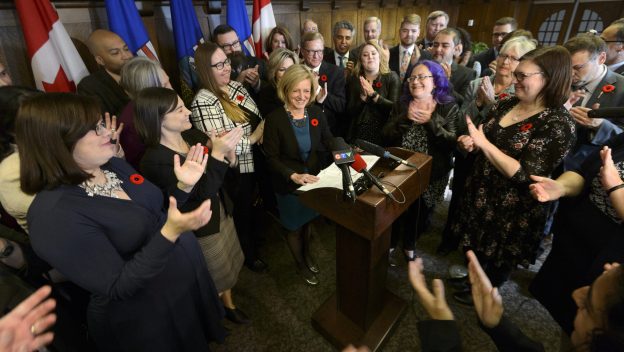
Premier Rachel Notley rallies her NDP Caucus MLAs before the start of the fall legislative sitting on Oct. 30, 2017. (photo by Chris Schwarz/Government of Alberta Flickr)
Photo: Premier Rachel Notley rallies her NDP Caucus MLAs before the start of the fall legislative sitting on Oct. 30, 2017. (photo by Chris Schwarz/Government of Alberta Flickr)
NDP focus their attacks on Kenney
Jason Kenney
A first-time visitor to the Assembly this week could have confused Premier Rachel Notley‘s New Democrats with the Official Opposition as backbencher after backbencher asked government ministers to explain the damage that new UCP leader Jason Kenney would do to Alberta. The NDP even released a handful of attack ads on Facebook, targeting Kenney’s comments about outing students who join Gay-Straight Alliances.
The NDP want to define Kenney and the UCP early in his mandate and are eager to respond to the vicious attacks targeted at them by the Wildrose Party, Kenney’s supporters, and now the UCP since the 2015 election. But this week’s opening shots were over-kill.
We cannot expect political parties to avoid playing politics, especially as we approach the next provincial election. The NDP have every right to challenge Kenney on his controversial statements but the government should carry itself with a little more dignity than it did this week with it’s staged criticisms of the new UCP leader in the Assembly.
Justice Minister Kathleen Ganley tabled Bill 23: Alberta Human Rights Amendment Act, which adds “age” as a prohibited ground of discrimination in cases of tenancy, goods, services and accommodation. The bill puts an end to adults-only apartment buildings as of Jan. 1, 2018 and gives condo owners a 15-year grace period to implement the new rules. Seniors-only housing is exempt.
UCP trying to tie Notley to Trudeau
United Conservative Party leader in the Legislature Jason Nixon started Question Period each day this week with a question to the Premier about oil pipelines and the relationship between Notley and Prime Minister Justin Trudeau. As I wrote earlier this week, the UCP clearly sees a political advantage in trying to tie the Notley government to the Trudeau Liberals in Ottawa.
Following Kenney’s victory in last weekend’s UCP leadership race, more than 20 UCP Caucus staffers, mostly former Wildrose Caucus staff, lost their jobs at the Legislative Assembly.
According to AlbertaPolitics.ca writer David Climenhaga, Kenney has hired a handful of his close advisors, many from his years in Ottawa, to run the UCP Caucus: Chief of Staff Nick Koolsbergen, Deputy Chief of Staff Matt Wolf, Calgary Office Manager Blaise Boehmer, Communications Director Annie Dormuth, Director of Operations Jamie Mozeson, Daniel Williams, Peter Bissonnette and Andrew Griffin.
Now with two MLAs in the Alberta Party Caucus, the third largest caucus in the Assembly wants to be granted official party status, which would give Greg Clark and Karen McPherson increased resources and a more prominent role in daily Question Period.
Section 42 of the Legislative Assembly Act states that “recognized party status” shall be granted to a caucus with at least 4 MLAs and a party that received at least 5 percent of the vote in the most recent election.
Clark has pointed out that the NDP were granted official party status when only two of the party’s MLAs were elected in 1997, 2001 and 2008. But in each of those elections, the NDP met the second criteria of earning more than 5 percent of the vote. The Alberta Party currently meets neither of these criteria, having only earned 2.8 percent of the province-wide vote in 2015.
New Democrats who might oppose granting the Alberta Party official status should be reminded of their own party’s situation 35 years ago, when first-term Edmonton-Norwood MLA Ray Martin introduced a private members bill that would have lowered the threshold of recognized party status to one MLA. At the time, huge Progressive Conservative majorities were the norm, and in the 1982 election the only elected opposition consisted of two New Democrats and two Independent MLAs (both former Social Credit MLAs who would later form the Representative Party of Alberta).
The four-MLA threshold is arbitrary and the vote results from the previous election should be irrelevant in recognizing the creation of new caucuses. The Alberta Party should be granted recognized party status, provided with additional resources and given a more prominent role in Question Period now that their caucus has doubled.
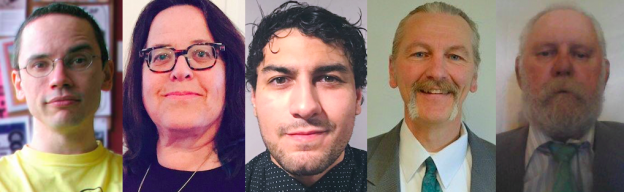
Grant Neufeld, Romy Tittel, Marco Reid, James Friesen and Brian Deheer have submitted their applications to run in the race to replace Janet Keeping, who has led the party since 2012 and announced earlier this year that she would step down. Members will select a new leader at the party’s annual general meeting in Red Deer on November 4, 2017. According to the party website, members can either vote in person at the AGM or cast their ballots online.
The party is far from the mainstream of Alberta politics on issues like the construction of oil pipelines, but it could be position to gain the votes of some environmentalist New Democrat voters dissatisfied with the Notley Government’s avid pro-pipeline advocacy and working relationship with energy industry leaders.
No one expects the Greens to form government, and their potential for electing their first Alberta MLA appears to be slim, but the lack of high-stakes puts the Greens in a position to talk about certain issues – especially around the environment and development – that the mainstream parties will not touch.
The party ran candidates in 24 constituencies in the 2015 election and earned a total 7,321 votes across the province. Leadership candidate Brian Deheer had the party’s strongest showing in the last election in Lac La Biche-St. Paul-Two Hills, where he earned 2.8 percent of the vote.
More recently, Keeping earned 2.9 percent in the 2015 Calgary-Foothills by-election and Thana Boonlert earned 2 percent of the vote in the 2016 Calgary-Greenway by-election.
The Green Party’s best ever showing in a provincial election took place in 2008, when the party earned 43,222 votes, or 4.5 percent of the province-wide vote. In that election, property rights activist Joe Anglin earned 22 percent of the vote in the Lacombe-Ponoka constituency. Anglin led the party for a short period until it was dissolved in 2009 (it reformed in 2011) and was later elected as a Wildrose candidate in Rimbey-Rocky Mountain House-Sundre, where he served as MLA until 2015.
The Green Party published a list of questions and answers posed to each of the five candidates:
The exact timing of the by-election will be determined by Premier Rachel Notley but the smart money is on it being called soon. Every day that Kenney is not tied up with Legislative duties in Edmonton, he will be campaigning across the province.
Despite being a close race in the 2015 election, with Rodney finishing 502 votes ahead of New Democrat Mihai Ion, the Orange Wave is now at low tide in Calgary. It seems likely that Kenney should have an easy time being elected in this constituency, which has elected conservative MLAs since it was first created in 1993 (but as well all know, by-elections can sometimes produce unexpected results…).
There is some irony that Kenney, who is in the midst of an ongoing feud with the Lougheed family, would become the MLA for a constituency named after Peter Lougheed. As a Member of Parliament, Kenney was quoted in 1999 describing the “neo-Stalinist make-work projects of the Lougheed and Getty years.“
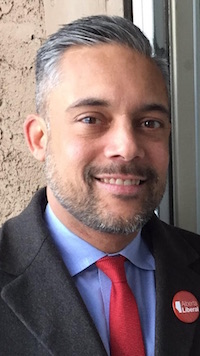
Presented with the chance to directly challenge Kenney, will Liberal Party leader David Khan carry his party’s banner in the by-election? His chance of victory are slim to none, but it would give him an opportunity to campaign and potentially face Kenney in any local all-candidates debates (if Kenney participates).
David Khan
The by-election also provides an opportunity for the Alberta Party to run a candidate. The party did not participate in the last Calgary by-election in Calgary-Greenway, but the recent floor-crossing of former NDP MLA Karen McPherson and potential future floor-crossings by former PC MLAs could provide some momentum for the upstart party.
The Calgary-Lougheed constituency was first created in 1993 and was represented by Provincial Treasurer Jim Dinning until 1997. PC MLA Marlene Graham then represented the constituency until 2004, when Rodney was first elected.
This would be the second time in recent history that a sitting MLA resigned in order to allow a party leader to run in a by-election. Len Webber resigned as MLA for Calgary-Foothills in 2014 to trigger a by-election for PC Party leader Jim Prentice. And in 1998, former Liberal Party leader Grant Mitchell stepped down as MLA for Edmonton-McClung to allow new party leader Nancy MacBeth to run in a by-election.
I have created a dedicated webpage to track party nominations and the candidates running in the Calgary-Lougheed by-election.
Here is a look at election results from Calgary-Lougheed for the General Elections from 1993 to 2015:
Jean told reporters that he declined to accept any critic role, and despite the ill will generated towards each other in the leadership race, it seems hard to believe Kenney would completely shut-out the former party leader.
But this move, or lack thereof, will undoubtably fuel rumours that Jean is considering leaving politics. His resignation would trigger a by-election in the Fort McMurray-Conklin constituency, which he has represented since May 2015.
United Conservative Party of Alberta leader Jason Kenney.
When the Legislative Assembly resumes for its fall sitting on Monday, there will be a new seating plan.
Brian Jean
A new Official Opposition United Conservative Caucus made up of twenty-two former Wildrose MLAs and six former Progressive Conservative MLAs will make its debut.
Leading the new United Conservative Party Caucus will be former Member of Parliament Jason Kenney, who won yesterday’s leadership vote with 61 percent, defeating former Wildrose Party leader Brian Jean, who finished with 31 percent, and Calgary lawyerDoug Schweitzer, who finished a distant third with 7 percent.
Kenney does not have a seat in the Assembly and indicated today that Calgary-Lougheed MLA Dave Rodney will resign on November 1, 2017 in order to create a by-election for his party’s new leader. Rodney was first elected in 2004.
David Eggen
As the new leader of the Official Opposition, Kenney will face some immediate issues as the Assembly reconvenes. He will need to reorganize his caucus office staff, reassign his party’s MLAs to new critic roles, and set an opposition agenda for the next 16 months. Kenney will do his best to avoid the bozo–eruptions that plagued the former Wildrose MLAs in his UCP caucus and pivot to issues that will solidify his party’s conservative base.
As Kenney enters his new role as the new face of Conservatism in Alberta, the NDP will hope that Albertans forgive their more unpopular policies when reminded of the new UCP leader’s more bizarre social conservative views and rhetoric.
Eggen has said most schools have been working with the province to establish codes of conduct against discrimination and adopt policies to protect LGBTQ youth, but a small group of mostly publicly-subsidized private schools are resisting. This bill could reignite the debate over the existence of publicly-subsidized private schools, some of which charge tens of thousands of tuition per student in order to attend.
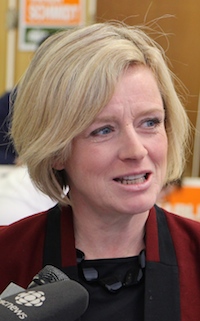
Rachel Notley
Despite calls from their political allies, Notley’s NDP government has avoided overhauling the structure of Alberta’s school system. But open resistance by private schools over GSAs, and by publicly-funded Catholic Superintendents wanting to dumb-down the Sexual Education curriculum, could force a debate over accountability of public funds being provided to these religious schools.
Kenney has been a vocal supporter of the Catholic schools, claiming that Notley’s opposition to a dumbed-down Sexual Education curriculum is the “statist ideology of the NDP on steroids.”
Of course, Notley is not telling publicly-funded Catholic schools not to teach Catholicism, she is telling them that they must teach consent and acknowledge the existence of homosexuality (welcome to the 21st century).
Alberta is one of a few remaining provinces that provides full public funding to Catholic schools. Former PC MLA David King, who served as education minister from 1979 to 1986, has collected close to 1,000 signatures in an online petitiondemanding a referendum on the future of publicly funded Catholic schools in Alberta.
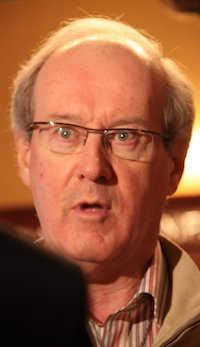
David King
On the flip-side, as Kenney enters his role as UCP leader, he will hope that Albertans forgive his more bizarre social conservative views and rhetoric when reminded of the NDP’s more unpopular policies.
We can expect Kenney to spend a lot of time criticizing Prime Minister Justin Trudeau, who has developed a relatively friendly working relationship with Notley’s government on issues ranging from oil pipeline construction to climate change. With deep connections to the Conservatives in Ottawa, expect a Kenney-led UCP to march in lockstep with their federal cousins on these issues.
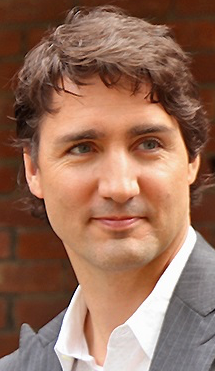
Justin Trudeau
Notley’s NDP subtly shifted their messaging last year, focusing on launching new programs and projects they argue will “make lives better for Albertans.” This will provide the NDP with a significant contrast to the Kenney-led UCP, who they will argue would attack public services and hurt Alberta families.
Kenney has said that if he becomes Premier in 2019, the months that follow would be known as the “Summer of Repeal” as his government would immediately move to repeal legislation passed by the NDP since 2015. The trouble with Kenney’s promise to repeal all of the NDP’s agenda is that, despite anger from conservatives still bitter from losing the 2015 election, some of the changes introduced by Notley’s NDP are popular among Albertans.
Would a UCP government cancel the construction of the Cancer Treatment Centre and the Green Line in Calgary or the new hospital in south Edmonton? Would a UCP government increase school fees and cancel the $25/day childcare program? Would Kenney close schools and hospitals, like his political role model Ralph Klein did in the 1990s? Expect the NDP start asking these questions when MLAs meet in Edmonton tomorrow.
This weekend’s UCP leadership vote and the resumption of the Legislative session tomorrow marks a huge change in Alberta’s political landscape. Alberta politics has changed drastically over the past two years, and even the past decade. The next few weeks, and the next 16 months, in Alberta politics will be fascinating to watch.
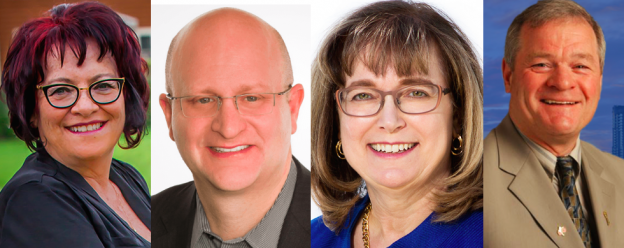
Photo: Former Alberta PC MLAs Jacquie Fenske, Don Scott, Linda Johnson and Art Johnston
Photo: Former Alberta PC MLAs Jacquie Fenske, Don Scott, Linda Johnson and Art Johnston
Alberta’s 2015 provincial election resulted in the election of 75 new MLAs in the 87 seat Legislative Assembly. More than two years after that historic election, a group of former Progressive Conservative MLAs put their names forward to stand in the October 16, 2017 municipal elections. Here is a quick look at how the former PC MLAs fared in their attempts to stage political comebacks:
Former PC MLAs elected in Fort McMurray
They served together in the Legislature from 2012 until 2015, and last week former Fort McMurray-Conklin MLA Don Scott was elected Mayor and former Fort McMurray-Wood Buffalo MLA Mike Allen was elected as a Councillor in the Regional Municipality of Wood Buffalo.
In 2015, Scott was unseated by Wildrose leader Brian Jean and Allen was unseated by Wildroser Tany Yao. Stephen Drover, who placed second to Yao in the 2015 election as the NDP candidate, was re-elected as a Fort McMurray Public School Trustee this week.
Other former PC MLAs not so successful
In Strathcona County, former PC MLA Jacquie Fenske finished third in a five-person race that saw incumbent Mayor Roxanne Carr unseated by former federal Liberal candidate Rod Frank. This marks the third time in three consecutive elections that an incumbent mayor has been defeated in Strathcona County. Fenske had served as MLA for Fort Saskatchewan-Vegreville from 2012 to 2015.
In Calgary, both former PC MLAs Linda Johnson and Art Johnston were unsuccessful in their bids to be elected to City Council. Johnson had served as MLA for Calgary-Glenmore from 2012 to 2015 and Johnston as MLA for Calgary-Hays from 2004 to 2012.
Conservative candidate Dane Lloyd surprised no one when he held his party’s stronghold in today’s federal by-election in Sturgeon River-Parkland. With 242 of 251 polls reporting, Lloyd had 77 percent of the vote, compared to 12 percent for Liberal Brian Gold, 7 percent for New Democrat Shawna Gawreluck and 2 percent of the vote for Christian Heritage Party candidate Ernest Chauvet.
Meanwhile in Quebec, the Conservatives were unable to hold the Lac-Saint-Jean riding in a federal by-election triggered by Denis Lebel‘s resignation. The Conservatives had held the riding since 2007 but, with 236 of 264 polls reporting, the party’s candidate was placed third behind Liberal Richard Hébertand Bloc Quebecois candidate Marc Maltais. The by-election marks the first time voters in this conservative riding have elected a Liberal since 1980, when another Trudeau was Prime Minister.
Liberal candidate Brian Gold and Prime Minister Justin Trudeau at a campaign event in Spruce Grove on October 20, 2017
Photo: Liberal candidate Brian Gold and Prime Minister Justin Trudeau at a campaign event in Spruce Grove on October 20, 2017. (Source: Twitter)
Overshadowed by this past Monday’s municipal elections, the federal by-election in Sturgeon River-Parkland scheduled for October 23, 2017 could be described as the forgotten by-election. I drove through Sturgeon County and the town of Morinville this week and spotted only a few Conservative, Liberal and Christian Heritage party signs scattered on the sides of the highways alongside the soon-to-be collected municipal election signs.
It was easy to forget that the by-election was evening happening.
Dane Lloyd
Along with the municipal election, the lack of general interest in the by-election could also be a result of its widely predicted outcome – a landslide victory by Conservative Dane Lloyd.
The district re-elected Conservative MP Rona Ambrose with 70 percent of the vote in 2015. And even though Ambrose’s handpicked successor, Jamie Mozeson, was surprisingly defeated in the party’s nomination race, the outcome will likely be similar, albeit with a much lower voter turnout. This is a reliably Conservative voting area of Alberta and any candidate running under that party’s banner can expect to be easily elected.
His party’s prospects aside, Prime Minister Justin Trudeau paid a visit to the district on October 20, 2017 to campaign alongside Liberal Party candidate Brian Gold.
Shawna Gawreluck
At a campaign event in a pizza parlour in Spruce Grove, the district’s largest community, Trudeau told supporters: “I know you’re going to be talking to families and you can talk to them about the fact that the first thing we did was lower taxes for the middle class and raise them for the wealthiest one per cent. You can talk about the fact, as (Gold) said, we approved pipelines that the previous government couldn’t get done.”
Trudeau deserves credit for the visit. The Liberal leader appears to have personally campaigned alongside his party’s candidates in every by-election since becoming leader, including in past by-elections in Calgary, Foothills, Fort McMurray, and Yellowhead.
Voting stations will be open from 7:30 a.m. to 7:30 p.m on Monday, October, 23, 2017. You can use the Elections Alberta online tool to locate your polling station.
Here are the list of candidates and their social media links:
Here are my quick thoughts on the latest fundraising numbers:
The NDP continue to demonstrate an impressive ability to raise money in Alberta. The NDP has raised the most of any party in the first three quarters of 2017.
This is the United Conservative Party’s first-ever quarter of fundraising, and I expect the party will raise significantly larger amounts in the next quarter when it has a permanent leader and when annual contribution limits reset before the first quarter of 2018.
This was likely the final quarter that the Progressive Conservative and Wildrose parties will report any significant fundraising amounts. Both parties are now controlled by the board of directors of the UCP. Funds donated to the two parties in the third quarter cannot be transferred to the UCP or any other party.
The Alberta Party is attempting to position itself as a centrist alternative to the NDP and UCP, but it will not be much of a political force going into the 2019 election if it party cannot start raising significantly more funds than it has in the first three quarters of 2017. I would not be surprised if these embarrassingly low fundraising returns raise questions inside the party about the future of Greg Clark‘s leadership. I expect the influence of the Alberta Together group and the influx of former PC Party officials into the Alberta Party will force the issue at the party’s annual general meeting on November 18, 2017.
A number of third-party advertisers (frequently referred to by the media as Political Action Committees) raised significant amounts of funds in the third quarter. I hope to delve a little deeper in this issue in a future post.
 The Calgary-Lougheed by-election, the Alberta Party leadership race, a new ThinkHQ poll, Rachel Notley as Canada’s Pipeline Paladin, and changing electoral boundaries are just some of the topics covered in the latest episode of The Daveberta Podcast with Dave Cournoyer and Ryan Hastman (recorded on Sunday, Nov. 26, 2017).

 Here is a look at election results from Calgary-Lougheed for the General Elections from 1993 to 2015: