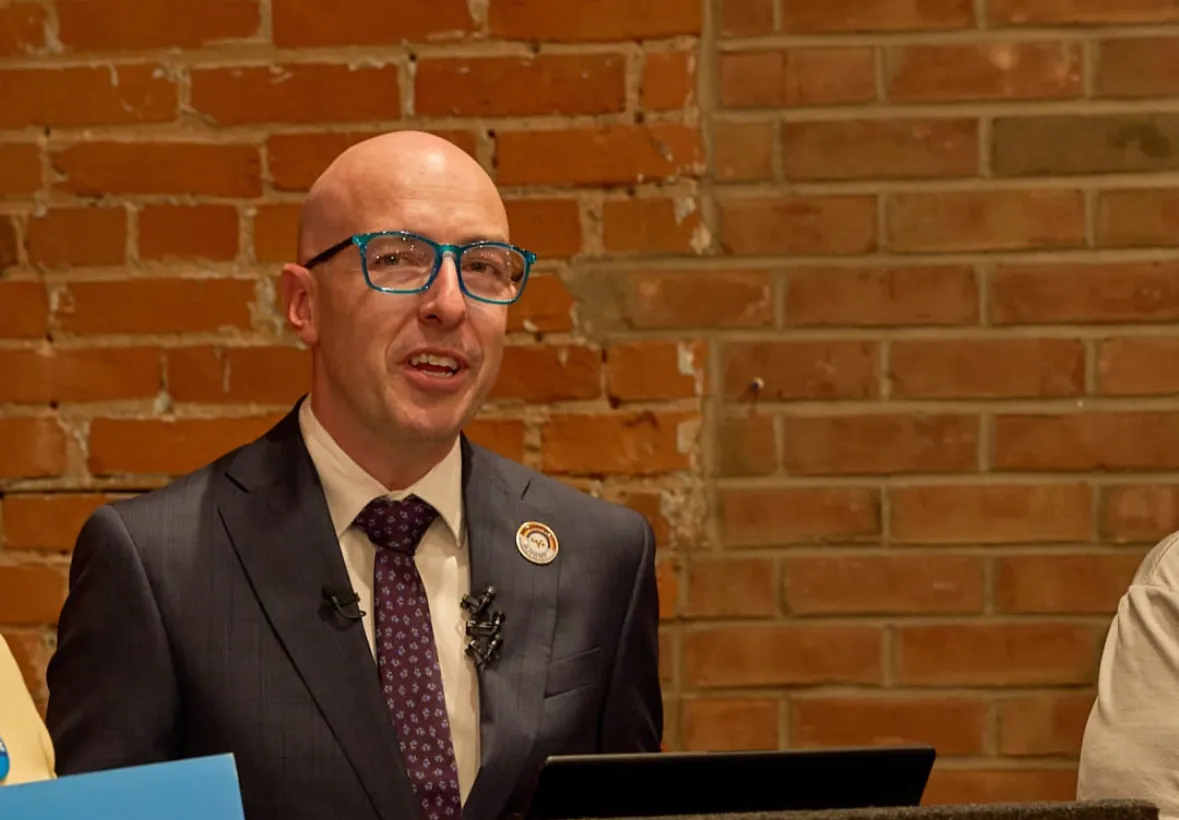
Andrew Knack speaks to reporters after winning Edmonton’s 2025 mayoral election (source: Andrew Knack / Instagram)
Knack bests former frontrunner Tim Cartmell in race to replace Amarjeet Sohi
Results from Edmonton’s low-key municipal election were very slow to trickle in but by mid-afternoon today we learned that Andrew Knack will be the next Mayor of Edmonton.
The three-term councillor has represented west Edmonton since he was first elected in 2013 and jumped into the mayoral race after initially planning to leave municipal politics and not seek re-election to council.
Knack bucked what felt like a strong wave of anti-incumbent sentiment going into the campaign and defeated south side councillor and Better Edmonton Party leader Tim Cartmell by a margin of around 8 points with an abysmal 30 per cent turnout of voters at the polls (at the time I am writing this only 217 of 236 polls are reporting in the mayoral election). Knack ran as an independent candidate.
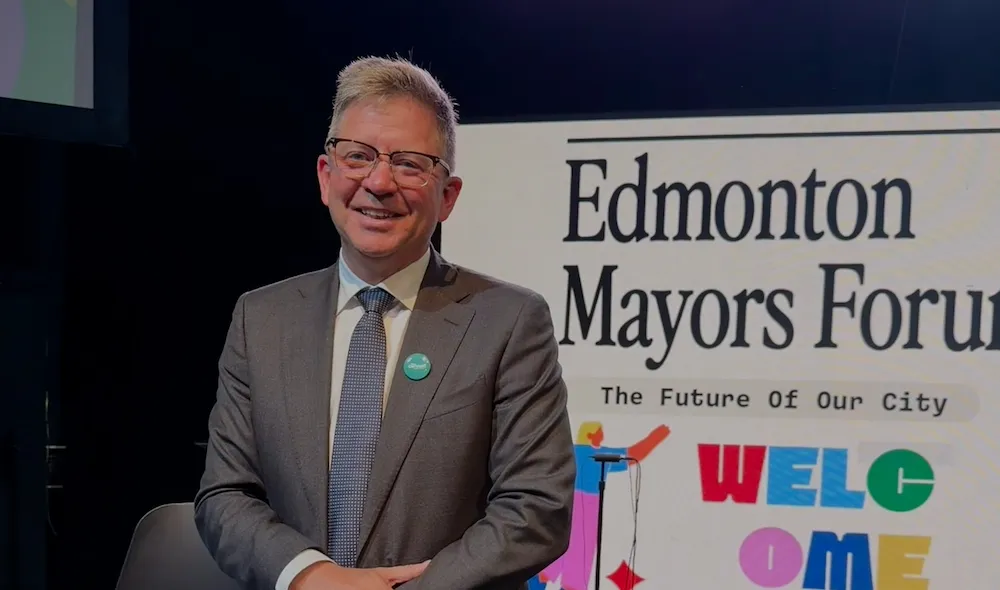
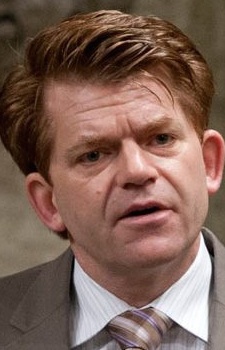
Edmonton mayoral candidate Tim Cartmell (source: Tim Cartmell / Facebook)
Tim Cartmell’s mayoral campaign stalling in the polls became even more surprising last week when Elections Edmonton financial disclosures showed that his campaign raised more than $800,000 by the end of July, largely because of corporate and wealthy individual donors. That means Cartmell’s campaign will have raised almost more money than all the other mayoral candidates combined and the most money of any mayoral candidate in Edmonton’s history.
Cartmell’s early start and Better Edmonton Party slate of council candidates should, in theory, give him a voter identification advantage on October 20. But Cartmell’s series of missteps, including his recently fumbling and bumbling when asked a simple question about whether his corporate donors put him in a conflict of interest, is not an inspiring performance of a future mayor.
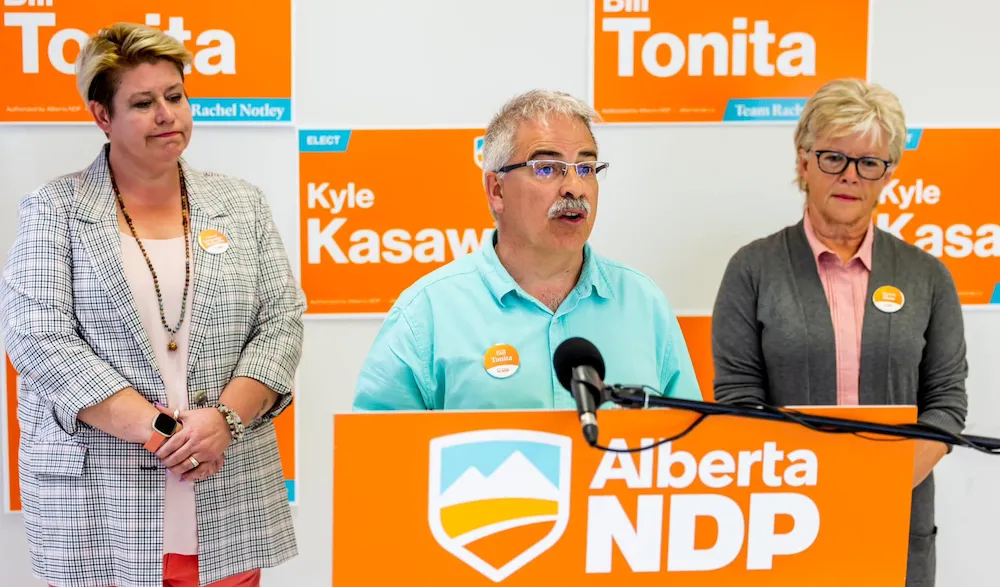
Bill Tonita (centre) with fellow NDP candidates Chantal Saramaga-McKenzie (left) and Karen Shaw (right) during the 2023 provincial election. (source: Bill Tonita / Facebook)
The introduction of municipal political parties in Calgary and Edmonton has generated a lot of confusion and consternation in this election but lost in the noise of the big city debate is that the presidents of Alberta’s two main provincial political parties are on ballots in county elections outside urban centres.
United Conservative Party President Rob Smith is running as a candidate in Mountain View County council’s Division 6 and Alberta NDP President Bill Tonita is running for re-election in Strathcona County’s Ward 4.
Also, big city mayoral candidates Andrew Knack and Jeromy Farkas got the gift every election candidate in Alberta dreams of in the final stretch of the campaign: a Janet Brown poll showing you’re in the lead.
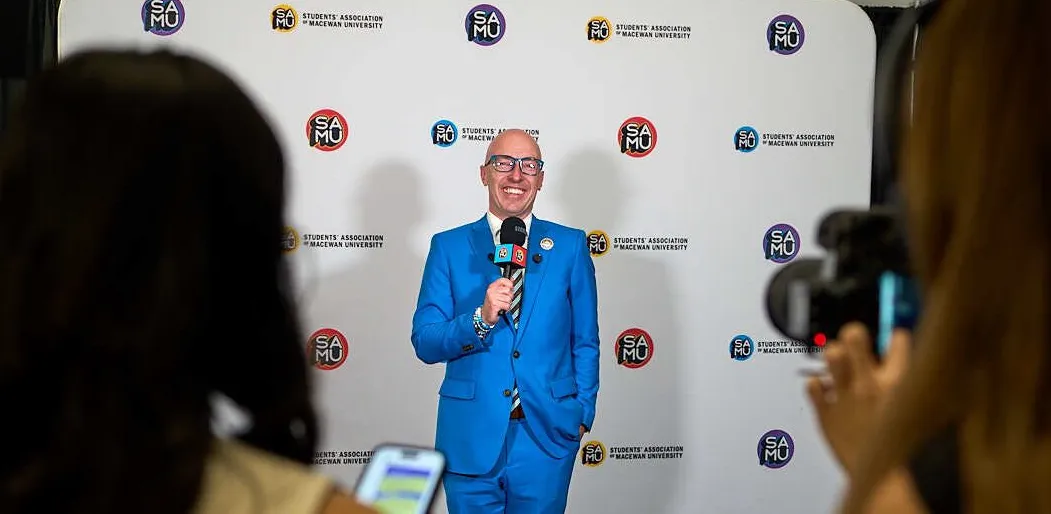
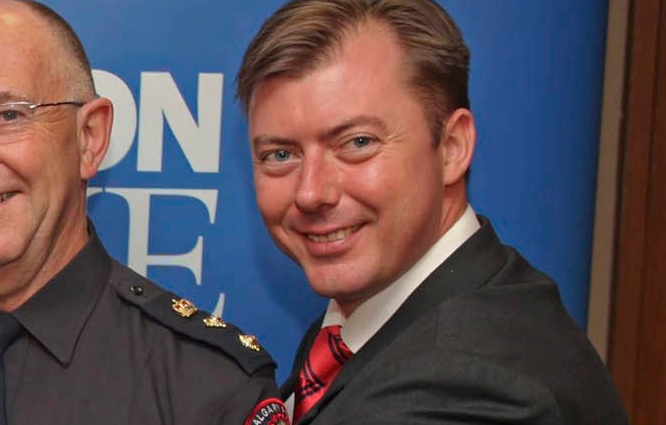
Edmonton mayoral candidate Michael Walters (source: Michael Walters / Facebook)
The latest public opinion poll shows current councillors Tim Cartmell and Andrew Knack and former councillor Michael Walters leading the pack in a close three way race. But with nearly 50 percent of voters saying they are undecided, it could be anyone’s to win.
The Cardinal Research poll showed Walters with 15 per cent support and Cartmell and Knack with 13 per cent each, and 48 per cent of voters undecided. I don’t want to focus too much on the horse race, but that poll shows a pretty tight race in a big open field.
Who’s on first in the race to replace Amarjeet Sohi? It’s hard to tell.
There are 87 days until municipal election day in Alberta and Edmonton’s sleepy mayoral race is beginning to take shape.
With Mayor Amarjeet Sohinot running for re-election after serving one term in the office, what looks like a fairly open field of current and former city councillors has emerged in the race to replace him.
With the city facing an addictions and mental health crisis, a pitch battle over zoning and infill in mature neighbourhoods, huge population growth that is putting immense pressure on the city’s public services, infrastructure, schools and hospitals, and a provincial government is openly hostile to the current city council, whoever is in the mayor’s chair for the next four years will face a rough and challenging time.
To celebrate 20 years of Daveberta, I’m happy to offer free subscribers a 20 percent discount on an annual paid subscription ($40/year down from the regular $50/year). Paid subscribers get full access to all Daveberta newsletters and columns, full episodes of the Daveberta Podcast and a shout out on the podcast, and special Alberta politics extras.
A motion from Mayor Amarjeet Sohi to reaffirm some of the most controversial parts of the current bylaw passed in a 6-5 vote, meaning that Cartmell’s vote would have made the difference had he shown up in-person or joined the meeting over Zoom.
The week before Cartmell left for vacation, he proposed halting infill development in the city with a dramatic motion that he was told ahead of time was likely illegal. Cartmell then posted a video on social media tut tutting his council colleagues before leaving for an undisclosed vacation spot that his campaign says has no internet connectivity.
Opposition shouldn’t panic – it should make smart changes
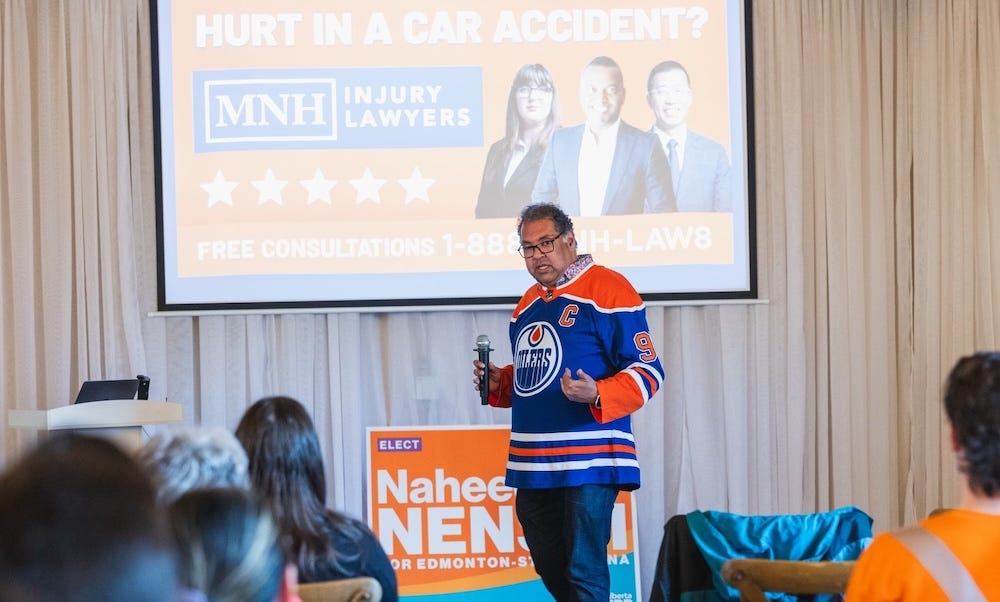
The three provincial by-elections are in full swing and the NDP are eager to have leader Naheed Nenshi join their MLAs in the Legislature. Two new polls will add extra urgency to the NDP’s efforts to hold on to two of those seats and have Nenshi hit the ground running when he is elected in Edmonton-Strathcona on June 23.
Rod Loyola was the NDP MLA for Edmonton-Ellerslie until stepping down this week (photo source: Rod Loyola / Facebook)
Rod Loyola has resigned as the Alberta NDP MLA for Edmonton-Ellerslie and is running as the Liberal Party candidate in the new Edmonton Gateway riding in the federal election. Loyola represented his south Edmonton provincial riding from 2015 until he stepped down earlier this week to pursue the federal Liberal nomination.
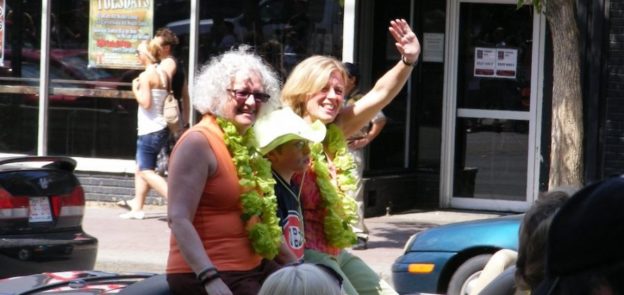
MP Linda Duncan and MLA Rachel Notley at Edmonton's Pride Parade.
Photo: MP Linda Duncan and MLA Rachel Notley at Edmonton’s Pride Parade.
It was one of the worst kept secrets in Edmonton politics.
Linda Duncan has announced that she will not seek re-election as the Member of Parliament for Edmonton-Strathcona when the next federal election is held in October 2019.
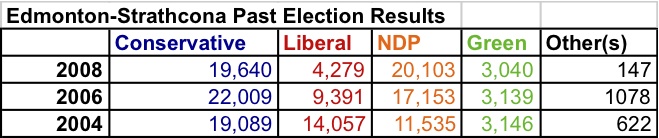
After a strong second place finish during her first run for elected office in 2006, Duncan unseated four-term Conservative MP Rahim Jaffer in the 2008 election. The race was so close, and the Conservative campaign was so confident that Jaffer delivered his election night victory speech before all the votes had been counted. Unfortunately for Jaffer, the final polls in the NDP-vote rich areas surrounding the University of Alberta were late to report and helped give Duncan a 463 margin victory that night.
That night she became the second ever NDP MP from Alberta, following in the footsteps of Ross Harvey, who served as the MP for Edmonton-East from 1988 to 1993.
Duncan’s rise into Alberta politics coincided with a resurgence for the NDP, first federally under Jack Layton’s leadership and later provincially under the leadership of now-Premier Rachel Notley.
Despite spirited campaigns in Edmonton-Centre, Edmonton-Griesbach , and Edmonton-Manning in 2015, the federal NDP have been unable to extend their foothold in Alberta beyond Duncan’s district, leaving Edmonton-Strathcona as an anomaly in Canadian politics. And despite its NDP-roots and the presence of Notley as the MLA for the provincial district of the same name, it is not a sure thing that Duncan’s successor in 2019 will be a New Democrat.
Until recently, Duncan had avoided getting involved in the debate over the construction of the Trans-Mountain Pipeline from Edmonton to Burnaby, but her successor will have a tougher time avoiding the subject.She only recently commented on the pipeline issue, saying that she it was ‘not the priority issue’ for voters in her district. As a life-long environmentalist and former environmental lawyer, her position came as no surprise.
Singh’s posturing and the dominance of the pipeline issue in the media and minds of many Albertans will certainly make it difficult, but not impossible, for the NDP to hold on to this seat in the next election.
In selecting their candidate for the next election, AlbertaPolitics.ca author David Climenhaga offered some wise advice, “…the NDP should pick wisely – perhaps looking for someone who can appeal to Albertans more broadly outside the environs of the University of Alberta – because if the 2015 provincial election proves anything, it’s that change can happen in Alberta, and if you’re playing a long game, it probably will.”
Duncan is the seventh NDP MP to announced they will not run for re-election in 2019, including former leader Tom Mulcair in Outremont, David Christopherson in Hamilton Centre and Irene Mathyssen in London-Fanshawe.
Red Deer-North Liberal and Green candidate Michael Dawe, disqualified Chestermere-Rockyview PC candidate Jamie Lall, acclaimed Chestermere-Rockyview PC candidate Bruce McAllister, and Fort McMurray-Conklin NDP candidate Ariana Mancini.
Progressive Conservative activist Jamie Lall was unexpectedly disqualified for unknown reasons before his party’s April 1 nomination meeting in Chestermere-Rockyview, allowing Wildrose PC MLA Bruce McAllister to be acclaimed. After months of campaigning, Mr. Lall lashed out at his party and questioned why he was disqualified when an incumbent MLA who plead guilt to prostitution related charges was allowed to be nominated. Mr. Lall is also the President of the PC association in the neighbouring Calgary-McCall, a position he has not been disqualified from.
@metrocalgary Whatever the phantom reason is, it’d better be worse than a solicitation of a prostitute conviction as that’s the bare minimum
According to the PC Party website, Jonathan Dai has been appointed as the party’s candidate in Edmonton-Highlands-Norwood in advance of the April 11 scheduled nomination meeting. Mr. Dai is the President of the Canada-China Council for Cooperation and Development and was the Liberal candidate in the 2000 federal election in Edmonton-Strathcona, where he placed 5,647 votes behind Canadian Alliance MP Rahim Jaffer. While attempting a rematch with Mr. Jaffer in 2004, he narrowly lost the Liberal nomination in Edmonton-Strathcona to Liberal MLA Debby Carlson. Highlands-Norwood is currently represented by NDP MLA Brian Mason.
The PCs are expected to appoint a candidate in Edmonton-Centre after it was unable to nominate a candidate before the March 28 nomination meeting. The PCs last elected an MLA in Edmonton-Centre in 1982.
Brian Jean
Wildrose Party
New Wildrose Party leader Brian Jean announced that he will run in Fort McMurray-Conklin, which was part of the federal constituency he represented in Ottawa from 2004 to 2014. Mr. Jean will face incumbent PC MLA Don Scott, the Minister of Advanced Education, and NDP candidate Ariana Mancini, a grade 1 teacher and Alberta Teachers’ Association activist. Mr. Scott narrowly defeated Wildrose candidate and former Wood Buffalo mayor Doug Faulkner by 470 votes in the 2012 election.
One of Mr. Jean’s first acts as leader was to dismiss Calgary-South East candidate Bill Jarvis, whose comments about “brown people” embarrassed the party on the night of its leadership announcement.
The Wildrose Party has now nominated at least 47 candidates, including recent nominees Angela Pitt in Airdire, Blaine Maller in Calgary Fish Creek, and Tany Yao in Fort McMurray-Wood Buffalo. Former leader and MLA Paul Hinmanwithdrew from the nomination contest in Cardston-Taber-Warner, leaving three candidates still in the race – Larry Bates, Jon Hood and Grant Hunter.
New Democratic Party
The New Democratic Party has now nominated at least 75 candidates in constituencies across Alberta. The latest nominated candidates include Christina Gray in Edmonton-Mill Woods, Jon Carson in Edmonton-Meadowlark, Emily Shannon in Drumheller-Stettler, Patricia Norman in Innisfail-Sylvan Lake, , Karen McPherson in Calgary-Northern Hills, William Pelech in Chestermere-Rockyview, and Lynn MacWilliam in Strathmore-Brooks.
Alberta Party
The Alberta Party has nominated 29 candidates, including recent nominees Jim Black in Medicine Hat and Rory Tarant in Grande Prairie-Wapiti.
Warren Kinsella
Liberal Party
The Liberal Party has nominated 24 candidates across the province. The latest nominated candidates include Ron Williams in Battle River-Wainwright, Todd Ross in Edmonton-Castle Downs, Bradley Whalen in Edmonton-Decore, Kevin McLean in Grande Prairie-Smoky and Helen McMenamin in Little Bow. Mr. McLean is a city councillor in Grande Prairie.
It appears that celebrity political strategist Warren Kinsella is headlining a $159.00 per ticket fundraiser for Edmonton-Meadowlark Liberal Dan Bildhauer and Edmonton-Manning Liberal Adam Mounzer on April 11 at the Courtyard Edmonton West hotel.
Green Party
The Green Party has nominated fifteen candidates and has recently nominated Josh Drozda in Leduc-Beaumont, Peter Meic in Calgary-Cross, Coral Bliss Taylor in Chestermere-Rockyview, and Sandra Wolf Lange in Edmonton-Riverview.
The Communist Party of Alberta plans to field two candidates in the upcoming election. Leader Naomi Rankin will represent her party in Edmonton-Mill Woods and Bonnie Devine will run in Calgary-East. Ms. Rankin has been leader of the Communist Party since 1992 and, according to her Wikipedia biography, has run in every provincial and federal election in Alberta since 1982.
I have added these updates to the list of nominees and nomination candidates planning to run in Alberta’s next general election. Please email david.cournoyer [at] gmail.com if there are additions to the list. Thank you.
Will former provincial cabinet minister Ron Liepert make the jump into federal politics?
With the launch of the TimeToDoBetter.ca website today, rumours began to spread that the former two-term Calgary-West Progressive Conservative MLA turned consultant could challenge ultra-conservative Rob Anders for the Conservative Party nomination in the new Calgary Signal Hill riding.
Ron Liepert
Mr. Liepert’s candidacy would surely spark another proxy-war between the supporters of the provincial PC and Wildrose parties first seen in last year’s Calgary-Centre by-election.
This would not be the first time these two men have publicly sparred. In 2009, Mr. Liepert accused Mr. Anders of campaigning against him in the 2008 provincial election. Many of Mr. Anders associates have joinedDanielle Smith‘s Wildrose Party, including his close confident Andrew Constantinidis, who ran to replace Mr. Liepert in the 2012 provincial election.
While many of his supporters flocked to the new provincial party, some in the Wildrose establishment see Mr. Anders as a political liability whose ideology could challenge their attempt to rebrand as a moderate conservative alternative to the governing PCs.
In the conservative bloodbath that is sure to ensue if the rumours are true, I would expect nothing less than for Mr. Anders and conservative entertainer Ezra Levant to slice directly at Mr. Liepert’s jugular. They will be sure to remind their conservative base about Mr. Leipert’s record as the Health minister who created the centralized Alberta Health Services and the Finance minister who introduced deficit budgets and talked about increasing taxes.
Mr. Liepert’s ties to the provincial PC establishment date back to the Peter Lougheed era, when he worked at the Legislative Assembly and was appointed as a staff member at Alberta’s trade office in Los Angeles. He first ran for the PC Party in 1993, first in an unsuccessfully bid for the party nomination in Edmonton-Glenora and then as the PC candidate in Edmonton-Highlands-Beverly (in the election he was defeated by his Liberal opponent, Alice Hanson). He was first elected to the Assembly in 2004 as the PC MLA for Calgary-West.
Alison Redford
Mr. Leipert is no slouch. In provincial politics, he thrived off the cut and thrust of partisan conflict. Whether he could win the Conservative Party nomination against Mr. Anders is yet to be seen.
Since he was first elected in 1997, Mr. Anders has been challenged by many high profile conservatives and easily defeated all of them in nomination battles.
At the age of 24, Mr. Anders, then a young Republican Party provocateur, returned to Canada to defeat nine other candidates to win his first Reform Party nomination in Calgary-West. His election coincided with the election of a group of young conservative Reformers, including Jason Kenney and Rahim Jaffer.
If he is challenged by Mr. Liepert in the upcoming nomination, it would not be the first time a high-profile politico who has attempted to end Mr. Anders career in Ottawa.
In 2004, future Progressive Conservative premier Alison Redford made her first jump into electoral politics with an unsuccessful nomination bid against Mr. Anders. Mr. Liepert was her campaign manager.
In 2000, he was unsuccessfully challenged by Calgary-Currie PC MLA Jocelyn Burgener (now a poet) and in 2009 he faced future Calgary-Varsity PC MLA Donna Kennedy-Glans. With the help of Mr. Levant, he nastily branded Ms. Kennedy-Glans as a “Liberal saboteur” and a “bizarre cross between a radical feminist and an apologist for a women-hating Arab dictatorship.”
Internal nomination contests are not the only area Mr. Anders has faced challengers. In the 1997 election, alderman and future mayor Dave Bronconnier led an unsuccessful campaign against him as the Liberal Party candidate. In the 2000 election, Mr. Anders defeated both former Calgary-North West Liberal MLA Frank Bruseker and PC candidate Jim Silye (a Reform Party MP for Calgary-Centre from 1993 to 1997). Wind energy entrepreneur Justin Thompson earned 29% as the Liberal candidate in the 2004 election, the highest of any of Mr. Anders challengers. And the 2006 and 2008 elections, former Calgary Board of Education trustee Jennifer Pollock carried the Liberal banner against Mr. Anders.
Despite these high-profile challengers from inside and outside his party, Mr. Anders has yet to face electoral defeat in the political arena.
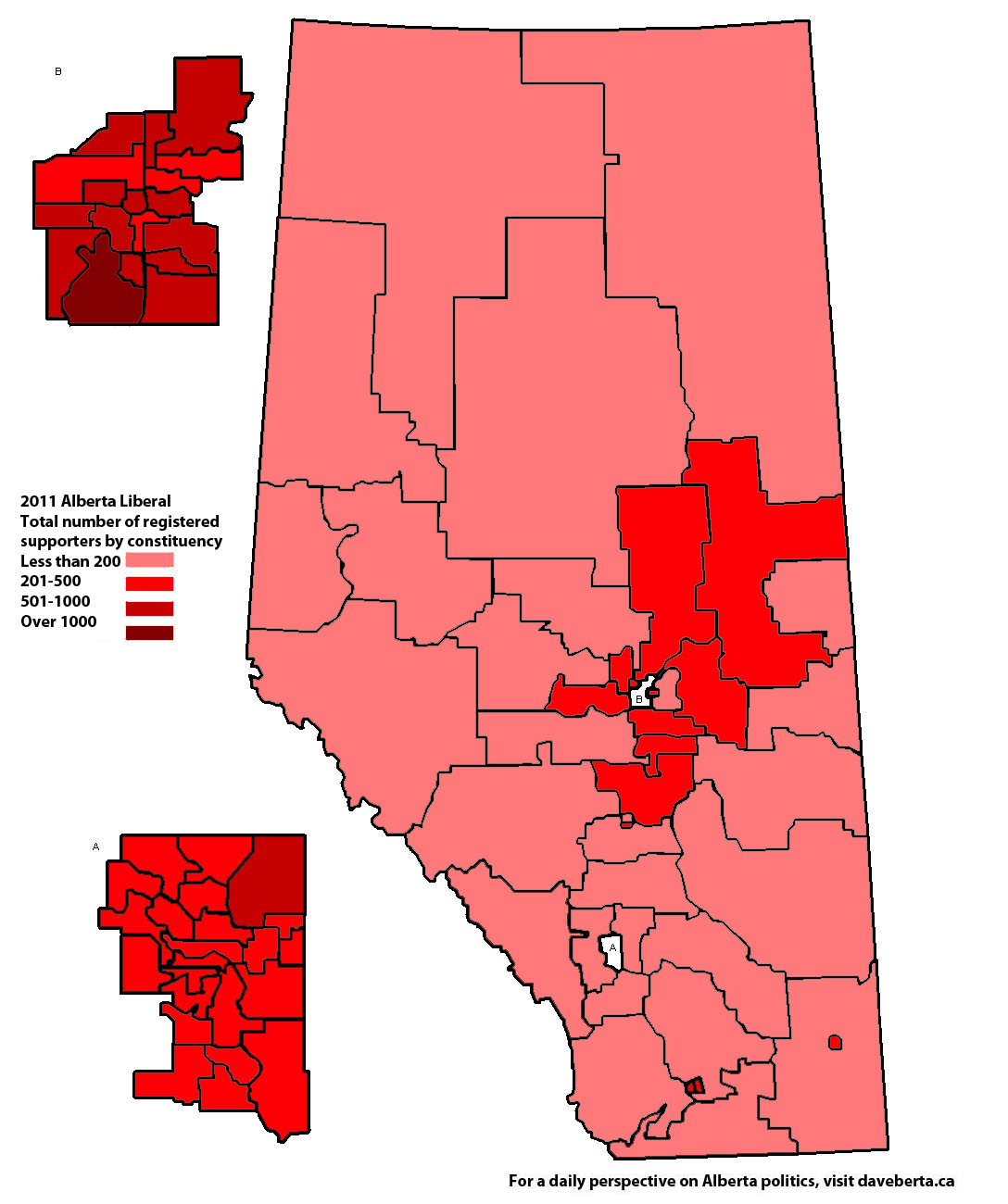
Map of eligible voters in the September 10 Liberal leadership contest by constituency.
The Alberta Liberal Party announced yesterday that over 27,567 Albertans are eligible to vote in their party’s September 10 leadership contest. The eligible group of supporters include 3,690 paid members and 23,877 “registered supporters” who could participate by registering their name and contact information without a fee.
Following complaints from leadership candidate and Edmonton-Gold Bar MLA Hugh MacDonald that the list was filled with fake names, including a cat, a dead woman, and former Conservative MP Rahim Jaffer, the Liberals have culled the list of obvious forgeries (which are to be expected in any leadership contest). Former Edmonton-Meadowlark Tory MLA Raj Shermanclaims to have registered over 18,000 of the 27,000 eligible voters. Edmonton-Centre MLA Laurie Blakeman claims that her campaign submitted names for around 1,000. The two other candidates in the contest are Calgarians Bill Harvey and Bruce Payne.
Although the Liberal leadership contest has by far been overshadowed by the more glamorous Progressive Conservative leadership contest set for September 17 (in which over 150,000 Albertans are expected to participate), I am impressed that the Liberals have been able to collect the names of over 27,000 potential supporters. Regardless if these registered supporters actually vote in their leadership contest, their names are now entered into a database that will be useful for the Liberals in the next provincial election.
Not surprisingly, eligible voters in this contest are largely centered in the two main cities of Calgary and Edmonton, highlighting Liberal Party’s almost non-existent levels of support in rural Alberta. Even in a constituency like Fort McMurray-Wood Buffalo, with a population estimated to be more than 100,000, the Liberals only attracted 134 people to register to vote in their leadership contest.
Unlike traditional one-member-one-vote leadership selection structures, the Liberals have opted to use a weighted-preferential system in constituencies with large numbers of voters. The slightly confusing system is explained on the party’s leadership website:
Each constituency in Alberta is allocated up to 500 points, where each vote up to that number represents one point. Should more than 500 voters cast a ballot in a constituency, each vote in the constituency is applied a weighing formula.
As there are only 15 constituencies with more than 500 eligible voters, it is likely that this system may only be implemented in a handful of them. The only constituency to register more than 1,000 supporters was Edmonton-Whitemud.
In the land where federal election results are typically much ado about nothing, the election scheduled for May 2, 2011 is not much of an exception. As the Liberals and NDP fill ballots across the province with last minute paper candidates, with few exceptions Alberta remains safe electoral territory for the Conservative Party of Canada.
If any riding in Alberta changes hands in this federal election, it will be Edmonton-Strathcona. It is the only riding represented by an opposition Member of Parliament and Conservatives have made it their goal to unseat NDP MP Linda Duncan, who defeated Conservative MP Rahim Jaffer by a slim 463 votes in 2008. After campaigning for two years, the Conservatives hope that candidate Ryan Hastman is the one who can do the job.
As the NDP’s Environment Critic in Ottawa, Ms. Duncan has gone against the grain of other Alberta MP colleagues by criticizing the oil sands and its impact on the environment. In a campaign stop in Edmonton this weekend, NDP leader Jack Layton only briefly mentioned the environment, suggesting that he may have been avoiding the issue while in Alberta (he also did not take media questions while in the province).
The Green Party has nominated Environmental Economics and Policy studentAndrew Fehr, who faces the challenge of convincing Green-leaning voters that actually voting for a Green Party is a better choice than a strategic vote for Ms. Duncan. The Liberals have not yet nominated a candidate and appear to be a non-factor in this contest.
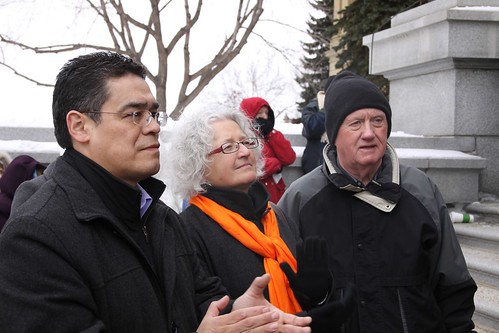
Federal NDP candidates Lewis Cardinal, Linda Duncan, and Ray Martin.
The highly polarized geopolitics of this riding have the Conservatives drawing strong support from polls in the east and NDP drawing strong support from polls in the west. Both candidates will lean heavy on financial and organizational support from their national parties, making this riding too close to call.
The irony is that the NDP could increase their vote total across Edmonton at the same time they could lose the only riding they currently hold.
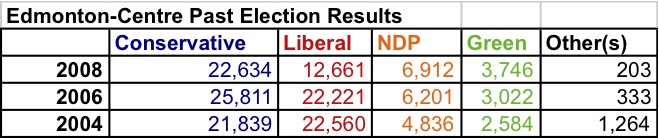
In Edmonton-Centre the real contest to watch is not to defeat door-knocking/hand-shaking/baby-kissing election-machine Conservative MP Laurie Hawn. The real contest is for second place. The Liberals hope their candidate Mary MacDonald can regain the support they lost in the last election and maintain their position as the de facto alternative to the Conservatives in this riding. The NDP are hoping that their candidate Lewis Cardinal can help build the kind of support needed to cut the Liberals down to third place. This is similar to the multi-election strategy that helped the NDP make gains in Strathcona.
The Liberals held this riding from 1993 until 2006 when Mr. Hawn defeated Deputy Prime Minister Anne McLellan. Mr Hawn’s vote share decreased in 2008 while his margin widened substantially as the Liberal vote collapsed. The Greens have nominated 2008 candidate David Parker and also running is Mikkel Paulson, leader of the Pirate Party of Canada.
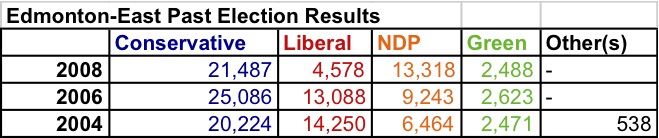
Edmonton-East MP Peter Golding is what I would refer to as a wall-paper backbencher. Since he was first elected in 1997, Mr. Goldring seems to only pop into the media spotlight when taking up odd causes like exposing the “truth about Louis Riel” or joining the bizarre drive to get the obscure Caribbean Islands of Turks and Caicos to join Canada.
The NDP have steadily increased their support in this riding since the 2004 election and former MLA Ray Martin is hoping that this trend continues. Mr Martin is an NDP institution in northeast Edmonton, having been elected as an MLA from 1982 to 1993, a public school board trustee from 2001 to 2004, and once again as an MLA from 2004 to 2008. This is the fourth time Mr Martin has sought a seat in Parliament since 1997. The Liberals have nominated IT management consultant Shafik Ruda.
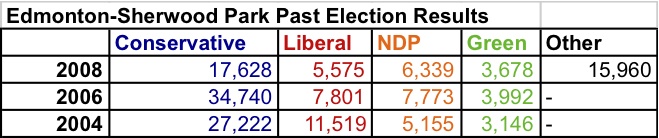
Edmonton-Sherwood Park was the second closest race in 2008, when Independent Conservative James Ford nearly defeated Conservative candidate Tim Uppal. It was a city mouse versus county mouse game as many voters in Strathcona County and Fort Saskatchewanwere upset with the Conservative nomination process that led to County Councillor Jacquie Fenske defeat and allowed Edmontonian Mr. Uppal to win the nomination.
Mr. Ford is running again and the Liberals and NDP, represented by Rick Szostak and Mike Scott, are expected to play minor supporting roles in this contest. The big question is whether voters in the county still feel that Mr. Uppal’s candidacy is the great injustice they believed it to be in 2008.
Happier times in the PC Caucus when Ted Morton and Dave Hancock held hands and sang Kumbaya.
Former Finance Minister Ted Morton believes that he is the best person to bring conservatives back to the PC “mothership,” but that is not stopping the speculation of who will challenge him in the contest to fill his party’s top job.
Stelmach’s McGarry
Rarely in the spotlight, Premier Ed Stelmach‘s Chief of Staff Ron Glenspoke with the Calgary Herald about his boss’ resignation announcement and the politics of the past week.
Vote a vote for Jim in 2011? Completely ruling out returning to politics when asked last Tuesday, former Finance Minister and 2006 PC leadership contest front-runner Jim Dinning was less committal later in the week. Many Tories I have spoken with in the past week tell me that while they would love Mr. Dinning to return to politics, that they believe it is unlikely that the University of Calgary Chancellor will seek his party’s leadership.
Two more candidates? Edmonton-Leduc Conservative MP James Rajotte is said to be considering a bid for the PC leadership. First elected as a Canadian Alliance MP for Edmonton-Southwest in 2000, Mr. Rajotte . He was the Ottawa roommate of Rahim Jaffer in the 1990s, when he worked as the legislative assistant for Edmonton-Strathcona MP Hugh Hanrahan and Surrey-North MP Margaret Bridgeman, and later as executive assistant to Edmonton MP Ian McClelland. Mr. Rajotte is currently the chair of the House of Commons Standing Committee on Finance.
First elected as the MLA for Edmonton-Whitemud in 1997, Minister Dave Hancock placed fifth out of eight candidates with 7,595 votes on the first ballot of his party’s 2006 leadership contest. He endorsed Premier Stelmach on the second ballot. Minister Hancock has served as Minister of Justice, Health, Advanced Education, and Education (among others) and has been a PC Party insider since serving as Youth President in the 1970s.
In his current role as Education Minister, Hancock encouraged Trustees, parents, administrators, and others to think big about the future of the education system. This process had encouraged good among education system participants until recently, when the government attempted to renegotiate an already agreed upon contract with Alberta’s teachers.
The right time for Griffiths?
A leadership bid by Battle River-Wainwright MLA Doug Griffiths is not only gaining support in internet polls. Metro Calgary columnist DJ Kelly wrote a column last week suggesting that the outspoken and insightful Mr. Griffiths might be the best candidate for the job.
Benitomania or Benitolution? Tongue in cheek campaign or the next big political shift? Paula Simonsexamines the political career of Edmonton-Mill Woods PC MLA Carl Benito and the recent online chatter about him.