Categories
Alberta Politics

What do the federal election results mean for Edmonton and Alberta?

With the excitement of the 2015 federal election one week behind us, now is a good time to take a look at how the results of the election could impact Edmonton and Alberta. The reality of a majority Liberal government in Ottawa will make Conservative Albertans uneasy, but there is little reason to believe this new government will lead to doom and gloom for our province.

Last Friday, I had the pleasure of participating in a panel discussion about the election results with Edmonton Journal editor-in-chief Margo Goodhand and University of Alberta professor Steve Patten at a Institute of Public Administration of Canada event at Government House. With this discussion still fresh in my mind, here is a look at some of the ways last week’s federal election results could impact Edmonton and Alberta.

Liberal growth in Conservative Alberta
Conservative Party candidates earned 59 percent of the vote and elected candidates in 29 of Alberta’s 34 federal ridings. The Liberals broke a nearly five decade long drought in Calgary with the election of Kent Hehr in Calgary-Centre and Darshan Kang in Calgary-Skyview. In Edmonton, two Liberals were elected in bellwether ridings – Randy Boissonnault in Edmonton-Centre and Amarjeet Sohi in Edmonton-Mill Woods. Since 1984, these two Edmonton ridings have elected MPs belonging to the party in government. (Note: the election results in Edmonton-Mill Woods will face a judicial recount).

The “Class of 2015”
There was a significant turnover in Alberta’s representation in Ottawa, with 18 of 34 Members of Parliament from our province being elected for the first time, including seven first-time MPs representing Edmonton ridings. This ‘class of 2015’ includes four Liberals and fourteen Conservatives.

Alberta in Cabinet
It is expected that Alberta will have representation in the federal cabinet but it is not clear how large that representation will be. In my opinion, it would be a grave mistake for incoming Prime Minister Justin Trudeau to not appoint a cabinet minister from both Edmonton and Calgary. The third and fifth largest municipalities in Canada should have representation at the highest levels in Ottawa. These large urban centres also represent an area of future electoral growth for the federal Liberal Party. In Calgary, the Liberals earned a surprising 30 percent of the vote and in Edmonton they earned 23 percent. The new cabinet will be sworn-in on Nov. 4, 2015.

Federal-Provincial Relations
We have already witnessed a change in tone that could signal a significant improvement in the federal government’s relationship with the provinces. In the first week after the election, Mr. Trudeau invited provincial premiers to join Canada’s delegation to the important COP21 Climate Change Conference in Paris in November. Mr. Trudeau has also indicated his intention to negotiate a new health accord with the provinces.

Alberta-Ottawa Relations
The relationship between Ottawa and Edmonton would have been sour had Stephen Harper’s Conservatives been re-elected. After attacking Alberta’s NDP government numerous times during the campaign, it is unlikely that Mr. Harper and Premier Rachel Notley would have been able to develop the kind of productive working relationship that would benefit Albertans.

Even though she appeared on stage with NDP leader Tom Mulcair in the final days of the election campaign, Ms. Notley has indicated that she was willing to work with whoever became the next Prime Minister. If she and Mr. Trudeau can develop a good working relationship, Canadians may see progress on issues like pipeline expansion in the next four years. Although Mr. Harper was a vocal supporter of Canada’s oil and gas industry, he failed to secure the construction of new pipeline projects during his decade as Prime Minister.

A Municipal Agenda
The Liberals promised increased investment in public infrastructure and increased funding for municipal public transit projects. During his three-terms on city council, Mr. Sohi has been an vocal advocate for expanded Light-Rail Transit funding in southeast Edmonton. Mayor Don Iveson has been critical of the Conservative government’s lack of commitment to LRT funding in the past.

Commitment to defence funding
The Liberal platform committed to “maintain current National Defence spending levels, including current planned increases” which should at least be positive news for Edmontonians who work at CFB Edmonton.

The last First-Past-the-Post election
Mr. Trudeau promised that this federal election would be Canada’s last using the antiquated ‘first past the post’ electoral system. This would likely mean an end to Conservative overrepresentation of Alberta in Ottawa. Any system, whether it be proportional representation, single transferable vote or mixed member proportional representation, could allow voters choices to be better reflected in their representation in Ottawa. This would likely mean an end the system which allows 59 percent of voters to be represented by 81 percent of the Members of Parliament from Alberta.

Conservative Leadership
With Mr. Harper’s resignation as leader of the Conservative Party of Canada, that party will be thrust into a contest to select a new leader. While that party may seek to choose a new leader from another region of Canada, it is expected that Conservative MPs from Alberta will be candidates in that race. Already, there is speculation that Calgary-Nose Hill MP Michelle Rempel and Calgary-Midnapore MP Jason Kenney are interested in seeking the leadership.

Liberals and NDP in the West
Western Canada is no longer a monolith of the Conservative Party support. With British Columbia and Manitoba electing more Liberal MPs than Conservative MPs, Alberta and Saskatchewan are now the only provinces where Conservatives outnumber other parties. While the Conservatives remain strong in the rural west, that party has lost ground to the Liberals and NDP in the western urban centres of Calgary, Edmonton, Regina, Saskatoon, and Winnipeg. Twenty of the NDP’s 44 MPs and 29 of the 184 Liberal MPs were elected in ridings west of Ontario.

Trudeau wave bad news for Notley?
Conservative critics have already predicted that the rise of the federal Liberals in Alberta spells bad news for Ms. Notley’s provincial NDP. I suspect that the results of this federal election will have little impact on the level of NDP support in the next provincial election. It has been clear for some time that Mr. Mulcair is unpopular in Alberta. His noticeable absence from the province during the spring election campaign and low support for the federal NDP in four by-elections since 2011 suggests that Mr. Mulcair’s unpopularity has little impact on Ms. Notley’s political fortunes.

Categories
Alberta Politics

Trudeau Liberals crack Conservative “Fortress Alberta” in nationwide sweep

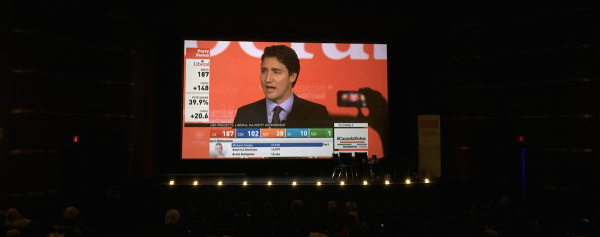
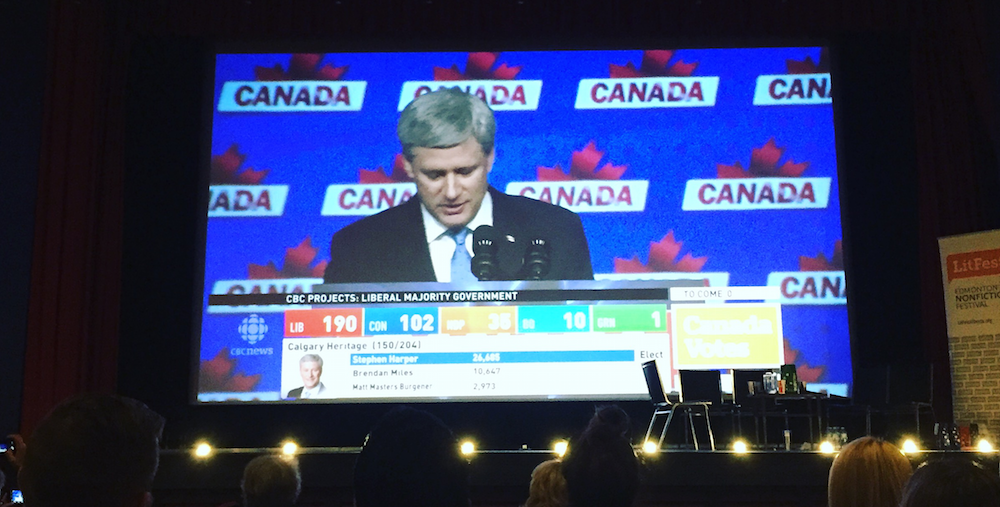
The dust has yet to finally settle on tonight’s election night results but we know that the Liberal Party led by Justin Trudeau will form a majority government with more than 180 seats in the next parliament. Conservative Party leader Stephen Harper, who has led his party’s government since 2006, conceded to defeat and resigned as party leader. The New Democratic Party led by Tom Mulcair, who rocketed from fourth place to Official Opposition under Jack Layton‘s leadership in 2011, was cut back to third place.

In Alberta, the Liberals appear to have cracked the Conservative fortress with wins in Edmonton and Calgary.

In Calgary-Skyview, former Liberal MLA Darshan Kang has become the first Liberal Member of Parliament elected in Calgary since 1968. Another former Liberal MLA, Kent Hehr, is currently leading Conservative MP Joan Crockatt in Calgary-Centre with more polls yet to be counted. In Edmonton-Mill Woods, popular city councillor Amarjeet Sohi, running for the Liberals, is in a tight race with Conservative cabinet minister Tim Uppal. In Edmonton-Centre, Liberal Randy Boissonnault is leading Conservative candidate James Cumming and NDP hopeful Gil McGowan.

While Canadians rejected a Conservative government led by a Calgary MP, Alberta will not be left without representation in government. It will be expected that at least one Liberal MP from each of Alberta’s two largest cities will be appointed to Mr. Trudeau’s cabinet.

For the NDP, it appears that only incumbent Linda Duncan was re-elected to a third-term as the MP for Edmonton-Strathcona.

Conservative leader Stephen Harper delivers his concession speech.

There will be plenty of times in the coming days to discuss what happened on election night and over the past eleven weeks, and what it means for the future of Canada. But tonight’s results make it clear that Canadians have rejected the politics of negativity, fear and division that Mr. Harper’s Conservative believed would help them secure re-election.

Tomorrow morning, Albertans will wake up in a new Canada  – with an incoming progressive Liberal Prime Minister Justin Trudeau, a progressive New Democrat Premier Rachel Notley, and progressive mayors Don Iveson in Edmonton and Naheed Nenshi in Calgary.

Categories
Alberta Politics

Justin Trudeau rallies Alberta Liberals just like Notley did five months ago

While Canadians could be on track to elect the country’s first Liberal Party government since 2004, it looks like Albertans could remain firmly in the Conservative Party camp, even after Stephen Harper‘s decade-long reign in Ottawa. But while most of Alberta’s federal ridings are expected to produce large victories for Tory candidates when the votes are counted tomorrow night, a handful of ridings in Alberta’s two major cities could produce some interesting results.

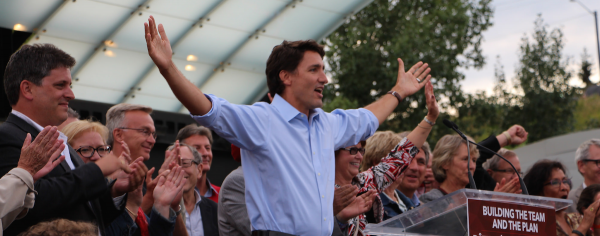
Attracting crowds of 2,000 in Edmonton and 4,000 in Calgary today, Liberal Party leader Justin Trudeau spent the final day of the 11-week election campaign in western Canada. The excitement in the crowd was undeniable. It has been a long time since Alberta Liberals have had something to be excited about.

I don’t know what Trudeaumania felt like in 1968, but the energy at today’s rally in Edmonton rivalled the energy at Rachel Notley‘s 2,000 person rally in the final week of this year’s provincial election. And I bet if you polled the people at that Trudeau rally, I would expect that most will have enthusiastically voted for Ms. Notley’s New Democratic Party on May 5, 2015. It was that ability to unite moderate and progressive voters under her party’s banner that led to the NDP’s election victory earlier this year.

While many of those moderate voters may help re-elect the Alberta NDP in 2019, they were excited about the federal Liberals today. And with moderate and progressive voters still divided between the federal Liberals and NDP in Alberta, it remains likely that any gains in the province could be marginal.

But while hopes for an NDP government led by Tom Mulcair in Ottawa may have been dashed, for now, the NDP remain well-positioned to elect two Members of Parliament in Edmonton, the epicentre of Ms. Notley’s orange wave. Two-term NDP MP Linda Duncan is expected to be re-elected in Edmonton-Strathcona. The NDP have also poured plenty of energy and resources in the campaign in Edmonton-Griesbach, where a two-way race has pitted NDP candidate Janis Irwin against former one-term city councillor Kerry Diotte.

Back at the rally, where the crowd of Liberals cheered enthusiastically for the Edmonton area Liberal candidates on stage, the largest cheers were for Trudeau and Amarjeet Sohi, the popular city councillor running for election in Edmonton-Mill Woods (where the rally was held). During his speech, Mr. Trudeau focused on some of the issues that Mr. Sohi has fought hard for on city council – like the much needed expansion of the LRT line to south east Edmonton.

Edmonton Mayor Don Iveson briefly entered the federal election fray earlier in the campaign when he criticized the federal Conservatives for not proposing new funding for Edmonton’s LRT system, while promising similar funding for projects in other cities. While his criticisms ruffled the delicate feathers of some local Conservatives, Mr. Iveson may find a more cooperative partner in a new federal government willing to invest in urban transportation infrastructure. And that kind of change is exciting.


Here is a list of some other Alberta ridings to watch on Election Night:

Calgary-Centre: Former Liberal MLA Kent Hehr is facing Conservative candidate Joan Crockatt, who was narrowly elected in a 2012 by-election.

Calgary-Confederation: Lawyer Matt Grant, running for the Liberals, faces former Progressive Conservative MLA Len Webber. Well-known former journalist Kirk Heuser is running for the NDP.

Calgary-Skyview: Former Liberal MLA Darshan Kang faces Conservative MP Devinder Shory.

Edmonton-Centre: A three-way race between Liberal Randy Boissonnault, New Democrat Gil McGowan and Conservative James Cumming.

Fort McMurray-Cold Lake: Liberal Kyle Harrietha and Conservative David Yurdiga face each other in a rematch from a closely fought 2014 by-election.


If you find yourself without an election night party tomorrow night, feel free to come down to the Metro Cinema (Garneau Theatre) and watch the coverage on a 30 foot theatre screen. While you watch the results, I will be talking politics on stage with Wab Kinew, Samantha Power, Drew Hayden Taylor and Mike Hudema. The event, part of Litfest, begins at 8:00 p.m. Tickets are $10.

Categories
Alberta Politics

Tuesday Morning Federal Election Updates from Alberta

Some of the latest from the federal election campaign trail in Alberta:

  • NDP leader Tom Mulcair will visit the Lethbridge riding this week to campaign alongside candidate Cheryl Meheden during his visit to Alberta. He will also speak at a rally in Calgary tonight. Mr. Mulcair is back in Alberta this week to participate in a Globe and Mail debate on Sept. 17.
  • Introduced by Health Minister Sarah Hoffman, Mr. Mulcair spoke to an estimated crowd of 1,700 supporters in Edmonton on Sept. 10.
  • Liberal leader Justin Trudeau made a campaign stop in Edmonton on Sept. 9 to rally a crowd of 1,500 supporters. During his visit, Mr. Trudeau promised additional funding for the southeast LRT to Mill Woods if the Liberals form government on Oct. 19.
  • Both Mr. Mulcair and Mr. Trudeau met briefly with Edmonton mayor Don Iveson during their visits.
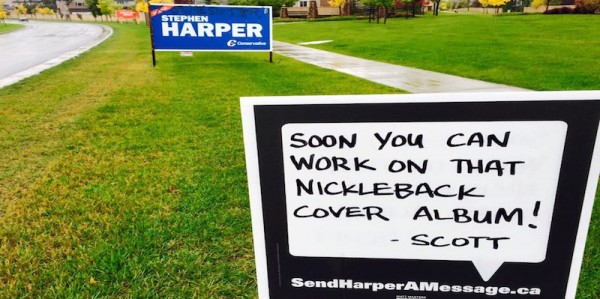
  • For a $50.00 donation to Calgary-Heritage NDP candidate Matt Masters Burgener, anyone can place a custom message on a campaign-style lawn sign that will be placed near one of Conservative leader Stephen Harper‘s election signs.
  • The federal Liberals have chosen their final candidate in Alberta by nominating businessman Robert Prcic in Calgary-Nose Hill. Mr. Prcic earned 3.8 percent of the vote as the provincial Liberal candidate in the October 2014 Calgary-Foothills by-election.
  • The Laurier Institute for the Study of Public Opinion and Policy has released projections of ten ridings that the NDP need to win to get the most seats and ten ridings the Liberals need to win to get out of third place. For the NDP, the list includes the Alberta riding of Edmonton-Manning, and for the Liberals, the list includes the ridings of Calgary-Centre and Edmonton-Centre.
  • ThreeHundredandEight.com is maintaining riding levels projections that show a handful of Alberta ridings in play during this federal election. As of Sept. 13, 2015, the projections show potential NDP wins in Edmonton-Griesbach, Edmonton-Manning, Edmonton-Strathcona and Lethbridge. The Liberals are projected to do well in Calgary-Centre, Calgary-Confederation, Calgary-Skyview and Edmonton-Centre.
  • A poll conducted by Mainstreet Technologies suggests the election in the new Fort McMurray-Cold Lake could be closer than last year’s by-election results in the old riding of Fort McMurray-Athabasca. The poll showed Conservative David Yurdiga with the support of 35 percent and Liberal Kyle Harrietha with 27 percent support. In the June 2014 by-election, Mr. Yurdiga only finished 11 points ahead of Mr. Harreitha in what was considered a very close race for this riding (in the 2011 election, former Conservative MP Brian Jean was re-elected with a margin of 58.6 percent).
Categories
Alberta Politics

Pressure builds for Alberta to ban corporate and union donations in municipal elections

On June 22, 2015, Alberta’s new NDP Government passed Bill 1: An Act to Renew Democracy in Alberta, imposing a retroactive ban on corporate and union donations to provincial political parties starting on June 15.

Don Iveson Edmonton Mayor Election
Don Iveson

Since that law passed, pressure has been building for the provincial government to extend that ban to municipal elections. The level of spending by some candidates in the last municipal election was described as “insane” by Calgary Mayor Naheed Nenshi, after some Calgary city council candidates raised more than $270,000 largely through corporate donations.

During the debate about the provincial law, Edmonton Mayor Don Iveson called for the ban to be extended to municipal elections. Last week, Edmonton City Council voted in favour of a motion introduced by Councillor Andrew Knack to ask the provincial government to ban corporate and union donations in municipal elections.

Edmonton Public School Board trustees endorsed a similar motion introduced by trustee Michael Janz on June 23, 2015.

Andrew Knack Edmonton Ward 1
Andrew Knack

A special select Ethics and Accountability Committee chaired by Edmonton-Mill Woods MLA Christina Gray is set to review the Election Act, the Election Finances and Contributions Disclosure Act, the Conflicts of Interest Act, and the Public Interest Disclosure (Whistleblower Protection) Act.

While the committee is not specifically reviewing the Local Authorities Elections Act, the law that governs municipal elections, the MLAs on that committee should be encouraged to ask Municipal Affairs Minister Deron Bilous to extend the changes municipal elections before the 2017 municipal elections.

Christine Gray MLA Edmonton Mill Woods
Christina Gray

Any move to ban on corporate and union donations in municipal elections must also include resources to enforce the law, which has been lacking under the current legislation. Some municipalities have even refused to enforce the existing legislation.

Here is the motion approved by Edmonton City Council:

That the Mayor write a letter and/or advocate to the Minister of Municipal Affairs and Premier:

1. Requesting that the city be given be the ability to independently establish campaign finance and disclosure rules in advance of the 2017 Municipal Election, either via the City Charter or other means.

2. Notwithstanding desiring the autonomy for municipalities to set the other campaign finance and disclosure rules, Edmonton calls for amendments to the Local Authorities Elections Act to eliminate corporate and union donations for all local election candidates.

3. Requesting that should the legislature move to limit corporate and union contributions for all local elections, that the province level the playing field by introducing tax credit eligibility for local election donations.

4. That restrictions on contributions and related disclosure requirements be the same for third party advocacy groups/individuals as they are for municipal candidates.

Categories
Alberta Politics

Notley NDP waste no time implementing popular progressive agenda in former conservative heartland

Banning corporate and union donations: Check.
Restoring funding to health, education and human services: Check.
Increasing corporate taxes: Check.
Introducing a new climate change strategy: Coming soon.
Phasing in a $15 per hour minimum wage: Coming soon.
Reviewing Alberta’s natural resource royalty framework: Coming soon.

Progress is the order of business in Canada’s so-called Conservative heartland as Premier Rachel Notley’s newly elected Alberta NDP government begins implementing the main promises from their winning election platform. Leaders of the previous PC regime, Alison Redford and Jim Prentice, styled themselves as Progressive Conservatives, their actions rarely matched their words. The NDP proposed a fairly moderate progressive agenda and it is refreshing to see it take action so quickly after the election.

Marg McCuaig Boyd
Marg McCuaig Boyd

Revenue and tax reform was a big issue before and during the recent election, with Mr. Prentice and the opposition argued over how best to remove Alberta from the oil revenue roller coaster. It remains clear that Alberta cannot continue to rely on revenues generated from oil and gas royalties to fund the provincial operating budget. Both the PCs and NDP proposed tax increases in the recent election, but Mr. Prentice’s refusal to increase corporate taxes, even symbolically, was a huge miscalculation.

While conservatives preach doom and gloom, our province still has corporate and personal tax rates lower than when Ralph Klein was premier, no provincial sales tax, and huge reserves of oil and gas. Alberta will now have the same corporate tax rate as Saskatchewan and Manitoba.

Deron Bilous Edmonton Alberta MLA Minister
Deron Bilous

But there is still plenty more for the new government to do. Agriculture Minister Oneil Carlier should extend protections to farmworkers injured on the job. Municipal Affairs Minister Deron Bilous should follow calls from Calgary’s Naheed Nenshi and Edmonton’s Don Iveson and Michael Janz to reform municipal election finance laws. And the province can do much more to clean up provincial election laws, something that a new all-party committee will be tasked to do soon (and they should consider adopting some of the amendments made by Wildrose MLAs during recent debates in the Legislature).

Kathleen Ganley NDP Calgary Buffalo
Kathleen Ganley

Apologizing for previous governments lack of action to stop residential schools and calling for a national inquiry into missing and murdered aboriginal women was absolutely the right step to take but action needs to follow. Justice and Aboriginal Affairs Minister Kathleen Ganley needs to show through government policy that this apology is more than just political posturing.

The government also announced it will soon take action to improve Alberta’s record of poor environmental management and lack of action of climate change, which has helped fuel international opposition to pipeline expansion and the oil sands. On climate change, the PCs lost the public relations battle years ago. Now the challenge will fall to Ms. Notley, Environment Minister Shannon Phillips and Energy Minister Marg McCuaig-Boyd to win the policy war on climate change.

Shannon Phillips
Shannon Phillips

I do not have enough room in this post to even begun to discuss the challenges facing Health Minister Sarah Hoffman and Education Minister David Eggen (which will be included in a series of future posts).

As the new government moves forward with what in most other provinces would be considered a moderate progressive agenda, Canada’s conservative outrage industry is gearing up its attacks on the Alberta’s new government.

Talking heads like Ezra Levant are fuelling the paranoia of right-wing fringe conservatives afraid we are witnessing a Red Dawn-style communistic coup (federal Conservative candidate Kerry Diotte and Wildrose MLAs Drew Barnes and Rick Strankman were among the registered spectators at one of Mr. Levant’s travelling circus shows). And recent opinion editorials by critics like conservative economist Jack Mintz, who suggested Alberta could be the next Greece, have verged on the bizarre.

Drew Barnes Wildrose MLA Cypress Medicine Hat
Drew Barnes

Ms. Notley and Infrastructure Minister Brian Mason moved quickly to quell criticism of their fiscal plan by announcing last week that former Bank of Canada Governor David Dodge will be advising the Premier on infrastructure investment issues. Hiring Mr. Dodge is a smart move and shows a willingness to bring in talent from outside traditional NDP circles.

Aside from the angry conservatives, the new government appears to still enjoy popular support from Albertans, who tossed out the scandal-ridden and tone deaf Tories on May 5. Recent polling shows Ms. Notley, still in her honeymoon period, enjoying the approval of 53% of Albertans, making her the second most popular premier in Canada next to Saskatchewan’s Brad Wall.

The NDP need to be careful not to cut short their honeymoon by making small mistakes. They have already faced criticism for hiring too many provincial outsiders and the media is poking around the perceived influence of Ms. Notley’s husband. These are minor issues that I am sure most Albertans will look past today but the small mistakes can pile up quickly if the new government is not careful.

If the NDP can continue to limit their missteps, focus on implementing their popular platform, and remember why Albertans endorsed Ms. Notley’s charismatic leadership, they will enjoy a warm welcome on the summer political barbecue and parade circuit.

Categories
Alberta Politics

Sources say Karen Leibovici to run for federal Liberals in Edmonton-West

Numerous sources report that former Edmonton city councillor Karen Leibovici is preparing a jump into federal politics by seeking the federal Liberal Party nomination in the new Edmonton-West riding.

Kelly McCauley Edmonton-West Conservative
Kelly McCauley

Ms. Leibovici is a long-time local politician who was first elected as a Liberal MLA for Edmonton-Meadowlark in 1993 and served on city council from 2001 to 2013. From 2012 to 2013, she was President of the Federation of Canadian Municipalities. She ran for mayor in 2013, placing a distant second behind Don Iveson.

Speaking at a fundraiser during the mayoral election campaign, Ms. Leibovici is reported to have said that Edmonton “would grind to a halt” if voters did not choose her as mayor. Her mayoral bid was managed by prominent Progressive Conservative insiders Hal Danchilla and Catherine Keill.

At least one other candidate, Greg Springate, is seeking the Liberal nomination in Edmonton-West. Dan Bildhauer had been seeking the nomination but instead ran for the provincial Liberals in Edmonton-Meadowlark in the recent provincial election.

Amarjeet Sohi Edmonton
Amarjeet Sohi

Hotelier Kelly McCauley was acclaimed as the Conservative candidate in Edmonton-West, but not without controversy. During the nomination race, Edmonton-McClung PC MLA David Xiao was disqualified from the contest by the Conservative Party National Council (Mr. Xiao was defeated in this month’s provincial election).

The federal NDP have not yet nominated a candidate but as a result of the May 5 provincial election NDP candidates were elected with large margins in the four constituencies that overlap the federal Edmonton-West riding. Those new NDP MLAs include Jon Carson in Edmonton-Meadowlark, Lorne Dach in Edmonton-McClung, Thomas Dang in Edmonton-South West, and Sarah Hoffman in Edmonton-Glenora.

If Ms. Leibovici does run in Edmonton-West, she will add to a growing trend of municipal politicians running for federal office in the October 2015 federal election. Three-term Edmonton city councillor Amarjeet Sohi is the nominated federal Liberal candidate in Edmonton-Mill Woods, former Edmonton councillor Kerry Diotte is the Conservative candidate in Edmonton-Griesbach, Hinton Town Councillor Ryan Maguhn is running for the Liberals in Yellowhead and City of Brooks Mayor Martin Shields is the Conservative candidate in Bow River.

Categories
Alberta Politics

The Final Countdown: 6 days left until Election Day in Alberta

Staying above the fray of Alberta’s wild 2015 election campaign, Edmonton Mayor Don Iveson argued in his annual State of the City Address that which ever political party forms the provincial government after the May 5 election will have to focus on the capital city.

Stephen Mandel Health Minister Alberta Edmonton Whitemud MLA
Stephen Mandel

“I’m confident that no matter what Albertans decide on May 5, together you, along with our city council will not stand for any provincial government ever forgetting about Edmonton again,” Mr. Iveson told an audience in downtown Edmonton.

At his final State of the City Address two years ago, former Mayor Stephen Mandel publicly lambasted the Progressive Conservatives for their short-sighted funding cuts to Alberta’s colleges and universities.

“We should expect nothing less than passionate, relentless defence of this sector from our provincial representatives, who should know better than to just stand by,” Mr. Mandel said in 2013.

Now as the PC candidate in Edmonton-Whitemud, Mr. Mandel has remained quiet about deep cuts to education funding included in the most recent PC budget.

Michael Janz Edmonton
Michael Janz

The Edmonton Public School Board passed a budget this week that will not include enough provincial funding to compensate for the growth in student population in September, as a result of provincial budget cuts.

“If I have one key message for parents, it would be get out there and engage your candidates. Ask them how are you going to ensure that your party will fund my school? How will you ensure that my student will be successful as well as the other students in their class?,” school board chair Michael Janz told the Edmonton Journal.

As we enter the final six days of the election, the parties will now focus their energy and resources on consolidating their support and working to get their voters out to the advance polls and on election day.

Rachel Notley Alberta NDP leader
Rachel Notley

NDP leader Rachel Notley faced criticism last week after a meeting with the Calgary Chamber of Commerce. The Calgary Herald published a one-sided editorial criticizing the NDP proposal for a phased-in $15 minimum wage (which would ensure Albertans working full time earned at least $600 per week and around $31,200 per year).

While lobby groups like the Canadian Federation of Independent Business oppose the proposed increase, some economists, including Nobel Prize winner Paul Krugman, suggest an increase to the minimum wage as a means to stimulate the economy [via Ricochet].

The Progressive Conservative Party has not released any new policy positions since Jim Prentice announced last week that he would reopen the budget to reverse changes to the Charitable Donations Tax Credit. Since the leaders’ debate, the PCs have focused their energies on attacking Ms. Notley, who the governing party appears to perceive as their greater challenger on election day.

Danielle Smith Wildrose PC MLA
Danielle Smith

In one of the more bizarre moments of the campaign, former Highwood PC MLA Danielle Smith jumped to Ms. Notley’s defence on Twitter, claiming that the NDP leader’s doubts about the success of the Enbridge corporation’s Northern Gateway Pipeline project are similar to an opinion Mr. Prentice publicly expressed in September 2014.

Wildrose Party leader Brian Jean announced his party’s plans for funding special needs education and a formula for funding municipal growth. And AlbertaPolitics.ca blogger David Climenhaga wrote one of the more comprehensive backgrounds on Mr. Jean and his Fort McMurray “rags to riches” story.

Janet Keeping Alberta Green Party
Janet Keeping

The PCs sent out a press release yesterday attacking Calgary-Bow Wildrose candidate Trevor Grover who was a candidate for the anti-free trade Canada Action Party in the 2006 federal election. If the PCs hope to win the “controversial candidate accusations game,” they should reflect on one of their own nominated candidates who was arrested and plead guilty to prostitution related charges while travelling abroad on government business in December 2013.

The Alberta Party released plans to provide stable funding to post-secondary institutions and deal with municipal issues such as housing and public transit. The Liberals released plans to fix the health care system and accused the NDP of playing board games with finances. And Green Party leader Janet Keeping called for the adoption of an Environmental Bill of Rights [Ms. Keeping is running against Mr. Prentice in Calgary-Foothills].

Advance polls will be open across the province over the next four days from 9:00 a.m. to 8:00 p.m. Voters unable to cast a ballot on the May 5 Election Day can now vote on April 29 and 30, and May 1 and 2.


I made my debut on CBC Radio’s The Current yesterday morning when I joined the National Post’s Jen Gerson, the Edmonton Sun’s Lorne Gunter and host Anna Maria Tremonti for a panel discussion about Alberta’s election campaign.

Categories
Alberta Politics

#abvote Google Hangout with MLA Laurie Blakeman

It has been a banner month for Edmonton-Centre MLA Laurie Blakeman.

At the start of last week, the Progressive Conservative government did a 180 degree flip to endorse Ms. Blakeman’s bid to allow students to create Gay-Straight Alliances in Alberta schools. By the end of the week, the five-term Liberal MLA announced that she had secured her party’s nomination to run for re-election, as well as nominations from the Alberta Party and Green Party in Edmonton-Centre. Billed as a plan to unite progressives in Edmonton-Centre, Ms. Blakeman’s unusual step has caught the attention of political watchers from across Alberta.

We were pleased to welcome Ms. Blakeman as our guest on the second #AbVote Google Hangout. The topics covered in the hour-long discussion ranged from the future of progressive politics in Alberta, why she chose not to join Rachel Notley‘s New Democratic Party, the state of the Liberal Party, the importance of electing more women in politics, reducing carbon emissions from coal burning electricity plants, protecting the right to water, Star Trek versus Star Wars, lunch with Pope Joan and much more.

Watch the full Google Hangout in the screen below.

Watch abvote.ca for details about our next #AbVote Google Hangout and new guests and co-hosts.


Check out our past hangouts with Don Iveson and Kerry Diotte from the 2013 Edmonton Municipal Elections.

Categories
Alberta Politics

A Decade of Daveberta – Marking 10 Years of Blogging

Ten years ago, on January 21, 2005, I sat down at a computer in a University of Alberta library and launched the blog known as daveberta.

Ed Stelmach Dave Cournoyer
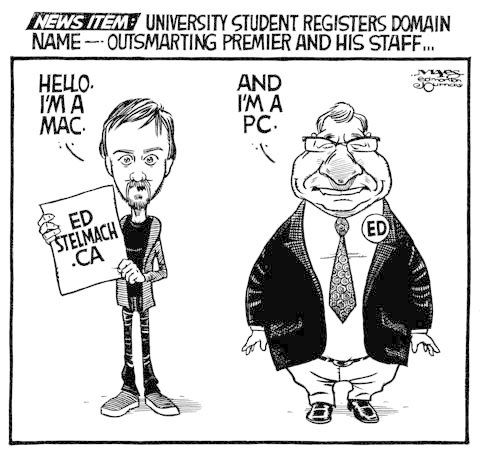
Malcolm Mayes’ Edmonton Journal political cartoon in January 2008 (I’m the Mac).

I had no idea at the time where the blog would take me. Blogging was new and I started one because many of my friends had started their own. Initial posts were more personal and not necessarily limited to politics, but the blog soon focused almost entirely on Alberta politics.

Ever since I was in junior high school, I have taken a keen interest in Alberta politics. The world of blogs, still relatively young when I was a university student in 2005, offered a great venue for a young political science student to share his opinions and observations. I was immediately hooked.

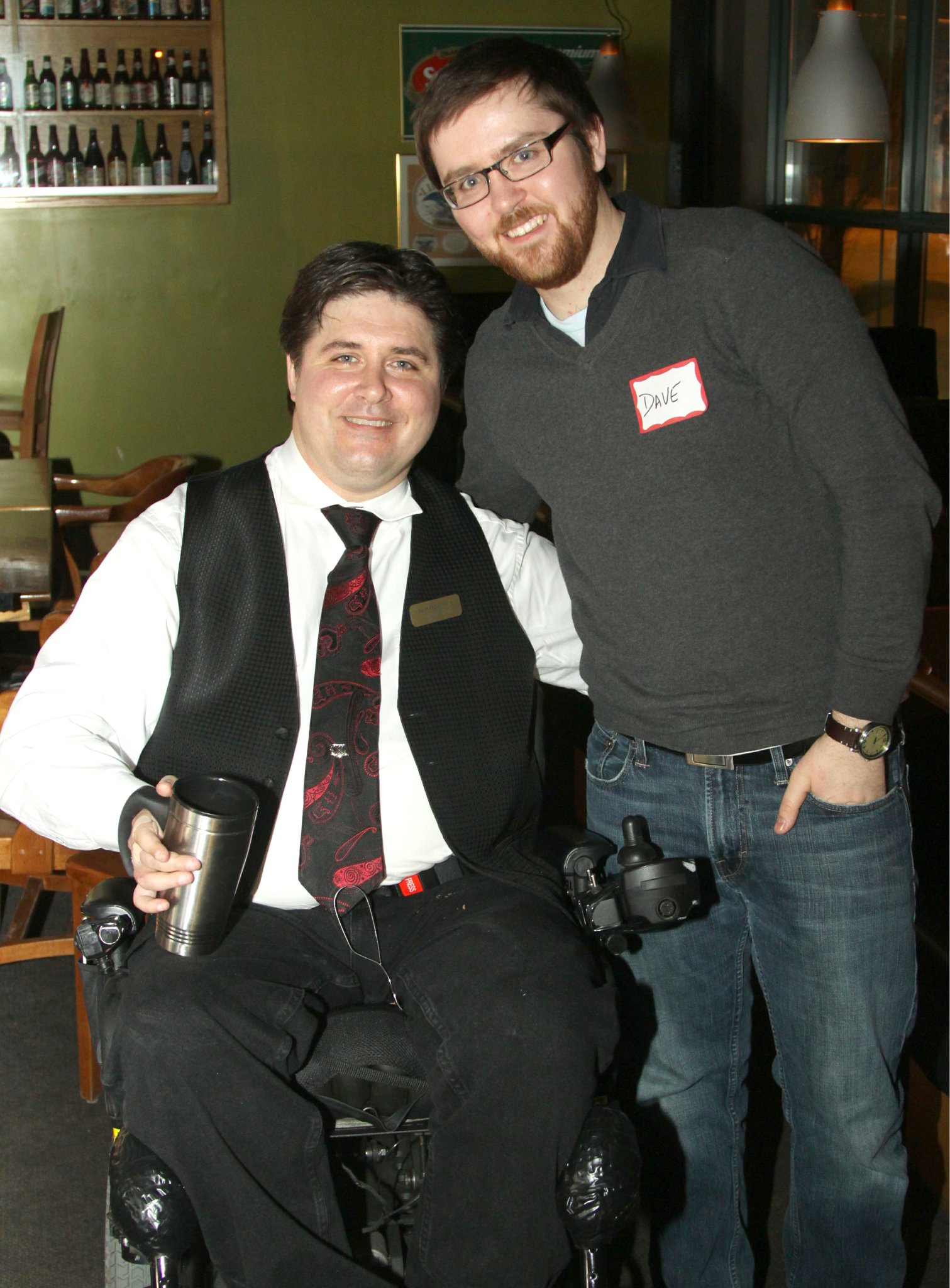
Calgary-Buffalo MLA Kent Hehr and Dave Cournoyer daveberta
With Liberal MLA Kent Hehr in 2011.

The readership of this blog has grown enormously over the past ten years and I only once came close to shutting it down. In December 2007, after returning to the University of Alberta and planning to focus on my studies, I received a letter from a lawyer representing Premier Ed Stelmach. The Premier gave me new reasons to continue blogging and helped boost my readership considerably. The rest is history.

The world of blogging has changed a lot over the past ten years. Blogs have become more sophisticated and many aggregators, once hubs for links and readers, have disappeared as social networks like Facebook and Twitter have allowed bloggers to reach greater audiences.

Dave Cournoyer David Dorward
With PC MLA David Dorward in 2014.

Writing this blog has led to many great opportunities over the past ten years. I have spoken at dozens of conferences, interviewed politicians of all stripes and participated in dozens of media panel discussions – including as a regular panelist on the Alberta Primetime politics panel.

I am also humbled to have received a few awards for this blog, including Best Political Blog and Best Progressive Blog in the 2007 Canadian Blog Awards. More recently, I placed second in the 2014 Canadian Weblog Awards and was nominated for a Yeggie in 2013. In 2010, I had the privilege of being named one of Edmonton’s Top 40 under 40 by Avenue Magazine.

Don Iveson Dave Cournoyer
With Don Iveson in 2007.

My opinions and political allegiances have shifted over the years. For the first four years of this blog, I supported the Liberal Party and had the pleasure of working for Edmonton MLA Kevin Taft when he led the Official Opposition Party. When he stepped down from the leadership, I drifted for a time towards the Alberta Party and had the opportunity to volunteer alongside some great people in that organization.

Now, as a non-partisan, I feel free to write about Alberta politics without a partisan lens. It is refreshing.

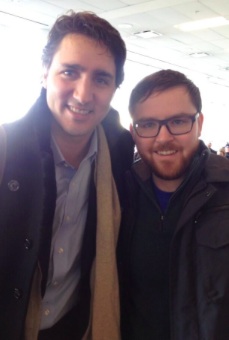
Dave Cournoyer Justin Trudeau
With Justin Trudeau in 2014.

As the disclaimer on this blog reads, my thoughts and opinions change from time to time and I consider this a necessary consequence of having an open mind. This blog is intended to provide a semi-permanent point in time snapshot and manifestation of the various ideas running around my brain, and as such any thoughts and opinions expressed within out-of-date posts may not be the same, nor even similar, to those I may hold today.

I do not know whether this blog will last another ten years, but so long as I continue to enjoy writing about Alberta politics, and have the time to do so, I will do so. Blogging is a great hobby and Alberta politics continues to offer great content.

To the readers, commenters, and occasional guest contributors who continue to return to this blog to follow Alberta politics, I offer a heart-felt Thank You.

Categories
Alberta Politics Satire

What a year 2015 has been in Alberta politics!

Alberta Legislature Building Edmonton Canada
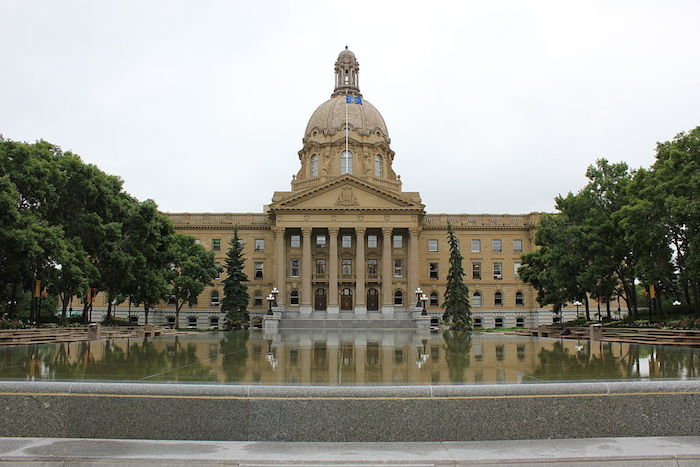
Alberta’s Legislative Assembly (photo credit Timorose, CC BY-SA 3.0)

December 29, 2015

Column by: Dirk Pranter, Provincial Affairs columnist, Edmonton Journal-Sun

Tories re-elected for 14th time

A snap mid-Summer election returned Jim Prentice’s renamed “Conservative Party of Alberta” to its fourteenth term as government. In an unexpected twist of fate, Finance Minister Danielle Smith was defeated in her home riding by Wildrose Party leader Randy Thorsteinson.

But don’t feel sorry for Smith. She was appointed to the Senate in one of Stephen Harper’s last acts as Prime Minister before the Conservatives lost the October federal election. Harper’s applecart was upset when the beautiful, unseasonably warm October weather caused Canadian voters to turn out in droves.

Back on the provincial scene, NDP leader Rachel Notley led her party to a breakthrough in Edmonton to form the Official Opposition with 21 MLAs. Notley’s party won its first seat in Calgary since the 1980s and its first ever seat in Lethbridge.

But perhaps the biggest surprise was the re-election of Wildrose-turned-Liberal MLA Joe Anglin, who won by 3,000 votes in Rimbey-Rocky Mountain House-Sundre. As the only Liberal to survive the election, Anglin is now the leader of the party.

“Unlike the 2012 election, 2015 gave Albertans two clear choices in the PCs and NDP,” said Rick Dunderland, a professor of political science at University of Red Deer. “Even though the PCs still won, there is now a difference between the government and official opposition and that will be a good thing for democracy.”

Tough Economic Times behind us

With a return to $120/barrel oil, Premier Prentice praised good economic times ahead for Albertans in the 2016.

“Back to budgeting as usual,” a senior government official said. “Now we don’t have to worry about saving money for the future, because the price of oil is never going to go down again.”

The Prentice Government is facing international criticism for his government’s continued lack of climate change plan. “Alberta’s climate change framework is important and will be a continued focus of our government in 2016,” Energy Environment Minister Rob Anderson said. “Under new management, we are continuing to take the time to ensure the decisions we make are right.”

And big city mayors have a lot to celebrate. The recently negotiated City Charters granting the municipalities new powers are expected to be unveiled in early 2016. A newly released poll showed Mayors Don Iveson and Naheed Nenshi with 95% approval among voters.

Redford tell-all

Palm Springs resident Alison Redford is set to launch a new tell-all book about her time as Premier of Alberta. Driven out by scandal in 2014, Redford has dedicated her time to charity work and has announced all proceeds from the book will go to charity. Not surprisingly, Tory insiders are expecting the wurst about what might be included in the book.

Keystone XL Pipeline

Recently elected Prime Minister Justin Trudeau celebrated the approval of the Keystone XL Pipeline over a bottle of champagne with President Barack Obama during his first visit to the White House last month. Conservative opposition leader Jason Kenney complained that Canadians should thank former Prime Minister Stephen Harper for the pipeline’s success.

In an unexpected gesture, Prime Minister Trudeau named Harper the Canadian Ambassador to Ukraine where, unfortunately, the Canadian Ambassador’s residence was burned down last week by a pro-Russian mob.

Read Dirk Pranter’s December 20, 2014 column: What a year 2014 has been in Alberta politics!

Categories
Alberta Politics

Iveson and Nenshi in strong position for City Charters

Don Iveson Naheed Nenshi Brian Bowman Gregor Robertson Grey Cup Sarah Chan 2014
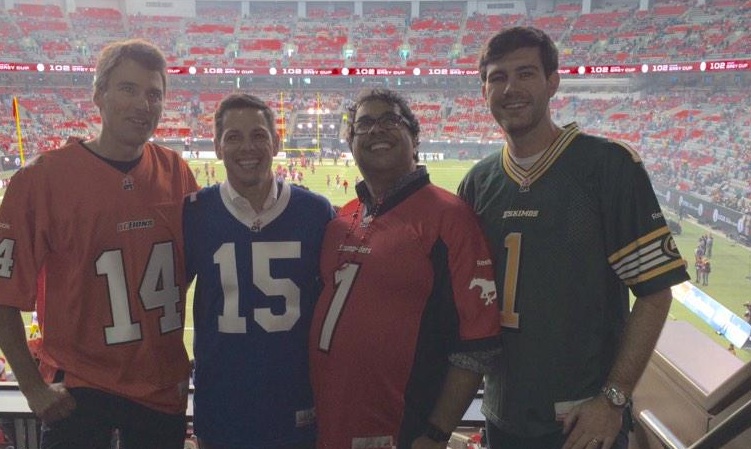
Western Canada’s Big City Mayors at the 2014 Grey Cup in Vancouver. From left to right: Vancouver Mayor Gregor Robertson, Winnipeg Mayor Brian Bowman, Calgary Mayor Naheed Nenshi and Edmonton Mayor Don Iveson. Photo credit: @misssarahchan

As the collapse of the Wildrose Party and speculation about Alberta’s next provincial budget dominate political discussions, one of the most politically important discussions impacting governance in our province next year could be about the creation of City Charters.

In his first month as Premier, Jim Prentice met with Edmonton Mayor Don Iveson and Calgary Mayor Naheed Nenshi to restart discussions around the creation of City Charters for Alberta’s two largest cities.

A recent survey conducted by ThinkHQ Public Affairs Inc. and provided to daveberta.ca shows Mr. Iveson and Mr. Nenshi with 74% and 70% approval ratings. For Mr. Iveson, this is an impressive increase from a survey in March 2014 in which respondents gave him 70% approval rating.

“The two mayors of the big cities are the second and third most powerful politicians in the province,” ThinkHQ President Marc Henry told this blogger. “The mayors are obviously the two people in the province Premier Prentice has to take into consideration,” Mr. Henry said.

The popular mayors have made City Charters a priority. The adoption of charters would be a long overdue change that could recognize the crucial roles and responsibilities that our largest municipal governments have in the lives of millions of Albertans.

“Most Albertans like the idea of a charter but don’t understand it,” Mr. Henry explained. “The challenge with the city charter is defining it,” he said.

The Centre for Constitutional Studies at the University of Alberta published a detailed explanation and background of City Charters in April 2013:

Civic charters are different in every city, but a “charter city” (a city with a civic charter) has its own stand-alone legislation, rather than following the general municipal government acts of the province.  It is a special agreement between a province and city designed to meet the demands of city governance, usually by giving a city more tax-raising powers, along with more autonomy to set policy that will allow it to meet its individual needs.

The cities of Winnipeg, Vancouver and Toronto have City Charters passed by their provincial governments granting those municipalities increased levels of responsibility and access to additional revenue.

In an October 2014 blog post, Mr. Iveson explained why City Charters are important and why they can also be an abstract concept to explain:

The City Charter process can be an abstract concept; talking about roles and responsibilities with another order of government probably isn’t the sexiest thing for many people. But – I would argue – delivering on this is one of the most important factors in Edmonton’s future success. Correcting the imbalance in responsibility and authority with the Province is one of the most critical city building things we can do because it enables the ‘real work’ like building LRT lines and keeping our cities safe to actually happen.

Rather than a broad increase in taxation powers, City Charters in Alberta could include a more serious commitment to revenue sharing by the province as recognition that our big cities are no longer tiny localized organizations. They are important levels of government that provide services and infrastructure that also benefit millions of Albertans living outside the city boundaries.

Discussions about City Charters began in 2012 while Premier Alison Redford was in office but slowed down as political scandals engulfed the Progressive Conservative government. A Memorandum of Understanding signed by Mr. Iveson, Mr. Nenshi and Mr. Prentice on October 7, 2014 laid out the following timeframe for City Charters:

  • Phase one will address matters specific to the two cities and Municipal Affairs (MA) by Spring 2015;
  • Phase two will address matters between the two cities, MA and any other Government of Alberta ministries by Fall 2015; and
  • Phase three will address the development of a new fiscal framework for the two cities by Spring 2016.

The ThinkHQ online research panel had a sample size of 1656 people and was conducted between November 26 to December 1, 2014.


The Yards Podcast
In episode one of The Yards podcast, host Omar Mouallem talks with Mayor Iveson about downtown memories, bike culture and whether downtown development can survive another oil crash.

Categories
Alberta Politics

Sunday night federal candidate nomination updates from Alberta

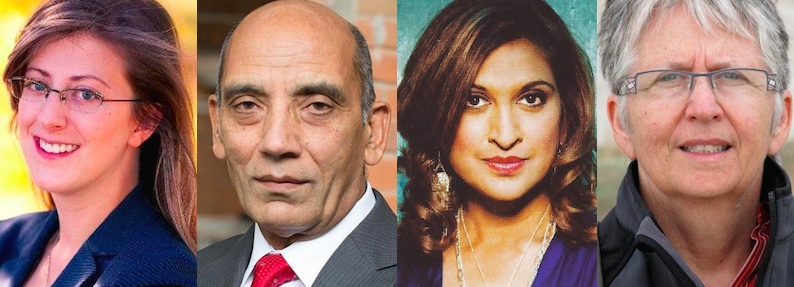
Stephane McLean,  Tariq Chaudary,  Nirmala Naidoo, and  Annie McKitrick.
Stephane McLean, Tariq Chaudary, Nirmala Naidoo, and Annie McKitrick.

With signs pointing towards a potential spring 2015 federal election, Canada’s opposition parties are picking up pace in nominating candidates. The Liberals, NDP, Greens and Libertarians are far behind the Conservatives in nominating candidates in Alberta, but they are in the process of compiling their slates. A full list of federal nominated candidates in Alberta can be found here.

Here are some of the latest nomination updates since I wrote about this topic last week.

Calgary-ConfederationStephane McLean is seeking the NDP nomination. Ms. McLean was most recently the NDP candidate in the Calgary-Elbow provincial by-election.

Calgary-Rocky RidgeQamar Khan will be challenging former CBC news anchor Nirmala Naidoo for the Liberal Party nomination in this new northwest Calgary constituency. The nomination meeting is scheduled to take place on Dec. 16, 2014.

Calgary-Shepard: Dany Allard is expected to be acclaimed as the NDP candidate at a Dec. 15, 2014 nomination meeting. Mr. Allard will face nominated Conservative candidate Tom Kmiec.

Edmonton-CentreBlaine Bilocerkowec has been nominated as the Libertarian Party candidate.

Edmonton-Griesbach: Former city councillor Kerry Diotte defeated Omar Tarchichi in this riding’s Conservative Party nomination. Mr. Diotte is a former Edmonton Sun columnist and one-term city councillor who ran in the 2013 mayoral election under the slogan “Diotte or Detroit” (suggesting that the City of Edmonton would go bankrupt unless he was elected mayor). Mr. Diotte earned 15% of the vote in the mayoral election won by Don Iveson.

Edmonton-RiverbendTariq Chaudary defeated Tom O’Leary at a November 29, 2014 nomination meeting to become the Liberal candidate in this south west Edmonton constituency.

Edmonton-West: Andrew Mclean has been nominated to run as a Libertarian Party candidate.  Dan Bildhauer and Greg Springate are running in the yet to be scheduled Liberal Party nomination.

Foothills: Artist and businessperson Romy Tittel was nominated as the Green Party candidate.

Lakeland: Past Wildrose Party candidate Shannon Stubbs and former constituency president Terry James are seeking the Conservative nomination in this sprawling rural riding. Ms. Stubbs is married to Lac La Biche-St. Paul-Two Hills Wildrose MLA Shayne Saskiw. She was the Wildrose candidate in Fort Saskatchewan-Vegreville in the 2012 election and the Progressive Conservative candidate in Edmonton-Strathcona in the 2004 provincial election.

Red Deer-LacombeJeffery Rock has announced plans to seek the Liberal Party nomination. Mr. Rock is the Minister at Gaetz Memorial United Church in Red Deer.

Sherwood Park-Fort Saskatchewan: Annie McKitrick is seeking the NDP nomination in this riding east of Edmonton. The nomination meeting is scheduled to be held on Feb. 12, 2015.

Yellowhead: Two recent by-elections candidates have announced plans to run in the next general election. Hinton town councillor Ryan Maguhn is seeking the Liberal nomination on Dec. 19, 2014 and Cory Lystang has been nominated as the Libertarian candidate. Mr. Maguhn earned 19.9% of the vote in the recent by-election.

Categories
Alberta Politics

Updated: A Timeline of Alberta’s Gay-Straight Alliance debate

Alberta Gay Straight Alliance Debate
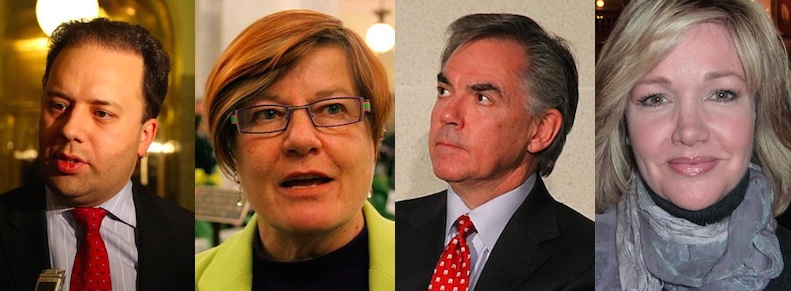
Justice Minister Jonathan Denis, Liberal MLA Laurie Blakeman, Premier Jim Prentice and PC MLA Sandra Jansen

It is sometimes amazing how quickly one political issue can transform and dominate the debate. This week’s raging debate about allowing Gay-Straight Alliances (GSA) in Alberta schools has twisted and turned so many times, it has become difficult to figure out who is in and out of the closet on this issue.

Wikipedia defines a Gay-Straight Alliance as student-led organizations that are intended to provide a safe, supportive environment for lesbian, gay, bisexual, transgender, and queer/questioning (LGBTQ) youth and their straight allies. A recent study from the University of British Columbia found that Canadian schools with GSAs may reduce the odds of suicidal thoughts and attempts among both sexual minority and straight students.

Here is a simple timeline following the ongoing provincial debate around these student clubs in Alberta schools:

April 7, 2014: Liberal MLA Kent Hehr introduces Motion 503:

“Be it resolved that the Legislative Assembly urge the government to introduce legislation, like Manitoba’s and Ontario’s, requiring all school boards to develop policies to support students who want to lead and establish gay-straight alliance activities and organizations, using any name that is consistent with the promotion of a positive school environment that is inclusive, welcoming, and respectful for all students regardless of sexuality, sexual orientation, or gender identity.”

A coalition of 31 Progressive Conservative and Wildrose MLAs vote down Motion 503. Nineteen Liberal, NDP and PC MLAs, including PC anti-bullying Minister Sandra Jansen vote in favour of the motion.

September 15, 2014: Premier Jim Prentice appoints Gordon Dirks as Education Minister. Mr. Dirks is criticized for his relationship with evangelical Christian schools in Calgary.

 October 15, 2014: Liberal MLA Laurie Blakeman announces plans to introduce a private members’ bill to mandate school boards to develop policies to support students who start a gay-straight alliance in their schools by offering meeting space and benefits given to other clubs.

November 15, 2014: At the party’s annual policy convention, Wildrose members reject a ‘definitive’ statement on equality. Party members voted against adopting as policy a statement affirming the rights for everyone regardless of race, religion, sexual orientation, and other differences.

November 18, 2014: Wildrose leader Danielle Smith says her caucus will likely support Ms. Blakeman’s private members’ bill and prominent members of Edmonton’s LGBTQ community speak in favour of the bill.

November 20, 2014: Ms. Blakeman introduces Bill 202: Safe and Inclusive Schools Statutes Amendment Act, 2014 into the Legislative Assembly. It passes first reading.

November 22, 2014: Attending the annual Gay-Straight Alliances conference at the University of Alberta, Edmonton Mayor Don Iveson speaks in favour of Bill 202. “People don’t all come in the same shapes and sizes, colours and genders so it is important that a space everyone is compelled to go to as part of their education makes space for everyone,” Mr. Iveson told reporters.

November 24, 2014: Wildrose MLAs Kerry Towle and Ian Donovan cross the floor to the PC caucus. The Wildrose Caucus defies its party’s members by issuing its own resolution on equality.

Wildrose MLA Rob Anderson proposes amendments to Bill 202 which would allow Catholic and other religious schools to opt-out of allowing student to form gay-straight alliances.

November 25, 2014: Mr. Prentice announces that PC MLAs will be allowed a “free vote on Bill 202. Mr. Donovan tells CBC that the PC Party is now more socially conservative than the Wildrose Party and that the GSA vote contributed to his joining the PC Party.

November 27, 2014: At a hastily called press conference, Mr. Prentice declares that Ms. Blakeman’s bill was no longer needed because he plans to introduce his own bill dealing with Gay-Straight Alliances. Arguing in favour of ‘parental rights,’ Mr. Prentice says his bill will allow school boards to decide whether GSAs should be allowed. If students are turned down, Mr. Prentice says they can take legal action against their school boards. It is suspected that Mr. Prentice’s bill was not yet written at this time.

December 1, 2014: Mr. Dirks, Ms. Jansen and Justice Minister Jonathan Denis hold a press conference during the time originally allotted to debate Bill 202. Bill 10: An Act to Amend the Alberta Bill of Rights to Protect our Children is introduced into the Legislature by Ms. Jansen and passes first reading. ‘We’re moving forward. We’re moving forward incrementally,‘ said Ms. Jansen on the issue of gay rights. The Edmonton Journal and Calgary Herald publish editorials harshly critical of Bill 10.

December 2, 2014: Bill 10 passes second reading and procedurally removes Bill 202 from the legislative order paper. Forty-two PC and Wildrose MLAs vote in favour and 9 opposition MLAs, including Ms. Blakeman, Ms. Smith, NDP leader Rachel Notley and Liberal leader Raj Sherman, vote against the bill.

Only one PC MLA, Thomas Lukaszuk, votes against it. “I simply do not believe in incremental granting of human rights,” Mr. Lukaszuk told the media. “We didn’t give women half a vote, we gave them a full vote during the suffrage debate.”

Klein-era Alberta Treasurer Jim Dinning condemns the PCs on Twitter for the limited time made available to debate the GSA issue in the Legislature.

Jon Cornish, a running back for the 2014 Grey Cup champion Calgary Stampeders, criticizes Bill 10 on Twitter.

December 3, 2014: Two days after it was introduced in the Legislature, Mr. Denis announces plans to amend Bill 10. The Edmonton Youth Council votes 14-1 to pass an amendment against Bill 10.

Ms. Jansen introduces an amendment that opposition parties say will simply segregate gay students and move their support groups out of schools entirely. “That student now does not have to go to the court, they come to the Alberta ministry of education and we provide that GSA for them, and hopefully within the school environment,” Jansen said in the Assembly. “But if that is impossible, we’ll make sure they get that GSA regardless.” Education Minister Mr. Dirks was silent during this debate and Mr. Prentice was not in attendance.

The amendment passes with the support of 38 PC MLAs, including Mr. Dirks. PC MLAs Doug Griffiths, Mr. Donovan and Mr. Lukaszuk join with 14 opposition MLAs and vote against the amendment. PC MLA Jason Luan spoke against Bill 10, but was absent during the vote on the amendment.

December 4, 2014: Former PC MLA and Senator Ron Ghitter tells the Calgary Herald he is disappointed in the “backwards” legislation put forward by Mr. Prentice’s government to deal with the issue of gay-straight alliances in schools.

BT Edmonton host Ryan Jespersen uses his platform on the popular morning television program to castigate PC MLAs for their support of Bill 10.

Popular artists Tegan and Sarah published a post on their blog against Bill 10 and well-known Canadian entertainer Rick Mercer also takes aim at Mr. Prentice’s Bill 10 and his position on gay rights.

A number of PC Party members announce their resignations from positions in their party in opposition to Bill 10. Calgary-Bow PC association President Josh Traptow announced he resigned in order to speak out against Bill 10. Former Calgary City Council candidate Chris Harper announced on Twitter that he left the PC Party and resigned from his local PC constituency association. And Brenda Meneghetti, campaign manager for former leadership candidate Ken Hughes, announced she has left the PC Party because of Bill 10.

After facing four-days of widespread opposition and condemnation, Mr. Prentice announces at a hastily arranged press conference that he is putting Bill 10 on hold and that is postponing the third reading vote on the controversial bill.

Bill 10 has added to, rather than resolved these divisions, and I accept personal responsibility for that as the premier,” Mr. Prentice told reporters. Following Mr. Prentice’s backtrack on Bill 10, Ms. Blakeman announced plans to ask the Legislature to resurrect her original Bill 202.

Categories
Alberta Politics

Child poverty a problem worth eliminating in wealthy Alberta

November 24, 2014 marked 25 years since members of the Canadian Parliament voted unanimously to end child poverty in our country. The motion introduced by then-NDP leader Ed Broadbent supported abolishing child poverty in Canada by the year 2000.

Twenty-five years later, we are far away from reaching this goal.

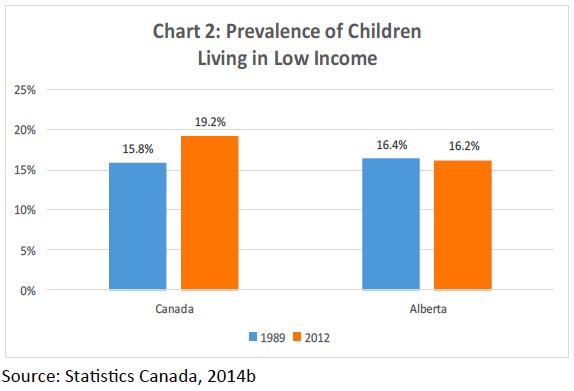
Although Alberta has benefited from rapid economic growth, not everyone has shared in this prosperity. The Edmonton Social Planning Council, Alberta College of Social Workers and Public Interest Alberta released a new report on Nov. 24 showing that 143,200 children in our province lived below the low-income measure in 2012.

Alberta Child PovertyThe numbers in the report are depressing but important to recognize. According to the report, the percentage of Alberta children living in poverty is essentially unchanged since Mr. Broadbent’s motion was passed in 1989.

Unemployment is not necessarily the main cause of child poverty in Alberta. The report shows that in 2011, a record high of 59.2% of children in poverty lived in a household where one or more persons were working full-time job.

According to the report, Alberta’s income inequality has increased faster than the national average, with the top 1% of earners seeing real income increases of over 60% since 1982 while the bottom half of income earners only saw a small increase of 3.4%.

The report also shows that in March 2014, more than forty-nine thousand Albertans accessed food banks, an increase of 2.3% from  2013 and 48.2% higher than in 2008.

The recent Homeless Count found 2,252 people without a home in Edmonton, an increase of 3.5% from 2012. The number of youth increased by 17% from 481 to 562. Of all those counted in the survey (including non-youth), 47% identified as being of Aboriginal heritage.

But despite an intense political focus in Alberta on low taxes and oil pipeline expansion, the discussion around income-inequality and eliminating poverty has gained some attention in recent years.

Poverty Parents Working Alberta

In March 2014, Edmonton Mayor Don Iveson named a task force on Poverty Elimination to develop a plan with recommendations to eliminate poverty in the city.

“There are over 100,000 Edmontonians living below the poverty line, 30,000 of whom are children. For me, that is not acceptable,” Mr. Iveson said in a press release earlier this year.

Speaking to a group of Edmontonians during a break from budget hearings last week, Mr. Iveson explained some of the ways Edmonton can help contribute to the reduction of child poverty through public library education programs and reduced-fee transit passes for low-income parents.

“Poverty elimination will be the result of good prevention,” Mr. Iveson said, as he explained the need for a renewed focus on the social determinants of health.

“If we don’t deal with some of those things proactively they can become policing challenges, which is the most expensive thing we do,” he said.

As city governments are limited in their resources compared to provincial and federal governments, he spoke to the need for municipalities to pressure MLAs to make much needed funding increases to Family and Community Support Services.

During the 2012 election, Progressive Conservative leader Alison Redford promised the creation of a ten year strategy to end poverty in Alberta, which would include a five-year plan to eliminate child poverty and a plan to address the root causes of poverty. Following Ms. Redford’s departure, it is suspected that a strategy will not be released until next year. But it remains unclear how Premier Jim Prentice will approach this issue.

Despite our prosperity, Mr. Prentice is pleading poverty due to slightly deflating world oil prices and is already suggesting education funding cuts are likely in next year’s budget.

It is shameful that child poverty in Canada still exits in 2014, twenty-five years after every Member of Parliament stood and committed to eliminating it by 2000. And in a wealthy and prosperous jurisdiction like Alberta, where we have the financial means and ingenuity to ensure every resident can live outside of poverty, there is no excuse why child poverty still exists.

Read the reportNo Change: After 25 years of Promises it is Time to Eliminate Child Poverty.

Listen: Ed Broadbent’s interview with CBC’s The Current on the 25th anniversary of the motion to end child poverty