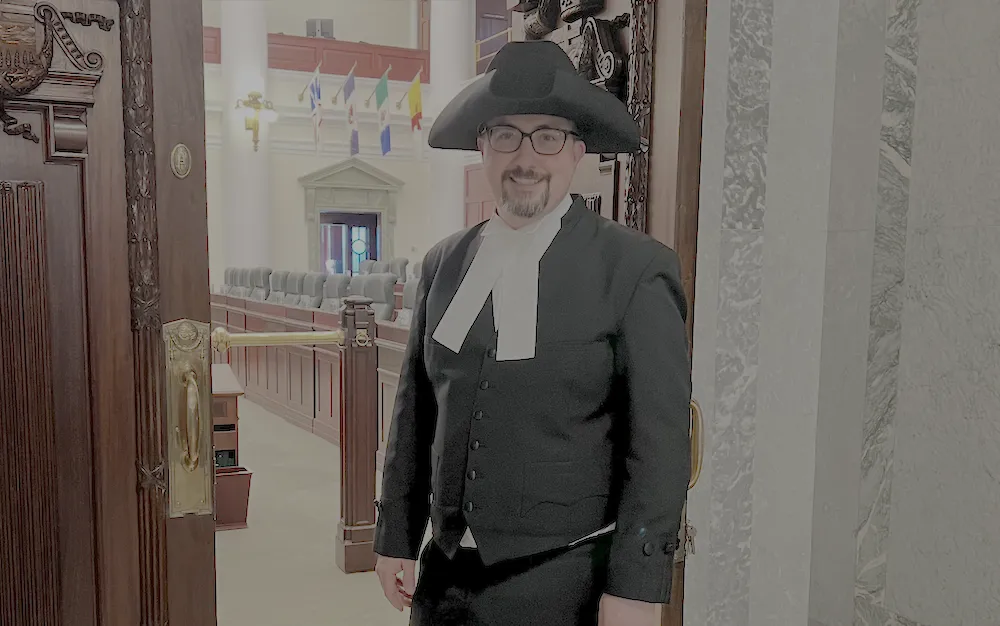
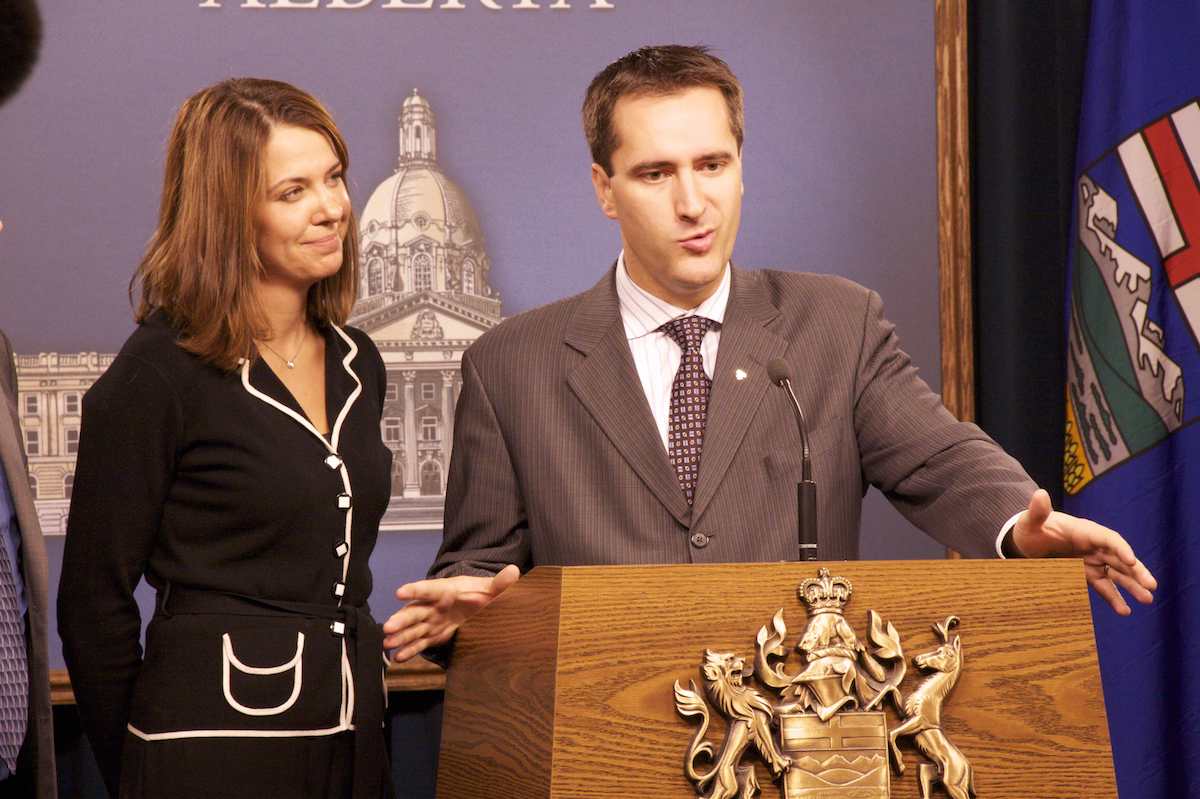
Alberta Legislative Assembly Speaker Nathan Cooper wearing the newly designed western-style tricorn hat designed by Smithbilt Hats Inc. (source: Legislative Assembly of Alberta)
Also: Six thoughts on Danielle Smith’s separatist threats
After ten years as the MLA for Olds-Didsbury-Three Hills and nearly six years as Speaker of the Legislative Assembly, Nathan Cooper is leaving the Legislature to take up a new job as Alberta’s senior representative to the United States.
In a statement released yesterday, Premier Danielle Smith announced that Cooper would replace representative James Rajotte, who recently stepped down after filling the role since 2020.
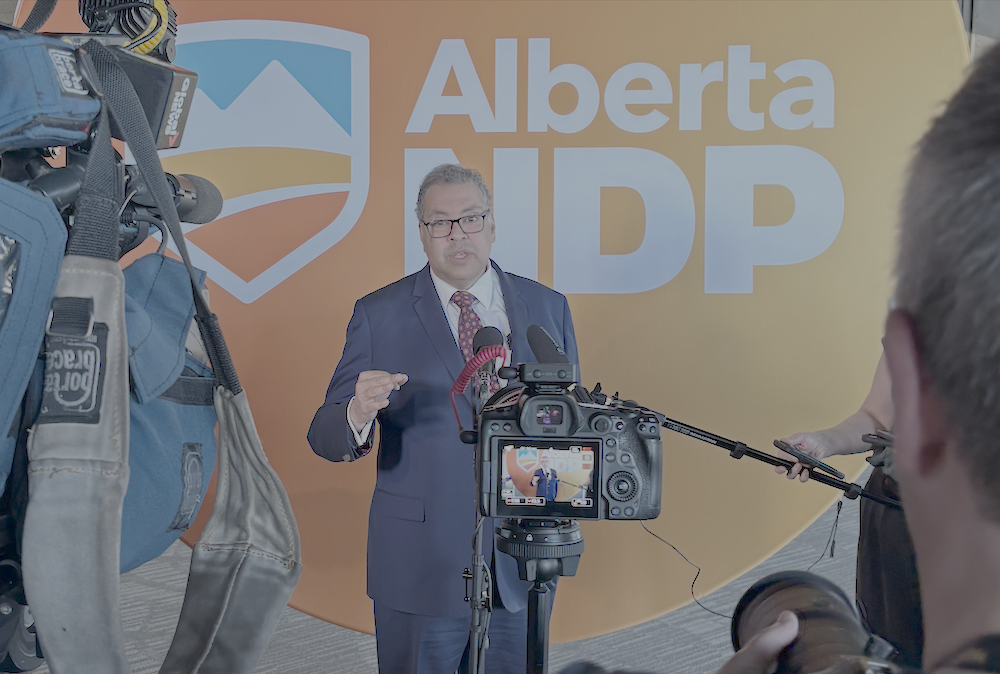
Alberta NDP leader Naheed Nenshi (source: Dave Cournoyer)
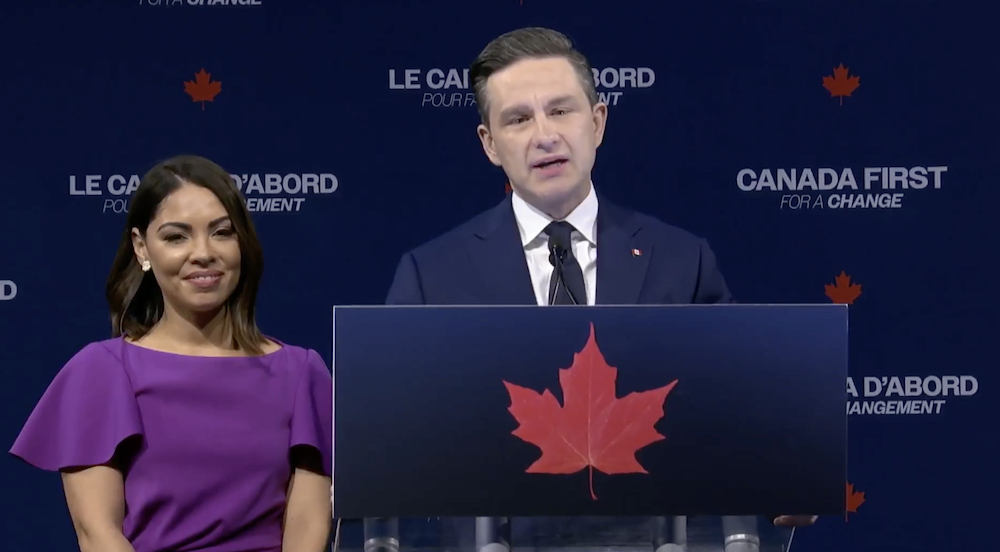
Also: Pierre Poilievre running in Battle River—Crowfoot by-election, gets unwelcome greetings from UCP VP
Naheed Nenshi’s speech was upbeat and touched on a lot of traditional NDP points about public health care, public education and rights for workers, but he was most animated when ripping into Premier Danielle Smith’s threat that the Liberal Party’s re-election would spark an unprecedented national unity crisis and her flirtation with Alberta separatists.
‘I will be damned if we ever let Danielle Smith tear the country down,’ Nenshi said. “Alberta’s New Democrats will always, always, always stand with the millions and millions of Canadians who believe in a stronger, more unified country,” Nenshi said.
“No more playing stupid separatist games with the future of our province! No more disrespecting Indigenous communities! No more disrespecting Albertans!”
The votes are counted and the surprising results of Monday’s federal election will have big ramifications for Canada. Friend of the podand Partner & Chief Strategist at Y Station Communications and Research, Chris Henderson, joins us on the Daveberta Podcast to break down the election results and what they mean for the country, Alberta, and Premier Danielle Smith’s continued pursuit of a sovereignty agenda.
We also delve into Pierre Poilievre’s future as leader of the Conservative Party what opportunities Mark Carney’s Liberals have to reset their relationship with Albertans.
The Daveberta Podcast is hosted by Dave Cournoyer and produced by Adam Rozenhart. This episode was recorded on April 29, 2025 in the offices of Adverb Communications in beautiful downtown Edmonton.
One of Daveberta’s first rules of Alberta politics is to never underestimate the Conservatives, and that rule appears to have held true last night as votes in the federal election were counted across the province.
At the time I am publishing this, Conservative Party candidates are elected in 34 of 37 ridings in Alberta. This makes them a significant block in what will be a 144 MP Conservative Opposition in Ottawa. This is a larger Conservative caucus than existed before this election but falls far short of the huge majority government the Conservatives were expecting Pierre Poilievre would lead them to only a few months ago. The Liberal Party led by Prime Minister Mark Carney were re-elected with 168 seats, including two in Alberta.
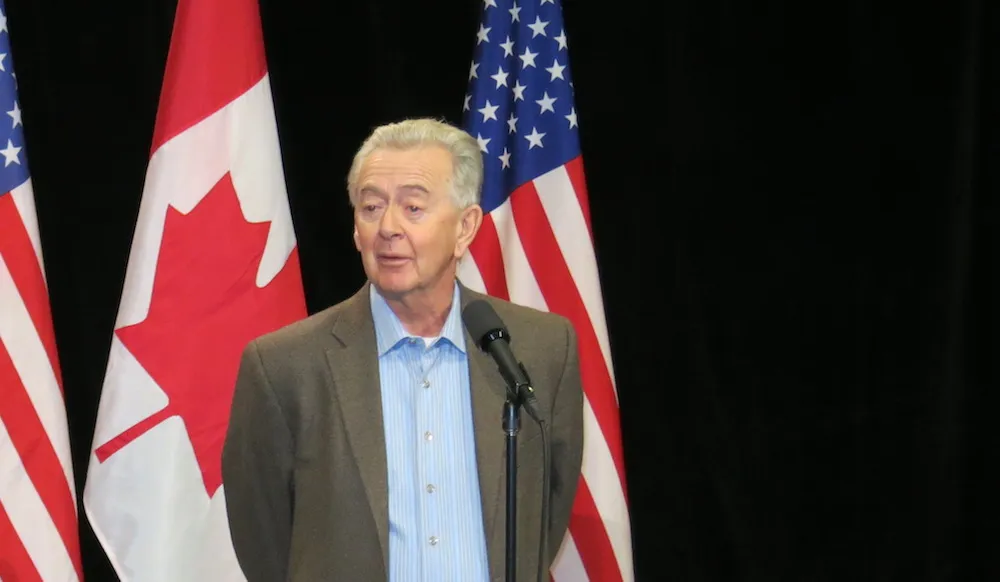
Manning Centre founder and former Reform Party Leader Preston Manning (Photo credit: David J. Climenhaga).
Conservative movement grandfather emerges from political retirement with grumpy separatist threats
Preston Manning emerged from political retirement to insert himself into the federal election mix by writing an op-ed in the Globe & Mail claiming that Liberal Party leader Mark Carney poses a threat to national unity. Manning’s argument triangulates with Premier Danielle Smith’s threats that a re-elected Liberal government would lead to an “unprecedented national unity crisis” – claims that are likely not very helpful for Pierre Poilievre’s Conservatives.
Manning is undoubtably frustrated by the Liberal Party’s resurgence in public support but threatening that the country will be torn apart if the Conservatives don’t win the election is a shameful bookend to his long and fascinating career in Albertan and Canadian politics.
But who’s Preston?
Manning is probably a familiar name to a lot of Daveberta readers but, now that he’s been out of elected office for more than two decades, there’s a good chance that even a few keen politician watchers in 2025 aren’t too familiar with him.
Liberal Party leader Mark Carney on the campaign trail (source: Mark Carney / Facebook)
UCP MLA writes that Canada is broken and Team Canada is a “fake team”
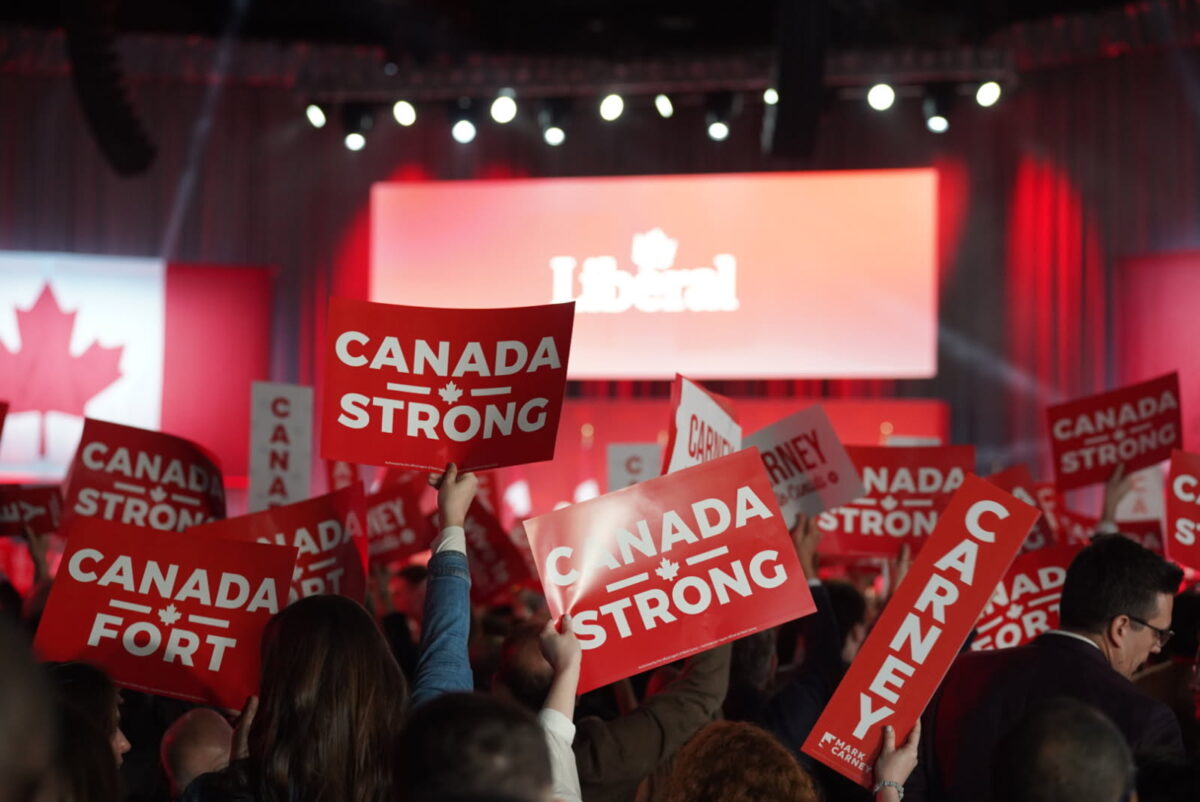
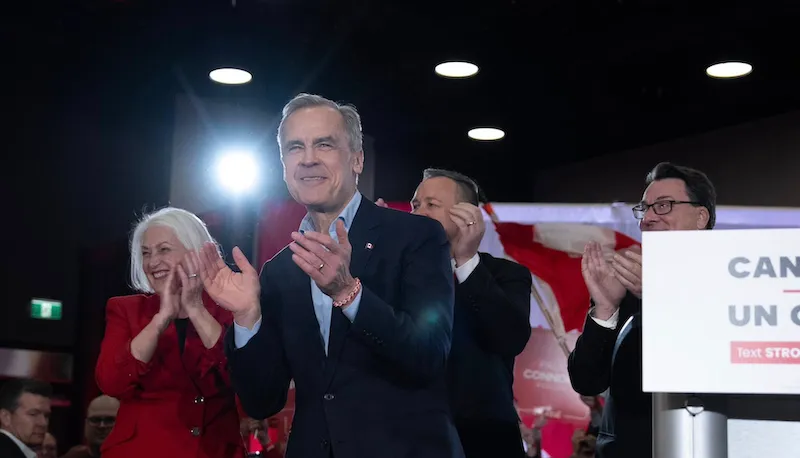
Mark Carney has only been Prime Minister of Canada for 17 days but last week he may have made one of the most consequential statements by a Canadian political leader in recent memory.
“The old relationship we had with the United States based on deepening integration of our economies and tight security and military cooperation is over,” Carney said in response to American President Donald Trump’s almost daily threats against Canada.
Trump backed down on his threats last week to level 25 percent tariffs against the Canadian automobile manufacturing industry, probably temporarily, after Carney announced retaliatory tariffs, but this week could feature Trump’s next big intervention in a federal election campaign where he has become the biggest villain. April 2 is what the Trump is calling “Liberation Day.” It’s the day he says he plans to level more huge tariffs on products being imported into the US.
Nominated Cypress-Medicine Hat UCP candidate Justin Wright (source: WrightForUCP.ca)
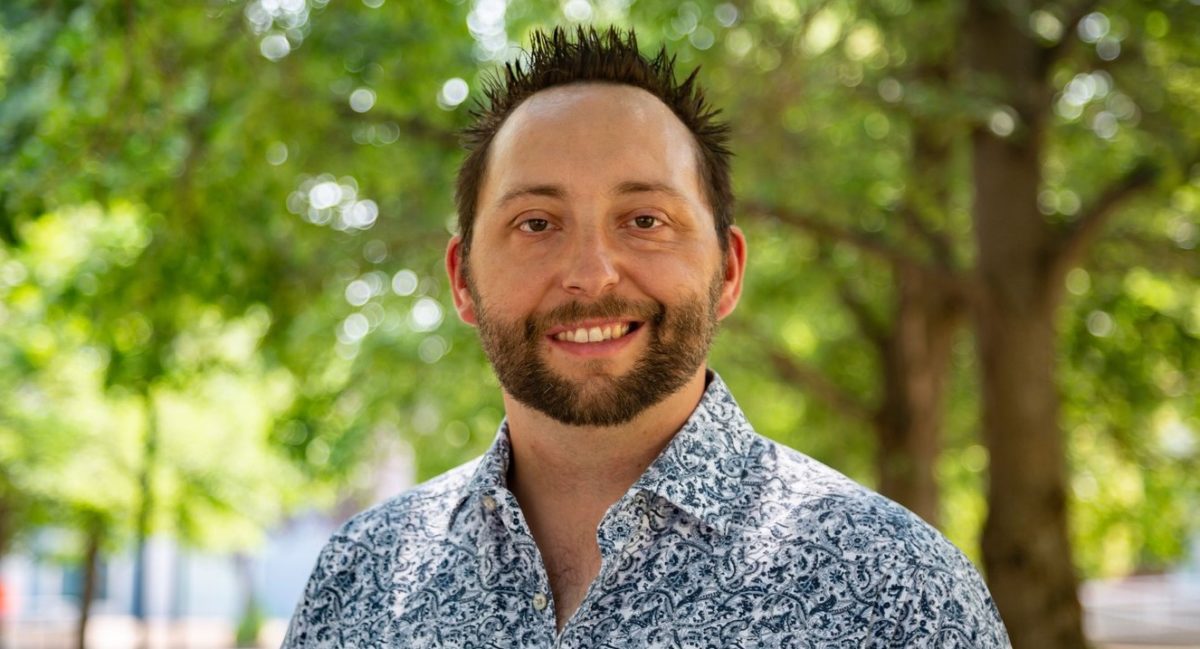
Food truck owner Justin Wright defeated former Western Standard vice-president of operations James Finkbeiner to win the United Conservative Party nomination in Cypress-Medicine Hat.
Wright is the owner of the Fryer Tuck’s food truck and catering, which also runs a number of concessions around Medicine Hat. He ran for city council in 2021 and is the chairman of the Spectrum Festival committee.
Drew Barnes
Wright is expected to face MLA Drew Barnes, who has represented the riding since 2012 and is widely believed to be running for re-elected as an Independent candidate. Barnes was kicked out of the UCP Caucus in 2021 for being a general thorn in the side of former premier Jason Kenney.
But despite being elected as a Wildrose MLA at the same time as Danielle Smith in 2012, Barnes was not welcomed back into the UCP tent after the new premier was sworn-in to office last October.
The Alberta NDP have nominated Prairie Rose Public Schools chairperson Cathy Hogg. Hogg has served as a trustee on the school board since 2013.
Paul Hinman’s Wildrose Loyalty Coalition
A screenshot from Paul Hinman’s Facebook Page.
Months after he was removed as leader of the Wildrose Independence Party, it appears as though Paul Hinman is starting another new Wildrose Party.
The appearance of a new “Wildrose Loyalty Coalition” banner on Hinman’s Facebook page and the appearance of the group on the “Reserved Party Names” list maintained by Elections Alberta caught the attention of some political watchers. And a website for the new party now confirms it.
‘Albertans are in a dysfunctional relationship with Ottawa and must take control of our future. We shall determine our path forward, NOT legacy political parties who divide the people, usurp freedoms, and enforce ruinous social, economic, and environmental policies,’ says a statement on the Wildrose Loyalty Coalition website that also lists Hinman as leader.
Hinman has a long history in Alberta politics and best-known for having served as Wildrose MLA in two separate ridings and as leader of that party before Danielle Smith became leader in 2009.
But more recently, he served as the founding leader of the separatist Wildrose Independence Party, which was a merger of the Freedom Conservative Party and the Wexit Alberta group, from 2020 until he was ousted in 2022. Hinman loyalists briefly retook control over the party before their takeover was overruled in courts.
Other nomination updates
The UCP has set April 3 as the date for its nomination vote in Grande Prairie. Gladys Blackmore, Nolan Dyck, Larry Gibson, and Tayyab Parvez are in the race to succeed retiring MLA Tracy Allard as the candidate in that northern Alberta riding.
Daniel Birrell has been nominated as the Green Party candidate in Spruce Grove-Stony Plain.
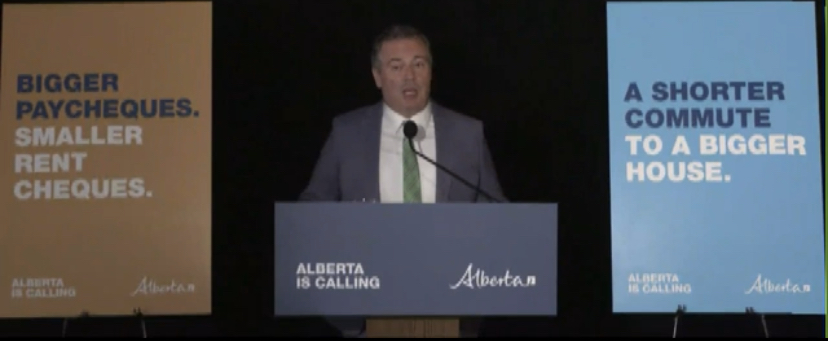
JASON: Hi there, it’s Premier Jason Kenney calling to tell you about how affordable houses are in Alberta.
CANADA: Ok, cool, eh.
JASON: Salaries are higher and we have mountains and a big mall. We also…
BEEP BEEP
CANADA: Just a minute Jason I have another call.
DANIELLE: Hi, this is Danielle Smith the front runner to become the next Premier of Alberta. I’m calling to warn you that Justin Trudeau, international bankers and Greta Thunberg are building an army of climate change police to take away your trucks.
CANADA: Sorry, what?
DANIELLE: That’s why I’m going to pass a law that lets Alberta ignore federal laws.
CANADA: …what…?
DANIELLE: We need your vote, except if you’re a secret communist, then you’re not welcome in Alberta.
CANADA: uh….
BEEP BEEP
CANADA: Danielle I’m going to put you on hold.
Hello?
TRAVIS: Hi, this is Travis Toews. I’m calling to tell you that Justin Trudeau’s climate change police are trespassing on your farm.
CANADA: Uh, I think that’s what Danielle Smith already called me about.
TRAVIS: [silence]
CLICK.
BEEP BEEP.
BRIAN: Hi, this is Brian Jean. I want to talk to you about Alberta Autonomy.
CANADA: Sorry, you want to talk to me about your anatomy?
BRIAN. No. Autonomy.
CANADA: Um, ok. Like separatism?
BRIAN: No, autonomy.
CANADA: Um, ok…
BEEP BEEP.
JASON: Hi, it’s Jason Kenney calling again. Have you thought about moving to Alberta?
CANADA: Uh, yeah, about that, I think we’re going to wait to see how things turn out next May. Do you have Rachel’s number?
There ain’t no party like a fringe right-wing Alberta separatist party.
Less than two months after Paul Hinman was ousted as leader of the Wildrose Independence Party and replaced by interim leader Jeevan Mangat, it appears that a counter-kudatah (known outside Alberta as a “coup d’état”) has pushed out Hinman’s opponents.
An online statement and email to WIP members from former Wexit Alberta interim leader Kathy Flett, who identifies herself as the WIP VP Communications, says a false narrative is being put out by the former Provincial Board after a well-attended annual general meeting on July 23, 2022 in Red Deer.
“There have been repeated claims that a “Minority Group of 40 or so” members “Took Over” the AGM,” Flett writes. “The Facts tell a different story.”
“This weekend in Red Deer, history was made as Wildrose members stood steadfast for what they knew was right. Their tenacity and persistence forced those who thought they should remain on the board to finally walk out in shame.”
“What occurred yesterday is a sad example of what happens when a small group of individuals completely lose touch with the will of the majority.”
“The Wildrose Independence Party belongs to its members, not the Party Board of Governors, and, therefore, Rick Northey, Wes Caldwell, Bill Jones, et al, are no longer Governors of the Wildrose Independence Party.”
“As of this moment, they still control the party’s website and email system. As such, we advise you to disregard any communications originating from “Wildrosenation.com” until we’ve confirmed with you that it is, again, from us.”
According to Flett’s statement, the newly elected board includes President Angela Tabak (the party’s president in Cardston-Siksika), Chief Finance Officer Allan Wesley, and Secretary Gord Elliot (who until recently was President of the United Conservative Party constituency association in Calgary-North West).
The takeover appears to have pushed out President Rick Northey (the former President of the Wildrose Party association in Airdrie) and CFO Bill Jones.
As of this afternoon, the party’s website showed most of the party’s Board of Governors positions as vacant but still listed Northey and Jones, as well as former Conservative MP Rob Anders and separatist activist Bob Lefurgey as members of the party’s board.
It appears as though Hinman has been reinstated as party leader but Elections Alberta still lists Mangat as the party’s interim leader, so it’s not totally clear.
Hinman originally stepped into the role on an interim basis in 2020 but later became the party’s permanent leader when no one else ran for the leadership. He was leader of the Wildrose Alliance from 2005 to 2009 and was elected to the Legislature twice – as MLA for Cardston-Taber-Warner from 2004 to 2008 and MLA for Calgary-Glenmore from 2009 to 2012. He briefly mounted a campaign for the UCP leadership in 2017 but withdrew before the nomination deadline and endorsed Jason Kenney.
The Wildrose Independence Party was created in 2020 as a merger of the Wexit Alberta group created after the federal Liberals were re-elected in 2019 and the Freedom Conservative Party, which was previously known as the Alberta First Party, Separation Party of Alberta, and the Western Freedom Party.
The WIP has suffered from poor fundraising returns in recent months, raising a measly $7,613 in the second quarter of 2022, and low support in the Fort McMurray-Lac La Biche by-election.
A recent push by UCP leadership candidates Danielle Smith, Brian Jean and Todd Loewen toward all out separatism or some form of provincial autonomy has given a second wind to Alberta separatists but sucked the wind out of the sails of the actual separatist parties.
Recent merger talks with the competing Independence Party of Alberta fell apart in June 2022. A statement on the IPA website lists Northey and Jones as key negotiators for the WIP in those talks.
The IPA, formerly known as the Alberta Independence Party, went through its own internal drama after the 2019 election and is now in the process of choosing its second new leader since that election. Former federal Liberal candidate and anti-COVID restrictions activist lawyer Katherine Kowalchuk is the only candidate in the race.
All this ongoing drama is almost par for the course for Alberta’s small cottage industry of right-wing separatist parties, but it raises the big question: How do they plan to fight Ottawa when they are so busy fighting themselves?
Danielle Smith and Rob Anderson in 2010 (source: Dave Cournoyer)
Popular opinion would have that summer is a quiet and boring time in politics, but not so in Alberta.
I can’t remember there was a boring political summer in Alberta?
Last year was the Best Summer Ever disaster and the summer before that was the first COVID summer. Before that was the Summer of Repeal. And so on.
This summer, the most unexpected political comeback might be happening before our eyes.
In almost every aspect, former Wildrose Party leader Danielle Smith is defining what the United Conservative Party leadership race is about.
Following her “Alberta First” campaign slogan, Smith declared plans to introduce an Alberta Sovereignty Act to let Alberta MLAs vote on which federal laws they want the province to follow.
Her campaign chair, Rob Anderson, is founder of the Free Alberta Strategy and was one of two Progressive Conservative MLAs to cross the floor to Smith’s Wildrose in 2010 (he later crossed the floor back to the PCs with Smith in 2014).
Smith declared Alberta will never ever have a lockdown again (we never *really* had a lockdown).
The other candidates responded.
She made wild statements about any cancer before Stage 4 is a result of poor personal choices.
Everyone responded.
Postmedia columnist Don Braid wrote that her “dabbles in quackery” are sometimes almost funny but “this one is dangerous.”
When Smith hosted a popular radio talk show she promoted hydroxychloroquine as a cure to COVID-19. She even touted ivermectin as a treatment. Now she wants to appoint chief medical officers of alternative medicine.
Quackery is putting it politely.
It’s the realm of internet pseudoscience.
As my friend David Climenhaga opined, it is the Donald Trump strategy of saying outrageous stuff that appeals to the base voters and damn the consequences.
Rehn was briefly expelled from the UCP Caucus in 2021 after taking a hot holiday to Mexico while most Albertans respected the government’s own COVID-19 travel advice and stayed home, and local municipal leaders called on him to resign after spending more time in Texas than his own riding.
Kenney said Rehn would not be allowed to run for the UCP nomination in the next election but he was quietly allowed to rejoin the UCP Caucus last summer. But now Kenney is on his way out.
Some might say I’m playing into the Smith-comeback narrative by writing this article, but she’s the only candidate saying anything interesting – even if it’s quackery.
She’s drawing crowds and appears to be hitting the right notes with a motivated segment of the UCP base, which says a lot about who the membership of the UCP is today.
This isn’t your father’s Progressive Conservative Party, folks.
The other candidates in the UCP race better get their acts together, because the membership sales deadline is on August 12.
Paul Hinman and Danielle Smith in 2010. (source: Dave Cournoyer)
If there’s one thing we can depend on Alberta’s cottage industry of fringe right-wing separatist parties to deliver, it’s drama.
It looks like Paul Hinman has been ousted as leader of the Wildrose Independence Party. The ouster comes shortly after the Independence Party of Alberta announced that merger talks with WIP broke off.
Hinman has been replaced by Jeevan Mangat, who ran for the Wildrose Party in Calgary-Fort in 2012 and 2015.
The WIP was created in 2020 through the merger of the Wexit group and the Freedom Conservative Party (which was previously known as the Alberta First Party, the Separation Party of Alberta and the Western Freedom Party). The party has struggled with fundraising and Hinman placed a distant third in the recent Fort McMurray-Lac La Biche by-election.
Before his time as WIP leader, Hinman served as a Wildrose MLA from 2004 to 2008 and 2009 to 2012, and as leader of the Wildrose Alliance Party immediately before Danielle Smith was chosen as leader in 2009.
Meanwhile, the IPA is still looking for a new leader. Past federal Liberal candidate Katherine Kowalchuk is the only candidate in the race, so far.
Alberta is a pretty boring place to spend a federal election. Even as the polls shift nationally, there is a good chance the seat total could be the same as the 2019 election: 33 Conservative and one NDP.
It’s a quiet campaign.
Unlike the 2019 election, when Albertans were still riled up from that year’s April provincial election and federal campaign issues like pipelines and the carbon tax, this year feels sleepy. The majority of Albertans will surely cast their ballots again on September for the Conservative Party, but it might not be with the same level of enthusiasm and gusto as the last election.
But, if there is a chance that any seats could switch parties, here are a few of the ridings where it might happen:
Edmonton-Griesbach
Blake Desjarlais
Probably one of the only centres of electoral excitement in Alberta is where Conservative candidate Kerry Diotte is seeking re-election for his third-term against New Democrat Blake Desjarlais.
The NDP are hoping they can elect a second MP from Alberta and are putting that hope into Desjarlais’ campaign. Party leader Jagmeet Singh has visited the riding twice in the past month, spending an entire day campaigning in the district during the first week of the election, and pouring volunteer, financial and online advertising resources into the local campaign.
If the NDP are going to pick up a second seat in Alberta in this election, this is it.
Even NDP MLAs, who shunned the federal party in 2019, have been campaigning with Desjarlais in his bid to unseat Diotte. Edmonton-Highlands-Norwood MLA Janis Irwin, Edmonton-Glenora MLA Sarah Hoffman, Edmonton-Rutherford MLA Richard Feehan, Edmonton-South MLA Thomas Dang, Edmonton-North West MLA David Eggen, and Edmonton-West Henday MLA Jon Carson have been spotted on the campaign trail in Edmonton-Griesbach.
Full list of candidates in Edmonton-Griesbach:
Communist: Alex Boykowich
Conservative: Kerry Diotte
Green: Heather Lau
Liberal: Habiba Mohamud
Libertarian: Morgan Watson
Marxist-Leninist: Mary Joyce
NDP: Blake Desjarlais
People’s Party: Thomas Matty
Edmonton-Centre
Randy Boissonnault
Conservative James Cumming and Liberal Randy Boissonnault are facing each other for the third time since 2015. Boissonnault won the first time they face each other in 2015 and Cumming unseated him in 2019.
NDP candidate Heather MacKenzie, a former public school board trustee and past municipal candidate, is hoping to dislodge the Liberals as the main alternative to the Conservatives.
NDP vote has held firm over the past three elections, suggesting that Boissonnault’s win in 2015 and defeat in 2019 was more about voters switching between the Conservatives and Liberals than a split between the Liberals and NDP.
Toronto Liberal MP Chrystia Freeland stopped in the district at the beginning of the campaign to support Boissonnault’s bid for re-election.
Full list of candidates in Edmonton-Centre:
Conservative: James Cumming
Liberal: Randy Boissonnault
Libertarian: Valerie Keefe
Marxist-Leninist: Merryn Edwards
NDP: Heather Mackenzie
People’s Party: Brock Crocker
Edmonton-Mill Woods
Edmonton City Councillor Ben Henderson is running for the Liberal Party in Edmonton-Mill Woods
Conservative Tim Uppal’s main challenger is city councillor Ben Henderson, who hopped south from his long-held municipal ward to run in his federal district.
While Uppal served as an MP for many terms, this is his first time running for re-election in Edmonton-Mill Woods. He was the MP for Edmonton-Sherwood Park from 2008 to 2015.
The district was represented by Liberal MP Amarjeet Sohi from 2015 to 2019. Sohi is running for Mayor of Edmonton.
Full list of candidates in Edmonton-Mill Woods:
Communist: Naomi Rankin
Conservative: Tim Uppal
Liberal: Ben Henderson
NDP: Nigel Logan
People’s Party: Paul McCormack
Calgary-Centre
Sabrina Grover
It’s a long-shot but if the Liberals are able to salvage their national campaign in the next two weeks they could be in a position to pick up this district that Liberal Kent Hehr won in 2015. In this election Liberal Sabrina Grover is challenging first-term Conservative Greg McLean.
Full list of candidates in Calgary-Centre:
Christian Heritage Party: David Pawlowski
Conservative: Greg McLean
Green: Austin Mullins
Liberal: Sabrina Grover
NDP: Juan Estevez Moreno
Calgary-Skyview
Justin Trudeau and George Chahal (source: Twitter)
Conservative Jag Sahota is facing a challenge from city councillor George Chahal who is running for the Liberals in this northeast Calgary district. Chahal has been endorsed by Mayor Naheed Nenshi, and a handful of city councillors including mayoral election hopefuls Jyoti Gondek and Jeff Davison.
Liberal Party leader Justin Trudeau’s plane touched down just long enough for him to appear at a rally in support of Chahal during the first week of the election.
Former MLA Darshan Kang was elected as the Liberal MP in 2015 but left the Liberal caucus after allegations of sexual harassment.
Full list of candidates in Calgary-Skyview:
Centrist Party: Nadeem Rana
Conservative: Jag Sahota
Green: Janna So
Independent: Lee Aquart
Liberal: George Chahal
Marxist-Leninist: Daniel Blanchard
NDP: Gurinder Singh Gill
People’s Party: Harry Dhillon
Banff-Airdire
Conservative candidate Blake Richards will probably safely coast to re-election on September 20, but the cast of conservative characters in this district make it interesting. Richards faces former Ontario Conseravtive MP Derek Sloan, who has relocated to Alberta in order to hold rallies for anti-mask and COVID conspiracy theorists, Maverick Party candidate and rodeo competitor Tariq Elnaga, People’s Party candidate Nadine Wellwood, and Independent separatist candidate Ron Voss.
Full list of candidates in Banff-Airdire:
Conservative: Blake Richards
Green: Aidan Blum
Independent: Caroline O’Driscoll
Independent: Derek Sloan
Independent: Ron Voss
Liberal: David Gamble
Maverick: Tariq Elnaga
NDP: Sarah Zagoda
People’s Party: Nadine Wellwood
The smaller right-wing parties
It has yet to be seen what kind of impact two smaller right-wing parties will have in Alberta in this election.
People’s Party leader Maxime Bernier is in Alberta this week holding a series of rallies and it seems like the right-wing populist party is gaining support among disenchanted conservatives and anti-vaxxer crowds.
Wildrose Independence Party leader Paul Hinman has been spotted at People’s Party events and Bernier also met with Cypress-Medicine Hat Drew Barnes, who currently sits as an Independent MLA after being ejected from the United Conservative Party caucus earlier in the summer. It also appears as though outgoing Fort McMurray-Cold Lake Conservative MP David Yurdiga endorsed the local People’s Party candidate in a post on his personal Facebook account.
The separatist Maverick Party is only running candidates in districts they have determined are not likely to elect a Liberal or NDP MP, which is most of Alberta, but limiting themselves to running in Conservative strongholds has probably eliminated their chances of being relevant in this election.
Former talk radio host Dave Rutherford has been joining Maverick Party interim leader Jay Hill at candidate events across the province.
According to the returns, the NDP raised $1,515,419 and the UCP raised $769,847 between April 1 and June 30, 2021.
This marks the second quarter in a row that Rachel Notley’s NDP have out-fundraised the governing UCP. The NDP raised twice as much money as the UCP in the first three months of 2021.
Here is what all of Alberta’s registered political parties raised in the second quarter of 2021:
Alberta NDP: $1,515,419.87
United Conservative Party: $769,847.15
Pro-Life Political Association: $90,870.00
Alberta Party: $38,270.19
Wildrose Independence: $25,791.06
Alberta Liberal Party: $25,563.61
Green Party: $2,019.00
Independence Party of Alberta: $1,015.00
Alberta Advantage Party: $890.00
Communist Party: $200.00
Once again, Notley’s NDP are on a roll, leading in the polls and continuing to dominate in fundraising. The NDP have solidified a larger base of donors, many whom appear to be contributing larger amounts to the official opposition party. In this quarter, 49 per cent of individual donations received by the NDP in the first quarter were in denominations of less than $250, compared to 64 per cent in the previous quarter.
The governing UCP’s continued drop in fundraising continues to mirror plummeting political support for the party and its leader, Premier Jason Kenney. The UCP raised in total only slightly more than the NDP raised in small donations in the second quarter.
The Wildrose Independence Party is a product of a name-change that happened after the Freedom Conservative Party and the Wexit Alberta group united. The party itself has existed under various names since it was founded in 1999 as the Alberta First Party.
The Independence Party of Alberta is also searching for a new leader following Dave Bjorkman’s resignation after the 2019 election. Former Wexit leader Peter Downing, who left the Wexit group following its merger with the Freedom Conservative Party had registered to be a leadership candidate but withdrew his candidacy this week. The party’s director of communications, Vicky Bayford, is the only candidate remaining in the race.
Also searching for new permanent leaders are the Alberta Advantage Party, the Alberta Party, and the Alberta Liberal Party.
As talk of Alberta’s separation from Canada once again bubbles up in certain political circles, as it tends to every decade or two, rarely discussed is the idea of regions separating from Alberta.
Just over one hundred years ago, a movement sprung up in the Peace Country to have the region split off from Alberta and British Columbia to form its own province.
A map of the proposed Province of Peace River
According to a report from The Globe on Nov. 26, 1927, the proposed Province of Peace River would be larger than either British Columbia or Alberta and would include all the Peace River drainage basin in Alberta, in addition to the Lesser Slave Lake region and the City of Prince Rupert, with the Pacific terminus of the Canadian National Railway.
Its most enthusiastic cheerleader was former Peace River mayor Charles Frederick, who, in 1927 published a signed letter in support of Peace Country secession in the newspapers he published, the Peace River Record and Grande Prairie Herald.
In his letter, Frederick stated that public opinion in the then-booming Peace Country favoured “drastic measures to either secure the railway development demanded for years, particularly with respect to an outlet to the Pacific coast, or to demand an opportunity to undertake its own development.”
“So far as Edmonton and Calgary are concerned, these cities ‘view with alarm’ at the prospect of the North country being given he opportunity that should be afforded through the provision of an outlet to the Coast,” Frederick wrote of the region of approximately 30,000 people.
“The remainder of the Province of Alberta is interested in the Peace River country only to the extend of its purchases of goods through Edmonton and Calgary wholesale houses. Vancouver is interested in the Peace River country only as another source of supply for its elevators, and as an outlet for the wholesale trace of its merchants.”
Frederick maintained in his letter that the promises made to Peace River settlers were not kept. “Dominion and provincial governments alike,” he wrote, “have neglected the claims of this fertile northern district.
Pointing to the Peace Country’s region’s rich soil, he then claimed the region would become “wealthier, more populous, a more valuable contribution to the nation of Canada than either of the mother provinces of Alberta and British Columbia.”
Earlier that year, the world’s prize for wheat at the Chicago international fair was reported to have been won by a Peace Country farmer.
“Let the Peace River country paddle its own canoe,” wrote Frederick.
Hugh Allen, MLA for Peace River
Dismissing the idea of Peace River secession outright was local United Farmers of Alberta MLA Hugh Allen.
Allen spoke about the issue in the Legislative Assembly in Feb. 1928.
In his opinion, the idea was more of a “publicity” stunt than anything else, according to a report by the Edmonton Bulletin. Allen told the Assembly that there had been some serious thought given the subject in sections of British Columbia, but “the majority of deep thinking Peace Riverites had never taken kindly to the proposal.”
Premier John Brownlee was also an enthusiastic opponent of the idea of the Peace Country leaving Alberta. He toured the region numerous times in the following years to appeal to demonstrate the Alberta government’s commitment and investments in the Peace Country.
Frederick’s Peace River secession movement did not get the political traction it needed to actually form a new province, which would likely involve a complicated constitutional process, but it is also likely that this was not a top priority during the Great Depression that followed only a few years later.
Since then, there have been a handful of calls by locals elected officials in northern British Columbia for the largely conservative voting region to join Alberta, but the provincial boundaries established in 1905 remain in tact.
Former Wildrose Alliance Party leader Paul Hinman is expected to maybe become interim leader of the new separatist Wildrose Independence Party.
Alberta’s oldest newly rebranded separatist party has a new interim leader, maybe.
The tweet from the Wildrose Independence Party announcing Paul Hinman as its interim leader.
A now deleted tweet from the newly renamed Wildrose Independence Party announced that former Wildrose Alliance leader Paul Hinman is the new interim leader of the party. Unless the party’s account was hacked, it would appear that Hinman is launching another attempt at a political comeback.
The press release included with the now deleted tweet said that Hinman would speak to his new role at this week’s Freedom Talk “Firewall Plus” conference, a pro-separatist event organized by former Wildrose candidate and right-wing online radio show host Danny Hozak that features speakers including former arch-Conservative MP Rob Anders, conservative lawyer John Carpay, Postmedia columnist John Robson, and federal Conservative leadership candidate Derek Sloan.
The name change does not appear to have been approved by Elections Alberta, which still lists the party under its most recent previous name on its official website. But it was reported last week that former Wildrose activist and FCP candidate Rick Northey was the party’s new president. Former Social Credit leader James Albers is also on the party’s executive.
The oldest newest separatist party on Alberta’s right-wing fringe should not be confused with the also recently renamed Independence Party of Alberta (formerly known as the Alberta Independence Party and now led by past UCP nomination candidate Dave Campbell), the Alberta Advantage Party (led by former Alberta Alliance Party president Marilyn Burns), and the unregistered Alberta Freedom Alliance (led by former Wildrose Party candidate Sharon Maclise).
Edgar Hinman
The United Independence Party name was also recently reserved with Elections Alberta, presumably by another former Wildrose candidate trying to start another new separatist party.
But back to the new interim leader of the new separatist Wildrose party…
The grandson of former Social Credit MLA and cabinet minister Edgar Hinman, Paul Hinman’s first foray into provincial electoral politics saw him elected in Cardston-Taber-Warner as the lone Alberta Alliance MLA in the 2004 election. Hinman inherited the leadership of the tiny right-wing party when Randy Thorsteinson (who had previously helped found the Alberta First Party) failed to win his election in Innisfail-Sylvan Lake. He endorsed Progressive Conservative leadership candidate Ted Morton in 2006 and led the party through an eventual split and re-merger with a faction branding itself as the Wildrose Party – and thus the Wildrose Alliance was formed.
Hinman lost his seat in the 2008 election in a rematch with former PC MLA Broyce Jacobs. He announced plans to step down as leader shortly afterward and then surprised political watchers when he won a 2009 by-election in posh Calgary-Glenmore, pumping some momentum behind Danielle Smith when she won the party’s leadership race a few months later.
Danielle Smith with Wildrose MLA’s Paul Hinman, Heather Forsyth, and Rob Anderson in 2010.
In 2010, Hinman was joined by floor crossing PC MLAs Heather Forsyth, Guy Boutilier, and Rob Anderson (who four years later crossed the floor back to the PC Party and now hosts a Facebook video show where he promotes Alberta separatism), but, despite the party’s electoral breakthrough in 2012, Hinman was again unable to get re-elected.
Drew Barnes stands at Paul Hinman’s side as he announced his bid to once again run for the Wildrose nomination in Cardston-Taber-Warner in 2015.
More recently, Hinman launched a brief bid for the UCP leadership in 2017, announcing a campaign focused on parental rights and conscience rights, but when the Sept 2017 deadline to deposit the $57,500 candidate fee passed, he did not make the cut. Hinman later endorsed Jason Kenney‘s candidacy.
Paul Hinman endorsed Jason Kenney in the 2017 UCP leadership contest.
Now he might be taking over the interim leadership of the fledgeling fringe separatist party at a time when public opinion polls show that Albertans’ appetite for leaving Canada is cooling as memory of the 2019 federal election fades. If historic trends hold, then the desire for separatism will drop if it looks like the next federal Conservative Party leader can form a government in Ottawa.
Separatism is ever-present on the fringes of Alberta politics and is more of a situational tendency than a real political movement with legs but a half-organized separatist party could syphon votes away from the UCP in the next provincial election.
And with next October’s Senate nominee election likely to be a showdown between candidates aligned with the federal Conservative Party led by whoever wins this summer’s leadership race and the federal Wexit Party led by former Conservative MP Jay Hill, expect the UCP to be paying a lot of attention to these fringe separatist groups sniping at its right-flank.
If he actually does become the leader of the oldest newest separatist party, Hinman will provide some profile and credibility in political circles where conservatives are perpetually disgruntled with New Democratic Party leader Rachel Notley and Prime Minister Justin Trudeau, and newly disgruntled with Premier Kenney, presumably for not pushing hard enough for Alberta’s separation from Canada.
A reaction to a threat from the right: The appointment of the Fair Deal Panel was a direct response to a perceived threat to the United Conservative Party from the political right and fringe separatists following the re-election of Prime Minister Justin Trudeau’s federal Liberal government in October 2019.
The panel, which was announced by Premier Jason Kenney at the Manning Networking Conference in Red Deer, was a relief value to give frustrated Conservatives an opportunity to express their anger at the Liberals and a steering wheel to allow the Premier to control the political narrative around Alberta’s political relationship with Ottawa.
Kenney played a major role in the federal Conservative Party’s campaign against the Trudeau Liberals, with the premier even traveling to Ontario and Manitoba to campaign during the election, but despite all the bluster it appeared to have little impact on voters in those provinces on Election Day. The Conservatives did very well in Alberta, earning 69% of the vote, but saw their support decline in almost every riding Kenney campaigned in.
A federal Conservative landslide in Alberta is nothing new, it literally happens every four years. But the latest electoral division reflects an increasing feeling inside Alberta that the rest of Canada does not support the province’s energy industry and a growing feeling outside of Alberta that the province is a laggard on climate change and reducing carbon emissions.
Alienation and anger at Ottawa is omnipresent in Alberta politics, but the separatist threat that spooked Kenney seven months ago has largely evaporated and the crash in the international price of oil and the COVID-19 pandemic has reinforced the importance of the provinces being able to work with a federal government for financial relief.
Fair Deal Panel meant to distract from the UCPs job cuts agenda: Creating external enemies and manufacturing crises is something that Kenney excels at. The focus on the Fair Deal report and its recommendations are meant to distract Albertans from the UCP’s political agenda closer to home.
Despite claiming to be obsessed with creating jobs, Kenney’s government has done the opposite by cutting tens of thousands of jobs in Alberta’s public service, schools, colleges and universities. A high-profile dispute with Alberta’s doctors, which included an incident where Health Minister Tyler Shandroyelled at a physician at the driveway of his home, has mired the government’s response to the COVID-19 pandemic. The UCP is also moving forward with plans to close and privatize Alberta’s provincial parks.
And it is expected that the Kenney government could soon introduce anti-union legislation and a $2/hour rollback of the $15/hour general minimum wage, directly targeting many of the low income service workers who have been praised as “heroes” during the pandemic.
Police and pension plans: There is little in the final report that the UCP government wasn’t already prepared to pursue or consider. Kenney has said that the government plans to implement or study 23 of the 25 recommendations in the panel’s final report.
Despite public opinion polls showing Albertans do not support replacing the Canada Pension Plan with an Alberta Pension Plan and replacing the RCMP with an Alberta police service, Kenney’s response to the panel report indicated the government was planning to study the two proposals. Both ideas are expensive and likely within provincial jurisdiction to implement, but the creation of an Alberta Pension Plan contradicts other proposals in the report meant to break down trade barriers and increase labour mobility with other provinces.
Equalization referendum: Kenney has spent much of the past year threatening to hold a referendum to remove the equalization article from the Constitution of Canada, so it was unsurprising to see the panel recommend it as well. The threat originated with frustration around delays with the expansion of the Trans Mountain Pipeline and the federal government’s purchase of the pipeline did not convince Kenney to abandon the pledge.
In its report, the panel admits that a provincial referendum will not have the power to force the federal government or other provinces to reopen the Constitution or renegotiate the equalization formula.
There is probably no scenario where Alberta, a province that is wealthier than most other Canadian provinces even during an economic downtown, will receive funds from a national equalization program. But the unfairness of equalization is a talking point engrained in mainstream Alberta that is not based in fact and is not going away anytime soon.
The panel suggests holding a referendum on equalization would “morally obligate” the federal government and provinces to negotiate amendments to the Constitution. The same argument has worked unsuccessfully for thirty-years on the issue of Senate reform, which the panel report also recommends the province continue to pursue through provincial Senate Nominee elections.
Hijacking the 2021 Municipal Elections: As I first wrote more than a year ago, it is no coincidence that the proposed referendum and the rebooted Senate Nominee election will take place on the same day as the municipal elections across Alberta, October 18, 2021. The timing of these two votes will be used to increase turnout by conservative voters in the municipal and school board elections in an effort to boost support for candidates aligned with the UCP.
Although they dominate in federal and provincial elections, Conservatives have less success at the municipal level where candidates campaign as individuals and mayors offices, town councils and school boards have been more likely to be populated with Albertans more closely aligned with the NDP or Liberals.
Candidates in Alberta’s previous Senate Nominee elections ran under provincial party banners or as Independents. Changes introduced in the Senate Election Act in 2019 (which the report incorrectly refers to as the Senatorial Selection Act, which expired in 2016), will allow candidates to be marked on as a ballot as affiliated with federal political parties.
Injecting a federal party like the Conservative Party of Canada and its resources into a provincial vote being held during a municipal election will muddy the waters during the municipal election, forcing equalization and federal issues into local campaigns that usually focus on local issues. With the federals Liberals having abandoned their Senate caucus and the New Democratic Party continuing to call for Senate abolition, it is unlikely that the those parties will have any interest in participating in the Senate election, leaving the Conservatives to collect voter data and drive conservative voters to the polls.
Perhaps the best example of how the Fair Deal report is a partisan political document and not a serious effort in public engagement is this map found on page 52 of the report.
The map on page 52 of the Fair Deal Panel final report.
Framed as an East versus West political crisis over satisfaction with Canada, the map excludes British Columbia, where 60% of respondents to the Angus Reid Institute survey in January 2020 said they were satisfied with “the way things are going in Canada.”
The map also wedges Manitoba into the western bloc by listing that province’s dissatisfied number when the survey showed that 54% of Manitobans were satisfied.
So I fixed the map.
An edited version of the map on page 52 of the Fair Deal Panel final report.
The only two provinces where a majority of survey respondents were unsatisfied are Alberta and Saskatchewan, which also happen to be the only two provinces where a majority of voters supported the Conservative Party of Canada…