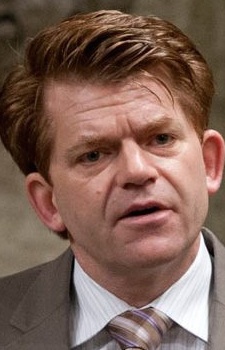
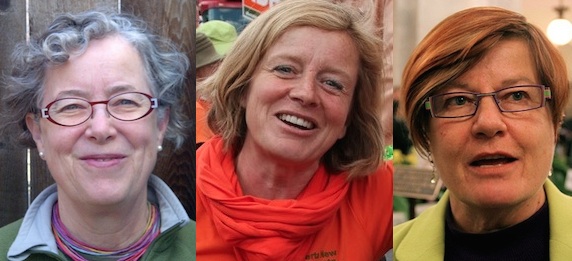
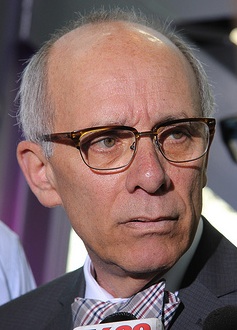
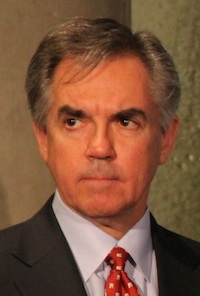
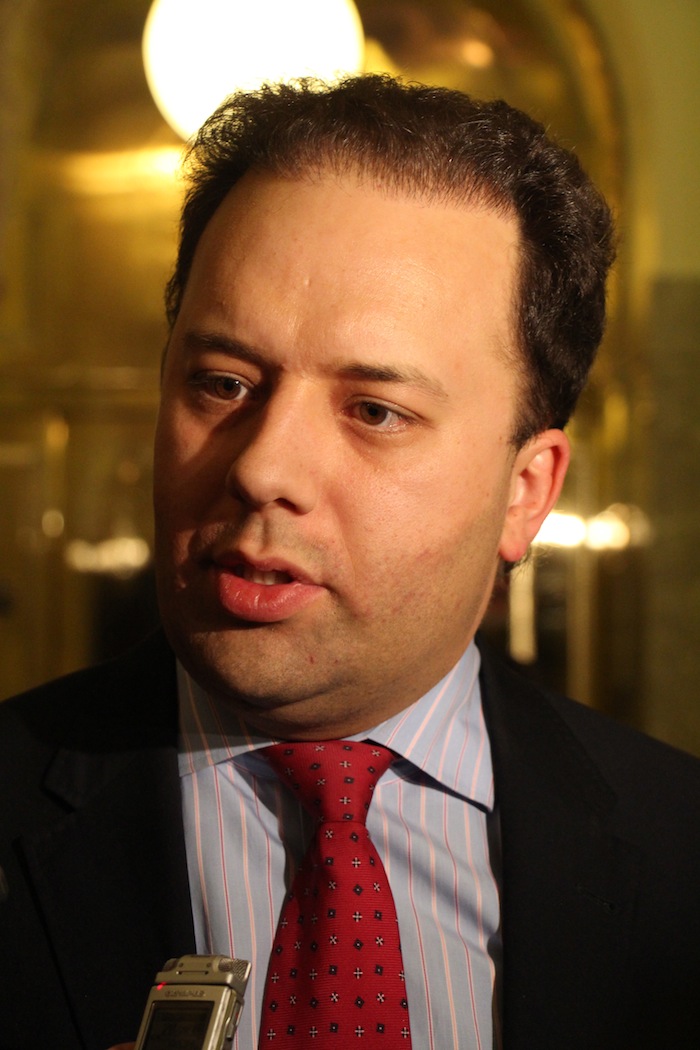
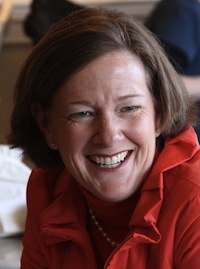
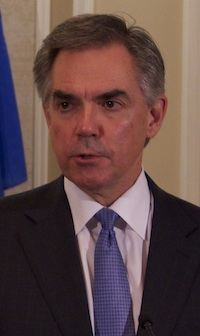
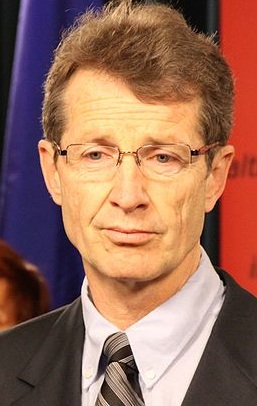
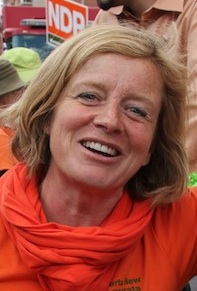
Conservative MP David Yurdiga and Wildrose leader Brian Jean pose with volunteers.
Provincial Tories in northern Alberta are not pleased with Fort McMurray-Athabasca Conservative Member of Parliament David Yurdiga after he appeared in a photo on social media this weekend helping Wildrose leader Brian Jean and party volunteers assemble election signs [see photo above].
Don Scott
Mr. Jean is the former MP for the area and is currently running against PC MLA and Innovation and Advanced Education Minister Don Scott in the Fort McMurray-Conklin constituency.
Facing a strong challenge from federal Liberal candidate Kyle Harreitha in the 2014 by-election, Mr. Yurdiga’s campaign received a last minute endorsement from PC leadership candidate, and now Premier, Jim Prentice. Mr. Yurdiga’s support for Mr. Jean is sure to have raised the ire of Mr. Prentice’s inner circle.
Mr. Harreitha will once again challenge Mr. Yurdiga in the October 2015 federal election in the newly redrawn Fort McMurray-Cold Lake constituency.
Kyle Harrietha
Mr. Yurdiga’s by-election campaign manager, Kim Farwell also tweeted a photo of volunteers helping Athabasca-Sturgeon-Redwater Wildrose candidate Travis Olson build campaign signs. Mr. Olson is running against PC MLA Jeff Johnson, who also endorsed Mr. Yurdiga in the 2014 by-election.
According to Elections Alberta financial disclosures, Mr. Yurdiga also made a $900 donation to the Athabasca-Sturgeon-Redwater Wildrose constituency association in 2014.
A deep divide between the federal Conservatives and provincial PCs emerged during the 2012 provincial election when a number of Conservative MPs actively campaigned for Wildrose candidates in their areas of the province. The ascension of former Ottawa cabinet minister Mr. Prentice to the PC leadership and mass floor-crossing of Wildrose MLAs was expected to erase the divide.
Jim Prentice scrums with the media after his victory speech on September 6, 2014.
In a surprising reversal, Alberta Premier Jim Prentice announced that the next provincial election will be held in spring 2016, not in 2015 as many Albertans expected.
“Three years ago, Progressive Conservative MLAs passed Alberta’s fixed election date law,” said Prentice. “I intend to honour the spirit of this law by holding the next election in 2016.”
The Election Amendment Act, 2011 created a fixed, three-month period in which provincial elections are held every four years.
“Establishing the fixed election period has benefits for all Albertans,” said Jonathan Denis, Minister of Justice and Attorney General. “Albertans are better able to plan to participate or involve themselves in the election process – as voters, as candidates, and as volunteers.”
Some critics believe the delay is a result of a recent poll showing a negative public reaction to the provincial budget and an NDP surge to above 40 per cent support in Edmonton.
Prentice also announced tough new climate change targets that will reduce Alberta’s carbon emissions by 50 per cent before the 2016 election is called.
“Climate change is the defining challenge of our generation and we will not fail in defeating it,” Prentice said. “That is why I am appointing Danielle Smith to lead this initiative as the first Chief Executive Officer of the new Alberta Global Warming Institute.”
“Albertans have put their trust in us and going forward, we will demonstrate beyond a doubt that our government will be the change that Albertans are looking for,” Prentice said.
Jim Prentice looked like a political juggernaut when he won the October 2014 Calgary-Foothills by-election. Today, voters in Foothills will choose his replacement.
OTTAWA, ONTARIO
“If Alberta can deliver a budget, why can this minister of finance not,” Liberal MP Scott Brison asked of Finance Minister Joe Oliver, who was absent from the House of Commons today. Opposition Members of Parliament have been chastizing the Conservatives for refusing to set a date for when this year’s federal budget will be released even after Alberta and Saskatchewan have released their provincial budgets.
Robin Campbell
In the Conservative-heartland of Alberta, despite months of doom and gloom warnings triggered by low oil prices, Progressive Conservative Premier Jim Prentice and Finance Minister Robin Campbell did not present the budget filled with the massive across the board cuts many Albertans were expecting.
The PCs are once again running a deficit budget, as Alberta has in every budget since 2008, even during times when oil prices were high. Despite the Ralph Klein-era mythology of Alberta as a deficit adverse province, it has become the norm in provincial financing.
Funding cuts to health care and education will not have a positive impact on Albertans. Politicians claim the cuts will not impact front-line services but it is unclear how cuts like this can not impact the front-line services that Albertans depend on. Although the price of oil has declined, our provincial population is still growing and demand for health and education services has not decreased.
“We’re going to see more students arriving at the school doorsteps with no new money provided to educate them,” Edmonton Public School Board chairperson Michael Janz told Metro Edmonton. “I don’t think this is a good news budget for Edmonton public schools.”
The budget introduces a new health care levy, which appears to be similar to a health care premium that existes until the PCs cancelled the tax in 2009. Despite its name, the previously incarnation of health care premiums were directed into the province’s general revenue pool, not directly towards the health care budget.
The single-rate 10 percent flat-tax, a strange and short-sighted policy championed by former Finance Ministers Steve West and Stockwell Day in the early 2000s, appears to have been died. Minor tax rate increases are being introduced for Albertans earning more than $100,000 and $250,000 annually. According to the Parkland Institute, the flat-tax reduced government revenue by $5 billion annually from pre-2001 rates.
Sin taxes, gas taxes and user fees increased in the budget mean life will become a little more expensive for drinkers, smokers and drivers in Alberta. A previously existing alcohol tax was implemented then almost immediately reversed in the 2009 budget, which reduced government revenues by $180 million per year.
Personal taxes and fees are increasing but Alberta’s low corporate taxes will not be increased. Despite having the lowest corporate taxes in the country by far, for Conservatives there appears to never be a good time to raise taxes for corporations.
When the economy is slower, Conservatice politicians argue tax increases would cause corporations to layoff workers. When the economy is booming, politicians argue tax increases would cause corporations to stop investing.
The truth is that Alberta could raise tax rates by $11 billion annually and would still have the lowest tax rate in Canada.
This budget was a missed opportunity to introduce a provincial sales tax, which exists in every other province in Canada and nearly every expert has endorsed. At a 2013 provincial fiscal summit in Edmonton, economist Bob Ascah suggested that a 1 per cent sales tax could raise $750 million in annual revenue for the provincial government.
In Alberta, we hear a lot from our political leaders about tough economic times, even when times are prosperous. In advance of an expected spring election, our politicians are managing voters’ expectations and positioning themselves to take credit as ‘prudent fiscal managers’ when the world-wide price of oil inevitably increases.
Without the massive cuts that were expected, it could be tough for the opposition parties to campaign against this budget in the upcoming election. After four decades in power, it is difficult to envision the PC Party actually fixing Alberta’s long-standing revenue problems, but this budget will not stand in the way of Mr. Prentice easily extending his party’s next four years as government.
Wildrose Leadership Candidates Brian Jean, Linda Osinchuk and Drew Barnes.
It has been a rough seven months for the Wildrose Party of Alberta. After losing four by-elections in September 2014, the party was decimated when eleven Wildrose MLAs, including leader Danielle Smith, crossed the floor to the governing Progressive Conservatives.
Now, with an election call expected within weeks, the opposition conservative party is searching for new leader.
Three leadership candidates – Cypress-Medicine Hat MLA Drew Barnes, former Member of Parliament Brian Jean, and former Strathcona County Mayor Linda Osinchuk – are running for the leadership. Party members are already voting and the results will be released on March 28.
The candidates joined us on the latest #ABVote Google Hangout to talk about their campaigns, the state of conservative politics and respond to Premier Jim Prentice‘s televised address to the province. [Following a death in Mr. Jean’s family, Strathmore-Brooks candidate Derek Fildebrandt is standing in for the candidate in the final week of the leadership campaign].
Premier Jim Prentice (centre) announces the repeal of Bill 45. Also in photo: Finance Minister Robin Campbell (left) and Employment Minister Ric McIver (right).
One year ago, the PC Party was on verge of meltdown as Alison Redford resigned as leader and Premier. Since then, the political landscape has shifted so dramatically that the only significant thing that remains the same is the PC Party is still in government and will almost certainly extend its 44 year reign in the upcoming spring election.
Thousands of Albertans protested the Redford Government’s anti-labour laws in November 2013.
Jim Prentice is being praised as a saviour by conservatives for turning around his party’s electoral fortunes, but he is no magician. Like each of his predecessors over the past 44 years, Mr. Prentice’s goal is to ensure the PC Party remains in government. And also like these predecessors, he is succeeding.
Most of Mr. Prentice’s success has been based on his ability to reverse many of Ms. Redford’s most unpopular decisions. And this week, with an election expected to be called soon, he announced the government would repeal the unpopular Bill 45: Public Sector Services Continuation Act.
Dave Hancock
Introduced into the Assembly by former minister Dave Hancock, the unnecessary and probably unconstitutional Bill 45 was part of Ms. Redford’s attack on public sector workers. The bill was passed with the support of 33 PC MLAs and one Wildrose MLA in December 2013 but was never proclaimed into law (five Wildrose MLAs, two New Democrats and one Liberal voted against it). If made into law, it would have significantly increased the fines for public sector strikes and made it illegal for any person to publicly suggest that government employees take job action.
The bill also appeared to give significant powers to the Minister of Human Services to issue fines to government employees if there has even been a hint of discussion about an illegal strike or strike threat.
Killing Bill 45 is only one step in repairing the government’s damaged relationship with its front-line workers. Five months ago, Mr. Prentice said he found low morale and high turnover in the public service “shocking.” But with Finance Minister Robin Campbell warning of 9 percent across the board funding cuts in next week’s provincial budget, it is difficult to see how Mr. Prentice plans to change this situation.
It remains embarrassing that so many of our elected officials supported this bill, but today Mr. Prentice deserves some kudos for committing to repeal Bill 45.
Wildrose Party leadership candidates Brian Jean, Linda Osinchuk and Drew Barnes.
Wildrose Party leadership candidates Drew Barnes, Brian Jean and Linda Osinchuk will be guests on the next AbVote Google Hangout on Tuesday, March 24, 2015. Tune in to abvote.ca at 7:00 p.m. and ask questions to the candidates using the #abvote hashtag on Twitter.
PC Party executive director Kelley Charlebois was recently featured in lobby company Canadian Strategy Group's annual "House of Cards" photo shoot.
“It’s like we’ve become House of Cards,” is how one Progressive Conservative Party member, who spoke on the condition of anonymity, described their party’s candidate nomination process. With a rush of nomination contests being held in advance of a spring provincial election in Alberta, the member said “the entire process has gone straight to hell.”
A number of frustrated PC Party members have contacted me over the past few weeks to vent their frustration with interference by senior cabinet ministers and party officials in local nomination contests, especially in rural constituencies where long-standing PC Party loyalists are challenging former Wildrose MLAs who crossed the floor to the PC Party in December 2014.
Over the past few months, cabinet ministers have criss-crossed the province to campaign and be seen alongside their favoured candidate nominees. The interference is coming from “the boys on the third floor,” said another disaffected PC activist, referring to the Premier’s Office, which is located on the third floor of the Legislative Assembly Building.
While hurt feelings, drama and even the odd scandal are not uncommon in party nomination contests, the increased number of controversies arising from PC nomination contests this year could be a cause of concern for the 44-year long governing party. In many Alberta constituencies, winning the PC nomination is a more challenging campaign than winning the actual election.
When running for the PC leadership last year, Jim Prentice promised to restore trust in a PC Party badly damaged by former Premier Alison Redford, but the latest nomination controversies undermine his promise and will likely increase cynicism among Alberta voters.
Here is a quick run-down of some of the more contentious nomination races that have been reported in by the media:
– PC MLA Naresh Bhardwajresigned as Associate Minister for Persons with Disabilities last Friday pending an investigation by the PC Party into allegations of bribery in the recent Edmonton-Ellerslie nomination contest. Metro Edmonton first reported that a party member publicly accused Mr. Bhardwaj of offering him, through another person, a $10,000 bribe in return for recanting his support for candidate Balraj Manhas. Mr. Bhardwaj, who was acclaimed as the PC candidate, has stated that he plans to clear his name.
–As I suspected in February, former Calgary Police Chief Rick Hansonwas appointed by Mr. Prentice as the PC Party’s candidate in Calgary-Cross. Normally, the appointment of this type of star candidate is celebrated, but in this case, there were at least six other candidates already campaigning for the nomination. Although the party leader has the power to appoint the candidates of his choosing, it is a delicate balance not to offend or alienate local party organizers.
– One day before the Edmonton-Meadowlark PC nomination vote on March 14, 2015, candidate Tom Choucairwas disqualified after another candidate, Steve Benson, alleged someone from another candidate’s campaign offered him money to drop out of the race. Mr. Benson announced in an email sent to the local PC Association that he had filed an affidavit with the party. “Personally, the party wants a particular person to be the nominee,” Mr. Choucair told CBC. Former Globe & Mail reporter Katherine O’Neill won the nomination vote this weekend.
CBC reporter John Archer has written about the strange details behind the Meadowlark nomination controversy, including mistaken phone calls from senior staff in the Premier’s Office and a former Edmonton City Councillor.
– Don Martin, a 2012 Wildrose candidate and a 2015 nomination candidate in Edmonton-Decore, claims he was forced out of the nomination contest by a PC Party official. Mr. Martin posted his account of the situation on his Facebook page, claiming he was forced out of the race amid wrongful accusations of misconduct and threats of a mystery affidavit. His withdrawal from the nomination led to PC MLA Janice Sarich being acclaimed as the PC candidate.
– Defeated nomination candidate Dixie Dahlstedt submitted an official complaint to the PC Party about the conduct of the party’s nomination vote in the Bonnyville-Cold Lake constituency. Ms. Dahlstedt’s complaint lists a series of objections about the organization of the nomination, alleged conflicts of interest, and calls for the party to conduct an inquiry. The nomination vote was won by Cold Lake Mayor Craig Copeland.
Only two remaining constituencies – Chestermere-Rockyview and Calgary-McCall – have not yet scheduled nomination contests, leaving some PC Party members to speculate that Mr. Prentice is aiming to appoint candidates in those spots.
The Alberta Legislature returned for what is expected to be short sitting before an expected Spring election. With the provincial budget scheduled to be tabled on March 26 and the last major round of Progressive Conservative candidate nominations being held on March 28, many political observers are speculating that the writ of election could be called on March 30, 2015. If the writ is dropped on March 30, the 2015 election will be held on April 27, 2015.
Sandra Jansen
Making amends for Bill 10 The backwards Gay-Straight Alliance law introduced by PC MLA Sandra Jansen in December 2014 was heavily amended and passed on the first day of this Assembly sitting. When Bill 10 was first introduced last year, it faced harsh public criticism from across the country as it would have allowed school boards to ban the student-led clubs and force students to appeal those decisions through the courts. The newly amended version will do the opposite.
Laurie Blakeman
This is a big win for Liberal MLA Laurie Blakeman, who’s private members’ bill – Bill 202 – forced PC MLAs into some very uncomfortably conversations about gender, sexuality and bullying in Alberta schools last year. At its core, this debate was really about whether the government should block students from setting up clubs, and the initial version of Bill 10 was largely considered to be Jim Prentice’s first big fumble as Premier. The amended law will likely defuse any backlash to the original controversial legislation during the upcoming election.
During the Bill 10 debates, opposition MLAs were joined by PC MLAs Thomas Lukaszuk, Doug Griffiths and Jason Luan, who spoke out against the government’s bill. Sources say PC Caucus staff were directed to keep a watchful eye over Mr. Lukaszuk after his outspoken criticism of the GSA bill.
Brian Jean
The Wildrose Sideshow The Wildrose Party held its first leadership debate this week in Red Deer. The three candidates – Drew Barnes, Brian Jean and Linda Osinchuk – face the significant challenge of trying to generate public interest in a leadership vote only weeks before a general election is expected to be called. The party’s new leader will be announced on March 28, 2015.
Dixie Dahlstedt
PC nomination controversy Recent PC nomination candidate Dixie Dahlstedt submitted an official complaint to the PC Party about the conduct of the party’s recent nomination vote in the Bonnyville-Cold Lake constituency. Ms. Dahlstedt’s complaint lists a series of objections about the organization of the nomination and calls for the party to conduct an inquiry.
PC nomination hopefuls Don Martin and Balraj Manhas told Metro Edmonton they were unfairly pushed out of candidate nomination contests in Edmonton-Decore and Edmonton-Ellerslie. Both constituencies are currently represented by PC MLAs who were acclaimed as candidates in the next election.
Kevin Bacon
That town from Footloose… The southern Alberta Town of Taber has become the source of national ridicule and confusion after town councillors voted to ban yelling, swearing and spiting. The new bylaw also allows police to break up assemblies of three or more people, which is likely unconstitutional. But the biggest surprise to this writer is that Taber has its own municipal police force, which is incredibly uncommon for a town of its size in Alberta.
The Green Party's Janet Keeping, NDP leader Rachel Notley and Liberal MLA Laurie Blakeman.
In recognition of International Women’s Day, today’s candidate update focuses specifically on the total number of women nominated to run for Alberta’s political parties in the upcoming provincial election. Women make up the majority of our population, but they rarely come even close to being the majority in electoral politics.
Women in Alberta politics have accomplished a number of milestones in recent years, including the election of Alison Redford as our first female premier, but the total percentage of women elected to the Legislative Assembly has actually decreased since the late-1990s.
Alberta’s 2012 election was notable for many reasons, most notably because it marked the first time the two major parties were led by women – Progressive Conservative leader Ms. Redford and Wildrose leader Danielle Smith. Three years later, only one major party will be led into the 2015 spring election by a women – the New Democratic Party’s Rachel Notley. Wildrose Party interim leader Heather Forsyth, who has served as MLA for Calgary-Fish Creek since 1993, is not seeking re-election. The Green Party, with no MLAs in the Assembly, is led by Janet Keeping, who is nominated to run in Calgary-Foothills.
The Liberal and NDP have had women lead them in past elections – Pam Barrett led the NDP during the 1997 election and Nancy MacBeth led the Liberals in 2001 – and former Edmonton school trustee Sue Huff led the Alberta Party until 2011. Edmonton-Gold Bar Liberal MLA Bettie Hewes became the first woman to lead a major political party when she served as interim leader of the Official Opposition in 1994.
There are currently 22 women MLAs serving in the Alberta Legislature (25%), down from a high-mark of 23 women MLAs (27%) in 1998. This number decreased upon Ms. Redford’s resignation in 2014, the percentage was still lower than 1998 because the total number of MLAs increased from 83 to 87 in 2012.
Only four of the twenty members of Jim Prentice‘s current cabinet are women.
The longest serving woman in the Assembly is Lesser Slave Lake PC MLA Pearl Calahasen, who was first elected in 1989 and has been acclaimed as her party’s candidate in the next election. First elected in 1997, Edmonton-Centre Liberal MLA Laurie Blakeman is the longest serving opposition MLA.
With the next election expected to be called in the next few weeks, Alberta’s political parties are still in the process of nominating candidates. Here is a look at how many women have been nominated so far by the five main parties.
The NDP, with a commitment to nominate a high percentage of women candidates, has so far chosen the most women candidates of the political parties contesting the 2015 election. By my count, the NDP has chosen 18 women out of 41 candidates (43%) already nominated or acclaimed. This is slightly less than the full NDP slate from the 2012 election, when that party nominated 40 women out of 87 candidates (45%).
The Progressive Conservatives have chosen 13 women out of the 58 candidates nominated to run in the next election (22%) as of today. In the last election, the PCs nominated 22 women in their slate of 87 candidates (25%), which was up slightly from 17 out of 83 candidates in the 2008 election (20%).
The Wildrose Party has nominated 33 candidates, 5 who are women (15%). In the last election, led by Ms. Smith, the Wildrose Party nominated 11 women in a slate of 87 candidates (12%).
The Liberal Party, with 12 candidates currently nominated, has nominated 2 women (16%). The Liberals saw a decrease of women candidates nominated in the 2012 election, down to 18 of 87 (20%) from 22 of 83 in 2008 (26%).
Five of the 17 candidates currently nominated by the Alberta Party are women (29%).
Number of women candidates by party
2015 election nominated/acclaimed (as of March 8, 2015) NDP: 18 of 41 – 43% Alberta Party: 5 of 17 – 29%
PC: 13 of 58 – 22%
Liberal: 2 of 12 – 16%
Wildrose: 5 of 33 – 15%
2012 election NDP: 40 out of 87 – 45%
Alberta Party: 6 out of 21 – 28%
PC: 22 out of 87 – 25%
Liberal: 18 out of 87 – 20%
Wildrose: 11 out of 87 – 12%
2008 election NDP: 38 out of 83 – 45%
Liberal: 22 out of 82 – 26%
PC: 17 out of 83 – 20%
Wildrose: 6 out of 61 – 9%
The best of the #PrenticeBlamesAlbertans meme (by @SallyPoulsen)
Are Albertans to blame for the province’s current financial situation, as Premier Jim Prentice would have you believe? Mr. Prentice faced a public backlash this week when he commented on a CBC Radio call in show that “in terms of who is responsible, we need only look in the mirror.”
With an election call expected only weeks away, it is an odd strategy for a political leader to blame the voters for his own party’s record of poor long-term planning.
Robin Campbell
Of course, while Mr. Prentice’s comments are supremely arrogant, there is a small kernel of truth in them. Albertans have voted Mr. Prentice’s Progressive Conservative Party into government in each election since 1971 and it is that party’s leaders who have made the decisions that have led us into the current situation.
And while hundreds of thousands of Albertans have cast ballots for the PCs over the past four decades, there are hundreds of thousands of Albertans who consistently vote for opposition parties. There have also been dozens of opposition MLAs in the Legislature over the same period who have demanded that the PCs take a more disciplined and mature approach to long-term planning.
Stephen Mandel
The response to the bad press received in the media and online through the #PrenticeBlamesAlbertans meme was truly strange. On short notice, Mr. Prentice sent out senior cabinet ministers – Finance Minister Robin Campbell and Health Minister Stephen Mandel – to defend his comments and explain to the media why what people say on the internet does not matter.
The truth is that Alberta’s current financial situation is a crisis by design.
The PC Government made an intentional decision to have the lowest corporate and personal tax rate in Canada, by $11 billion. A consequence of the decision to forgo an estimated $11 billion in potential revenue is that the government has relied heavily on revenue from unstable natural resource royalties to fund a significant portion of its operational budget.
Now, facing a shortfall in resource revenues, our politicians are taking advantage of the perceived crisis to make short-sighted 9% funding cuts to public services instead of focusing on diversifying the revenue sources that are causing our problem.
If our political leaders had kept corporate taxes at reasonable levels, not replaced our progressive income tax with the flat tax, and implemented a moderate provincial sales tax while saving the funds collected from royalties, Alberta could be in a situation today where we could rely on a large reserve fund for these “rainy days.”
Mr. Prentice blames Albertans. Who will Albertans blame when the next election is called?
Premier Jim Prentice and Finance Minister Robin Campbell steer Alberta through 'tough economic times.' [Note: Individuals portrayed in the image are not actually Jim Prentice and Robin Campbell.]
Sometimes living in Alberta is like living in the classic film Groundhog Day, in which actor Bill Murray finds himself in a time loop, repeating the same day again and again.
In Alberta, relying on the cyclical nature of oil prices while not planning for the future, we appear doomed to repeat the same mistakes over and over again. Despite our enormous natural wealth, the declining price of oil and a lack of long-term planning has left our government with a significant short-term gap in revenue.
While other oil-rich jurisdictions, like Norway, set aside large financial reserves in order to weather this sort of slowdown, Alberta’s Progressive Conservative leaders have historically not shared that vision.
Looking for other sources of revenue, Finance Minister Robin Campbell floated the idea this week of reintroducing Health Care Premiums. Albertans paid monthly health care premiums until the PC Government cancelled them in 2009, forfeiting an estimated $1 billion in annual revenue at the time.
Despite the name, the previous version of the health care premiums were not dedicated health care funding but were instead funnelled into the provincial government’s general revenue.
The health care premiums trial balloon is another distraction from the real revenue problems that Alberta’s politicians are reluctant to address, such as the reintroduction of a progressive taxation system, like the one Alberta had before the short-sighted flat tax was introduced in 2000.
While Mr. Campbell has travelled the province to meet with business groups and rooms filled with friendly supporters, there has been no real attempt by the government to start a meaningful conversation or consultation with Albertans about how their public services are funded. And while the PCs have signalled an intent to increase revenue by some manner, which is a positive step, Premier Jim Prentice has already ruled out some sensible changes.
Mr. Prentice has nixed any plans to make increases to corporate taxes and natural resource royalties, and likely the introduction of a provincial sales tax. The decision to avoid more corporate taxes and royalty increases is not surprising, as it serves to protect the large corporations and wealthy individuals who continue to make large donations to the PC Party.
What Albertans collect as a share of natural resource royalties from the oil sands (image from the AUPE document “Factcheck 2015 Budget”)
According to comments made my Mr. Prentice, it would seem that the Alberta Government’s projected $7 billion in royalties from the oil sands have completely evaporated. Documents from Alberta’s Department of Energy show that when the price of oil was sitting at $120.00 a barrel, Albertans were only collecting $10.80 per barrel in royalties (9%) on gross revenue from the oil sands. Now, with oil at less than $55.00 a barrel, we are estimated to be collecting around $0.55 per barrel (1%) in royalties. Even when the price of oil was at its highest, Albertans might have only been collecting 40% from the net revenue of the oil sands.
As the owners of the natural resources, Albertans are within their right to ask for and expect to receive their fair share from the resources in our province.
Ed Stelmach was the last Premier who attempted to change the royalty structure and he faced a severe backlash from the oil and gas industry. With close ties to corporate Calgary, it is unlikely that Mr. Prentice will want to touch the issue of royalties.
Corporate and personal taxes in Alberta are estimated to be $11 billion lower than any other province in Canada. It is believed that a 5% increase for personal incomes above $150k could bring in an estimated $1.13 billion in revenue for the government. It is also estimated that each 1% increase in corporate taxes would bring $500 million in revenue.
Unfortunately, as is usually the case in politics, the loudest voices get the most attention. And Mr. Prentice’s hint of a 9% funding cut for public services has been followed by a barrage of opinion-editorials from market fundamentalists and the tax outrage industry calling on the province to slash health care and education funding.
Other opinion-makers, like the City of Edmonton’s Chief Economist, John Rose, warn that provincial budget cuts to combat the falling price of oil will have a negative impact on the economy. Mr. Rose also suggested the province have a serious discussion about a provincial sales tax.
Alberta is the one jurisdiction in Canada that has the capacity to weather this kind of economic downturn. Rather than relying on short-sighted budget cuts that are sure to only cost more money in the long-term, Alberta’s political leaders have an opportunity to redefine how our province prepares for its future.
In Groundhog Day, Bill Murray’s character finally ends the time-loop after doing a great job on his reporting assignment and finding true love. Maybe Alberta’s version of Groundhog Day will end with meaningful revenue reform. It is not a motion picture ending, but it would be good of the future of our province.
Premier Jim Prentice directs the PC MLAs on the Standing Committee on Legislative Offices.
Progressive Conservative MLAs sitting on the Standing Committee for Legislative Offices voted last week to deny a request from Child and Youth AdvocateDel Graff to reinstate more than $200,000 in funding cut in Dec. 2014. At the same committee meeting, MLAs voted to reinstated more than $500,000 in funding previously cut from the Office of the Auditor General.
Jim Prentice
Sending a strong message that he just might not trust his party’s MLAs to act unsupervised, Premier Jim Prentice held a press conference shortly after the vote and publicly ordered his PC MLAs to backtrack on their decision to reinstate the Auditor General funding. This move served to redirect the public focus from cuts to the Child and Youth Advocate and on the cuts to the Auditor General.
Mr. Prentice’s directive removes the thin veneer of “committee independence.” It was always assumed that PC MLAs received their marching orders from the Premier’s Office, but typically those types of dispatches are sent from the 3rd floor before the committee meetings, not after the votes have already been counted.
Not one of the Progressive Conservative MLAs on the committee, including former Wildrose MLAs Gary Bikman and Jeff Wilson, had the fortitude to defend the decision they made last week. Only NDP MLA David Eggen and Liberal MLA Laurie Blakeman voted against the funding cut.
And now, because of Mr. Prentice’s orders, both the Auditor General and Child and Youth Advocate will face budget cuts this year.
Dave Hancock
Looking past the thick-rhetoric of “tough economic times,” the Office of the Auditor General is probably the last office of the Legislature that should have its funding cut. As Mr. Prentice and Finance Minister Robin Campbell plan to impose a 9% across the board budget cut, the Auditor General should have the funding available to audit the financial statements and the systems of government.
With an election expected within weeks, the 43-year long governing PCs are likely cautious of any further scandals or critiques that a fully-funded Auditor General could uncover.
This is not the first time the PCs have cut funding to the Auditor General.
In 2009, then-Auditor General Fred Dunn announced the delay or cancellation of 27 out of 80 planned system and financial audits due to lack of financial resources. At the time, backbench PC MLA Jonathan Denis (now Justice Minister) was quoted as justifying the lack of funding to the Auditor General by defending that year’s one-year MLA pay freeze. [editor’s note: Alberta is always in tough economic times]
The 2009 funding cut came soon after Mr. Dunn’s office reported the PC Government kept quiet for 3 years about reports showing the province could bring in more than $1 billion in additional royalties each year without harming industry, that a former PC cabinet minister and his top aide charged nearly $50,000 in personal expenses to their government credit cards, and that the PC government’s poor planning left it with a maintenance backlog of roughly $6.1 billion.
Jim Prentice celebrates his victory in the PC Party leadership contest on September 6, 2014.
Living in the land of the lowest taxation rates in Canada allows many personal benefits but long-term government stability has not been one of them. Relying heavily on natural resource revenues, our political leaders continue to stumble from embarrassment of riches to poverty and never appear to learn from our past.
Robin Campbell
And here we go again. Progressive Conservative Finance Minister Robin Campbell announced plans yesterday for a 9% across the board funding cut in the 2015/2016 provincial budget, which is expected to tabled near the end of March.
Two years ago, we were told that funding for colleges and universities needed to be slashed in order to survive Alison Redford‘s “Bitumen Bubble.” Twenty years ago, many Albertans accepted the deep funding cuts imposed by former Premier Ralph Klein and then watched with cynicism as the government spent the next two decades trying to repair the damage done to our public infrastructure and health and education systems.
Alison Redford
While claiming “all options” are on the table, the PCs have already ruled out increases to corporate taxes or resource royalties, and likely also the introduction of a provincial sales tax or a return to a progressive taxation system. Rather than looking at alternative revenue sources, Mr. Campbell and Premier Jim Prentice appear to be on an unfortunate course towards drastically cutting public service funding.
Four months ago, Mr. Prentice said he found low morale and high turnover in the public service “shocking.” But with the Finance Minister warning of deep funding cuts across the government, it is difficult to see how he plans to change this situation.
As a province with decades worth of dependence on revenues from natural resource royalties, it should not be a shock that we need to be smarter about how we plan and finance our government spending. Maybe our only problem is not our over reliance on cyclical natural resources revenues, but that the Progressive Conservatives are just bad fiscal managers.
“I don’t really believe they’ve sharpened their pencils as sharp as they could have,” Ms. Leskiw told CBC reporter John Archer when asked why the advocate’s request was denied. When pressed for details about why the funding was denied, Ms. Leskiw responded that she was not an accountant.
This is not the first time Ms. Leskiw has used the ‘I’m not an accountant’ defence. In 2012, she pleaded ignorance when asked about the extra money she was collecting from the infamous ‘no-meet committee,’ telling the CBC that “I don’t even look at my paycheque.”
Mr. Graff asked for the funds in order to continue investigations into the deaths of children who are in the province’s care or who are supported by the province. In 2014, the PC Government faced harsh criticism when a Calgary Herald-Edmonton Journal investigation revealed the government had dramatically under-reported the number of child welfare deaths over the previous decade.
Mr. Prentice defended the funding cut and ordered the MLA committee to revoke the $500,000 in additional funding it had just granted this week to the Auditor General. The Premier’s heavy-handed move raises the question of why legislative committees exist if he can unilaterally overrule their decisions. Will any of the PC MLAs on the committee have the backbone to stand up for their decision when they meet again next Tuesday? Or will they simply bow to the whim of their party leader?
The past few months have been a sobering reminder that it foolish to underestimate the staying power of Alberta’s 43-year long governing Progressive Conservatives. A year ago the scandal ridden PC Government appeared to be on the verge of collapse. And now, without needing to present a clear vision for Alberta’s future, it looks like the PC Party could once again wipe out its opposition in the next election.
You read it here first, folks. The daveberta.ca decision desk has called a PC majority win in Alberta’s 2015 election. Congratulations, Premier Jim Prentice. You win. We are not worthy.
Yup. It has been another strange week in Alberta politics.
Cabinet Shuffle: Rumours are circulating in political circles that Mr. Prentice could soon shuffle his cabinet with appointments for former Wildrose MLAs Danielle Smith and Kerry Towle. Returning to social media after a recent vacation in Mexico, Ms. Smith apologized to her former party’s supporters for not notifying them before she led the majority of the Wildrose caucus to cross the floor to the PCs in December 2014.
Unite what’s Left: The resignation of Raj Sherman as leader of the Liberal Party has spaced another round of discussion about uniting Alberta’s tiny progressive opposition parties. Liberal MLA Laurie Blakeman said that she is willing to step in as interim leader and would like to work to unite the various opposition parties. NDP leader Rachel Notley is firmly against this venture, a concept that was overwhelmingly vetoed by her party’s activists at numerous conventions.
More Right: The Alberta Party appears a little less progressive this week as leader Greg Clark announced that former Wildrose candidate Tim Grover is now the party’s Executive Director. Mr. Grover ran for the Wildrose in the September 2014 Edmonton-Whitemud by-election and placed third behind NDP candidate Bob Turner.
Uniting Anyway: One local candidate is taking it upon himself to find an alternative to the current progressive vote split. Past Red Deer-North Liberal candidate Michael Dawe announced via email this week that he will “investigate what might be involved, and what might be possible, in creating cross partisan alliances in the next election, in order to ensure that the people who elect us come first, instead of a group of semi-anonymous backroom players, who are always trying to set the agenda, regardless of what the general public might feel.”
“I will be investigating what might be involved in creating cross partisan alliances, cooperation etc.,” wrote Mr. Dawe.
More Boots: Former PC and Wildrose MLA Guy Boutilier resigned from Wood Buffalo Municipal Council this week and rejoined the PC Party, sparking rumours that he might challenge MLA Mike Allen for the nomination in Fort McMurray-Wood Buffalo. MyMcMurray reports Mr. Boutilier’s resignation from council was part of a court settlement related to his residency in Fort McMurray.
Resignations and Re-Elections: Retirement and re-election announcements continue: Dunvegan-Central Peace-Notley PC MLA Hector Goudreau announced his plans to retire. Former NDP leader Brian Mason will seek re-election as MLA for Edmonton-Highlands-Norwood. Edmonton-Mill Creek PC MLA Gene Zwozdesky, Calgary-North West MLA Sandra Jansen, Calgary-Hawkwood PC MLA Jason Luan and Edmonton-South West PC MLA Matt Jeneroux announced they will seek re-election. The PCs picked up a big name candidate today as businessman and Edmonton-enthusiast Chris Labossiere announced he is running for that party’s nomination in Edmonton-Rutherford. The list of nomination candidates has also been updated.
Calling for a public health care inquiry in March 2011, folk-hero Independent MLA Raj Sherman stood united with NDP leader Brian Mason, Alberta Party leader Sue Huff, Wildrose leader Danielle Smith and Liberal leader David Swann.
All four main political parties will have new leaders going into the next election after today’s announcement by Liberal leader Raj Sherman that he is resigning as leader and will not seek re-election as the MLA for Edmonton-Meadowlark.
Jim Prentice
Like the Wildrose Party, who lost leader Danielle Smith and 10 other MLAs when they crossed the floor to the Progressive Conservatives in the final months of 2014, the Liberals will now need to find someone to lead them into the next election. Despite being less than three years from the last election, Premier Jim Prentice expected to trigger an election within weeks.
The Liberals will choose an interim party leader next weekend but the state of the party remains dire. Disorganization, low fundraising returns and a poor showing in four recent by-elections suggest the Liberals might have a difficult time surviving the next election. This is a scenario that likely pushed Dr Sherman to resign.
Hugh MacDonald MLA
Rumour is that Dr. Sherman was facing considerable pressure from party constituency presidents and fellow MLAs to leave. Though it is not clear if the Liberal Party is in any better position without him as leader.
Elected as a PC MLA in 2008 and ejected in 2010, Dr. Sherman immediately enjoyed folk hero status as an Independent MLA for criticizing the PC Government’s record on health care. As an Independent, the former Tory toyed with joining all of the four opposition parties, but eventually used his status to help propel him to win the Liberal Party leadership in 2011, defeating party stalwarts Hugh MacDonald and Laurie Blakeman.
Laurie Blakeman
His political capital as Alberta’s political folk hero was quickly diminished as the PCs used a narrowly focused health care inquiry to publicly discredit his claims. Internally, a very bizarre rebranding attempt confused and alienated many long-time party supporters (see Liberalberta Green).
As a health care advocate, he was a natural fit in the opposition benches. As a former Tory MLA, he was not the right fit to lead Alberta’s Liberal Party.
With such short notice before a potential spring election, who will replace Dr. Sherman as leader?
David Swann
The soft-spoken and altruistic MLA from Calgary-Mountain View, David Swann, already served as leader from 2008 to 2011 and might be unlikely to step back into that role.
Party President Shelley Wark-Martyn is a former New Democratic Party MPP with cabinet experience in Ontario. Her profile in Alberta politics is extremely limited, but one Liberal organizer has suggested to me that she could be tapped as interim leader.
As the only remaining Liberal MLA who is running for re-election and has not already been leader, Ms. Blakeman is the obvious choice, if she wants it.
Rachel Notley
Alberta’s longest serving opposition MLA, Ms. Blakeman took centre stage in the 2014 fall session with Bill 202 and Bill 10, which sparked the debate about Gay-Straight Alliances in Alberta schools. Over the course of the debate, she proved herself to be the only opposition MLA who has been able to throw Mr. Prentice off balance and exposed a huge rift between moderates and social conservatives in the PC caucus. It was a strategy that could be hard to repeat.
In the not too distant past, the popular Edmonton-Centre MLA mused about joining the Alberta Party and many political observers suspect the NDP would welcome her with open arms if she choose to run under their banner.
The vacuum in the Liberal leadership is good news for the PC Party, Rachel Notley‘s New Democrats and the Alberta Party, who will try to offer Liberal voters a new home to park their votes. A weakened Liberal presence in Edmonton is a positive for the NDP, who will now no longer have the luxury of a conservative vote split between the PCs and Wildrose.
As I am sure Dr. Sherman and Dr. Swann would attest, being leader of the Liberal Party in Alberta is probably one of the least rewarding positions in provincial politics. And with an election quickly approaching, I do not envy the challenges faced by anyone willing to step into the role.
Three more PC MLAs announced on today that they will not be seeking re-election.
Former Wildrose leader Danielle Smith and Premier Jim Prentice on December 17, 2014.
What we know:
The last provincial General Election was held 2 years, 9 months and 3 days ago on April 23, 2012.
The Election Amendment Act introduced by Wetaskiwin-Camrose Progressive Conservative MLA Verlyn Olson and passed on December 6, 2011 legislated that a General Election would be held between March 1 and May 31, 2012, and in the same three-month period in the fourth calendar year thereafter. This means that the next general election should be held between March 1 and May 31, 2016.
In accordance with our parliamentary system of government, the Election Amendment Act also stated that nothing in the law “affects the powers of the Lieutenant Governor, including the power to dissolve the Legislature, in Her Majesty’s name, when the Lieutenant Governor sees fit.” This means that Lieutenant Governor Donald Ethell could issue a writ of election and dissolve the Legislative Assembly whenever he is asked to do so by Premier Jim Prentice. It would be highly irregular for a Lieutenant Governor to deny a Premier’s wish to issue a writ of election.
Election campaign periods in Alberta last 28 days. Section 39 (d) of the Election Act states: “the 28th day after the date of the writ is the day on which voting is to take place, or if the 28th day is a holiday, the next following day not being a holiday.”
March 10 iswhen the Legislative Assembly is scheduled to reconvene for the spring sitting according to the sessional calendar. March 15 is the PC Party deadline to have candidates nominated in all 87 constituencies. “…by the end of March” is when Justice Minister Jonathan Denis announced the 2015-2016 provincial budget would be tabled in the Assembly. The last four provincial budgets have been tabled on Thursdays. If this trend continues, the budget would be tabled on March 19 or 26, 2015. From March 30 to April 12 the Assembly pauses and MLAs return home for a “constituency break.” May 18 is Victoria Day, a statutory holiday.
Speculation:
The nomination of PC candidates in all 87 constituencies by March 15 suggests the governing PC Party is preparing for an election this spring. Elections Alberta financial disclosure reports show the PC Party raised more than $1.3 million in the final quarter of 2014, meaning the the party has a substantial more funds available than any of the opposition parties.
On January 16, 2015, the Calgary Herald reported that Mr. Prentice said he intends to seek “a clear mandate from the people” to deal with the provincial government’s revenue shortfall. It is hard to speculate this means anything but calling a spring election with the budget as the defacto PC Party platform.
In his media statement on January 15, Mr. Denis said that the “government will present a spring legislative agenda,” which would suggest the Assembly would be required the Assembly to sit for at least two or three weeks to pass new laws before dissolving for an election. Bill 10, the controversial Gay-Straight Alliance law, is the only piece of government legislation remaining from the fall session.
A big question is how soon the PCs will wait after tabling the budget to call an election. In 1997 and 2008, the PCs called an election soon after tabling the budget in the Assembly and used the provincial budget as a defacto campaign platform.
The constituency break from March 30 to April 12 would allow PC MLAs and cabinet ministers to travel the province on government business to test reaction to the budget. The extra few weeks would also allow PC candidates to get organized and allow cabinet ministers to join them at events in their constituencies.
An spring election would also take place before the Official Opposition Wildrose Party is able to choose their new leader. The Wildrose Party has scheduled their leadership vote for June 6, 2015. This means that the Official Opposition Party may not have a permanent leader during the next election (interim leader Heather Forsyth is retiring from politics).
If an election is called after a budget is tabled on Thursday, March 19, the election would be held on Thursday, April 16. If an election is called after a budget is tabled on Thursday, March 26, the election would be held on Thursday, April 23. And if the election is called after MLAs return from their “constituency week,” on Monday, April 13, then an election would be held on Monday, May 11.
But until we know for sure, it is all speculation.