Categories
Alberta Politics

Delegate election rules make it easy for Kenney to win, Unite Alberta Party name reserved by Elections Alberta

Jason Kenney has been fined $5,000 by the Progressive Conservative Party for breaking leadership rules by holding a hospitality suite in the same building as a party Delegate Selection Meeting on Nov. 16, 2016. He lost the 15 delegates spots elected at the Edmonton-Ellerslie meeting, where the rule breaking occurred. A second vote in that constituency will be scheduled for a later date.

Despite losing the 15 delegates, Mr. Kenney is still cleaning up at Delegate Selection Meetings being held in other constituencies. According to my rough count, Mr. Kenney currently has the support of 35 delegates elected at three recent meetings. The other three candidates – Richard Starke, Stephen Khan and Byron Nelson – have the support of 9 elected delegates.

Mr. Kenney has the weight of the federal Conservative Party, including former Prime Minister Stephen Harper, behind him. Even with the organizational and financial advantage of having the support of Alberta’s conservative establishment, including a legion of lobbyists and Wildrose Party supporters, the system being used to elect delegates to the March 2017 leadership convention might lead to his greatest advantage.

Unlike delegate systems that have been used by other parties, like the federal Liberal and New Democratic Parties, the delegates elected in the PC Party leadership race are not proportional to the total votes cast in support of each leadership candidate. The PC Party delegate selection rules state that “The voter must clearly mark an ‘X’ to select their top fifteen (15) delegate candidates,” which amounts to a first-past-the-post system (or a winner-takes-all system) to select delegates.

This means that, like general elections in Alberta, the delegates with the most votes, not necessarily a majority of the votes, will win. This means it is possible for delegates supporting Mr. Kenney to earn 30 percent of the total votes cast and still win 100 percent of open delegate spots at a Delegate Selection Meeting.

For example, at a local Delegate Selection Meeting to choose 15 delegates (10 open delegate spots and 5 delegate spots reserved for local executives) it would be possible for delegates supporting Mr. Kenney to win all 15 spots if his slate earned the votes of a minority of voting party members at that meeting. If 30 party members at a DSM voted for the slate of ten delegates supporting Mr. Kenney, while slates supporting Mr. Starke, Mr. Nelson and Mr. Khan earned 26 votes, 24 votes and 20 votes, then Mr. Kenney’s slate could win all 15 of the delegate spots up for election that meeting.

Although the delegates elected at these meetings are not officially “bound” to a leadership candidate, Mr. Kenney’s campaign is organizing slates in each constituency. It is likely that these delegates will face heavy pressure to support Mr. Kenney at the March 2017 leadership convention. And as long his opposition is split between the other three candidates, a united front against him could be unlikely.

While it was initially believed that a delegate system would help shield the party from a hostile takeover, like the one being led by Mr. Kenney, this weakness might actually make it easier for him to win the leadership. Unless support for the continued existence of the PC Party coalesces around one single candidate, it might be difficult to stop his campaign from securing a majority of delegate spots to seal his victory before Christmas.

Meanwhile, the “Unite Alberta Party” name has been reserved by Elections Alberta, meaning that someone has initiated the process of registering a new political party under that name. Unite Alberta is the for-profit organization set up to fund Mr. Kenney’s leadership campaign when he announced his candidacy this past summer. Political watchers will have noticed the “Unite Alberta” slogan on the Kenney campaign’s Trump-like baseball caps.

The “Unite Alberta Party” could be the planned name for a new party that would be created if Mr. Kenney wins the PC Party leadership and moves forward with his plans to merge the party with the Wildrose Party.

While I am sure Mr. Kenney and his supporters would prefer to brand the new party as the Conservative Party of Alberta, that might not be an available option. Section 7 (3) (a.1) of the Elections Finances and Contributions Act states that a party cannot use a name used by another party until the name goes unused for a general election.

So it is possible the Chief Elections Officer could determine that the Progressive Conservative Party and Conservative Party are too similar to support that name change before the next election. In that case, the “Unite Alberta Party” could be a convenient placeholder until after the next election, expected to be held in 2019 or 2020.

Categories
Alberta Politics

It’s Official – Don Iveson is planning to run for re-election as Mayor of Edmonton

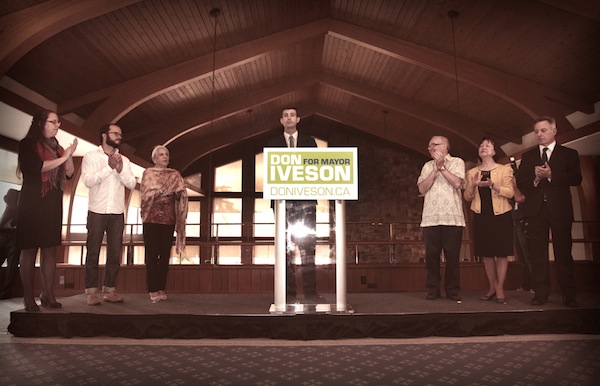
Mayor Don Iveson and 25 other Edmontonians have officially submitted forms expressing their intent to run in Edmonton’s next municipal elections, which are scheduled to take place on Monday, October 16, 2017.

Mr. Iveson’s papers were signed on October 16, 2016 and are now filed in the Office of the City Clerk. After serving two-terms on City Council starting in 2007, Mr. Iveson was elected Mayor by an overwhelming 62 percent of voters in 2013. Along with his mayoral duties, he is currently the chair of Canada’s Big City Mayors’ Caucus, which includes the mayors of Canada’s largest cities.

Other council incumbents who have filed their intent to run for re-election are Mohinder Banga, Tony Caterina, Bev Esslinger, Ben Henderson, Andrew Knack, Dave Loken, Scott McKeen, Mike Nickel, and Michael Walters. Six-term councillor Bryan Anderson announced in October that he would not seek re-election in his southwest Edmonton ward.

Candidates do not have to declare what positions they plan to run for until the official nomination day, on Monday September 18, 2017.

Some recent additions to the list of interested candidates, who have filed their papers since my previous updates, include:

Beatrice Ghettuba – A Chartered Professional Accountant and Board Chair of Edmonton’s Africa Centre. She ran as a federal Liberal candidate in the St. Albert-Edmonton riding in the 2015 election. In that race she finished second with 22.6 percent of the vote, ahead of incumbent Independent MP Brent Rathgeber.

Rocco Caterina – The son and executive assistant of Ward 7 Councillor Tony Caterina. He says he does not plan to run against (or to potentially succeed) his father but instead that he plans to run in the neighbouring Ward 4 currently represented by Councillor Ed Gibbons.

Here is the list of the remaining candidates, most who have been mentioned in previous updates:

Categories
Alberta Politics

Floor Crossing! What to make of Tory MLA Sandra Jansen joining the NDP?

Progressive Conservative Calgary-North West MLA Sandra Jansen took to the podium with Premier Rachel Notley this afternoon to announce that she is crossing the floor to join the governing New Democratic Party Caucus.

It would have been hard to imagine only one year ago that we would witness a PC MLA join the NDP but nothing should surprise us in Alberta politics anymore. Ms. Jansen has spent the past 18 months as an unwelcome moderate in a largely conservative caucus of 9 PC MLAs and it is hard to see what other options she may have had.

“Most Albertans are reasonable, moderate, pragmatic people,” Ms. Jansen was quoted as saying in an NDP caucus press release. “And most Albertans want a reasonable, moderate, pragmatic government. I believe we are getting that kind of government from Premier Notley.”

“I also believe that is absolutely not what would be on offer from those who are taking over the Progressive Conservative Party,” Ms. Jansen said. “The best traditions of the Peter Lougheed legacy in Alberta politics are being pursued by Premier Notley. And that legacy is being kicked to the curb by the extremists who are taking over my former party.”

There could not be a more direct shot at her conservative opponents in the PC and Wildrose parties but mostly PC leadership front-runner Jason Kenney.

In the opposition benches, Ms. Jansen has been a voice for moderate conservatism in the Legislative Assembly, clashing with her conservative MLA colleagues, including interim party leader Ric McIver, on numerous occasions. She also faced a backlash from conservative activists when she decided to publicly endorse Liberal candidates Kent Hehr and Nirmala Naidoo during last year’s federal election.

Last month Ms. Jansen announced plans to run for the PC Party leadership, building a campaign team that included Ms. Naidoo and strategist Stephen Carter. But she dropped out of the race last week, claiming that Mr. Kenney’s social conservative supporters had bullied her at the party’s annual convention over her progressive views on abortion and gay rights. She has also been the target of fierce sexist harassment on social media.

With Mr. Kenney’s hostile takeover of the PC Party in full-swing, it has become increasingly clear that there is less room for the moderates and liberals who played a key role in the party’s broad governing coalition from 1971 until 2015. Ms. Jansen was the voice of the “progressive wing” in the PC Caucus and she will certainly sit in the “conservative wing” of the NDP, which is a fascinating development in the evolution of the Alberta NDP’s centre-ish political coalition two years ahead of the next election.

While I expect Ms. Jansen had an opportunity to consider joining MLA Greg Clark in the Alberta Party or run for the leadership of the Liberal Party, returning to a position where she can influence government policy would have certainly been more appealing than joining or leading a smaller opposition caucus.

Although she is a moderate, Ms. Jansen has clashed with the NDP on a few occasions. In November 2015, Ms. Jansen accused then-Status of Women Minister Shannon Phillips of having “lost the authority to govern” after a heated debate over budget estimates and the old PC government’s record.

Her strong connections to former premier Alison Redford’s government are also notable.

A broadcaster by trade, she traded in her journalist’s hat for a job working in Ms. Redford’s southern Alberta office at the McDougall Centre in 2011. Shortly after that she was elected as a PC MLA and served as associate minister of families and community safety from 2013 until after Ms. Redford’s departure in 2014.

With this floor crossing, the NDP Government Caucus is one MLA short of having an an equal number of women and men, what I expect is a first in Canadian history. As far as I can tell, she is the first MLA, from any party, to cross the floor to join the NDP in Alberta’s history.

Ms. Jansen will sit as a backbench government MLA but we should expect she will soon make her way into cabinet in the new year.

Categories
Alberta Politics

Alberta Politics This Week: Affordable Childcare, Kenney’s Conspiracy Theory and ‘hysterical political correctness’

“Future Ready” with full stomachs and affordable daycare

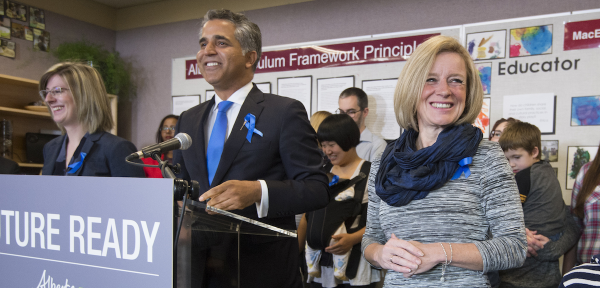
The Alberta NDP government’s awkwardly branded “Future Ready” campaign includes some pretty good policy initiatives. Premier Rachel Notley unveiled this week that the government plans to fund healthy breakfasts for low-income students in primary and secondary schools. She initially promised to create this type of program when running for the NDP leadership in September 2014.

Ms. Notley, along with Human Services Minister Irfan Sabir and Status of Women Minister Stephanie McLean, also announced the creation of one thousand $25 per day childcare spaces in urban and rural communities across the province. The cost of childcare in Alberta has skyrocketed in recent years, with many parents paying more than $1,000 per month for childcare. This pilot project is a welcome change that will have a positive impact on many Alberta families.

Kenney sees a socialist conspiracy

In the midst of his own hostile takeover of the PC Party, leadership candidate Jason Kenney accused radical New Democrats of purchasing PC Party memberships. A thin-skinned Mr. Kenney lashed out at Mike Morrison, the author of the popular Calgary culture website Mike’s Bloggity Blog, as an example of a socialist conspiracy to take over the PC Party. Mr. Morrison responded sharply, pointing out that he used to be a PC Party member and had voted for PC candidates in most elections. Meanwhile, in a fundraising letter for Mr. Kenney’s campaign, former prime minister Stephen Harper urged Wildrose Party members to join the PC Party to force the merger of the two parties.

Wildrose MLA Don MacIntyre, who represents the Innisfail-Sylvan Lake constituency, told Postmedia that “I would have preferred that Mr. Harper retire and stay out of it, and not try to influence this whole thing one way or the other.”

Mr. Kenney’s supporters swept the first delegate selection meeting held in the Edmonton-Ellerslie constituency, electing 15 delegates for the 2017 PC leadership vote. A scruitineer representing another candidate has filed a formal complaint with the party, accusing Mr. Kenney’s campaign of breaking party rules by hosting a hospitality suite near the polling station.

Jansen & Kennedy-Glans missed in PC race

The only women running for the leadership of the PC Party dropped out of the race last week, citing sexist attacks and a lack of space for centrist ideas in the party. Both Sandra Jansen and Donna Kennedy-Glans appeared to be willing to challenge the status quo thinking in Alberta’s conservative establishment, with Ms. Jansen even questioning the holy grail of Alberta’s past economic prosperity. She wrote on her campaign website that “…a young Albertan born this decade could see oil and gas replaced as our primary industry. Preparing our next generations for every possibility is a priority.” She is the only Conservative politician I can recall ever publicly mentioning the idea of a future where Alberta can no longer depend on oil and gas to drive our economy.

This is an important debate about our economy and education system that Conservatives should not shy away from. But now Ms. Jansen has now left the race and is even pondering whether she even has a future in Alberta’s PC Party.

Alberta Party first out of the gate

Alberta Party members in Calgary-Buffalo constituency will nominate their candidate for the next election on Nov. 27, 2016. Whoever they choose will be the first candidate, from any party, to be nominated to run in Alberta’s next provincial general election. Leader Greg Clark became the first MLA elected under the Alberta Party banner when he unseated PC Education Minister Gordon Dirks in Calgary-Elbow in in May 2015.

Angry Wildrose MLA’s latest social media rant

During a month when online sexist attacks against women politicians in Alberta appear to getting worse, Wildrose finance critic Derek Fildebrandt has posted a 743 word treatise on his Facebook page decrying “hysterical political correctness in politics. Mr. Fildebrandt was briefly (sort-of) disciplined by Wildrose leader Brian Jean earlier this year after launching a verbal attack against Ontario Premier Kathleen Wynne during her visit to the Alberta Legislature and being involved in an offensive social media blunder about her sexual orientation soon afterward.

In contrast to Mr. Fildebrandt’s post, Wildrose MLA Nathan Cooper shared a reasonable response on Facebook, stating that “Hateful, violent, sexist comments are not acceptable in any way or in any form.”

“I want to encourage all individuals to consider our words carefully. These are people’s mothers, daughters, fathers and sons. We owe each other our best. Women in politics should not serve in fear,” Mr. Cooper wrote.

Categories
Alberta Politics

Alberta’s overseas Army, Navy and Air Force Election of 1945

Months before the end of the Second World War, the largest global conflict in human history, the Alberta government conducted a vote of Alberta-residents serving in the three branches of the Canadian armed forces. The vote was held to elect representatives of the Army, Navy and Air Force to serve as Members of the Alberta Legislature. Tens of thousands of Albertans were serving in the Canadian forces across the globe at the time.

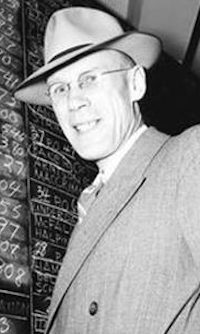
Elmer Roper
Elmer Roper

The Soldier vote, also known as the Serviceman vote, was the second phase of the 1944 election that took place in 1945 and was sanctioned through Orders-in-Council from the provincial cabinet of Premier Ernest Manning. The cabinet order temporarily increased the number of seats in the Assembly from 57 to 60. A bill was passed through the Assembly after the vote in order to legally create the three new MLA positions.

Pressure from the opposition, including CCF MLA Elmer Roper, convinced the governing Social Credit Party to allow the servicemen vote and create the three MLA positions.

There men are fighting for all we hold dear in democracy and political expediency is a sorry excuse for depriving people, particularly soldiers, the right to vote,” Calgary Liberal MLA Hugh MacDonald told the Legislature in March 1943, according to Edmonton Journal reports.

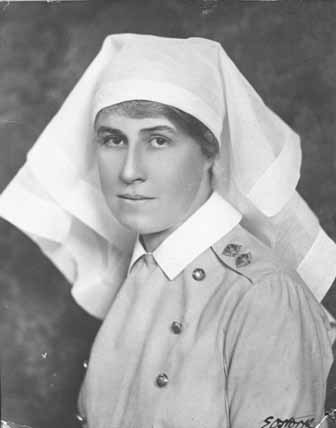
A similar vote was held following the 1917 provincial election, which elected two MLAs representing overseas servicemen and nurses, including Alberta’s second-ever woman MLA, Roberta MacAdams.

Roberta MacAdams
Roberta MacAdams

Voting conducted overseas was counted in England and sent to Edmonton by telegraph. In total, 7,985 votes were cast by servicemen (6,125 army votes, 1,207 air force votes, and 653 navy votes).

When the votes were counted, Captain James Harper Prowse was elected as the Army MLA, Wing Commander Frederick C. Colborne was elected as the Air Force MLA, and Chief Petty Officer Loftus Dudley Ward was elected to represent the Navy. They served as Independent MLAs until their terms expired in 1948.

Once in the Assembly, the MLAs raised issues ranging from housing, employment and education for veterans who returned to Alberta after the war ended.

Harper Prowse Liberal MLA Alberta
Harper Prowse

Two of the MLAs continued their political careers after their terms ended in 1948, Mr. Prowse as a Liberal MLA from Edmonton until 1959 and Mr. Colborne as a Social Credit MLA from Calgary until 1971.

Mr. Colborne served in numerous cabinet positions, including Minister of Public Works and Minister of Municipal Affairs. He represented the Calgary-Centre constituency from 1959 until 1971. He was defeated in his bid for re-election in the new Calgary-Currie constituency in 1971.

Mr. Prowse served as Liberal Party leader from 1947 to 1958 and leader of the Official Opposition from 1952 to 1958. He would run for Mayor of Edmonton in 1959, finishing second to Mr. Roper, one of the strongest proponents of the Soldier vote. He was later appointed to serve in the Canadian Senate.


Saskatchewan also had a Soldier Vote
A similar vote was held in the Saskatchewan election of 1944, which saw three MLAs elected from geographic region of service (1 MLA for soldiers serving in Great Britain, 1 for soldiers serving the Mediterranean Theatre, and 1 for soldiers serving in Canada outside of Saskatchewan).

Categories
Alberta Politics

Thinking of my grandfather, the Canadian Army Engineer

On the eve of Remembrance Day I am thinking of my maternal grandfather, Lawrence Anthony Bradley, who served as an engineer with the Canadian Army in England during the Second World War.

Born in Timmins, Ontario, on Nov. 6, 1917, he left his humble family home in Drumheller at age eleven to work in the lumber camps near Rocky Mountain House. He spent years riding the rails from job to job and later travelled with his brother Henry by covered wagon to homestead in northern Alberta during the height of the Great Depression.

I don’t know if he fully understood how his life would change when he left the farm in the Peace Country in 1939 and travelled to Edmonton to enlist in the army.

Maybe he saw joining the army as his duty to King and Country, or a ticket to adventure and seeing the world, or maybe it was the promise of  three square meals a day? He trained at Calgary and served at Aldershot in England until he lost his arm in an accident. He returned to Canada in 1943.

The loss of his arm never appeared to slow him down – he was an avid gardener and handyman. He became a life-time volunteer with the War Amps of Canada.

He had a kind soul and was a salt of the earth man. It has been almost 15 years since he passed away, but if he was still alive today I would give him a hug and thank him for his service.

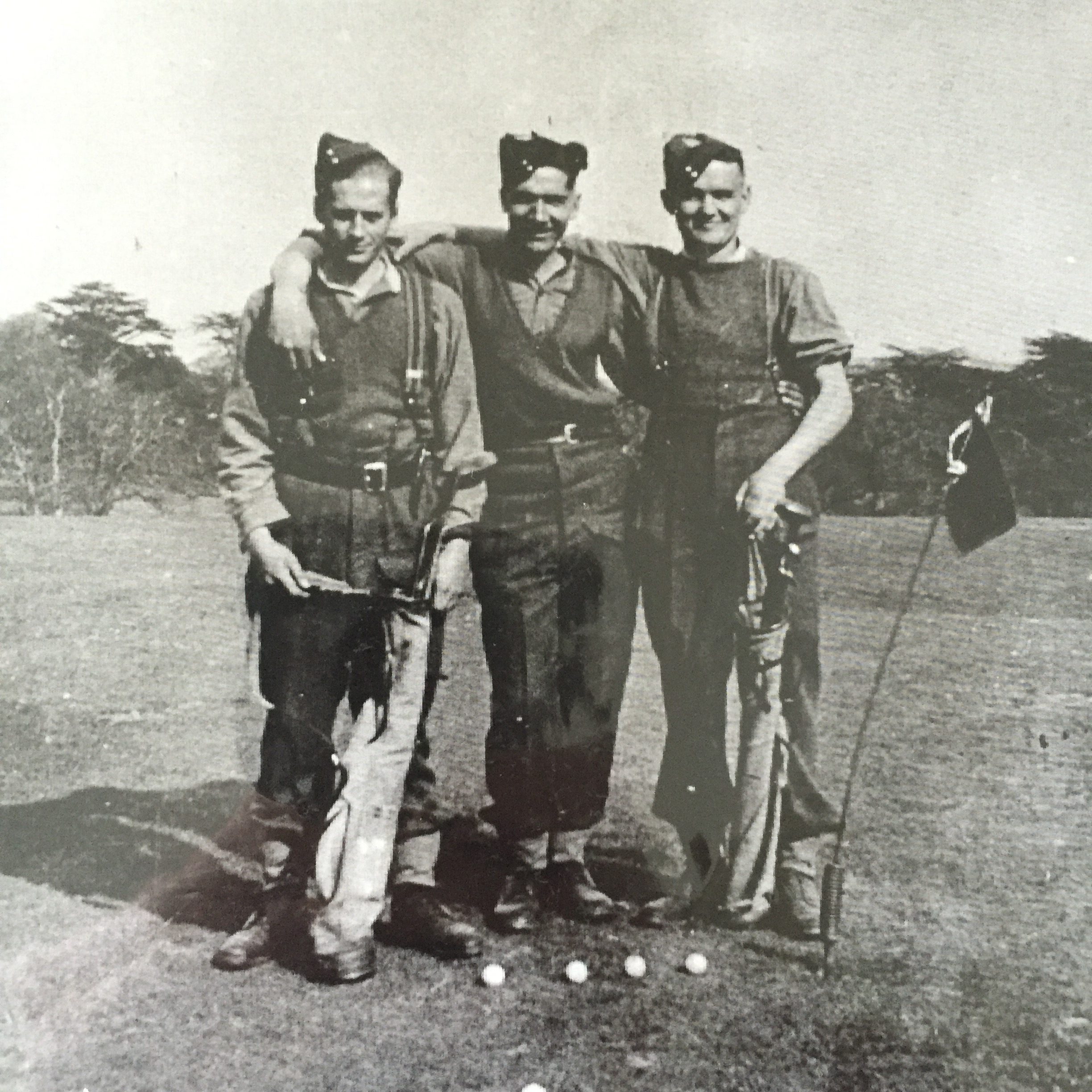
My grandfather Lawrence Bradley (sitting on the left).
lawrence-bradley-royal-canadian-engineers-2
Golfing at St. Andrews in Scotland. Writing on the photo identifies Wilson, Lowden, and Lawrence Bradley.
lawrence-bradley-royal-canadian-engineers-1
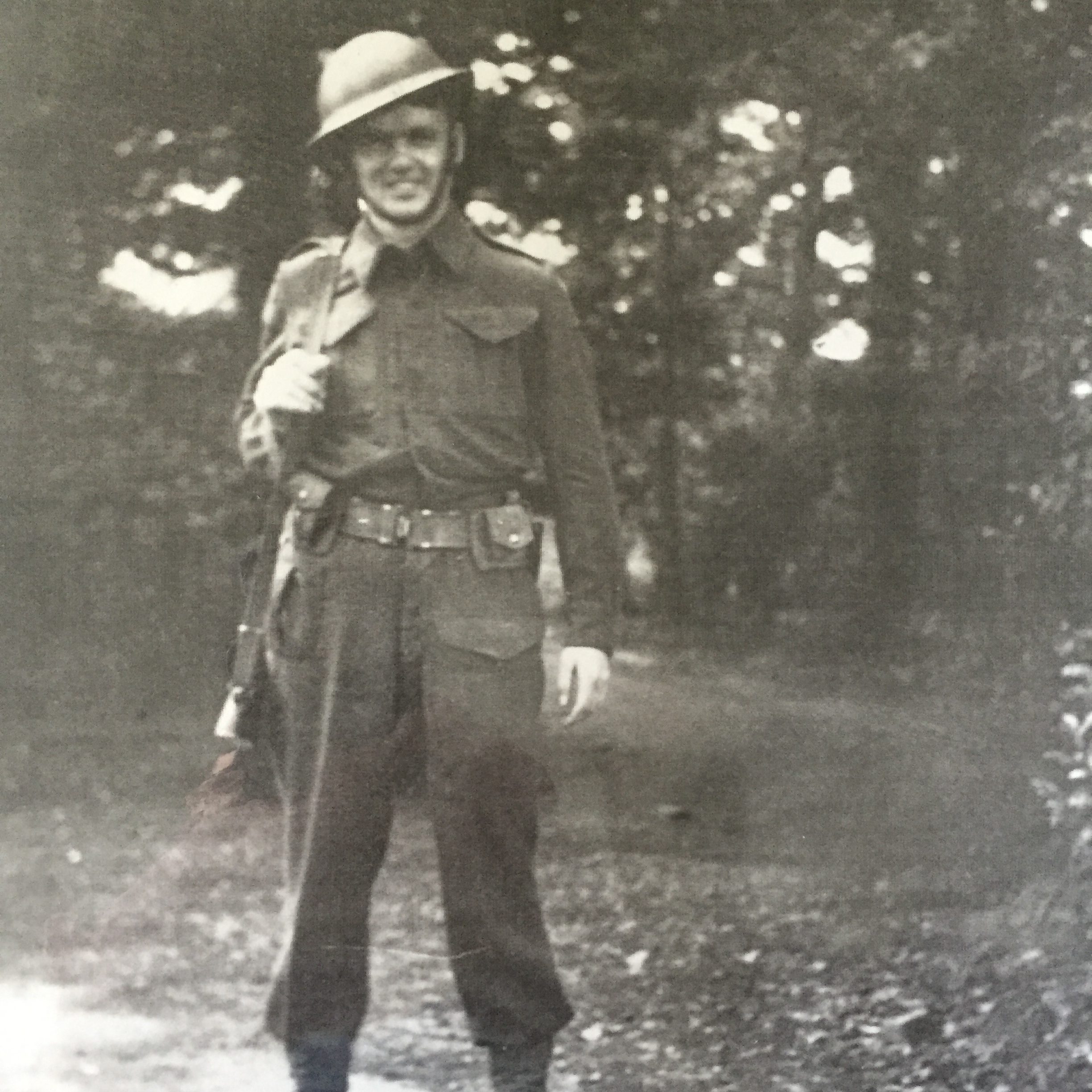
Canadian Army Engineers in Aldershot, England in 1942.
lawrence-bradley-royal-canadian-engineers-3
My grandfather, Laurence Anthony Bradley, served in the Canadian Army during the Second World War.
Categories
Alberta Politics

How did 59 million Americans come to support a loud-mouthed boor?

There will be plenty of analysis in the coming weeks about the results of the United States Presidential election focusing on how Donald Trump defeated Hillary Clinton. As many people around the world will have done today, I have spent many distracted hours trying to understand the consequences of this election. While I do not wish to be alarmist I cannot help but find the result very troubling.

Among the things that trouble me about this election is the threat that the views and behaviour of Mr. Trump and his more extreme supporters will become seen as acceptable in mainstream American politics. It is obvious that Mr. Trump successfully tapped into a deep-seated fear and anxiety among Americans and that his hollow call to “Make America Great Again” resonated. But I remain astonished that more than 59 million Americans voted for an offensive loud-mouthed boor who spent the past 17 months spewing racist, xenophobic, sexist and misogynist hatred on the campaign trail.

Even more mind-boggling to understand is that the man who launched his political career as the de-facto leader of the “birther” movement, a racist conspiracy theory aimed at undermining Barack Obama’s presidency, will now succeed America’s first African-American President.

The dog whistles are now megaphones, and we need to ensure that these toxic politics do not infect our national discourse with hatred and fear. Politicians like Conservative Party leadership candidate Kellie Leitch, must be challenged when they call for racist “Canadian values” tests for immigrants. And political forces that target women with sexist attacks, like those levelled against Sandra Jansen and Donna Kennedy-Glans, must not be allowed to succeed in their goal of driving progressive, moderate and reasoned voices out of our politics.

The results of the American election are deeply disturbing and they should be a call for all Canadians to stand up for values that protect inclusivity, diversity and respect.

Categories
Alberta Politics

Watch the US Presidential Election results on the big screen at the Garneau Theatre

donkey-and-elephant-fighting-e1453464526473Still deciding where to watch the results of the United States Presidential election roll in tomorrow night? If you are in Edmonton, come over the the Garneau Theatre and watch the future of democracy unfold on a the big screen!

Starting at 5:00 p.m. on Nov. 8, 2016, the election coverage will be played live on the big screen at Metro Cinema. The evening of election results will also include live music by The Give ‘Em Hell Boys in the lobby, food for sale from Urban Diner and a quick panel discussion from local politicos (including myself as a moderator).

I had a fun time moderating a similar political panel at Metro Cinema as results rolling in during the October 2015 federal election and I am looking forward to being there again tomorrow night. I hope to see you there!

Details:

Location: Garneau Theatre (8712-109 Street, Edmonton)
Start time: 5:00 p.m.


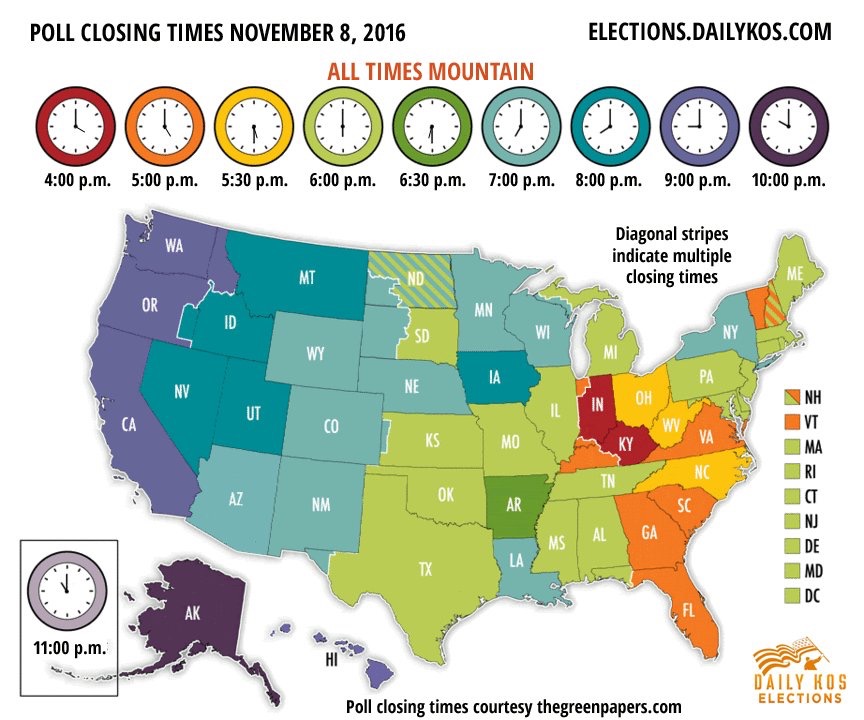
If you are watching from home, here is a look at when the polls close in states across the USA (image from Daily Kos Elections):

img_9536

Categories
Alberta Politics

Alberta Politics By The Numbers on November 5, 2016

Total number of MLAs: 87

Number of Government MLAs: 54

Number of Opposition MLAs: 33

Number of former government MLAs now sitting in the opposition caucus: 7

Number of former opposition MLAs sitting in the government caucus: 4

Number of women MLAs: 28

Number of male MLAs: 59

Number of cabinet ministers: 19

Number of women cabinet ministers: 10

In the current session of the Legislature, which began on March 8, 2016…

…”carbon tax” has been mentioned 2568 times.

…”carbon levy” has been mentioned 622 times.

…”oil” has been mentioned 1308 times.

…”climate change” has been mentioned 1254 times.

… “revenue neutral” has been mentioned 272 times.

…”fentanyl” has been mentioned 216 times.

…”transparency” has been mentioned 198 times.

… “risky” has been mentioned 112 times.

… “ideology” has been mentioned 95 times.

… “Leap Manifesto” has been mentioned 92 times.

… “socialist” has been mentioned 46 times.

… “Trudeau” has been mentioned 19 times.

Number of MLAs first elected in 2000, 2004, 2008, 2012, 2014, 2015, 2016: 1, 3, 2, 8, 1, 71, 1

Number of MLAs who were previously elected to municipal councils or school boards: 9

Number of MLAs who were previously elected to the House of Commons: 1

Number of bills introduced into the Assembly in this session: 34

Number of bills that have received Royal Assent in this session: 23

Numbers of declared candidates for the Progressive Conservative Party leadership: 6

Number of women running for the PC Party leadership: 2

Categories
Alberta Politics

Nothing new under the Prairie Sun: Alberta’s Social Credit Invasion of Saskatchewan

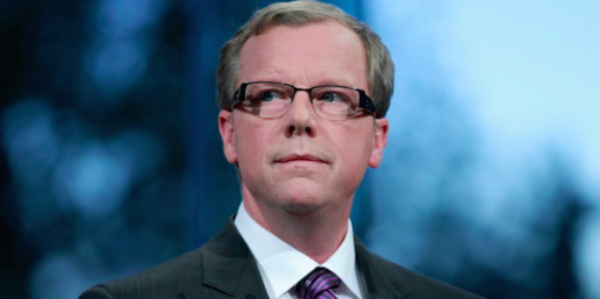
The recent news that Premier Brad Wall’s Saskatchewan Party is flush with cash from Calgary-based corporations is both noteworthy and concerning. Due to that province’s lax political finance laws, the Saskatchewan Party is reported to have received at least $2 million in donations from Alberta-based energy companies since 2006. This is notable considering the Premier’s fierce opposition to the federal government’s plans to fight climate change and his frequent criticisms of Premier Rachel Notley’s NDP government (a government that has banned corporate donations to political parties).

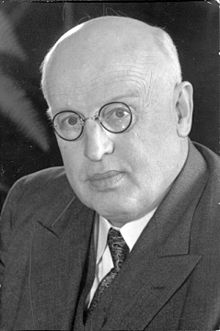
William Aberhart
William Aberhart

Mr. Wall is not the first Saskatchewan politician to get his financial backing from Calgary. There was a time when the people of Saskatchewan faced another, more literal, political invasion from Alberta.

Seventy-eight years ago, Alberta Premier William Aberhart staged an invasion of Saskatchewan politics.

Mr. Aberhart’s Social Credit Party had swept the 1935 Alberta election, going from zero to 56 seats and forming a majority government during the height of the Great Depression. Upon learning of the election victory, the Social Credit Greenshirts in London were reported to have marched around the Bank of England Building holding torches and blowing their trumpets (no doubt inspired by the Battle of Jericho).

During its first decade in government, Mr. Aberhart’s radical administration tried to print its own currency, legislate control over the media, nationalize the banking system and ban alcohol sales.

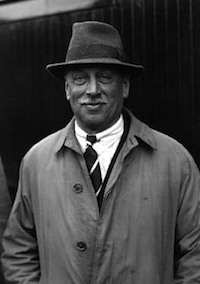
Major C.H. Douglas
Major C.H. Douglas

Eager to spread the gospel of Major C.H. Douglas and Social Credit theory, Mr. Aberhart’s party propped up a Socred Party in Saskatchewan to contest the June 8, 1938 provincial election. The Alberta Premier viewed Saskatchewan as a beachhead for his party’s expansion across Canada and, eventually, to Ottawa.

While The Battlefords Member of Parliament Joseph Needham was party leader by default, the Saskatchewan Social Credit Party organization in that election was manufactured by Albertans. It was run by Alberta MLA and Provincial Secretary Ernest Manning, who would succeed Mr. Aberhart as Premier in 1943 and serve until his retirement 1968.

Ernest Manning
Ernest Manning

Nearly all of Alberta’s Social Credit MLAs and cabinet ministers hit the hustings in Saskatchewan, spending weeks campaigning for local candidates. Mr. Aberhart spent two weeks on the campaign trail, speaking to rallies across Saskatchewan along with a band of experts in Social Credit theory.

“The outlook in Saskatchewan is very encouraging,” Mr. Aberhart was reported to have said upon a brief return to Alberta in May 1938. “It would appear from the definite interest manifested by the people who gathered in such large numbers that they realize a change is absolutely necessary,” Mr. Aberhart said.

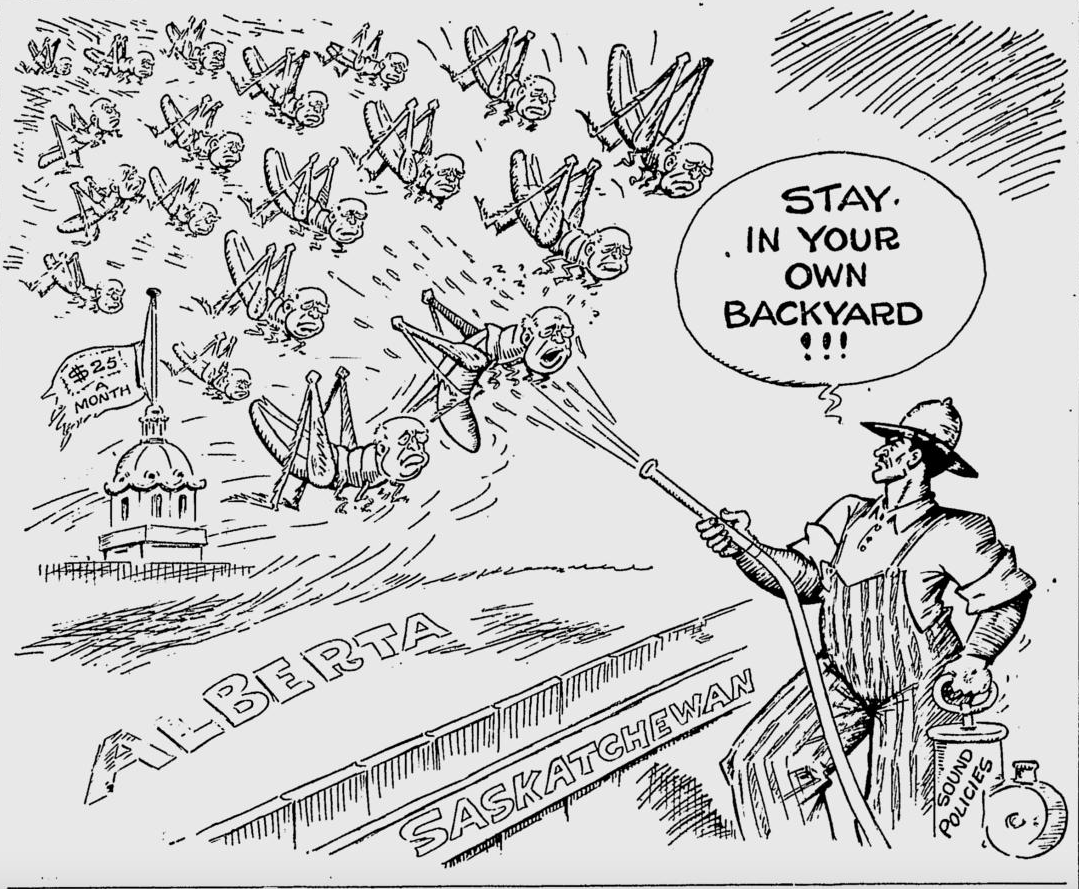
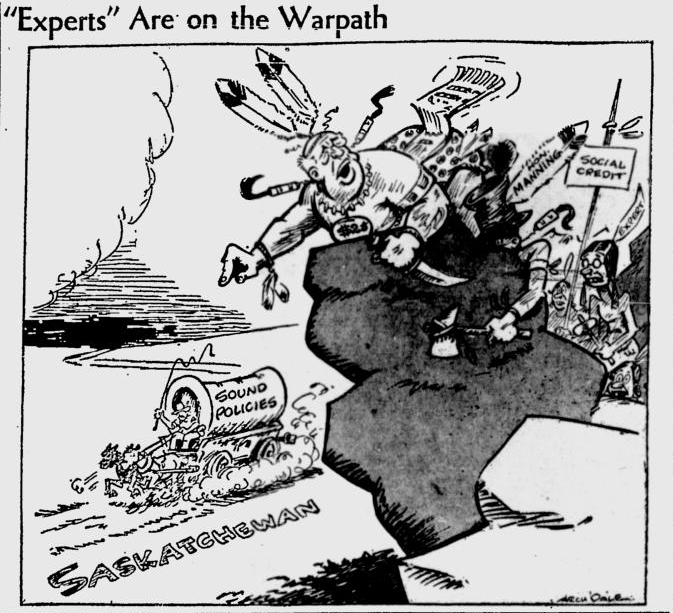
The “troupe from Alberta invading Saskatchewan,” as one Saskatchewan newspaper described them, did not go unnoticed and faced fierce opposition from local political establishment and opponents on both sides of the provincial border.

A political cartoon in The Leader-Post in May 1938.

The intentions of Social Credit candidates on the ballot were called into question by The Leader-Post, whose editors asked in a June 6 editorial who they would be loyal to if elected. “Will their loyalty be given to the Alberta Premier or to the people of Saskatchewan?,” the editorial asked.

Saskatchewan’s Liberal Minister of Natural Resources, William Franklin Kerr, called Social Credit a disease and claimed that if its candidates were elected those MLAs would represent the Premier of Alberta in the Saskatchewan Legislature.

John Hugill, a former Social Credit Attorney General who had become an outspoken critic of Mr. Aberhart, said in May 1938 that the Alberta Premier “visualizes being the dominant force in the political life of Western Canada as a stepping stone to becoming the Hitler of Canada.”

On the eve of the election, Mr. Aberhart is reported to have spoken to a rally of 5,000 people in the Town of Melville. The rally was policed by party activists, wearing official Social Credit armbands, who tossed out protesters from the event. It is unclear if the armbands were accompanied by official party uniforms. This was 1938 after all.

“Mr. Aberhart and his government are a peril to the people of Alberta. Not only is he a threat to Alberta, but his actions coming into Saskatchewan and disrupting the affairs of neighbouring province has been a menace to Canadian unity,” J.T. Shaw told The Leader-Post in June 1938. Mr. Shaw was a Knight of Columbus who traveled from Calgary to campaign against the spread of the Social Credit menace in Saskatchewan.

A political cartoon in The Leader-Post in May 1938.

On June 6, the Kerrobert League for Democracy, based in the town of Kerrobert, sent a telegram to the chairman of the Canadian Broadcasting Corporation asking him to stop Mr. Aberhart’s radio broadcasts into Saskatchewan. “The law prohibits radio broadcasting of political propaganda for certain periods before election days,” the League wrote. “…Premier Aberhart of Alberta took unsportsmanlike advantage of situation by broadcasting his propaganda against Saskatchewan opponents from Calgary Prophetic Bible Institute Sunday…”

Mr. Aberhart earned his nickname, “Bible Bill” from his weekly Christian radio sermons broadcast from the Calgary Prophetic Bible Institute in downtown Calgary.

Despite his best efforts, Mr. Aberhart’s Social Credit invasion of Saskatchewan was repelled. The Liberal Party led by Premier William Patterson was re-elected with a reduced majority of 38 seats and the Co-operative Commonwealth Federation formed official opposition with 10 seats. The Social Credit Party earned only 15.9 percent of the vote and elected two MLAs.

“The Alberta-run Social Credit election effort in Saskatchewan provided only two Social Credit seats in a fifty-five-seat house… The Social Credit revolution had been stopped at the Alberta-Saskatchewan border,” wrote historian Alvin Finkel in his 1989 book The Social Credit Phenomenon.

The Leader-Post editorial on the day following the election read: “The result is also satisfactory because it means the repulse of an outside government that threw itself into the domestic affairs of a neighboring province and attempted to lure Saskatchewan into adopting a plan of government and economics that has failed signally in Alberta. Mr. Aberhart and his men can now go home and attend to the business of running the province of Alberta, where they will find plenty of work to do. Mr. Aberhart may now cease from his extravagant claims that the people of the west are clamouring for Social Credit.”

Categories
Alberta Politics

Justice Myra Bielby to chair Alberta’s Electoral Boundaries Commission [with updates]

The chair of the next Electoral Boundaries Commission was appointed last Thursday with little fanfare. Justice Myra Bielby, a Court of Appeal judge for Alberta, the Northwest Territories and Nunavut, will chair the commission charged with redrawing Alberta’s provincial electoral boundaries before the next provincial election. She is the first woman to chair this commission in Alberta.

The other four members of the commission will be appointed tomorrow (update: see a list of appointees below) and will include two appointees selected by the government and two by the official opposition.

As I wrote last September, the NDP should have used an opportunity to amend the Boundaries Commission Act to allow for the appointment of a completely non-partisan commission, similar to the commissions appointed in every province to redraw federal electoral boundaries (they did not).

The final reports of previous commissions, which included two appointees chosen by the Progressive Conservative government and two from the then-Liberal Official Opposition tended to end with one or both of the opposition appointees publishing a minority dissenting report (which usually argued that Edmonton was being under-represented in the Legislative Assembly).

With the rhetoric running high from both the NDP and Wildrose this week, I expect we might see a similar situation develop with the appointees to this commission (but with the Wildrose appointees claiming rural areas are under-represented).

While the population of Alberta has grown since the last boundary redistribution in 2010, the population centres in our province have not shifted dramatically. Some boundaries will shift to reflect population changes but I would not expect a massive redistribution to create dozens of new constituencies in urban areas, as has been in the case in the past.

The final report from the 2009/2010 Electoral Boundaries Commission included a handful of recommendations for future commissions:

  • The Legislative Assembly needs to seriously consider how urban and rural perspectives will be addressed in the future.
  • The Legislative Assembly should consider reassessing the resources allocated for constituency offices.
  • Future commissions should be appointed early in the calendar year.
  • The Legislative Assembly may wish to consider adopting a protocol for the naming of electoral divisions for the guidance of future commissions.

Update: The commission appointees were announced on October 31, 2016:

Nominated by Premier Rachel Notley:

  • Bruce McLeod, Mayor of the Village of Acme and former president of CUPE Alberta.
  • Jean Munn, a lawyer with Caron & Partners LLP in Calgary and NDP candidate in Calgary-Montrose in the 1993 election.

Nominated by Official Opposition leader Brian Jean:

  • Laurie Livingstone, litigation lawyer from Calgary and the former Secretary of the Wildrose Party executive committee.
  • Gwen Day, former councillor in the County of Mountain View and co-owner of the Silver Willow Sporting Club (the location of a June 2016 fundraiser for Wildrose MLA Nathan Cooper).
Categories
Alberta Politics

Is the Sky Blue? Conservatives crush in Medicine Hat-Cardston-Warner by-election

Glen Motz
Glen Motz

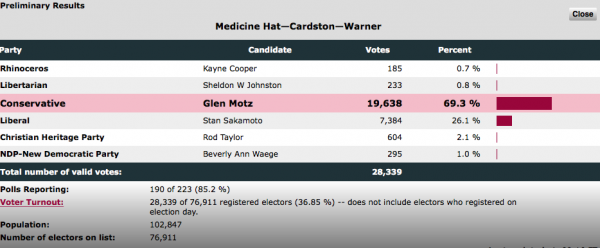
It is 10:20 p.m. and Conservative Party candidate Glen Motz has cruised to a crushing victory in the Medicine Hat-Cardston-Warner federal by-election. With 190 of 223 polls reporting, Mr. Motz had earned 69.3 percent of the vote, which is slightly higher to what the Conservative candidate earned in the October 2015 federal election. This is not unexpected, as voters in this sprawling southeast rural Alberta riding have a long history of supporting conservative candidates.

Though in a distant second place, Liberal candidate Stan Sakamoto is set to have achieved a high-water mark for the Liberals in this riding by earning the highest share of the vote for the Liberals since since 1974. An impressive mid-campaign splash by Prime Minister Justin Trudeau, a first by a sitting prime minister since 1993, also prompted a visit by Conservative leader Rona Ambrose, a first by a Conservative Party leader since before 2006.

Meanwhile, the New Democratic Party candidate, Bev Waege, is sitting at an embarrassingly low 1 percent of the vote, down from the 2015 candidate’s 9 percent. Neither the federal nor provincial parties appear to have put much, if any, effort into this by-election campaign. The lack of an NDP candidate until midway through the campaign also likely pushed NDP supporters towards Mr. Sakamoto’s campaign.

The results are undoubtably a reflection of how voters in this deep southern rural Alberta riding (the heart of Wildrose Party territory) feel about the federal NDP opposition in Ottawa and the provincial NDP government in Edmonton (which is not encouraging news for Medicine Hat NDP MLA Bob Wanner).

I expect Wildrose MLAs will try to blame Premier Rachel Notley for this poor showing, but anyone who has been paying attention to rural politics in this province over the past 17 months will not be completely shocked by this result.

Shorter version: Not much has really changed. Carry on with politics as usual.

The final results of the by-election can be found on the Elections Canada website.

Categories
Alberta Politics

Liberal underdog versus Conservative favourite in Medicine Hat-Cardston-Warner by-election

stan-sakamoto-liberal
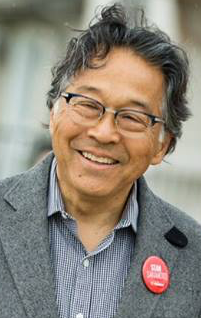
Stan Sakamoto

Today is election day in the federal riding of Medicine Hat-Cardston-Warner. Polls are open from 8:30 a.m. to 8:30 p.m.

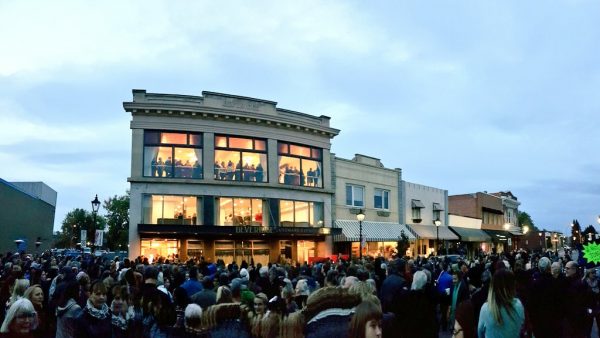
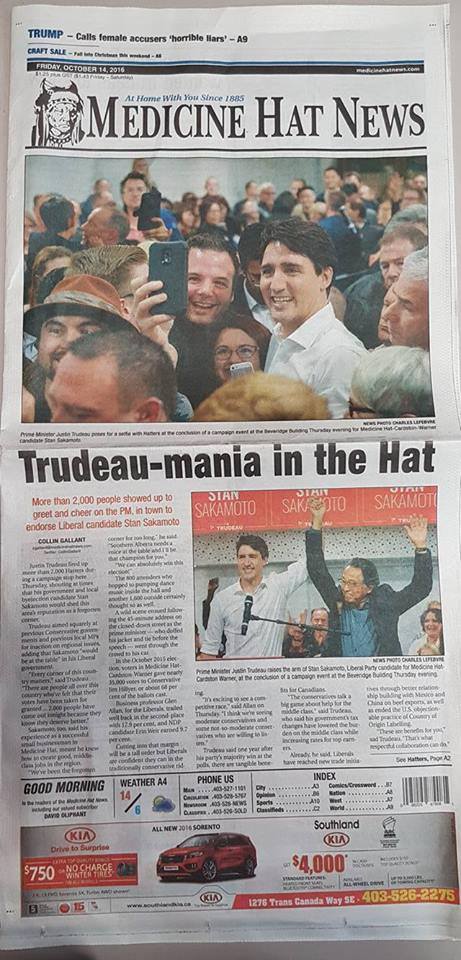
What was expected to be a sleepy by-election campaign in this long-time Conservative-held riding in southeast Alberta turned out to be surprisingly exciting. More than 2,000 Albertans showed up to see Prime Minister Justin Trudeau at a rally for local Liberal Party candidate Stan Sakamoto, marking the first time a sitting prime minister has visited Medicine Hat since 1993.

Mr. Sakamoto is a well-known local businessman and appears to be fairly popular in the city.

glen-motz-conservative
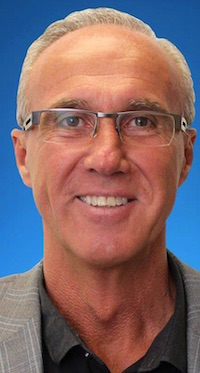
Glen Motz

Conservative Party candidate Glen Motz is a retired police officer and also appears to be a fairly well-liked figure in the community. The Conservatives won this riding with 68.8 percent of the vote in October 2015 and Mr. Motz is expected to win. Interim party leader Rona Ambrose was in the riding last week and was met by a crowd of 500 local Conservatives.

Mr. Trudeau has said “I know that this is one we can win, but the odds of Mr. Sakamoto winning the by-election still feel like a long-shot. I expect that Conservatives know this, but the strong turnout to Mr. Trudeau’s rally in this southern Alberta city has likely spooked the Conservative establishment.

Not a headline I ever would have expected to read from a newspaper in Medicine Hat.

A Liberal win in this by-election would send shockwaves through the Conservative Party, but a strong second place would be a success for the Liberals, who last earned more than 20 percent of the vote in this riding in the 1993 election.

Meanwhile, despite being officially connected, neither the federal or provincial New Democratic parties appear to have put much public effort or resources into supporting candidate Bev Waege during this by-election campaign. As Toronto Star columnist Chantal Hebert noted today, “this byelection has illustrated the dysfunctional nature of the relationship between the federal NDP opposition and Alberta’s New Democrat government.”

This is a race between a Liberal underdog and a Conservative favourite.

Categories
Alberta Politics

PCs don’t need the Wildrose to win, NDP should watch their Liberal flank

Uneventful weeks have become rare in Alberta politics and this week in particular has been uniquely interesting.

We started with the release of political party fundraising data from Elections Alberta showing the NDP raised more funds in the last quarter than any of the conservative parties combined, a first. This news was followed by a State of the Province address from Premier Rachel Notley and an oddly curious poll showing the Progressive Conservatives with a 13 point lead in support ahead of the NDP and the Wildrose Party.

The telephone poll conducted by the Citizen Society Research Lab at Lethbridge College, which was in the field from from October 1 to 8, 2016, showed the formerly governing PCs with 38.4 percent support. The survey showed the Wildrose Party in second place with 25.7 percent and the NDP in a distant third-place with 19.7 percent. It is important to look at polls with a grain of salt, especially ones which deviate dramatically from other polls, but it is important to recognize that polls can be indicative of trends.

Here are a few thoughts and observations:

1) NDP electoral coalition is fraying
We are still two or three years away from the next election so the NDP are smart to avoid focusing on any horse race polls but they should be concerned.

There are signs that moderate voters, who were a key part of the NDP’s winning coalition in 2015, are migrating to the PCs and Liberal parties. The NDP need to ask themselves why, only 17 months after their election, they appear to have lost nearly half their supporters.

Ms. Notley tried to bolster support for her government’s agenda through the State of the Province Address delivered to a crowd of 700 at downtown Calgary’s Jack Singer Concert Hall. She used the opportunity to reiterated her commitment not to make the sort of funding cuts to health care and education that Albertans could expect her Conservative opponents to make if they were in government.

The NDP need to take a hard look at why key elements of their government agenda, including some of their flagship policies, might not be resonating with the Albertans who voted them into office. This may require a more thoughtful and aggressive communications strategy and putting Ms. Notley front and centre is a good start to remind Albertans why they voted NDP. She is their greatest asset.

2) PCs don’t need to merge with the Wildrose Party to win the next election 

Having the NDP drop into third place in the polls weakens the argument promoted by Jason Kenney and groups like the Manning Centre that the PC and Wildrose parties need to merge in order to defeat the NDP in the next election.

It is probably more true that the Wildrose Party needs to merge with the PC Party in order to break the ceiling it has reached under Brian Jean’s leadership. But this poll would suggest that the PCs do not need to merge with the Wildrose Party in order to win the next election.

Despite both parties being conservative in philosophy, the PCs and Wildrose hold fundamentally different views on issues ranging from climate change to social issues to education and health care. The strength of the PC Party during its 44 years as government was its ability to attract a broad coalition of conservative, moderate and liberal voters. Everything the Wildrose Party has done over the past 17 months indicates the leadership of that party is not interested in building a broad coalition of Albertans.

We should expect support for the PCs and Wildrose Party to fluctuate over the next few months as the PCs choose their next leader. If the PCs anoint a more right-wing social conservative leader on March 18, 2017, they could drive moderate voters back into the NDP coalition.

3) Watch out for the Liberals

An unexpected result of a decline in NDP support could be a resurgence in support for the Alberta Liberal Party, which will be choosing a new leader in early 2017. According to the survey, Liberal support is at 9 percent up from an abysmal 4 percent in the May 2015 election. The popularity of Prime Minister Justin Trudeau is likely part of the provincial Liberal Party’s small boost, which saw the party’s candidate place a close third in a by-election earlier this year.

A significant part of the NDP’s winning coalition from the 2015 election was made up of former Liberal voters who abandoned their party in favour of the PCs in the 2012 election (in order to stop a Wildrose victory). It appears that many of those moderate voters may have become disenchanted with the NDP and have migrated back to the Liberals, and the PCs, for the time being.

As AlbertaPolitics.ca blogger David Climenhaga wrote earlier this week, the loss of this vote may signal to the NDP that “[m]aybe it’s time to start talking about uniting the left again.


Speaking of Liberals, it was announced today that Edmonton lawyer Kevin Feehan has been appointed as a Judge on the Court of Queen’s Bench of Alberta. Mr. Feehan was serving as co-chair of the Alberta Liberal Party’s leadership selection process, a position he will likely have to vacate due to his judicial appointment. Mr. Feehan is the brother of Richard Feehan, the NDP MLA for Edmonton-Rutherford and Minister of Indigenous Relations.

The Liberals replaced Calgary leadership co-chair Nirmala Naidoo last month when she resigned to join the campaign team trying to elect Sandra Jansen to the leadership of the PC Party.

Categories
Alberta Politics

Stephanie McLean wants more women to run in next year’s municipal elections

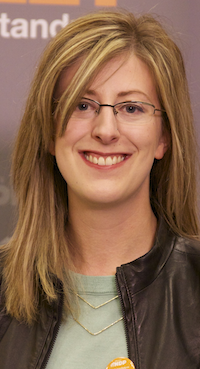
Stephanie McLean
Stephanie McLean

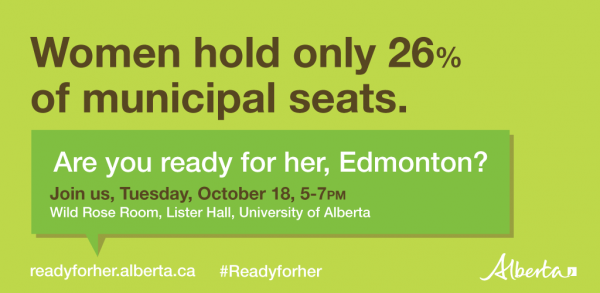
Alberta’s Minister for the Status of Women Stephanie McLean is heading on a four-city tour to convince more women to run for elected office in next year’s municipal elections. The tour will feature events in Edmonton on October 18Medicine Hat on October 20Calgary on October 24, and Lethbridge on October 27.

Despite a record number of women being elected to the Alberta Legislature in May 2015, including nearly a majority in the governing New Democratic Party caucus, and the majority of provincial cabinet ministers being women, the number of women elected to municipal office remains low.

According to the Alberta government website that promotes the tour and includes an online campaign toolkit, women hold an average of 26% of elected seats in municipal politics and Albertans elected 490 women out of a possible 1,874 municipal positions during the 2013 municipal elections.

At the Edmonton event on October 18, the only woman elected to our City Council, Bev Esslinger, will join Ms. McLean and Métis Nation of Alberta President Audrey Poitras for a discussion about how women can launch campaigns for municipal office. The discussion will be moderated by Edmonton Journal reporter Elise Stolte.

The Lethbridge event will feature Maryanne Sandberg, Councillor from the Municipal District of Willowcreek. The Medicine Hat discussion will include past mayoral candidate Milvia Bauman, Newell County Reeve and past provincial election candidate Molly Douglass and moderator Christy Pick from Shaw TV Channel 10.

The Calgary event discussion will include Piikani Nation Councillor Angela Grier former Calgary City councillor Gael MacLeod and will be moderated by radio host and former Wildrose and PC MLA Danielle Smith.

2016 marks 100 years of women’s suffrage in Alberta. As we can see in the current American presidential race, women candidates face many challenges when it comes to seeking office, least of all still having to campaign hard against an opponent who is grossly under qualified. I have heard it said that women have to be asked five times to run for office before accepting, while it usually only takes men one ask. It is my hope that more women will seek election, and will be elected throughout the province. After all, it is 2016.


On the topic of women running in municipal elections, Miranda Jimmy launched her campaign for Edmonton City Council in the southwest Ward 5. She will be facing incumbent Michael Oshry, should he choose to run again.