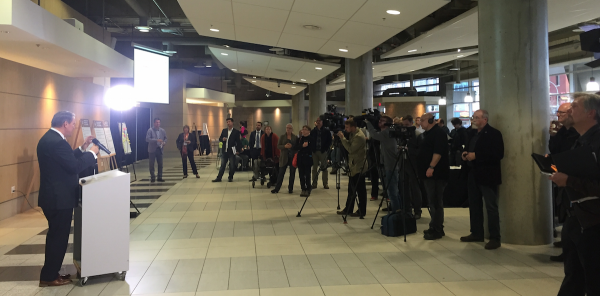
Jim Prentice is dwarfed by a giant photo of himself on the PC campaign bus outside an election rally in Edmonton.
I will be reminiscing on this blog over the next few days about some of the key moments from Alberta’s May 5, 2015 election campaign that stand out in my memory. The one year anniversary of that historic election, which saw the defeat of the 44-year old Progressive Conservative government and the election of Rachel Notley‘s New Democratic Party, is fast approaching.
One key moment was an April 14, 2015 rally held for Progressive Conservative leader Jim Prentice at a community hall in the Edmonton-Whitemud constituency, where PC MLA Stephen Mandel was running for re-election. The area had been a Tory stronghold since the 1997 election, when Dave Hancock was first elected, and voters in the area had chosen former mayor Mr. Mandel in a by-election only five months earlier.
The mid-afternoon event was well-organized and attracted a respectable crowd of about 250 supporters, candidates and party stalwarts into a hall in an affluent southwest Edmonton neighbourhood. It was a fairly typical political event, but it was an exchange at the tail-end of the rally convince me that the PC Party’s once-mighty campaign machine was running on fumes.
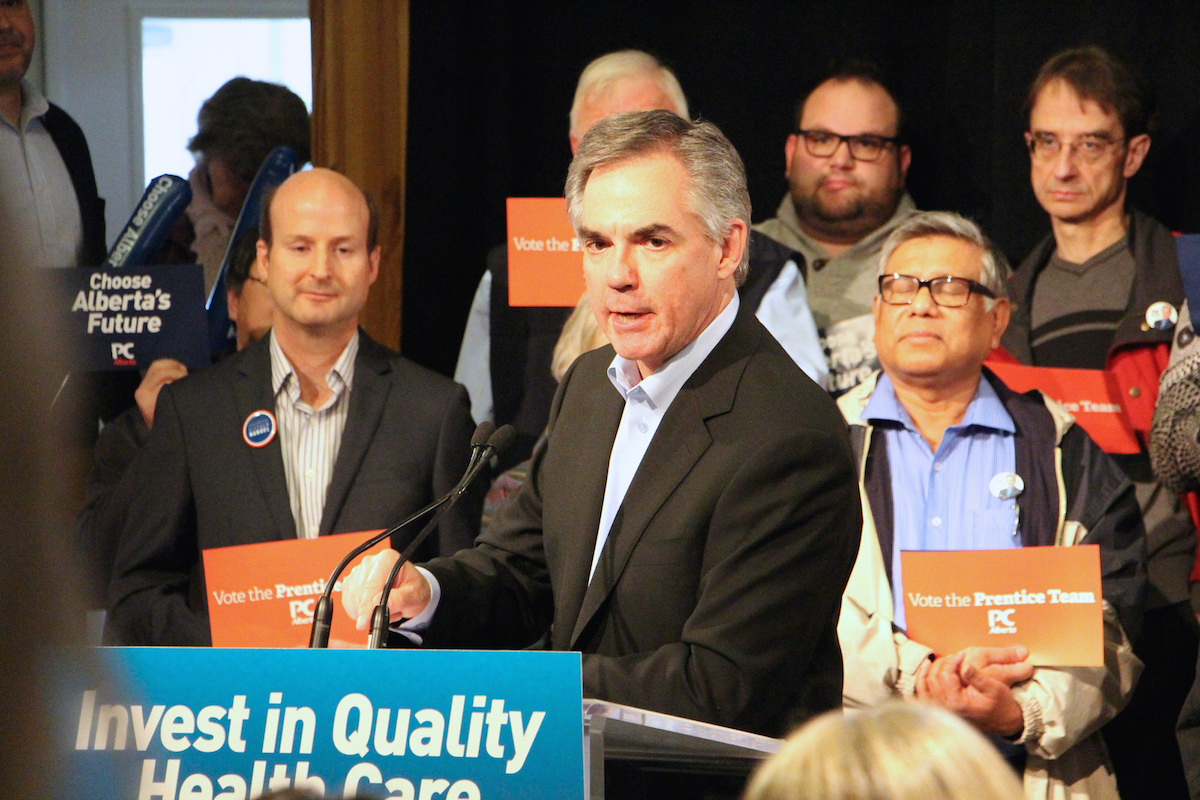
After a fairly unremarkable speech about his party’s commitment to fixing the problems it created in the health care system, Mr. Prentice remained on stage to take questions from the media. There had already been big signs of trouble on the campaign trail but his answer and the crowd’s response to the final media question convinced me that the PC campaign machine was running on fumes.
Over the course of the campaign Mr. Prentice had been harshly critical of the NDP election promise to review Alberta’s natural resource royalty structure and raise corporate taxes from 10 percent to 12 percent.
When asked if he would ever review royalties [note: the question was about either royalty rates or the corporate tax structure, I can’t remember for sure], Mr. Prentice delivered the most politically-mushy and non-commital answer I have ever heard: [paraphrased] ‘perhaps maybe sometime in the future my government might consider reviewing the structure.’
As soon as he delivered his response a forced cheer erupted from the party staffers in the back of the room and spread through the crowd of supporters, drowning out any further media questions and signalling an end to the official event program.
The crowd’s cheer was completely unenthusiastic. It was not the kind of answer that anyone would actually cheer. And it was undoubtably the wrong note on which to end a political rally.
If the PCs were unable to rally enthusiasm into a crowd of supporters in Edmonton-Whitemud, arguably the most loyal conservative area of the capital city, it was clear that Mr. Prentice’s party was in deep trouble in Edmonton.
On May 5, 2015, the NDP swept the Edmonton region, and Bob Turnerdefeated Mr. Mandel with 12,805 votes to 7,177 votes.
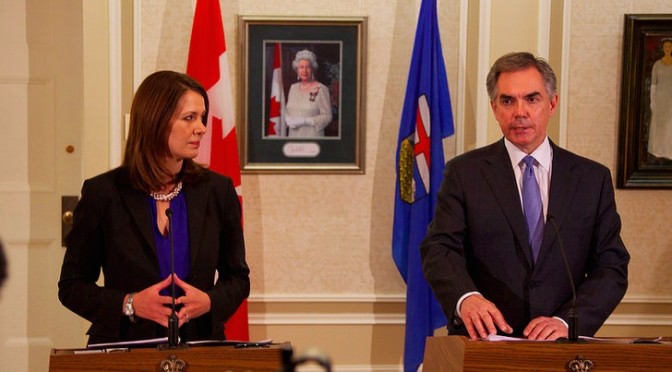
Jim Prentice speaks at the podium of his campaign rally on April 14, 2015.
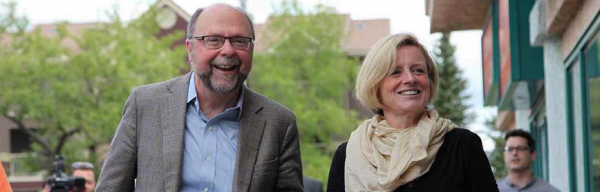
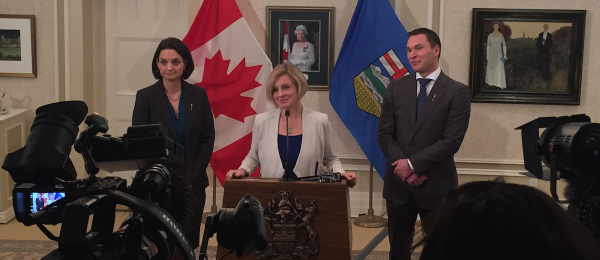
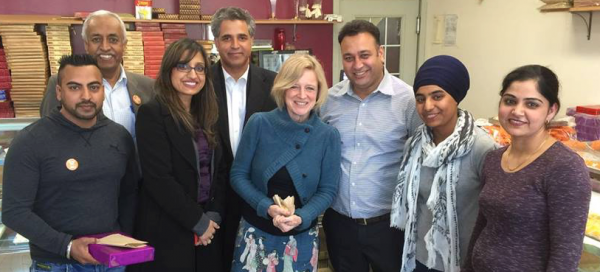
Premier Rachel Notley (centre), Human Services Minister Irfan Sabir (fourth from left) and NDP candidate Roop Rai (third from left) at a campaign stop in Calgary-Greenway. (Photo from Roop Rai's Facebook page)
The second by-election since Alberta’s May 2015 election will be held on March 22, 2016 in the northeast Calgary constituency of Calgary-Greenway. With the re-election of Manmeet Bhullar, this constituency was one of eight in Calgary to elect a Progressive Conservative candidate in that election. His death in November 2015 triggered this by-election.
By-elections can produce unexpected results. While they are important snapshots of the political mood of an electorate at a certain point in time, the results can be poor indicators of outcomes of future general elections.
Last year’s by-election in Calgary-Foothills, triggered by Mr. Prentice’s election night resignation, was the first in Alberta’s dramatically new political environment. The NDP poured significant resources in their campaign to elect former MLA Bob Hawkesworthand his loss to Wildroser Prasad Panda was a blow to the NDP, which is likely why the NDP appear to have done a better job managing expectations for Roop Rai‘s campaign in Greenway.
Alternatively, the Calgary-Greenway by-election is a must-win for the PC Party, which has dropped down to eight MLAs from 70 MLAs before the 2015 election. PC candidate Prab Gill needs to retain this by-election to signal his party will continue to be a viable alternative to the NDP.
A win by the PC Party would also throw a wrench into the plans of the official opposition Wildrose Party, which has been aggressively attacking the new NDP government since it took office less than a year ago. A Wildrose win might be a final nail in the coffin of the PC Party.
Unlike most of the 44-years of PC Party government, Albertans no longer live in a political environment where we can expect the governing party to win every seat. And that’s a good thing.
The following candidates will be listed on the ballot on the March 22, 2016 by-election in Calgary-Greenway:
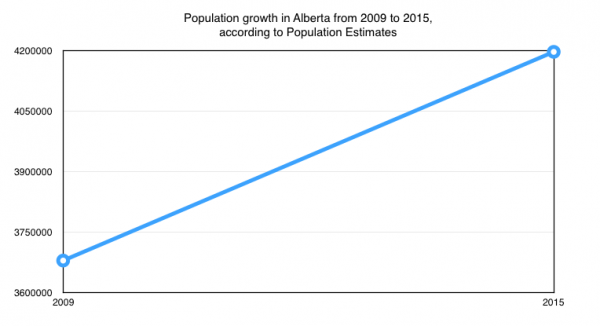
Alberta’s population has grown by 517,365 since the last time our provincial electoral boundaries were redrawn to reflect population growth. According to population estimates released on the provincial government’s Open Data portal this week, Alberta’s population reached 4,196,457 in 2015, up from population estimates of 3,679,092 in 2009, the last time boundaries were redistributed.
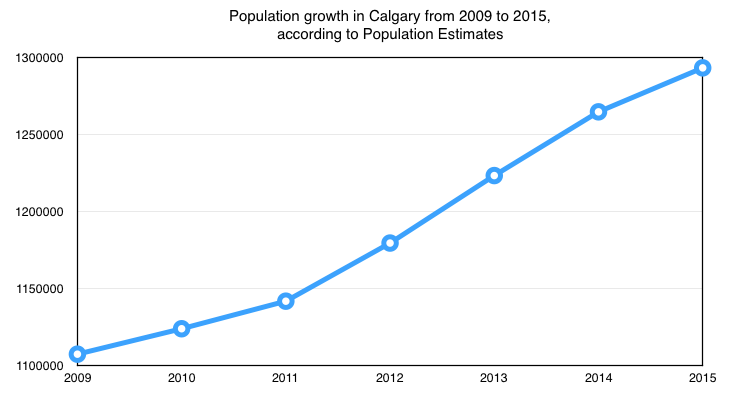
Over this six year period, Alberta’s two largest cities saw a huge population spike, with Edmonton growing from a population of 817,867 in 2009 to 950,421 in 2015 and Calgary from 1,107,192 to 1,293,023. Sixty-one percent of the province’s population growth is estimated to have moved to Calgary and Edmonton during this time.
According to these estimates, the combined population of Calgary and Edmonton represents 53 percent of Alberta’s population.
While most of the province’s growth is estimated to have been in the two big cities, Alberta’s medium-sized municipalities have also grown. According to the population estimates, Strathcona County grew from 92,299 in 2009 to 107,104 in 2015, Airdrie grew from 38,704 in 2009 to 50,257 in 2015, St. Albert grew from 62,563 in 2009 to 71,096 in 2015, and Wood Buffalo grew from 63,376 in 2009 to 77,804 in 2015.
Some smaller rural communities, like Hanna, Oyen, Starland County, Stettler County, Swan Hills, and the town and county of Provost, actually saw a decline in the population since the electoral boundaries were last redrawn, according to the estimates.
In order to reflect this significant population shift, the Government of Alberta should take action to ensure the electoral boundaries are redrawn before the next provincial election, which is scheduled to be held between March 1 and May 31, 2019. Redrawing the province’s electoral boundaries to reflect population growth will ensure that Albertans receive more effective representation in the Legislative Assembly after the next election.
The 2009/2010 Electoral Boundary Commission estimated that the average population of Alberta’s 87 electoral districts was 40,880. Using the same formula, the average population according to 2015 population estimates would be 48,235, which is very close to 51,100 maximum allowable population in each electoral district (25 percent above the 2009 average).
As I wrote in Sept. 2015, Section 5 of the Electoral Boundaries Commission Act states that a commission be appointed following every second election and a minimum of eight years and maximum of ten years since the previous commission. Two elections have been held since the last commission was appointed only seven years ago. This timeline was skewed when Progressive Conservative leader Jim Prentice called an election one year earlier than was set in Alberta’s fixed election date law.
According to a statement made by Chief Electoral Officer Glen Resleron Sept. 24, 2015, the currently existing legal timeline would not give the commission and Elections Alberta staff enough time to prepare for the 2019 election. Mr. Resler told an MLA committee that he would recommend the government introduce an amendment to the Act to shorten the timeline so a commission can be appointed before the eight year minimum period.
The government should amend the timeline to ensure the electoral boundaries are redrawn before the next provincial election. The government should also make changes other sections of the Electoral Boundaries Commission Act that would create a more fair process of drawing electoral districts and remove partisan appointments to the commission (I wrote about some of the changes that should be made in an earlier post).
According to the event listing: “Day of Change is a look at the events taking place in Alberta’s provincial election May 5th, 2015. Following candidates new to politics, veteran politicians, supporters, volunteers, and members of various political parties, the film takes a personal, behind-the-scenes look at the NDP victory that changed the landscape of Alberta and Canadian politics like no election in recent history.”
Three years ago this week, Conservative Premier Alison Redford took to the airwaves to warn Albertans about the ominous “bitumen bubble.” Ms. Redford warned that a pipeline bottleneck and a dramatic drop in the price of oil would rob the provincial government of up to $6 billion in natural resource revenue.
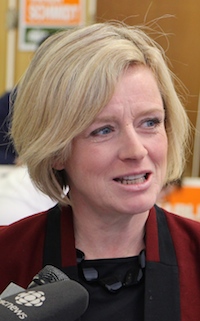
Rachel Notley
Ms. Redford spent much of her two and a half years in office focusing on pipelines, as did her successor Jim Prentice during his short eight months in the Premier’s Office.
One of the jobs Mr. Prentice left when he decided to run for the leadership of the Progressive Conservative party in 2014 was as liaison between the (now moribund) Enbridge Northern Gateway Pipeline and First Nations in northern British Columbia. Despite this experience, there was little evidence of pipeline advancement during his brief time as premier before the PCs were defeated in the May 2015 election.
As AlbertaPolitics.ca publisher David Climenhaga noted last week, “Premier Rachel Notley, after less than nine months in office, secured the tentative approval of the premier of Ontario and the enthusiastic endorsement of the prime minister of Canada, both members of a different political party than hers, for a pipeline to carry diluted bitumen from Alberta to New Brunswick for refining.”
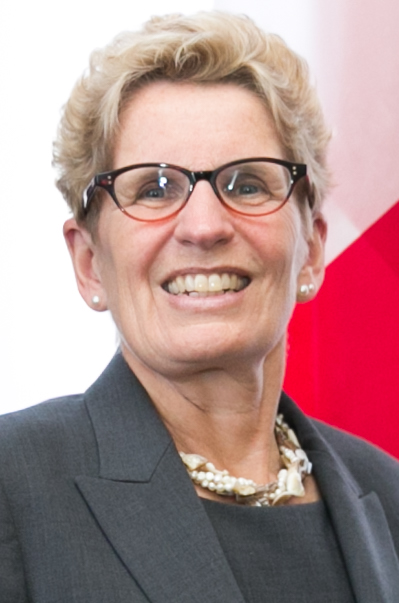
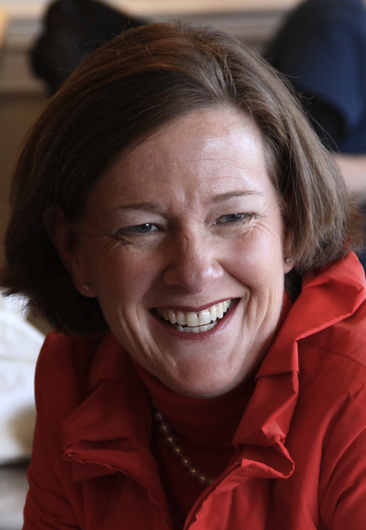
Alison Redford
What we are witnessing is unfamiliar: an NDP Premier advocating for this approval of a privately-owned, privately-operated pipeline that would ship oil from Alberta’s oil sands to a privately-owned and privately-operated refinery in New Brunswick. This is hardly characteristic of the radical marxist socialist extremist that Ms. Notley’s more fanatical critics claim she is.
This pipeline will not save the Alberta government from the revenue shortfall caused by the drop in the international price of oil, which is intensified due as a result of poor long-term planning during the previous 44 years of conservative governments. But it could narrow the price gap between West Texas Intermediate and Western Canadian Select and provide a new point of export for Canadian oil while also keeping refinery jobs in Canada rather than exporting jobs to refineries overseas.
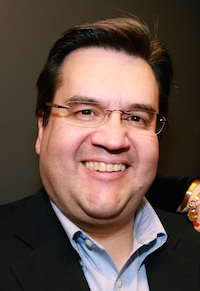
Denis Coderre
The decision to approve this pipeline will be up to the federal Liberal government, which includes strong representation from Alberta Members of Parliament.
Edmonton-Centre Liberal MP Randy Boissonnault reiterated his support for TransCanada’s Energy East pipeline last week. “Our government is committed to ensuring our natural resources have access to market. This process will include a credible environmental assessment process based on science, facts and evidence,” Mr. Boissonneault said in a statement.
Randy Boissonnault
Building a national consensus around climate change and the transportation and export of Canada’s oil will be helpful for future projects. It also gives Ms. Notley an opportunity to highlight her government’s climate change plan, which includes the phasing out of dirty coal fired power plants by 2030, a move that could significantly reduce Alberta’s carbon emissions.
While Wildrose opposition leader Brian Jeansquabbles with Montreal Mayor Denis Coderre over the municipal politician’s opposition to the pipeline, it would appear that Ms. Notley’s quiet diplomacy might be showing results. These type of public spats distract from the reality that Mr. Jean supports TransCanada’s Energy East pipeline but would cheer if Ms. Notley’s bid fails.
If TransCanada’s Energy East pipeline is approved before the 2019 Alberta election, Ms. Notley will be able to make the claim that an NDP Premier was able to accomplish something her conservative predecessors could not: get a new pipeline built from the oil sands to an ocean port.
Alberta MLAs to watch in 2016: Sarah Hoffman, Nathan Cooper, Deborah Drever, Greg Clark, Sandra Jansen, Deron Bilous, Danielle Larivee, Richard Starke, Shannon Phillips, and Prasad Panda.
The past few years in Alberta politics have reminded us that politics can be an extraordinarily unpredictable and forecasting the future can be a very tricky business for political pundits. Aside from the obvious choices of Premier Rachel Notley, Finance Minister Joe Ceci and Wildrose leader Brian Jean, here is a list of eleven Alberta MLAs worth watching in 2016.
Deron Bilous (Edmonton-Beverly-Clareview): As Economic Development and Trade Minister, Deron Bilous faces the challenge of proving the government’s job creation plan can work as the provincial economy faces declining international oil prices.
Greg Clark (Calgary-Elbow): As leader of the one MLA Alberta Party opposition, Greg Clark is punching above his weight in getting media attention and working hard to position himself as a moderate conservative alternative to the NDP and Wildrose Parties. He was also the only opposition MLA to propose an alternative budget and climate change plan in 2015.
Nathan Cooper (Olds-Didsbury-Three Hills): With a detailed knowledge of Assembly rules and procedure, Official Opposition House Leader Nathan Cooper will prove to be a valuable asset to the rookie Wildrose Caucus.
Deborah Drever (Calgary-Bow): Elected as a New Democrat and sent into legislative exile as an Independent after embarrassing social media posts were reported, she has been the target of relentless personal attacks by Wildrose MLAs and anonymous internet trolls. She has redeemed herself as a well-spoken representative and shepherded her first private members’ bill – Bill 204 – to unanimous approval in the Legislature. Expect Ms. Drever to be invited to rejoin the NDP caucus in 2016.
Derek Fildebrandt (Strathmore-Brooks): Probably the most high profile Wildrose MLA, Derek Fildebrandt is the loudest critic of the NDP government. But his hyper-partisan outbursts, including an embarassing fight with a Globe & Mail reporter and an angry tweet directed at the Assembly Speaker, are not necessarily the kind of attention his MLA colleagues are pleased to receive. Can he tone down the rhetoric and offer reasonable solutions and alternatives in 2016?
Sarah Hoffman (Edmonton-Glenora): As Health and Seniors Minister, Sarah Hoffman is well-spoken and smart as a fox. She can explain complex issues and spar with the opposition with ease. She is a contender for strongest member of Rachel Notley’s cabinet, and I place her in the “future Premier material” category.
Sandra Jansen (Calgary-North West): Sandra Jansen is the voice of the moderate wing of the Progressive Conservative Party. She has publicly clashed with interim leader Ric McIver over his decision to endorse the federal Conservatives, and with Wildrose supporters over her decision to endorse Liberal candidates in the 2015 federal election. Her record as a vocal opponent of a merger with the Wildrose would make her a candidate to watch in her party’s next leadership race.
Danielle Larivee (Lesser Slave Lake): Appointed to cabinet as Minister of Municipal Affairs and Service Alberta in a fall shuffle, Danielle Larivee has proven herself as a tough and well-spoken advocate. As one of the government’s point-people for the fumbled Bill 6 Farm Safety Bill, she demonstrated her toughness. A Registered Nurse, she is also co-chair of the government’s review of mental health services, which is expected to be released early in 2016.
Prasad Panda (Calgary-Foothills): When he won a Sept. 2015 by-election in Jim Prentice’s former constituency, he became the Wildrose Party’s only MLA from Calgary. He has been quite quiet since his win, but Mr. Panda’s performance as MLA over the coming years could determine how far his rural-based party might expand its presence in Alberta’s largest city.
Shannon Phillips(Lethbridge West): Smart, passionate and a fierce partisan, Shannon Phillips impressed many with her calm and cool delivery of Alberta’s climate change plan ahead of the Paris Climate Change conference in Nov. 2015. As Environment and Parks Minister, she helped bring together oil industry leaders and environmental groups to endorse the province’s plan. Selling the plan and its carbon tax to Albertans over the next year will be a serious test of Ms. Phillips’ political skills.
Richard Starke (Vermilion-Lloydminster): As a critic of Bill 6, Richard Starke took a more reasoned approach to criticizing the farm safety law and avoided the hysterical and negative reactions characteristic of his counterparts in the Official Opposition caucus. One of two remaining rural PC MLAs, he is said to be interested in making a bid for his party’s leadership.
The Under 30s: Jon Carson, Michael Connolly, Estefania Cortes-Vargas, Thomas Dang, Trevor Horne, Anam Kazim, Stephanie McLean, and Graham Sucha.
The Under 30s: Another result of the massive turnover in the legislature last year was a significant drop in the average age of Alberta’s MLAs, from 53 to 40 years old. Among the newly elected younger MLAs are a handful who are under thirty-years old (including Ms. Drever, who is noted above).
While it is not uncommon to have one to two under-30s elected to the Assembly from time to time, I cannot remember a time when so many were elected at once. It is a refreshing change, as younger Albertans bring a very different perspective than the typical older, greyer elected representative.
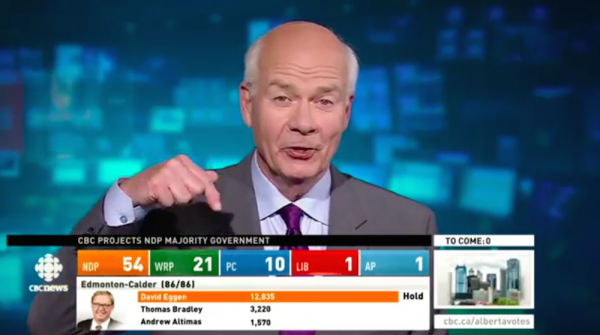
CBC National News Anchor Peter Mansbridge reacts to the results of Alberta's 2015 provincial election.
It was an exciting year to be a progressive in Alberta.
Rachel Notley
May 5, 2015 marked the first time since the 1930s that a conservative party did not win a provincial election in Alberta. The defeat of the Progressive Conservative government, which had been in power since 1971, by Rachel Notley’s New Democratic Party represented a significant shift in Alberta’s political environment.
As someone who has been writing about Alberta politics for ten years and advocating for more progressive politics in our province, this year’s provincial and federal elections produced strange and exciting results.
Ms. Notley proved to be a smart, likeable and charismatic leader on the campaign trail. I would argue that she was then and remains now her party’s greatest asset.
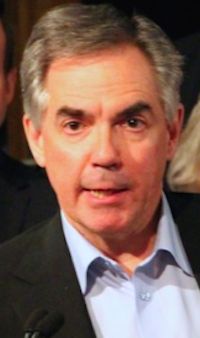
Jim Prentice
Voters opted for wholesale change by choosing 75 new MLAs, a huge turnover, to serve in Alberta’s 87 seat Legislative Assembly. The NDP started the election with 4 seats and ended it with 54 seats, including every seat in Edmonton, 15 seats in Calgary, seats in Lethbridge, Medicine Hat and Red Deer, and a handful in rural Alberta.
The PCs lost a total of 60 seats and were relegated to third place with 10 MLAs (9 after leader Jim Prentice resigned on election night) and the official opposition Wildrose won 21 seats, four more than the party won in 2012.
A record number of women were elected to the Legislature, including 26 in the 54 MLA NDP caucus and 7 of 13 cabinet ministers.
Thomas Dang, age 20, became the youngest MLA in Alberta history.
Optimism was in the air as thousands of Albertans showed up to the Legislature Grounds to watch the new Premier and cabinet be sworn-in to office.
In their first session as government, the NDP banned corporate and union donations, restored $1 billion in health care, education and human services funding cuts made by the PCs, increased Alberta’s corporate tax rate from 10 percent to 12 percent and announced a phased in $15 per hour minimum wage by 2018.
Ms. Notley demonstrated an ability to reach outside NDP circles for expert advice by appointing Alberta Treasury Branches President & CEO Dave Mowat to lead a Royalty Review Panel, respected economics professor Andrew Leach to lead a Climate Change Panel, and former Bank of Canada governor David Dodge to provide advice on infrastructure investment. Calgary Liberal MLA David Swann was asked to co-chair a review of the province’s mental health services and Joseph Doucet, Dean of the University of Alberta’s School of Business, was tapped to chair the Premier’s Advisory Committee on the Economy.
David Swann
The PC Party patronage machine ground to a halt. University and college boards of governors are still dominated with well-connected conservatives, but some high-profile appointees have been replaced. For example, Alberta’s representative in Washington D.C. Rob Merrifield, a former Conservative MP, was replaced by Gitane De Silva, a former Deputy Minister of International and Intergovernmental Affairs and Canadian Consul General to Chicago.
On the financial front, the NDP government faces serious problems inherited from the old PC government.
After years of poor long-term planning and over-reliance on royalty revenues to fund the province’s operations budget, the sharp decline in the international price of oil had a huge impact on the government’s coffers. The drop in the price of oil has also led to significant job losses in Calgary and northern Alberta, which have impacted tens of thousands of Albertans.
Rob Merrifield
Instead of dealing with the drop in revenue by cutting budget funding and slashing public sector jobs, like the Wildrose and PC parties proposed, the NDP have decided to invest in public infrastructure, such as highway, school and hospital construction.
As well as keeping many Albertans in the construction industry employed during the economic downturn, investing in building public infrastructure now means the government will spend less time playing catch up when the next oil boom arrives. Ironically, this is similar to what Wildrose leader Brian Jeanargued in favour of when he resigned as Fort McMurray’s MP in January 2014.
Despite a constant barrage of criticism from conservative critics, who claim the NDP election win was simply a fluke, a recent poll showed the NDP with a narrow lead in Calgary and a wide lead in Edmonton. The poll was not fantastic news for the governing party, but it undermines the argument that the NDP were elected by accident. The NDP appear to be developing a solid base of support among moderate and progressive voters in urban Alberta.
This election was a reminder that Alberta has defied its stodgy political stereotype and has rapidly become a young and urban province.
The city of Calgary, long known for its conservative political roots, has now elected progressive politicians in the municipal, provincial and federal levels of government, something that would have been unheard of in past years.
According to Statistics Canada, in 1961, 53 percent of Albertans lived in rural areas. As of 2011, 83 percent of Albertans lived in urban centres with only 17 percent of our province’s population living in rural areas. This is a massive population shift that has and will continue to impact our political map for decades to come.
The year’s election was a rejection of establishment politics and a reminder that Albertans are largely politically moderate and more populist than conservative, which is an important distinction that the ruling PCs forgot after 44 years in power. It was also a reminder of how dramatically voters can abandon their traditional patterns of voting and embrace change.
This year was filled with many exciting firsts for progressive politics in Alberta. And while it is impossible to tell what the next year will bring in Alberta politics it is clear that our province changed in a significant way in 2015.
I had the pleasure of joining Ryan Jespersen on 630CHED on Dec. 16, 2015 to talk about the past year in Alberta politics. Take a listen and let me know what you think about what happened in 2015.
One year after nearly the entire official opposition crossed the floor to join Alberta’s Progressive Conservatives, the 44 year long governing party is expected to sweep the province for a record thirteenth election victory. Premier Jim Prentice is said to be preparing his party and its candidates for an early spring 2016 election.
The Wildrose MLA floor crossings on December 17, 2014 hurt the PCs in the polls in the first half of 2015. But after the Tories began to recover in the polls a fall cabinet shuffle brought two former Wildrose MLAs, Danielle Smith and Rob Anderson, into Prentice’s cabinet as Finance Minister and Justice Minister.
Danielle Smith
Public opinion polls now suggest most Albertans have embraced the Prentice Tories once again. The PCs now have the support of 77 percent of Albertans, according to the most recent Western Insite poll.
“A few months ago it looked like the Tories had a real fight on their hands but today they are back on top,” said Jake Randall, vice-president of Western Insite Inc. “Prentice really didn’t start resonating with Albertans until after May 2015,” he said.
Speaking on the condition of anonymity, a senior official in the PC Party admitted they were glad the provincial election wasn’t called in early 2015, as some party insiders had pushed for.
“We simply weren’t prepared to go to the polls in spring 2015,” the source said.
“We would have got smoked, boy, it would have been the end of us,” they said.
David Climenhaga
The hopes of New Democratic Party supporters were boosted when David Climenhaga defied expectations with a 67 percent landslide win for the NDP in a May 5, 2015 by-election in the Spruce Grove-St. Albert constituency.
Liberal MLAs Laurie Blakeman and David Swann added to the orange momentum on May 6 when they joined the NDP caucus, creating speculation that Rachel Notley‘s NDP could pose a serious challenge to the Tories in the next election.
But with recent polls showing the NDP back in their traditional range of 10 percent support, Albertans may never know what an NDP government looks like.
The Wildrose Party has wilted, with most of its support relegated to a handful of rural southern Alberta constituencies.
Derek Fildebrandt
Wildrose leader Derek Fildebrandt remains a harsh critic of the PCs and is in talks to create a ‘real conservative alternative’ by merging his party with the right-wing Social Credit and Alberta First parties.
“Most Albertans are moderates and are very suspicious and uncomfortable with the kind of social conservative politics inside the Wildrose Party,” said Darlene Sinclair, professor of political science at Vermilion River University in Lloydminster.
Sinclair predicted that the PCs had successfully built a coalition of moderate and progressive minded urbanites that could keep the Tories in government for many decades to come. But she warned that even with high polling numbers, the Prentice government faces serious challenges.
Tory supporters are quick to defend Prentice from criticisms about the job losses caused by a downturn in the economy, tax increases and his refusal to make deep funding cuts to public programs.
Former Conservative MP Brian Jean, who will be running for the Tories in the Fort McMurray-Conklin constituency, said that Prentice is not to blame for job losses in the oil patch.
“It would be silly to believe that any Premier of Alberta, even Jim Prentice, has the power to control the international price of oil,” Jean said.
“It just doesn’t work like that, ” he said.
(Note: This article is a satirical take on what might have happened if the PC Party had waited until Alberta’s 2016 fixed election date to call the most recent provincial election. In reality, the PCs called the election one year early and Albertans elected Notley’s NDP with a majority government on May 5, 2015).
Alberta’s conservative Wildrose Party is holding its annual general meeting this weekend in Calgary and, according to one media source, the event will be closed to the media with the exception of leader Brian Jean‘s speech ahead of the leadership review vote on the evening of Nov 13, 2015.
It feels like an eternity in Alberta politics since the Wildrose Party’s last annual meeting in Nov. 2014, which saw then-leader Danielle Smithclash with the party’s social conservative base over support for sexual minority rights. Wildrose members at the open door meeting voted down a definitive statement on equal rights for all Albertans, destroying the party’s attempt to appear more mainstream on social issues.
Now, the Wildrose Party led by Mr. Jean will spend its first annual meeting after its spectacular return from the dead debating policy and politics behind closed doors.
Wildrose members will debate motions ranging from equalization payments, public sector pensions, ending mandatory membership in students’ unions, increasing access to firearms, abolishing the Canadian Senate, and allowing private enterprise to receive government grants to compete against public essential services.
Members will also debate a series of motions aimed at banning MLAs from crossing the floor to another party, an issue that nearly destroyed the party when 13 of its MLAs crossed the floor to join the Progressive Conservatives in the final months of 2014.
This type of anti-floor crossing policy could prove difficult to enforce, as it is against the spirit of the Westminster parliamentary system and idea of responsible government. Wildrose members should also note that none of the floor-crossers were re-elected in this year’s general election, providing some evidence that elements of our system of democracy worked without unneeded tinkering.
The closed door meeting could help hide controversial comments or embarrassing eruptions that regularily happen when political party members line up to speak at the microphone.
Rumours have circulated for months about a group of party members who still harbour bad feelings from the party’s March 28, 2015 leadership race and could create trouble for Mr. Jean at this annual meeting. The leadership vote, which Mr. Jean won with 54 percent to Drew Barnes’ 40 percent, was held days before the provincial election was called.
An internal investigation was launched amid allegations of illegal robocalls and the party imposed a $15,000 fine against Mr. Barnes’ campaign. The message in the robocalls allegedly attacked Mr. Jean for his $10,000 donation to Jim Prentice‘s PC leadership campaign only months before he entered the Wildrose Party leadership race.
Mr. Jean is now carefully manufacturing his pitch to convince members of the former governing PC Party to join his party’s ranks. Later in November, the Wildrose Party is hosting a “conversation” fundraiser in Calgary where Mr. Jean will make his pitch to conservatives to unite behind his party against the NDP. Any embarrassing or divisive fights at this meeting could derails those attempts.
Wildrose MLAs have eclipsed the tiny PC opposition in media attention while relentlessly hammering almost every decision made by Rachel Notley‘s NDP since they won the May 2015 election. But recently Wildrose MLAs have found themselves tied up in an embarrassing missteps including fighting a new 9:00 a.m. start time for the Legislature and a very public dispute with a Globe & Mail reporter.
If Mr. Jean’s Wildrose Party truly wants to prove it is ready to govern and represent mainstream Alberta, they should demonstrate it by giving Albertans a view into how their grassroots members really believe our province should be governed.
Bob Hawkesworth with Premier Rachel Notley during the by-election in Calgary-Foothills. (Photo from @AlbertaNDP on Twitter)
Former Calgary alderman Bob Hawkesworth has been appointed Executive Director of Premier Rachel Notley’s southern Alberta office at the McDougall Centre in Calgary. A press release sent out on Nov. 7 states that Mr. Hawkesworth will be responsible for “the day-to-day operation of McDougall Centre, including stakeholder relations, communications and outreach services.”
Richard Gotfried
Mr. Hawkesworth is a familiar name in Calgary politics, having served on city council from 1980 to 1986 and 1993 to 2010, and as the NDP MLA for Calgary-Mountain View from 1986 to 1993.
But his long career in municipal politics ended with a flame out. When faced with dwindling support in his bid for mayor in 2010, the respected alderman known for his ‘nice guy’ image launched a blistering negative attack on Naheed Nenshi before dropping out and endorsingBarb Higgins (his name still appeared on the ballot – he earned 1,513 votes). The negativity and surprised endorsements had many Calgarians scratching their heads in confusion.
Reaction from the opposition parties to his appointment this weekend was surprisingly mixed.
Prasad Panda
Calgary-Fish Creek Progressive Conservative MLA Richard Gotfriedtweeted a congratulatory note, describing Mr. Hawkesworth as “A good man and an able representative of the @albertaNDP in #YYC.”
Rimbey-Rocky Mountain House-Sundre Wildrose MLA Jason Nixonattacked the announcement as “a patronage appointment while Albertans across the province are hurting.” It seemed odd that the Wildrose caucus did not choose their only MLA from Calgary, Mr. Panda, to respond to the appointment. Maybe they are still preparing themselves for the rigours of a 9:00 a.m. start time?
Was this appointment based on political connections? It is hard to argue it is not. We can expect Ms. Notley to hire who she knows and who she trusts to these top positions. Mr. Hawkesworth might be the most well-connected and well-known partisan New Democrat in Calgary (Finance Minister Joe Ceci, another former alderman, might be the only other Calgary New Democrat as well connected). And he did earn endorsements from a number of conservatives during his by-election bid, including Councillor Diane Colley-Urquhart, former PC MLA Gordon Shrake andformer mayor Rod Sykes.
Jason Nixon
This appointment of a long-time party loyaltist also signals that the NDP don’t have a broadly developed network of fresh talent to draw from in Calgary and southern Alberta, which may explain the large number of out-of-province hires. Many Calgary progressives I speak with regularily, some who are affiliated with Mr. Nenshi’s mayoral campaigns, are completely unfamiliar with the NDP’s political networks in their city, mostly because these networks are just now being built.
Despite electing 15 MLAs in Calgary, the NDP only earned 35 percent of the city-wide vote in the May 2015 election. It will largely depend on these 15 MLAs in Calgary and their colleagues in Banff-Cochrane, Lethbridge and Medicine Hat to develop those networks through the work they do on the ground in their constituencies over the next four years.
Rob Merrifield
The appointment of Mr. Hawkesworth does raise the question about Ms. Notley’s pledge to operate differently than the old PC government. In fact, only a few months ago, the NDP government publicly fired and criticized former Alberta representative in Washington D.C. Rob Merrifield for being a political appointee.
Mr. Merrifield was a partisan political appointee, hired by former Premier Jim Prentice, because he knew him and believed he could trust him to do a good job. Just as I am sure Ms. Notley knows and believes she can trust Mr. Hawkesworth to do a good job running the Premier’s office in at the McDougall Centre.
A sunny day on the campus of University of California, Berkeley.
President Barack Obama
Having enjoyed the last week in the sunny Berkeley, California, it felt odd to turn on the car radio to hear the local disc jockeys discussing the tarsands and the merits of a pipeline that would pump unrefined bitumen from Canada to Texas. Being one of the most liberal areas in the U.S. – there were more than a few cars sporting “Bernie Sanders 2016″ bumper stickers – the discussion revolved around climate change and the environmental impact of the tarsands.
So, to the shock of no one who was paying attention, American President Barack Obama rejected the TransCanada corporation’s application for the cross-border permit needed to link the Keystone XL pipeline across the Canada-United States border.
It had become clear over the past few years that the project was unlikely to be approved by the American President. While counter-messages from the oil industry and environmental groups set the tone internationally, opposition to the pipeline by a handful of rural landowners in Nebraska is what ended up tying the pipeline project in the courts.
Justin Trudeau
While the rejection of Keystone XL represents a victory for the projects opponents, it also represents a failure of Canadian foreign policy. For the past decade, the federal and provincial governments have been subsidizing TransCanada by spending significant amount of time and resources providing public funding for the pipeline through lobbying activities.
Elected officials like former Premier Alison Redford and her cabinet ministers were essentially publicly-funded lobbyists as they travelled to the U.S. dozens of times to advocate for Keystone XL and other oil industry projects. The decision by Jim Prentice to appoint well-connected Member of Parliament Rob Merrifield to the post of Alberta’s representative in Washington D.C. was supposed to give a boost to the government’s pipeline lobbying goals (he was later dismissed by Premier Rachel Notley). And the government led by Saskatchewan Premier Brad Wall was reported to have paid at least $3 million to lobbyists in Washington D.C.
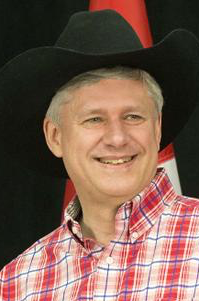
Stephen Harper
The Conservative government of Stephen Harper, which was rejected by Canadians on Oct. 19, had arguably been the most pro-oil industry administration we have seen in decades. But instead of trying to build a national consensus in favour of projects like Keystone XL, the Conservative government demonized opposition to the pipelines in Canada. Opponents of Bill C-51 claimed that new spy laws passed by the former Conservative government with support from the Liberals could target Canadian citizens who oppose the expansion of oil pipelines.
Prime Minister Justin Trudeau declared his support for TransCanada’s Keystone XL pipeline in a speech to the Calgary Petroleum Club in October 2013 while also criticizing the Conservative government’s approach to lobbying for the pipeline in Washington D.C. “They have poked and prodded, annoyed and irritated the Obama administration at every turn. Largely, I suspect, because they don’t know how to work with people who don’t share their ideology,” Mr. Trudeau told Calgary’s oil elite.
Rachel Notley
While Mr. Trudeau has not publicly supported TransCanada’s other major pipeline project, the Energy East pipeline, new Natural Resources Minister Jim Carrfaces a challenging task of managing the interprovincial politics of pipelines. An Energy East pipeline that would would pump oil from Alberta to port terminals in New Brunswick or Quebec, keeping jobs in Canada, was endorsed by Ms. Notley and New Brunswick Premier Brian Gallant last month.
The appointment of Ottawa MP Catherine McKenna as Minister of Environment and Climate Change, and former environment minister Stephane Dion as Minister of Foreign Affairs signals that the new federal government may not be as singularly focused on pipelines as the previous government. Mr. Dion is well versed in environmental policy after serving as environment minister from 2004 to 2006 and spearheading the Green Shift policy while leading the Liberal opposition in the 2008 election.
Catherine McKenna
One of the new federal government’s first major tasks will be to bring its ideas to address climate change to COP21, the 2015 United Nations Climate Change Conference, being held Nov. 30 to Dec. 11 in Paris, France. Ms. McKenna will be advised by a strong Alberta voice in these matters, with former Pembina Institute executive director Marlo Reynolds, a Canmore, Alberta resident, as her chief of staff.
Ms. Notley and Alberta Environment Minister Shannon Phillips will also be attending the conference in Paris.
The Pembina Institute may have spotted one of the biggest changes that the rejection of TransCanada’s Keystone XL signifies for Canada’s new foreign relations and energy strategies. In a statement released yesterday, Alberta director Simon Dyer said the “decision by President Obama reiterates that climate change is a key consideration for all energy infrastructure projects going forward.”
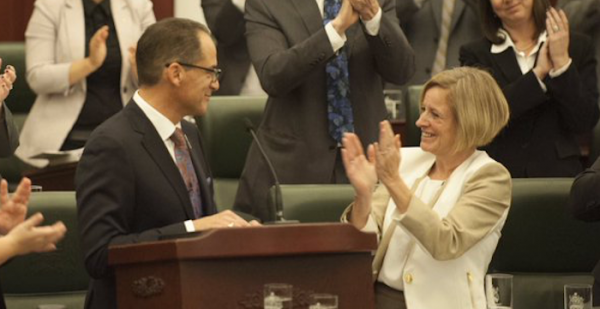
Premier Rachel Notley applauds Finance Minister Joe Ceci as he presents the Alberta NDP's first budget.
When Finance Minister Joe Ceci stood in the Legislature on Oct. 27 to deliver the Alberta NDP’s first budget, it marked the first time since 1972 that the budget was not tabled by a Progressive Conservative finance minister.
Rachel Notley
The first budget of Premier Rachel Notley‘s NDP government includes a 15 percent increase in capital spending over the next five years, with a goal to create jobs and tackle the province’s aging and neglected hospitals, schools, roads and other public infrastructure.
The NDP budget includes modest increases and projected stable funding for health care, education, advanced education and human services – core services that Albertans depend on. This was a key component of the election platform that helped propel the NDP into government on May 5. The job creation and economic stimulus elements of the budget followed last week’s creation of an Economic Development and Trade portfolio, led by Edmonton MLA Deron Bilous.
Deron Bilous Edmonton Alberta MLA Minister
A projected $6.1 billion deficit in the NDP budget is larger than the $5 billion deficit presented in the Tory spring budget, which was tabled but never passed. But the Alberta government’s eighth consecutive deficit budget is “…hardly sky is falling territory,” wrote University of Calgary economist Trevor Tombe in Maclean’s Magazine this week.
“While not trivial, obviously, it is completely manageable. Alberta is fully able to handle it and no one need panic. It represents 1.8 per cent of the province’s GDP, which is fairly small, as far as some deficits go,” Dr. Tombe wrote.
The NDP government will borrow to pay for parts of its operations budget starting next year, which will hopefully be a short-term move. Decades of bad financial management and poor long-term planning by the previous conservative government has exacerbated the provincial government’s current fiscal situation. The PCs simply became too comfortable and dependent on unreliable revenue from natural resource royalties to fund the province’s operations budget.
Jim Prentice
Mr. Ceci also announced that the government would legislate a debt ceiling of 15 percent debt-to-GDP in order to hold off a risk of credit downgrades and higher debt service costs.
Former premier Jim Prentice was correct last year when he warned about getting “off the royalty roller coaster.” The Alberta government faces serious revenue problems and moving Alberta away from its over dependence on resource revenue will be a significant test of Ms. Notley’s first term in government.
Any plan to deal with the revenue problem will likely come after the government receives a much anticipated report from the royalty review panel chaired by ATB President and CEO Dave Mowat. The panel is expected to finalize its recommendations by the end of the year. But it will not be enough to simply wait for the international price of oil to rise again. Albertans need to have a serious conversation about revenue and taxation, including the potential introduction of a provincial sales tax.
Mr. Jean’s post-budget press conference was somewhat overshadowed by Mr. Fildebrandt’s bizarre decision to refuse to answer a question from Globe & Mail reporter Carrie Tait (see the ~8:50 mark in this video). Mr. Fildebrandt is sour from a recent interview Ms. Tait published in which she quotes him as claiming the NDP duped Alberta voters by actually implementing promises made during the election (and he later referred to Ms. Tait as a b-list reporter and accused her of auditioning for a job in the Premier’s Office – a comment he later retracted).
Brian Jean
A joint opinion-editorial written by Wildrose MLAs Rick Strankman (Drumheller-Stettler), Grant Hunter (Cardston-Taber-Warner), and Don MacIntyre (Innisfail-Sylvan Lake) and Dave Schneider (Little Bow) and circulated to rural weekly newspapers in September 2015 provides some sense of how that party would approach provincial budgeting if elected to government:
“When governments borrow and spend, there’s no marketable asset. There’s only debt. It’s like using a credit card to buy pizza. Even when governments borrow to spend on bridges and highways rather than programs, the debt is still not connected to a marketable asset. It’s a liability. Mortgages can be liquidated. Houses can be sold. Who buys used government bridges and worn-out highways?”
This is a crude ideological approach to public governance. Using capital financing to pay for the construction and maintenance of public infrastructure like hospitals, schools, bridges and roads is nothing like using a credit card to buy a pizza.
The Alberta NDP’s first provincial budget is sensible and reflects the thoughtful approach that has defined the first six months of Ms. Notley’s tenure as Alberta’s Premier. Rather than follow a disastrous road taken by some of her predecessors, and slash funding to government services while the price of oil is low, the NDP government is taking an opportunity to invest in much needed public infrastructure when the economy is slow and the price is right. It’s not a brand new approach in Alberta politics, but it is refreshing to see a government focus on building rather than tearing down.
At Government House: Danielle Larivee, Rachel Notley and Deron Bilous.
Alberta’s provincial cabinet grew from twelve to thirteen today with the appointment of Lesser Slave Lake MLA Danielle Larivee to the posts of Minister of Municipal Affairs and Service Alberta.
Ms. Larivee takes over those roles from Deron Bilous. Mr. Bilous, one of the four NDP MLAs elected before this year’s orange chinook swept across Alberta, is now the Minister of Economic Development and Trade, a new department created from elements of the Ministry of Advanced Education and Innovation and International and Intergovernmental Affairs.
With Finance Minister Joe Ceci scheduled to table the provincial budget in the Legislative Assembly on Oct. 27, the creation of this new ministry is meant to send a message about the importance of job creation and economic diversification. It was announced today that the budget will also include an “economic development plan” that will help provide some direction for this initiative.
The provincial budget is expected to include significant investment in public infrastructure and job creation projects to compensate for the loss of jobs caused by the drop in the international price of oil.
Calgary No Longer the Centre of Alberta’s Political Universe
The appointment of a rural northern Alberta MLA to cabinet has already generated complaints from some Calgary-based pundits. Only four of thirteen cabinet ministers represent constituencies south of Edmonton, including Finance Minister Joe Ceci, Justice Minister Kathleen Ganley and Environment Minister Shannon Phillips.
Over the course of its 44 years in power, the old Progressive Conservative government was led by Calgarians for more than three decades – Premiers Peter Lougheed(1971 to 1985), Ralph Klein(1992 to 2006), Alison Redford (2011-2014) and Jim Prentice(2014-2015).
It is suspected that former Alderman Bob Hawkesworth would have been appointed to cabinet as Minister of Municipal Affairs if he had won a September by-election in the Calgary-Foothills riding. If this is true, Calgarians can rightfully ask why one of the other eleven NDP MLAs in Calgary wasn’t appointed to cabinet. But they would be mistaken to believe they are the only group the provincial government is trying to represent.
As an MLA representing a large rural constituency, Ms. Larivee’s appointment to the Municipal Affairs post is more likely a tip of the hat to the Alberta Association of Municipal Districts and Counties. An incredibly well-connected lobby group during the PC Party’s time in power, the AAMDC has found itself sitting on the outside of political power for the first time in decades.
The group was known in political circles as the PC Party’s “farm team,” because many of its officials have used the group as a springboard in attempts to win PC candidate nominations (including current president Al Kemmere and former cabinet minister Jack Hayden).
As a registered nurse who worked in a community health care setting, Ms. Larivee will understand some of the challenges facing the rural and remote communities represented by the AAMDC. It just so happens that Ms. Larivee’s new job starts a month before her first large event as minister – the AAMDC’s annual general meeting on November 17 and 18.
Alberta’s New Cabinet
Rachel Notley (Edmonton-Strathcona) – Premier
Deron Bilous (Edmonton-Beverly-Clareview) – Economic Development and Trade
Oneil Carlier (Whitecourt-Ste. Anne) – Agriculture and Forestry
Joe Ceci (Calgary-Fort) – Finance and Treasury Board President
David Eggen (Edmonton-Calder) — Education and Culture and Tourism
Kathleen Ganley (Calgary-Buffalo) Justice and Aboriginal Affairs
Sarah Hoffman (Edmonton Glenora)— Health and Seniors
Danielle Larivee (Lesser Slave Lake) – Municipal Affairs and Service Alberta
Brian Mason (Edmonton-Highlands-Norwood) – Infrastructure and Transportation
Margaret Mccuaig-Boyd (Dunvegan-Central Peace-Notley) – Energy
Shannon Phillips (Lethbridge-West) – Environment and Parks and Status of Women
Irfan Sabir (Calgary-McCall) – Human Services.
Lori Sigurdson (Edmonton-Riverview) – Advanced Education, and Jobs, Skills, Training & Labour
It’s been a rough year for Conservatives in Canada as two major elections in six months have resulted in major blows for Conservative parties in Alberta and Ottawa.
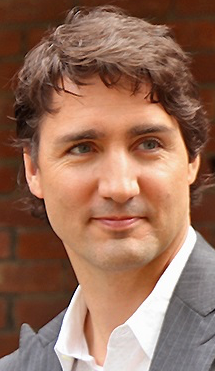
Justin Trudeau
In May 2015, former federal cabinet minister and bank vice-president Jim Prentice, a political moderate and patrician of the province’s Conservative establishment, led the 44-year long governing Progressive Conservatives to a stunning defeat by Rachel Notley‘s New Democratic Party.
These two major election defeats shattered many common beliefs about politics in Alberta and Canada. In both cases, Conservative parties were defeated by parties promising moderate progressive platforms that included tax increases and significant increases to public infrastructure investment and explicit commitments to run deficit budgets, for at least the short-term period in the case of the NDP. In Alberta, both the PC Party and NDP promised various tax increases.
On the final Sunday of the federal election campaign, Mr. Trudeau spoke to an energetic crowd of more than 2,000 supporters in the Edmonton-Mill Woods riding, home of now elected Liberal MP Amarjeet Sohi. During his speech, he explained to the crowd that if the Liberals were elected on Oct. 19, that they would raise taxes by asking Canada’s wealthiest income earners “to pay just a little bit more.”
Rachel Notley
If these words sounded familiar to anyone in the crowd, it’s because they might have heard Ms. Notley deliver nearly the exact same message five months earlier when speaking to similarly energized crowds during the provincial election. And they in both cases, the message resonated with the crowd, and on election day with voters.
This new reality will certainly come to a shock to those gathering at Preston Manning‘s institute on Oct. 22 to watch the Canadian Taxpayers Federation present former Alberta Treasurer Stockwell Day with a “TaxFighter Award” for his role in implementing Canada’s first 10 percent flat-rate personal income tax in the late 1990s and early 2000s. This is the same flat-tax that Ms. Notley’s NDP replaced with a progressive income tax system only a few short months ago.
These tax increases and other changes brought in by the NDP have not been without their critics, some more vocal and violent than others. But perhaps the biggest irony of these criticisms is that even with the tax increases brought in by Ms. Notley’s NDP, corporate and small business tax rates are still lower than they were when Mr. Day served in Premier Ralph Klein‘s cabinet.
While taxes might not have been the only issue that drove voters to the polls, it didn’t drive them away. These two elections have shattered the myth cultivated by conservative politicians, newspaper columnists, think tanks and lobby groups for decades that promising to increase taxes is political kryptonite.
As Rachel Notley proved on May 5 and Justin Trudeau showed on Oct. 19, voters in 2015 are willing to reward political leaders who present smart, sensible and responsible plans for increased taxation and government revenue.
Royalty Review panel chairperson Dave Mowat addresses a crowd of about 120 at MacEwan University in Edmonton.
Alberta’s Royalty Review panel stopped in Edmonton on Oct. 6, 2015 for the fourth and final scheduled community consultation meeting. Compared to reports from a tense meeting the previous evening in Calgary, the crowd of about 120 Edmontonians was generally polite and quite tame.
A review of Alberta’s natural resource royalty rates was a key plank in the New Democratic Party‘s election platform and a panel was appointed shortly after Rachel Notley was sworn-in as Premier earlier this year. The panel is chaired by Alberta Treasury Branches President and CEO Dave Mowat and includes Town of Beaverlodge Mayor Leona Hanson, former deputy finance minister Annette Trimbee, and respected energy economist Peter Tertzakian.
The difference in tone at the two consultation meetings is likely explained in the job losses caused by the decline in the international price of oil, which has impacted Calgary and communities in northern Alberta in larger numbers than Edmonton, which has been somewhat sheltered by a boom of large construction projects and a large public sector workforce.
Unlike other parts of the province where the new government’s policies may be met with varying levels of hostility or cynicism (and where NDP MLAs were elected with thin margins), support for Ms. Notley’s party is deep in Edmonton where 64 percent of voters cast ballots for NDP candidates.
As Mr. Mowat described it, it is critical to separate overlying vision (which is inherently emotional) and the complex technical structure (which is very complex) of Alberta’s natural resource royalties when trying to have a public discussion about the issue. And to Mr. Mowat’s credit he presented the panel’s goals and answered questions from the crowd using layman’s terms with ease.
Of course, what is actually implemented when the panel submits its report to the government will be a decision left to the politicians.
An advantage of appointing an arms-length panel like the one Mr. Mowat is chairing is that the government can pick and choose what recommendations it deems viable, both politically and economically.
The drop in the international price of oil exposed a large cleavage in the government’s finances as past governments became too comfortable and over reliant on these unstable resource revenues to fund the province’s operations budget.
Like her predecessor, Ms. Notley says she plans to fix this, albeit without significant cuts to public services as Mr. Prentice and the opposition Wildrose Party proposed.
But before Alberta’s government is in a position to decide whether the royalties we collect in exchange for allowing private corporations to extract our natural resources should be lowered, kept the same, or increased, the panel is continuing to collect feedback and submissions from Albertans.








 Despite a constant barrage of criticism from conservative critics, who claim the NDP election win was simply a fluke,