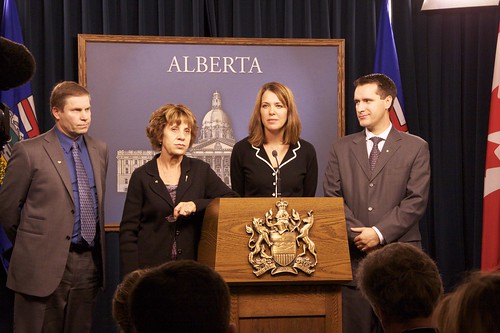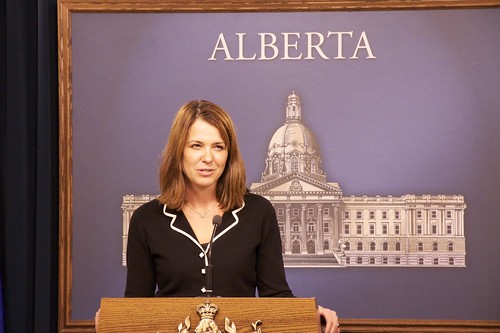
Today’s much hyped Wildrose Alliance news conference in Calgary did not live up to expectations. When announced yesterday that leader Danielle Smith would “be making an important political announcement” about the her party, the speculation was rampant. Was Preston Manning signing his endorsement pledge? Was Tom Flanagan going be their campaign manager? Was Calgary-Fish Creek MLA Heather Forsyth going to step down to let Ms. Smith to run in a by-election? Were more PC MLAs going to cross the floor?
The news turned out to be ever so underwhelming. Party president Jeff Calloway has stepped down to allow disenchanted former Ralph Klein advisor Hal Walker to enter the role. Last September, Mr. Walker let it be known to the world that he strongly disliked Premier Ed Stelmach when he widely circulated an email that oozed the with entitlement of a longtime-insder who no longer had the ear of the powerful. The underwhelming announcement sparked a some very entertaining social media satire from the political crowd on Twitter this afternoon (follow #waptopstory to see what I mean).
While the underwhelming story of Mr. Walker and the hilarious online reaction grabbed headlines, do not be convinced that nothing important happened today in Alberta politics. Here are three things that you should be paying attention to:
1)Edmonton-Rutherford PC MLA Fred Horne has announced the start of consultations for a new Alberta Health Act. The Act would seek to merge currently existing health care laws under one piece of mega-legislation. As was the case when the PCs created the Post-secondary Learning Act in 2003, the devil will be in the details of what is left in legislation and what will be moved into regulation (or just left out). In a media release, Friends of Medicare‘s David Eggen said: “The Alberta Hospitals Act, and the Alberta Health Care Insurance Act both provide core legal underpinnings for our public system. If they are repealed and not strengthened under the new legislation, it could open the doors wide for a full two-tiered, parallel private health market in the province immediately.”
2) Premier Stelmach announced on the Rutherford Show this morning that Alberta will not be holding a Senate election anytime soon. The terms of Alberta’s current three Senators-in-Waiting will expire in November 2010, but instead of holding an election to replace them, Premier Stelmach and his cabinet will decide in a closed door cabinet meeting to extend their terms. Aside from being anti-democratic, the move also undercuts the opposition parties who were preparing for a Senate election to coincide with the October municipal elections. The Wildrose Alliance began seeking Senate candidates last week and I am told that the new Alberta Party was also organizing a campaign to support a candidate this fall. At this point, Premier Stelmach might as well appoint the Senators-in-Waiting.
3) Alberta’s new Mental Health Patient Advocate is longtime PC-insider Fay Orr. Ms. Orr worked as a media relation advisor to now Senator Elaine McCoy in the early 1990s and in the 1993 election she was the PC candidate in Edmonton-Norwood (she placed third behind Liberal Andrew Beniuk and New Democrat Ray Martin). Following the election, she served as Premier Klein’s spokesperson and was appointed as managing director of the Public Affairs Bureau in 2000 (a position where current PAB Director of New Media and Internet Communications Tom Olsen described her as ‘the chief of all Alberta government talking heads‘). Soon after that, Ms. Orr served as Deputy Minister for a number of Departments, including Community Development; and Government Services, and until today, the Department of Children and Youth Services.
Alberta's Legislative Assembly Building in Edmonton.
The 2010 Spring session of the Alberta Legislature wrapped up yesterday with little fanfare. Ending a month and a half earlier than the increasingly pointless Legislative calendar had scheduled, Premier Ed Stelmach‘s PCs seemed happy to cut short one of their roughest sessions in decades. Here are some thoughts on how each of the parties fared during the 2010 Spring session:
Progressive Conservatives
Entering their 39th year in office, the Progressive Conservatives caucus appeared to list from left to right and back again during this session. The massive cuts expected in the 2010 budget never emerged (and the cuts that did take place were largely overshadowed by funding to health care and education). Their flagship bill, the Competitiveness Act, is already becoming largely forgotten in the minds of most political watchers and did not have the public splash impact that was likely intended.
Premier Ed Stelmach speaking to students and staff at the University of Alberta.
Their political machinery is still well-financed, but the PC Party leadership appears disconnected from mainstream Albertans. Premier Stelmach’s weak public speaking skills were crutched by some of the cabinet ministers who were shuffled into new positions in February and have made an impact this Spring. Most notably, Health Minister Gene Zwozdesky, Labour Minister Thomas Lukaszuk, Finance Minister Ted Morton, Housing Minister Jonathan Denis, and Solicitor General Municipal Affairs Minister Hector Goudreau have performed fairly well in their new roles. In the Health Care file, Minister Zwozdesky appears to have spent much of the past three months travelling the province attempting to extinguish the fires set by his predecessor (now -Energy Minister Ron Liepert). While his style has brought a much friendlier tone to his position, there are still remains unanswered questions around issues ranging from seniors’ pharmacare to the future of Alberta Hospital Edmonton.
Finance Minister Ted Morton delivered his first budget in March 2010.
As criticisms have increased from outside the Legislature, it appears that a few PC backbenchers are increasingly unwilling to read the puff-ball questions that they regularly line up for. Whitecourt-Ste. Anne MLA George VanderBurg, Lesser Slave Lake MLA Pearl Calahasen, and Grande Prairie-Wapiti MLA Wayne Drysdale have asked some pretty tough questions and have noticeably got under the skin of some cabinet ministers during Question Period.
Premier Stelmach and his cabinet ministers will undertake a province-wide tour over the summer to talk with Albertans (and try to win back the hearts and minds of PC supporters who have flocked to the Wildrose Alliance). The optimist in me hopes that the tour will actually be effective in reconnecting our elected government officials with Albertans.
Liberal leader David Swann and MLAs Bridget Pastoor, Laurie Blakeman, Kevin Taft, Hugh MacDonald, Kent Hehr, and Harry Chase.
Liberals
With the exception of Health critic Kevin Taft and Calgary International Airport-tunnel advocate Darshan Kang, the Official Opposition Liberals struggled to focus during this session. David Swann‘s rag-tag Liberal caucus gained some attention after releasing a new oil and gas policy, but have had a difficult time finding a role in the new and increasingly dominant political narrative being developed between the PCs and the Wildrose Alliance.
The very public departure of Calgary-Currie MLA Dave Taylor and his verbal lashing of Dr. Swann in the media seemed to be the most memorable moment for the Liberals during this session, though internally, they are probably better off without Mr. Taylor. The Liberals won a reprieve from negative attention when a motion by backbench PC MLA Verlyn Olson temporarily removed the independence of Public Accounts Committee chairman Hugh MacDonald. While I believe Dr. Swann’s performance actually improved after Mr. Taylor’s departure, similar to their federal counterparts, the provincial Liberals biggest weakness is their focus on daily tactics, rather than long-term strategy to form government.
Danielle Smith with Wildrose Alliance MLAs Paul Hinman, Heather Forsyth, and Rob Anderson.
Wildrose Alliance
With the addition of former PC MLAs Rob Anderson and Heather Forsyth, the WRA caucus was boosted to third-party status for the first time. Ms. Forsyth’s Mandatory Reporting of Child Pornography bill was passed on third reading (I cannot remember any time that an opposition MLAs private members bill was passed into legislation). The Wildrose Alliance was faced with the challenge of not becoming the NDP of the right and have been strategic in what issues they chose to focus on (ie: opposing the centralization of regional health authorities into Alberta Health Services).
With three MLAs in the Assembly, seatless leader Danielle Smith has spent the majority of her time during this session criss-crossing the province, speaking to town hall meetings, trade shows, chambers of commerce, and anyone interested in meeting with the newly anointed Dauphine of Alberta politics (a very smart decision in my mind).
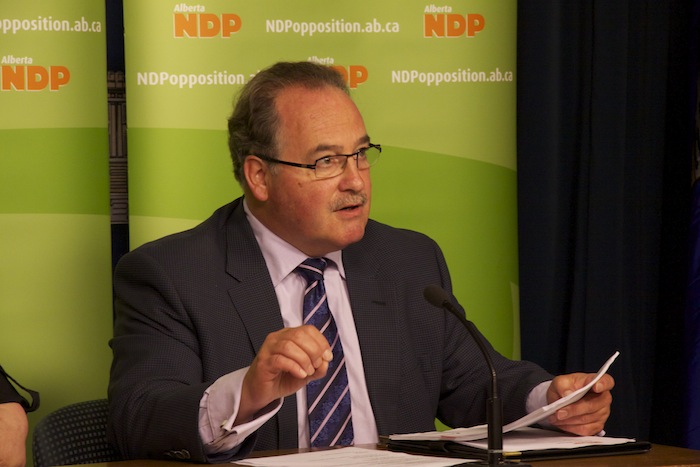
NDP MLA Brian Mason in a media scrum at the Alberta Legislature.
New Democrats
The NDP caucus of Brian Mason and Rachel Notley did what they do well this session: get media attention. Rather than striking out on their own when their position in the Question Period line-up was in jeopardy, they joined with the Liberals and Wildrose Alliance at the press gallery podium to present a united front against this change. On the policy front, the NDP released a report on Health Care that was generated after a series of town hall meetings.
Outside the Legislature, the NDP appear to be stalled in the polls and have not been able to capitalize on the destabilization inside the Liberal Party. At their 2009 convention, Nova Scotia NDP organizer Matt Hebbadvised his Alberta cousins to build a bigger tent of supporters and to act like a party of government by taking a pragmatic and constructive approach to politics. “Act like a party of government, don’t talk about it,” was Mr. Hebb’s message. Judging by the daily outrage and ankle bitting during Question Period, it does not appear that the two MLAs have heeded Mr. Hebb’s advice.
Independent MLAs now include Guy Boutilier and Dave Taylor.
Independents
Independent MLAs Guy Boutilier and Dave Taylor now share the lonely northwest corner of the Assembly floor. It was suspected that Mr. Boutilier might join the Wildrose Alliance caucus (his 2008 campaign manager has joined the WRA), but he may be too much of a wildcard for a party that is riding high in the polls and posturing to form the next government. More recently, there have been rumors floating that Mr. Taylor would like to acquire the leadership of the newly reorganized Alberta Party and reshape it into his own image (knowing the people involved in the Alberta Party, this might not be a welcoming prospect).
Floor-crossings
Since the 2008 election, five of 83 MLAs have forced the changing of seating arrangements on the Assembly floor. There has not been this much movement across the Assembly floor between elections since the early 1990s, which saw some significant Liberal by-election victories, a New Democrat cross to the PCs, a PC leave to sit as an Independent, and a handful of right-leaning Liberals cross to the PCs. It is also the first time since 1989 that an opposition party other than the Liberals or NDP have had more than one MLA in the Assembly (the Representative Party elected two former Social Credit MLAs in 1986).
Press Gallery
This was the final session for long-time Canadian Press reporter Jim MacDonald, who will be retiring from his role in May. After 27 years working for Canadian Press, Mr. MacDonald has become an institution in the Press Gallery. During my time as a spokesperson for the Council of Alberta University Students from 2006 to 2007, Mr. MacDonald was always the most nerve-racking reporter in a media scrum – always asking the toughest questions and not taking spin for an answer. He will be missed.
On a final note, I feel the need to recognize Calgary Herald columnist Don Braid, who is normally a very good columnist, but during this spring session has written some excellent columns about politics in Alberta.
– David Akin recently sat down with Liberal Senator Tommy Banks for a chat on Senate reform. – Alberta has held Senate elections in 1989, 1998, and 2004, and is expected to hold a Senate election in the next two years to fill upcoming vacancies. Senator-in-Waiting Link Byfield has declared his intentions to seek the Wildrose Alliance nomination. – Alberta will be getting five new federal ridings if new legislation is passed in Ottawa. – The provincial Electoral Boundaries Commission will be starting their second round of public hearings on April 12 in Calgary. – After originally being lukewarm to the idea of an urban riding for Grande Prairie as proposed in the Boundaries Commission’s interim report, City Councillors have decided to support the two existing ‘rurban’ ridings of Grande Prairie-Smoky and Grande Prairie-Wapiti. – Alberta Health Services CEO Dr. Stephen Duckett was given failing grades from employees and physicians this week. Friends of Medicare executive director David Eggen told the Edmonton Journal that the survey points to the need for new leadership: “To make a fresh start, I think it’s important to make significant changes in senior leadership. This is a back-to-Australia kind of performance indicator.” – Advanced Education Minister Doug Horner caved to the wishes of the University Administrations by allowing them to increase their base tuition rates beyond what is currently allowed under Alberta’s tuition policy for six programs. I wrote some background on the Universities quest for tuition hikes in November 2009. – Premier Ed Stelmach will be speaking at the University of Alberta tomorrow at an event hosted by the campus Conservative club. The same club hosted an event with Wildrose Alliance leader Danielle Smith last month. – From Capital Notebook, Alberta Sustainable Resource Development paid $33,963 to a company called Borat High Five Consulting Ltd. between April 2008 and October 2009. This gives me a good excuse to post my favourite Borat clip…
They may have dropped to the fourth largest party in the Legislative Assembly in 2010, but the NDP are the first out of the starting gate to nominate a candidate for the 2012 election. The Edmonton-Beverly-Clareview NDP have scheduled their nomination for May 5, 2010. As far as this blogger knows, local teacher and 2008 Edmonton-Centre candidate Deron Bilous is the only candidate seeking the nomination. The constituency was represented by NDP MLA Ray Martin from 2004 until his narrow defeat to Tory Tony Vandermeer in 2008. Under the interim proposed boundary changes for 2012, the new Edmonton-Clareview constituency would reduce Mr. Vandermeer’s 2008 margin of victory down to 101 votes. With recent polls looking quite different than those of 2008, past results could mean very little in two years.
Word has it that a recent shake up in the NDP was not limited to their departing Executive Director. Some recent turnover on the board of executive officers has introduced some fresh blood onto the tiny party’s central bureau (since no table officers are listed on the NDP website, it is left to this kind of speculation). While they are reported to have raised $681,000 in 2009, insider sources have told me that slower economic times have contributed to a decline in individual donations in 2010, making staff layoffs likely.
Not too far behind in their search for candidates is the Liberal Party, who I have been told are hoping to nominate candidates in Edmonton-Decore, Edmonton-Glenora, Edmonton-McClung, Edmonton-Mill Woods, and Edmonton-Rutherford by Fall 2010. The Liberals are reported to have raised $768,000 in 2009, but are struggling to even hold their support in the polls, a problem that has some Liberals talking about a palace coup.
The Liberals may also be looking for a candidate to run in an upcoming by-election if rumors that one of two Calgary MLAs run for Mayor this Fall. A growing number of Liberals in Calgary are seriously talking about supporting a Mayoral bid by popular Calgary-Buffalo MLA Kent Hehr. One Liberal told me that Mr. Hehr “is seriously considering running for Mayor, and is currently arranging lunches with former Bronco heavy weights.” A by-election in Calgary-Buffalo would be an ideal opening for a new party with a potential candidate who has extensive experience organizing a winning election in that progressive downtown constituency.
In his most recent blog post and column in the Saint City News, David Climenhaga (aka Perfesser Dave) pointed out five main challenges that the new Alberta Party faces in becoming relevant in the 2012 election. It is a good list and these challenges do not face the new Alberta Party alone. Mr. Climenhaga is also accurate in describing the challenges facing the other opposition parties in Alberta.
For all the talk of vote-splitting among the opposition parties, the political field is really not that crowded. In 2008, over 60% of Albertans stayed away from the polls, which signals that Albertans are hardly overflowing the polling stations to split votes. Even the electoral equations provided by the Democratic Renewal Project show that a merger of Liberal and NDP votes in recent elections would only create a moderately-sized opposition. It is true that the new Alberta Party leader, Edwin Erickson, is not high profile and is unlikely to be the next Premier of Alberta, but once you step out of the political echo chamber or away from the Dome, all the parties become irrelevant. For all their hard work, show a picture of David Swann or Brian Mason to a random person on the street, and you will likely get a puzzled look.
Voter Turnout versus Eligible Voters (Alberta 1975-2008) Total Vote: Party Breakdown (Alberta 1971-2008)
Mr. Climenhaga claimed that the Alberta Party is a group of “self-important yuppified professionals who would like to go straight into power.” I have met with some of the organizers of the new Alberta Party and some of them are even good friends of mine. I can attest that while they are ambitious (and perhaps a bit naive), they are not what Mr. Climenhaga describes.
I have spoken with many Liberals and New Democrats who remain befuddled as to why anyone would attempt to start something new, rather than join the ranks of the already assembled politicos. On many levels, the people behind the new party are looking for a cultural shift in Alberta politics. Although they may agree with some of the policies promoted by the traditional political parties, they see the culture of these traditional parties as part of the problem. The Alberta Party organizers appear to be fully aware of the risks of failure and that they are stepping beyond the political comfort zones of many people already involved in other parties.
I know many jilted Liberals and jolted New Democrats who have resolved to bask in the glory days of Pierre Trudeau or Laurence Decore and Tommy Douglas or Grant Notley. I somewhat admire their political stamina and strength (or madness) in the face of adversity, but I also completely understand why a group of young politically ambitious reformers would want to chart their own course. Joining a group that has become content with spending decades in the relative obscurity of the opposition benches is hardly attractive if you are serious about changing government policy.
Building a new political party from the ground up is hard work. The current leadership of the Liberals and New Democrats inherited a base of support and network that has existed for decades. Considering that the party was formed only eight years ago, the growth of the Wildrose Alliance is impressive (recognizing that it did have roots in the mini-resurgence of the Randy Thorsteinson-led Social Credit Party in 1997). It will be interesting to see whether the people involved with the new Alberta Party can actually build something different.
Contrary to what you may sometimes read on this blog, I do not always enjoying pointing out the flaws of Alberta’s opposition parties. I wish they would do better. I wish for opposition parties that were not uncompetitive in half the constituencies represented in the Assembly. I wish for a competitive election in 2012 that will attract Albertans back to the ballot booths. If the current polling trends continue, it looks like it may be competitive, but it remains to be seen who will actually be the contenders.
– New polls from Angus-Reid (Wildrose: 42%, PC: 27%, Liberal: 19%, NDP 9%, Other 3%) and Environics (PC: 34%, Wildrose: 30%, Liberal: 23%, NDP 10%). Calgary Grit has more on these polls. – According to the PC Party website, Patricia Godkin has replaced Jim Campbell as Executive Director (Mr. Campbell recently joined Cenovus Energy as their Vice-President Government Relations and Corporate Accountability). Ms. Godkin previously served as Director of Finance and was the acting Executive Director in 2007 after the resignation of Peter Elzinga. While holding the interim position in 2007, Ms. Godkin faced a challenge from outgoing PC Youth President David McColl, who published an op-ed in the Calgary Herald predicting that “PC Alberta will continue its slow death march, to the beat of a rural drum and tired, stale policies.” – Vitor Marciano is expected to become the new Executive Director of the Wildrose Alliance. Mr. Marciano recently stepped down from his position on the National Council of the Conservative Party of Canada and served as Campaign Manager for Edmonton-Centre MP Laurie Hawn in 2004 and 2006, and for Nunavut MP Leona Aglukkaq in 2008. In 2006, he supported former Edmonton-McClung PC MLA Mark Norris‘ bid for the PC leadership. This is the second prominent Edmonton conservative to join Danielle Smith‘s staff in recent months. In February, former PC Party VP Outreach and 2004 Edmonton-Strathcona candidate Shannon Stubbsbecame Executive Assistant to Ms. Smith. – Former Edmonton-Meadowlark Liberal MLA Maurice Tougas has written a piece in this month’s Alberta Views Magazine that focuses on Danielle Smith’s time on the Calgary Board of Education from 1998 to 1999. Mr. Tougas’ reliance on comments from former Trustee Jennifer Pollock provided a fairly one-sided perspective of the issue. You can read my four part series Smith v. Board of Educationpart 1, part 2, part 3, and part 4. – The Alberta Party has posted an update on The Big Listen. – Tyler Shandro has raised some interesting questions about the interim report of Alberta’s Electoral Boundaries Commission. – Three years after the a committee of top-tier economic experts recommended increasing the royalty rates collected by the provincial government, Premier Ed Stelmach has cut back the amount of resource royalties that are collected. The Pembina Institute responded by pointing out that “Albertans, the owners of the province’s oil and gas resources, were completely left out of the process of reviewing Alberta’s royalty rates.”
As far as international events go, it is hard to beat the size of the Olympic Games. Over 80 countries from across the world will be participating in the Winter sports event that kicked off in Vancouver last night.
With hundreds of millions of dollars likely being spent on wining and dining, it might feel like a drop in the bucket for the Province of Alberta to spend nearly $15 million dollars to promote the province to attendees, including the sponsorship of six Rocky Mountaineer train cars and the Alberta Pavilion.
Unparalleled comfort in the premier business networking venue at the Games.
The Rocky Mountaineer expense is billed by the Government of Alberta website as an opportunity to “provide the premier business networking venue at the Games” for only $499 for a round-trip ticket from Vancouver to Whistler. Who will be networking with the elite business Olympians of the world? Premier Ed Stelmach and eleven cabinet ministers will be there to wine, dine, and “offer guests unparalleled comfort” during their stay on the Alberta train! While experiencing this luxury, most passengers on the Alberta train this week would probably have a hard time believing that Alberta is in the midst of “tough economic times” and that just four short days ago, these 12 elected officials tabled a provincial budget that included the largest deficit in Alberta’s history.
Sending Premier Stelmach, Tourism Minister Cindy Ady, and Culture Minister Lindsay Blackett makes sense, but what of the other nine cabinet ministers? Are Albertans well served by covering the costs of sending eleven cabinet ministers to the Vancouver Winter Olympic Games? What business could Agriculture Minister Jack Hayden, Justice Minister Alison Redford, Housing Minister Jonathan Denis, or Finance Minster Ted Morton have at the Winter Olympic Games? I am sure the “unparalleled comfort” of the posh train cars will live up to its reputation, but is it really necessary to have half of Premier Stelmach’s cabinet on site?
As Graham Thomson pointed out in his Edmonton Journal column this morning, other PC MLAs will joining them, but “nobody in government seems to know exactly how many backbenchers are going.” I do not oppose Alberta having a presence at these games, but modesty is virtue our elected officials should not forget.
Would Alberta’s cabinet ministers travel time be better spent flying elsewhere? Perhaps Intergovernmental Affairs Minister Iris Evans‘first mission to Washington DC in her new role this week would be more effective if she had some backup from her colleagues? Alas, no one wants to fly to DC during a winter blizzard!
Other Provinces?
When compared to our provincial neighbours, Alberta’s elected officials look like the rich kids whose parents picked up the annual tab for their spring break in Mexico. The Province of Saskatchewan is spending $4.1 million on their pavilion and Premier Brad Wall has committed to keep their political presence low at the Winter Games. Premier Wall will be joined by Tourism Minister Dustin Duncan and Enterprise Minister Ken Cheveldayoff. The Province of Manitoba is spending $6.4 million and sending a two-person team of Premier Greg Selinger and Aboriginal Affairs Minister Eric Robinson.
“I would rather have seen any kind of travel budget being spent in Alberta,” Smith said. “They’re communicating to the wrong people.”
When was the last time Alberta had a Premier who spent this kind of money to sincerely communicate with Albertans? I am not talking about fancy videos commercials, visits to the Rutherford Show, or hiring expensive advertising companies to brand new messages. I am talking about actually travelling across this province and holding open town hall meetings outside of a highly managed and artificial election environment.
This feeds the perception that our elected officials are only accessible to those with political power or business interests. When was the last time Alberta had a Premier who allowed himself to be publicly accessible to any Albertan, regardless of political persuasion or income-bracket? When was the last time a Premier of Alberta hopped aboard a train filled with ordinary people of Alberta?
Alberta’s 2010 provincial budget, set to be released in 2 hours, is already making headlines. While Finance Minister Ted Morton has framed it as a “give up a little” budget, an Edmonton blogger almost caught a sneak peak of the budget documents:
For the second year in a row, Premier Ed Stelmach‘s government will run a budget deficit, this time estimated at $4.7 billion and total spending is estimated to be a record $38.7 billion. The PCs are counting on increased oilsands production to boost them out of the cycle of deficits before the 2012 election (I am sure they hope it will boost their party in the polls as well). Compared to the intense cut throat budget that many Albertans expected, this budget dealt a mixture of increases and decreases across the government. Overall, fourteen departments will be on the bitter end of cuts and eight departments will be seeing increases to their budgets in 2010.
With a 17% increase to its operating budget, Alberta’s health care system is the biggest beneficiary of this budget. Alberta Health Services will also receive a one-time infusion of $759 million for debt repayment (perhaps to the Royal Bank…). Since the 2008 election, health care has been one of the toughest files for the PCs, who have felt public pressure from across the province after the dissolution of the regional health authorities and bottom-line based system reforms. If replacing the blunt and controversial Minister Ron Liepert with the more gentler Minister Gene Zwozdesky was a first major step in the government’s health care public relations shift, this budget increase and debt repayment could be the second most substantial. The challenge will be to turn these budget increases into positive changes on the ground level.
The Municipal Affairs and Infrastructure budgets were also substantially increased, due to what I imagine to be the result of strong lobbying efforts by the AUMA and AAMDC.
Perhaps a statement on the level of political capital that Culture & Community Spirit Minister Lindsay Blackett has left after the Bill 44 controversy, that Ministry will reduce operating expenses by 15%. Among other cuts, Advanced Education & Technology will face a 6% budget decrease to program expenses after being on the better end of budget increases over the past five years. Changes to the student finance section of the Advanced Education budget include decreases to student scholarships by $3 million and grants by $51 million, and increases to student loans by (ie: increased student debt).
When Liberal leader David Swanncriticized the budget and the PCs for not “responsibly managing the public purse,” it may have sounded like a predictable opposition response, but it raises some important points about recent government budgets and the provincial government’s large dependance on natural resource revenues for income. Alberta is a resource-based economy, but the budget turbulence in recent years highlights why Albertans should be concerned about the lack of economic diversification in our province.
Wildrose Alliance leader Danielle Smith (who will be releasing her party’s alternative budget tomorrow) criticized the budget and Finance & Enterprise Minister Ted Morton‘s credentials as a true fiscal conservative, but this budget is just another step in Minister Morton’s public moderation. Since the 2006 PC leadership race, Minister Morton has transformed his public image as the great right-wingfire-wall lighter to a competent and softer governor. This budget includes both cuts and increases, striking a kind of political balance. This was Minister Morton’s first budget and if he is able to survive his tenure in the Finance portfolio, he could be well positioned to be the leading candidate in the next PC leadership race.
Long-time Government spokesperson Jerry BellikkareplacesTom Olsen as spokesman for Premier Ed Stelmach (Olsen now becomes Alberta’s Olympic Spokesperson in Vancouver). Former MLA Jim Gurnett replaces Jerry Toews as Chief of Staff at the NDP caucus. Instead of laughing atsatire, PAB blogger David Sands leaves Twitter altogether. Taking a more open approach to the media than his predecessor, Health & Wellness Minister Gene Zwozdesky‘s cell phone number is now showing up on Government media releases.
Not your father’s NEP
With new Energy Minister Ron Liepert‘s mandate to reclaim PC dominance over energy sector support from Danielle Smith‘s Wildrose Alliance, the Liberals do not want to be left out. Calgary-Currie MLA Dave Taylor is leading his party’s 180-degree policy change from their previous position that resource royalties are too low. On the policy change, Mount Royal University Professor Bruce Foster told FFWD:
“It seems as if the Liberals didn’t take the lead on this or didn’t distinguish themselves and now they’re playing catch-up,” he says.
Former deputy leader of the now-defunct Alberta Green PartyEdwin Erickson is now leader of the Alberta Party. In the last election, Erickson placed second with 19% of the vote against Tory Diana McQueen in Drayton Valley-Calmar. Erickson and Joe Anglin led the fight against Bill 50 and Erickson had publicly mused about creating the Progress Party of Alberta. The Alberta Party has existed in a number of forms since 1986, but has never been competitive (highest support: leader Mark Waters earned 1,200 votes in Calgary-Currie in 1993).
Ralph University
Olds College has re-named their Community Learning Centre after former Premier Ralph Klein andnot everyone in Olds is enamoured with the decision.
The defection of Progressive Conservative Party Vice-President Policy and Resolution Shayne Saskiw to the Wildrose Alliance has raised questions about how much influence do PC Party members have on the actual policy that a government implements? According to Saskiw, not much.
“I was able to give their opinions on policy to the government, but the government was not acting on their advice.”
This is not a surprise, nor a new criticism of how responsive governments are to ordinary citizens – engaged or otherwise. Does anyone remember Premier Ed Stelmach campaigning on the PC Party platform of dissolving the regional health authorities and centralizing control into the largest employer in the province? It was not mentioned in the “Change that Works for Albertans” (PDF) document, nor do know of any PC candidates who campaigned on this policy position. Perhaps after nearly 40 years in government, the upper echelons of power at the Legislature feel that the election process is simply a formality. Perhaps the PC Party interpreted the 52% support they received in the election that recorded the lowest voter turnout in Alberta history equal a blank check mandate?
It would be wrong to suggest that policy does not matter, because it does. It is important to recognize that in many cases, the majority of challenges that a government will deal with during a term in office will be reactive. In these cases, it is important to recognize leadership and which elected official or officials will offer the kind of leadership that will be best suited to dealing with reactive situations. For example, mainstream business and economic forecasters were predicting smooth sailing ahead during the 2008 election when politicians were practically promising a jet-pack for every citizen. In 2010, the economic outlook is quite a bit more modest (though we are fairing better than our American neighbors).
During my time working with the Liberal Party until 2007, I remember it being normal for policies to be generated from the Official Opposition Caucus offices, rather than the party policy committees. Perhaps this is one of the problems with the traditional political parties in Alberta. They do consult with stakeholders and rely on well-educated researchers and analyst, but in the end, new policies became more about marketing and messaging instead of listening and generating a party membership driven policy apparatus.
This leads me back to Ms. Smith and a statement she made about Wildrose Alliance policy:
“Our party does not take a position on divisive social issues. We prefer to focus on those areas where we agree.”
This statement reflects a smart (and so far successful) strategy of positioning the Wildrose Alliance as the moderate conservative/conservatively moderate anti-establishment party in Alberta politics. I have been told that many of Ms. Smith’s financial backers in Calgary’s oil and gas sector would like to turn the page on the more hard social conservative views that the party has advocated in the past. Refusing to talk about divisive social issues is a smart political tactic, given the positions that her party has taken in the past.
During the 2004 election, the Alliance led by Randy Thorsteinson called for province-wide votes on abortion and same-sex marriage. There have also been questions about the influence that conservative members of the Church of Jesus Christ of Latter-day Saints have had on the development of Alliance policies.
This said, an elected official’s personal or religious views on social issues do not necessarily result in major government policy changes. During the 2001 election, Vegreville-Viking MLA Ed Stelmach responded to a questionnaire from LifeSiteNews in which he declared his opposition to abortion under any circumstances (his response to the 2004 election questionnaire is not published online). This was his position nine years ago and may continue to be his position today, but since becoming Premier three years ago, Stelmach has hardly been a champion in the fight against allowing women the choice to access abortions. Like Premier Stelmach’s, it would be extremely difficult for Ms. Smith’s party to enter a divisive debate on social issues and continue to hold their current mainstream support in the polls.
Tempering the more extreme elements in her party is going to be one of Ms. Smith’s largest challenges. In 2009, nearly 2,000 Wildrose Alliance members voted for social conservative candidate Mark Dyrholm. What happens if these “grassroots” dispute Ms. Smith’s position? Is Ms. Smith willing to cut them loose in order to avoid the damage of being labeled as the “scary conservative party?” If it reaches the point where push comes to shove, maybe policy will matter.
Since stepping into her new role as leader of the Wildrose Alliance, Danielle Smith has taken on more of a celebrity role than that of the leader of a party with 3 seats in a 83 seat Legislative Assembly. Ms. Smith is impressively politically savvy, and judging by the attention she has been receiving from the media, you would have a hard time believing that she is not the elected leader of Alberta’s Official Opposition.
Little of the incredible media attention received by Ms. Smith has focused on her party’s policy or even her political stances. I do not believe that I have read any reporter or columnist seriously dig into Ms. Smith’s only past-experience as an elected official on the Calgary Board of Education which began in 1998 and ended when the Minister of Learning dissolved the board in 1999 (which I covered in part 1, part 2, part 3, and part 4). The by-election victory in Calgary-Glenmore, the floor-crossings of PC MLAs Heather Forsyth and Rob Anderson, and rise in the pollsare convincing (and exciting) political coups in the context of an otherwise boring political environment. At least in the short-term, Ms. Smith has definitely changed the game.
Ms. Smith has faced some criticism for her confusing views on climate change and her former Chief of Staff felt the repercussions of an uneasy Twitter finger, but she has easily deflected questions about hard policy questions by telling the media to wait until her party’s upcoming policy conference or hiding behind the label of libertarianism.
Premier Ed Stelmach has labelled Wildrose Alliance policies as “draconian,” but in the context of his falling popularity, the Premier’s reaction smacked of desperation and political spin (however accurate his comments may have been). Even the recent cabinet shuffle was framed as a reaction to the increasing popularity of Ms. Smith’s party. The reaction of the Official Opposition Liberal Party was to launch of a YouTube video comparing Premier Stelmach and Ms. Smith to Ronald Reagan and Brian Mulroney (a strategy that top minds are still attempting to decrypt).
An American conservative blogger recently held Ms. Smith up as “a guiding northern star for the building anti-establishment movement in the GOP” and suggested that her “delivery reminds me of Sarah Palin when she’s at her best.” I recognize that these are the words of one individual with a website, but it is not the first time that I have heard conservatives speak of Ms. Smith in that manner.
The Ontario media appears to have warmly embraced Ms. Smith by lobbing softball questions and accepting vague answers. During a stint as a guest panelist on CTVs Question Period, Smith was asked questions about Social Credit leader Harry Strom and almost accepted as the next leader of Alberta. Her coverage on Peter Mansbridge’s One-on-One and upcoming on Rick Mercer’s Report is also unprecedented for an opposition leader in Alberta.
Amidst this flurry of media attention, nearly no additional attention is paid to the actual opposition leaders elected by Albertans in the 2008 election as David Swann and Brian Mason continue to linger stalled in the polls in the unconvincing ranks of the opposition benches. I tend to believe this is symptomatic of the antipathy felt towards to traditional political parties in Alberta. This antipathy is likely why non-traditional groups like the Wildrose Alliance, Renew Alberta, and Reboot Alberta are attracting a growing number of Albertans into their ranks, while the traditional opposition parties are barricading their gates without taking stock of the decreasing value of their guarded treasures. While some people are holding out for change within the two traditional opposition parties (or simply asking them to get their acts together!), I tend to believe that it is likely too late.
With Premier Stelmach appearing politically weak and a provincial election expected in 2012, will the guardians of establishment conservatism in Alberta sit idly while their movement is fractured between the Wildrose Alliance and the Progressive Conservative Party? With this scenario in mind, is it too far fetched to foresee a scenario in the not too distant future where Premier Ted Morton welcomes Danielle Smith as the Finance Minister in a government formed by the newly merged Conservative Party of Alberta?
UPDATE: David Climenhaga has written a response to this blog post listing the top 11 reasons he feels Albertans should not support the Wildrose Alliance . Climenhaga’s list prompted the Alberta Altruist blog to pen a response.
There has been a lot of chatter about what Premier Ed Stelmach can do to reverse the Progressive Conservatives downward spiral in recent polls. According to these recent polls, the PCs now sit at 25% province-wide and in third place behind Danielle Smith‘s Wildrose Alliance and David Swann‘s Liberals in Edmonton and Calgary. Another recent poll framed Premier Stelmach as the least popular Premier in Canada with a 14% approval rating.
Sheila Pratt has written an interesting article in today’s Edmonton Journal about the PCs current misfortune and the new groups of Albertans like Reboot Alberta and Renew Alberta that have emerged. Even Preston Manning is interested in starting something new. Luckily for Premier Stelmach, he still has two years before he has to face the electorate for a second time, but what does the Premier need to do to turn his fortunes around?
Will finally ending the disastrous reigns of Children & Youth Services Minister Janis Tarchuk and Health & Wellness Minister Ron Liepert change Premier Stelmach’s position in the polls? Will moving Education Minister Dave Hancock in the midst of the School Act Review boost their numbers? Will moving Energy Minister Mel Knight to another portfolio halt the Calgary energy sector support that is flowing towards the Wildrose Alliance? Will promoting Advanced Education Minister Doug Horner to Finance Minister improve their image? Will relocating Culture & Community Spirit Minister Lindsay Blackett bring back the PC supporters who were offended over the embarrassment of Bill 44?
Will rearranging the deck chairs change the course of the ship? It is going to take something much more meaningful than a cabinet shuffle to change PC Party fortunes. As I said during an interview with Calgary Today’s Mike Blanchard this week, one of Premier Stelmach’s greatest challenges is that his government doesn’t have a defining purpose beyond governing for governing sake, and it shows.
In his recent book, Rich Vivone accurately pointed out that when Premier Ralph Klein declared Alberta to be debt free in 2004, the PCs began to drift. Aiming to defeat the deficit and debt saved the PCs from being unseated by Laurence Decore‘s Liberals in the 1993 election and it was the defining theme in Alberta politics in the 1990s and early 2000s. In many ways, Premier Klein’s 55.4% approval in 2006 reflected the drift.
Premier Stelmach is far from an amazing orator or political strategist, but one of his greatest strengths is that he is constantly underestimated by his opponents and the media. No one expected him to defeat Jim Dinning and Ted Morton in the PC leadership race or lead his party to win a 72-seat majority in the March 2008 election. The recent polls may spell demise for the near 40-year governing PCs, but with at least another two years to create a defining purpose for governing, their political and electoral opponents would be foolish to write them off just yet.
August 14, 1999: In a complaint to the Office of the Privacy Commissioner, Calgary Board of Education (CBE) Trustee Peggy Anderson accused Judy Tilston of getting John Lovink to file a privacy complaint against her. She also publicly speculated that Tilston, Liz LoVecchio and Jennifer Pollock encouraged the filing of Lovink’s complaint to embarrass Anderson and Danielle Smith. From the Calgary Herald:
Smith and Anderson have called for Tilston’s resignation after it was learned that Tilston had leaked letters dealing with a different issue that resulted in a complaint to the privacy commissioner. Tilston had initially denied leaking the letters which resulted in a taxpayer-financed probe into the matter. The privacy commissioner said Tilston leaked the letters.
Commissioner Bob Clark is investigating a complaint by Lovink who had a $120,000 contract with the CBE for an 18-month period ending after last October’s municipal election.
Calling Lovink a “$500-a-day spin doctor”, Smith, a rookie trustee, earlier this year released Lovink’s invoices and criticized veteran trustees for spending money to boost their image. Lovink said he provided “strategic communications” when the board was trying to get more money from the provincial government.
In Saturday’s story Pollock denied encouraging Lovink to complain to the privacy commissioner but did say she had friends who asked her to encourage him but wouldn’t identify the friends. LoVecchio and Tilston denied they had anything to do with Lovink’s complaint. “I accept their word on that,” said Anderson.
August 16, 1999: After being advised by Chair Teresa Woo-Paw that the CBE had become “completely dysfunctional” due to internal bickering, Learning Minister Lyle Oberg dismissed the CBE Trustees. Woo-Paw said in a statement that the decision represented “a failure of adults to act in an adult manner.” Following the decision, LoVecchio told the Herald that “the atmosphere is so poisoned that I don’t believe this board could work together.” The CBE, which was responsible for 100,000 students, had accumulated a deficit of $55 million in 1999.
George Cornish, Calgary’s chief commissioner under Mayor Ralph Klein, was appointed as interim trustee until the results of by-elections scheduled for November 29, 1999. Angus-Reid reported that 7 in 10 Calgarians agreed with the decision to dissolve the board.
August 22, 1999: Anderson and Smith declared their intentions to seek re-election in the by-elections.
August 24, 1999: From an Edmonton Journal column by Lorne Gunter:
Within minutes of Oberg announcing his intention to dismiss the seven elected trustees and replace them with one government- appointed trustee until byelections can held, a senior staffer in his office was on the telephone to Danielle Smith and Peggy Anderson, the board’s two right-wingers, encouraging them to run again.
Oberg, the staffer explained, did not want to get rid of the pair, but his hands were tied. The School Act permits him only to fire all or none of the trustees. Oberg, it seems, wanted to purge the board’s three avowed Liberals and weak chairwoman, and in order to discard the bath water had to dispose of the baby, too.
August 30, 1999: Declining to seek re-election, Smith accepted an editorial writer position with the Calgary Herald. Nishimura told the media that she “respected the way in which she [Smith] was able to tackle the tough issues.”
September 14, 1999: Nishimura declared her intentions to seek re-election.
September 24, 1999: Herald columnist Don Martin wrote that Premier Klein’s former Chief of Staff Rod Love was exploring the possibility of running against Tilston. Love’s previous forays as a candidate included running unsuccessfully against Lee Richardson for the Calgary-Southeast Progressive Conservative nomination in 1988 and as the PC candidate in the Calgary-Buffalo by-election in 1992.
October 7, 1999: Pollock declared her intentions to not seek re-election.
November 1, 1999: At the nomination deadline, only three incumbent trustees filed papers to seek re-election: Woo-Paw, Nishimura, and Anderson. Love did not file papers to run in the by-election. 50 candidates filed nomination papers, a leap from 17 in 1998 and 27 in 1995.
November 29, 1999: Nishimura was the only incumbent Trustee re-elected. Woo-Paw was defeated by David Pickersgill and Anderson placed third in the race that saw Sharon Hester elected. Current CBE Trustees Gordon Dirks, a former Saskatchewan MLA and Cabinet Minister, and Pat Cochranewere first elected in these by-elections. Total voter turnout was 9.3%.
David Heyman,the Herald reporter who wrote many of the articles covering the CBE in 1998 and 1999, is now the Calgary Communications Manager in the Office of the Premier of Alberta.
June 22, 1999: After being forced to leave a meeting due to conflict of interest, it was decided that Liz LoVecchio, Jennifer Pollock and Judy Tilston needed to submit their legal bills to an arbitrator before they could have them paid by the Calgary Board of Education (CBE). The motion was passed unanimously by the four remaining trustees. The question for the arbitrator was whether the trustees acted as members of the board or as individuals when controversial letters written by a school board candidate were given to a reporter during last year’s election campaign. If they acted as a board, their legal fees would be covered by the CBE, but if they acted as individuals, the CBE would not cover the cost.
While leaving the meeting, Pollock declared it to be a “travesty of fairness” because “the administration and CBE Chair [Teresa Woo-Paw] would not provide legal support on an action that was taken on behalf of this board and known by the chief superintendent.” Smith said the CBE had already received a $12,300 legal bill from its own lawyer for the inquiry and wouldn’t name a trustee who also submitted an $18,000 legal bill.
July 15, 1999: Despite calls for her resignation, Tilston declared that “couldn’t care less” about the demands for her resignation by Danielle Smith and Peggy Anderson. Tilston told the Calgary Herald that she had been wrongly blamed for breaching provincial privacy laws by ordering former CBE trustee candidate Andrew Koeppen letters released to the media.
The matter was then investigated by Alberta’s Privacy Commissioner. A hearing was scheduled for later that year to determine if the letters contained personal information. If so, Tilston and other trustees could have been liable for a fine up to $10,000, and a lawsuit.
July 29, 1999: After being told by CBE administrators that it would be too expensive to host on the CBE’s official site, Anderson and Smith launched their own website to publish board reports, discussion papers and agendas. The two trustees drew the ire of their colleagues after not informing them of their decision to launch the website.
August 8, 1999: A collection of notes are discovered in a CBE trash bin and are published by the Alberta Report, the Herald, and the National Post:
– One of the notes is addressed to “Lizard,” and another writes Ms. Tilston’s name five times, as if someone was practising writing it.
– One note refers to Ms. Woo-Paw as a despot, and a second one says “TWP absolutely nauseates me.”
– Another note accuses “DS”– an apparent reference to Ms. Smith — of having “crappy hair,” while a fourth note has the authors conspiring to recruit people to oppose Ms. Smith politically. “I have to find a constituent to write a formal letter of complaint,” the short missive says. “Any ideas?”
– A note in response includes the names of two potential complainants, each of whom “lives in DS’s ward.” But the note says the pair may be too high-profile, and so it may be better to recruit “someone more obscure.”
– Saying “I’ve decided to apply for aides for DS and PA, as they appear to be slow learners.”
– Questioning whether Ms. Anderson is wearing a “mood ring,” and is “more distant and pissed-off than usual.”
– Describing Ms. Pollock as looking like she has “stitches or a scar” on her face.
– Asking where “the FCD (an apparent reference to Ms. Woo-Paw) got her suit — it sure is ugly!”
– Saying “the FCD is being decidedly pissy this evening, as is her sidekick.”
– Asking “what’s trustee-half-a- brain is doing?”
Woo-Paw reminded trustees to abide by their code of conduct, which prohibited malicious behaviour. Smith told the Herald that she had seen the notes and believed the hand-writing was Tilston’s and LoVecchio’s. “Judy and Liz pass notes back and forth all the time” at board meetings. It’s a shame people are so petty when there is such important work to be done on the school board.”
August 9, 1999: Reported in the Herald:
The Calgary Board of Education voted Monday to punish two members who’ve been writing nasty notes about their colleagues at public meetings.
But only one of the two has admitted responsibility, and neither has apologized to her colleagues, board chairwoman Teresa Woo-Paw said after the board met privately.
Woo-Paw said her colleagues voted to have her write letters of reprimand later this week to the trustees, telling them their behaviour breached the board’s code of ethics.
Although Woo-Paw refused to name the two trustees, one acknowledged her role last week.
“The only way somebody could’ve got hold of these (notes) was either they ruffled through garbage and pieced them back together, or they stole them from me,” Liz LoVecchio said.
All the notes are in two handwriting styles that some board members have said match LoVecchio’s and trustee Judy Tilston’s. Tilston has refused to comment.