– David Akin recently sat down with Liberal Senator Tommy Banks for a chat on Senate reform.
– Alberta has held Senate elections in 1989, 1998, and 2004, and is expected to hold a Senate election in the next two years to fill upcoming vacancies. Senator-in-Waiting Link Byfield has declared his intentions to seek the Wildrose Alliance nomination.
– Alberta will be getting five new federal ridings if new legislation is passed in Ottawa.
– The provincial Electoral Boundaries Commission will be starting their second round of public hearings on April 12 in Calgary.
– After originally being lukewarm to the idea of an urban riding for Grande Prairie as proposed in the Boundaries Commission’s interim report, City Councillors have decided to support the two existing ‘rurban’ ridings of Grande Prairie-Smoky and Grande Prairie-Wapiti.
– Alberta Health Services CEO Dr. Stephen Duckett was given failing grades from employees and physicians this week. Friends of Medicare executive director David Eggen told the Edmonton Journal that the survey points to the need for new leadership: “To make a fresh start, I think it’s important to make significant changes in senior leadership. This is a back-to-Australia kind of performance indicator.”
– Advanced Education Minister Doug Horner caved to the wishes of the University Administrations by allowing them to increase their base tuition rates beyond what is currently allowed under Alberta’s tuition policy for six programs. I wrote some background on the Universities quest for tuition hikes in November 2009.
– Premier Ed Stelmach will be speaking at the University of Alberta tomorrow at an event hosted by the campus Conservative club. The same club hosted an event with Wildrose Alliance leader Danielle Smith last month.
– From Capital Notebook, Alberta Sustainable Resource Development paid $33,963 to a company called Borat High Five Consulting Ltd. between April 2008 and October 2009. This gives me a good excuse to post my favourite Borat clip…
Year: 2010

Categories
hot air.
With recent political contribution disclosures showing the PC Party holding ground, maybe the Wildrose Alliance groundswell in Calgary is just a bunch of hot air…
Categories
from the earth to the moon.
This weekend some friends and I began watching the mini-series From the Earth to the Moon. The HBO mini-series ran from April to May 1998 and focused on the Apollo program that led to the first Moon landing on July 20, 1969.
Over forty years later on March 30, 2010, CERNs Large Hadron Collider successfully collided beams of protons at the highest energy levels ever seen. While these technological advancements may not be directly (or indirectly linked), it is a perfect example of the leaps that have been made since.
It is likely that within my lifetime, there will be technological changes that could completely redefine how our society functions. In a field close to the hearts and paycheques of Albertans, how would the province of Alberta if a giant technological leap occurred in the field of energy? Would Alberta be prepared for the result of new energy technology that could decrease the world’s dependence on oil and natural gas?
What would Alberta look like if this happened in 2010? What would happen to the oilsands and the billions of dollars that have been spent building the infrastructure around them? According to local futurist Kevin Kuchinski, “Alberta’s oil belt will be the new rust belt.”
In 1905, Alberta’s provincial boundaries were defined with railway access in mind. What will our next boundaries be and what will define them?
I have been meaning to write about this for a couple of weeks. The Edmonton International Airport recently launched a semi-guerilla marketing campaign to convince Edmontonians and northern Albertans to “Stop the Calgary Habit.” The campaign is geared towards stopping travellers from flying on departing flights from the Calgary International Airport (where there are many more connecting flights) and depart from the Edmonton International.
In recent conversations with some friends, the question was raised: “Why would we want to compare ourselves to Calgary?“
A big deal was made in the mid-1990s by political groups like The Edmonton Stickmen and politicians like Mayor Bill Smith about the lack of corporate headquarters in Edmonton and businesses being lost to Calgary. The hockey rivalry does not interest me and now that Premier Ralph Klein has retired to become a gameshow host, the political rivalry feels practically inexistent and pointless. From the amount of cranes in its downtown skyline, it appears that Calgary is continuing its dream of becoming the Toronto of the West. As a proud Edmontonian, I say: “they can have it.”
As Calgary charts its own course, Edmonton is charting one that will be shaped by its own unique identity, strengths, and opportunities. Outsiders might be shocked to learn about the vibrant and engaged communities that our city has (last week’s GalaGuru event at the packed Latitude 53 Studio was a great example of these vibrant communities). I used to believe that I would need to move to bigger cities like Vancouver or Toronto (or even Calgary) in order to find a great job and quality of life, but I share the perspective of a growing number of younger city-dwellers who believe that Edmonton is a place to be. There is a new confidence in a younger generation that perhaps was not there when the Edmonton-Calgary rivalry was at its hottest twenty or thirty years ago.
When I fly to other cities, I fly from the Edmonton International Airport, not because of loyalty or rivalry, but because it is the closest. If Calgary International Airport is attracting important international flights and airlines, I say: “good for them. It is good for Calgary, good for Alberta, and good for Edmonton.”
Categories
rainbows and unicorns.
It probably would have been more effective if they had kept their up the tongue-in-cheek theme, but before it devolves into a fairly predicable attack ad, this April Fools Day joke from the US Republican Senate Committee is pretty entertaining.
EAVB_BXFWQIGSDB
They may have dropped to the fourth largest party in the Legislative Assembly in 2010, but the NDP are the first out of the starting gate to nominate a candidate for the 2012 election. The Edmonton-Beverly-Clareview NDP have scheduled their nomination for May 5, 2010. As far as this blogger knows, local teacher and 2008 Edmonton-Centre candidate Deron Bilous is the only candidate seeking the nomination. The constituency was represented by NDP MLA Ray Martin from 2004 until his narrow defeat to Tory Tony Vandermeer in 2008. Under the interim proposed boundary changes for 2012, the new Edmonton-Clareview constituency would reduce Mr. Vandermeer’s 2008 margin of victory down to 101 votes. With recent polls looking quite different than those of 2008, past results could mean very little in two years.
Word has it that a recent shake up in the NDP was not limited to their departing Executive Director. Some recent turnover on the board of executive officers has introduced some fresh blood onto the tiny party’s central bureau (since no table officers are listed on the NDP website, it is left to this kind of speculation). While they are reported to have raised $681,000 in 2009, insider sources have told me that slower economic times have contributed to a decline in individual donations in 2010, making staff layoffs likely.
Not too far behind in their search for candidates is the Liberal Party, who I have been told are hoping to nominate candidates in Edmonton-Decore, Edmonton-Glenora, Edmonton-McClung, Edmonton-Mill Woods, and Edmonton-Rutherford by Fall 2010. The Liberals are reported to have raised $768,000 in 2009, but are struggling to even hold their support in the polls, a problem that has some Liberals talking about a palace coup.
The Liberals may also be looking for a candidate to run in an upcoming by-election if rumors that one of two Calgary MLAs run for Mayor this Fall. A growing number of Liberals in Calgary are seriously talking about supporting a Mayoral bid by popular Calgary-Buffalo MLA Kent Hehr. One Liberal told me that Mr. Hehr “is seriously considering running for Mayor, and is currently arranging lunches with former Bronco heavy weights.” A by-election in Calgary-Buffalo would be an ideal opening for a new party with a potential candidate who has extensive experience organizing a winning election in that progressive downtown constituency.
Meanwhile, Wildrose Alliance leader Danielle Smith is taking advantage of not being burdened with the responsibility of holding a seat in the Assembly by delivering campaign style stump speeches across the province. Ms. Smith’s party remains strong in the polls and raised nearly $700,000 in 2009 (most since she became leader in October 2009.
– Don Braid has all the latest news on the Highwood PC revolt, including the letter sent by Constituency officials to PC Party President Bill Smith.
– Sometime campaign manager Don Lovett is reporting insider rumours about heightened tension between Liberal Party leader David Swann and his party executive committee. As reported in the Alberta Political Notes 3/09/2010, the tension is nothing new and may create some interesting confrontation at the upcoming Liberal Convention in May 2010.
– According to How’d they Vote, since the beginning of the current session of Parliament on March 3, Alberta MPs Ted Menzies, Prime Minister Stephen Harper, Linda Duncan, Mike Lake, and Rob Merrifield are the Alberta MPs who have spoken the most on the floor of the House of Commons. Alberta MPs Brian Storseth, Peter Goldring, and Rob Anders have not spoken a word since the beginning of the current Session.
– Calgary-West MP Rob Anders is the latest Conservative Party convert to the Wildrose Alliance (not to be confused with Wildrose MLA Rob Anderson).
– Via Trish Audette, a new politics magazine has launched in Canada. The first issue features an interview with Danielle Smith and includes a photograph taken by yours truly, which the editors failed to credit under the Creative Commons licensing (#FAIL).
I bet there are some people who were wishing this letter would have just been a cruel April Fools joke:
In a blistering, unprecedented letter to Premier Ed Stelmach, a key Progressive Conservative riding association says the party is “nearing the precipice of moral insolvency to govern.”
The Highwood riding board charged that the Tory party “is bereft of policy, planning, execution, follow-through and communication to the members of the party, and, most importantly, to the citizens of Alberta.”
Without a rebirth of grassroots participation, the letter says, “this party can expect no mercy from the electorate on the election day, which is just two short years away.”
Highwood PC MLA George Groeneveld was dropped from cabinet in January 2010 after serving as Minister of Agriculture and Rural Development since December 2006. After his departure from cabinet, Mr. Groeneveld told the High River Times:
“I was a little surprised to be removed,” he told the Times. “I was hoping for another year. But at the same time I was there three years, which is about par for a minister.”
He said he is getting a “little long in the tooth” (a term his wife hates), he said with a laugh, and he thought that may have been a factor as well. The premier might have been trying to bring in new blood.
I used to believe that the toughest job in the Alberta cabinet was held by Health & Wellness Gene Zwozdesky, but lately I am starting to believe that it is actually held by Children and Youth Services Minister Yvonne Fritz. Following this week’s shenanigans and resignation over foster care funding, it is clear that something is not functioning properly in our government.
On Monday morning, NDP leader Rachel Notley held a media conference leaking a public document that outlined changes to foster care funding in the Edmonton region. Ms. Notley claimed that the plan was to cut foster funding, and called on Minister Fritz to rescuing the new funding formula. She did and insisted that she told department officials not to cut support. Paula Simons raised the issue in her Tuesday column: Was Minister Fritz sabotaged? Does the Minister actually have a handle on the decisions being made inside the Minister of Children & Youth Services?
Minister Fritz was appointed to the portfolio in January 2010, replacing Banff-Cochrane MLA Janis Tarchuk, who had not excelled when faced with challenges in that Department.
Yesterday, Premier Ed Stelmach undoubtably breathed new life into the foster care issue by accusing the NDP of playing politics with the issue. While he may have been trying to save face, his point is somewhat well taken. Should Ms. Notley have brought the issue directly to Minister Fritz? Ms. Notley claims that if she had brought the issue directly to the Minister, it would have been buried (not an unjust assumption). At what point does this kind of political gamesmanship become irresponsible? Like so many issues raised in the Assembly, what was really accomplished when they devolve into this kind of weekly round-robin?
Following Mayor Stephen Mandel‘s recent announcement that he will be running for a third-term in office, I have a couple of quick thoughts on the October Municipal election:
1) A cake-walk through the park? It is really too early to tell whether Mayor Mandel will face an easy re-election in October. In the non-race for Mayor of 2007, second place challenger Don Koziak earned 25% while only running a semblance of a city-wide campaign. I would not underestimate the electoral potential of an even moderately organized & well-funded outsider/anti-Council candidate, especially if it looks like Mayor Mandel is going to cruise to another victory.
2) Opposition is split. Mayor Mandel enjoys wide-spread support and the opposition he does face appears to be fragmented around varying issues. The people who are furious about the closure of the Edmonton City Centre Airport or annoyed about the funding of the Art Gallery of Alberta are unlikely to vote for the same candidate as the people angry over the Capital Power-Epcor decision. At this point, no champion challenger apparent has emerged with the potential of galvanizing this dissent (watching Season 3 of The Wire has taught me that even two or three reasonable challengers could bleed a Mayor’s support and create some interesting results).
3) What issues? There are no shortage of issues that I hope will be the focus of debate in this election (urban sprawl, inner city schools, regional amalgamation, and others that I plan to write about over the next six months), but the one issue that may have the potential to create a major wave is the Katz Group‘s desire to have the City of Edmonton to fund $400,000,000 for a new downtown arena. The Katz Group has hired long-time PC-insider Peter Elzinga as a lobbyist and launched a political campaign to “Revitalize Downtown” in advance of the election. Mayor Mandel was an early supporter of the downtown arena, but remains publicly coy about his position on the actual Katz Group proposal.
Meanwhile in Calgary, the race to replace retiring Mayor Dave Bronconnier remains eerily quiet. Former PC MLA Jon Lord and food activist Paul Hughes are in the race. Former Ontario NDP MPP George Dadamo entered the race last Summer and has since dropped off the political map. Game show contestant and Alderman Ric McIver is widely expected to join the race and an online campaign to draft Mount Royal University professor Naheed Nenshi is growing.
Question: Mayor Stephen Mandel has announced his intentions to seek re-election in October 2010. If the election were held today, would you vote for Mandel?
Results: Yes: 64%, No: 36%
Question: Mayor Stephen Mandel has announced his intentions to seek re-election in October 2010. Who should step up to challenge him?
Top 5 Results: Kevin Taft, Don Iveson, Michael Phair, Brian Mason, Roberto Noce.

Edmonton Journal columnist Scott McKeen is reporting via Twitter that Mayor Stephen Mandel is expected to announce whether or not he will run for re-election in the October 18, 2010. Mayor Mandel was re-elected to a second term in 2007 with 65% of the vote. He served as Councillor for Ward 1 from 2001 until becoming unseating Mayor Bill Smith in 2004.
In May 2009, I wrote a blog post speculating some of the contenders who could replace Mayor Mandel.
UPDATE: At a media conference held at the Bissell Centre this morning, Mayor Mandel has announced his intention to seek re-election for a third-term as Mayor of Edmonton. It is not yet known whether he will face a strong challenger in his campaign for re-election.
Word on the street is that Alberta NDP Executive Director Sandra Houston is resigning to pursue an job in Islamabad, Pakistan involving women and democracy. Ms. Houston has held the position for a couple of years and is considered a close ally of leader Brian Mason, something that has frustrated many reform-minded New Democrats that I have spoken with.
The Wildrose Alliance and Progressive Conservative Party have also had recent turnover in their offices leading to the hirings of new Executive Directors Vitor Marciano and Patricia Godkin. In September 2009, Corey Hogan became Executive Director of the Liberal Party after filling a vacancy left after the resignation of long-time Executive Director Kieran Leblanc in 2008.
In his most recent blog post and column in the Saint City News, David Climenhaga (aka Perfesser Dave) pointed out five main challenges that the new Alberta Party faces in becoming relevant in the 2012 election. It is a good list and these challenges do not face the new Alberta Party alone. Mr. Climenhaga is also accurate in describing the challenges facing the other opposition parties in Alberta.
While the Wildrose Alliance, now led by Danielle Smith, has been successful in raising piles of cash through their oil and gas sector bankrollers, both the Liberals and New Democrats have had a difficult time raising the kind of funds needed to compete with the near 40-year governing Progressive Conservative Party. In 2007, the Liberals led by Edmonton MLA Kevin Taft raised over $1 million, but it remained a miniscule amount compared to the PC Party’s multi-million dollar war chest.
For all the talk of vote-splitting among the opposition parties, the political field is really not that crowded. In 2008, over 60% of Albertans stayed away from the polls, which signals that Albertans are hardly overflowing the polling stations to split votes. Even the electoral equations provided by the Democratic Renewal Project show that a merger of Liberal and NDP votes in recent elections would only create a moderately-sized opposition. It is true that the new Alberta Party leader, Edwin Erickson, is not high profile and is unlikely to be the next Premier of Alberta, but once you step out of the political echo chamber or away from the Dome, all the parties become irrelevant. For all their hard work, show a picture of David Swann or Brian Mason to a random person on the street, and you will likely get a puzzled look.

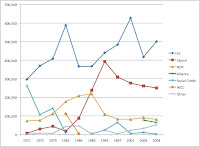
Total Vote: Party Breakdown (Alberta 1971-2008)
Mr. Climenhaga claimed that the Alberta Party is a group of “self-important yuppified professionals who would like to go straight into power.” I have met with some of the organizers of the new Alberta Party and some of them are even good friends of mine. I can attest that while they are ambitious (and perhaps a bit naive), they are not what Mr. Climenhaga describes.
I have spoken with many Liberals and New Democrats who remain befuddled as to why anyone would attempt to start something new, rather than join the ranks of the already assembled politicos. On many levels, the people behind the new party are looking for a cultural shift in Alberta politics. Although they may agree with some of the policies promoted by the traditional political parties, they see the culture of these traditional parties as part of the problem. The Alberta Party organizers appear to be fully aware of the risks of failure and that they are stepping beyond the political comfort zones of many people already involved in other parties.
I know many jilted Liberals and jolted New Democrats who have resolved to bask in the glory days of Pierre Trudeau or Laurence Decore and Tommy Douglas or Grant Notley. I somewhat admire their political stamina and strength (or madness) in the face of adversity, but I also completely understand why a group of young politically ambitious reformers would want to chart their own course. Joining a group that has become content with spending decades in the relative obscurity of the opposition benches is hardly attractive if you are serious about changing government policy.
Building a new political party from the ground up is hard work. The current leadership of the Liberals and New Democrats inherited a base of support and network that has existed for decades. Considering that the party was formed only eight years ago, the growth of the Wildrose Alliance is impressive (recognizing that it did have roots in the mini-resurgence of the Randy Thorsteinson-led Social Credit Party in 1997). It will be interesting to see whether the people involved with the new Alberta Party can actually build something different.
Contrary to what you may sometimes read on this blog, I do not always enjoying pointing out the flaws of Alberta’s opposition parties. I wish they would do better. I wish for opposition parties that were not uncompetitive in half the constituencies represented in the Assembly. I wish for a competitive election in 2012 that will attract Albertans back to the ballot booths. If the current polling trends continue, it looks like it may be competitive, but it remains to be seen who will actually be the contenders.
While speaking to the Alberta Association of Municipal Districts and Counties this week, Premier Ed Stelmach confirmed the obvious when defending his government’s decision to increase the number of constituencies in the next election: it was in order to preserve the existing number of rural constituencies in the Legislative Assembly. This decision continued the over-represention of rural Alberta ridings in the Assembly, despite rapid growth in the urban centres.
With a few exceptions, the PCs have been able to rely on non-competitive electoral districts in rural Alberta since wiping out the Social Credit rump in 1975. Over the past 39-years, the PCs have relied heavily on rural politicians as a “farm team” to replenish their ranks of rural MLAs (some now include Premier Stelmach, and Ministers Jack Hayden, Iris Evans, Ray Danyluk, Lloyd Snelgrove, Mel Knight, and MLAs Wayne Drysdale, Broyce Jacobs, Richard Marz, and Len Mitzel).
The PCs have dealt with competitive elections in the two major urban areas (Edmonton and Calgary), but the threat of a Wildrose insurgency across Alberta would be cause for great concern and is likely the reason behind Premier Stelmach’s posturing over rural over-representation.