Categories
Alberta Politics

Former Speaker David Carter warns of too many Alberta MLAs

Former Calgary PC MLA David Carter, who served as Speaker of the Legislative Assembly from 1986 to 1993, wrote to the commission expressing his concern about increasing the total number of MLAs from 87 to 89:

“This will result in crowding. Including potential hinderance in the event of fire or evacuation from the Chamber. In my opinion, these additional seats are an ill-advised intrusion by the government and should be regarded architecturally as the absolute limit to the number of seats within the Chamber. I recommend this limitation be noted in the report.”

Read more on the Daveberta Substack

Categories
Alberta Politics

UCP MLA Glenn van Dijken on the “Unique Burden of Rural Representation”

Athabasca-Barrhead-Westlock UCP MLA Glenn van Dijken asked the commission to consider what he described as the “Unique Burden of Rural Representation” when redrawing Alberta’s electoral map.

The three-term MLA urged the commission to lower the population averages in rural ridings so that rural MLAs will not have an increasingly large geographic region and more municipalities to represent in the Legislature, even if that means increasing the population averages in urban ridings.

Read more on the Daveberta Substack

Categories
Alberta Politics

Former Calgary mayor Al Duerr asks commission to respect city’s municipal boundaries

Former Calgary mayor Al Duerr argued in his written submission to the commission that lumping rural and commuter communities into Calgary ridings would be impractical, unfair and a detriment to effective representation.

The former four-term Calgary mayor, who served from 1989 to 2001, wrote that Calgary residents share different interests than people in neighbouring communities and they access different services and go to schools in wholly different school systems…

Read more on the Daveberta Substack

Categories
Alberta Politics

Former Medicine Hat MLAs Rob Renner and Bob Wanner want big changes to provincial ridings

East of Lethbridge, two former Medicine Hat MLAs are asking the commission to redraw the Medicine Hat ridings after the city was divided into two large rural-urban ridings when the riding boundaries were last redistributed in 2017.

Different submissions from Rob Renner, who was the Progressive Conservative MLA for Medicine Hat from 1993 to 2004, and Bob Wanner, who represented Medicine Hat as an NDP MLA from 2015 to 2019, argued that pairing the Medicine Hat with the City of Brooks in the current Brooks-Medicine Hat riding doesn’t well-serve the interests of Alberta’s sixth largest city.

Read more on the Daveberta Substack

Categories
Alberta Politics

UCP MLA Nathan Neudorf wants Lethbridge carved into 3-4 big rural-urban ridings

I read all 197 submissions to Alberta’s Electoral Boundaries Commission so you don’t have to

The City of Lethbridge could be carved into four provincial ridings that sprawl into the surrounding rural areas if a local United Conservative Party MLA gets his wish. Lethbridge-East MLA Nathan Neudorf submitted a written proposal to the Electoral Boundaries Commission calling for the southwest Alberta city to be reconfigured into “three or four complementary ridings that create a cohesive “agri-innovation corridor.”

Neudorf’s submission, which is one of 197 written submissions received by the commission and posted on its website, proposes a dramatic change in the electoral map he says would give “producers, processors, researches, and urban businesses a unified voice in the Legislature.”

Read all about it on the Daveberta Substack

Categories
Alberta Politics

Oh, Grant Hunter. Where do I start?

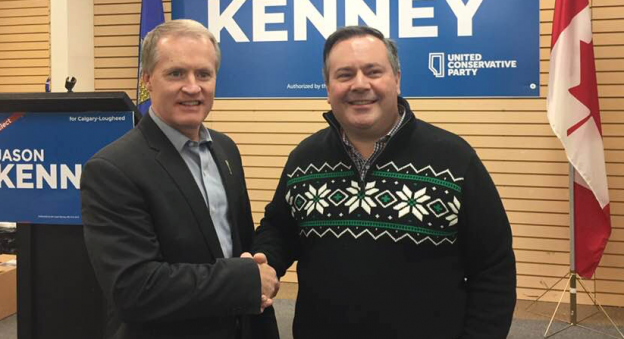
Photo: Cardston-Taber-Warner MLA MLA Grant Hunter and UCP leader Jason Kenney. (source: Facebook)

While announcing his plans to run for re-election in the new Taber-Warner district, United Conservative Party MLA Grant Hunter is reported to have compared the New Democratic Party’s 2015 election win to the 2004 Tsunami that ravaged southeast Asia and is estimated to have killed upwards of 280,000 people.

Hunter offered an apology to anyone was offended by his comments, but this is just the sort of ridiculous anti-NDP hyperbole that we have become accustomed to hearing from some Wildrose/UCP MLAs over the past three years.

But when talking about his decision to run in the new Taber-Warner district, rather than challenging his caucus colleague Dave Schneider for the UCP nomination in the new Cardston-Siksika district, he made another statement that caught my attention.

“…the NDP have put us in a bad position in this southern part here, in that when the boundaries were redrawn, they split Cardston-Taber-Warner into two different ridings.”

The Cardston-Taber-Warner district Hunter currently represents will see significant changes when the next election is called. While he may have legitimate concerns about the redistribution of the electoral boundaries in southern Alberta, it is misleading to blame the NDP for putting him “…in a bad position…”

The new district boundaries for the 2019 election were drawn by a commission composed of an independent chairperson (Justice Myra Bielby), two NDP Caucus appointees (Bruce McLeod of Acme and Jean Munn of Calgary) and two Wildrose Caucus appointees (Laurie Livingstone of Calgary and Gwen Day of Carstairs). The commission was appointed in October 2016 and held public hearings and received hundreds of submissions from Albertans throughout 2017.

Of the Wildrose appointees, Livingstone supported the final report recommending the new electoral map, including the changes to Hunter’s district, and Day submitted a minority report opposing changes to rural district boundaries.

The bi-partisan commission submitted recommendations for a new electoral maps to the Legislative Assembly for debate and it were voted into law by 40 NDP MLAs and Alberta Party MLA Greg Clark last December.

The process used to redraw Alberta’s electoral boundaries certainly has its flaws (I will write more about this soon), but with Hunter’s own party’s handpicked appointees deeply involved in the process it is misleading for him to blame the party in power for changes he might not like.

Note: 25 MLAs voted against the new electoral map, including two NDP MLAs, Colin Piquette and Eric Rosendahl.