The November 26 by-election in Calgary-Centre will be the fourth federal by-election held in Alberta in the past twenty-six years. In that time, only one of the by-elections saw the election of a candidate not from the incumbent political party. All three by-elections were won by candidates representing conservative parties.
Walter Van De Walle
PembinaBy-election (September 29, 1986)
Progressive Conservative Member of Parliament Peter Elzinga jumped into provincial politics and was elected as an MLA that year, vacating the riding he had represented since 1974. Longtime Sturgeon County councillor and reeve Walter Van De Walle faced a high-profile main competitor, New Democrat Ivor Dent, in a closely fought by-election. Mr. Dent had served as Mayor of Edmonton from 1968 to 1974.
When the votes were counted, Mr. Van De Walle defeated Mr. Dent by a narrow margin of 274 votes. Although Mr. Dent did not win the by-election, the strong showing for the NDP foreshadowed that party’s first federal electoral win in Alberta two year’s later when Ross Harvey was elected in Edmonton-East.
Deborah Grey
Beaver River By-election (March 13, 1989)
Tory MP John Dahmer died five days after he was elected in the November 21, 1988 election, triggering a by-election in this safe Tory riding. Reform Party candidate Deborah Grey earned a distant 4th place finish in the 1988 general election and carried the young protest party’s banner in the by-election only months later.
Riding a wave of western Canadian discontent with Prime Minister Brian Mulroney‘s PCs, Ms. Grey surprised the nation when she defeated PC candidate Dave Broda by 18%, becoming the first Reform Party MP. (Mr. Broda would later serve as the PC MLA for Redwater from 1997 to 2004). Ms. Grey was re-elected with 58% of the vote in the 1993 election along with 51 other Reform Party candidates.
Stephen Harper
Calgary-SouthwestBy-election (May 13, 2002)
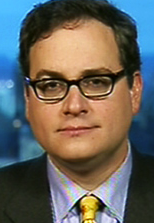
While he served as the Reform Party MP for Calgary-West from 1993 to 1997, Stephen Harper was not a sitting MP when he replaced Stockwell Day as leader of the Canadian Alliance in 2002. With a by-election expected in the riding vacated by former Reform Party leader Preston Manning, Mr. Harper managed to convince a reluctant Ezra Levant to step aside as his party’s already nominated candidate.
Mr. Harper was elected with 71% of the vote, more than 10,000 votes ahead of United Church Minister Bill Phipps, his NDP challenger. The Liberal Party declined to run a candidate in order to not oppose the new party leader’s entry into the House of Commons.
Late last month, the Liberals nominated lawyer and conservationist Harvey Locke. Soon after his nomination Mr. Locke was boosted by a visit from Justin Trudeau, who launched his leadership campaign a day earlier in his Montreal riding of Papineau.
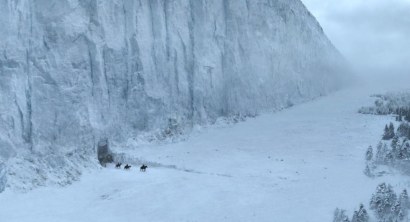
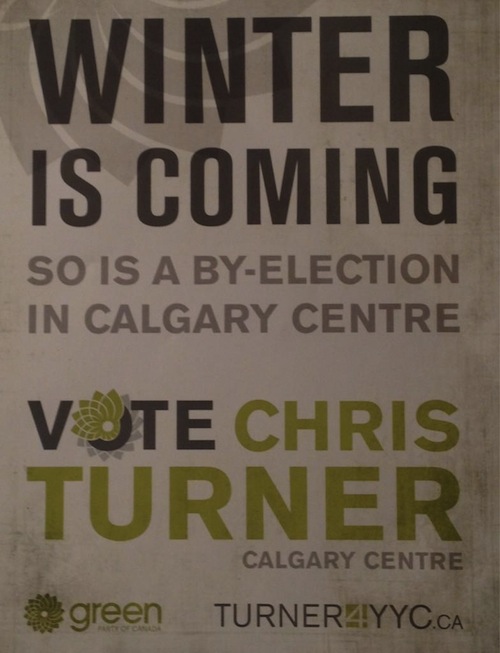
Calgary-Centre Green candidate Chris Turner is targeting the highly influential “Game of Thrones” voters.
Late to the game, the New Democrats are finally starting the process of nominating a candidate to run in the by-election. The three candidates seeking the yet-to-be scheduled nomination contest for the yet-to-be called by-election are recent provincial NDP candidate Brent Maklinson, social media consultantScott Payne, andMatthew McMillan.
After a number of rumoured high-profile candidates declined to seek the nomination, the NDP focused much of their energy over the summer on organizing a functional riding association in Calgary-Centre. In 2011, a parachute candidate earned 14% of the vote for the NDP.
This week, Members of Parliament in Ottawa voted on Motion 312, which if passed could have re-opened a divisive debate about a woman’s right to make decisions concerning her own body. Thankfully, Motion 312 was defeated 203-91 votes, but it remains disappointing that in this modern age one-third of federal MPs stood in favour of this Motion.
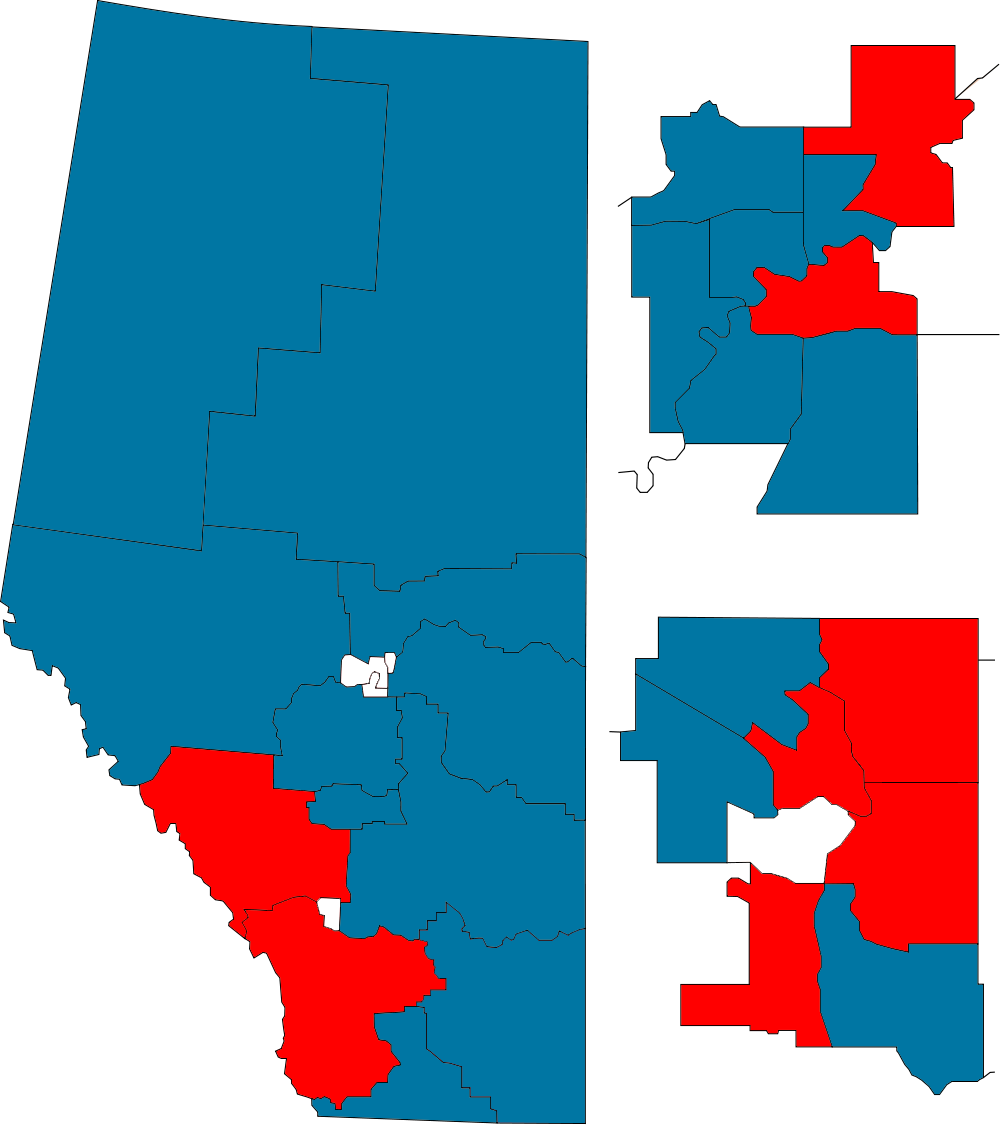
Eight of Alberta’s twenty-seven MPs voted against and nineteen voted in favour of the Motion (the riding of Calgary-Centre is not currently represented in the House of Commons following the resignation of MP Lee Richardson).
How Alberta’s Members of Parliament voted on Motion 312: Yay (Blue), Nay (Red)
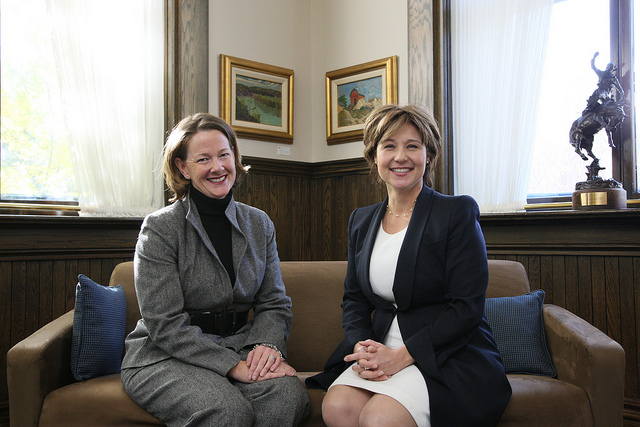
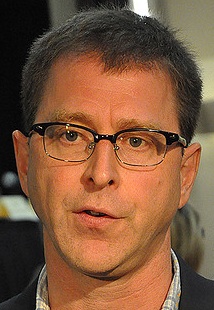
Under past Premiers Ralph Klein, Ed Stelmach, and Gordon Campbell, the conservative governments of Canada’s two western-most provinces enjoyed very friendly relationships. Vocal opposition to the pipeline, largely based around concerns about environmental impact and the transit of large oil tankers through the narrow Douglas Straight, has pushed the normally free-market loving BC Liberals away from the project. Premier Clark is also facing a strong NDP opposition. According to the latest poll, Adrian Dix‘s NDP sits 17% ahead of the BC Liberals.
As some political observers have mentioned, Premier Clark may use her time shaking some fundraising money from corporate Calgary in advance of next year’s provincial election.
With the next BC provincial election set for May 14, 2013, Premier Redford may want to start outreaching to Mr. Dix in hopes that his party might take a pragmatic approach and soften its stance on the Northern Gateway Pipeline if it forms government.
Or perhaps the re-election of President Barack Obama in November’s American elections will once again shift focus to the construction of the Keystone XL Pipeline from Alberta to Texas? Wildrose opposition leader Danielle Smith might have some insight to share on this topic. Ms. Smith is currently in the middle of a three-week trip of the United States to meet with political and policy leaders.
Mr. Boessenkool, who has strong-ties to Prime Minister Stephen Harper‘s office and was a signatory of the infamous “Alberta Firewall” letter, briefly managed Premier Clark’s leadership campaign in 2011 before a decree from the Conservative Party of Canada forbid its officials from participating in the contest.
Earlier this year, Mr. Boessenkool left his job at the public relations and lobbyist company Hill & Knowlton and his position with the newly formed ‘Alberta Blue Committee‘ to run the Premier’s Office in Victoria.
I have no reason to doubt Premier Redford’s political acumen or capability. Having only become Premier of Alberta eight months ago, she has hardly had an opportunity to demonstrate leadership on the national stage.
The upcoming Premiers’ conference, hosted by Premier Darrell Dexter from July 25 to 27 in Halifax, might give Albertans, and Canadians, an opportunity to watch Premier Redford demonstrate her leadership skills on a national level.
Closer to home, more than 50 organizations are calling on the Alberta Government to review the safety standards of the province’s aging pipelines.
Premier Redford has an opportunity to lead, and distinguish herself from her federal counterparts, by taking a positive lead on the renewal of the Canada Health Accord. The Accord, which was signed 10 years ago and expires in 2014, gave the provinces a significant monetary transfer for health care funding. The previous incarnation had little strings attached and the success of a future accord would benefit Canadians if more accountability were attached to the federal transfer.
Premier Redford’s road to 24 Sussex Drive is also complicated by another major factor. Only six years in to the job and still a young 53 years old, there is no indication that Prime Minister Stephen Harper will be retiring in the near future.
Relations with Premier Redford’s Progressive Conservatives is cool to cold in some, or perhaps even most most, federal Conservative circles. Immigration Minister Jason Kenney‘s recent reply-all email describing Deputy Premier Thomas Lukazsuk as a “complete and utter asshole” serves as a reminder of how strained the relations are between some federal and provincial Conservatives. In the recent election, a significant number of Conservative Members of Parliament supported Danielle Smith‘s upstart Wildrose Party.
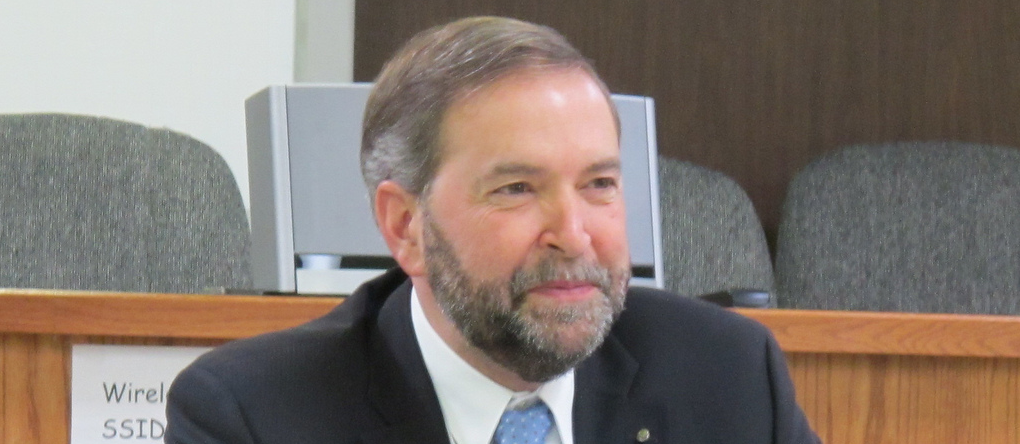
Two years ago it would have seemed impossible, but current federal NDP leader Thomas Mulcair may actually have a shot at 24 Sussex Drive after the next federal election. The NDP are tied or leading in the polls and while there is three years until the next election (aka an eternity in politics when anything could happen), Mr. Mulcair appears to be the first Leader of the Official Opposition to take an aggressive offensive position against Prime Minister Harper’s Conservatives.
Earlier this week, the NDP released an attack ad against Prime Minister Harper, giving the federal Conservatives a taste of their own medicine. If anything, the ads demonstrate that Mr. Mulcair’s NDP are not afraid to use the same tactics that Prime Minister Harper’s Conservative Party used to destroy the political careers of weak former Liberal leaders Stephane Dion and Michael Ignatieff.
The Greatest Show on Earth, also known as the Calgary Stampede, kicked-off celebrating its 100th anniversary this weekend. Between the chuck wagons and rodeo clowns, politicians off all stripes will drop into Calgary over the next week to kiss babies and grill pancakes.
Twitter was, well, atwitter with chatter comparing the level of applause received by Premier Alison Redford and Wildrose leader Danielle Smith at Prime Minster Stephen Harper‘s annual Stampede BBQ. It sounds silly, because it is, and it signals how deep the divide between Progressive Conservatives and Wildrose partisans are in this province.
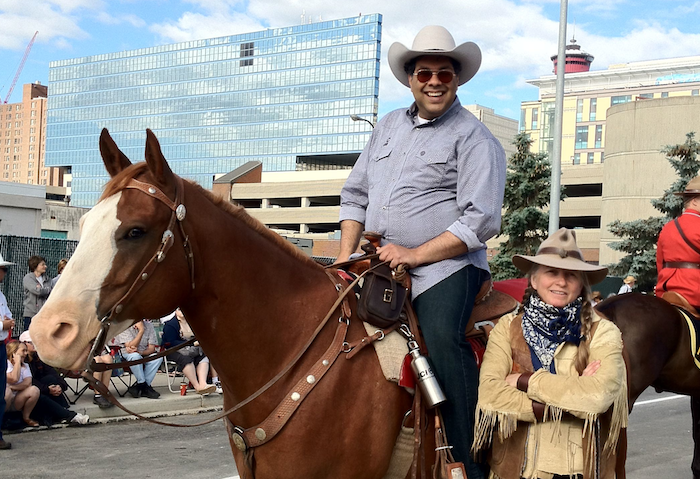
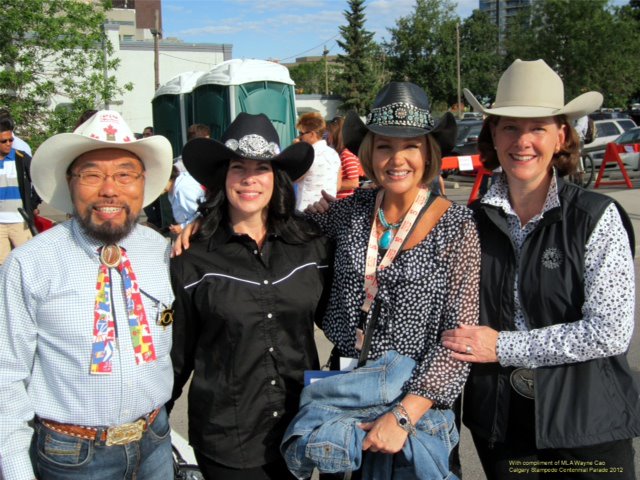
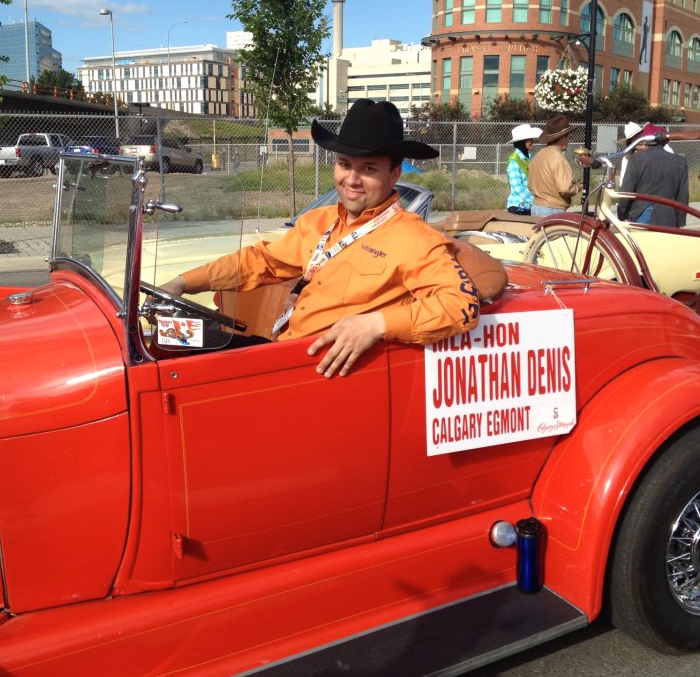
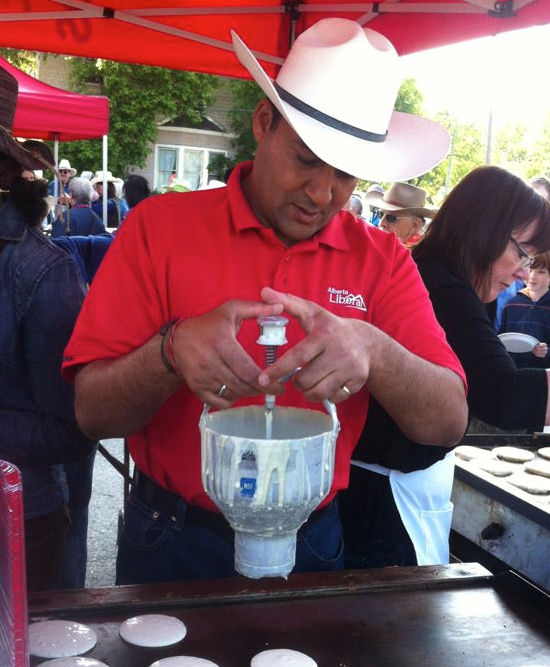
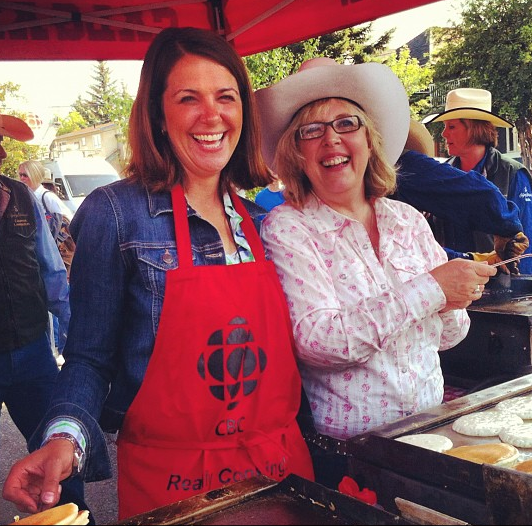
Here are some photos that were floating around social media networks this weekend. Check out Calgary Grit this week for his annual collection of political photos from the Stampede.
Calgary-Fort PC MLA Wayne Cao, Tourism Minister Christine Cusanelli, Calgary-North West PC MLA Sandra Jensen, and Premier Alison Redford. (via Wayne Cao on Facebook)Edmonton-Beverly Clareview NDP MLA Deron Bilous and Longueuil–Pierre- Boucher NDP MP Pierre Nantel. (via Deron Bilous on Facebook)Justice Minister Jonathan Denis. (via Jonathan Denis on Facebook)Alberta Liberal leader Raj Sherman. (via Raj Sherman on Facebook)Wildrose leader Danielle Smith and federal Green Party leader Elizabeth May (via via @katyanderson)
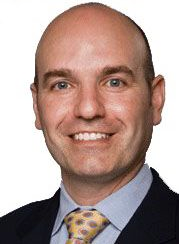
Skeena-Bulkley Valley New Democrat Member of Parliament Nathan Cullen is jumping into Calgary’s Stampede celebrations next week to host a workshop on uniting progressives in advance of the inevitable by-election in Calgary-Centre.
On July 11, Mr. Cullen will co-host a workshop with Edmonton-Strathcona NDP MLA Rachel Notley with the goal of sending “Stephen Harper a stinging message in his own backyard that his divisive politics aren’t going to cut it anymore.”
In 2011, the NDP orange wave made more of a ripple than a splash in Calgary-Centre. Parachute candidate Donna Montgomery earned only 14% of the vote, up from 9% in 2008. It is difficult to imagine any candidate other than a Conservative will win the expected by-election, but it is interesting to see that the NDP are putting some energy into cultivating and engaging potential supporters in this downtown Calgary riding.
Representing the northern British Columbia federal riding through which the proposed Enbridge Northern Gateway Pipeline will travel, Mr. Cullen has been a vocal critic of the development that would export crude oil and bitumen from the Athabasca oil sands to a marine terminal in Kitimat, BC. The NDP launched a spoof website last week in response to claims by Conservative politicians that “radicals” are holding up the public hearing process.
Conservative political pundit and former Calgary Herald editor Joan Crockatt and former Canadian Taxpayers’ Federation board member Andy Crooks were the first two candidates to announce their intentions to seek the Conservative Party nomination in Calgary-Centre. Mr. Crooks has already been endorsed by Calgary-West MP Rob Anders, a supporter of the Wildrose Party who is known for his far-right conservative politics.
Two-term Calgary Alderman John Mar, recently in the news for his tough on potato farmers stances, entered the contest last week. With ties to the PCs, Alderman Mar could represent the voice of moderate Conservatives in the nomination contest.
Tory victory inevitable? Almost certainly, but…
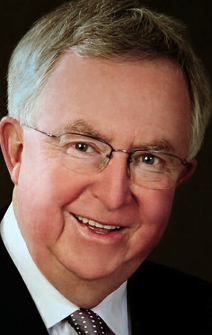
Joe Clark
Unless something cataclysmic occurs in the next six months, it is highly unlikely that the by-election in this riding will result in anything but the election of another Conservative MP. The type of Conservative candidate could effect how strong that outcome is.
While it may not translate to votes on the federal level, voters in this riding have a streak of electing non-Conservative representatives on the provincial level, including Liberal MLA’s Kent Hehr and Dave Taylor (Mr. Taylor later joined the Alberta Party).
Fresh off the provincial election trail, Beena Ashar has announced her intentions to seek the Liberal Party nomination. As the Liberal candidate in Calgary-Elbow, Ms. Ashar placed a distant third behind Premier Alison Redford. She also placed third when challenging Ward 5 Alderman Ray Jones in the 2010 municipal election.
Update: William Hamilton, the 2011 Green Party candidate, has announced that he will seek the Green Party nomination when the election is called. Mr. Hamilton was also the EverGreen Party candidate in Calgary-Elbow in the recent provincial election.
Update (July 24, 2012): Andy Crooks has dropped out of the Conservative nomination.
Premier Alison Redford is attending the 2012 Bilderberg Group conference.
There are no shortage of internet conspiracy theories about the mysterious Bilderberg Group conference, but now Alberta Premier Alison Redford will know the truth about the invite-only private annual meeting of the world’s top neo-liberal financial, business, and political elites.
Premier Redford has been invited the the event, which is being held in Virginia from May 31 to June 3. Only a small group of Canadian political leaders have been invited to attend, including Prime Minister Stephen Harper, former Prime Ministers Jean Chretien and Paul Martin, and former premiers Mike Harris and Gordon Campbell, to name a few.
Danielle Smith: Outraged.
As the emperors of industry behind the Bilderberg Group continue to push failed neo-liberal economic policies that have helped create crumbling markets across the globe, the unbounded potential of Alberta’s natural resource wealth will undoubtedly be a topic of discussion.
Premier Redford’s decision to attend this meeting earned immediate denunciation from Wildrose Official Opposition leader Danielle Smith. Ms. Smith criticized the Premier for not staying in Alberta to confront NDP leader Thomas Mulcair, who was in the province yesterday to visit Fort McMurray and tour an oilsands operation. Reaction to Mr. Mulcair’s visit drew a supportive comment from Wood Buffalo Mayor Melissa Blake, who told the Edmonton Journal:
“It seems like his interests are not necessarily out of alignment with what most Canadians would be interested in – a healthy sustainable environment.”
Breaking from the cries of outrage displayed by many of her Conservative counterparts, Premier Redford has taken a nuanced approach to responding to Mr. Mulcair’s comments that Alberta’s natural resource wealth has contributed to a high Canadian dollar and the decline of Ontario’s manufacturing industry.
Thomas Mulcair: It's a trap!
Rather than playing into Mr. Mulcair’s strategy to leverage a wedge issue among many voters outside of Alberta (especially in the economically depressed and voter rich southern Ontario) who are uncomfortable with the West’s economic growth and resulting environmental issues, Premier Redford has largely played it cool when responding to criticisms of the oilsands.
For all the criticism of Mr. Mulcair’s strategic play, it provides further evidence that the NDP Official Opposition under his leadership are prepared to use the same type of wedge politics that Prime Minister Harper’s Conservatives have successfully used over the past eight years. It should be noted that Ms. Smith’s Wildrose Party attempted to emulate the same type of wedge politics in the recent provincial election.
Premier Redford’s calm response is a break in style from recent political leaders like former Premier Ralph Klein, who expressed little interest in taking a leading role on the national stage.
As well as a change in tone, Premier Redford has made a number of political moves that suggest a shift toward Alberta’s provincial government becoming a serious player on the national stage, including beginning discussions with other provincial leaders about a [still vaguely defined] National Energy Strategy.
Earlier this month, Premier Redford announced the opening of an Alberta Office in Ottawa. Ms. Smith criticized the announcement, suggesting that the 27 Conservative Party Members of Parliament were doing a good enough job advocating for Albertans in the national capital. As both Ms. Smith and Premier Redford know, many of those Conservative MPs showed various levels of support for the Wildrose Party in the recent election. As a former lobbyist herself, Ms. Smith will undoubtedly be aware that successful lobbying includes more than meeting with politicians.
One person rumoured to be in line for the appointment as the Alberta government’s lobbyist in Ottawa is former Finance Minister Ted Morton, who is a former colleague of now-Prime Minister Stephen Harper. In Ottawa yesterday, Calgary-Centre Conservative MP Lee Richardsonannounced he had been hired as Premier Redford’s Principal Secretary and senior strategist. Before first heading to Ottawa in the 1980s, Mr. Richardson was the Chief of Staff to Premier Peter Lougheed, who may have been Alberta’s last provincial leader who was also a significant player on the national stage.
Recently resigned MP Lee Richardson, soon to be Principal Secretary to Premier Alison Redford. (Photo from 5of7 on Flickr)
After a bitterly fought provincial election campaign drove a deep rift into Alberta’s conservative movement between the moderate institutional Progressive Conservatives and the ideologically-driven Wildrose Party, a federal by-election in Calgary may be the first real test of how united supporters of the federal Conservative Party supporters are in Alberta.
As a senior political advisor, Mr. Richardson is an old pro. From 1979 to 1983, Mr. Richardson was Chief of Staff to Alberta Premier Peter Lougheedand later served as Deputy Chief of Staff to Prime MinisterBrian Mulroney. In last year’s PC leadership contest, Mr. Richardson supported candidate Rick Orman, who he worked with at the Legislative Assembly before he was first elected as a PC MP in Calgary-Southeast in 1988. He served until his defeat by Reform Party candidate Jan Brown in 1993. He re-entered federal politics as the Conservative MP for Calgary-Centre in 2004.
Triggering a by-election that will occur in the next six months, the contest for the Conservative Party nomination in this constituency could expose some uncomfortable cleavages between moderate and ideologically conservatives in Alberta.
Ezra Levant
A Twitter account supporting the possible candidacy of right-wing talk show host Ezra Levant was created within a hour of Mr. Richardson’s announcement. Many Albertans may remember Mr. Levant as the Wildrose Party’s biggest cheerleader on his cable news program during the recent provincial election. In 2002, he stepped down as the Canadian Alliance candidate in Calgary-Southwest to allow Stephen Harper to win a seat in the House of Commons.
Also rumoured as a potential candidates are Calgary Alderman John Mar, who has close connections to PC Party organizers, and recent Calgary-Klein Wildrose Party candidate Jeremy Nixon. Mr. Nixon placed second with more than 34% of the vote in the recent election. Although unlikely in my mind, one Conservative supporter emailed me this evening to name former Calgary-Glenmore Wildrose MLA Paul Hinman as a potential candidate.
Of course, the Conservatives could avoid a nasty nomination battle and simply acclaim a candidate, as they did to party organizer Michelle Rempel after cabinet ministerJim Prentice resigned as MP for Calgary-Centre North in 2010.
The Liberals earned respectable second-place votes in this constituency under its former boundaries in the 1990s, but have fallen further behind the Conservatives in recent elections.
In the 2011 federal election, Liberal candidate Jennifer Pollock placed second with 17% of the vote, a full 40% behind Mr. Richardson. Edmontonian parachute candidateDonna Montgomery earned 14% for the NDP.
While some sort of centre-left coalition could place a respectable second in the imminent Calgary-Centre by-election, it seems unlikely that anyone other a Conservative would win this vote.
Federal NDP leader Thomas Mulcair talked his way into inevitable criticism of the oil sands this past weekend. Speaking on CBC Radio’s The House, Mr. Mulcair suggested that the development of the oil sands is contributing to a strong Canadian dollar, and thus hurting the industrial manufacturing sector in other provinces (also known as “Dutch Disease“).
The comments earned harsh criticism from Saskatchewan Premier Brad Wall.
Calgary economist Jack Mintz pointed out that the manufacturing industry malaise in Central Canada and the Mid-West United States has less to do with the western provinces and is almost entirely a result of an automotive industry that failed to compete with its international competitors.
The natural resource wealth in Alberta and Saskatchewan and the shift of political power westward may redefine Canadian politics in the next decade. The industrial base in the oil sands is driving the national economy and poses a great challenge to the traditional economic dominance of Ontario and Quebec, where the NDP found the majority of its political support in the May 2011 federal election.
Speaking from his experience as a provincial cabinet minister in Quebec, I must believe that Mr. Mulcair has a better grasp of economic issues than even most of our federal politicians. Realistically, it probably would not have mattered what Mr. Mulcair said about the oil sands. Had Mr. Mulcair said he liked the oil sands, his Conservative critics would have decried him for not declaring his love for the oil sands.
Not your grandfather's NDP.
Mr. Mulcair’s NDP faces a number of political challenges in preparation for the 2015 election, including expanding its support between the British Columbia and Ontario boundaries, where the party elected only three Members of Parliament in the last federal election. For the past twenty-years, the Reform Party, the Canadian Alliance, and now the Conservative Party of Canada led by Prime Minister Stephen Harper have held an electoral monopoly over the region.
The federal NDP base of support in Western Canada, which sent strong contingents of New Democrats to Ottawa in the 1970s, 1980s, and 1990s, was weakened due to changing electoral boundaries and evaporated after finding itself on the unpopular side of wedge issues successfully leveraged by Conservative parties in rural areas. In 2011, as the Orange Wave swept Quebec and formed Official Opposition in Ottawa for the first time, the NDP placed a distant second in the West.
Over the course of the election campaign, I have identified candidates from all the political parties who would be good MLA’s in the next Legislature. Out of the group of more than 400 Albertans seeking office in the 2012 general election, I have chosen six candidates who I personally believe would make excellent additions to Alberta’s public life and I wholeheartedly and enthusiastically endorse.
Shannon Phillips in Lethbridge-West
Shannon Phillips is a dynamo who would bring new energy to the opposition benches as an MLA. With the two main conservative parties poised to sweep most of the province, the smart and politically savvy Ms. Phillips would bring a strong voice for her constituents on the floor of the Assembly.
Michael Walters in Edmonton-Rutherford
Michael Walters understands how to connect with and engage with large groups of people, which is a critical skill for anyone holding public office. As a seasoned community organizer and a quick learner, Mr. Walters’ would be a strong and refreshing voice to Alberta politics.
David Swann in Calgary-Mountain View
If you are troubled by the lack of honesty and integrity in politics, then David Swann is someone that you want in Alberta’s Legislative Assembly. Not a traditional politician, Dr. Swann is a voice of reason and calm in a political culture increasingly filled with blind partisanship.
David Eggen in Edmonton-Calder
From 2004 to 2008, David Eggen was one of the most effective opposition voices on the Assembly floor. Since 2008, he used the skills he honed in the opposition benches to become a strong defender of public medicare. He is a hard worker and Alberta politics will be better if Mr. Eggen returns to the Assembly.
Sue Huff in Edmonton-Glenora
Sue Huff provides a perfect example of how politics can be done differently in Alberta. As a trustee on Edmonton’s public school board, she maintained a positive tone while effectively advocating against the closure of core neighbourhood schools (a heated topic). As acting leader of the Alberta Party in 2011, she brought her positive tone to the provincial level. Hers is an effective voice that would bring a welcome change to the floor of the Assembly.
Ian Urquhart for Senate
Every few years in Alberta, we elect a non-elected position called a Senate Nominee (or Senator-in-Waiting). These elections have been held since the late 1980s in hopes that one day the appointed Upper House of Parliament in Ottawa will become elected. No matter what you believe about the Canadian Senate, this election is an opportunity to send a message to Prime Minister Stephen Harper and the Ottawa Conservative Party that Albertans are not to be taken granted for. This is why I will be casting my ballot for Ian Urquhart.
A professor of political science at the University of Alberta, Dr. Urquhart was one of my favourite instructors during my time as a student. His candidacy gives political moderates and centre-left voters of all stripes an option other than refusing to vote or spoiling their Senate ballots at the polls.
Wildrose is under attack! The same people that caused the Liberal Party of Canada to be in power for 13 uninterrupted years now have Wildrose in their crosshairs. They want nothing more than to see the Redford PCs re-elected to impose their big government knows best, ivory tower views on all of us.
Progressive Conservative Party leader Premier Alison Redford has started to hone in on some of the Wildrose Party’s controversial policies, like citizen-initiated referendums that some critics say could lead to province-wide votes on issues like abortion and same-sex marriage. A similar constroversial policy was prominently placed in the platform of the former Reform Party and its successor, the Canadian Alliance. While many Albertans still have fond memories and continued respect for Preston Manning and the movement he created, one recent survey suggests that this could be a good strategy for the PCs to use against Danielle Smith‘s party.
Much has been written about how much the electoral battle between Alberta’s PCs and the Wildrose Party is a continuation of the long-standing family feud between moderate Tories and Reform Party minded conservatives of yesteryear.
Premier Redford, who was a staffer to former Prime Minister Joe Clark, stepped up to challenge controversial right-winger Rob Anders for the Conservative Party nomination in Calgary-West before the 2004 federal election. Ms. Redford was defeated. (Ms. Redford’s ex-husband’s father was the last PC MP for Calgary-West and was defeated by Reform Party candidate Stephen Harperin 1993). PC campaign manager Susan Elliott was the national director of the former PC Party of Canada and a few of Premier Redford’s cabinet ministers, including Wetaskiwin-Camrose MLA Verlyn Olson and Lethbridge-West MLA Greg Weadick were federal PC candidates during the height of the Reform Party’s strength in Western Canada.
The Wildrose Party campaign includes a number of former Reform Party and federal Conservative stalwarts, including Mr. Fryers (who was Chief of Staff to Preston Manning), campaign manager Tom Flanagan (who was strategist for the Reform Party), Senate candidate and strategist Vitor Marciano (who is a long-time federal Conservative Party operative), and Jim Armour (an Ontario-based consultant and former Communications Director to Mr. Manning and Prime Minister Harper). Former federal Conservative candidate also Ryan Hastman joined the Wildrose Party staff shortly after the 2011 federal election.
Calgary-Southeast Conservative Member of Parliament Jason Kenney was reported to have said that “any attempt to hurt Wildrose by linking them to old Reform movement will backfire.”
With a few exceptions most Members of Parliament have kept a low-profile during this provincial campaign. Westlock-St. Paul Conservative MP Brian Storseth was spotted in the Bonnyville A&W with Ms. Smith earlier this week. Edmonton-Spruce Grove Conservative MP Rona Ambrose has endorsed Spruce Grove-St. Albert PC candidate and Deputy Premier Doug Horner.
On the NDP side, Edmonton-Strathcona MP Linda Duncan has endorsed Edmonton-Gold Bar candidate Marlin Schmidt. Quebec NDP MP Marjolaine Boutin-Sweet will be campaigning with Mr. Schmidt today. The shift in electoral boundaries places Edmonton’s francophone community in Bonnie Doon into the Gold Bar constituency. The NDP are hoping that the retirement of popular Liberal MLA Hugh MacDonald could be their opportunity to make electoral gains in this east Edmonton constituency.
Later this week, Papineau Liberal MP Justin Trudeau joining Lacombe-Ponoka Liberal candidate Kyle Morrowover cyberspace to speak to a class of students at St. Augustine School in Ponoka.
Around 1:30 am on May 2, 2011, I returned to Edmonton after spending a month travelling across the vast continent of Australia. That day also happened to be Election Day in Canada. On a social media detox while I was out of the country and suffering from severe jet lag from the moment I returned, I missed and was near oblivious of the phenomenon that had become known as “the Orange Wave.”
To magnify the degree of how out of the loop I was at the time, I fall into a category with an incredibly small fraction of Canadians who voted for the NDP in the 2006 and 2008 elections, but cast their ballot for the Liberal candidate in 2011 (also known as the “Liberal Back Eddy of 2011“). This choice had little to do with Michael Ignatieff and nearly everything to do with the hard-working and very-likeable local Liberal candidate, Mary MacDonald.
I was not sure what to expect from his talk, but I found myself pleasantly surprised with Mr. Mulcair’s ability to offer intelligent pragmatic social democratic answers to a crowd consisting of committed leftists was both impressive and sometimes brave.
As a centre-leftish voter, I am looking for a party that will put forward a forward-looking progressive agenda for Canada, which should not be confused with the tired traditional partisan socialist dogma (referred to by some as the Church of the NDP). As an outsider to the NDP, I have found Mr. Mulcair’s ability to challenge those traditional positions encouraging and I recognize that it may be one of his largest challenges from inside his own party’s ranks.
Western Canada is becoming the country’s economic leader. As a Quebec MP, Mr. Mulcair should try to avoid being sucked into the traditional eastern Canadian “father knows best” attitude around economic development. Mr. Mulcair should also try to avoid being caught in the Conservative Party trap that would have any criticism or suggestion of deviation from our current resources extraction methods labelled as “anti-Albertan.” (Stephen Harper‘s Conservative Party has already released talking points to be used against Mr. Mulcair).
Mr. Mulcair and all of the NDP Members of Parliament from central and eastern Canada should consider travelling west and knocking on some doors during Alberta’s upcoming provincial election. Their provincial cousins will undoubtably appreciate the help and it may give those MP’s a better idea of what real Albertans, not just their Conservative politicians, are actually thinking.
I am confident that the LPC convention this past weekend, which I attended as a delegate and past candidate for AB-Yellowhead , is an event that I will look back at in 50 years and tell people, “I was there”.
For those of you who pithily pontificate that the Liberal Party does not fully comprehend the gravity and seriousness of its situation following the 2011 election – we know. Lord in heaven, do we know. As I chatted and dialogued with over 3,200 fellow Liberals in Ottawa, I found unimaginable optimism. With the Harper majority, we have several years to renew and reinvent ourselves – and enough time to get it right.
I believe we have passed the tipping point towards full renewal. We had several bold policy initiatives and constitutional changes on the docket, and with a 2/3 majority required to pass them, there was no certainty at all heading into the convention that the delegates would opt for change and bold ideas as opposed to maintaining the status quo (which won us a great majority in 1980 but hasn’t done much since).
Although we retained leader veto over specific policy and the ability of the leader to appoint candidates, we made several seismic structural changes that have set the stage for the Liberal Renaissance.
First – we are now the most open federal party in the history of the country with the adoption of the “supporter” system. Those delegates that spoke at the microphone for the “No” side of this resolution pleaded that this would open the party to be hijacked by special interests. I marched up to the yes microphone and I told 2,000 Liberals (and whoever was watching on CPAC) that in order for this party to truly become a party of the people, we cannot be afraid of Canadians, we must embrace them. The more voices we have, the better our platform will be. The more Canadians we engage, the more that will trust us with their vote in 2015. Against the odds most pundits and talking heads predicated – the party agreed.
Second – rejecting Sheila Copps for party President, we collectively rejected the leader-centric “Messiah” model in favour of pragmatism. I have nothing but respect and admiration for Ms. Copps, and as talented and dedicated as she would have been, electing her as party President would have sent the wrong message about renewal. Her presence is a reminder of the destructive leadership wars of the 1990s, and I am not convinced that she would not have implicitly gravitated toward the “winning formula” of the 1990s, a formula that only works with a shattered and splintered opposition. Furthermore, I doubt she would have remained in the background. She made more TV appearances in the weeks up to the convention than past President Alf Apps has made in his lifetime.
Third – the policy we passed is Liberal and is in concert with current Canadian sentiment. We rejected the option of severing ties with the monarchy. (For the undecided in the room, all it took was a delegate to march up to the microphone and thunder “Two words: PRESIDENT HARPER”.) We recognized the need for innovation in our infrastructure, and reaffirmed our commitment to development of the oilsands in an environmentally sustainable way.
But of course – the pot resolution. Like most, I was sceptical it would pass. But when I saw the results on the gigantic screen – well over the required 2/3 to pass – I had a profound realization. This convention, with all of the national media in the room – said loud and clear that we are no longer afraid to be Liberal.
As a Liberal, I believe in evidence based policy. I also believe in creative solutions to challenging problems. And I am not afraid to defend my position.
During the tumult of the minority parliaments, we were afraid. Time and again we capitulated to Harper in order to avoid bringing down the government. We did not have the balls to stand up to him – especially on crime. Terrified of the inevitable barrage of “soft on crime” ads, we lied about who we were.
No longer. Not a single person spoke against the pot resolution by arguing that we should be afraid of what Harper will do to us. No one trembled at the thought of an apoplectic Vic Towes predicting Armageddon should this policy come into effect. Why? Because we have evidence, science, and Canadian public opinion on our side. Imagine that. A policy based on evidence. (I’ll explain “evidence” to Gary Goodyear later.)
We opened the party. We took bold policy initiatives. We rejected the celebrity President in favour of a backroom business man with a brilliant vision. And we weren’t afraid to adopt a bold stance on a taboo subject and we will not be afraid to be Liberal.
And we also realize that our return to power will not be easy, and it may take more than one election. The arrogant Liberal Party that sent 3 “power brokers” to Harvard to pluck the next Prime Minister of Canada out of academic obscurity, complete with rigging the local riding nomination to shut out the two local candidates who signed up hundreds of new members, is no more. Casting our eyes south to the hysterical partisanship of a two-party state, we are secure in our belief that there must continue to be a Liberal Party of Canada.
So where does Alberta fit in? Well I learned something astounding. Albertan Liberals are held in tremendous regard by Eastern Liberals. Why? Because given the uphill battle we face in Alberta, our commitment to the Liberal Party is sincere. The supporter motion was born at the Alberta Liberal Party level, and part of the reason I helped convince the delegates to adopt that motion was the fact that the ALP database grew by over 1,000% during the course of last year’s leadership race.
The Liberal Party recognizes that the days of winning majorities with only a smattering of seats in the prairies (see Trudeau, Chretien) are over. There is a sincere and honest desire to build a grassroots, national party. As one delegate put it to me, “when we win a seat in Alberta, it will electrify the whole party.” And I know it can be done. Our new President made it clear that grassroots rebuilding in Alberta is a priority. The Liberal Party gets it. We cannot govern – in fact, I would argue we don’t deserve to govern – unless we can command support across this great nation.
Necessity is the mother of invention. Boy, did we ever (re)invent!
——-
Zack Siezmagraff is a fixture in the Edmonton Liberal community. He ran for the Liberal Party of Canada in the 2011 election in Yellowhead , and currently serves as the President of the Edmonton-Glenora Provincial Liberal Association. You can follow him on Twitter @ZackSiezmagraff.