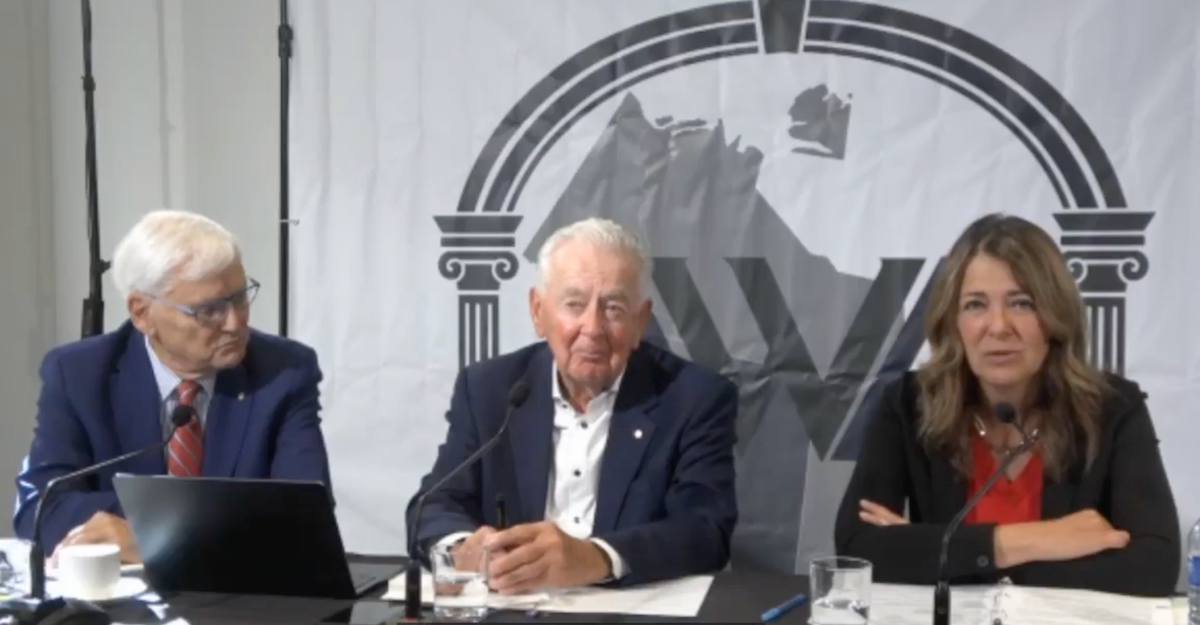
Premier Danielle Smith joined former Reform Party leader Preston Manning and former BC Premier Gordon Campbell on a zoom call-based Alberta and the West Assembly conference last weekend.
Alberta Premier Danielle Smith has had a rough few weeks.
Ten days ago, Smith’s United Conservative Party lost the by-election in Calgary-Shaw, a south Calgary riding that had been a stronghold for her party in the last two elections. The surprise win by NDP candidate Kyle Campbell has been widely interpreted as a backlash against Smith’s referendums on October 19, including a vote on Alberta’s separation from Canada.
Smith quickly blamed the loss on vote splitting with the Progressive Tory Party candidate who earned 6 percent of the vote, but that doesn’t explain the 22.2 point drop in UCP support in the riding since the 2019 election. The Progressive Tories may have been a dynamic in the race but they weren’t the reason why the UCP lost the Calgary-Shaw by-election.
Under past Premiers Ralph Klein, Ed Stelmach, and Gordon Campbell, the conservative governments of Canada’s two western-most provinces enjoyed very friendly relationships. Vocal opposition to the pipeline, largely based around concerns about environmental impact and the transit of large oil tankers through the narrow Douglas Straight, has pushed the normally free-market loving BC Liberals away from the project. Premier Clark is also facing a strong NDP opposition. According to the latest poll, Adrian Dix‘s NDP sits 17% ahead of the BC Liberals.
As some political observers have mentioned, Premier Clark may use her time shaking some fundraising money from corporate Calgary in advance of next year’s provincial election.
With the next BC provincial election set for May 14, 2013, Premier Redford may want to start outreaching to Mr. Dix in hopes that his party might take a pragmatic approach and soften its stance on the Northern Gateway Pipeline if it forms government.
Or perhaps the re-election of President Barack Obama in November’s American elections will once again shift focus to the construction of the Keystone XL Pipeline from Alberta to Texas? Wildrose opposition leader Danielle Smith might have some insight to share on this topic. Ms. Smith is currently in the middle of a three-week trip of the United States to meet with political and policy leaders.
Mr. Boessenkool, who has strong-ties to Prime Minister Stephen Harper‘s office and was a signatory of the infamous “Alberta Firewall” letter, briefly managed Premier Clark’s leadership campaign in 2011 before a decree from the Conservative Party of Canada forbid its officials from participating in the contest.
Earlier this year, Mr. Boessenkool left his job at the public relations and lobbyist company Hill & Knowlton and his position with the newly formed ‘Alberta Blue Committee‘ to run the Premier’s Office in Victoria.
Premier Alison Redford is attending the 2012 Bilderberg Group conference.
There are no shortage of internet conspiracy theories about the mysterious Bilderberg Group conference, but now Alberta Premier Alison Redford will know the truth about the invite-only private annual meeting of the world’s top neo-liberal financial, business, and political elites.
Premier Redford has been invited the the event, which is being held in Virginia from May 31 to June 3. Only a small group of Canadian political leaders have been invited to attend, including Prime Minister Stephen Harper, former Prime Ministers Jean Chretien and Paul Martin, and former premiers Mike Harris and Gordon Campbell, to name a few.
Danielle Smith: Outraged.
As the emperors of industry behind the Bilderberg Group continue to push failed neo-liberal economic policies that have helped create crumbling markets across the globe, the unbounded potential of Alberta’s natural resource wealth will undoubtedly be a topic of discussion.
Premier Redford’s decision to attend this meeting earned immediate denunciation from Wildrose Official Opposition leader Danielle Smith. Ms. Smith criticized the Premier for not staying in Alberta to confront NDP leader Thomas Mulcair, who was in the province yesterday to visit Fort McMurray and tour an oilsands operation. Reaction to Mr. Mulcair’s visit drew a supportive comment from Wood Buffalo Mayor Melissa Blake, who told the Edmonton Journal:
“It seems like his interests are not necessarily out of alignment with what most Canadians would be interested in – a healthy sustainable environment.”
Breaking from the cries of outrage displayed by many of her Conservative counterparts, Premier Redford has taken a nuanced approach to responding to Mr. Mulcair’s comments that Alberta’s natural resource wealth has contributed to a high Canadian dollar and the decline of Ontario’s manufacturing industry.
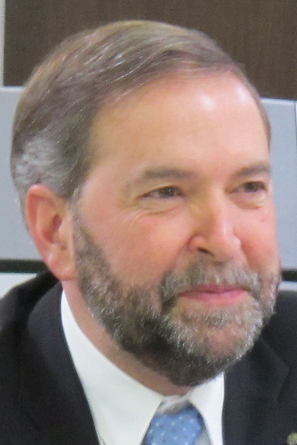
Thomas Mulcair: It's a trap!
Rather than playing into Mr. Mulcair’s strategy to leverage a wedge issue among many voters outside of Alberta (especially in the economically depressed and voter rich southern Ontario) who are uncomfortable with the West’s economic growth and resulting environmental issues, Premier Redford has largely played it cool when responding to criticisms of the oilsands.
For all the criticism of Mr. Mulcair’s strategic play, it provides further evidence that the NDP Official Opposition under his leadership are prepared to use the same type of wedge politics that Prime Minister Harper’s Conservatives have successfully used over the past eight years. It should be noted that Ms. Smith’s Wildrose Party attempted to emulate the same type of wedge politics in the recent provincial election.
Premier Redford’s calm response is a break in style from recent political leaders like former Premier Ralph Klein, who expressed little interest in taking a leading role on the national stage.
As well as a change in tone, Premier Redford has made a number of political moves that suggest a shift toward Alberta’s provincial government becoming a serious player on the national stage, including beginning discussions with other provincial leaders about a [still vaguely defined] National Energy Strategy.
Earlier this month, Premier Redford announced the opening of an Alberta Office in Ottawa. Ms. Smith criticized the announcement, suggesting that the 27 Conservative Party Members of Parliament were doing a good enough job advocating for Albertans in the national capital. As both Ms. Smith and Premier Redford know, many of those Conservative MPs showed various levels of support for the Wildrose Party in the recent election. As a former lobbyist herself, Ms. Smith will undoubtedly be aware that successful lobbying includes more than meeting with politicians.
One person rumoured to be in line for the appointment as the Alberta government’s lobbyist in Ottawa is former Finance Minister Ted Morton, who is a former colleague of now-Prime Minister Stephen Harper. In Ottawa yesterday, Calgary-Centre Conservative MP Lee Richardsonannounced he had been hired as Premier Redford’s Principal Secretary and senior strategist. Before first heading to Ottawa in the 1980s, Mr. Richardson was the Chief of Staff to Premier Peter Lougheed, who may have been Alberta’s last provincial leader who was also a significant player on the national stage.
Just over a year ago, the governments of British Columbia, Alberta and Saskatchewan met for our inaugural joint cabinet meeting. We knew then that it is critical that we break down unnecessary barriers between our provinces. Yesterday, we transformed words into action by announcing The New West Partnership. The New West Partnership recognizes the strong economic foundation of the West and the benefits of co-operation – co-operation that will foster lasting prosperity for the region, our people and our businesses.
Once you wade through the political language and buzz words of the op-ed, there appears to be little that is really “new” about this western partnership agreement. New West appears to be little more than an eastward expansion of the already existing Alberta-BC TILMA agreement, which the Premier of the bloc’s newest member denied being interested in joining only two years ago. I imagine Saskatchewan’s economy will benefit greatly by opening up to its western neighbours, but Premier Wall remains coy on what the agreement will mean for his province (as he will likely face strong opposition to the agreement).
Removing these kinds of inter-provincial barriers to investment, trade, and labour mobility are positive steps, but there are strong arguments against the secrecy in which these agreements have been created. There are also some negative elements of TILMA that many citizens may not aware of. For example, in March 2009, PC MLAs voted against removing Section 5 of Bill 18: Trade, Investment and Labour Mobility Agreement Implementation Statutes Amendment Act, which allows Cabinet Ministers to suspend or modify sections of the TILMA Act without having to deal with public debate in the elected Legislature. (Edmonton-Centre MLA Laurie Blakemanspoke against Section 5 of TILMA in March 2009).
While I am not holding my breath, it would be very encouraging to discover that the “new” elements of the New West Partnership are more democratically inclined than its predecessor agreements.