A snap mid-Summer election returned Jim Prentice’s renamed “Conservative Party of Alberta” to its fourteenth term as government. In an unexpected twist of fate, Finance Minister Danielle Smith was defeated in her home riding by Wildrose Party leader Randy Thorsteinson.
But don’t feel sorry for Smith. She was appointed to the Senate in one of Stephen Harper’s last acts as Prime Minister before the Conservatives lost the October federal election. Harper’s applecart was upset when the beautiful, unseasonably warm October weather caused Canadian voters to turn out in droves.
Back on the provincial scene, NDP leader Rachel Notley led her party to a breakthrough in Edmonton to form the Official Opposition with 21 MLAs. Notley’s party won its first seat in Calgary since the 1980s and its first ever seat in Lethbridge.
But perhaps the biggest surprise was the re-election of Wildrose-turned-Liberal MLA Joe Anglin, who won by 3,000 votes in Rimbey-Rocky Mountain House-Sundre. As the only Liberal to survive the election, Anglin is now the leader of the party.
“Unlike the 2012 election, 2015 gave Albertans two clear choices in the PCs and NDP,” said Rick Dunderland, a professor of political science at University of Red Deer. “Even though the PCs still won, there is now a difference between the government and official opposition and that will be a good thing for democracy.”
Tough Economic Times behind us
With a return to $120/barrel oil, Premier Prentice praised good economic times ahead for Albertans in the 2016.
“Back to budgeting as usual,” a senior government official said. “Now we don’t have to worry about saving money for the future, because the price of oil is never going to go down again.”
The Prentice Government is facing international criticism for his government’s continued lack of climate change plan. “Alberta’s climate change framework is important and will be a continued focus of our government in 2016,” Energy Environment Minister Rob Anderson said. “Under new management, we are continuing to take the time to ensure the decisions we make are right.”
And big city mayors have a lot to celebrate. The recently negotiated City Charters granting the municipalities new powers are expected to be unveiled in early 2016. A newly released poll showed Mayors Don Iveson and Naheed Nenshi with 95% approval among voters.
Redford tell-all
Palm Springs resident Alison Redford is set to launch a new tell-all book about her time as Premier of Alberta. Driven out by scandal in 2014, Redford has dedicated her time to charity work and has announced all proceeds from the book will go to charity. Not surprisingly, Tory insiders are expecting the wurst about what might be included in the book.
Keystone XL Pipeline
Recently elected Prime Minister Justin Trudeau celebrated the approval of the Keystone XL Pipeline over a bottle of champagne with President Barack Obama during his first visit to the White House last month. Conservative opposition leader Jason Kenney complained that Canadians should thank former Prime Minister Stephen Harper for the pipeline’s success.
In an unexpected gesture, Prime Minister Trudeau named Harper the Canadian Ambassador to Ukraine where, unfortunately, the Canadian Ambassador’s residence was burned down last week by a pro-Russian mob.
Alberta MLAs to watch in 2015: Rob Anderson, Joe Anglin, Manmeet Bhullar, Laurie Blakeman, Robin Campbell, Gordon Dirks, Heather Forsyth, Kent Hehr, Thomas Lukaszuk, Stephen Mandel, Rachel Notley, Danielle Smith
As 2014 reminded us, politics can be an extraordinarily unpredictable and forecasting the future can be a tricky business for political pundits. Aside from the obvious choice of Premier Jim Prentice, here is a list of a dozen Alberta MLAs worth watching in 2015.
Alberta MLAs Rob Anderson, Joe Anglin, Manmeet Bhullar and Laurie Blakeman
Rob Anderson (Airdrie): The outspoken rookie MLA left the PC Caucus in 2010 to join the upstart Wildrose Party. And in 2014, after two years as a loud and enthusiastic critic of the government, he was one of 9 Wildrose MLAs who crossed to the PC Caucus in December 2014. It is speculated that Mr. Anderson could end up with a cabinet post in early 2015, to the ire of his new caucus colleagues. He thrived in the limelight of the opposition benches but can he survive in the government benches?
Joe Anglin (Rimbey-Rocky Mountain House-Sundre): Mr. Anglin left the Wildrose Caucus in November 2014 before his colleagues could vote him out. On his way out, he declared that “an internal civil war” was being waged inside the Wildrose Party. It was recently revealed that Mr. Anglin has been in discussions with the Liberals about forming a legislative coalition that could steal Official Opposition status away from the downsized Wildrose Caucus.
Manmeet Bhullar (Calgary-Greenway): A rising star in the PC Party. Mr. Bhullar rose in the ranks under premiers Ed Stelmach and Alison Redford and became one of Mr. Prentice’s lieutenants during his party’s lacklustre 2014 PC leadership contest. In his current role as Infrastructure Minister, he has a big influence over which public projects get funding.
Alberta MLAs Robin Campbell, Gordon Dirks, Heather Forsyth and Kent Hehr.
Robin Campbell(West Yellowhead): As the price of oil declines, the soft-spoken Mr. Campbell finds himself in a situation where he must deal with his party’s poor long-term financial planning. Unfortunately, the PC Caucus is reluctant to entertain the idea of more stable funding sources like sales taxes, a progressive taxation system or an increase in natural resource royalties. Look to Mr. Campbell to provide a more diplomatic approach to public sector pension changes, an issue that hastened the demise of his predecessor, Doug Horner.
Heather Forsyth (Calgary-Fish Creek): The interim leader of the Official Opposition is one of the longest serving MLAs in the Legislature. First elected as a PC MLA in 1993, Ms. Forsyth served in the cabinets of Ralph Klein before joining the Wildrose in 2010. Her big challenge is keep the Wildrose Remnant alive and relevant as her party chooses their next leader in early 2015.
Kent Hehr (Calgary-Buffalo): This respected, hard-working MLA is aiming to become the first Liberal Member of Parliament in Calgary since the early 1970s. He is hoping to build on the support earned by Liberal Harvey Locke in the 2012 by-election. His departure from provincial politics will trigger a by-election that will test the popularity of the provincial Liberals in Alberta’s largest city.
Alberta MLAs Thomas Lukaszuk, Stephen Mandel, Rachel Notley and Danielle Smith.
Thomas Lukaszuk (Edmonton-Castle Downs): Cast to the backbenches after Mr.Prentice became premier, Mr. Lukaszuk has not gone quietly. His connection to deep funding cuts to universities and colleges earned him many political enemies, including then-mayor of Edmonton Stephen Mandel. Mr. Lukaszuk turned on Ms. Redford when her star was falling and ran in PC leadership contest as an outsider. He has been outspoken from his spot in the backbenches, leading some political watchers to believe he could be the next Ken Kowalski.
Stephen Mandel (Edmonton-Whitemud): After nine years as Edmonton’s mayor, Mr. Mandel declared he was done with politics in 2013. One year later, he found himself riding to the rescue of Alberta’s 43 year old Progressive Conservative dynasty. As Mr. Prentice’s capital city commodore, Mr. Mandel is responsible for the most politically dangerous government department, Health. He has promised to increase local decision making in health care and is faced with a growing list of aging hospitals and health care centres that have faced decades of neglect by the provincial government.
Rachel Notley (Edmonton-Strathcona): Expectations are high that Ms. Notley will lead Alberta’s New Democratic Party to greatness. The second generation leader of Alberta’s social democratic party is smart, witty and well-positioned to boost her party’s standings in the opposition benches. Her challenge will be to present a viable alternative to the governing PCs while expanding her party’s support outside its traditional enclaves in Edmonton.
Danielle Smith (Highwood): After two years as the leader of the Wildrose Official Opposition, Ms. Smith shocked Albertans in December 2014 when she quit her job and join the Government. It is widely suspected that Ms. Smith will be appointed to cabinet in early 2015, possibly as Deputy Premier. She is a skilled politician but will continue to face heavy criticism in 2015 from her former colleagues for her betrayal.
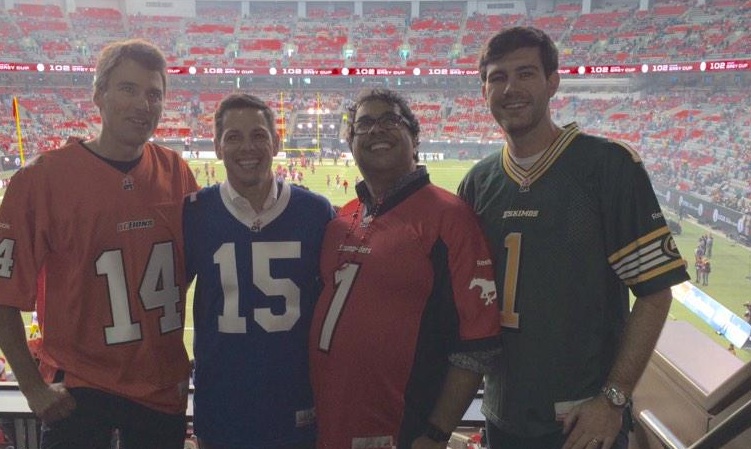
Western Canada’s Big City Mayors at the 2014 Grey Cup in Vancouver. From left to right: Vancouver Mayor Gregor Robertson, Winnipeg Mayor Brian Bowman, Calgary Mayor Naheed Nenshi and Edmonton Mayor Don Iveson. Photo credit: @misssarahchan
As the collapse of the Wildrose Party and speculation about Alberta’s next provincial budget dominate political discussions, one of the most politically important discussions impacting governance in our province next year could be about the creation of City Charters.
In his first month as Premier, Jim Prentice met with Edmonton Mayor Don Iveson and Calgary Mayor Naheed Nenshi to restart discussions around the creation of City Charters for Alberta’s two largest cities.
A recent survey conducted by ThinkHQ Public Affairs Inc. and provided to daveberta.ca shows Mr. Iveson and Mr. Nenshi with 74% and 70% approval ratings. For Mr. Iveson, this is an impressive increase from a survey in March 2014 in which respondents gave him 70% approval rating.
“The two mayors of the big cities are the second and third most powerful politicians in the province,” ThinkHQ President Marc Henry told this blogger. “The mayors are obviously the two people in the province Premier Prentice has to take into consideration,” Mr. Henry said.
The popular mayors have made City Charters a priority. The adoption of charters would be a long overdue change that could recognize the crucial roles and responsibilities that our largest municipal governments have in the lives of millions of Albertans.
“Most Albertans like the idea of a charter but don’t understand it,” Mr. Henry explained. “The challenge with the city charter is defining it,” he said.
Civic charters are different in every city, but a “charter city” (a city with a civic charter) has its own stand-alone legislation, rather than following the general municipal government acts of the province. It is a special agreement between a province and city designed to meet the demands of city governance, usually by giving a city more tax-raising powers, along with more autonomy to set policy that will allow it to meet its individual needs.
The cities of Winnipeg, Vancouver and Toronto have City Charters passed by their provincial governments granting those municipalities increased levels of responsibility and access to additional revenue.
In an October 2014 blog post, Mr. Iveson explained why City Charters are important and why they can also be an abstract concept to explain:
The City Charter process can be an abstract concept; talking about roles and responsibilities with another order of government probably isn’t the sexiest thing for many people. But – I would argue – delivering on this is one of the most important factors in Edmonton’s future success. Correcting the imbalance in responsibility and authority with the Province is one of the most critical city building things we can do because it enables the ‘real work’ like building LRT lines and keeping our cities safe to actually happen.
Rather than a broad increase in taxation powers, City Charters in Alberta could include a more serious commitment to revenue sharing by the province as recognition that our big cities are no longer tiny localized organizations. They are important levels of government that provide services and infrastructure that also benefit millions of Albertans living outside the city boundaries.
Discussions about City Charters began in 2012 while Premier Alison Redford was in office but slowed down as political scandals engulfed the Progressive Conservative government. A Memorandum of Understanding signed by Mr. Iveson, Mr. Nenshi and Mr. Prentice on October 7, 2014 laid out the following timeframe for City Charters:
Phase one will address matters specific to the two cities and Municipal Affairs (MA) by Spring 2015;
Phase two will address matters between the two cities, MA and any other Government of Alberta ministries by Fall 2015; and
Phase three will address the development of a new fiscal framework for the two cities by Spring 2016.
The ThinkHQ online research panel had a sample size of 1656 people and was conducted between November 26 to December 1, 2014.
The Yards Podcast
In episode one of The Yards podcast, host Omar Mouallem talks with Mayor Iveson about downtown memories, bike culture and whether downtown development can survive another oil crash.
The mass-floor crossing, encouraged by Conservative Godfather Preston Manning, could increase the likelihood of an early 2015 general election. Now with 72 MLAs, the PCs are in a position to quickly nominate candidates across the province and take advantage of an opposition in disarray by calling a snap election early in the new year.
With Premier Jim Prentice increasingly warning of Alberta’s tough economic times, it is not far fetched to believe the PCs could seek a new mandate earlier than the 2016 fixed-election period. There is suspicion that Mr. Prentice wants to take advantage of the low price of oil in order to impose budget cuts before the price exits the “price trough” and begins to rise.
Rob Anderson
NDP MLA Brian Mason and blogger David Climenhaga suggest a snap election could be called in early January 2015, but it could be more likely the Tories would wait until February or March.
In their 43 years in government, it has been common for the PCs to table a provincial budget in February or March and then immediately drop the Writ of election in order to use the budget as their de-facto campaign platform. This timeline would also allow for an early 2015 cabinet shuffle to make room for floor-crossers Danielle Smith and Rob Anderson, and allow the Tories time to build their message around a “tough economic times” budget/campaign platform.
Mr. Prentice may also want to hold an election before more information is released by the R.C.M.P. regarding their investigation into Ms. Redford and her staff. The CBC reported on November 4, 2014 that a Justice Department internal review concluded Ms. Redford could face criminal charges if allegations about her use of government airplanes are proven by an RCMP investigation.
Doug Horner
The possibility of an early election should be a wake-up call for Alberta’s fractious non-conservative opposition parties, who are mostly contained within Alberta’s two largest cities. The lack of conservative vote split that the New Democrats, Liberals and Alberta Party had hoped to capitalize on may have vanished the moment Ms. Smith crossed the floor.
One potential speed bump to an early election could be dissent within the PC Caucus to the Wildrose MLA floor-crossing. I am told that more than a few PC MLAs are not pleased with their new colleagues of convenience, who have spent the past two years attacking and embarrassing them as the opposition. If Mr. Prentice suspects this internal dissent is potentially explosive, he may decide to hold off an election until tensions inside the PC Caucus cool down.
Fred Horne
It is yet to be seen if the hostility to the PC-Wildrose Caucus merger – including the RecallDanielle campaign – will die down or whether it will manifest itself into a real backlash at the polls. This could have a big impact on whether an early election is held. The defection has certainly left a bad taste in the mouths of many Albertans, but the political maneuver removes the most likely alternative that voters had to send a message to the Tories.
Despite having the luxury of a government-in-waiting for the past two years, it appears that the PC Party are once again are on a trajectory to form another massive majority and extend the their 43-year reign.
Wildrose candidates?
Drew Barnes
Before the mass floor-crossing, Ms. Smith’s Wildrose Party had nominated candidates in 28 constituencies. Following the leader-led defection, the number of nominated Wildrose candidates has dropped to 18.
Many of the party’s now-former MLAs were already nominated to run under the Wildrose banner in the next election. Of the five remaining Wildrose MLAs, only Drew Barnes, Pat Stier and Rick Strankman have been nominated to run in the next election.
And Lac La Biche-St. Paul-Two Hills MLA Shayne Saskiw‘s intentions remain unknown. It is suspected that Mr. Saskiw was waiting until after the Lakeland federal Conservative nomination to make a decision about staying in the Wildrose Caucus. His wife, past Wildrose candidate Shannon Stubbs, won the nomination late last week.
It is also likely that some of the already nominated Wildrose candidates will re-think their decision to run under that party’s banner in the next election. I am told that Edmonton Catholic School District Trustee Laura Thibert dropped out as the Wildrose candidate in Edmonton-Mill Woods earlier this month.
The NDP have nominated 10 candidates, not including their four MLAs and the Liberals have not yet started their candidate nomination process. Two Liberal MLAs, Kent Hehr and Darshan Kang, are leaving provincial politics to run as federal Liberal candidates in next year’s federal election.
Of the floor-crossers, none have publicly declared their plans to run for re-election as PC candidates, but many will try. And despite Mr. Prentice’s promised pledge of endorsement for their candidacies, the new PC MLAs could still face nomination challenges from their former opponents on the constituency level.
In Calgary-Shaw, arch-conservative activist Craig Chandler has already announced plans to seek the PC nomination, challenging Wildrose-turned-PC MLA Jeff Wilson.
ATTN #wrp Calgary Shaw members. You are welcome to help on my nomination campaign to defeat Jeff Wilson in the #pcaa nomination #ableg
Mass MLA defection cripples Alberta’s Official Opposition
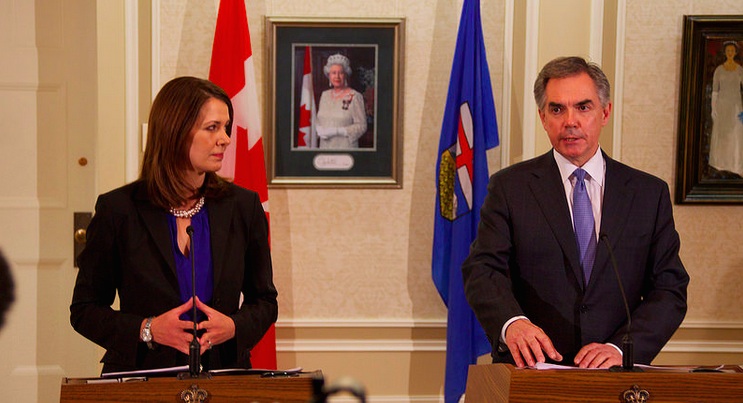
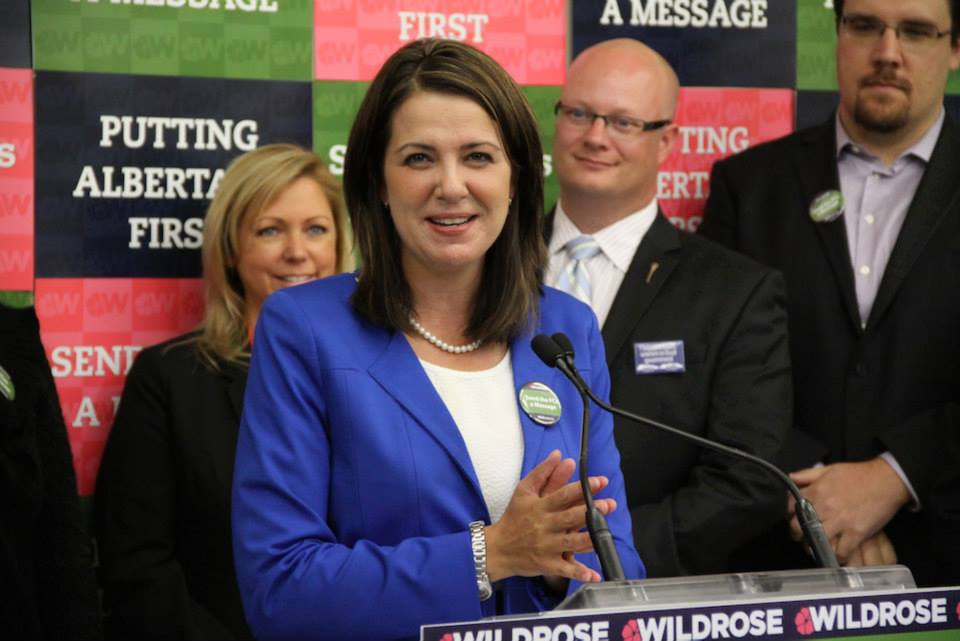
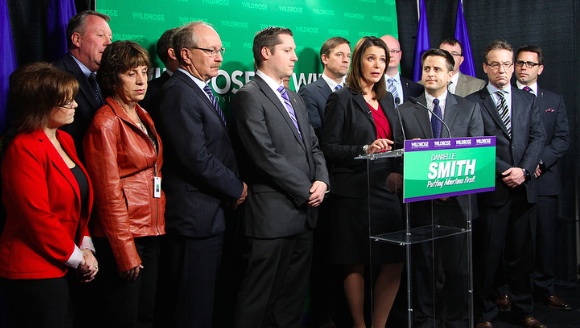
Danielle Smith and Jim Prentice make a grande entrance at yesterday’s press conference at Government House.
Anyone already cynical about politics in Alberta will have their views reinforced with yesterday’s announcement that Wildrose leader Danielle Smith and eight of her party’s MLAs have abandoned their role as the Official Opposition and joined the 43-year governing Progressive Conservatives.
Danielle Smith
After a five hour meeting of the PC Caucus at Government House, Premier Jim Prentice and Ms. Smith walked side-by-side down the staircase to announce news that nine Wildrose MLAs had been accepted into the government caucus.
It was a shrewd move that could be a decisive win for Mr. Prentice in the Conservative Civil War that the two parties have waged against each other since the mid-2000s. But what led to this mass exodus of Wildrose MLAs?
Many political watchers, including myself, have pointed to Mr. Prentice’s leadership or the September 2014 by-election losses as catalysts for today’s news, but one long-time reader and observer of Alberta politics shared a different view:
“The Wildrose was not founded on political principles, like the fiscal conservatism of the Progressive Conservatives, or the social democracy of the New Democrats – but rather it was created, out of nothing, for the sole purpose of exerting political pressure on the PC government.”
While the Wildrose Party was founded on a social conservative base, the purpose of the party was to pull the meandering centrist Tories back to their conservative political roots. Over the past four years the Wildrose has excelled at using wedge issues like oil and gas royalties and property rights to drive the political agenda in Alberta.
Premier Ed Stelmach‘s meddling with natural resource royalties led the oil industry to quickly begin funnelling donations to the Wildrose, then led by a photogenic former school trustee named Danielle Smith. When the PCs abandoned plans to raise royalties, the Wildrose honed in on property rights and stirred up a considerable amount of fear and resentment among rural landowners, who were mostly traditional PC voters.
The nutty social conservatives proved to be the Wildrose’s greatest weakness in the 2012 election, costing the party a chance at forming government. But the many blunders of Alison Redford’s embarrassing government gave the Wildrose a renewed lease on life.
And now, with Mr. Prentice as leader of the PC Party, it has become difficult to point out significant policy differences between the two parties. By refusing to meddle in the marketplace, halting the poorly written Bill 10 and pledging to protect property rights, Mr. Prentice has robbed the Wildrose of their most effective critiques of the PC Party.
The Wildrose Party still exists with a significant campaign war chest and a membership role of 23,000. But it now lacks a leader, which the party executive says it will soon begin a search for. The steps taken by the party over the coming weeks could determine whether it can actually recover or whether it will join the list of conservative fringe parties after the next election.
Despite Ms. Smith’s agreement with new premier, the departure of the nine MLAs is a betrayal of the party’s hundreds of volunteers and donors and the more than 440,000 Albertans who voted Wildrose in the last election.
Life as an opposition MLA in Alberta is not glamorous, but as the Official Opposition, those nine MLAs played a critically important role in our parliamentary democracy. The timing and nature of the floor crossing reeks of political opportunism. And the quality of our democratic system will be weaker tomorrow with the loss of these nine opposition MLAs into the government backbenches.
The five remaining Wildrose MLAs will technically form the Official Opposition, but with their party in disarray, many political observers are watching to see if another political leader -NDP leader Rachel Notley – is able to form an effective opposition to the 43-year governing PC Party.
The nine Wildrose MLAs who crossed the floor to the PCs are:
Wildrose leader Danielle Smith introduces candidate Tim Grover during the September 2014 Edmonton-Whitemud by-election.
For four years, Progressive Conservatives told Albertans not to trust those kooky and scary Wildrosers. At the same time, the Wildrosers told Albertans not to trust those crooked and corrupt PCs. Today, it now appears that the leaders of the two parties have now put the past four years behind them and are joining forces.
Following a Tuesday, Dec. 16 caucus meeting, it is being reported that six of the Wildrose Official Opposition’s 14 MLAs, including leader Danielle Smith, have decided to leave their party to join the 43-year governing PC. Calgary Sun columnist Rick Bell reported yesterday that PC leader Jim Prentice offered a “Reunification Agreement” as incentive to his opposition colleagues.
The governing PC Caucus will meet on Wednesday, Dec. 17 and are expected to discuss the acceptance of the six MLAs into their ranks. The addition of the six would bring the total number of Tories to 69 of 87 MLAs in the Assembly. The remaining eight Wildrose MLAs would remain Official Opposition.
The Edmonton Journal’s Graham Thomson reports that a cabinet shuffle could happen as early as Thursday to make room for the new MLAs.
Some sources say that Ms. Smith could become Mr. Prentice’s Deputy Premier and Mr. Anderson, a former PC MLA who joined the Wildrose in 2010, could be appointed to a senior ministry. Another potential cabinet appointment could be former Wildrose MLA Kerry Towle, who crossed the floor earlier this month.
Once source speculated that current PC ministers like Kyle Fawcett or Maureen Kubinec could be shuffled out of cabinet to make room for their new caucus-mates.
The phenomonally rapid collapse of the Wildrose Party raises questions about the unstable foundation of the party. Splits in the party became public after the loss of four by-elections and as Ms. Smith battled with party’s activists over an equality motion and her position in the Gay-Straight Alliances debate.
Just six months ago, the Wildrose Party was out-fundraising and outpolling the 43-year governing PCs. Only three months since becoming PC leader, Mr. Prentice has been able to demoralize, destabilize and now co-opt his main opposition.
The departure of the six could damage the Wildrose Party beyond repair and remove it as a viable political force in Alberta, at least in the short-term. Whatever your opinion of the party, the floor crossings are certainly a betrayal of the hundreds of thousands of voters who cast a ballot for Wildrose candidates in order to send the PCs a message.
Wildrose Party activists are pledging to fight any formal merger between the two parties, but the loss of high-profile leader Ms. Smith is a death-blow to the party.
The loss of Ms. Smith to the government benches and the crippling of her soon to be former party is also a blow to democracy in Alberta. After coming very close to winning the 2012 election, the Wildrose have been the most effective and aggressive opposition parties in recent memory. Their work exposed corruption and cronyism in the government and ended the careers of premiers Ed Stelmach and Alison Redford.
It is unclear who will replace Ms. Smith as leader of the Official Opposition, but candidates could includeShayne Saskiw or Drew Barnes. Neither have the provincial profile of their predecessor.
While the blow to the Wildrose could rob the non-conservative opposition parties of a conservative vote split in the next election, the decline of the Wildrose creates opportunities for other opposition leaders. This is especially true for new NDP leader Rachel Notleyand Alberta Party leader Greg Clark, who now have an opportunity to present an alternative vision to Mr. Prentice’s (and Ms. Smith’s) 43-year governing PC Party.
Awards…
I was pleased to discover that daveberta.ca earned second place in the 2014 Canadian Weblog Awards in the Politics category.
Congratulations to Gender Focus for their first place finish and John Ibbitson for placing third. Thank you to everyone who continues reading, commenting, contributing and sharing this blog.
Are more Wildrose MLAs preparing to cross the floor to the Progressives Conservatives? Independent MLA Joe Anglin has told reporters that Danielle Smith‘s 14 MLA Wildrose Official Opposition Caucus will vote on Tuesday, December 16, 2014 on whether to join the governing PC Caucus.
Rob Anderson
Mr. Anglin’s comments, claims published on an anonymously blog and tweets from conservative activists fuelled the rumours of the Wildrose Party’s demise on social media last night.
The sources of the rumours are questionable, but the curious silence of official Wildrose Party social media accounts suggests that the merger of the two caucuses could indeed be on the table when Wildrose MLAs meet on Dec. 16.
More reliable sources say that Mr. Anderson and Mr. Saskiw will make a presentation to their fellow MLAs on Dec. 16 detailing an offer extended by Mr. Prentice to Wildrose MLAs to join the PC Caucus. [Update: The Calgary Sun’s Rick Bell has obtained a copy of the “Reunification Agreement.”]
This is not the first time we have heard rumours of a merger. In May 2014, Ms. Smith told reporters that then-PC leadership candidate Jim Prentice had proposed a merger of the two conservative parties. At the time, Premier Dave Hancock denied the claims, but it was clear that Mr. Prentice was reaching out to Wildrose MLAs.
Drew Barnes
Since becoming Premier, Mr. Prentice has robbed the Wildrose of its most effective talking points by committing to focus on property rights and reversing many of former premier Alison Redford‘s most unpopular decisions. In some ways, it is now difficult to tell what differentiates the Wildrose Party from Mr. Prentice’s PCs.
Last month, Wildrose MLAs Ian Donovan and Kerry Towle, crossed the floor to the PC Caucus. And only weeks before that, Mr. Anglin left the Wildrose Caucus, claiming that a ‘civil war‘ was being waged within the party.
After losing four by-elections in October 2014 and losing three MLAs since then, the normally loud Wildrosers have toned down, and in some cases struck a more conciliatory tone with the governing PCs.
Kerry Towle
Even normally hyper-partisan Justice Minister Jonathan Denistweeted about working with Mr. Anderson on a Wildrose Caucus amendment to Bill 2: Alberta Accountability Act. If that does not signal a warming of relations between the two caucuses, I’m not sure what else would.
But despite the party’s recent poor showing, a Wildrose Party led by Ms. Smith could still remain competitive going into the next election.
The party has collected an impressive war chest and has nominated candidates in more than a quarter of Alberta’s constituencies. Recent polls show the party sitting at 29% support, only five points behind Mr. Prentice’s PCs.
The question is whether the change in tone signals a new strategy or preparation for a merger with the 43-year governing PC Party? If there is truth to the merger rumours, the departure of more Wildrose MLAs (including Ms. Smith) would be a death blow to that party.
What would a Wildrose-PC Caucus merger mean?
Raj Sherman
MLAs crossing the floor is a fairly common occurrence in Alberta and Canadian politics, but I cannot think of any time when an Official Opposition Caucus has voted to merger with a governing caucus.
Unlike the merger of the federal Canadian Alliance and PC Party that created the Conservative Party of Canada in 2003, there is little to no chance another party will form government in the next election (in the context of 2003, a PC-Wildrose merger would be more like Stephen Harper‘s Canadian Alliance joining Paul Martin‘s Liberal Party).
In a scenario where nearly all the Wildrose MLAs crossed the floor to the PC Party, Raj Sherman‘s five MLA Liberal Caucus could regain its role as the Official Opposition. But the Liberals would only hold that title until MLAs Kent Hehr and Darshan Kang resigned to run in the October 2015 federal election. Upon their resignations, Rachel Notley‘s four MLA NDP Caucus could become the Official Opposition.
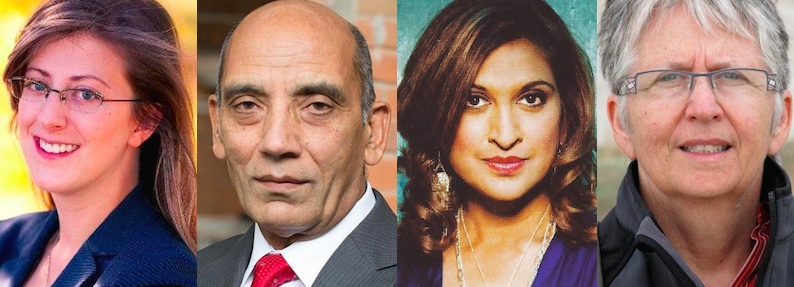
Stephane McLean, Tariq Chaudary, Nirmala Naidoo, and Annie McKitrick.
With signs pointing towards a potential spring 2015 federal election, Canada’s opposition parties are picking up pace in nominating candidates. The Liberals, NDP, Greens and Libertarians are far behind the Conservatives in nominating candidates in Alberta, but they are in the process of compiling their slates. A full list of federal nominated candidates in Alberta can be found here.
Here are some of the latest nomination updates since I wrote about this topic last week.
Calgary-Rocky Ridge: Qamar Khan will be challenging former CBC news anchor Nirmala Naidoo for the Liberal Party nomination in this new northwest Calgary constituency. The nomination meeting is scheduled to take place on Dec. 16, 2014.
Calgary-Shepard: Dany Allard is expected to be acclaimed as the NDP candidate at a Dec. 15, 2014 nomination meeting. Mr. Allard will face nominated Conservative candidate Tom Kmiec.
Edmonton-Centre: Blaine Bilocerkowec has been nominated as the Libertarian Party candidate.
Edmonton-Griesbach: Former city councillor Kerry Diotte defeated Omar Tarchichi in this riding’s Conservative Party nomination. Mr. Diotte is a former Edmonton Sun columnist and one-term city councillor who ran in the 2013 mayoral election under the slogan “Diotte or Detroit” (suggesting that the City of Edmonton would go bankrupt unless he was elected mayor). Mr. Diotte earned 15% of the vote in the mayoral election won by Don Iveson.
Edmonton-Riverbend: Tariq Chaudary defeated Tom O’Leary at a November 29, 2014 nomination meeting to become the Liberal candidate in this south west Edmonton constituency.
Edmonton-West: Andrew Mclean has been nominated to run as a Libertarian Party candidate. Dan Bildhauer and Greg Springate are running in the yet to be scheduled Liberal Party nomination.
Foothills: Artist and businessperson Romy Tittel was nominated as the Green Party candidate.
Lakeland: Past Wildrose Party candidate Shannon Stubbs and former constituency president Terry James are seeking the Conservative nomination in this sprawling rural riding. Ms. Stubbs is married to Lac La Biche-St. Paul-Two Hills Wildrose MLA Shayne Saskiw. She was the Wildrose candidate in Fort Saskatchewan-Vegreville in the 2012 election and the Progressive Conservative candidate in Edmonton-Strathcona in the 2004 provincial election.
Red Deer-Lacombe: Jeffery Rock has announced plans to seek the Liberal Party nomination. Mr. Rock is the Minister at Gaetz Memorial United Church in Red Deer.
Sherwood Park-Fort Saskatchewan: Annie McKitrick is seeking the NDP nomination in this riding east of Edmonton. The nomination meeting is scheduled to be held on Feb. 12, 2015.
Yellowhead: Two recent by-elections candidates have announced plans to run in the next general election. Hinton town councillor Ryan Maguhn is seeking the Liberal nomination on Dec. 19, 2014 and Cory Lystang has been nominated as the Libertarian candidate. Mr. Maguhn earned 19.9% of the vote in the recent by-election.
“They don’t know what to do with tough economic times. It was easy enough to govern when the money was flowing in, when things were going well. They took all the credit for it at that time. It’s much harder to govern, and the mark of a good government is how they handle it, when times get difficult.” – Ray Martin, Leader of the Official Opposition (June 13, 1986)
Jim Prentice
Despite Alberta’s prosperity, Premier Jim Prentice is warning we could be heading into tough economic times. The decline in the world price of oil has spooked the 43-year governing Progressive Conservative establishment and the corporate elites in downtown Calgary.
The perilous “price trough” has led Mr. Prentice to warn of a potential $7 billion revenue shortfall if oil prices remain at lower than expected levels for the entire 2015/2016 fiscal year. According to a government spokesperson, some of the missing $7 billion could come from revenue streams such as land leases, but at this point the number is largely based in speculation and politically spin.
Mr. Prentice’s prophetic $7 billion shortfall becomes more startling when learning the Alberta Government is projected to collect only $7.5 billion in crude oil and bitumen royalty revenue in the 2014/2015 budget year. This projected revenue is based on the price of Western Canada Select (WCS) oil remaining at $77.18 per barrel. Although the yearly average price is $84.02 per barrel the current price of WCS has dropped to $48.44 per barrel.
Ray Martin
If the “tough economics times” message sounds vaguely familiar, that is because it is. In oil-rich Alberta, we hear a lot from our political leaders about tough economic times, even when times are prosperous. In most cases, our politicians are managing voters’ expectations and positioning themselves to take credit as ‘prudent fiscal managers’ when the world-wide price of oil inevitably increases.
The sharp decline of natural gas royalty revenue and that year’s world-wide recession, which felt more like a mild economic pause in Alberta, even convinced the Tories to amend the Klein-era Fiscal Responsibility Act to allow the government to pass deficit budgets.
And in January 2013, Premier Alison Redford used a televised address to warn Albertans that a $8 billion shortfall in the provincial budget was being caused by an ominous “bitumen bubble.” Ms. Redford’s bubble was then used as justification to slash funding to colleges and universities by 7% in that year’s budget.
Ron Liepert
But the PCs have not always predicted “tough economic times.” In 2012, then-finance minister Ron Lieperttold the Calgary Chamber of Commerce to expect $16 billion in projected resource revenues by 2015. A huge jump in revenue would certainly increase the likelihood of Mr. Prentice calling a provincial election in early 2015.
Alberta’s government has heavily depended on revenue from cyclically priced resource commodities for decades. After years of unrestrained growth, no one should be surprised that Alberta’s economy could slow down.
The question is how we respond to actual tough economic times in Alberta. Was NDP Official Opposition Leader Ray Martin correct in 1986 when he said that “they don’t know what to do with tough economic times”?
While some right-wing think tanks call for a return to brutal slash and burn fiscal policies, the implementation of real long-term financial planning would probably be a more mature solution.
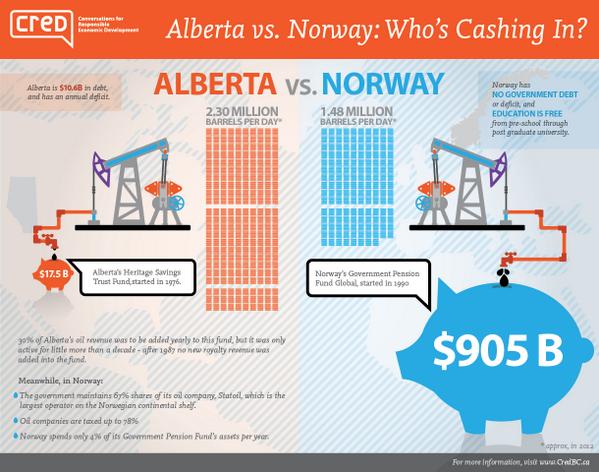
Comparing Alberta’s Heritage Fund and Norway’s Petroleum Savings Fund.
Norway, a country with 5.1 million people, invests oil revenues into the Government Pension Fund Global and contains more than $857 billion. The fund was established in 1990 to smooth out the disruptive effects of highly fluctuating oil prices. Oil-rich jurisdictions like Norway prove that economies can be both economically prosperous and environmentally green.
Peter Lougheed
Alberta, a province of 3.6 million people, launched the Alberta Heritage Savings Trust Fund in 1976. Under the leadership of Peter Lougheed, the Heritage Fund initially received 30% of government resource revenues and was worth $12.7 billion in 1986. The Heritage Fund is now worth only $17.4 billion.
Facing tough economic times in 1987, the PC government of Don Getty halted all transfers to the Heritage Fund. Zero deposits were made between 1987 and 2004.
This week, PC MLAs passed Bill 11: Savings Management Repeal Act, which repealed the Savings Management Act, which was enthusiastically passed by the same group of PC MLAs in March 2014. The earlier bill would have diverted resource revenue to the newly created Alberta Future Fund, Social Innovation Endowment account and Agriculture and Food Innovation Endowment. The bill passed this week eliminates those new funds.
Kevin Taft
Despite talk of revenue diversification, it is questionable whether the governing PCs would seriously consider increasing resource royalties, reinstating a progressive taxation system or introducing a provincial sales tax.
While many politicians view tax increases as politically unpalatable, a slight tax increase would not destroy the our province’s economy. “If Alberta increased its tax rates by $11 billion our province would still have the lowest tax rate in Canada,” Kevin Taft wrote in his 2012 book, Follow the Money.
Dr. Taft’s book breaks down government spending patterns over the past 30 years and details how corporate profits have skyrocketed in Alberta at the same time the PC Government has struggled with deficit budgets.
As a province with decades worth of dependence on revenues from natural resource royalties, it should not be a shock that we need to be smarter about how we plan and finance our government spending. Maybe our only problem is not our over reliance on cyclical natural resources revenues, but that the Progressive Conservatives are just bad fiscal managers.
Located north east of downtown on the Northlands Exposition Grounds, Rexall Place is an aging facility and, unlike the planned entertainment district surrounding the new downtown arena, the current arena is located inside a concrete no-man’s land surrounded by residential neighbourhoods.
As a homeowner in the Bellevue neighbourhood directly east of the Northlands Grounds, I am naturally interested in the future of Rexall Place, which could both impact the future quality of the area neighbourhood and the property value of my home. In fact, part of the current Northlands Grounds were once part of Bellevue, before the blocks of houses were demolished to make way for an expansive parking lot.
Northlands has named a 17-person strategy committee to help determine the future of Rexall Place. While it is a good sign that Northlands is now weighing its options, it is concerning that the committee does not appear to include any residents of the neighbourhoods surrounding the arena.
As a neighbour who has politely lived through the lively crowds of KDays, has not complained publicly about the sounds of SONiC BOOM, and who chooses to recycle the empties deposited on our lawn after hockey games, it is my hope that the committee will seriously consider what the implications of their decisions will be on the local community.
I hope that Northlands will listen to the advice and ideas of the residents living in the neighbourhoods surrounding the soon to be former arena. While Northlands provides venues for the entire city and northern Alberta, the people living with the arena in their backyard deserve to be given significant input into the decision making process.
I worry that in the rush to compete with the new downtown arena district, Northlands may miss bigger opportunities.
Northlands would be wise to look to the revitalization of 118th Avenue (also known as Alberta Avenue) to its west and become part of the ongoing renewal. Although large parts of the area are still rough around the edges, the area has come a long way. Drive down 118th Avenue on a Saturday morning and you will discover bustling locally-owned butcher shops, bakeries, cafes and grocery stores.
The redevelopment of Borden Park, south of the Northlands Grounds, could provide inspiration for the future of the current concrete expanse that surrounds Rexall Place. A friendlier and greener area would certainly be more welcoming than the current expanse of concrete walkways and parking lots.
Northlands should also consider the success of the nearby Commonwealth Community Rec Centre, adjacent to Commonwealth Stadium (home to the Edmonton Eskimos), in providing value for residents in this area of the city. Rather than just being a venue for travelling carnivals, conferences and cattle shows, Northlands should look at ways the arena space can become more relevant to the communities that surround it.
Given the opportunities available to the Northlands committee and future developers, the worst thing that could happen would be to leave the arena as it is; devoid of street interaction, free of community building activities and unfriendly to better development.
The departure of the Edmonton Oilers from Rexall Place presents a unique opportunity for Northlands to engage the residents living in the area. Just as the arena district is reshaping the area north of downtown Edmonton, the redevelopment of the arena could present a positive opportunity for residents north east of downtown.
Thank you to everyone who reads daveberta.ca, leaves comments, shares links, and provides a wealth of feedback through email and direct messages. You make it worth writing.
Justice Minister Jonathan Denis, Liberal MLA Laurie Blakeman, Premier Jim Prentice and PC MLA Sandra Jansen
It is sometimes amazing how quickly one political issue can transform and dominate the debate. This week’s raging debate about allowing Gay-Straight Alliances (GSA) in Alberta schools has twisted and turned so many times, it has become difficult to figure out who is in and out of the closet on this issue.
Wikipedia defines a Gay-Straight Alliance as student-led organizations that are intended to provide a safe, supportive environment for lesbian, gay, bisexual, transgender, and queer/questioning (LGBTQ) youth and their straight allies. A recent study from the University of British Columbia found that Canadian schools with GSAs may reduce the odds of suicidal thoughts and attempts among both sexual minority and straight students.
Here is a simple timeline following the ongoing provincial debate around these student clubs in Alberta schools:
“Be it resolved that the Legislative Assembly urge the government to introduce legislation, like Manitoba’s and Ontario’s, requiring all school boards to develop policies to support students who want to lead and establish gay-straight alliance activities and organizations, using any name that is consistent with the promotion of a positive school environment that is inclusive, welcoming, and respectful for all students regardless of sexuality, sexual orientation, or gender identity.”
A coalition of 31 Progressive Conservative and Wildrose MLAs vote down Motion 503. Nineteen Liberal, NDP and PC MLAs, including PC anti-bullying Minister Sandra Jansen vote in favour of the motion.
October 15, 2014: Liberal MLA Laurie Blakemanannounces plans to introduce a private members’ bill to mandate school boards to develop policies to support students who start a gay-straight alliance in their schools by offering meeting space and benefits given to other clubs.
November 15, 2014: At the party’s annual policy convention, Wildrose members reject a ‘definitive’ statement on equality. Party members voted against adopting as policy a statement affirming the rights for everyone regardless of race, religion, sexual orientation, and other differences.
November 22, 2014: Attending the annual Gay-Straight Alliances conference at the University of Alberta, Edmonton Mayor Don Iveson speaks in favour of Bill 202. “People don’t all come in the same shapes and sizes, colours and genders so it is important that a space everyone is compelled to go to as part of their education makes space for everyone,” Mr. Iveson told reporters.
Wildrose MLA Rob Anderson proposes amendments to Bill 202 which would allow Catholic and other religious schools to opt-out of allowing student to form gay-straight alliances.
November 25, 2014: Mr. Prentice announces that PC MLAs will be allowed a “free vote“ on Bill 202. Mr. Donovan tells CBC that the PC Party is now more socially conservative than the Wildrose Party and that the GSA vote contributed to his joining the PC Party.
November 27, 2014: At a hastily called press conference, Mr. Prentice declares that Ms. Blakeman’s bill was no longer needed because he plans to introduce his own bill dealing with Gay-Straight Alliances. Arguing in favour of ‘parental rights,’ Mr. Prentice says his bill will allow school boards to decide whether GSAs should be allowed. If students are turned down, Mr. Prentice says they can take legal action against their school boards. It is suspected that Mr. Prentice’s bill was not yet written at this time.
December 1, 2014: Mr. Dirks, Ms. Jansen and Justice Minister Jonathan Denis hold a press conference during the time originally allotted to debate Bill 202. Bill 10: An Act to Amend the Alberta Bill of Rights to Protect our Children is introduced into the Legislature by Ms. Jansen and passes first reading. ‘We’re moving forward. We’re moving forward incrementally,‘ said Ms. Jansen on the issue of gay rights. The Edmonton Journal and Calgary Herald publish editorials harshly critical of Bill 10.
December 2, 2014: Bill 10 passes second reading and procedurally removes Bill 202 from the legislative order paper. Forty-two PC and Wildrose MLAs vote in favour and 9 opposition MLAs, including Ms. Blakeman, Ms.Smith, NDP leader Rachel Notley and Liberal leader Raj Sherman, vote against the bill.
Only one PC MLA, Thomas Lukaszuk, votes against it. “I simply do not believe in incremental granting of human rights,” Mr. Lukaszuk told the media. “We didn’t give women half a vote, we gave them a full vote during the suffrage debate.”
“Gay-Straight Alliance? No! Get back in the closet!” Said with fingers in their ears and their eyes closed #Bill10 — Jon Cornish (@jonnycornish) December 3, 2014
Ms. Jansen introduces an amendment that opposition parties say will simply segregate gay students and move their support groups out of schools entirely. “That student now does not have to go to the court, they come to the Alberta ministry of education and we provide that GSA for them, and hopefully within the school environment,” Jansen said in the Assembly. “But if that is impossible, we’ll make sure they get that GSA regardless.” Education Minister Mr. Dirks was silent during this debate and Mr. Prentice was not in attendance.
The amendment passes with the support of 38 PC MLAs, including Mr. Dirks. PC MLAs Doug Griffiths, Mr. Donovan and Mr. Lukaszuk join with 14 opposition MLAs and vote against the amendment. PC MLA Jason Luan spoke against Bill 10, but was absent during the vote on the amendment.
December 4, 2014: Former PC MLA and Senator Ron Ghittertells the Calgary Herald he is disappointed in the “backwards” legislation put forward by Mr. Prentice’s government to deal with the issue of gay-straight alliances in schools.
BT Edmonton host Ryan Jespersen uses his platform on the popular morning television program to castigate PC MLAs for their support of Bill 10.
Popular artists Tegan and Sarah published a post on their blog against Bill 10 and well-known Canadian entertainer Rick Mercer also takes aim at Mr. Prentice’s Bill 10 and his position on gay rights.
“Rights are never absolute,” Prentice told reporters. Nice ring to it Jim maybe that should be on the licence plate. #Bill10#cdnpoli
A number of PC Party members announce their resignations from positions in their party in opposition to Bill 10. Calgary-Bow PC association President Josh Traptowannounced he resigned in order to speak out against Bill 10. Former Calgary City Council candidate Chris Harper announced on Twitter that he left the PC Party and resigned from his local PC constituency association. And Brenda Meneghetti, campaign manager for former leadership candidate Ken Hughes, announced she has left the PC Party because of Bill 10.
After facing four-days of widespread opposition and condemnation, Mr. Prentice announces at a hastily arranged press conference that he is putting Bill 10 on hold and that is postponing the third reading vote on the controversial bill.
“Bill 10 has added to, rather than resolved these divisions, and I accept personal responsibility for that as the premier,” Mr. Prentice told reporters. Following Mr. Prentice’s backtrack on Bill 10, Ms. Blakeman announced plans to ask the Legislature to resurrect her original Bill 202.
With the next federal election less than one year away, the Conservative Party of Canada is close to nominating a full slate of candidates in Alberta’s 34 newly redrawn ridings. By my count, Calgary Rocky Ridge, Edmonton-Griesbach, Edmonton-Riverbend, Lakeland and Peace River-Westlock are the only ridings without nominated Conservative candidates in this province. The other parties lag behind, with the Liberals only having nominated eleven candidates, the NDP four and the Green Party only two.
Nirmala Naidoo
Calgary-Rocky Ridge The Liberals rolled out a high-profile nominee in this northwest Calgary constituency. Former CBC News anchor Nirmala Naidoo has announced her plans to seek the Liberal nomination, scheduled for December 16, 2014.
Five candidates are contesting the Conservative nomination in this constituency. Party activist Gord Elliott has collected endorsements from Nova Scotia MP Scott Armstrong and Manitoba Senator Donald Plett. City of Calgary lawyer Paul Frank also ran in Alberta’s 2012 Senator-in-Waiting election. Patrick Kelly is a Conservative Party volunteer and former Real Estate Board member. Teacher and homebuilder Dan Morrison was a third candidate in his party’s painful Calgary-Signal Hill nomination. And ArnieStephens is a retired oil and gas business executive with the endorsement of former MP Eric Lowther, who had initially announced plans to run in this nomination contest.
Michael Cooper
St. Albert-Edmonton
Long-time partisan activist and lawyer Michael Cooper defeated past Edmonton-Strathcona candidate Ryan Hastman to become the next Conservative candidate in this suburban riding.
Mr. Cooper is known in political circles for his hard-line conservative positions and has been involved in politics since he was a teenaged national director of the Canadian Alliance Party. His previously electoral experience includes running a generously self-financed campaign for St. Albert City Council at the age of 19 (he was unsuccessful in that bid).
Mr. Cooper will face incumbent Independent Member of Parliament Brent Rathgeber. Mr. Rathgeber has been harshly critical of Prime Minister Stephen Harper since he resigned from the Conservative caucus in 2013.
Terry Hogan
Peace River – Westlock
Former Member of Parliament Albert Cooper is looking to make a political comeback. The Progressive Conservative MP for the former Peace River riding from 1980 to 1993 faces school principal Terry Hogan for the Conservative nomination.
Calgary-Centre Popular Calgary-Buffalo Liberal MLA Kent Hehr was nominated as the federal Liberal candidate in this hotly contested riding on Nov. 28. First elected to the provincial assembly in 2008, Mr. Hehr will face off against Conservative incumbent Joan Crockatt. Ms. Crockatt was narrowly elected in a 2012 by-election that saw her party’s share of the vote drop by 18,210 votes. Only a sharp vote split between Liberal Harvey Locke and Green Chris Turnerensured a Conservative win.
Kerry Diotte
Edmonton-Griesbach
On Dec. 6, former city councillor Kerry Diotte and party organizer Omar Tarchichi will face off for the Conservative nomination in this redrawn east Edmonton riding.
The current Edmonton-East riding is represented by MP body-cam advocatePeter Goldring, who plans to retire after 18 years in Ottawa. Mr. Tarchichi has received Mr. Goldring’s endorsement and both candidates have been endorsed by former premier Ed Stelmach. Mr. Diotte’s former council colleague Tony Caterina has endorsed Mr. Tarchichi.
Sherwood Park – Fort Saskatchewan Past Wildrose candidate Garnett Genuisdefeated three competitorsone competitor to win the Conservative nomination in this new riding east of Edmonton. In the 2012 provincial election, Mr. Genuis ran as the Wildrose candidate in the Sherwood Park constituency, placing second behind PC candidate Cathy Olesen.
The Liberals nominated lawyer Rodney Frank on Nov. 25. A Liberal press release describes Mr. Frank has working in the “telecommunications industry” and specializing “in competition and antitrust law.”
I am maintaining a list of candidates who have announced their intentions to seek nominations and run in the next federal election in Alberta ridings. Please contact me at david.cournoyer [at] gmail.com for additions or updates related to candidate nominations in Alberta.
November 24, 2014 marked 25 years since members of the Canadian Parliament voted unanimously to end child poverty in our country. The motion introduced by then-NDP leader Ed Broadbent supported abolishing child poverty in Canada by the year 2000.
Twenty-five years later, we are far away from reaching this goal.
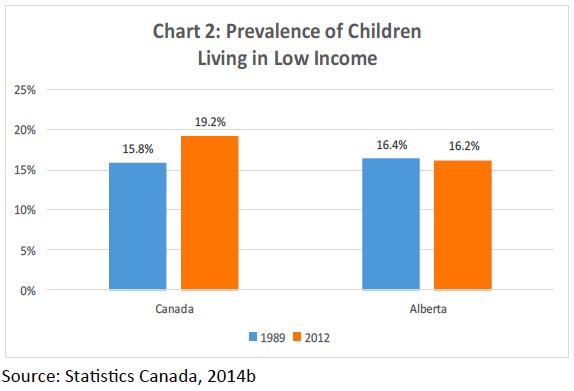
The numbers in the report are depressing but important to recognize. According to the report, the percentage of Alberta children living in poverty is essentially unchanged since Mr. Broadbent’s motion was passed in 1989.
Unemployment is not necessarily the main cause of child poverty in Alberta. The report shows that in 2011, a record high of 59.2% of children in poverty lived in a household where one or more persons were working full-time job.
According to the report, Alberta’s income inequality has increased faster than the national average, with the top 1% of earners seeing real income increases of over 60% since 1982 while the bottom half of income earners only saw a small increase of 3.4%.
The report also shows that in March 2014, more than forty-nine thousand Albertans accessed food banks, an increase of 2.3% from 2013 and 48.2% higher than in 2008.
The recent Homeless Count found 2,252 people without a home in Edmonton, an increase of 3.5% from 2012. The number of youth increased by 17% from 481 to 562. Of all those counted in the survey (including non-youth), 47% identified as being of Aboriginal heritage.
But despite an intense political focus in Alberta on low taxes and oil pipeline expansion, the discussion around income-inequality and eliminating poverty has gained some attention in recent years.
“There are over 100,000 Edmontonians living below the poverty line, 30,000 of whom are children. For me, that is not acceptable,” Mr. Iveson said in a press release earlier this year.
Speaking to a group of Edmontonians during a break from budget hearings last week, Mr. Iveson explained some of the ways Edmonton can help contribute to the reduction of child poverty through public library education programs and reduced-fee transit passes for low-income parents.
“Poverty elimination will be the result of good prevention,” Mr. Iveson said, as he explained the need for a renewed focus on the social determinants of health.
“If we don’t deal with some of those things proactively they can become policing challenges, which is the most expensive thing we do,” he said.
As city governments are limited in their resources compared to provincial and federal governments, he spoke to the need for municipalities to pressure MLAs to make much needed funding increases to Family and Community Support Services.
It is shameful that child poverty in Canada still exits in 2014, twenty-five years after every Member of Parliament stood and committed to eliminating it by 2000. And in a wealthy and prosperous jurisdiction like Alberta, where we have the financial means and ingenuity to ensure every resident can live outside of poverty, there is no excuse why child poverty still exists.
Liberal MLA Laurie Blakeman (second from the left) introduced a private members’ bill that would stop school boards from blocking the student-led creation of Gay-Straight Alliances.
What does it look like when a politician tries to build his credibility among social conservative voters? We found out this week when Premier Jim Prentice sideswiped Edmonton-Centre Liberal MLA Laurie Blakeman’s private members’ bill – Bill 202: Safe and Inclusive Schools Statutes Amendment Act, 2014 – that would allow students to form Gay-Straight Alliances (GSAs) in Alberta schools.
Although Mr. Prentice initially said Progressive Conservative MLAs would be allowed a ‘free vote’ on Bill 202, he changed his mind late this week.
At a hastily called press conference held on Nov. 27, Mr. Prentice declared that Ms. Blakeman’s bill was no longer needed because he was going to introduce his own bill.
Under the guise of protecting school board rights, Mr. Prentice’s soon to be introduced bill would add sexual orientation to the list of prohibited grounds of discrimination in the Alberta Bill of Rights while continuing to allow individual school boards to decide whether the student GSA clubs can exist.
Gordon Dirks
This would allow publicly funded religious schools, like Catholic school boards, the power to deny students the ability to create safer and more welcoming environments for their sexual minority classmates. Essentially, if a school board votes to discriminate against students for religious reasons, it is okay.
Although Mr. Prentice’s bill has not yet been made public, it is expected to allow some recourse for students. If students feel their attempts to create GSAs were unjustly blocked, they can take legal action against the school boards. That is correct, Mr. Prentice’s bill could force schools kids to hire lawyers to fight school board decisions.
Unsurprisingly, there was a lot of outrage on social media against Mr. Prentice’s bill. But Ms. Blakeman’s bill was never likely going to pass in the first place.
It is not hard to see what Mr. Prentice is doing. He is a shrewd politician and he is trying to play both sides of the debate with the next election in mind. On one side, he cannot afford to allow Ms. Blakeman to make his party look like a group of backward social conservatives by not supporting her bill. At the same time, he is trying to appeal to those same backward social conservatives who want him to oppose her bill.
Wildrose leader Danielle Smith may have created an opening for Mr. Prentice to appeal to these social conservative voters when she openly suggested her party’s MLAs would vote in favour of Ms. Blakeman’s bill.
Ian Donovan
Before the Premier’s announcement, Wildrose MLA Rob Anderson had introduced a series of amendments to the Liberal bill that would have watered down sections considered the most offensive to social conservatives.
Education Minister Gordon Dirks, who is also the former chair of the Calgary Board of Education, has remained noticeably silent during this debate. Having faced criticism during his recent by-election about his relationship with evangelical religious schools in Calgary, perhaps it is not surprising that he is not Mr. Prentice’s spokesperson on the issue of Gay-Straight Alliances in schools
After you wade through the politics on all sides of this issue, it is important to remember what this debate is really about: whether individual students can, without interference from narrow-minded school administrators, board politicians or parents, create clubs that are proven to help make school environments more safe and welcoming for some of their classmates.
The Wildrose Official Opposition started the month of November with 17 MLAs and might be ending it with only fourteen. Today, Progressive Conservative leader Jim Prentice, flanked by Little Bow MLA Ian Donovan and Innisfail-Sylvan Lake MLA Kerry Towle, announced at an afternoon press conference that the two Wildrose MLAs were joining the PC Government Caucus.
Ian Donovan and NDP MLA David Eggen protesting the closure of the Little Bow Health Centre at a rally in front of Alison Redford’s constituency office on August 14, 2012.
The floor-crossings come at the end of a tumultuous month for Danielle Smith’s Wildrose Party, which began with the sting of defeat in four by-elections and the departure of Rimbey-Rocky Mountain House-Sundre MLA Joe Anglin, who now sits as an Independent MLA.
Kerry Towle
Ms. Smith tried to demonstrate her party had modernized at its recent annual meeting but was sideswiped by angry conservative activists, who voted down a motion recognizing equality for specific minority groups and then blamed the media for the party’s poor reputation.
The loss of three MLAs in such a short period of time raises questions about Ms. Smith’s future as leader. As the party’s most recognizable face, she is one of her party’s strongest assets. But if more MLAs decide to leave her caucus and the internal turmoil continues, will her leadership survive until the next general election?
Jim Prentice
Since becoming PC Party leader in September, Mr. Prentice has strived to distance his party from the toxic memory of Alison Redford and Ed Stelmach. He has skillfullyrobbed the Wildrose of its strongest talking points by proposing the repeal of unpopular property rights laws, stalling the closure of the Michener Centre, announcing the sale of the government’s fleet of airplanes, firing cabinet ministers too closely associated with the previous leader and a handful of other lightening rod issues.
He also has deep roots in Canada’s Conservative establishment, serving as a federal cabinet minister in Ottawa and as a bank executive on Bay Street. And the PCs are using Mr. Prentice’s Tory credibility to invite former Tory supporters in the Wildrose party back under their big tent.
Mr. Prentice has started strong and still has plenty of time to stumble, especially with the prospect of declining natural resource revenues, which leads me to believe a provincial election may come sooner than the fixed date of Spring 2016.
Ken Boessenkool
The temptation to take advantage of a crumbling official opposition, which could lead to a lack of vote splitting among conservative voters might be too appealing to resist (a bad sign for the NDP, Alberta Party and Liberals). If there is one thing that is true of Alberta politics, it is that the PC Party knows how to consolidate and preserve its own power.
As Ms. Smith’s party struggles through a tough month, they need to figure out what fundementally differentiates them from the PC Party led by Mr. Prentice. One conservative strategist – Ken Boessenkool – has once again raised the idea of a potential merger of the two parties to create the “Conservative Party of Alberta.”
Despite its bleak prospects in the immediate future, political fortunes can shift quickly. But if the party’s fortunes do not improve soon, more MLA floor-crossings may follow.
Wildrose knows about floor-crossing
Wildrose leader Danielle Smith (centre) with MLAs Heather Forsyth and Rob Anderson in 2010.
Floor-crossing is a familiar activity for the Wildrose Party, but they are used to it going the other way. In 2010, the Wildrose received a big boost when then-PC MLAs Rob Anderson and Heather Forsyth left Mr. Stelmach’s PC Party to join Ms. Smith’s upstart party. Not long afterward, they were joined by former PC MLA Guy Boutilier, who had been sitting as an Independent MLA.
Over the course of its 43 years of uninterrupted power, one of the great successes of the PC Party has been its ability to build a big tent that includes individuals of all sorts of political persuasions. The two former Wildrose MLAs will now find themselves in the same caucus as two former Liberal MLAs who also crossed the floor to the PCs – Speaker Gene Zwozdesky and Lethbridge-East MLA Bridget Pastoor.
Over the past 25 years, there have been a total of six Liberal MLAs, one Representative Party MLA and one New Democrat MLA who have crossed the floor to the PCs. The lone NDP floor-crosser, Stony Plain MLA Stan Woloshyn, made himself comfortable in the Tory Party ranks as a Ralph Klein-era cabinet minister.
Should floor-crossing be illegal?
Thomas Lukaszuk
In 2010, following Mr. Anderson and Ms. Forsyth’s departure from the PC Caucus, Edmonton-Castle Downs PC MLA Thomas Lukaszuk declared that floor crossing should be banned. PC MLA Jonathan Denis responded to the defections by telling Sun Media that “[t]he Wildrose talks about parliamentary recall — why not initiate that and run in a byelection?”
Manitoba is the only province that currently prohibits MLAs from crossing the floor. If an MLA wishes to leave their party, they must step down and run in a by-election or sit as an Independent MLA until the next election.