Categories
Dave Taylor David Swann Ed Stelmachh Kevin Taft Mo Elsalhy

david swann’s 1st anniversary.

Yesterday marked the first year anniversary of Calgary-Mountain View MLA David Swann becoming leader of the Alberta Liberal Party and Leader of the Official Opposition in Alberta’s Legislative Assembly. In the race to replace former leader Kevin Taft, Swann was selected on the first ballot with 2,468 votes, compared to 1,616 for Calgary-Currie MLA Dave Taylor and 491 votes for former Edmonton-McClung MLA Mo Elsalhy.

Swann is one of the most sincere MLAs that I have had the pleasure to meet, but since entering his current role his party has continued to struggle to define itself and has had difficulty creating messages that resonate with Albertans. Although Swann entered his role under the banner of internal party reform, the attempts at reform appear to have stalled. Media releases from the Official Opposition offices sometimes include aggressive quotes that I have a difficult time imaging coming out of gentle Swann’s mouth, leading me to believe that he has yet to fully discover his voice in his role.

The Liberals appeared to have stalled after their narrow defeat in this year’s Calgary-Glenmore by-election, but according to a recent poll, the party is tied with Premier Ed Stelmach‘s PCs at 25% province-wide and has second place support in Edmonton and Calgary.

Categories
Edmonton Downtown Arena Edmonton Oilers The Katz Group

crying wolf.

June 25, 2009: Cal Nichols said that losing the City Centre Airport would have a greater economic impact than if the city lost the Oilers.

December 13, 2009: The future of the Katz Group owned Oilers won’t be secure in Edmonton unless a new arena is built, says former Oilers owner Cal Nichols, an adviser on the new downtown arena proposal.

According to Forbes Magazine, the Edmonton Oilers annual revenue has increased from $40 million in 2000 to $83 million in 2009. The magazine lists the Edmonton Oilers with a $9.4 million operational income in 2009, one of the highest in the NHL.

Categories
Uncategorized

round two: top alberta political moment of the decade.

After a raucous first round of voting, the second round of the Top Alberta Political Moment of the Decade contest is now open. With 997 votes counted, the following top 10 moments have made it to the second round.

Some readers have raised concerns that certain NDP organizers helped push Linda Duncan over the top in the first round of voting, but like real elections, the results are decided by those who show up. The point of the contest is to find a good balance between what was exciting at the time and what would make it into a Alberta Social Studies textbooks 30 years from now (when the next change in government is due to happen). You can vote daily for your choices until Saturday, December 19, 2009, when a winner will be announced and crowned shortly afterward.

Top Alberta Political Moment of the ’00s?
2000: Thousands of Albertans protest the passage of private health care Bill 11.
2001: Ralph Klein berated the homeless in a late night visit to a mens shelter in Edmonton.
2004: Ralph Klein declared fiscal debt erased, making Alberta the first debt-free province in decade
2005: Gay marriage becomes legal in Alberta.
2006: Calgary MP Stephen Harper became Prime Minister of Canada.
2006: $400 Ralphbucks cheques mailed to every Albertan.
2006: Ralph Klein received 55.4% approval in the PC leadership review.
2006: Ed Stelmach defeated Jim Dinning in the PC leadership contest.
2008: Linda Duncan defeated Rahim Jaffer to become the second-ever NDP MP from Alberta.
2009: Danielle Smith was elected as leader of the Wildrose Alliance.
pollcode.com free polls
This blog has been voted into the second round of the 2009 Canadian Blog Awards. You can now vote for daveberta.ca in the Best Political Blog, and Best Blog Series, and Best Overall Blog categories (the series Smith v. Board of Education was nominated).

I also recommend voting for Mastermaq for Best Technology & Science Blog, Calgary Grit for Best Political Blog, and Capital Notebook for Best Blog written by Journalist. Remember to please vote early, and vote often.

Categories
ChangeCamp Edmonton David Climenhaga Reboot Alberta Renew Alberta

what will be the 21st century tidal wave?

The politics of the latter half of the 20th century were shaped by the Cold War. Communism and free-market capitalism were the tidal waves that splashed everywhere and pooled into hundreds of mini-ideologies across the world (in Alberta, this included formation of the Cooperative Commonwealth Federation, the United Farmers of Alberta, and Social Credit). We tend to forget our history, or accept modern day revisionism, and ignore how much our history has shaped modern day politics. Even as they gravitate their policies towards the ‘centre’ of the political spectrum, the traditional political parties in our Legislative Assembly continue to frame their debates, their ideas, and their opponents in a similar left-right context.

After attending the recent annual conventions of both the Liberal Party and New Democratic Party, I have not seen convincing evidence that the membership of either party are willing to step out of their traditionally defined comfort zones. A participant at the recent Reboot Alberta gathering in Red Deer framed it well by suggesting that when the party logos are removed from their campaign material, it becomes difficult to tell which motherhood and apple pie statement belongs to who. I see Reboot Alberta as an incubator of new progressive ideas, something that is easier to do when liberated from traditional party loyalties.

I have talked with a lot of people who have had a difficult time understanding why I have become involved in a non-party progressive group like Reboot Alberta. “Join the Liberals or NDP, Dave. Pick your side,” is a phrase I have heard a lot over the past two weeks. “Politics aren’t going to change, so join what exists” is another common response. What exists is not good enough. Unlike the delegates at the recent Liberal and NDP conventions, many of the participants at Reboot Alberta have made a commitment to contribute to the reshaping of political ideas in Alberta beyond what already exists.

When asked to define “progressive,” the three words I heard that resonated strongly with me were: adaptability, understanding, and interconnectivity. I am not sure that these ideas fit in a left-right spectrum and I know many people who have had a difficult time understanding that.

Does a political generation gap exist in a constructivist versus structuralist context?

Another new (and similarly named) group,
Renew Alberta, is collecting signatures to start a new political party. I am not at the point of jumping on any bandwagon, but I am supportive of the people involved in this group. Political warhorses, like David Climenhaga, are understandably skeptical, but are relying on traditional partisan labels to frame the yet to be registered political party. An honest dose skepticism is healthy, but when it is mixed with undertones of negativity and mistrust it quickly becomes toxic.

With countless election results (and recent polls) showing that the traditional opposition parties are not resonating with Albertans, there are many people who are feeling vulnerability in this volatile political environment. I remain open-minded to any group of people who are willing to put in the personal commitment to contribute something new to the politics of our province. A successful new political party cannot be a mirror of the current unsuccessful political parties, it must be different or it will fail.

Twenty years ago, the Berlin Wall fell and communism collapsed. A generation of 20 to 30 year-olds now exist whose only exposure to this time period is through reading about the Soviet Union and Bert the Turtle alongside Rome and the Renaissance in their social studies textbooks. If the political waves that shaped my parents and grandparents politics are now in the history books, what are the waves that will shape the politics of the 21st century?

Social media like blogs, Facebook, and Twitter are connecting citizens with new communities and instant information in incredible ways. Groups of citizens have begun gathering organically in movements like ChangeCamp and CivicCamp, but what is next? Does the interconnectivity built through the online social networks need to translate to change on the street level?

It is an exciting time to be involved in politics in Alberta! As a next step for Reboot Alberta, I have joined a group of participants in generating idea papers that will be used to stimulate more positive debate and discussion when we gather again in February 2010. Questions I plan to raise include: What does the word ‘ progressive’ mean in the 21st century? What does progressive change mean in the 21st century? Will the change be technological? Will it be environmental? Will the next generational waves even be ‘political’ in the traditional sense of the term?

Categories
Brian Mason Danielle Smith David Swann Ed Stelmach

wildrose-in-waiting.

At least according to a recent Angus-Reid poll:

An Angus Reid Public Opinion survey of 1,000 decided Alberta voters finds 39 per cent of the electorate would cast a ballot for party leader Danielle Smith and the right-of-centre Wildrose Alliance if they went to the polls today.

The fledgling party is pulling away from Premier Ed Stelmach‘s Progressive Conservatives, who are tied with David Swann‘s Liberals for second place, with the backing of 25 per cent of decided voters provincewide.

Brian Mason and the NDP are in fourth spot with the support of nine per cent of Alberta voters, while two per cent said they would vote for another party.

The Wildrose Alliance still has a long way to go before it has the policy infrastructure, credible candidates, and functionally competitive constituency association in 87 ridings to realize the advantage of these polls, but at the moment these results should send shockwaves through the three institutional parties.

Categories
Uncategorized

tough economic times.


I wonder how many regular Albertans can say that they have received a 30% to 40% pay hike in one year?

Categories
Uncategorized

vote now: top alberta political moment of the decade.

Voting is now open in the first round of “Alberta’s top political moment of the decade.” Thank you to everyone for the numerous nominations that were submitted over the past few weeks. You can vote daily the moments of your choice until Saturday, December 12, 2009. The top 10 moments will move on to the final round of voting next week.

Top Alberta Political Moment of the ’00s?
2000: Thousands of Albertans protest the passage of private health care Bill 11.
2001: Ralph Klein defeated his long time rival Liberal leader Nancy MacBeth.
2001: Ralph Klein berated the homeless in a late night visit to a men’s shelter in Edmonton.
2001: Dave Bronconnier elected as Mayor of Calgary in a tight three-way contest.
2002: Alberta teachers strike for weeks, leading to a longtime souring of gov-teacher relations.
2003: Mad cow disease found in Alberta, triggering years of farm crisis and trade bans.
2003: Shell opened up first new oilsands plant in Fort Mac since the 1970s.
2004: In honour of Monty Python, Klein created Ministry of Restructuring and Govt Efficiency (RAGE).
2004: Ralph Klein declared fiscal debt erased, making Alberta the first debt-free province in decade
2004: Stephen Harper became leader of the Conservative Party of Canada
2004: Stephen Mandel defeated incumbent Bill Smith and becomes Mayor of Edmonton
2004: Election: Opposition breakthroughs, Liberals breakthrough in Calgary.
2005: Gay marriage finally becomes legal in Alberta.
2006: In final attempt to expand privatized health care, Ralph Klein launched “Third Way” reforms.
2006: Ralph Klein threw the Liberal Health Care policy book at a 17-year old Legislature page.
2006: Ralph Klein received 55.4% approval in the PC leadership review.
2006: $400 Ralphbucks cheques mailed to every Albertan.
2006: Calgary MP Stephen Harper became the Prime Minister of Canada.
2006: Edmonton Liberal MP Anne McLellan was defeated after 13 years in office.
2006: Ed Stelmach defeated Jim Dinning in the PC leadership contest.
2007: Alberta’s energy regulator caught hiring a PI to eavesdrop on powerline opponents’ phone calls
2007: Don Iveson defeats incumbent Mike Nickel in the Edmonton City Council election.
2007: Alberta increases resource royalties charged to energy companies.
2008: EdStelmach.ca
2008: Election: Ed Stelmach’s PC were re-elected with a 72-seat majority in the Legislature.
2008: Thousands of ducks die in the Syncrude tailing ponds in Alberta’s oil sands.
2008: Linda Duncan defeated Rahim Jaffer to become the second-ever NDP MP from Alberta.
2009: Bill 44 was passed in the Alberta Legislature.
2009: Amid global recession and falling natural gas prices, Alberta returns to deficit.
2009: Danielle Smith was elected as leader of the Wildrose Alliance.
pollcode.com free polls


When you are done voting in this contest, make sure to check out Calgary Grit’s Canadian Political Moment of the Decade contest.

Categories
Battle River Railway Jerry Iwanus

new generation co-operative railway in alberta.

In the spirit of sharing good conversations, I had the pleasure of sitting down for lunch yesterday afternoon with Justin Archer, Jerry Iwanus and his wife, Michelle.

As the Mayor of the Village of Bawlf, Jerry is a wealth of information about people, politics, and current events in east central Alberta. One of the interesting stories that Jerry shared with us was about a New Generation Co-operative railway that has been formed in that region. I am told that the Battle River Railway is the first of its kind in Alberta (there are similar Railway Co-operatives in Saskatchewan) and it is located on the former CN line from the Village of Alliance to the City of Camrose.

The Department of Agriculture and Rural Development provides a description of New Generation Co-operatives:

A cooperative is a legally incorporated business arrangement that provides for the control of the business by its membership. A new generation co-op (NGC) is a type of cooperative that uses a system of delivery rights and obligations to encourage business loyalty and provide a form of vertical integration. NGC’s are particularly suitable to ventures involved in value-added agricultural processing and marketing.

Based on a model first used in California, NGC’s emerged and flourished in the mid-western US in the 1990’s. Since that time, all three Canadian Prairie Provinces have introduced new laws or modified existing legislation to allow for NGC’s. Alberta’s Cooperatives Act, (effective on April 2, 2002) defines NGC’s in sections 422 to 429.

There are some key attributes of NGC’s that are consistent with all co-ops:

  • NGC’s are controlled by their membership using the principle of one member, one vote
  • Earnings are distributed to the members based on patronage.
  • The board of directors is elected by the membership.

However, there are several characteristics of NGC’s that differentiate them from traditional co-ops:

  • NGC’s may issue designated shares which carry delivery rights and obligations.
  • Individuals (members and non-members) may hold higher levels of equity through the purchase of investment shares.
  • Membership may be restricted to designated share holders.
  • In Alberta, NGC’s are applicable only to agricultural ventures, and the word “co-op” or “co-operative” does not necessarily have to appear in the name of the venture.

In general, New Generation Co-ops are typified by restricted, project-oriented enterprises which require significant investments from their members, and a membership which strives for increased profits and return on capital through this investment.

I have found that living in a large urban centre makes it is easy to be blinded by the big city lights and overlook the creative local business and community initiatives that are happening outside of the city limits (we are lucky that people like Jerry are around to remind us of that).

Here is a video interview with the Chairman of the Board of Directors Ken Eshpeter that was posted on YouTube:

Categories
Doug Griffiths Hugh MacDonald

not so tough economic times for some.

Tough economic times are all the talk, but Alberta’s Progressive Conservative MLAs are still collecting up to $35,000 in extra pay annually for work done in closed-door caucus committee meetings.  

In May 2008, government MLAs started receiving $12,000 a year for serving on cabinet policy committees which are supposed to advise government in five areas: community services, economy, health, public safety and services and resources and the environment.

Previously, only the committee chairpersons were paid for the work, but now all government MLAs except the speaker and the premier, get paid.

Cabinet ministers get more than $35,000 a year for their committee duties. The difference in cost is a tenfold increase from $140,000 to $1.4 million.

“We have no record of their work, no record of their attendance and they’re making mega-bucks on these committees,” Liberal MLA Hugh MacDonald said.

He added that in addition to being paid to meet, the Conservative-only committees also overspent their $653,000 budget by $503,000 or 77 per cent.

Battle River-Wainwright MLA Doug Griffiths deserves credit for being the first and singular PC MLA noble enough to publicly reject the private perk. Humility is a virtue that we do not often see from our elected leaders in our Legislative Assembly.

The same day that the private PC perks were made public, our provincial Health Care Authority, Alberta Health Services, announced that they had borrowed $220 million through a private line of credit from the Royal Bank of Canada.

Earlier last week, when members of AHS executive declared that they would run out of money by February 2010, Premier Ed Stelmach said that taxpayers would fund any shortfall in the Health Care budget. On Thursday, Paula Simons pointed out that this was a key justification used by the PC government when they unilaterally dissolved the regional health authorities in favour of a province-wide superboard two years ago.

Is Alberta Health Services so colossally badly managed, so inefficient and bureaucratic, that it has plunged our health-care system into crushing, massive debt in just two years?

I am not aware of any laws prohibiting a government agency like AHS from taking on debt from a private bank, but I cannot think of any other organization like AHS that has done so. Alberta taxpayers have the right to ask some fair questions about the prime + 0.5% line of credit that AHS has taken out.

How does a government agency like AHS expect to repay a line of credit this large? As Don Braid has pointed out, is this not why the $13 billion Sustainability Fund exists? Why did AHS choose a Toronto-based bank over the Edmonton-based and Albertan-owned Alberta Treasury Branches? And the question that piques my curiosity: what has AHS listed as collateral for the private line of credit? The Royal Alexandra Hospital? The Alberta Children’s Hospital in Calgary? If you are looking for answers to these questions, you have already missed the deadline to ask Ed.

While our elected government officials would like Albertans to believe that these contextually historic normal economic times are actually a hurricane of tough economic times for essential public services like Health Care and Education, Albertans should ask what PC MLAs have done to deserve financial shelter from the storm they want us to believe they are guiding us through?

Categories
Reboot Alberta Renew Alberta

buzz about reboot & renew.

There is still a lot of buzz being generated about the Reboot Alberta weekend. I continuing to get questions from people all across the political spectrum about the event and a new group called Renew Alberta. If you have yet to hear about Renew Alberta, one of their organizers commented on one of my previous posts with some information:

Josh Kjenner said…

I think this would probably be a good time to make a pitch for the movement I’m currently involved in: Renew Alberta. We’re attempting to build a party that will appeal to moderate Albertans, and address some of the issues people speak to above: viability, pragmatism, and the embrace of change.

Provincial legislation requires the signatures of 0.3% of the electorate (currently 7050 people) for registration of a political party. We initiated our petition campaign last weekend, and we’ll be working toward 7050 signatures over the coming months. We’re very much interested in finding people to help us reach this target, and to help us shape the party into something that can address some of the shortcomings of current parties while maintaining electoral viability.

If you’re interested in getting more involved, or learning more about us, I’d suggest joining our group at rebootalberta.org, or checking out our website, www.renewalberta.ca (where you can’t do TOO much for the time being, but you can sign up for updates, or get in touch with us using the “contact” link at the top right of the page).

You can also follow them on Twitter at @RenewAB.

Categories
Uncategorized

tis the season.

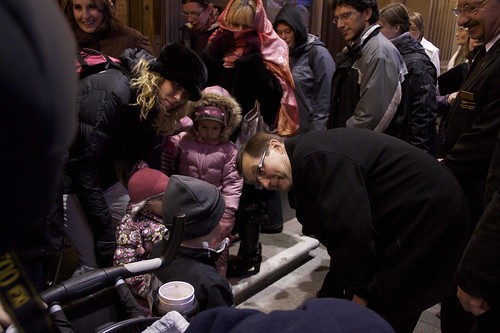
A lighter moment with Premier Ed Stelmach at the Christmas light-up event at the Alberta Legislature.
Categories
2009 Canadian Blog Awards

vote for daveberta.

The first round of voting for the 2009 Canadian Blog Awards has begun and this blog has been nominated in two three categories – Best Political Blog, Best Post Series for the Smith v. Board of Education series (Read: Part 1, Part 2, Part 3, and Part 4), and Best Overall Blog.

Thank you for the nominations. Please feel free to vote for this blog in these categories and support some of my favorite blogs in their respective categories:

Political Blog: DJ Kelly, Eaves.ca, Pundits’ Guide, Ken Chapman, MediaStyleCalgaryGrit, and CalgaryRants.
Science & Technology Blog: Mastermaq
Blog written by a Journalist: Capital Notebook, Colby Cosh
New Blog: The Rurban Fringe

First round voting will be open until December 12, 2009.

During 2007 Canadian Blog Awards, this blog was voted Best Political Blog, Best Progressive Blog, and Best Blogosphere Citizen.

Categories
Reboot Alberta

my political reboot.

In many ways, this blog serves as a public archive of my journey through and the evolution of my beliefs about politics and democracy since January 2005. Rather than a disclaimer, an informer is posted in the sidebar to your right:

…my thoughts and opinions change from time to time. I consider this a necessary consequence of having an open mind. This blog is intended to provide a semi-permanent point in time snapshot and manifestation of the various ideas running around my brain, and as such any thoughts and opinions expressed within out-of-date posts may not the same, nor even similar, to those I may hold today.

Re-reading my posts over the past year will give a reader an understanding of how my reflections on politics and democracy have evolved. The intent of this post is not be prophetically deep, but sensibly reflective of my experiences and how they have shaped my current feelings towards politics and democracy.

I attended the annual Alberta Liberal Party convention last December October. The Liberal Party was in the midst of a leadership contest, but was only able to attract around 200 supporters to its convention. It was my experience that many of the party members and delegates held a deep bitterness towards the governing Progressive Conservatives and towards the Albertans that voted for them. I may not have liked the outcome of the last election, but I trust Albertans and believe that they are intelligent enough to understand and make decisions. I worked hard for that party in the past, but it was during that convention that I came to the realization that in many ways I had outgrown the Liberal Party.

I am tired of negativity in politics. I love my province and have no patience to be involved in any political organization that thrives off undertones of negativity. At the convention last December and since, I do not see a political party in Alberta that fits this qualification. That is why I left the Liberal Party and have not renewed my membership since.

I have wandered since leaving party politics, I have talked about politics and democracy with many people over the past year, and I have observed that while our politicians continue to focus on the spectrum of left-right politics to define themselves, their parties, and their opponents, it is a fairly insular idea. I am guilty of writing about politics in the left- or right- context, but with all the current political parties floating in what they perceive as “the middle” of the political spectrum, I wonder if the concept is as outdated as the Berlin Wall.

Nothing big has happened without the risk of failure. The risks of not doing something are greater.

This weekend’s Reboot Alberta meeting in Red Deer was exciting. Around 100 participants travelled from all the corners of the province – and represented a diverse range of Albertans from vast agricultural- and forestry-based rural areas, villages, towns, and small and large cities.

I am a proud Albertan. In the 1890s, my family followed an Oblate priest from Quebec and settled near Morinville (Alberta was still part of the North West Territories at the time). They worked hard, against many odds, to help build their community. Skip forward one hundred and thirteen years later and I am a third generation Albertan. It is my home. But as proud as I am of being an Albertan, I am less proud of how our leaders have handled important issues like the development of the oil sands, the social issues in Bill 44, and basic issues of integrity in governance.

Participant Sue Huff quoted another Reboot Alberta participant on her blog:

One very wise man stood up and talked about wanting to feel proud of being an Albertan again and how he did not that currently. This pride was not a boastful or arrogant pride but simply the pride of feeling good about doing the right things and doing them well. He noted that the conversations that had taken place at Reboot were about possibility, not just about problems. He urged us to accept responsibility for what is and resist the urge to blame the government. We are the government. We must not feel victimized, fatalistic, hopeless or unable to act. Instead by accepting our responsibility, our culpability for the current state of affairs, we take the first step towards making the change. He marvelled at the increased sense of ownership in the room and the powerful authentic connections.

I am a progressive. A number of discussions last weekend focused on what it meant to be a “progressive” in Alberta. While it is easy to fall into the trap of pigeon holing “progressive” as “lefty,” this would not be an accurate description of the real conversations that happened. When asked to define “progressive,” the three words I heard that resonated strongly with me were: adaptability, understanding, and interconnectivity.

One of the main characteristics of Reboot Alberta that really struck me was the positive and respectful tone of the debate over the weekend. In a room filled with 100 type-A personalities, no egos dominated the discussion, no ideology dominated the room, and there was a willingness to listen and consider other points of view. Participants were honest about the challenges facing our province, but little of any discussion dwelled on the negative. The conversations focused on the solutions, and how to turn thoughts into action. This is a tone that I would like to see set for the politics of my home province.

I have written a lot about the need for a new political movement, and at times I have wavered in whether or not this is the best idea. There are still questions, but a new movement is emerging. It exists through the participation of citizen in open discussions like ChangeCamp, CivicCamp, and Reboot Alberta. It is open source democracy, a new way of participation in civic society.

Opinions at Reboot Alberta were diverse, but there was a clear belief by the majority of participants that our current political parties are not fulfilling the potential of this province. There were differences in terms of the solutions offered, some wanting to work within the current structure, some interested in working outside of it, and some who believed that a new political movement needs to be formed (like the folks involved with Renew Alberta).

On December 15, 2008, I wrote that I was:

…a politically engaged and frustrated Albertan who is looking to become involved in 1) an organization that is serious about engaging and challenging Albertans to be better citizens, and 2) a viable and competitive alternative to the current governing party.

There were many participants at Reboot Alberta who sincerely expressed and seriously discussed their desire to help create a movement that embodies these two characteristics. If something new and meaningful can be created from of the positive and creative energy of the participants who attended this weekend, I want to be there and help make it happen.

Categories
Reboot Alberta

reboot alberta (8:25 am)

Dateline: Red Deer
After an interesting first day at Reboot Alberta (and a late night/early morning for some participants), a number of participants have put their thoughts together and published some initial reflections on the weekend thus far:
Chris Labossiere: I just rebooted myself and it feels good.
DJ Kelly: Look out Alberta, you’re about to get “rebooted” – first impressions
Alex Abboud: Rebooting Alberta: Instant Reaction
Jonathan Teghtmeyer: Progressives gather to reboot Alberta
The weekend event wraps up this morning and I will have some more detailed insights into the weekend in a soon to come post.
Categories
Reboot Alberta

reboot alberta 2:11pm.

Dateline: Red Deer

What do you call a group of people who have decided to spend the Grey Cup weekend debating and discussing the future of Alberta? Passionate and weird.

Reboot Alberta has been an interesting experience thus far. It is hard to describe what this weekend has looked like, so I will try to articulate my thoughts deeper in a future post. Around 100 progressive thinking men and women are here from across Alberta – north, south, central, urban, and rural. I have had some incredibly meaningful discussions about what the future of Alberta should look like. The challenge is how to put these discussions into action.

There is a lot of talk about the future of Alberta politics. Many of the people here want to change the existing parties, some want to work outside the party system, and some want to talk about a new party. There has been a lot of talk around Renew Alberta and there is a lot of deep debate about whether a new political party is a solution. It is my opinion that Alberta is ripe for a new political movement. Starting a new political movement in Alberta is a risk. It can absolutely fail, but big things rarely begin without that risk.

Follow Reboot Alberta via Twitter at #rebootab. More updates coming…