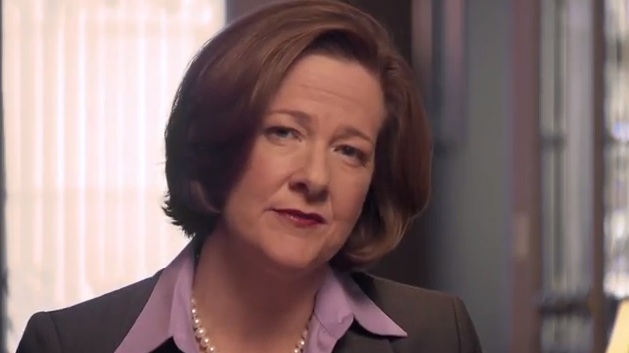
The staff overhaul in Premier Alison Redford‘s Communications Office has resulted in two new hires. One was already working in Alberta’s Legislature and the other comes direct from Ontario’s provincial legislature.
Already under the dome, Michael Norris left his job as Municipal Affairs Minister Doug Griffiths‘ press secretary to become the Premier’s Issues Manager.
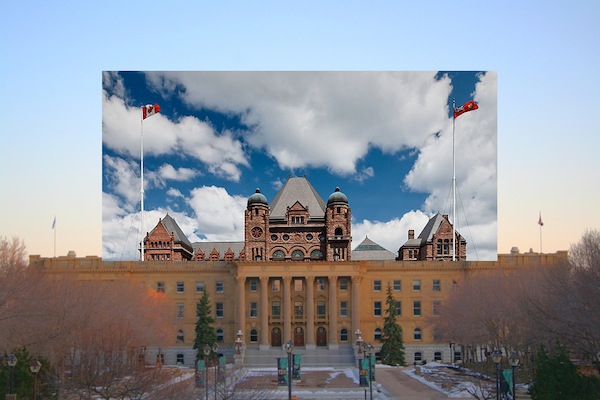
Neala Barton is the outgoing Director of Media Relations for recently retired Ontario Liberal Premier Dalton McGuinty and will soon begin her new job as the media relations lead in the Alberta Premier’s Communications Office (now to be referred to as “Queen’s Park West“). She is also a former reporter with CBC television in Edmonton.
Ms. Barton will be joining another Ontario political expat in Queen’s Park West, Communications Director Stefan Baranski. Mr. Baranski previously worked for Ontario Tory leaders Ernie Eves, John Tory, andTim Hudak.
Facing-off against an aggressive official opposition, it is no coincidence that the Premier’s communications team is looking to hire political operators from a province where political competition is not a new phenomenon.
On a related note, I have been unable to confirm rumours that special orders from the Brewers Retail and Pizza Pizza will be flown in daily to Edmonton.
If you have any questions about these changes, please contact 416-967-1111.
Eighteen days ago, Alberta became a have-not province.
Eighteen days ago, Premier Alison Redford appeared on Albertans television screens to warn them of the notorious “bitumen bubble” that has been keeping the price of our oil down.
Today, after eighteen days of political spin about deep budget cuts and tough economic times, it would be easy to believe that the federal transfer payments are on their way (finally, equalization will work for us!).
Of course, Alberta is not a have-not province.
Alberta’s economy remains competitive, our population is growing, and job growth is on the rise. Alberta is Canada’s economic engine.
Most of the talk is part of the government’s attempt to manage the expectations of Albertans before the provincial budget is tabled on March 7. From the opposition benches, there are always political points to be gained before a government budget is tabled.
As has been the case each year since the Alberta government began to run “technical deficits,” the earlier projected deficits will likely be much lower when the budget is tabled. As any accountant or political strategist knows, bookkeeping is closer to an art-form than an exact science.
On budget day, a lower than predicted deficit will result in the government looking like better fiscal managers than the opposition has claimed and the opposition researchers will be caught scrambling through the volumes of budget documents to fill their message box.
With this year’s budget ready to be sent to the printers, the first Alberta Economic Summit was held this past Saturday in Calgary.
Initially derided by the opposition parties as a government-sponsored public relations exercise, the day-long event brought together panels of experts from the private, public, and not-for-profit sector to discuss our province’s fiscal future.
Whether it was a PR exercise or not, it did present an opportunity for a continued discussion about the need to raise taxes in Alberta. Our government relies heavily on the sometimes unpredictable revenues from our natural resources to fill the gap created by our low taxes to fund our essential public services.
As Kevin Taft explained last year in his book, Follow the Money, if Alberta increased its tax rates by $11 billion our province would still have the lowest tax rate in Canada
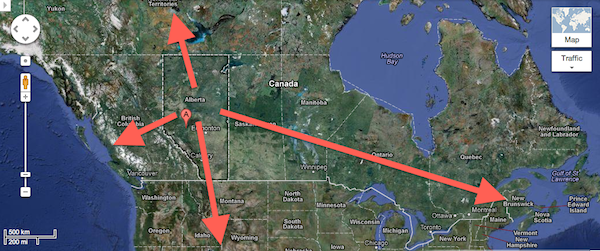
With almost no details or research about whether it would be financially viable, both Premier Redford and Premier Alward touted the Alberta-to-New Brunswick pipeline as progress.
Considering how many problems, both political and geographical, the province has faced with the proposed Enbridge Northern Gateway Pipeline from Alberta to British Columbia (two provinces), I can only imagine the level of political challenges that could be stirred up by an oilsands pipeline running through six provinces.
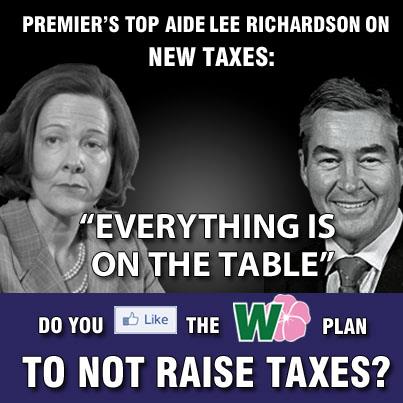
An image released online by the Premier’s Communications Office.
MLA pay remains an uncomfortable issue for Alberta’s political leaders. Yesterday, MLA’s sitting on the Member Services Committee voted to freeze the annual cost-of-living increase to their salary and housing allowance ahead of provincial budget release on March 7, 2013.
“The rationale is clearly we want to lead by example,” Edmonton-Riverview Tory MLA Steve Young told the Edmonton Journal.
A Wildrose image picturing Premier Alison Redford in a less than flattering light.
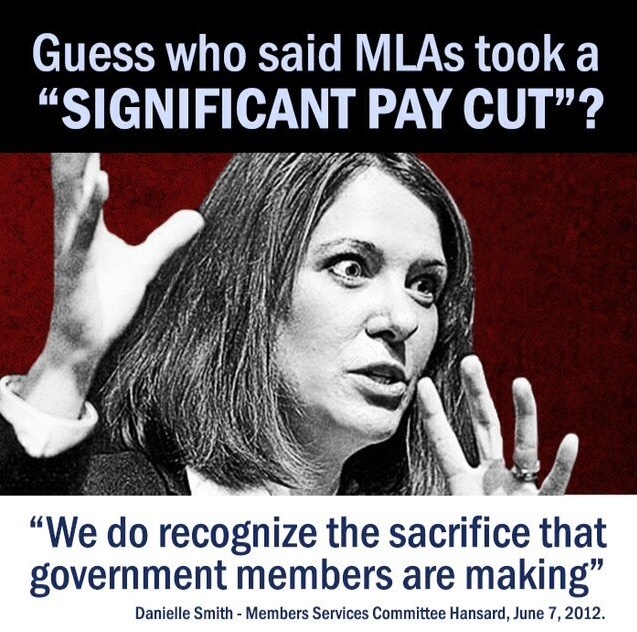
Yesterday’s pay vote also resulted in more online mudslinging on Twitter’s #ableg hashtag, though this time from an unexpected source.
The Twitter account operated by Premier Alison Redford‘s Communications Staff – @ABPremierComms – tweeted an image featuring an incredibly unflattering photo of Wildrose leader Danielle Smith with a quote she made at a meeting on June 7, 2012 (see image at the top of this post).
While distasteful, the reaction from the Premier’s Office is not unprovoked.
The harsh negative politics and aggressive use of images and info-graphics has helped the Wildrose Party cultivate a significant online following, who have helped spread their message through social media.
Mr. Khan’s time in cabinet was largely seen as reserved and underwhelming. Ms. Cusanelli caused an unwelcome stir when she was forced to repay the government $10,600 for expenses made in her first five months in office, including $4,000 in airfare to have her daughter and mother join her at the 2012 Summer Olympics in London, United Kingdom. She was also given the unenviable task of defending the government’s large line of hospitality expenses at the London Games.
Ms. Cusanelli’s ministerial office was recently shuffled with the hiring of Chief of Staff Tammy Forbes, who previously served as the Premier’s media liaison, and press secretary Andrew Fisher, who previously served as Chief of Staff.
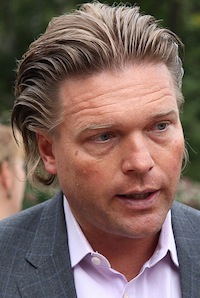
Replacing Mr. Khan is Deputy Premier Thomas Lukaszuk, who has been operating without an official cabinet portfolio since before last year’s election. First-term MLA Richard Starke, representing Vermilion-Lloydminster, has been tapped to replace Ms. Cusanelli as Minister of Tourism.
——
Minister Starke’s constituency has a long history of electing MLAs who later served as cabinet ministers.
First to the Tory cabinet was Lloydminster MLA Bud Miller served as the Minister of Public Lands and Wildlife in Premier Peter Lougheed‘s cabinet from 1979 to 1982.
Directly preceding Minister Starke was Lloyd Snelgrove, who was MLA from 2001 to 2012 and served in a number of portfolios during Premier Ed Stelmach‘s time in office, including a period of Minister of Finance. Citing irreconcilable differences, Mr. Snelgrove left the PC caucus to sit as an Independent MLA following Premier Redford’s successful leadership bid.
Preceding Mr. Snelgrove was Steve West, who served as the constituency’s MLA from 1986 to 2001 and served in a number of cabinet portfolios during Premier Ralph Klein‘s time in office, including Minister of Finance.
(Judging from historical trends, you might think there is a good chance that Minister Starke could one day be Minister of Finance).
One month before Alberta’s Legislative Assembly reconvenes to deal with this year’s provincial budget, Leger Marketing has released a new survey of political party support in our province.
This is only one survey and all political polls should be taken with a grain of salt, but the results will be a tad discouraging for Alberta’s opposition parties. While the survey shows the governing PCs dropping in support from 44% in last year’s provincial election, the opposition Wildrose has dropped from 34% in the 2012 election and the two other opposition parties have only marginally increased their support.
According to the Calgary Herald, the survey of 900 Albertans was conducted January 14 to 20 as part of the PwC Business and Consumer Confidence Index. The survey has a margin of error of plus or minus 3.3 percentage points, 19 times out of 20.
Caught having accepted 45 prohibited donations from municipalities and publicly-funded institutions since 2009, the Progressive Conservative Association spent the past few days sending mixed messages whether it would or already had repaid the full amount of illegals funds as requested by Alberta’s Chief Electoral Officer .
Party officials previously stated the funds would be repaid, but during a conference call to PC constituency presidents last month, executive director Kelley Charlebois laid out laid out plans to not repay the funds.
“Repaying the money does us no good in the court of public opinion” – PC Party executive director Kelley Charlebois
PC Party president Jim McCormicktold the Edmonton Journal last week that he felt the orders from the elections office to repay illegal donations were unfair. Mr. McCormick later downplayed his public comments in an email to PC Party supporters in which he stated his party had “fully and willingly complied and repaid the dollars [the Chief Elections Officer] asked us to.”
Mr. McCormick then stated that talks between the PC Party and the elections office would continue and his “argument is not relative to the dollar amount but rather a request for clarification on the legislation.” There is some irony in that some of the prohibited donations were made to now-Justice Minister Jonathan Denis‘ Calgary-Egmont constituency association.
2012 PC campaign manager Susan Elliott jumped to her party’s defence on Facebook, claiming that party officials had no way of knowing that many of the donors were being reimbursed by municipalities or public institutions for money spent at party fundraisers.
I am mystified by the Chief Electoral Officer’s conclusion that a political party is responsible if an individual illegally expenses a political donation to a prohibited organization. So Joe Smith buys a fundraising ticket using a personal cheque or credit card. That’s OK. He collects the tax receipt personally. That’s OK. But later, he submits the cost on his expense claim. He has now done something illegal. The prohibited organization does something illegal by paying it. But how is it the political party is supposed to anticipate Joe’s actions, learn about them later, prevent them or correct them? Since they can do none of those things, why are they the ones cited?
The 45 cases of illegal donations identified in the investigation were all made to the PC Party, not to any of the eight other registered political parties in Alberta.
In some cases Ms. Elliott’s argument may hold water, but in other cases the PC constituency organizers may have directly or indirectly solicited funds from these individuals through their places of employment in municipalities or public institutions.
In one case, which is not being investigated because it took place before the arbitrary 2009 cut-off date set by the elections office, a PC constituency official was actually employed by the organization that the donation was made by. In the former Athabasca-Redwater constituency, the local PC President was the head of the Athabasca University secretariat, which approved the financial contributions.
As was the case with the long list of municipalities that were named in the investigation, they were encouraged to purchase tickets to PC Party fundraisers as a means of lobbying provincial politicians. Over its 42 years in power, the PCs have fostered the creation of a culture where the lines between government business and party business are sometimes blurred.
The elections office is also investigating allegations that pharmaceutical industry billionaire and Edmonton Oilers owner Daryl Katzmade a $430,000 donation to the PC Party in the 2012 election, blowing away the $30,000 annual contribution limit stipulated in the Election Finances and Contributions Disclosures Act.
Conservative linked to Katz donation named chairman of the Alberta Economic Development Authority
BY KAREN KLEISS, EDMONTON JOURNAL JANUARY 30, 2013
EDMONTON – Premier Alison Redford has given a provincial political appointment to a veteran Conservative insider who allegedly brokered a $430,000 donation from Oilers owner and billionaire Daryl Katz.
Media reports quoting unnamed sources suggested Wednesday that Calgary businessman Barry Heck is the party fundraiser who persuaded Katz to make the donation now under investigation by Alberta’s Chief Electoral Officer.
Redford has named Heck chairman of the Alberta Economic Development Authority.
Heck has declined to comment on the allegations, citing the ongoing investigation.
On another election finance related note, Progressive Conservative President Jim McCormick has also asked Chief Electoral Officer O. Brian Fjeldheim to reverse orders mandating that the party repay thousands of dollars in illegal donations tied to post-secondary institutions and local governments
Leading thinkers, key industry, non-profit and academic leaders, MLAs, and passionate citizens prepare for the Alberta Economic Summit.
Bitumen bubbles and the unpredictable price of oil mentioned in last week’s televised address have led Premier Alison Redford‘s Tory government to hastily called a one-day “Alberta Economic Summit” to continue a “conservation” about our province’s current fiscal woes and potential fiscal future.
The summit will bring together ‘leading thinkers, key industry, non-profit and academic leaders, Members of the Legislative Assembly and passionate citizens” for a day of panel discussions at Mount Royal University on February 9, 2013 (yes, that is ten days from now).
Premier Alison Redford
Despite the talk of “continuing the conversation” with Albertans, it is easy to be suspicious that the conference is a public relations exercise and a tool for the Tories to direct the public debate towards a certain direction. It seems difficult to image that any meaningful discussion about such complex issues could occur in such a short-period of time.
The government says it just wants to look at its options, which was a reoccurring theme in a discussion I had with Premier Redford last week. One option already off the table are tax increases, which despite growing public debate, the Premier says will not be in this year’s budget.
“It has got to be about economic diversification and what we want our fiscal framework to look like,” said Premier Redford when I asked her about what she would like to see come from the summit. “We want to engage people who give a lot of thought about these issues but don’t always have a chance to spend time together,” she said.
I asked the Premier if the Alberta Economic Summit was just a way for the government to deflect the public discussion away from taxes and toward a pre-determined answer. “We are not looking to deflect anything,” she said.
“As we move ahead it would be folly to say that every decision we make without consulting with Albertans would be the right decision. We want to make sure we are talking to Albertans and making decisions that reflect Albertans values.” – Premier Redford, January 25, 2013
Premier Ralph Klein
If all this talk of a big summit about Alberta’s economic future triggers hints of deja vu, you are probably not alone.
Eleven years ago almost to the day that the”Alberta Economic Summit” will be held, Premier Ralph Klein and Revenue Minister Greg Melchin held the “Alberta Future Summit” in Red Deer. The February 4, 2002 conference brought together 260 delegates to draft “strategic directions and ideas for action” for several areas identified as priorities – including the economy and fiscal responsibility.
The final report generated from the Future Summit included the following observation, which will sound familiar to anyone who tuned in to watch Premier Redford’s televised address last week:
Despite rapid growth in manufacturing and services exports over the past 10 years, Alberta continues to rely heavily on primary resource exports (such as oil, gas, grains and oil seeds) and intermediate commodities (such as lumber, pulp and petrochemicals). Alberta’s reliance on primary and intermediate resource exports makes the economy vulnerable. Economic and market diversification are key to future prosperity. – Alberta Future Summit 2002 final report
While I hope next month’s Alberta Economic Summit succeeds in generating a meaningful conversation between Albertans and their government, I cannot help but think this summit is a partially a result of the Tories failing to act on some of the advice they heard at their last big summit in 2002.
——
Today, the government launched a online build your own budget tool budgetchoice.ca, which allows Albertans to cut and raise taxes, and see a simplified version of how the provincial ledgers balance.
Curiously, participants are not given the option of raising royalties on natural resources and some Tory pet projects are not included in the tool or partially protected, including the controversial Carbon Capture and Storage Fund (CCS). The CCS Fund, intiated by Premier Ed Stelmach in 2010, directed $2 billion towards research with the private sector into the unproven technology that some large energy companies have abandoned. Of the more than $200 million expected to be budgeted for CCS in this year’s budget, only $60 million is available to be cut in the online budget scenario tool.
High-drama took place on Twitter’s #ableg hashtag yesterday morning as Premier Alison Redford‘s online communications team took aim at QR77 talk radio host Dave Rutherford. In response to a tweet from Innisfail-Sylvan Lake Wildrose MLA Kerry Towlecongratulating Mr. Rutherford on the 30th anniversary of the show, the Premier’s Communications staff tweeted that the show was “Wildrose Radio.”
The popular radio talk show host has become a vocal critic of the provincial Tories and is seen as a tacit supporter of Wildrose leader Danielle Smith, who is a frequent guest on his show.
Nice to see Prem Communications paying attention to tweets, but let’s understand that @rutherfordshow deals with issues and policies only.
While it might not seem smart to attack a radio program with a large audience across the province, it is not as if the Premier was receiving rave reviews on the Rutherford Show anyway. After being pummelled in the media by the opposition parties in last year’s fall sitting of the Assembly, this could be the beginning of a new and more aggressive communications strategy from the Premier’s office.
Any observer of the #ableg hashtag will have become accustomed almost daily Twitter battles between hyper-partisan Wildrose Caucus staffers and increasingly-partisan Ministerial Press Secretaries, who are now free from the non-partisan veneer of the Public Affairs Bureau.
——-
During a telephone town-hall to Progressive Conservative Party members last night, Premier Redford took a shot at the Wildrose, claiming that “if another political party had been elected, there would be NO building in this province.”
This comment follows comments by Wildrose critic Rob Anderson about the government’s four-year project to renovate the historic Federal Building in downtown Edmonton.
In fairness to the Wildrose Party, with some high-profile exceptions, its platform in the last election would have would have rolled back spending and stretched out infrastructure projects over a longer period (but not cancel it altogether). – h/tJosh Wingrove
——-
Last week, I had an opportunity to speak with Premier Redford over the phone for a few minutes following her televised address. I will have some notes about the interview posted on the blog over the next few days.
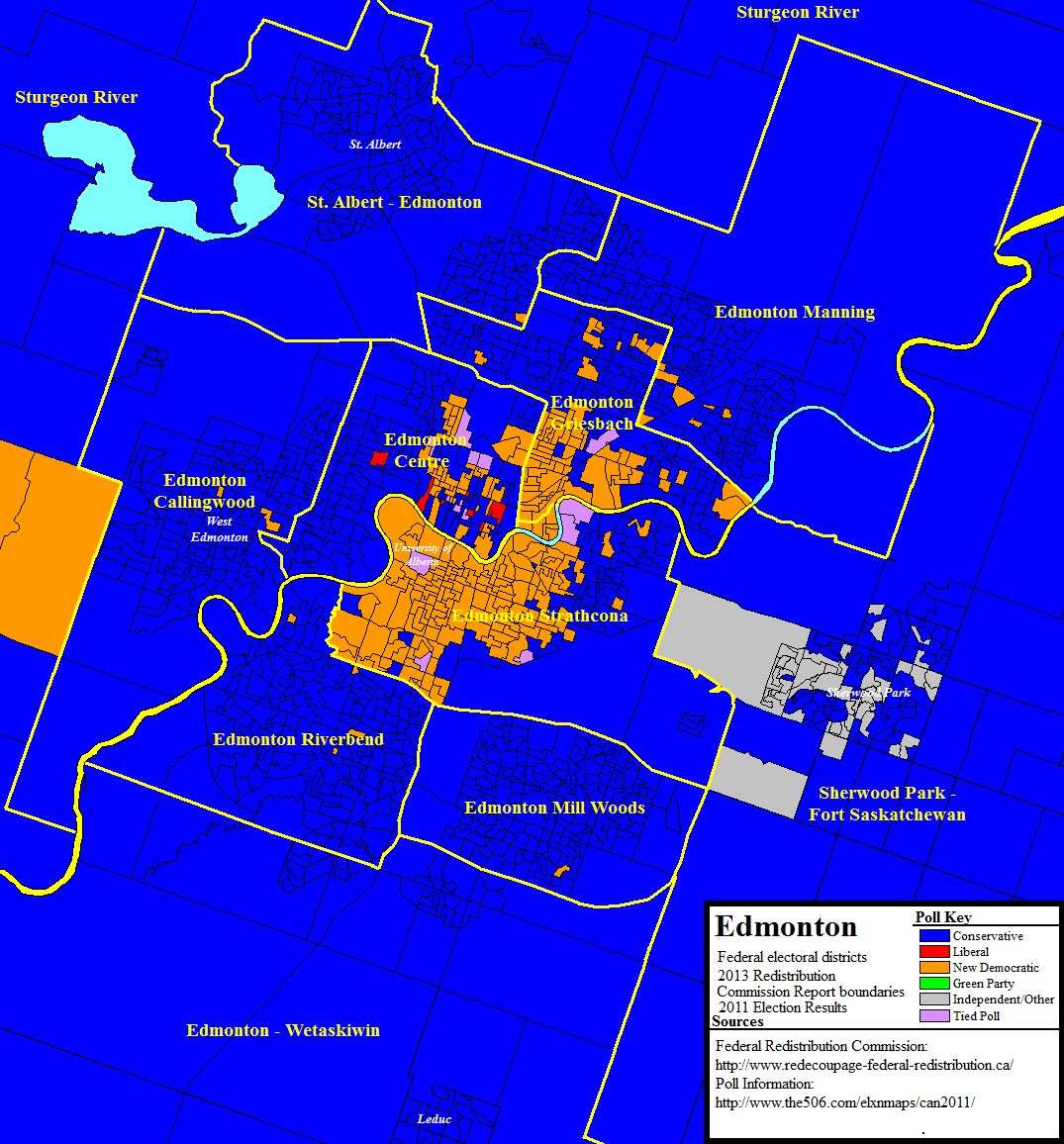
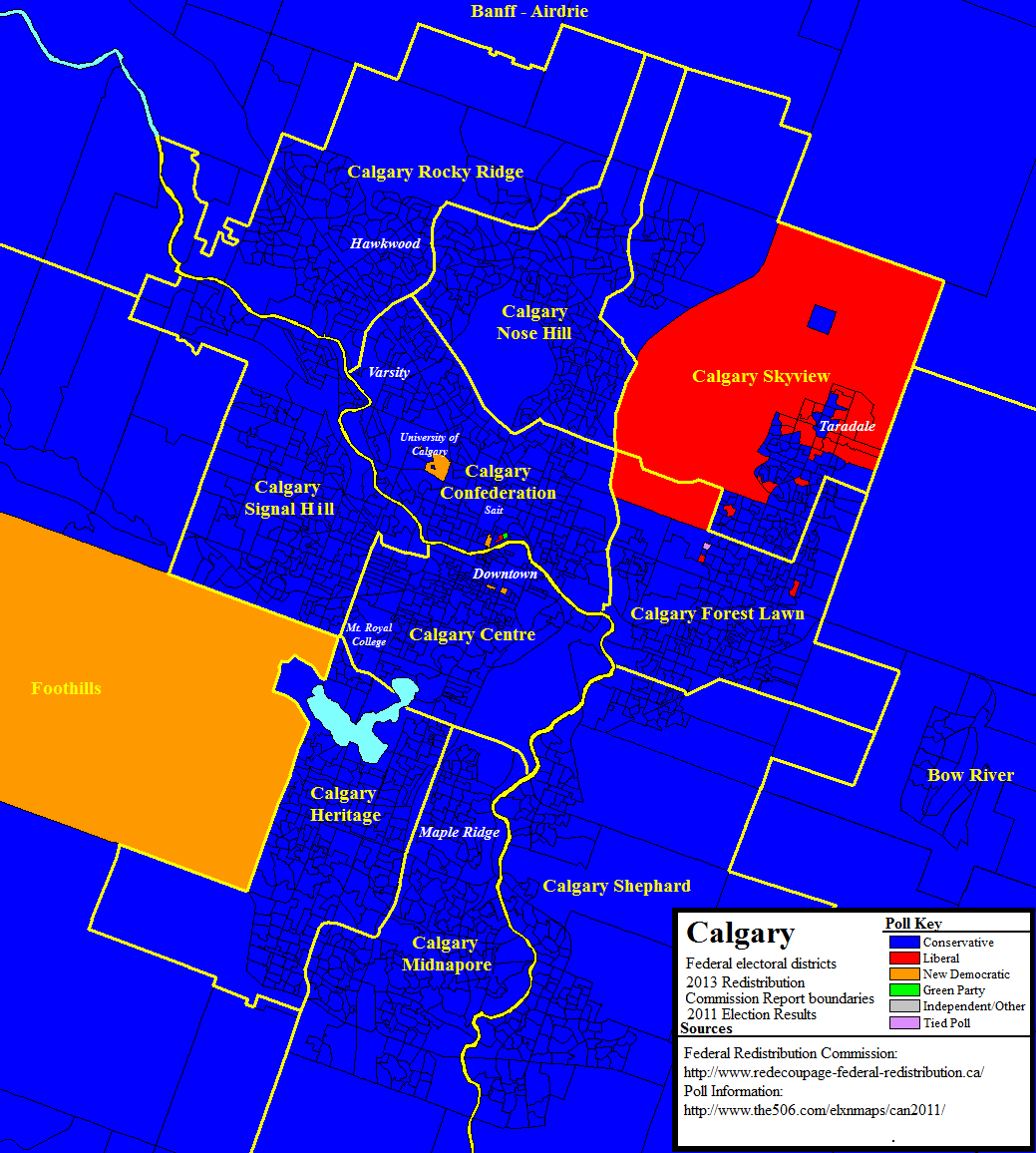
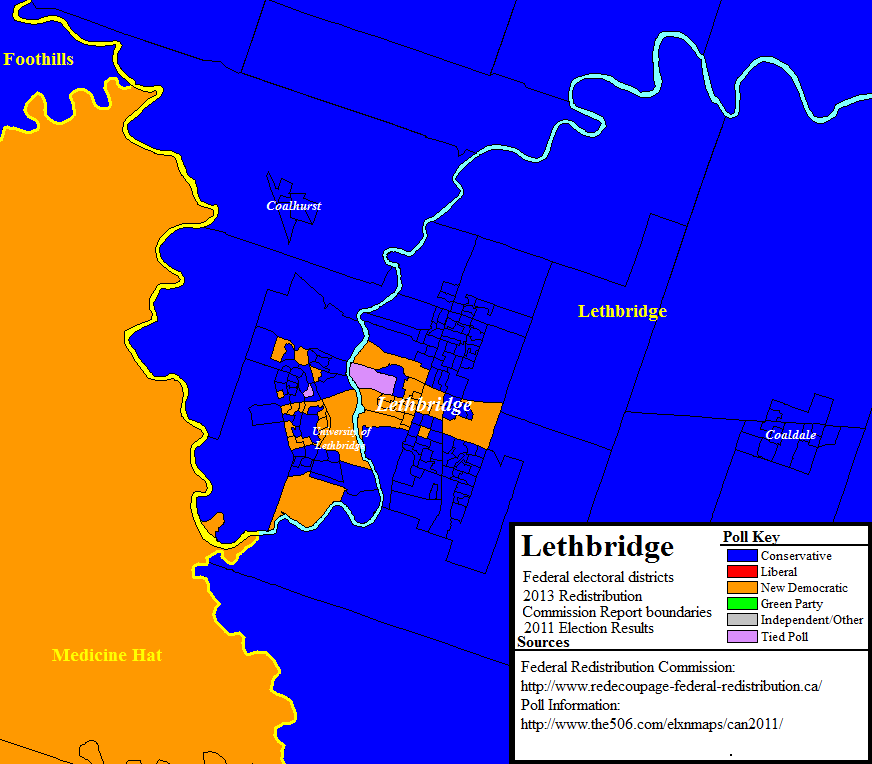
The commission responsible for updating Canada’s federal riding boundaries have released their recommendations for redistribution in Alberta. The boundaries make some significant changes in rural areas and create fully-urban ridings in the cities of Calgary and Edmonton (following the 2003 redistribution, many of Edmonton’s ridings were expanded to include surrounding rural areas).
Below are the maps of the new boundaries transposed with the poll-by-poll results from the 2011 federal election. Looking back at the 2011 results, the new riding boundaries would have narrowed the Conservative Party’s margin of victory in a handful of ridings, including Lethbridge, Calgary-Skyview, Edmonton-Centre, and Edmonton-Greisbach (currently Edmonton-East), but would not have changed the electoral map in that election.
Also interesting to watch will be Calgary-Centre, where last year’s hotly-contested federal by-election drew national attention. Was the close race in Calgary-Centre the beginning of a new trend for that city or was it simply a mid-term anomaly?
New federal riding boundaries in Edmonton with poll-by-poll results from the 2011 election.New federal riding boundaries in Calgary with poll-by-poll results from the 2011 election.New federal riding boundaries in the Lethbridge area with poll-by-poll results from the 2011 election.
Short on specifics, Premier Alison Redford‘s much-hyped televised address may have ended up leaving more question unanswered.
1) Referring to a “bitumen bubble”, the Premier announced that the provincial government’s revenue shortfall is now projected to be six billion, up from the three billion budget deficit recently projected by Finance Minister Doug Horner. This is a result of lower than predicted oil prices, which historically cycle from high to low.
2) During her address, the Premier praised the construction of new pipelines as a way to increase the price of Alberta’s oil, and government revenue. While this is be positive, it still does not solve the problem that our government relies heavily on an unstable stream of revenue determined by international markets. Another reason why Albertans need to talk about taxes.
3) At the conclusion of her address, the Premier announced that she will be holding an “Alberta Economic Summit.” The Premier explained that the Summit will bring together “industry experts, business and not-for-profit sector leaders and academics from our colleges and universities” to continue the “conversation” about Alberta’s finances.
Premier Redford will need to work hard to ensure that this will not be a government-sponsored public relations exercise designed to produce a pre-determined result.
“Our party was elected to keep building Alberta — to focus our spending on the priorities that you told me were important, and that is exactly what
we’ll do.” – Premier Alison Redford in an email to Progressive Conservative Party supporters on January 23, 2013
Premier Alison Redford will star in a pre-recorded television message tonight following the 6pm news hour on CTV in Calgary and Edmonton. The Premier is expected to use the 8-minute address as part of the government’s ongoing exercise of managing public expectations about the upcoming provincial budget.
The budget is expected to include a projected $3 billion deficit, largely influenced by a lower price of oil than including a drop in the price of oil. The promise of “no new taxes, no service cuts” has put Alberta’s Tories in an unenviable political bind and set the tone for this year’s provincial budget debate.
Despite the cries of fiscal hawks wanting to slash and burn the province’s public services, as I wrote earlier this month, Alberta’s revenue problem has already become the defining issue the 2013 budget debate.
Raising the levels of natural resources royalties or reasonably increasing taxes are not issues the Premier is expected to touch on during tonight’s television appearance, but raising taxes is an issue that a handful of former politicians have recently delved into. Former Premier Ed Stelmach, former Finance Minister Shirley McClellan, former Deputy Prime Minister Anne McLellan, and former provincial Liberal leader Kevin Taft tackled the tax dilemma facing Alberta’s finances last weekend at the University of Alberta.
According to economistBob Ascah, who was at the weekend event, a one-per cent sales tax could raise $750 million in revenue for the province.
And as reported on David Climenhaga‘s Alberta Diary Blog, Glen Hodgson, the chief economist of the Conference Board of Canada has also weighed in on Alberta’s tax dilemma:
“Not having a provincial consumption or sales tax is highly popular and has been great politics, but it denies the provincial government a steady and stable source of revenue through the business cycle.”
Brussels, Bucharest, and Juneau are three international destinations where Tory MLAs were scheduled to visit during Government of Alberta sponsored trips today.
Environment and Sustainable Resources Minister Diana McQueen and Intergovernmental and International Relations Minister Cal Dallas have embarked on a pan-European tour, meeting with business and government leaders in a handful of continental counties. Backbench Tory MLA Richard Starke, from Vermilion-Lloydminster, is on government business in Juneau, Alaska.
On Wednesday, Health Minister Fred Horne is scheduled to depart for a trip that will take him to Ireland, the United Kingdom, and Belgium.
On October 1, 2012, I published a Google Map, tracking the travel of Alberta’s Tory cabinet minister and MLAs on government business. Here is an updated map, which includes all published scheduled government of Alberta travel by cabinet ministers and MLAs from November 2011 to February 2013.
Trips added since November 2012 include Middle-Eastern travel by Minister Dallas, trips to the United States by Calgary-Bow MLA Alana DeLong, Calgary-Foothills MLA Len Webber, and Strathcona-Sherwood Park MLA Dave Quest, a trip to Chicago by Premier Alison Redford and the four trips mentioned at the beginning of this post.
As I wrote in October, I understand the value of sending cabinet ministers on these trips to promote our province abroad and I generally believe it is in our best interest, but there reaches a certain point when return on investment needs to be demonstrated.
After staff departures, former Ontario-based political operatives hold two top roles in Alberta Premier’s Office.
Last week it was announced that Jay O’Neill is departing his job as Director Communications under Premier Alison Redford‘s. Although Mr. O’Neill only joined the Premier’s office in late 2011, it is not uncommon for individuals to only fill these types positions for a short period of time.
The Tories were hit with a handful of embarrassing scandals in the closing months of 2012 and were caught unprepared, having to spend the fall sitting of the Assembly playing defence against an aggressive Wildrose Party opposition. The Spring sitting of the Assembly will begin on March 5, 2013.
Premier Alison Redford
Four other staff left or announced their departures from Premier Redford’s communications office over the past few months, perhaps a result of internal pressure to change direction and take a more aggressive approach towards political communications in 2013.
Tammy Forbes left her job as the Premier’s Communications Liaison Manager to become Chief of Staff to embattled Tourism Parks and Recreation Minister Christine Cusanelli.Minister Cusanelli faced harsh criticism before the Christmas break when she was forced to repay the government $10,600 for expenses racked up in her first five months in office, including a $4,000 airfare charge to have her daughter and mother fly with her to the 2012 Summer Olympics in London, United Kingdom.
Before joining the Premier’s office in 2011, Ms. Forbes was director of communications in the Department of Transportation.
Two other departing staff have jumped from their political jobs to roles in the public service. Tracy Balash has left the Premier’s Communications Office to become the Executive Director of Communications Planning in the Public Affairs Bureau (PAB). As noted in a recent Globe & Mail article, the PAB is in a period of transition after the retirement of Kathy Lazowski, its executive director of strategic communications.
Stefan Baranski
The Premier’s Issues Manager Nikki Booth is now the Acting Issues Manager (Communications) in the Department of Environment and Sustainable Resource Development.
Kim Misik, the Premier’s press secretary, also announced that she will be leaving her position.
Social Media Manager Mike Jenkinson remains the longest serving member of the Premier’s team, having started in the office during Ed Stelmach‘s premiership.
Mr. Baranski is not the only former Ontario-based political operative in the Premier’s office. While originally from Alberta, Director of Operations Darren Cunningham is a veteran of Ottawa’s political scene, having served in Chief of Staff and communications roles for Prime Minister Stephen Harper and various Conservative cabinet ministers. He started working for the Premier’s office in June 2012. Another Ottawa insider, Lee Richardsonleft his job as a Member of Parliament to become the Premier’s Principal Secretary in May 2012.
It is suspected that not all of these vacant positions in the Communications office will be filled. Some sources suggest that the Premier’s office may increase their reliance on consultants from outside political and communications companies to fill the gap.
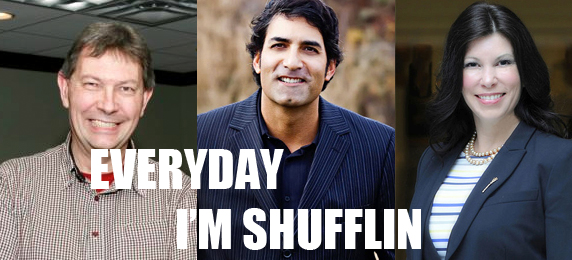
The event, which is being organized by Edmonton-Mill Creek NDP president Stephen Anderson, Alberta Party president William Munsey, and 2011 Liberal candidate Mike Butler, promotes “citizen engagement, collaboration, and cooperation” as the way of the future for Alberta politics.
In a December guest post on this blog, Calgary-Buffalo Liberal MLA Kent Hehr restarted the latest debate about cross-party cooperation and was stunningly, and strangely, rebutted by Liberalberta Party president Todd Van Vliet in a media release. Liberal leader Raj Sherman remained suspiciously silent during the very public rebuke, leading political observers to believe he sanctioned Mr. Van Vliet’s ill-advised response.
Edit: On January 8, Mr. Van Vliet announced that merger ideas would be debated at his party’s annual convention, scheduled for June 2013.
NDP leader Brian Mason has also spoken out against any formal electoral cooperation or merger with the other non-conservative opposition parties.
The main centre-left opposition parties (the Liberals, NDP, and Alberta Party) earned a combined 21% of the popular vote in the 2012 provincial election, down from 34% in the 2008 election and 39% in the 2004 election. In 2012, the three parties were pushed aside by a reinvigorated moderate Progressive Conservative Party led by Alison Redford and an aggressive conservative Wildrose Party led by Danielle Smith.
Mr. Hehr and Edmonton-Centre Liberal MLA Laurie Blakeman have confirmed their attendance on the “Soapbox, Suds, and Wings” Facebook event page, as have 2012 Green Party Senate candidate Elizabeth Johannson and 2008 federal NDP candidate Dave Burkhart.