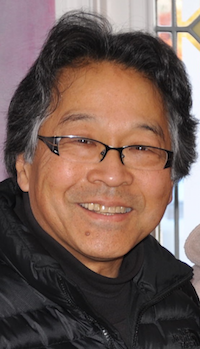
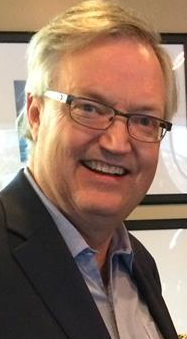
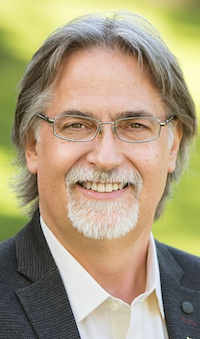
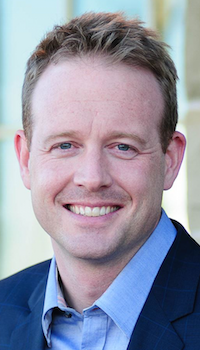
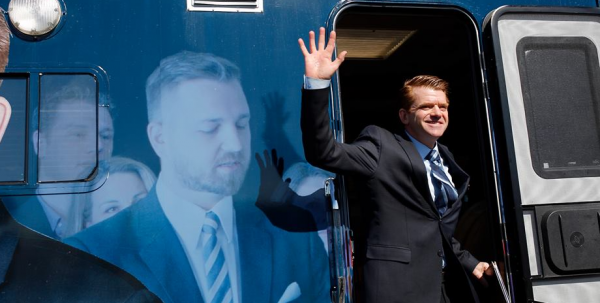
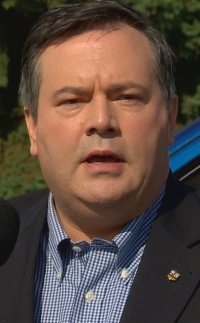
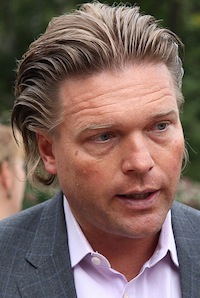
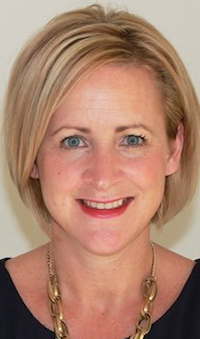
BC Minister of Jobs, Tourism, and Skills Training Shirley Bond (right) and former Alberta PC MLA Alana DeLong (left). Photo from @laurakmiller on Twitter.
A former Alberta MLA has been nominated to run in the upcoming British Columbia provincial election for the Liberal Party. Alana DeLong, who served as the Progressive Conservative MLA for Calgary-Bow from 2001 to 2015, has been nominated as a BC Liberal candidate in the Nanaimo-North Cowachin constituency.
Ms. DeLong served as a government backbencher during her time as an MLA in Alberta and briefly ran a campaign for the leadership of the PC Party in 2006 following Ralph Klein‘s retirement. She did not run for re-election in 2015. According to her wikipedia biography, she moved to British Columbia after her retirement.
If elected, Ms. DeLong would join a small group of Canadians who have been elected as representatives in more than one provincial legislature. Former Alberta MLA Gordon Dirks, who served as the PC MLA for Calgary-Elbow from 2014 to 2015 also served as a PC MLA in the Saskatchewan Legislature from 1982 to 1986.
Despite their name, the BC Liberals are known to be much more conservative than their Liberal counterparts in Ottawa and other provinces.
Government House leader Brian Masonmused to reporters that the New Democratic Party government was considering scrapping the committee when its deadline to make submissions is reached this week. Although the committee was tasked with reviewing four Acts, it only met fifteen times over the past year.
Regardless of the future of this committee, changes need to be made to Alberta’s elections and elections finance laws. Even if the committee is scrapped, the government could introduce changes to Alberta’s elections laws in the spring legislative sitting.
The NDP should lower the maximum annual amount that individuals can donate to provincial political parties. The current maximum annual donation limits in Alberta is $30,000 during election periods and $15,000 outside of election periods. The current maximum annual donation for federal political parties in Canada is $1,525.
The NDP should also implement maximum limits to how much candidates, political parties and third-party groups can spend during the election period, as already exist for candidates in federal elections. The limits should be reasonable and could easily be tied to the number of eligible voters in each constituency, as is the case in federal elections.
One potential change that has not been discussed, at least not much in public, is the possibility that the government could scrap Alberta’s fake fixed-election law. Introduced in 2011, the law states that an election be called every four years between March 1 and May 31. Alberta is the only Canadian province with a fixed-election law that does not actually include a fixed-election day.
As Albertans will remember, there is nothing to stop a government from calling an election early, like Jim Prentice’s Progressive Conservatives did in 2015. Scrapping this law would allow for the NDP to govern beyond the four year period, up to five years as stated in Section 4 of the Canadian Charter of Rights and Freedoms, meaning the next election could be held in 2020, not 2019.
The Legislative Assembly should grant the committee the time extension it has requested when MLAs reconvene on October 31, 2016. But it is difficult to imagine that both the NDP and opposition MLAs on the committee, especially Wildrose MLAs eager to embarrass the government, will conduct themselves any differently than they have in the past year since the Ethics and Accountability Committee was formed.
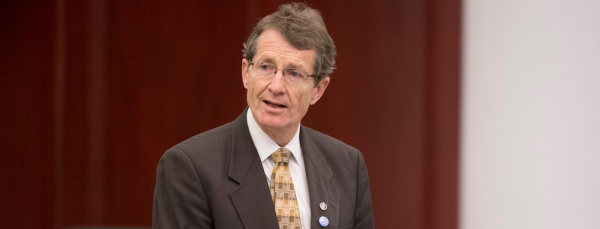
David Swann has served as the MLA for Calgary-Mountain View since 2004. He was Liberal Party leader from 2008 to 2011, and now serves as interim leader of that party. He will be replaced as leader in June 2017.
The Alberta Liberals announced this week that they will choose their next leader on June 4, 2017. Current leader David Swann stepped in to the role on an interim basis before the 2015 provincial election when former leader Raj Sherman stepped down and did not run for re-election. Dr. Swann has served as the MLA for Calgary-Mountain View since 2004 and was the only Liberal candidate elected in the 2015 election.
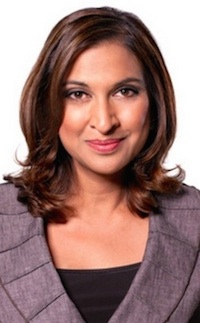
Nirmala Naidoo
The Liberals also announced that Nirmala Naidoo, the party’s Calgary co-chair of the leadership process, was stepping down as would be replaced with Calgary party official Bryndis Whitson.
The timing of Ms. Naidoo’s departure is curious because of recent news from another party’s leadership race. As the federal Liberal candidate in the Calgary-Rocky Ridge riding in the 2015 federal election, Ms. Naidoo was endorsed by her friend Sandra Jansen, the Progressive Conservative for Calgary-North West MLA and, as of last week, an expected candidate for her party’s leadership (Ms. Naidoo was also endorsed by former PC MLA Teresa Woo-Paw). It is yet to be seen whether Ms. Naidoo has left the Liberals to support Ms. Jansen’s campaign.
The Liberals will use a point system, explained here, to select their next leader. Calgarian Russell Scantlebury appears to be the only candidate openly campaigning for the leadership.
Calgary lawyer Doug Schweitzer is not running in the PC leadership race.
Calgary lawyer Doug Schweitzer announced in an email to his supporters today that he will not seek the leadership of Alberta’s Progressive Conservative Party. Mr. Schweitzer is the former CEO of the Manitoba PC Party and was involved in Jim Prentice‘s campaign for the Alberta PC Party leadership in 2014. He was widely seen as a potential flag bearer for centrist conservatives in the party and rumours of his candidacy had generated excitement among some party activists.
Here’s the text of the email, in which he also takes a swing at the PC Party and its leadership selection process:
Dear team,
This is a note that will disappoint some of my friends and supporters. I have made the decision not to pursue the Leadership of PC Alberta at this time.
My desire to be part of a significant political change in Alberta started a year ago in a coffee shop in Calgary – I just didn’t know it at the time.
At first, I was just meeting with friends to talk about how we could improve our province. Then I travelled across Alberta and met with people and listened to their concerns. People were frustrated and worried. Some had lost their jobs, others their homes and some had even lost hope. What was also very clear from these conversations was a deep sense of pride in the resilience of Albertans. Even in frustration, there was still a strong belief that Alberta could get back on its feet.
I gathered a group to talk about the future of Alberta. It led to some exciting meetings where we brought together hundreds of people to talk constructively about what our future could be. It was in these conversations that I was encouraged by many to seek the leadership of PC Alberta. I was humbled and flattered.
In exploring whether to run, the question that comes up across Alberta is, “How do we defeat the NDP?” The easy answer is to fuel anger and fear by spreading half-truths and representing them as facts for partisan benefit.
Our generation is tired of excessive partisanship. We want leaders that unite and empower us. We need to create the most competitive business environment in North America without sacrificing the environment. We want equality of opportunity, fairness and inclusion.
We need an Alberta for tomorrow, today.
The big question is can we do this through PC Alberta? I believe the Party needs to re-establish trust with voters, bring forward new ideas, a new plan and a new team. I was hopeful this could happen now.
In exploring this campaign, we have hosted hundreds of meetings across Alberta, attracted a talented team, and developed campaign infrastructure that is unrivalled. We are ready to launch what we believe is a winning campaign.
However, I am concerned about the Party’s commitment to a fair leadership process. In particular, the rules that have been established have raised some serious concerns that go to the legitimacy of the process.
This process has made me realize that if we stay focused on the past and established parties, we will lose the real opportunity that lies before us. That is the chance to define what it means to be a conservative for the next generation. We need a “New Blue”.
My team and I believe this opportunity cannot be realized while defending the status quo – we have to reach higher.
What I am interested in is participating in a larger debate that includes all Albertans who are seeking a strong alternative to the NDP. This is the inclusive debate Albertans deserve and one I will work to make happen.
To the volunteers that have been working with us, I’ll do my best to reach out to each of you over the coming weeks. It took me months to meet all of you, so please be patient. I truly appreciate everything you’ve done. I hope many of you choose to join us as we discuss next steps.
Yours truly,
Doug Schweitzer
The PC Party will select a new leader in March 2017. Federal politician Jason Kenneyand former MLA Donna Kennedy-Glans have officially announced their plans to run. Political strategist Stephen Carter announced this week that he will be supporting Calgary-North West MLA Sandra Jansen‘s bid for the leadership, which has yet to be officially announced.
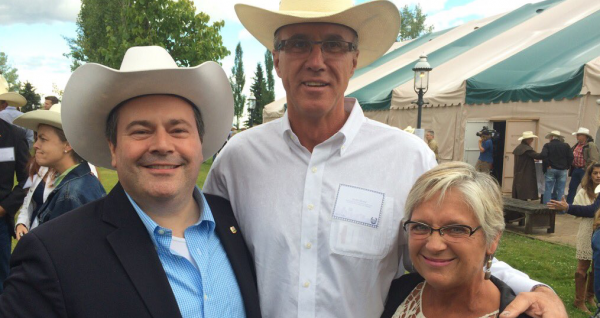
Conservative candidate Glen Motz (centre) with MP and PC leadership candidate Jason Kenney and Sue Motz.
A federal by-election will be held in the Medicine Hat-Cardston-Warner riding on October 24, 2016. Voters in the riding are choosing a successor to Conservative Member of Parliament Jim Hillyer, who died in March 2016.
Lawyer Richard Billington is the third candidate to enter the Conservative nomination race in Calgary-Heritage to replace former Prime Minister Stephen Harper, who resigned earlier this month. Mr. Billington joins party activist Bob Benzen and city prosecutor Paul Frank. As noted in a previous post, Mr. Billington ran for the Conservative nomination in Calgary-Centre in 2012 and has served as the President of the Conservative association in Calgary-Heritage for the past three years.
The Conservative nomination meeting in Calgary-Heritage is scheduled to take place on October 22, 2016, but could be pushed ahead if a by-election is called earlier. An open forum is expected to be held with the nomination candidates on October 12 or 13, 2016.
Kenny to resign this week
After spending the summer campaigning for the leadership of the provincial Progressive Conservative Party, Jason Kenney is expected to resign as MP for Calgary-Midnapore on September 23, 2016. Mr. Kenney had announced earlier this summer that he would resign on October 1, 2016, when the PC leadership race officially begins, but he announced last week at a campaign stop in St. Albert that he would resign one week earlier. A by-election must be called within six months of his resignation, which would be March 23, 2017.
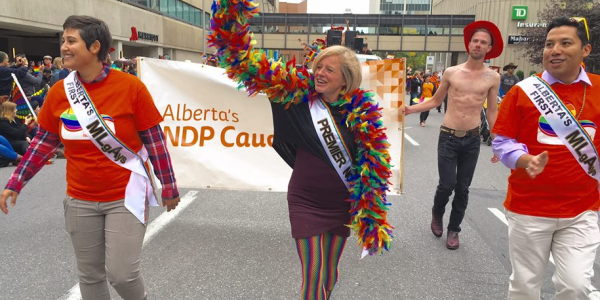
Alberta Premier Rachel Notley marches in the 2016 Calgary Pride Parade with MLAs Estefania Cortes-Vargas (left) and Ricardo Miranda (right). (Photo from Rachel Notley's Facebook Page)
Alberta’s Premier marches in Calgary’s Pride Parade on one day and then flips and serves burgers for unemployed and underemployed Albertans at a union-sponsored Labour Day BBQ in central Edmonton on the next day.
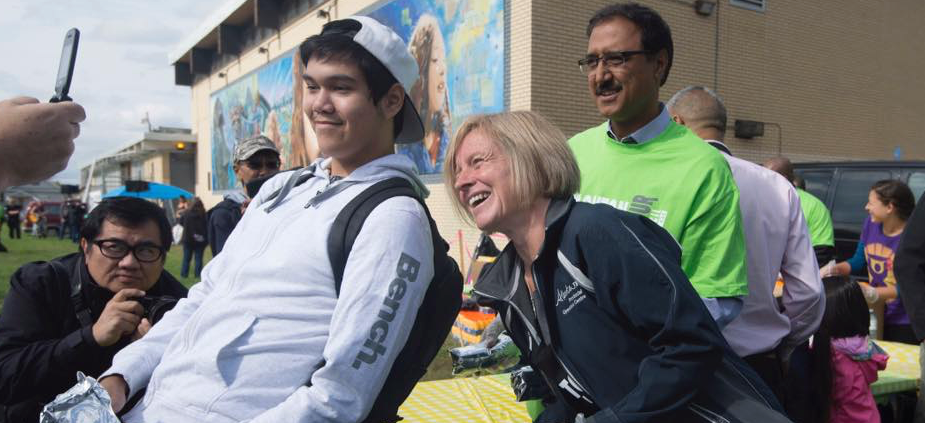
Alongside federal cabinet minister Amarjeet Sohi, Rachel Notley poses for a photo at the Edmonton & District Labour Council BBQ on Labour Day in Edmonton. (Photo from Rachel Notley’s Facebook Page)
Those two days provide some powerful symbolism of how Alberta’s politics have changed, and become a little more progressive, over the past few years. (I like this new Alberta)
Red Deer-South NDP MLA Barb Millerrecently found herself brewing in controversy after it was discovered in public expense disclosures that her constituency office had spent nearly $5,000 on K-Cup coffee capsules.
Barb Miller
Wildrose MLA Don MacIntyre, who represents the neighbouring Innisfail-Sylvan Lake constituency and has branded himself as an anti-communist crusader, penned a letter to the local newspaper criticizing the expense. If she had asked me for advice, I probably would have recommended that her office return and request for a refund for a portion of the $5,000, but last week Ms. Miller stuck to her guns in an interview in the Red Deer Advocate.
Here is an excerpt of the story written by Brenda Kossowan and published on August 25, 2016:
“I think a constituent is worth 50 cents. I’ve got the signage in my window that it’s a safe space, so anybody who is need can get to my office. I’m here representing the people of Alberta. If don’t care if they’re not from Red Deer South. They could be from Peace River, the could be from Pincher Creek. If they need help, my office is open.
The purchase has provided the Red Deer constituency office with enough coffee to last her entire term in office and the K-cups have a “best by” dates at the end of 2018, she said.
“I don’t want to give people sludge. That just looks bad and it smells bad. It was a convenience thing. You can’t not have something for a constituent when they come in, and it was the best value. After I purchased it, they did got up in price. That’s when coffee took that big spike when they had the crop failure down in South America.”
Miller said she ordered the coffee at the end of January and deliveries were made during February.
She said MacIntyre is welcome to have a coffee at the grand opening of her new office, toward the end of September.
He did not reply to the request for a telephone interview with the Advocate on Thursday.
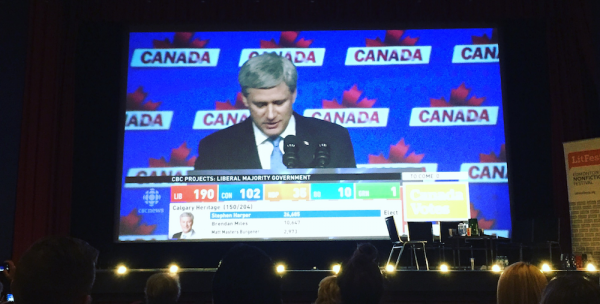
Conservative leader Stephen Harper delivers his concession speech after the votes were counted on the October 19, 2015 federal election.
Following former prime minister Stephen Harper’s resignation last week, a by-election must be called in the Calgary-Heritage riding by February 25, 2017. Two candidates have already entered the Conservative nomination race to succeed Mr. Harper in Calgary-Heritage.
The Calgary-Heritage federal riding (image from Wikipedia)
Local Conservative Party activist Bob Benzen was the first to announce his candidacy for the nomination. His website states that he is the co-founder of the Decade of Excellence Committee, which paid for large billboards thanking Mr. Harper for his service in office after the Liberal Party’s victory in the October 2015 election.
Calgary lawyer Paul Frank is the second candidate to join the nomination contest. He previously ran in the 2012 Senator-in-Waiting election and as a candidate for the Conservative Party nomination in Calgary-Rocky Ridge in 2014.
Local Liberals have been actively campaigning in Calgary-Heritage in anticipation of Mr. Harper’s resignation (and the neighbouring Calgary-Midnapore in anticipation of Jason Kenney’s resignation on October 1, 2016).
Brendan Miles
Rumoured potential candidates for the Liberal nomination include lawyer and past Calgary-Confederation candidate Matt Grant, Calgary Mayor Naheed Nenshi‘s chief of staff Chima Nkemdirim, and past candidate Brendan Miles. Mr. Nenshi quashed rumours of his candidacy when he told Metro Calgary in May 2016 that he would not run in the by-election.
Mr. Harper was re-elected in October 2015 with 63 percent of the vote, ahead of Liberal Dr. Miles with 25 percent, New Democrat Matt Masters with 8 percent and Green Kelly Christie with 2 percent.
Before the 2015 election, the riding was known as Calgary-Southwest and had been represented by Mr. Harper since 2002. The riding was previously represented by Reform Party leader Preston Manning from 1993 to 2002.
19 Days Left! South east of Calgary, there are 19 days left until a federal by-election must be called in the Medicine Hat-Cardston-Warner riding.
As a committee of Members of Parliament study, discuss and debate potential changes to Canada’s federal electoral system, three Alberta MPs are scheduled to hold town hall meetings in their ridings to discuss electoral reform with their constituents. The MP committee membership includes Banff-Airdrie Conservative MP Blake Richards and briefly included Calgary-Midnapore MP Jason Kenney (who later decided to focus on his provincial leadership ambitions).
September 8, 2016: Electoral Reform town hall with Edmonton-Strathcona MP Linda Duncan, 7:00 p.m. at the Westbury Theatre, ATB Financial Arts Barns at 10330 84 Ave NW in Edmonton.
September 8, 2016: Electoral Reform town hall with Calgary-Centre MP Kent Hehr, 6:00 p.m. – 7:45 p.m. at the Knox United Church – Theatre on 506 – 4th Street SW in Calgary.
September 9, 2016: Electoral Reform town hall with Sherwood Park-Fort Saskatchewan MP Garnett Genuisat Suite 214, 2018 Sherwood Drive in Sherwood Park (the notice asks that interested participants contact his office to register to attend the meeting ).
The Minister of Democratic Institutions, Maryam Monsef, will be hosting a town hall forum in Edmonton on September 10 from 7:00 p.m. to 9:00 p.m. at the Sutton Place Hotel at 10235-101 Street.
Edmonton-Centre MP Randy Boissonnault hosted a town hall on electoral reform on August 18, 2016.
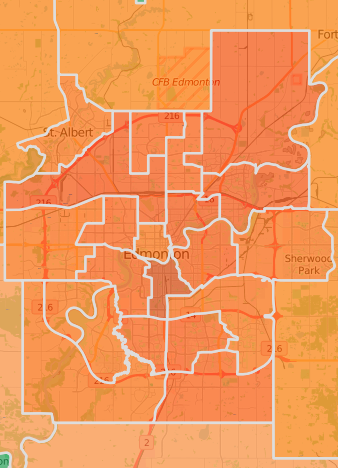
Current electoral boundaries in Edmonton, drawn in 2010, with the results of the 2015 election.
An Electoral Boundaries Commission will be appointed by October 31, 2016 and will propose changes to Alberta’s provincial constituency boundaries to reflect population changes and shifts since the last time the boundaries were redrawn in 2010.
Bill 7: Electoral Boundaries Commission Amendment Act, introduced by Justice Minister Kathleen Ganley in April 2016 adjusted the timelines for the commission and clarified the commissioners authority to consider municipal population information, such as a municipal census.
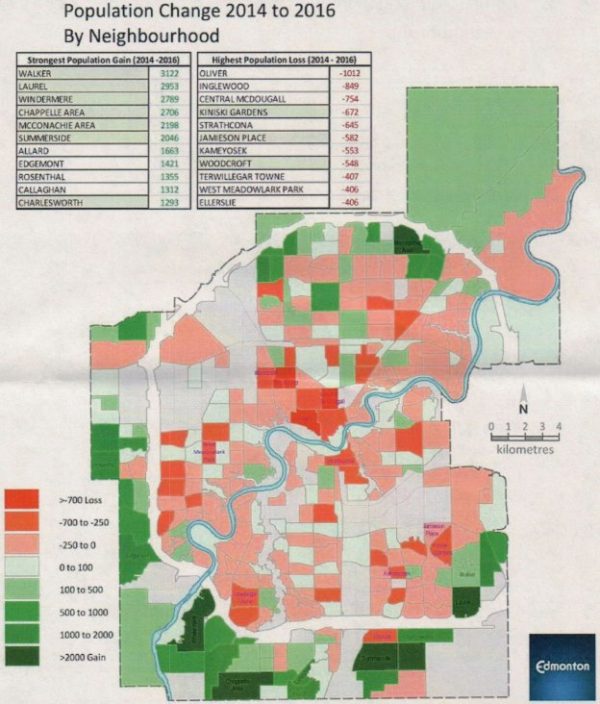
Overall, Edmonton’s population has increased by 117,008 since the 2009 Census and Alberta’s population has grown by more than 500,000 since our provincial electoral boundaries were last redrawn in 2010.
With the municipal census showing Edmonton is becoming more suburban, we should expect the boundary commission will redraw the city’s provincial electoral districts to reflect this growth in suburban neighbourhoods.
“I’ve been beating this drum for 10,11 years. I will continue to beat it, I promise. But it’s against the law to beat Rachel Notley…” – Wildrose leader Brian Jean
It appears as though Mr. Jean was trying to be funny while playing to a hometown crowd, which is no excuse for this kind of unacceptable comment. Jokes about assaulting women, even if they are off the cuff, are not funny. He did immediately apologize, twice, and quickly sent an apology directly to Premier Notley, but it is difficult to see how he can walk back this comment.
This wasn’t a joke made by an anonymous internet troll or a roughneck after a few beers at the local bar, this comment comes from the leader of the Official Opposition who presumably wants to be the next Premier of Alberta.
Mr. Jean’s recent comment is also embarrassing because of his previous call to Wildrose supporters to stop making online threats about assassinating Ms. Notley. “These kinds of comments cross all bounds of respect and decency and have absolutely no place in our political discourse,” Mr. Jean said in a note on his Facebook page in December 2015.
Women politicians in Alberta have been the target of constant online threats and harassment, which has unfortunately become almost normalized in our current political environment. Given recent threats levelled at Ms. Notley and women cabinet ministers, Mr. Jean’s comment is a mind boggling political fumble.
The drum Mr. Jean claims to have been beating for the past 10 or 11 years is related to the level of seniors care available in Fort McMurray, an issue which has a long history of causing political controversy in that community and in the provincial capital.
Back in July 2009, Fort McMurray-Wood Buffalo MLA and former cabinet minister Guy Boutilier was ejected from from the Progressive Conservative caucus for publicly criticizing the government for not funding a new facility. Mr. Boutilier publicly accused Health Minister Ron Liepert of “talking gibberish” and then criticized Premier Ed Stelmach for not wanting a cabinet minister “who graduated from Harvard with Barack Obama.” (he later admitted that he never met Obama while at Harvard).
At last night’s meeting, Mr. Jean is reported to have praised Ms. Notley for moving a planned long-term care facility from Parsons Creek to the downtown Willow Square site.
Chris is encouraging curious Edmontonians to email him with historical questions they want answered that could turn out to be inspirations for future podcast themes. Email him at chris@letsfindoutpodcast.com with your questions.
As an avid fan of history and podcasts, I am looking forward to listening to more podcasts from Edmonton’s official historian and chief story teller.
There are thirty-four days remaining until the Progressive Conservative leadership officially begins on October 1, 2016. The race is already unofficially underway with one candidate in the contest Jason Kenney – the Member of Parliament who launched a hostile takeover campaign earlier in the summer in a bid to merge the PCs with the Wildrose Party with the backing of lobbyists with Wildrose Party ties.
Jason Kenney
I keep hearing from my friends involved in the PC Party that a social conservative like Mr. Kenney cannot be allowed to win this race.
The third-place PC Party, which formed government in Alberta from 1971 until 2015, have abandoned its former one-member one-vote system that threw open the doors to any Albertan who wanted to participate. The party’s next leader will be chosen by locally elected delegates – 15 from each of the province’s 87 constituencies.
The PC Party committee drawing up the rules for the leadership race has decided that of each group of 15 elected delegates, ten which will be open to any local party member wishing to become a delegate and five reserved for local party officials. This is somewhat similar to the Superdelegate system used by the Democratic Party in the United States.
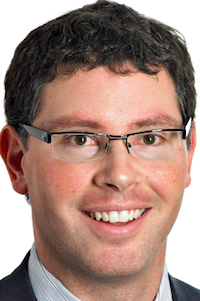
Doug Schweitzer
The adoption of this Superdelegate system means the thousands of Wildrose Party supporters who may purchase PC Party memberships to support Mr. Kenney may have a smaller impact than if all 15 delegate spots were wide open. It will likely make it more difficult for Mr. Kenney to succeed in his hostile take over the Alberta’s PC Party.
But stopping Mr. Kenney would mean someone would actually have to run against him.
We have heard rumours of that Calgary lawyer Doug Schweitzeris aiming to run, with the support from the party’s monied Calgary establishment. He is the former CEO of the Manitoba PC Party and was connected to Jim Prentice‘s 2014 leadership campaign. Also said be considering a run is Byron Nelson, another Calgary lawyer and a past PC election candidate.
Richard Starke
I am told that more than a few moderate Tories are warming up to the idea of supporting soft-spoken veterinarian Richard Starke, one of two remaining rural PC MLAs. Sandra Jansen has also been talked about as a voice of the party’s ‘progressive’ wing. She is despised by federal Conservative activists for throwing her support behind two Calgary Liberal Party candidates in the last federal election.
Will there be a candidate from Edmonton? The NDP remain popular and ahead in the polls in the capital city, which elected New Democrats in every constituency in the 2015 election.
Thomas Lukaszuk
Former Edmonton-Castle Downs MLA Thomas Lukaszuk has been rumoured but his support of funding cuts to the University of Alberta, his close association with former premier Alison Redford and his strange $20,000 cell phone bill are significant political impediments. According to a recent ThinkHQ poll, his disapproval rating in Edmonton sits around 50 percent.
City Councillor Michael Oshry has mused about running but his real goal might actually be to secure his spot as a PC candidate in Edmonton-McClung in the next election, a seat that the PCs might be able to pick up. Lawyer Harman Kandola, who was the PC candidate in Edmonton-Ellerslie in 2015 is also said to be testing the waters for a run.
Katherine O’Neill
I have heard some PC Party members wish party president Katherine O’Neill would join the leadership race. The former Globe & Mail reporter and past PC candidate has been criss-crossing the province at the same speed as Mr. Kenney and his big blue truck, though it is probably too late for the party president to shift gears into a leadership vote this close to the official start of the campaign.
Mr. Kenney has spent the summer travelling around the province preaching his gospel of merging the PCs and Wildrose Party to defeat the risky, dangerous and scary socialists in Edmonton. But it might not necessarily a bad thing that Mr. Kenney has sucked up all the PC leadership oxygen this summer. In doing so he has defined the narrative of this part of the campaign – merging the PCs with the Wildrose – an idea that 1,000 PC Party members, including many who will now vote as Superdelegates, loudly rejected at their annual general meeting earlier this spring.
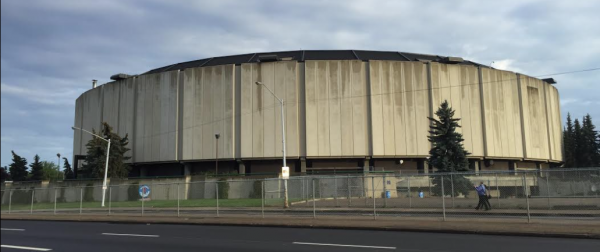
I agree that we must be realistic and act not only in the best interests of the city’s economy but also in the best interests of the residents who live in the neighbourhoods that surround Northlands.
As a homeowner in the area (we live three blocks away from Northlands), my biggest worry is that the 160 acres of land currently occupied by Northlands will become derelict if Northlands folds or the City takes over operations. A large unused space like this has the potential to have a negative impact on the surrounding neighbourhoods.
I am skeptical of some elements of the Northlands Vision 2020 plan, especially the proposal for the festival site but I support the idea of redeveloping the arena into a multi-rink or field sports complex.
It is frustrating to know that neither the previous City Council or Northlands had the foresight to create a plan before Mr. Katz moved the Oilers from Rexall into to their new downtown arena.
Dave
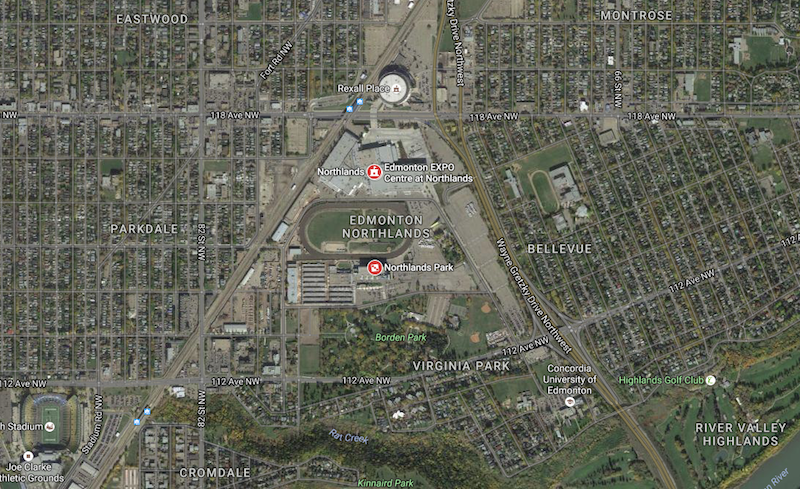
A satellite photo of Northlands and the residential neighbourhoods that surround it. (Source: Google Maps)
City Council is holding a non-statutory Public Hearing on August 31, 2016 starting at 1:30 p.m. to hear from the public about the Vision 2020 plan and the future of the Northlands site. Anyone interested in speaking at the hearing can register online or call the City Clerk’s office at 780-496-8178.
As Alberta MLAs debate the merits of limiting spending in election campaigns, introducing a reimbursement system and lowering the amount individuals can donate to political parties, let us cast our attention back to 1972 when rookie New Democratic Party MLA Grant Notley, the father of current Alberta Premier Rachel Notley, proposed similar changes.
Grant Notley
Mr. Notley’s first private members’ bill, An Act to Amend the Elections Act, proposed the creation of spending limits and the disclosure of financial contributions to candidates and political parties, which was not required at the time. The bill proposed to limit campaign spending to “25 cents per elector in the aggregate” or “$2,000 in anyone electoral division.” According to the Bank of Canada online inflation calculator, $2,000 in 1972 would be the equivalent of $11,898.62 in 2016.
“The first major principle in the bill is the concept that election expenses should be limited. It is my submission, Mr. Speaker, that it is important in a democratic society that all political points of view should have, as much as possible, equal access to public opinion,” Mr. Notley said when introducing Bill 202 for second reading in the Legislative Assembly. “The lack of control over the expenditures in an election campaign can lead to a great inequality in the right of political organizations to make their case before the people of the province or the country.”
“Mr. Speaker, one of the principal reasons for limiting election expenses is that, in my view, it would force political parties to move away from what I claim to be an over-dependence on the public media and to get back to the kind of participatory campaigning which to me is basic to the whole democratic process,” Mr. Notley argued.
The bill faced stiff opposition from some of his conservative colleagues in the Assembly.
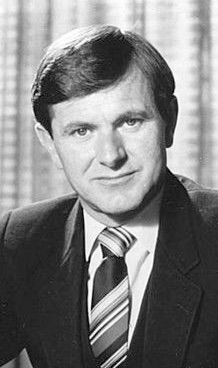
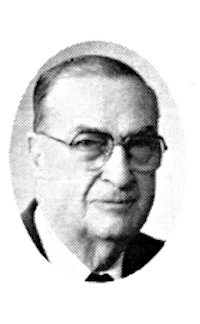
Gordon Taylor
Bill Purdy, the Progressive Conservative MLA for Stony Plain, warned that “…if we regulate campaign spending we are getting away from the democratic system” and Edmonton-Jasper Place PC MLA Les Young argued that “…the amount of money suggested in this particular bill, is in my opinion, quite inadequate. It is not a great deal more than I spent in my own personal campaign, but nevertheless, it would be quite inadequate if applied on a provincial basis.”
And cabinet minister Julian Koziak, the PC MLA for Edmonton-Strathcona, argued that “that if the gentleman will recall the election expenses that were advertised especially for the constituencies of Edmonton Glenora and Edmonton Whitemud by the Social Credit candidates, one can verily see that the amount spent has no bearing on the results of the election.”
Drumheller Social Credit MLA Gordon Taylor, who would later join the PC Caucus, spoke in support of Mr. Notley’s bill:
“I would like to support Bill No. 202 in principle. When I say that I can’t say I could subscribe to everything in the bill from clause to clause. But I think the principle of limiting to some degree election expenses is very sound. If each candidate from every status of life is going to have a reasonably equal chance to present his platform to the electorate then there has to be some limitation on the amount of money. Because otherwise we’re making things very unequal.
The labouring man can’t find huge sums of money with which to fight an election campaign, compared to a man who happens to be wealthy — and instead of saying a ‘labouring man’ let’s say a ‘poor man’, whatever category he happens to be in. He might be a doctor or lawyer, too, some of them are poor, maybe not very many but a few of them are poor also. But a poor man cannot find the same kind of money — large sums of money — to fight an election campaign from his own resources compared to a wealthy man.
When it comes to contributions from other people the poor man may have a wider scope and may be able to secure more money than a wealthy man, but it is questionable whether he could secure sufficient money to equal that of a wealthy man who is determined to be elected by the amount of money he has.”
But perhaps the most colourful and poetic commentary during the 1972 debate came from Charles Drain, the Social Credit MLA for Pincher Creek-Crowsnest:
“…looking at it as a history of democracy and a tree of democracy and how it has grown from the time of Athens and the time of ancient Rome and even to the time of the Magna Carta, when the voting and the processes of democracy, and the right of he who could hold office was predetermined by the prerogatives of birth, and in later time by religion and ancestry, and watching the progress that we have now made.
Truly, Mr. Speaker, the tree of democracy has managed to flourish despite the fact that it has been bent by many winds, many winds that have been retrogressive. But in spite of all this, we evolved onward and prosperously further along the road to what true democracy should mean to all of us. The right of people to predetermine the management of their affairs.”
So as history evolves, we can look at the history of early elections in Canada and the politician who bought the greatest amount of whiskey won the election, and this is history because I know where of I speak. I have talked to old timers who have managed to drink vast quantities of liquor for one party and then vote for the other; which is proper democratic justice.”
Bill 202 was debated in the Legislature but does not appear to have made it further than second reading. Mr. Notley would go on to introduce private members’ bills in 1974, 1977 and 1979 that also proposed amending the Elections Act to limit campaign spending by candidates and political parties in Alberta elections.