By: Justin Archer
Dave Cournoyer and I have known each other since 2005, when I got my first real job working in a junior staff position with the Alberta Liberals. Dave started working there shortly after I did, and the two of us became friends. He’s mentioned to me before that I could do a guest post at some point if there is a topic that seems to fit, but I’ve never asked to take him up on that offer until now.
 Let me just explain first that I am the kind of person you’d probably expect to be in the Alberta Party. I live in a condo downtown and have a pretty good job in what is thought of as the “creative economy”. I’m politically active. I still like to think I’m young (though I did find my first grey hair the other day, which needless to say was traumatic.) I am a strong supporter of human rights, and a proponent of mostly free markets with some government intervention in the economy to protect the common good. I also know quite a few people involved in the Alberta Party, and I like them and respect them. I agree with them in a broad sense on how this province should be governed, because their values are my values.
I think they might be making a Big Mistake though, and that’s what I want to talk about here.
The first part of my argument is that there are a couple of no-such-things:
1. There is no such thing as a post-partisan political party.
2. There is no such thing as a political party that falls outside of the traditional left/right spectrum.
No-such-thing 1 is essentially self-evident. The word partisan basically means “someone who supports a cause and works to achieve some end associated with that cause” . If an organization is trying to get people elected and maybe even form a government, it’s a partisan group. It’s not even really open to interpretation, that’s just what “partisan” means. It has been suggested to me that perhaps the Alberta Party intends to introduce a less partisan style of politics to the debate. I don’t really understand what this means, but if it means something along the lines of “no talking bad about the other guys”, I would be shocked if that sentiment sticks around the nascent organization for long, if it is even there now. Which it probably isn’t. No-such-thing 2 is also quite simple: When you get down to it, what a government does is take in the money and then figure out how to spend it. If you look at how each government philosophically approaches this job, you can figure out where it sits on the spectrum.
 It’s like this: Some people think that the government should take in lots of the money and make sure that everyone gets a nice amount. Those people often think that the government should be involved in lots of things and intervene in many economic transactions. Those people are on the left.
There are other people who think that the government should take in some of the money, and make sure that everyone gets at least a least a little bit. These people also usually think that the government should allow economic activity to take place free of government interference except where there is a real problem that needs fixing. Those people are in the centre.
Then there are people who think that the government should take in only a little bit of the money, and it’s up to individuals to get things for themselves. These people also usually think that the government should keep its damn nose out of pretty much everything (unless their rich friends are in trouble, in which case those rules no longer apply). These people are on the right.
I’ve heard it said by people in the Alberta Party that this party is not possible to pin down on the spectrum I’ve described above. It would be fun and exciting to think this, but it would be wrong. I haven’t seen the policy that the Alberta Party passed at its recent convention, but I would very surprised if an analysis of that policy wouldn’t reveal that the party is in the centre. In fact I’d almost guarantee it. I think if you follow Alberta politics closely and you know the people in that party and the sorts of things that those people tend to think, you’d have to agree with me.
So if the Alberta Party is in the centre, and it is partisan, it is basically the Alberta Liberal Party only cooler and better looking. What I mean is that the values are very similar, the policies are likely quite similar, but it’s a newer and more exciting organization. It has an ambitious and fun culture, lots of wonderful and smart people, and a great attitude about how to engage people in the political process. It has also embarked on a great citizen engagement process and done a great job of getting ink for its work. But the actual values, the guts of the party, are not very different from those of the Liberals.
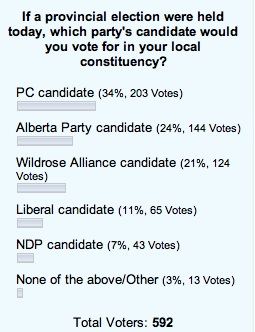
I also think that the Alberta Party will take many votes from the Liberals. I do not buy the argument that the 60% of people who didn’t vote last time will be the deciders in the next election. I think that for the most part, people who didn’t vote last time won’t vote next time. From the inside of a political party it is easy to start to believe that there is something big happening out there, and people are getting turned on. Largely though, political activity in Alberta takes place outside of the notice of the majority of the population and people who don’t follow politics are not getting turned on. In my view the pool of votes might be a little bigger next time, but not much.
Now this is the part where it’s easy to say, “sure, well if the Liberals are so great, why aren’t all these engaged young difference makers joining up with them?” The truth is that the Liberals haven’t done a good job of answering that question. But I actually don’t know that it’s the right question to be asking.
 You see, I think that we are on the cusp of one of those generational shifts in Alberta politics where a new government will come to power. If you are reading this blog you don’t need a primer in Alberta politics – we can all agree that historically there has been a one-party culture here, and when a change in government comes, it is fast and total. Many people, and particularly many rural constituencies, want to be on the side of the winning team, so support tends to move quickly to the party who looks like it may form government. I think that because of this, in the next election, small “c” conservative support will begin to drift from the PC Party to the Wildrose Alliance Party. In the election after that, that conservative support will firmly coalesce around the Wildrose Alliance Party, and that party could easily form a government at that time.
There is a strong parallel to federal politics here. Let’s be honest, the Chretien/Martin government years were made possible in large part by the split in the conservative family over much of that time period. Now that the federal conservatives are re-united under one banner, it’s not so easy for those in the centre to form a government, as we’ve continually seen. I think that this is probably one of the only times where we’ll have a similar political situation here provincially, and as moderates in this province it looks like we’re about to waste it by grouping in factions instead of realizing that we all pretty much agree on things. If centrist political organizers and voters are divided during the next five or six years between the Alberta Party, the Progressive Conservative Party and the Alberta Liberal Party, the moderates in this province will probably lose the opportunity to form a government for the next generation.
In summary my argument is this: We’re about to miss an opportunity while the conservative house is divided because of things like process and personality. I believe that process and personality are important in politics, but when you peel it all back, the values underneath are what really matter. And in the absence of a divergence on values, is it not foolish to have competing organizations?
I don’t know how to solve this. I’m not saying the Alberta Party should stop doing what they’re doing. I’m not saying the Liberals should fold up the tent. But I do think this is a real discussion that needs to take place on this side of the coming electoral opportunity, rather than a lament on the other side of it.
Anyway, thanks to Dave for letting me air this here. Please chime in in the comments.
——–
Justin Archer is a young guy in Edmonton who is involved in this and that around town. He grew up in Calgary but moved here about five years ago to take his first big kid job as a Liberal staffer. After a 2008 election night filled with tears and despair (but I thought we were gonna be the governm…….*sob* *sniffle*), he went to work for a Edmonton-based PR firm, where he is now a consultant. He believes that Alberta is a great place and most of the whole redneck thing is exaggerated. Follow him on Twitter @justin_archer.
Read other guest posts to this blog.