Categories
Alberta Politics

Albertans are more progressive than you might think. I’m not surprised.

A new report, “The Quiet Majority“, released by a new group called Progress Alberta shows that we Albertans may be more progressive than we believe we are.
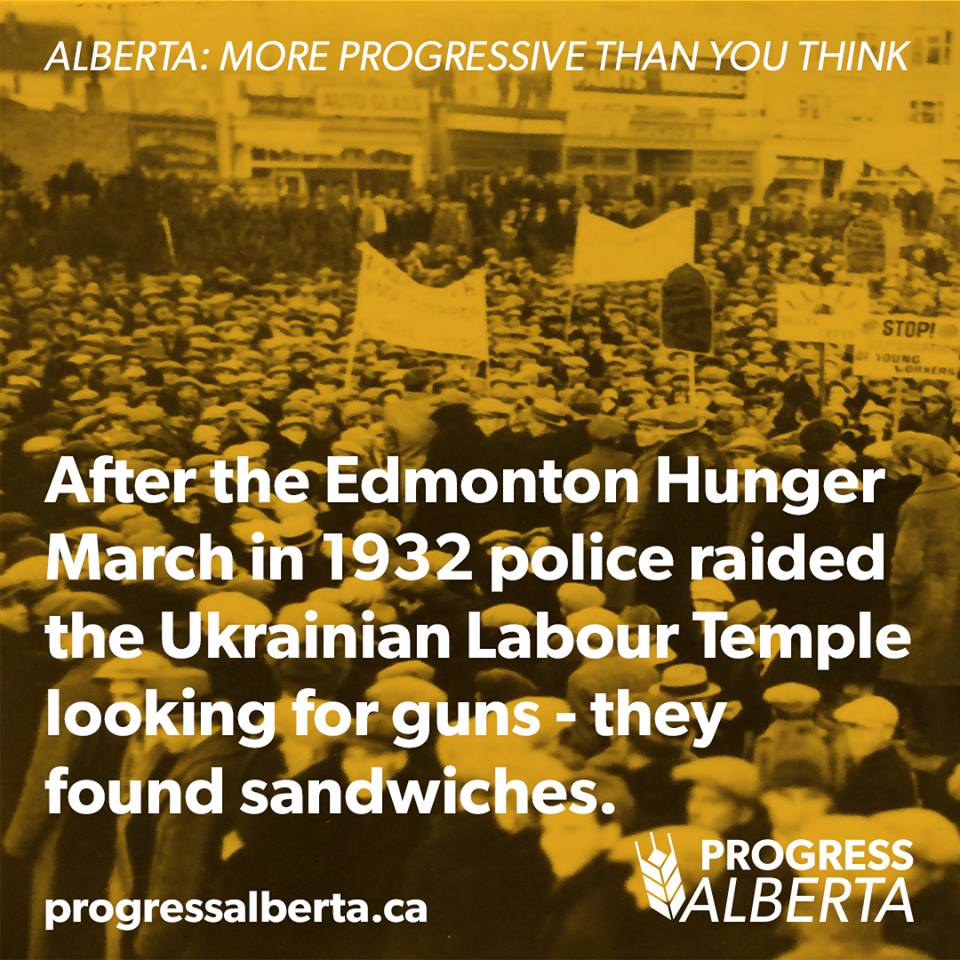
Progress Alberta Edmonton Hunger Ukrainian Strike
A infographic released by Progress Alberta.

According to a survey conducted by Abacus Data, when Albertans were asked whether they consider themselves to be progressive, 59 percent answered yes. It appears that although we identify our province as being conservative, a significantly larger group of Albertans identify as being moderate or progressive.

“Urbanization, in-migration, and generational change are all shifting the province’s political attitudes and behavior,” Abacus Data’s David Coletto said in a press release today.

The survey also shows strong support for same-sex marriage and the decriminalization of marijuana, and support for raising personal income taxes on high income earners and the introduction of a carbon tax.

This survey also reinforces the arguments made by political watchers like Corey Hogan, that shifting demographics and massive population growth have created a new political environment in Alberta which made an electoral win by the New Democratic Party possible in 2015.

As shown in the graphs below, where Albertans place themselves and where they believe most of the population sits on the ideological spectrum is quiet different.

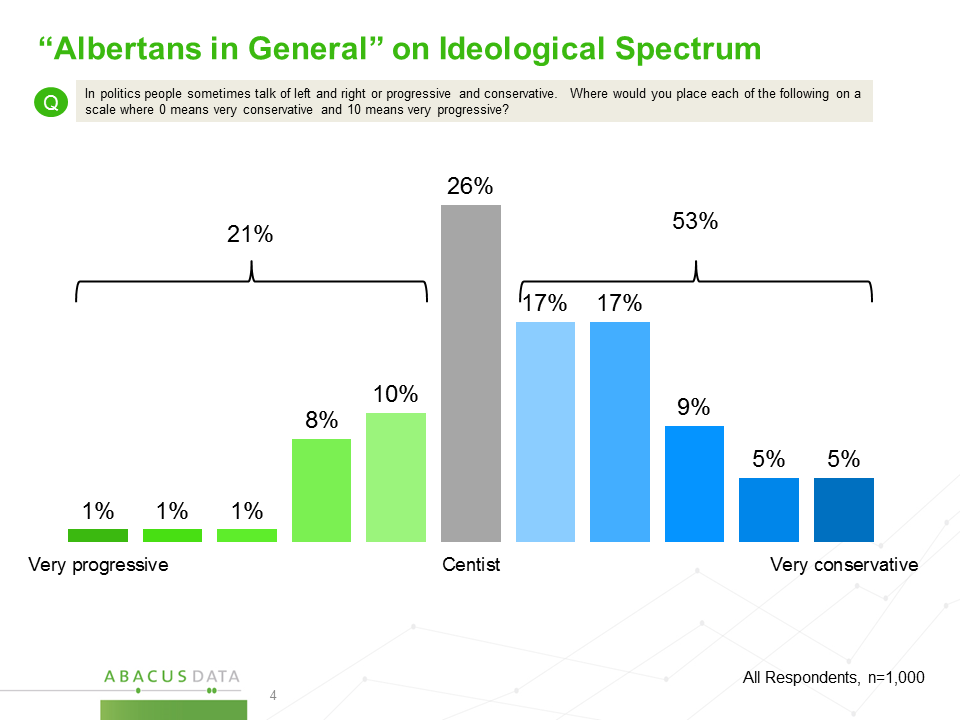
AB_Ideological_Self-Placement-1
Where Albertans place themselves on the ideological spectrum.
AB_in_General_Ideological_Placement
Where Albertans believe most of the population sits on the ideological spectrum.

The results of the survey are not surprising to anyone who has been paying close attention to Alberta politics, as I have over the past ten years. While there are a large number of self-identified conservatives in our province, Alberta’s electorate has always been more populist than conservative.
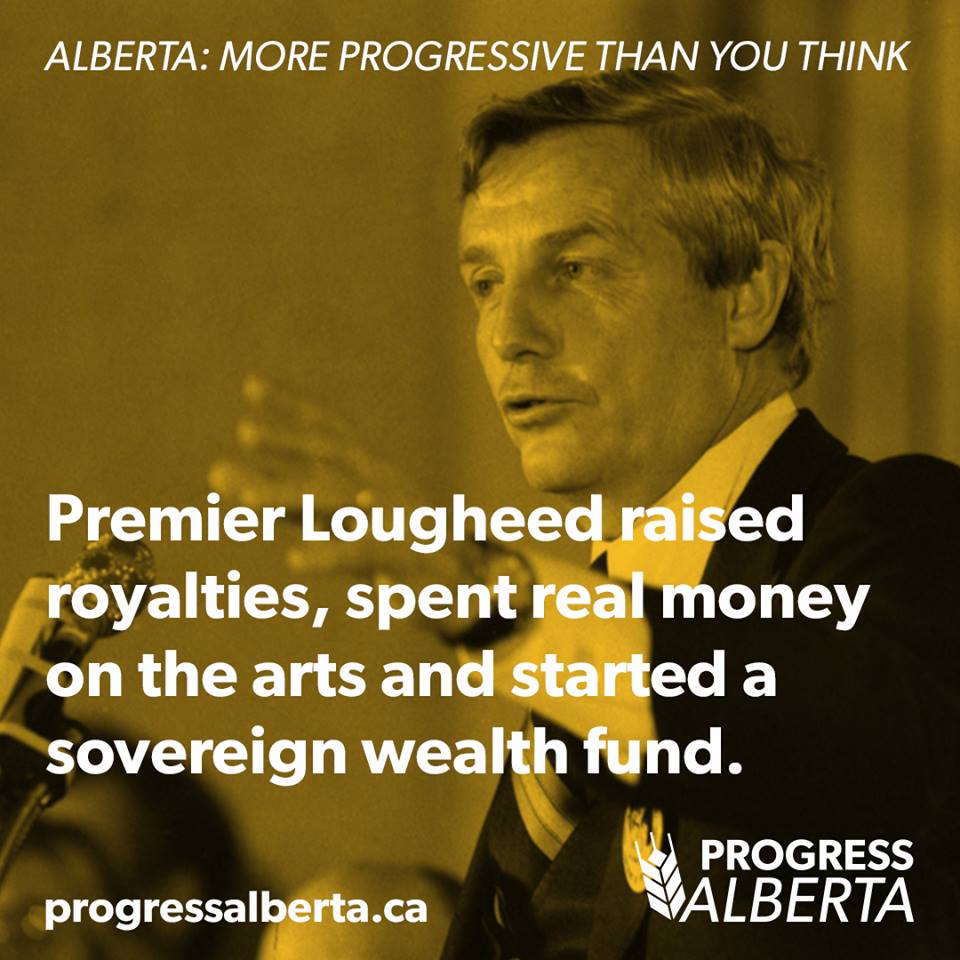
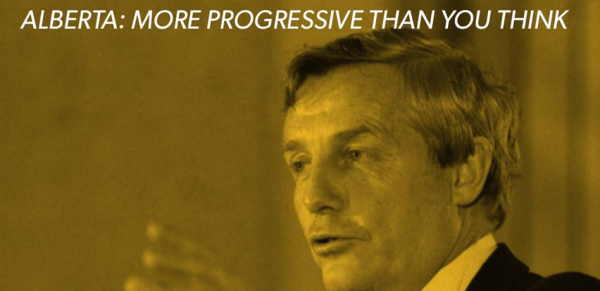
Peter Lougheed Alberta Conservative Premier
A infographic released by Progress Alberta.

The great success of the old Progressive Conservative government, starting under the leadership of Peter Lougheed in 1971, was forged with the creation of a broad political coalition that appealed to conservative, moderate and progressive voters in Alberta. And at the height of the Ralph Klein-era in Alberta politics, the Liberals and NDP were still able to garner between 30 and 40 percent of the province-wide vote.

This is why I am hesitant to predict the death of the PC Party in Alberta, even in its current weakened state.

The right-wing Wildrose Party led by Brian Jean continues to mount a campaign to take over the PC Party. At meetings across the province, Wildrose Party members are being encouraged to purchase PC Party memberships in order to push the merger agenda at constituency associations and other internal party levels.

Proponents of the take over characterize it as a merger but it is likely that the Wildrose needs the PCs more than the PCs need the Wildrose and the limited appeal of the ideological social conservatism that much of its membership base represents. The PCs won 12 elections from 1971 to 2012 by raising a big tent centrist party, not by just uniting conservatives under one conservative party banner, as Mr. Jean and MLAs like Derek Fildebrandt appear to be proposing.

A infographic released by Progress Alberta.

Many members of the PC Party, including Calgary-North West MLA Sandra Jansen remain opposed to merging with the Wildrose, which could drag the PCs further to the political right and away from where most Albertans stand, near the moderate centre. With the right leader, the PCs may be able to regain the trust of voters lost in 2015.

It is becoming increasingly clear that the Wildrose Party’s strategy is to eliminate the PC Party as an alternative while continuing to brand the NDP government as “risky”, “extreme” and “ideological,” despite no real evidence supporting those claims.

The success of Rachel Notley‘s NDP in 2015 was based on her appeal to moderate and progressive voters. It is not surprising that during last year’s election campaign Ms. Notley frequently invoked the memory of Mr. Lougheed, who was seen by many Albertans as the embodiment of a progressive and forward-looking leader.

The success of the NDP in the 2019 election could be based on their ability to remain appealing to that coalition of moderate and progressive voters. This will require Ms. Notley to keep the balance and moderation that was promised in her party’s election platform and not veer too far left to appease her party’s fringe.

This is only one poll and is not an indicator of how Albertans will vote in future elections but it does provide some valuable information about the values held by many voters in our province. It is encouraging that groups like Progress Alberta are being formed to ensure that issues important to progressive Albertans are publicly discussed in a province dominated by conservative commentators and pundits.

Publisher’s Note

I am pleased to be contributing to Progress Alberta as a member of their advisory board. See the full list of advisory board members here.

Information about the survey

The survey informing this study was conducted online with 1,000 Albertans aged 18 and older from December 2 to 7, 2015. A random sample of panelists was invited to complete the survey from a large representative panel of Albertans recruited and managed by Research Now, one of the world’s leading providers of online research samples.

The Marketing Research and Intelligence Association policy limits statements about margins of sampling error for most online surveys. The margin of error for a comparable probability-based random sample of the same size is +/- 3.1%, 19 times out of 20.

Categories
Alberta Politics

Breaking: Alberta’s Tories Poised to Sweep Election in Spring 2016

December 17, 2015

By: Dirk Pranter, Provincial Affairs columnist, Calgary Sunherald

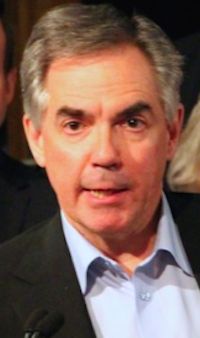
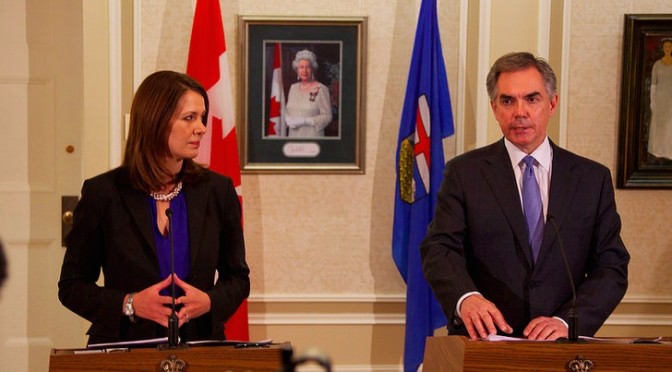
Jim Prentice Alberta Premier
Jim Prentice

One year after nearly the entire official opposition crossed the floor to join Alberta’s Progressive Conservatives, the 44 year long governing party is expected to sweep the province for a record thirteenth election victory. Premier Jim Prentice is said to be preparing his party and its candidates for an early spring 2016 election.

According to Alberta’s fixed election date law, a provincial election must be called between March 31 and May 1, 2016.

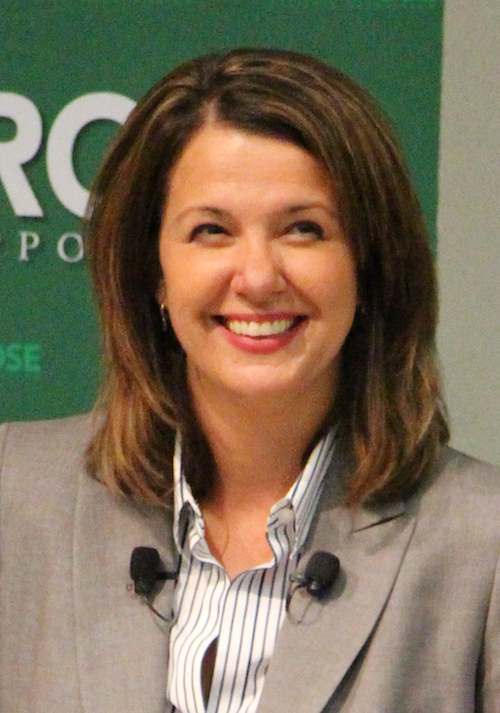
The Wildrose MLA floor crossings on December 17, 2014 hurt the PCs in the polls in the first half of 2015. But after the Tories began to recover in the polls a fall cabinet shuffle brought two former Wildrose MLAs, Danielle Smith and Rob Anderson, into Prentice’s cabinet as Finance Minister and Justice Minister.

Danielle Smith
Danielle Smith

Public opinion polls now suggest most Albertans have embraced the Prentice Tories once again. The PCs now have the support of 77 percent of Albertans, according to the most recent Western Insite poll.

“A few months ago it looked like the Tories had a real fight on their hands but today they are back on top,” said Jake Randall, vice-president of Western Insite Inc. “Prentice really didn’t start resonating with Albertans until after May 2015,” he said.

Speaking on the condition of anonymity, a senior official in the PC Party admitted they were glad the provincial election wasn’t called in early 2015, as some party insiders had pushed for.

“We simply weren’t prepared to go to the polls in spring 2015,” the source said.

“We would have got smoked, boy, it would have been the end of us,” they said.

David Climenhaga
David Climenhaga

The hopes of New Democratic Party supporters were boosted when David Climenhaga defied expectations with a 67 percent landslide win for the NDP in a May 5, 2015 by-election in the Spruce Grove-St. Albert constituency.

Liberal MLAs Laurie Blakeman and David Swann added to the orange momentum on May 6 when they joined the NDP caucus, creating speculation that Rachel Notley‘s NDP could pose a serious challenge to the Tories in the next election.

But with recent polls showing the NDP back in their traditional range of 10 percent support, Albertans may never know what an NDP government looks like.

The Wildrose Party has wilted, with most of its support relegated to a handful of rural southern Alberta constituencies.

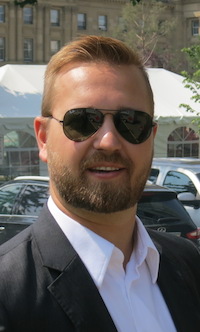
Derek Fildebrandt Alberta Taxpayers
Derek Fildebrandt

Wildrose leader Derek Fildebrandt remains a harsh critic of the PCs and is in talks to create a ‘real conservative alternative’ by merging his party with the right-wing Social Credit and Alberta First parties.

“Most Albertans are moderates and are very suspicious and uncomfortable with the kind of social conservative politics inside the Wildrose Party,” said Darlene Sinclair, professor of political science at Vermilion River University in Lloydminster.

Sinclair predicted that the PCs had successfully built a coalition of moderate and progressive minded urbanites that could keep the Tories in government for many decades to come. But she warned that even with high polling numbers, the Prentice government faces serious challenges.

Tory supporters are quick to defend Prentice from criticisms about the job losses caused by a downturn in the economy, tax increases and his refusal to make deep funding cuts to public programs.

Former Conservative MP Brian Jean, who will be running for the Tories in the Fort McMurray-Conklin constituency, said that Prentice is not to blame for job losses in the oil patch.

“It would be silly to believe that any Premier of Alberta, even Jim Prentice, has the power to control the international price of oil,” Jean said.

“It just doesn’t work like that, ” he said.

(Note: This article is a satirical take on what might have happened if the PC Party had waited until Alberta’s 2016 fixed election date to call the most recent provincial election. In reality, the PCs called the election one year early and Albertans elected Notley’s NDP with a majority government on May 5, 2015).

Categories
Alberta Politics

PC Party financials reveal $1.5 million debt from 2015 election

Reports of the death of the Progressive Conservative Association of Alberta might only be slightly exaggerated. Financial disclosure reports submitted to Elections Alberta show the former governing party amassed a $1.5 million debt during the May 2015 election.

After reportedly nearly missing the deadline to submit its financial disclosures from the recent provincial election, the PCs posted the disclosure on its own website, which provides some detail into the overwhelming wealth of the former governing party during its failed attempt at re-election in May 2015. (The full report is now posted on the Elections Alberta website).

The disclosure report provides information about a $2,000,000 loan secured by the PC Party from the Canadian Western Bank with an outstanding balance of $1,544,866 as of July 5, 2015. Security on the loan includes a personal guarantee of $1,455,000 from a former director, who is unnamed in the document.

The report shows the PCs raised $2,802,500 in donations greater than $250 and $90,625 lower than $250 during the April 7 to July 15, 2015 campaign period. The PCs spent $4,303,969 and ran a deficit of $930,236 during the election campaign.

In response to its financial troubles, the party received significant financial transfers from some of its wealthier constituency associations, including $30,000 from Edmonton-Whitemud, $25,000 from Calgary-Elbow, $20,000 from each Calgary-Varsity and St. Albert, and $15,000 from Whitecourt-Ste. Anne.

Major donors listed on the PC Party’s financial disclosure include Richard Haskayne ($30,000), Ronald Joyce ($30,000), Ken King ($30,000), Calfrac Well Services Ltd ($30,000), MacLab Hotels & Resorts Ltd ($30,000), Matco Investments ($30,000), Christopher Potter ($30,000), Primrose Livestock Ltd ($30,000), Susan Rose Riddell ($30,000), Clayton Riddell ($30,000), Ronald P Mathison Private Banking Ltd ($30,000), Cathy Roozen ($30,000), Mike Rose ($30,000), Shane Homes Ltd ($30,000), Walton International Group Inc ($30,000), TIW Western ($25,000), CIBC ($23,750), Scotiabank ($23,750), BMO Nesbitt Burns Inc ($20,000), Matthew Brister ($20,000), Brian Michael Brix ($20,000), Grandview Cattle Feeders Ltd ($20,000), Kolf Farms Ltd ($20,000), Kelly Koss ($20,000), Mancal Corporation ($20,000), Kyle Ross ($20,000), Nancy Southern ($20,000), and Sunset Feeders Ltd ($20,000).

During its 44 years in government the PCs were able to depend on large corporate donors to help pay off campaign bills and debts, but the party has struggled after corporate donations to political parties were banned by the first law passed by the Alberta NDP Government in June 2015. Interim leader Ric McIver initially denounced the ban, but later stood with the entire nine member PC caucus in voting in favour of the bill.

The PCs will hold their annual general meeting in spring 2016 and have launched a 500-Day Plan to prepare the party for the 2019 provincial election. The PCs are expected to choose a permanent leader in early 2016.

New Unite the Right By Moving Further to the Right Group

According to a report from the Calgary Herald, a new group calling themselves “ The Alberta Prosperity Fund” has launched the latest bid to unite the two main conservative parties in Alberta. The private group is reported to have looked far to the political right for inspiration by inviting American anti-tax crusader Grover Norquist as guest speaker to a closed-door session in Calgary this week. Mr. Norquist is known for his role in pushing the Republican Party further to the political right, contributing to the deep political division in America.

The group is headed by Barry McNamar, a former vice-president of the right-wing Fraser Institute and director of the Calgary School of Public Policy. It is unclear who is providing financial support for the Fund.

Responding to the group’s formation, Wildrose Party leader Brian Jean told the Herald that “[w]e have had our lawyer send them a letter requesting that they stop telling people they have our endorsement or support.