You can download the print-quality PDF here. Please help the search by printing these off and posting them all over your towns and cities! (Send a picture of you putting up a poster, and I will post/link to it on this blog!)
Care of How’d They Vote? (via Pundits’ Guide) are some statistics for Members of Parliament from Alberta during the last session of Parliament. Perhaps Alberta’s MPs don’t need the kind of 500 word prefaces that MPs from Toronto do, but it is a little concerning that out of 308 MPs, 19 of Alberta’s 28 representatives in Ottawa find themselves in the lower half of spoken words.
Words Spoken (42nd Parliament, 2nd Session): Alberta MPs 16th: Ted Menzies (Macleod): 38940 words 17th: Linda Duncan (Edmonton-Strathcona): 37654 words 55th: Brian Jean (Fort McMurray-Athabasca): 21003 words 63rd: Stephen Harper (Calgary-Southwest): 19212 words 83rd: Deepak Obhrai (Calgary-East): 16894 words 107th: Laurie Hawn (Edmonton-Centre): 14156 words 113th: Mike Lake (Edmonton-Mill Woods-Beaumont): 13617 words 141st: James Rajotte (Edmonton-Leduc): 10671 words 142nd: Brent Rathgeber (Edmonton-St. Albert): 10555 words 176th: Blaine Calkins (Wetaskiwin): 7885 words 178th: Jim Prentice (Calgary-North Centre): 7592 words 198th: Chris Warkentin (Peace River): 6107 words 214th: Rob Merrifield (Yellowhead): 5145 words 223rd: Kevin Sorenson (Crowfoot): 4546 words 230th: Jason Kenney (Calgary-Southeast): 4304 words 231st: Blake Richards (Crowfoot): 4272 words 233rd: LaVar Payne (Medicine Hat): 4203 words 237th: Lee Richardson (Calgary-Centre): 3951 words 239th: Tim Uppal (Edmonton-Sherwood Park): 3822 words 243rd: Leon Benoit (Vegreville—Wainwright): 3650 words 245th: Earl Dreeshen (Red Deer): 3610 words 259th: Brian Storseth (Westlock-St. Paul): 2934 words 287th: Rick Casson (Lethrbridge): 1376 words 291st: Diane Ablonczy (Calgary-Nose Hill): 940 words 295th: Devinder Shory (Calgary-Northeast): 769 words 300th: Peter Goldring (Edmonton-East): 506 words 301st: Rob Anders (Calgary-West): 355 words 303rd: Rona Ambrose (Edmonton-Spruce Grove): 202 words
While he made a brief appearance this week to announce Alberta’s projected record $6.9 billion deficit, many Albertans have begun to notice Premier Ed Stelmach‘s absence from the important debates happening in our province.
In the first of many upcoming collaborative productions, Adam Rozenhart and I have created this poster to help Albertans in the hunt to find our missing Premier.
You can download the print-quality PDF here. Please print these off and post them all over your towns and cities!
Wednesday, September 16, 2009 – Fort McMurray Thursday, September 17, 2009 – St. Paul Thursday, September 17, 2009 – Wainwright Tuesday, September 22, 2009 – Edmonton Wednesday, September 23, 2009 – Edmonton Thursday, September 24, 2009 – Calgary Friday, September 25, 2009 – Calgary Monday, October 5, 2009 – Drumheller Monday, October 5, 2009 – Medicine Hat Tuesday, October 6, 2009 – Lethbridge Wednesday, October 7, 2009 – Grande Prairie Wednesday, October 7, 2009 – Peace River Thursday, October 8, 2009 – Slave Lake Thursday, October 8, 2009 – Westlock Friday, October 9, 2009 – Edson Friday, October 9, 2009 – Red Deer
At the best of times, I have a really hard time taking federal politics in this country seriously. On the issue of Senate reform, I believe that it’s time we all stopped pretending that Prime Minister Stephen Harper is sincerely interested in reforming Canada’s Upper Chamber.
Stephen Harper on September 7, 2006:
“As everyone in this room knows, it has become a right of passage for aspiring leaders and prime ministers to promise Senate reform – on their way to the top. But once they are elected, Senate reform quickly falls to the bottom of the Government’s agenda. Nothing ever gets done.”
Prime Minister Stephen Harper is expected to name eight new members to the Senate as early as Thursday, and the appointments will include loyal and long-serving Conservative advisers…
(Thanks to a long-time reader for providing the Harper quote)
On August 26, 2008, Finance Minister Iris Evans announced that the Government of Alberta was headed to a $8.5 Billion surplus. “It’s clear that our economic outlook continues to be bright,” Evans was then quoted.
On August 26, 2009, it is expected that the Government of Alberta will announce a $6.9 to $8 billion deficit. That is a $16 billion dollar difference in one year.
Once considered to be the land of endless money and honey, Toronto-style bragging rights included, Albertans have now found their government back in a place that our political leaders swore they would never take us. But as development of our bitumen-glazed energy beach has slowed to a more manageable pace and natural gas prices have dropped, is it fair to criticize a one or five year deficit in a province that has in many ways become a rentier state?
I don’t usually like to be the person who says ‘I told you so,’ but in this case I’m going to take a bit of guilty pleasure out of it. For years, many of my PC-supporting friends would tell me again and again that because of the Fiscal Responsibility Act, Alberta was forever protected from future deficits. “Dave, you silly lefty,” they would tell me, “deficits are illegal in Alberta. Period.” I would of course respond with “it’s nothing a quick legislative amendment can’t change,” and we’d quickly go back to drinking our beer. Minister Evans introduced amendments to the Fiscal Responsibility Act in April 2009.
Aside from a significant downturn in resource revenue, our provincial leaders haven’t exactly been diligent in the area of smart planning. The lost revenue from the cancellation of approximately $1 billion dollars in Health Care Premiums and the 5-month long Alcohol Tax, as well as the continued support of the Carbon Capture Scheme (CCS), are the kind of decisions that have and will continue to contribute to the loss of billions of dollars of revenue.
As I wrote in my review of the 2009 Alberta Budget, before politicians and pundits begin talking about slashing spending and cutting services, let’s please keep some perspective on economic growth:
Alberta’s economy has depended on revenue from cyclically priced resource commodities for decades and has seen much worse economic times. After years of unsustainable growth, no one should be surprised that Alberta’s economy has slowed down and now is facing a 1.8% contraction. With +$50 barrels of oil and 2% projected economic growth next year, Alberta is in a much better position than it was during previous economic recession. Let’s please try to keep some historical perspective in mind when we’re talking about these tough economic times.
Perhaps he’s on summer vacation, or maybe he has entered a Bill 44 induced vow of silence, but if there is one comment I have consistently heard from my politically interested friends over the summer months, and more recentlyfromother bloggers, it has been: Where is Premier Ed Stelmach?
Over the summer, a number of important issues have emerged that are shaping Alberta, but Premier Stelmach has been absent from the important debates that have been occurring at BBQs and picnics across the province. Among the conversations I’ve been having, here are a couple of issues where people have noticed Stelmach’s absence:
Children’s Services
Resisting the calls for her resignation after public controversy from within the Department of Children’s Services and the recent conviction of a director of child services, Premier Stelmach remains silent as Children’s Services Minister Janis Tarchuk remains in her job. In a recent article by Kevin Libin, Keith Brownsey pointed out:
“Where’s the responsibility from the Minister for the actions in her department? That’s the key to the parliamentary system,” Mr. Brownsey says. “At the federal level this Minister would have been gone and in any other province she would be gone. But not here in Alberta.”
As Alberta Health Services (AHS) President/CEO Dr. Stephen Duckett continues his plans to reform and confront a $1 billion deficit in government health care spending, Stelmach remains silent.
The recent decision to close beds at the Alberta Hospital is meeting fierce opposition from Doctors, who fear that mentally ill patients will simply end up living on the streets of Edmonton. When Edmonton Journal journalist Archie McLeanasked an AHS spokesperson about the government’s decision, he was rebuffed and was told that even though taxpayers pay 100% of the AHS budget and that it is administered by a government appointed board, it is a separate entity from the government. As the elected government, led by Premier Stelmach, is essentially responsible for AHS, isn’t every AHS decision a government decision?
Civic, provincial and federal representatives will line up with producers and the general public to get their fill of porcine heaven, but Stelmach has declined his invitation. Perhaps the two dimensional premier should take a page from his predecessor’s playbook, show a little leadership for a change, and saddle up to the grill.
Recent polls have shown that Stelmach’s approval ratings among Calgarians sits around a low 34%, twelve points below his 46% disapproval rating among Calgarians. During the 2007 by-election in Calgary-Elbow, PC candidate Brian Heninger reacted to a similarly hostile atmosphere by threatening to choke Stelmach. It is unknown whether Colley-Urquhart will adopt a similar tactic.
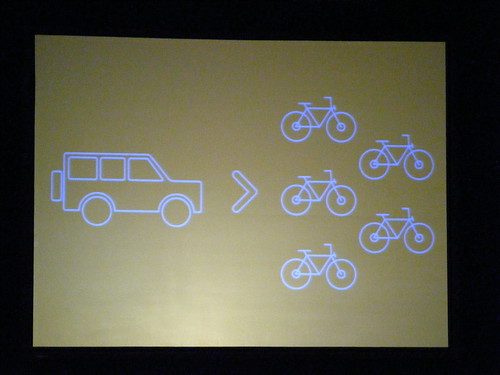
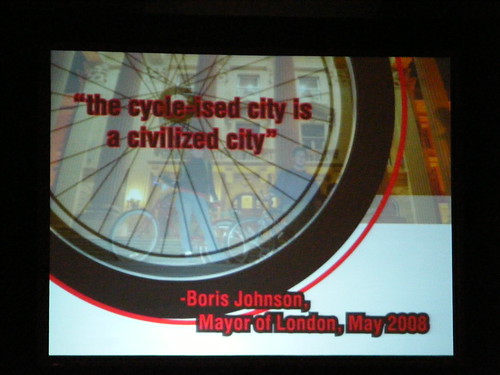
Instead of nearly $300 million, the proposal that will be put forward to the transportation and public works committee next Tuesday will recommend that between 1.5 and 2.5 per cent of the city’s annual capital budget be allocated to the plan, a number that will fluctuate year to year and amount to millions of dollars less.
As I wrote in a response to bicycle conspiracist Kerry Diotte, these types of plans should be geared towards average Edmontonians, who would ride their bikes to work a little more often if they felt they weren’t going to get plowed over by a motorist or sideswiped by a crazy cyclist.
As a long-term growth strategy for Edmonton it’s smart, it’s healthy, and it could even possibly cut down the ridiculous amount of traffic congestion that is increasingly jamming our roads.
Given the fifty per cent turnout rates of 2005, and the much worse security environment and disillusionment in 2009, any turnout rate between forty and forty-five per cent in 2009 would seem to be quite good…
Voter turnout in Alberta’s 2008 Provincial Eleciton: 40.6%
At this point, it appears that the two candidates most active on the social media front are PC candidate Diane Colley-Urquhart and Liberal candidate Avalon Roberts. Both of these candidates are using websites, writing blogs, and are active on Twitter and Facebook. NDP candidate Eric Carpendale doesn’t appear to have a website, but he has recently started a Twitter account and has a support group on Facebook. While Wildrose Alliance candidate Paul Hinman‘s current web presence appears to be limited to his website, it is chalk full of the message “Send Ed a Message” (even in the url).
At midpoint in the by-election, I will take a look at how each the candidates have been using social media to engage voters and catch the attention of both the old and new media.
A couple of weeks ago, I focused on the buzz around the right-wing Wildrose Alliance leadership contest, and candidate Danielle Smith in particular. This post focuses on Alberta’s opposition parties on “the left” – the Alberta Liberals and the Alberta NDP. As I have already written posts dealing specifically with the state of the Liberal and NDP parties, I have decided to take a look at the state of the institutional “political left” that they claim to represent.
Some people may argue that the centrist-left Liberals shouldn’t be included in the same category as the pseudo-socialist left-wing NDP (and vice-versa), but it is sometimes difficult to distinguish the two parties and the challenges and character flaws that they both face.
Since the 2008 provincial election, the Democratic Renewal Project, a group consisting of both NDP and Liberal members, has been calling for something to change. While I don’t agree with their solution – a temporary electoral coalition between the two parties that would push for proportional representation in our elections – I do respect that they are willing to break from traditional party lines and publicly call for change.
While the DRP holds hope that the two opposition parties can work together for positive change, I strongly believe that certain MLAs and individuals in the establishments of the two parties are too comfortable in the dysfunctionality of the current situation to work towards a real solution. In effect, I am becoming more convinced that as neither party in their past or current existences have proven that they are able to effectively bring political change to Alberta, their destruction is necessary for political change to take place. As long as the two parties are limited by their own partisan blinders to winning a combined total of 9 to 20 of the 83 seats in the Assembly, they will remain a tiny opposition.
I haven’t seen much evidence that the left as a movement has pride in Alberta. From a historical/political myth-building context, it appears that the political left doesn’t fit naturally in the narrative of Alberta’s story. As Mark Lisac wrote in his book ‘Alberta Politics Uncovered: Taking Back our Province‘ there are a large number of mainstream Albertans who self-identify as ‘conservatives.’ The left has allowed itself to be defined by Alberta’s narrative – the mythical land of rodeos, cowboys, red meat, and oil rigs – an image which urban academics, labour unions and environmental activists don’t easily fit into.
There are many reasons why the left continues to electorally and politically spin its wheels in Alberta, including lack of broad organizational capacity, self-interested party “leaders,” and an bizarre defeatist martyr complex, but many Albertans involved in opposition politics simply don’t show pride in their province. If I were a leader of an opposition party in Alberta (yes, I’m gawking too), I would constantly wrap myself in Alberta’s flag. At every opportunity, I would talk about how proud I am to be an Albertan – proud of our history, proud our beautiful province, and proud of what our future holds. I would talk about how strong our province is, the strength of Albertans hard working character, and I would emphasize the reality that Alberta isn’t going to realize its full potential if we allow the same tired politicians to control our Legislative Assembly.
Instead of being defined by its criticism of the governing PCs, Alberta’s opposition parties on the left should prove to Albertans that they stand for something that is more than a reaction to the actions of the governing party (or the other opposition party). By continuing to chase the flavour of the week, both opposition parties are allowing themselves to be marginalized by Alberta’s cultural and political narratives.
Party archetypes in both camps really need to put aside their biases and prejudices and take a serious and objective look at why their parties are not connecting with Albertans.
A year later, I am convinced that the party archetypes in both parties are continuing down the same road that has led to their sequestration to the opposition benches. At the moment, it’s difficult to see much hope for Alberta’s Liberals and NDP. I continue to hear from a growing number of disgruntled politically moderate Albertans displeased with the governing PCs and unimpressed with the opposition parties which leads me to believe that Alberta’s political left better start standing for something real or be destroyed. Failing to do either is killing democracy in this province.
If you’re in Edmonton this week, make sure to check out my favorite summer festival – the Edmonton Fringe Theatre Festival – which is happening until August 23.
I saw my first show, ‘Songs from the Ave‘, on Friday night at the BYOV A (the Avenue Theatre). It was well worth the trip to 118th Avenue from the Strathcona Fringe grounds, so check it out if you have the time! (and stop by the Carrot afterward for a coffee). I’ve also written a review of ‘Songs from the Ave’ that will appear in this week’s SEE Magazine annual amazing complete review of every Fringe show.
Eversinceattendingthe2009 ICLEI World Congress in Edmonton in June, I’ve been continually amazed at some of the positive change, innovative thinking, and idea sharing that is happening between municipalities across the globe.
Important civic issues have awakened the citizenship in a growing number of Albertans who are taking action and forming groups like ChangeCamp Edmonton and Civic Camp Calgary to participate in shaping the future of their communities and politics in a non-partisan way.
Using the Internet, websites like CityWiki and Cities Exchange (ht Rurban Fringe) are providing forums for great information sharing about urban growth strategies. There have also been some exciting positive debates about open data and open source government in Calgary and Vancouver that will create more transparency and broaden the ways that citizens can interact with their municipal governments. It’s really encouraging to watch our cities move forward in a positive direction on many issues. When I look at how much has been accomplished thus far, I become more hopeful for what can be accomplished in the future!
My thought: Writing about youth apathy is easy, but in general, at what point in history have younger generations not been apathetic to the politics of their parents’ generation?
UPDATE: David Eaves and Alison Loat have also provided two excellent responses to Martin’s column.