Celebrating one-year since the 2012 Tory victory is Moe Amery, Premier Alison Redford, Wayne Cao, and Peter Sandhu.
Edmonton-Manning MLA Peter Sandhu has resigned from the Progressive Conservative Caucus after a CBC investigation revealed that a company owned by the politician had accumulated a trail of unpaid debt. The report, by investigative reporter Charles Rusnell, also found that Mr. Sandhu made a false statement in a sworn affidavit.
It is not uncommon for Tory MLAs to face investigations by the ethics commissioner, but it is uncommon for Tory MLAs to actually resign from the Government caucus because of these investigations.
Mr. Sandhu’s resignation shows how different Alberta’s political environment has become in recent years. The Wildrose Official Opposition is waging a permanent aggressive campaign against the Tories, something the long-governing party is not accustomed to. And with Premier Alison Redford facing an internal party leadership review in November, the Tories are desperately trying to avoid the kind of embarrassing controversies that dominated the political narrative in 2012.
As far as I can recollect, the last Tory MLA to resign because of an ethics scandal was in 2001, when former cabinet minister Robert “Butch” Fischerquit as the MLA for Wainwright after being investigated for a breach of ethics regarding a private business deal.
Mr. Sandhu was first elected in Edmonton-Manning in 2008, defeating Independent MLA Dan Backs, who had been kicked out of the Liberal caucus in 2006 (Mr. Backs challenged Mr. Sandhu, and was defeated, in the PC nomination contest).
—-
Westward, support for Premier Christy Clark‘s Liberal Party surged in yesterday’s British Columbia provincial election, leaving Adrian Dix‘s New Democrats in the dust. Long expected to form government in this year’s vote, the NDP were only able to elect 33 MLAs, compared to 50 for the Liberals. The only win the NDP are likely to celebrate is the defeat of Premier Clark in her own Vancouver-Point Grey constituency against newly elected NDP MLA David Eby.
From the Keystone XL Pipeline protest on February 17, 2013 in San Francisco (photo by Steve Rhodes – CC BY-NC-ND 2.0)
One month ago, Premier Alison Redford took to the airwaves to warn Albertans about the revenue problem, or ‘bitumen bubble‘, the government will face in the 2013 provincial budget. The Premier cited the lack of pipelines pumping bitumen from our oilsands to external markets as a reason for the low price of Alberta oil and her government’s lack of resource revenues. Alberta had a revenue problem.
Premier Alison Redford
For the first time in recent memory, Alberta’s revenue problem was at the top of political discourse in our province. The government held a symposium to hear from experts about Alberta’s fiscal framework, but at the same time ruled out the return of health premiums and denied any rumours of a provincial sales tax (which, in fairness, would have been as popular as introducing rats into the province).
Two reasonable solutions that did not get enough attention were to increase the revenues from natural resources and to replace the Klein-era ‘flat-tax’ with a progressive taxation system that could collect more revenue without penalizing low- and middle-income Albertans.
It is hard not to point out that the group of individuals currently in a position to solve this problem are also the architects of our government’s short-sighted fiscal planning: Alberta’s Progressive Conservatives.
Now let us shift to the pipeline debate and what the Premer says is the source of our (now former?) revenue problem: Alberta’s pipeline problem.
Adrian Dix (photo from @taminator on Flickr)
After years of campaigns targeting Alberta’s tarsands as a major contributor to climate change, our oilsands are an easy political target for opponents of two major pipelines. Large protests across the United States last week have put the future of the Keystone XL Pipeline in question and a near political consensus in British Columbia against the Enbridge Northern Gateway Pipeline suggests a pipeline through that province is unlikely to be built anytime in the near future.
Premier Redford’s cause is not without political allies south of the border. The Keystone XL Pipeline has the support of a dozen United States Governors and TransCanada claims the southern section of the pipeline, through Texas and Oklahoma, is already half-complete.
Many critics of the Keystone XL pipeline have focused on climate change, raised legitimate concerns about the devastating environmental impact of pipelines leaks, and poked holes in the number of jobs pipeline proponents have promised to create.
It has been speculated that having these two large and influential constituent groups on opposite sides of this debate could make it increasingly difficult for President Barack Obama to approve the pipeline’s construction over the American border with Canada.
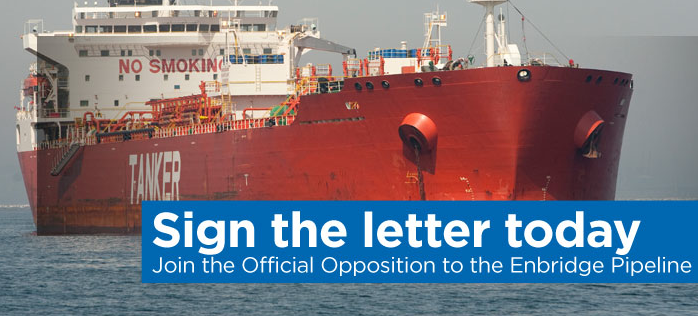
The BC NDP oppose the Northern Gateway Pipeline now, but will their position change if they form government? (Image from the BC NDP website)
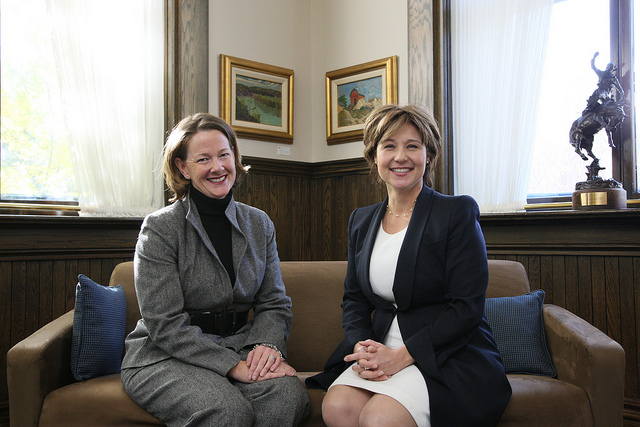
“Frosty” was the word used to describe the meeting between Alberta Premier Alison Redford and British Columbia Premier Christy Clark in Calgary this week. The two provincial Premiers have spent the summer months clashing over the proposed construction of the Enbridge Northern Gateway Pipeline. Premier Redford supports the pipeline, Premier Clark opposes it.
I have two thoughts this week about Premier Clark’s visit to Calgary and the continued debate around the pipeline:
1)Reacting to the BC Liberals drop in the polls, Premier Clark was speaking to British Columbians as she visited Calgary. She is standing up to those oil-thirsty Albertans by waving the BC flag in Calgary. If she is re-elected, I would not be surprised to see Premier Clark return to her free-market principles and support the pipeline.
2) The BC New Democrats have already firmly claimed the anti-pipeline territory that Premier Clark is now trying to claim. This does not necessarily mean a future government led by NDP leader Adrian Dix will not be open to negotiating a better deal or alternative route for the Northern Gateway Pipeline in the future.
While I am an outside observer to BC politics, I would not be shocked to see an NDP government support a future deal for the Northern Gateway Pipeline that they could trumpet as a job creator and celebrate as better deal than the previous BC Liberal government could negotiate.
It would appear that the both the BC NDP and the energy industry, which have significant investments in Alberta’s oil sands, are interested in improving their working relationship in the event Mr. Dix becomes Premier of BC after next year’s election.
As I wrote earlier this week, Premier Redford may have to wait for an NDP Premier to be elected in BC before a more pragmatic discussion around the Northern Gateway Pipeline can occur.
Under past Premiers Ralph Klein, Ed Stelmach, and Gordon Campbell, the conservative governments of Canada’s two western-most provinces enjoyed very friendly relationships. Vocal opposition to the pipeline, largely based around concerns about environmental impact and the transit of large oil tankers through the narrow Douglas Straight, has pushed the normally free-market loving BC Liberals away from the project. Premier Clark is also facing a strong NDP opposition. According to the latest poll, Adrian Dix‘s NDP sits 17% ahead of the BC Liberals.
As some political observers have mentioned, Premier Clark may use her time shaking some fundraising money from corporate Calgary in advance of next year’s provincial election.
With the next BC provincial election set for May 14, 2013, Premier Redford may want to start outreaching to Mr. Dix in hopes that his party might take a pragmatic approach and soften its stance on the Northern Gateway Pipeline if it forms government.
Or perhaps the re-election of President Barack Obama in November’s American elections will once again shift focus to the construction of the Keystone XL Pipeline from Alberta to Texas? Wildrose opposition leader Danielle Smith might have some insight to share on this topic. Ms. Smith is currently in the middle of a three-week trip of the United States to meet with political and policy leaders.
Mr. Boessenkool, who has strong-ties to Prime Minister Stephen Harper‘s office and was a signatory of the infamous “Alberta Firewall” letter, briefly managed Premier Clark’s leadership campaign in 2011 before a decree from the Conservative Party of Canada forbid its officials from participating in the contest.
Earlier this year, Mr. Boessenkool left his job at the public relations and lobbyist company Hill & Knowlton and his position with the newly formed ‘Alberta Blue Committee‘ to run the Premier’s Office in Victoria.
I have no reason to doubt Premier Redford’s political acumen or capability. Having only become Premier of Alberta eight months ago, she has hardly had an opportunity to demonstrate leadership on the national stage.
The upcoming Premiers’ conference, hosted by Premier Darrell Dexter from July 25 to 27 in Halifax, might give Albertans, and Canadians, an opportunity to watch Premier Redford demonstrate her leadership skills on a national level.
Closer to home, more than 50 organizations are calling on the Alberta Government to review the safety standards of the province’s aging pipelines.
Premier Redford has an opportunity to lead, and distinguish herself from her federal counterparts, by taking a positive lead on the renewal of the Canada Health Accord. The Accord, which was signed 10 years ago and expires in 2014, gave the provinces a significant monetary transfer for health care funding. The previous incarnation had little strings attached and the success of a future accord would benefit Canadians if more accountability were attached to the federal transfer.
Premier Redford’s road to 24 Sussex Drive is also complicated by another major factor. Only six years in to the job and still a young 53 years old, there is no indication that Prime Minister Stephen Harper will be retiring in the near future.
Relations with Premier Redford’s Progressive Conservatives is cool to cold in some, or perhaps even most most, federal Conservative circles. Immigration Minister Jason Kenney‘s recent reply-all email describing Deputy Premier Thomas Lukazsuk as a “complete and utter asshole” serves as a reminder of how strained the relations are between some federal and provincial Conservatives. In the recent election, a significant number of Conservative Members of Parliament supported Danielle Smith‘s upstart Wildrose Party.
Two years ago it would have seemed impossible, but current federal NDP leader Thomas Mulcair may actually have a shot at 24 Sussex Drive after the next federal election. The NDP are tied or leading in the polls and while there is three years until the next election (aka an eternity in politics when anything could happen), Mr. Mulcair appears to be the first Leader of the Official Opposition to take an aggressive offensive position against Prime Minister Harper’s Conservatives.
Earlier this week, the NDP released an attack ad against Prime Minister Harper, giving the federal Conservatives a taste of their own medicine. If anything, the ads demonstrate that Mr. Mulcair’s NDP are not afraid to use the same tactics that Prime Minister Harper’s Conservative Party used to destroy the political careers of weak former Liberal leaders Stephane Dion and Michael Ignatieff.
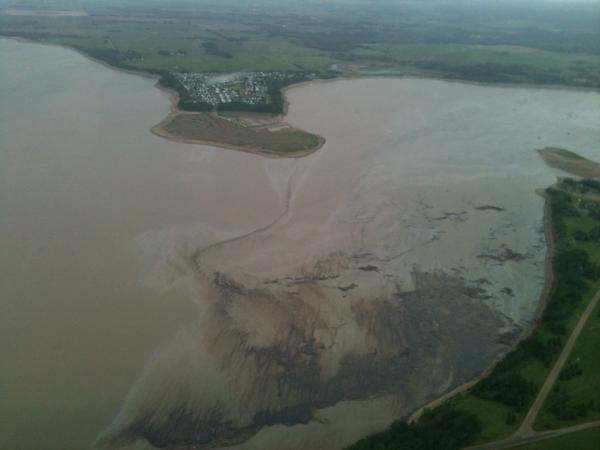
A pipeline leak spews oil into a central Alberta lake (photo from @tedgbauer at https://twitter.com/tedgbauer/status/211154927446278144/photo/1)
When word first broke that a leaky pipeline near the central Alberta town of Sundre had poured an estimated 1000 to 3000 barrels of oil into a tributary of the Red Deer River, Premier Alison Redford was quick to respond. That afternoon, the Premier, flanked by Environment and Sustainable Resource Development Minister Diana McQueen and local Wildrose MLA Joe Anglin, held a media conference near the location of the spill.
Premier Alison Redford
Despite the quick response, which is a change from the days when it felt like these types of leaks were publicly ignored by our political leaders, Premier Redford’s media conference cannot change the fact that oil spills and leaking pipelines have already become a regularly reported occurrence in Alberta. The latest leak comes at a crucial time when the Government of Alberta and Enbridge Inc are pushing the construction of a new oil pipeline that would travel through Alberta and British Columbia to the port at Kitimat.
As the Edmonton Journal’s Graham Thomson has pointed out, the latest leak only confirms the suspicions and fears that some British Columbians have about the Enbridge Northern Gateway Pipeline:
B.C. will only agree to the pipeline if the economic benefits outweigh the environmental risk. That is an argument the Alberta government has not managed to put forward.
In the land of political spin, Enbridge spokesperson Paul Stanway claimed last week that the company had secured the support for the pipeline from 60% of First Nations communities along the proposed corridor. The Coastal First Nations group disputed that number, accusing Enbridge of expanding its corridor by 80 kilometres to boost the number of supporters. The group claimed many of the First Nations listed by Enbridge as supporters are located outside of any area that could be impacted by a potential spill.
Premier Christy Clark (photo from @bcgovphotos on Flickr)
Readers of this blog may remember Mr. Stanway from his previous roles as columnist and publisher at the Edmonton Sun and communications director to former Premier Ed Stelmach from 2007 until 2010.
Although the next federal election could be nearly three years away, NDP leader Thomas Mulcair is capitalizing on the concerns central Canadian and British Columbian voters about the effect of oilsands development on the environment and its effects on traditional manufacturing industries (a la Dutch Disease). Everyone from former Reform Party leader Preston Manning to former Prime Ministers Paul Martin and Brian Mulroneyhavechimedin to criticize Mr. Mulcair.
As Prime Minister Stephen Harper‘s Conservatives have proven numerous times over the past nine years, leveraging social and regional wedge issues can lead to great electoral success. Mr. Mulcair would be foolish not to take a page from Prime Minister Harper’s book. While conservative pundits and politicians denounced Mr. Mulcair’s criticisms, the political strategy, at least in the short-term, does not appear to have hurt NDP chances in voter-rich regions outside the prairie provinces. A recent poll showed the federal NDP in a statistical tie with the governing Ottawa Conservatives.
After weeks of warring words about the economic influence of Western Canadian oilsands development on the crumbling Central Canadian manufacturing sector, NDP leader Thomas Mulcair will visit Alberta on May 31 to meet with business and political leaders. This will be Mr. Mulcair’s first visit to Alberta since being selected as his party’s leader in March (he visited Alberta at least once during the NDP leadership contest).
In a media release distributed this morning, provincial NDP leader Brian Mason was quoted as saying “Tom and I had a conversation over the phone a couple of days ago, and I invited him to come to Alberta. I’m pleased that he agreed to come.”
The federal NDP currently have only one Member of Parliament from Alberta and it is likely that Edmonton-Strathcona MP Linda Duncan will play a prominent role in Mr. Mulcair’s day-trip to Alberta. During the recent provincial election, a number of NDP MP’s, including Olivia Chow, Jack Harris, Niki Ashton, and Peter Julian, visited the province to campaign alongside their provincial colleagues.
While the provincial NDP recently made electoral gains in Edmonton, doubling their caucus from 2 to 4 MLA’s, the party still faces tough criticism for perceived anti-oilsands positions. During the campaign, Mr. Mason argued that Alberta’s economy would benefit from building bitumen refineries in-province rather than shipping unrefined product internationally through pipelines and ocean tankers.
Linda Duncan
Mr. Mulcair’s visit will take place only days after the Premiers of Canada’s western provinces and territories meet in Edmonton for the Western Premiers’ Conference. The annual meeting is being held on May 29 at the Fairmont Hotel MacDonald in Edmonton.
While Mr. Mulcair’s comments will be a topic of small chat amongst the Premier’s and their staff, the topic of pipelines and international markets will likely be a hot topic on the agenda. As the only current NDP leader in government in western Canada, Manitoba Premier Greg Selinger might be the closest person Mr. Mulcair has as an ally at this meeting.
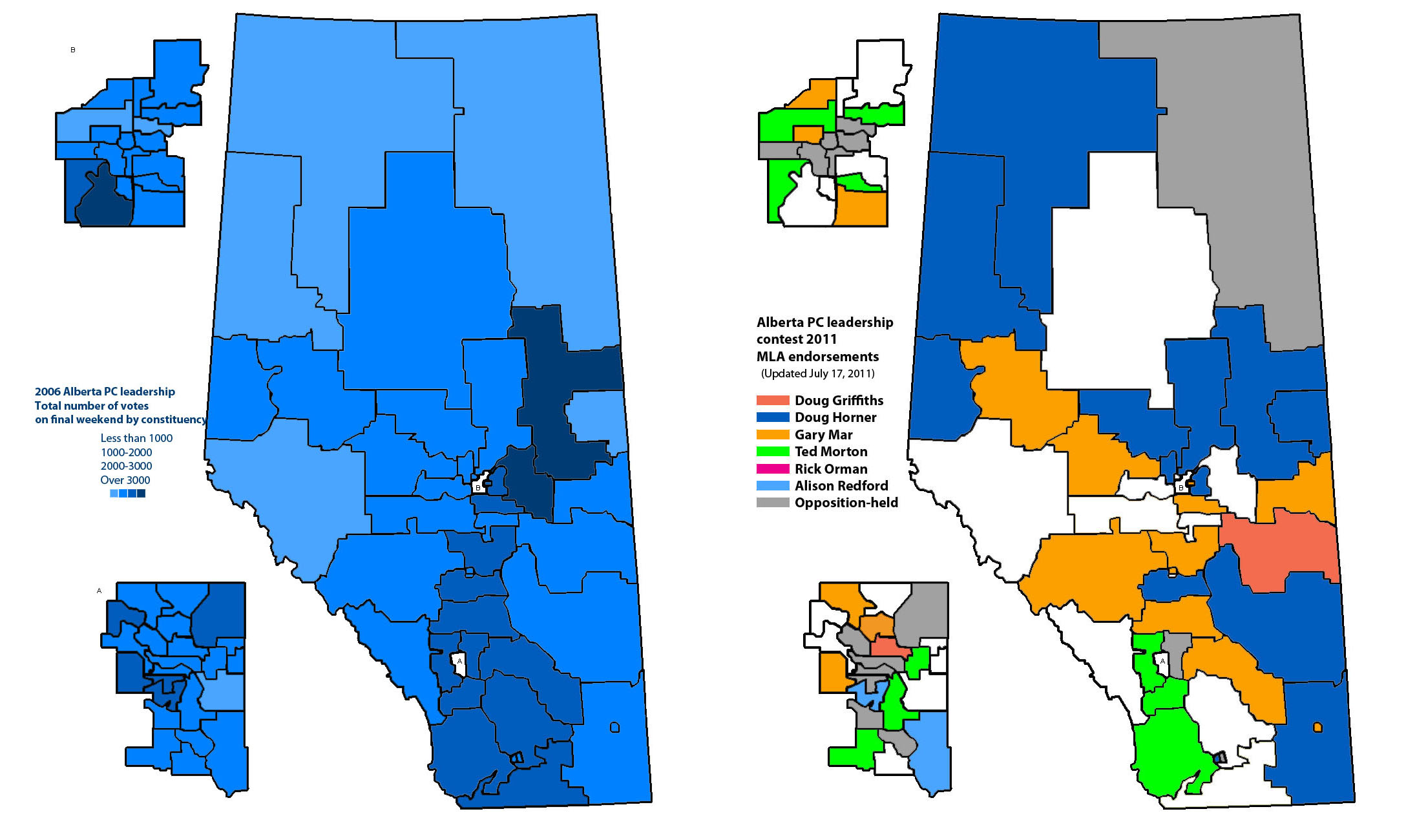
Total number of votes in the final ballot of the 2006 Alberta PC leadership contest and MLA support in the 2011 PC leadership contest.
As Jim Dinning learned six years ago, having the support of MLAs in a leadership contest does not assure victory. The long-time front-runner in the 2006 Progressive Conservative leadership contest counted the support of over forty sitting MLAs, but on the final ballot vote, it was a low-key cabinet minister named Ed Stelmach with the initial support of nine MLAs who upset Mr. Dinning’s sure-win.
Premier Christy Clark‘s recent victory in the BC Liberal leadership contest proved that even a candidate with the support of only one-MLA can become the leader of a governing party. A downside of this scenario, as Premier Clark is said to be discovering, and as Premier Stelmach discovered, is that you still have to work with those MLAs who did not support your bid.
Support from sitting-MLAs does have its advantages if the MLA has a strong local organization and especially in rural areas, where local representatives have a different kind of relationship with municipal councils, community organizations, and local weekly newspapers than their counterparts representing big city constituencies.
The maps above compare the total number of votes in the final weekend of the 2006 PC leadership contest with the support of MLAs in 2011. The number of voting members in each constituency will change in this year’s contest, due to different candidates and a different political environment, but it is an interesting look at where the largest groupings of PC memberships were sold in that year’s contest.
The Alberta Liberal Party will be holding a Special General Meeting on Sunday, May 29 to discuss a series of structural changes around how that Party selects its candidates and leader. The Liberals are facing many challenges that have been around for decades and while these proposals may not be a silver bullet to solve their problem, they may be a move in the right direction.
Opening Nomination Contests to All Albertans
Allowing any Albertan who registers as a supporter of the Alberta Liberal Party to vote in the Party’s contest for nominations, commencing in 2013 for all unheld constituencies and upon the retiring of the incumbent MLA for all held constituencies.
With a potential election call expected as early as November 2011, this proposal as it is currently written would not take effect until after the next election. There is another proposal that would have this and the next policy change implemented immediately (see below).
A close look at the wording of this proposal reveals that incumbent MLAs are excluded from this open change. Even with only 8 incumbent Liberal MLAs (including former Edmonton-Meadowlark PC MLA Raj Sherman ) and nomination contests already having been held to replace retiring Calgary-Varsity MLA Harry Chase and Edmonton-Riverview MLA Kevin Taft, it makes little sense to not allow constituencies with incumbent Liberal MLAs running for re-election to participate in this new party structure.
Opening Leadership Contests to All Albertans
Allowing any Albertan who registers as a supporter of the Alberta Liberal Party to vote in the Party’s leadership contests, commencing in 2013.
A lot of people will heckle that only a Party that cannot sell large swaths of memberships would do this, and in this case they would be correct, which is why I believe this is a good idea. Opening leadership contests up to “primary style” voting could draw in new blood and new candidates, something the Liberal Party desperately needs.
In a recent column in the Globe & Mail, John Ibbitson recommended that the Liberal Party of Canada make a similar move to open its leadership contests beyond its dwindling membership base.
Expediting Implementation of Open Contests
Speeding up the implementation of the previous two resolutions to commence immediately.
A good move. See my comments above for caveats.
Weighted One-Member-One-Vote
Moving from a pure one-member (or one-supporter) one-vote system for deciding leadership contests to one weighed by constituency, where each constituency gets up to 200 points.
There are good arguments for and against this type of weighted system. A weighed system was used in the recent BC Liberal leadership contest that selected Christy Clark. The idea behind the weighed system is to increase the equity between voters in constituencies with heavy support and low support, which would be urban versus rural constituencies in this case.