Categories
Alberta Politics

tories would love to put opposition-held ridings on the chopping block.

Edmonton-Riverview under the electoral boundaries created in 2003.

I was not surprised to hear rumours that Edmonton-Riverview might be on the chopping block when the final report of the Electoral Boundaries Commission is released in July (the interim report had kept Riverview largely intact). The Tories have been trying and have been incredibly unsuccessful in capturing enough support to elect an MLA in Riverview since it was created in 1997. With decisive margins, Liberal MLAs Linda Sloan and Kevin Taft have been successful in holding off Tory challengers including Gwen Harris, City Councillor Wendy Kinsella, Fred Horne, and local president Wendy Andrews. I have read and heard many arguments in favour of disassembling Riverview, the largest being that it does not make sense for a riding to span across the North Saskatchewan River, which should act as a natural boundary (under the current boundaries, three Edmonton ridings cross the River). It is silly to argue that an urban MLA cannot represent a riding divided by a river when many rural MLAs represent ridings that span across the province.

With three appointees on the five-member Electoral Boundaries Commission, the PCs may finally get their chance to put Riverview on the chopping block.

Large-scale changes to Riverview were not included in the Commission’s interim report, but there were large changes to other opposition held ridings. Much of Edmonton-Cadler may merge with Edmonton-Glenora, a change that could pit former Calder NDP MLA David Eggen against Glenora PC MLA Heather Klimchuk in a riding that also has a tradition of electing Liberal MLAs.

Edmonton boundary changes proposed in Electoral Commission's interim report with poll-by-poll results from the 2008 election.

In Edmonton-Gold Bar, proposed changes in the interim report would give four-term Liberal MLA Hugh MacDonald an 8-vote margin, compared to a 1,018 margin of victory under the current boundaries in 2008. While sometimes overly-eccentric, Mr. MacDonald is one of the hardest working Opposition MLAs in the Assembly. It should not be surprising that the PCs have their eyes on Gold Bar, a riding that has elected Liberal MLAs since 1986.

The changes proposed in the interim report are not entirely unkind to the opposition when looking at the 2008 election results. The interim boundaries reduce PC MLA Tony Vandermeer‘s margin of victory in Edmonton-Beverly-Clareview from 337 votes to 101 votes. Nominated New Democrat Deron Bilous is already gunning for Mr. Vandermeer’s job. The interim boundaries would have also helped Calgary-Elbow Liberal MLA Craig Cheffins defeat now-Justice Minister Alison Redford by 272 votes (instead, Mr. Cheffins was unseated by 419 votes in the current boundaries).

They are the most politically organized force province-wide, but it is understated how much of an advantage their 2006 leadership selection gave the PCs in 2008. Just over a year after their intensely competitive leadership race, large and fresh membership lists have the PCs a large advantage over their opponents, who had not developed these kind of large-scale lists.

The next election will present Albertans with new electoral boundaries and also a new political environment. The PC Party’s popularity has significantly dropped in the polls since the last election and its caucus has shrunk by a by-election defeat and MLA floor-crossingsDavid Swann is the first Liberal leader from Calgary since the 1970s and his party is nearly debt-free. The Wildrose Alliance is on its way to becoming well-organized and well-funded under the leadership of the politically-savvy Danielle Smith. The existence of the new Alberta Party is drawing support from many centrist and progressive political organizers. There is a general unhappiness and unease among Albertans with how the politics of governance is being operated in Alberta.

Even if some opposition-held ridings do get chopped and diced, the shifts in the political environment since the last election could make the could make any gerrymandering near irrelevant.

Categories
Alberta Electoral Boundary Review Alison Redford Brian Fjeldheim Lorne Gibson

alison redford’s big opportunity.

(Re)Enter Mister Fjeldheim.
There has been a certain amount of attention focused on Alberta’s Chief Electoral Officer and his comments regarding his philosophy towards his newly re-inherited position. Brian Fjeldheim, who held the position from 1998 to 2005, was recently reappointed following the dismissal of his more activist successor-turned-predecessor Lorne Gibson. After re-assuming his role last week, Mr. Fjeldheim was a little more reserved when describing his role in advocating the importance of the vote to Albertans (60% of Albertans did not vote in the 2008 election). Dave Breakenridge offered some thoughts on Mr. Fjeldhiem’s comments in today’s Calgary Sun.

Open up the Elections Act.
In the next few weeks, Justice Minister Alison Redford is expected to introduce legislative amendments to Alberta’s aging Elections Act. Minister Redford has said that the amendments will include some of the 182 recommended changes submitted by Mr. Gibson before his departure (but will not include fixed election dates). Of course, the recommendations included in the Bill will have be carefully chosen and measured for political impact by Minister Redford and her PC cabinet colleagues. Minister Redford’s amendments will likely include changes to how Returning Officers are chosen. During the 2008 election, it was revealed that the PC Party had provided lists of candidates for Returning Officers to the Elections Office (over half of the appointed Returning Officers had partisan connections to the PC Party).

Elections procedures can be improved through legislation, but democratic participation can be strengthened through meaningful engagement. In September 2007, the Government of New Zealand tried something completely different. As an innovative way to capture the views of the public on what a new Policing Act should look like, the Ministry of Justice launched an online Wiki. This Wiki allowed citizens from across that country to contribute their ideas and collaborate in the creation of new legislation.

What better way to reinvigorate our Elections Act than by opening up the amendment process to allow Albertans to collaborate by contributing their ideas for changes and improvements? What better opportunity to do things differently in than by allowing Albertans to invest their own ideas into the development of the important piece of legislation that will decide how their elections are structured? Is there a more meaningful piece of legislation that could be opened up to public collaboration than the Elections Act? Would this kind of online collaboration succeed in Alberta? There is only one way to find out.

Prior to entering elected office in 2008, Minister Redford cultivated an international legal career helping build democracies in countries around the globe (including as one of four international election commissioners appointed by the Secretary General of the United Nations to administer Afghanistan’s first parliamentary elections in September 2005). Legislative amendments can improve structure, but opening up the Elections Act to real public collaboration could be Minister Redford’s big opportunity to create more meaningful democratic participation in Alberta.

Making it easier for students to vote.
I am sure that there would be no shortage of Albertans who would contribute their ideas to an open dialogue on improving our Elections Act. The Council of Alberta University Students submitted a handful of recommendations (pdf) to Minister Redford last year when they heard about the upcoming legislative amendments. Each of the five recommendations have been adopted by Elections officials in provinces across Canada (though no jurisdiction has adopted all five). The recommendations would improve access to a voting demographic that due to its geographic transience, are likely to face barriers and challenges to participating in elections.

These are good recommendation, most of which would require minor administrative changes that are not anything that a little Alberta ingenuity could not overcome. Decreasing barriers to voting for younger Albertans will create a positive culture of participating in elections and could help create life-long voters – a group that is increasingly becoming a minority in Alberta elections. I hope to see some of these positive improvements included among Minister Redford’s amendments.

Coming Soon: New Maps.
Alberta’s Electoral Boundaries Commission is due to release its interim report by February 26, 2010.

Categories
Alison Redford Danielle Smith David Swann Ed Stelmach Ken Chapman Kent Hehr Ricardo Acuna Ron Liepert Shannon Stubbs Todd Hirsch

alberta politics notes 2/16/2010

– As Anarchist Day Camp showed up in Vancouver, opponents of the Winter Olympic Games have claimed victory against Alberta’s tarsands by forcing Premier Ed Stelmach to postpone his opening speech at the Alberta Pavillion.
– Energy Minister Ron Liepert wants your children to learn more about Alberta’s energy beach.
Ken Chapman has some words for Quebec Premier Jean Charest on the oilsands.
Can Alberta redesign its economy?, asks Todd Hirsch, senior economist with the ATB Financial.
– Speaking of redesign, the Left needs to define itself beyond the bottom line, according to Parkland Institute Executive Director Ricardo Acuna.
– Missed by most media outlets, Wildrose Alliance leader Danielle Smith hired a new Executive Assistant. Shannon Stubbs, former Progressive Conservative Party VP Outreach and 2004 candidate in Edmonton-Strathcona, joined Smith’s staff two weeks ago.
– The Liberals took exception to CBCs The House ignoring them in their Alberta-focused show on February 6. They have since posted an interview with David Swann on their website.
Calgary-Buffalo MLA Kent Hehr wants to know what exactly Justice Minister Alison Redford‘s new role as “political minister for Calgary” means for Albertans.

Categories
Alison Redford Brad Wall Cindy Ady Danielle Smith Ed Stelmach Greg Selinger Jack Hayden Jonathan Denis Lindsay Blackett Ted Morton Vancouver 2010 Winter Olympics

all aboard the alberta winter olympic train.

As far as international events go, it is hard to beat the size of the Olympic Games. Over 80 countries from across the world will be participating in the Winter sports event that kicked off in Vancouver last night.

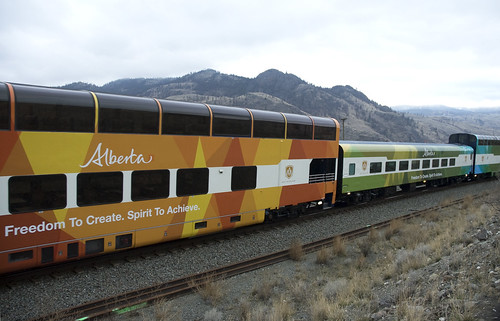
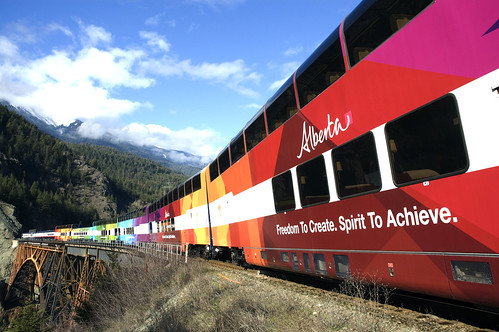
With hundreds of millions of dollars likely being spent on wining and dining, it might feel like a drop in the bucket for the Province of Alberta to spend nearly $15 million dollars to promote the province to attendees, including the sponsorship of six Rocky Mountaineer train cars and the Alberta Pavilion.

Unparalleled comfort in the premier business networking venue at the Games.

The Rocky Mountaineer expense is billed by the Government of Alberta website as an opportunity to “provide the premier business networking venue at the Games” for only $499 for a round-trip ticket from Vancouver to Whistler. Who will be networking with the elite business Olympians of the world? Premier Ed Stelmach and eleven cabinet ministers will be there to wine, dine, and “offer guests unparalleled comfort” during their stay on the Alberta train! While experiencing this luxury, most passengers on the Alberta train this week would probably have a hard time believing that Alberta is in the midst of “tough economic times” and that just four short days ago, these 12 elected officials tabled a provincial budget that included the largest deficit in Alberta’s history.

Alberta Train - Vancouver 2010 OlympicsAlberta Train

Sending Premier Stelmach, Tourism Minister Cindy Ady, and Culture Minister Lindsay Blackett makes sense, but what of the other nine cabinet ministers? Are Albertans well served by covering the costs of sending eleven cabinet ministers to the Vancouver Winter Olympic Games? What business could Agriculture Minister Jack Hayden, Justice Minister Alison Redford, Housing Minister Jonathan Denis, or Finance Minster Ted Morton have at the Winter Olympic Games? I am sure the “unparalleled comfort” of the posh train cars will live up to its reputation, but is it really necessary to have half of Premier Stelmach’s cabinet on site?

As Graham Thomson pointed out in his Edmonton Journal column this morning, other PC MLAs will joining them, but “nobody in government seems to know exactly how many backbenchers are going.” I do not oppose Alberta having a presence at these games, but modesty is virtue our elected officials should not forget.

Alberta Train - Vancouver 2010 OlympicsAlberta Train

Time and money well spent?

Would Alberta’s cabinet ministers travel time be better spent flying elsewhere? Perhaps Intergovernmental Affairs Minister Iris Evans first mission to Washington DC in her new role this week would be more effective if she had some backup from her colleagues? Alas, no one wants to fly to DC during a winter blizzard!

Other Provinces?

When compared to our provincial neighbours, Alberta’s elected officials look like the rich kids whose parents picked up the annual tab for their spring break in Mexico. The Province of Saskatchewan is spending $4.1 million on their pavilion and Premier Brad Wall has committed to keep their political presence low at the Winter Games. Premier Wall will be joined by Tourism Minister Dustin Duncan and Enterprise Minister Ken Cheveldayoff. The Province of Manitoba is spending $6.4 million and sending a two-person team of Premier Greg Selinger and Aboriginal Affairs Minister Eric Robinson.

What about the real Alberta train?

Wildrose Alliance leader Danielle Smith raised an interesting point this week while criticizing the expense:

“I would rather have seen any kind of travel budget being spent in Alberta,” Smith said. “They’re communicating to the wrong people.”

When was the last time Alberta had a Premier who spent this kind of money to sincerely communicate with Albertans? I am not talking about fancy videos commercials, visits to the Rutherford Show, or hiring expensive advertising companies to brand new messages. I am talking about actually travelling across this province and holding open town hall meetings outside of a highly managed and artificial election environment.

This feeds the perception that our elected officials are only accessible to those with political power or business interests. When was the last time Alberta had a Premier who allowed himself to be publicly accessible to any Albertan, regardless of political persuasion or income-bracket? When was the last time a Premier of Alberta hopped aboard a train filled with ordinary people of Alberta?

Categories
Alison Redford Brett Wilson Dave Hancock. Jonathan Denis Don Getty Doug Horner Ed Stelmach Jim Prentice Ted Morton

what’s going to happen at the pc leadership review?

Barring a stealth insurgency campaign, I anticipate that around 85% of Progressive Conservative convention delegates will support Premier Ed Stelmach in the leadership review vote this weekend. Why so high, you ask? Because this is a vote by dedicated partisans from Alberta’s PC Party. Premier Stelmach has his detractors, but I expect that the kind of party members who would pay hundreds of dollars to spend two days in Red Deer will predictably rally around the PC Party brand.

Seeking to revive fond memories a past era, the slogan chosen for this convention was also the PCs 1979 election slogan. Now… more than ever, which was chosen thirty years ago over the wrath tempting 79 in ’79, is meant to remind party faithful of the glory days and to put aside their feelings about more recent political baggage. 

With at least two or three years until the next election, Premier Stelmach has at least twelve months to pull his party’s support up again before he faces the kind of internal opposition that forced Don Getty into retirement. Similar to Getty’s time in office, Premier Stelmach is governing during an economic slowdown under the shadow of a popular predecessor. Getty’s administration was marred with scandals and internal dissent and so far, Premier Stelmach has demonstrated an ability to avoid taking personal responsibility for his government’s missteps. Getty retired in 1992 as Laurence Decore‘s Liberals were riding a wave of discontent that mirrored the rise of the Reform Party on the federal stage. While they are currently rising in recent polls, it remains to be seen whether Danielle Smith‘s Wildrose Alliance can sustain their support until the next election. It also remains to be seen whether David Swann can re-energize the Liberals to take advantage of a potential split on the political right.

Also uncertain is who would contest a 2010 leadership race if PC delegates voted to sack the Premier. Ted Morton, Brett WilsonJim Prentice, Dave Hancock, Jonathan Denis, Ray DanylukAlison Redford, and Doug Horner are names that I have heard bandied around, but it is too soon to tell who is actually prepared to step up to the plate.

Billed as a policy convention, a quick look at the policy booklet reveals a fairly dry agenda for debate. It is likely that the liveliest excitement of the weekend may come from outside the convention where the AUPEthe Friends of Medicare, and other public sector groups are busing hundreds of supporters from around the province to a huge Stop the Cuts rally only blocks away from the convention.

On Saturday night, PC archetypes will herald the convention as a success of the grassroots, but I expect that little will change after the convention concludes. Regardless of potential icebergs on the political horizon, a strong showing of support in the leadership review will certainly solidify the resolve of Premier Stelmach and his supporters that they are steering their party, and the Government of Albertans, in the right direction. “Rearrange the deck chairs…

Recommended Reading: 
Alex Abboud: State of Alberta: At a Crossroads
Calgary Grit: This week in Alberta – All good things…
Ken Chapman: Is Alberta about to enter an empire illusion stage politically?
Chris Labossiere: Run up the middle… to right of centre
Duncan Wojtaszek: Red Deer
Live Gov: PC AGM

Categories
Alberta Electoral Boundary Review Alison Redford Bauni Mackay Craig Copeland Guy Boutilier Laurie Blakeman Robert Bouchard Stephen Mandel

alberta redrawing boundaries.

Alberta’s Electoral Boundaries Commission is now into its third week of its first round of public hearings. My previous post on the Commission has generated some great discussion about the challenges of representing rural electoral districts and I am looking forward to an upcoming post by a guest contributor to this blog that will delve deeper into some of the issues raised in that discussion.

Thanks to the good people at Hansard, transcripts and audio are now available from the last two weeks of hearings in Fort McMurray: (afternoon, evening), St. Paul, Wainwright, Edmonton (September 22nd afternoon, evening). The transcripts and audio from the September 23rd public hearings in Edmonton and September 24th & 25th in Calgary are not available yet, but I would expect that they should be posted at some point this week. 

So far, it has been a relatively small number of Albertans who have presented to the commission, including MLAs Laurie Blakeman and Guy Boutilier, municipal officials including Cold Lake Mayor Craig Copeland, County of St. Paul Reeve Robert Bouchard, Edmonton Mayor Stephen Mandel, and a number of representatives from Liberal and Progressive Conservatives constituency associations.

Due to legislative amendments introduced into the Legislative Assembly by Justice Minister Alison Redford during the Spring session, the Electoral Boundaries Commission will increase the amount of electoral districts from 83 to 87. While it’s very questionable why Albertans would need more MLAs, the increase may help the case presented by Mandel, who urged the Commissioners to increase Edmonton’s representation by two seats. The outcome of the 2002/2003 Boundaries Commission saw Edmonton’s representation in the Legislative Assembly decrease by one MLA, a move that is widely believed to have contributed to the defeats of seven capital city PC MLAs in the 2004 provincial election (Commission member Bauni Mackay penned a spirited defence of Edmonton in her minority position).

These public hearings haven’t been overflowing with presenters, but I expect that interest will rise after the interim report and interim map are released in the coming months. The submission deadline for the first round of public hearings is on October 13.

Related:
Brian Dell: My Submission to the Alberta Electoral Boundaries Commission
Trish Audette: Rural vs Urban tug of war