Categories
Uncategorized

on sex scandals.

It almost caught me off guard, but I guess I shouldn’t be surprised at how much attention Canada’s mainstream media is paying to the Elliot Spitzer sex scandal. If you haven’t already heard, New York Governor Elliot Spitzer has been caught in the middle of a sex scandal involving his alleged employment of a $1,000-an-hour Washington D.C. call girl (you can read a breakdown of the affidavit here).

A quick scan of the exciting Canadian political scene makes it pretty evident why the Canadian media are hopping on board the Elliot Spitzer-sex-scandal-train-from-New York. What kind of exciting political debates that our elected representatives are having in Canada?

– The epic struggle between Dan McTeague and Jim Flaherty continues in the great RESP debate of 2008.

– The Alberta Tories have just won their 11th consecutive majority government since 1971. 41% of Albertans bothered participating.

Stephane Dion’s Federal Liberals back down again, leaving Canadians wondering why Dion even wanted to be the leader of that party in the first place.

At least the Obama-Harper NAFTA-gate leak has provided some sort of excitement in a Canadian political scene that could be otherwise disappointingly described as colourless, insipid, and platitudinous.

Categories
Statistics

the result of an underfunded education system.

“Statistics,” one long-time Tory told me a few days ago, “are for losers.”

Categories
Random Fun

everybody loves question time.

A new look at Question Period…

(h/t p.a.)

Categories
Alberta Politics

unite the left a fancy idea, but…

Like every election post-mortem period in Alberta, the talk of a unite-the-left move has reemerged. I was interested to read an op-ed piece in today’s Edmonton Journal in which Athabasca University Professor Alvin Finkle advocates in favour of a merger between the Alberta Liberals, New Democrats, and Greens. Now, I’m completely in favour of tearing down Alberta’s traditional party structures and attitudes, but I don’t believe it’s really as straight-forward as Finkle proposes. Here are six thoughts on a “united left” in Alberta…

1. Bad blood. There’s a ton of animosity and moral high-horsery going on between the Alberta Liberals and New Democrats. Party archetypes in both camps really need to put aside their biases and prejudices and take a serious and objective look at why their parties are not connecting with Albertans. With Kevin Taft and Brian Mason taking shots at each other during the campaign, both sides are guilty of creating the animosity, but both owe it to Albertans to look at the bigger picture and at least seriously look at the idea of a “united left.”

2. It’s aiming at the wrong target. I’m not sure that a merger between the parties is a silver bullet. With voter turnout at 41%, I’d be willing to suggest that all the parties are scrapping the bottom of their support-levels and need to look at the 59% of non-voting Albertans for growth.

3. Pass the vote. This argument assumes that support between parties will automatically carry over to a merged party. I’m not convinced that both parties cover the same spot on the political spectrum and this could leave a lot of Albertans without a party to vote for.

4. Greens on the left? I’m also not totally sure that the Alberta Greens could be considered part of “the left.” In fact, I’m not really sure where they are, but I’m sure that the 22% of Joe Anglin Green voters in Lacombe-Ponoka wouldn’t consider themselves as part of “the left.”

5. Different aims. The merger argument also assumes that both parties have the same target in mind? It’s clear that the Alberta Liberals are in it to form government, but I’m not sure that’s the same goal of the New Democrats. I’d be willing to bet that most New Democrats would feel a lot more comfortable staying in opposition than taking the reigns of power.

6. First-past-the-post. It seems that a bigger problem is the first-part-the-post electoral system that creates results that don’t result in a fair reflection of how Albertans voted. Change the system to STV or PR and I’m not sure we’d be having this conversation.

All of this said, a little pragmatism and give-and-take between the two parties probably wouldn’t hurt.

Is a merger a totally bad idea? No.

Is it feasible? That’s a completely different question.

Categories
Alberta Politics International Politics

australian cabinet making.

According to wikipedia, “cabinet making involves techniques such as creating appropriate joints, shelving systems, the use of finishing tools such as routers to create decorative edgings, and so on.” This process doesn’t sound too different than the actual process of political cabinet making which Tory Premier Ed Stelmach is currently undergoing.

Instead of speculating on which Tory MLAs will and won’t make the cabinet cut (though I do think it will be a challenging balance act and I may write a post about that), I thought it would be interesting to take a look at how cabinets are or have been selected in two other countries.

Down Under, the Australian Labour Party and New Zealand Labour Party have a tradition of allowing individual caucus member to elect cabinet ministers from their among their peers. Though the Prime Minister had retained the right to decide portfolios, members of factions within the caucus exercised considerable influence over who was elected to cabinet. In 2007, newly-elected Prime Minister Kevin Rudd did away with the substance of the tradition by selecting the cabinet but allowing the caucus to ratify it (which it did unanimously).

A similar cabinet selection process was proposed by Federal Liberal MP Belinda Stronach back in 2006 and was supported by former North West Territories Premier Joe Handley.

Categories
2008 Alberta Provincial Election Apathy Ed Stelmach Voter Turnout

"the fix is for politics to become relevant to people’s lives."

There’s been no shortage of discussion and opinion on the topic of the abysmal 41% voter turnout in the March 3, 2008 Alberta provincial election. With such low voter turnout, it’s clear that none of Alberta’s political parties, nor the political process as it currently exists, are engaging Albertans. So, what needs to happen to re-engage Albertans?

One of the suggestions that I’ve heard being bounced around is mandatory voting. In today’s column, Edmonton Journal columnist Lorne Gunter defends “the right of citizens not to cast ballots if they are unmoved by the choices. Though I agree with Gunter (yes, that’s right…) in that I don’t think forcing citizens to vote through fines or penalties is a healthy way to engage anyone in the political process, I’m not sure whether the 59% of registered voters who stayed home on Monday did so on the basis of principle or apathy (I’m tending to believe the latter).

If apathy is the symptom, what is the cause? Some have suggested that the current first-past-the post electoral system is the cause. With Ed Stelmach’s Progressive Conservatives’ 52% of the popular vote translating into 88% of the Legislature seats, it’s clear that the composition of the next Alberta Legislature are not reflective of the votes cast province-wide on Monday’s election. Ken Chapman argues that mere electoral reform won’t fix the problem and I agree. Though I whole heartedly believe that Albertans need to take a serious look changing the electoral system, I think that it’s a bit naive to believe all of a sudden changing the way ballots are counted is the silver bullet that will boost voter turnout and engagement. It’s clear that there are deeper issues as to why Albertans are opting out of the democratic process, and Ken put it plain and simple:

“[t]he fix is for politics to become relevant to people’s lives.”

Easier said than done, but I couldn’t help but be reminded of my New Years resolution from 2007. Participation in democracy is a much broader and important act than simply showing up to vote every four years. Albertans need to reclaim their politics and stop letting politicians and partisan agendas frame the debates and define the issues which are driving the direction of our society. For politics to become relevant, Albertans will need to believe that they can effect change and the emergence of a strong civil society in the form of community and public interest advocacy groups is something that could re-engage Albertans more than any traditional political parties could dream of. Albertans need to take ownership over their province and their political process, and re-engaging on the community and civil society level is probably the easiest way to begin this process.

Alberta’s future is too important to leave all the decisions to the 83 men and women under the dome. Alberta’s future is too important to allow the defining debates only occur within the traditional realm of partisan politics.

Rumour on the street is that Tory Premier Ed Stelmach will be appointing an unsuccessful Progressive Conservative candidate to head a task force to study why Albertans didn’t show up to the polls on Monday. If this is the case, and if the Premier is sincerely interested in discovering why the majority of Albertans are tuning out of the politics, he really shouldn’t have to look any further than the rumour of another partisan patronage position to discover why Albertans are opting out of traditional politics.

Categories
Alberta Tar Sands Fort McMurray

tar sands, the selling of alberta.

Tune in to CBC at 9pm on Thursday, March 13, 2008 to watch a new documentary film on Alberta’s tar sands titled: TAR SANDS, THE SELLING OF ALBERTA.

Tar Sands: The Selling of Alberta captures the intersecting storylines of a remarkable cast of characters eager to cash in on the oil boom in Fort McMurray, Alberta. Washington lobbyists, Newfie pipefitters, Chinese investors and Norwegian industrialists descend on tar-soaked “Fort McMoney”, a modern-day Eldorado, where rents are sky rocketing and cocaine abuse is four times the provincial average. Up for grabs – a stake in a $100 billion energy bonanza and Canada’s economic sovereignty.

Categories
2008 Alberta Provincial Election Voter Turnout

22 alberta constituencies had less than 40% turnout in monday’s election.

I’ve taken a look at the voter turnout from constituencies across Alberta and after a quick scan of the list, I’ve identified at least 22 constituencies that had less than 40% voter turnout. The worst turnout being in Fort McMurray-Wood Buffalo where nearly 80% of registered voters didn’t vote. Regardless of the results, this abysmal turnout is pretty appalling.

Voter Turnout – Constituency
21% – Fort McMurray-Wood Buffalo
26% – Lesser Slave Lake
27% – Calgary-Cross
28% – Grande Prairie-Wapiti
28% – Peace River
29% – Bonnyville-Cold Lake
29% – Red Deer-North
30% – Calgary-Buffalo
30% – Calgary-Montrose
30% – Grande Prairie-Smoky
32% – Calgary-East
32% – Calgary-McCall
35% – Calgary-Nose Hill
35% – Edmonton-Decore
38% – Banff-Cochrane
38% – Edmonton-Beverly-Clareview
38% – Edmonton-Ellerslie
38% – Edmonton-Centre
38% – West Yellowhead
39% – Calgary-Shaw
39% – Edmonton-Manning
39% – Livingstone-Macleod

Categories
2008 Alberta Provincial Election Talking Points Memo

i’d like thank the academy…

I am happy to accept the Talking Points Memo Award in the
Election Notebook Awards
from the good journalists at the Edmonton Journal. Thanks, guys!

(I’m actually just happy to be in any category with TPM)

Categories
2008 Alberta Provincial Election Alberta Politics YouTube

alberta election 2008: post-election blues on youtube.

Over the course of the election, Fringe North has recorded some interesting/entertaining commentary on the election. Here’s his reaction to Monday night’s election results. I get the feeling he was probably just as shellshocked as I was on election night…

Categories
2008 Alberta Provincial Election

alberta election 2008: the aftermath.

Well, I’m pretty glad I didn’t take any bets on last nights results.

So, what happened? Partisans and pundits can analyze this one to death, but I’m not sure it’s really that easy. In the end, the Tories got their vote out to get their 11th majority government since 1971. But with a 41% voter turnout it’s clear that none of the parties are connecting with Albertans on a meaningful level.

Province-wide Vote Total
PC – 501,028 (53%)
Lib – 250,862 (26%)
ND – 81,043 (9%)
WRA – 64,370 (7%)
GRN – 24,563 (5%)

Seat Total
PC – 72
Alberta Liberal – 9
NDP – 2

Turnout

It’s hard to call a voter turnout of 41% anything but embarrassing.

It’s commonly said that elections are decided by those who show up, but with two consecutive elections with less than 50% turnout, are Albertans entering an era in which elections are decided by those who don’t show up? In Edmonton, seven constituencies saw voter turnout lower than 40% and only one had turnout (barely) over 50% (Edmonton-Whitemud). It seems pretty clear that not only are none of the parties really connecting with Albertans, but that Albertans are completely disengaged from the electoral process, which is very troubling.

I’m really wondering what were the 59% of Albertans who didn’t vote were doing yesterday that was more important than voting?

Here’s an overview of how the election turned out in Alberta’s three main political regions…

Edmonton
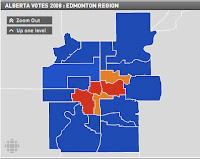
In Edmonton, welcome to 2001 + 2.

Ed Stelmach’s Tories have returned Edmonton to their 2001 win with the addition of Edmonton-Decore, Edmonton-Mill Woods, and Edmonton-Ellerslie (it’s +2 and not +3 because Edmonton lost a seat after the 2003 electoral redistribution).

I’ve always believed that Edmonton was competitive, but I didn’t believe that it would be this competitive. Along with Decore, Ellerslie, and Mill Woods, close races in Edmonton-Beverly-Clareview, Edmonton-Calder, Edmonton-Glenora, Edmonton-McClung, and Edmonton-Rutherford gave the Tories the large majority of the capital. The Tories swept all but five seats in Edmonton, leaving the capital city with an opposition of 5, the survivors being Alberta Liberals Kevin Taft in Edmonton-Riverview, Laurie Blakeman in Edmonton-Centre, and Hugh MacDonald in Edmonton-Gold Bar, and New Democrats Brian Mason in Edmonton-Highlands-Norwood and Rachel Notley in Edmonton-Strathcona. Though most races in the capital city could be considered close, with abysmal turnout and lost support, both the Alberta Liberals and New Democrats will need to take a critical look at why they lost so much ground in their former stronghold of Edmonton.

New Edmotnon Tory faces of note include former School Board Trustee Janice Sarich and Emergency Room doctor Raj Sherman.

On a personal note, I am really disappointed to see three of the Legislature’s most effective MLAs lose their seats last night. I’m talking about Rick Miller in Edmonton-Rutherford, Mo Elsalhy in Edmonton-McClung, and David Eggen in Edmonton-Calder. I’ve had the opportunity to work with Rick, Mo, and David on a number of issues over the past few years and I think I would have a hard time finding harder working and more genuinely good spirited people under the dome. I’m sad to that they were defeated, but wish them good luck in the next stages of their lives. Take a break, but try not to go too far.

Calgary
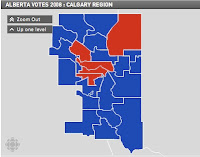
Calgary is an interesting one. The great Liberal surge that every one was talking about never really emerged, but interestingly the Liberals actually net-gained one seat inside Calgary. While holding the seats they gained in 2004 and losing Craig Cheffins in Calgary-Elbow, the Alberta Liberals elected Kent Hehr in Calgary-Buffalo and Darshan Kang in Calgary-McCall, bringing the total to 5 opposition MLAs in Calgary. This is an emerging dynamic that could be a sign of the new face of a politically competitive Calgary.

The Tories held their ground, but faced strong challenges in Calgary-Bow, Calgary-Elbow, Calgary-Foothills, and Calgary-North Hill. The Tories also elected a swath of new MLAs including big names Teresa Woo-Paw and Alison Redford, while star candidate Arthur Kent was unable to unseat Dave Taylor in Calgary-Currie.

Also, Independent Robin Leech in Calgary-Montrose placed a very strong second against Tory Manmeet Bhullar. And after much hoopla, former-Tory Craig Chandler placed third in Calgary-Egmont behind Tory Jonathan Denis and Liberal Cathie Williams.

Lethbridge and wildcards

Not much has changed as Lethbridge remains split between the Tories and the Liberals. Bridget Pastoor held Lethbridge-East for the Liberals. Lethbridge-West went to the Tory Greg Weadick over Liberal Bal Boora.

In Cardston-Taber-Warner, Wildrose Alliance Leader Paul Hinman apparently lost his seat to Tory Broyce Jacobs by 39 votes. I’d expect a recount at this point, but only a reversal of the results could save Hinman’s leadership in his now seatless party.

For the Alberta Greens, their big hope in Lacombe-Ponoka wasn’t able to overcome Tory Ray Prins. In the end, Green Joe Anglin netted 22% of the vote to Prins 58%.

What’s next?

Well, congratulations to everyone who ran, volunteered, and voted in this election. Democracy only works if citizens participate, and we now have to figure out how to get that 59% of voters to opt-in to the democratic system (in its current or a different form).

Tomorrow, I’m going to be posting on what the results mean for each of Alberta’s political parties.

Categories
2008 Alberta Provincial Election Alberta Views David King

"from time to time we should disempower them."

Former Education Minister David King has a great titled Democracy: The Unfinished Revolution this month’s edition of Alberta Views Magazine – if you haven’t already picked up a copy, you should. Here’s the quote:

“Government does not empower citizens, and the government that suggests it does is arrogant and ignorant. Citizens empower government, and citizens can disempower governments. From time to time we should disempower them.”
– David King, PC MLA Edmonton-Highlands (1971-1986)

Categories
2008 Alberta Provincial Election Alberta Politics Election Day

i voted. so should you, alberta.


Well, I’m back from voting for Tim Vant in Edmonton-Strathcona! Voting feels good. I wish I could vote every day. 🙂

I might try to do some liveblogging tonight, but I’m going to be busy getting out the vote for
Kevin Taft in Edmonton-Riverview and Sandeep Dhir in Edmonton-Manning so it might be later tonight until I make another appearance. Until then, check the CBC Alberta Votes 2008 website for election updates. Also, Alberta: Get Rich or Die Trying has a good run down of some of the blog coverage on today’s election.

After helping get the vote out in Edmonton-Riverview and Edmonton-Manning, I’m going to be heading down to the CBC election night gala at the Axis Cafe downtown before heading to the Alberta Liberal election night party at the Mayfield Inn in Northwest Edmonton. If you see me around, say hi.

I wanted to give a quick shout out to Leslie Penny in Barrhead-Morinville-Westlock. Barrhead-Morinville-Westlock is my family’s constituency and is where Penny is facing a incredibly uphill battle against long-time Tory Ken Kowalski‘s Tammany Hall machine as Kowalski is running for his ninth term as MLA. There wouldn’t be a better message that Albertans could send to this 37-year old Tory government than sending them and the Boss Hogg of Alberta politics packing.

If you don’t know where to vote, find out where to vote here.

If you haven’t already, take a look at your local candidates here.

Categories
2008 Alberta Provincial Election

hey alberta! get out and vote!

The polls have opened in Alberta’s 2008 Provincial election and I’m off to go and vote at my polling station at Allendale School in Edmonton-Strathcona. The polls will be open until 8:00 p.m. tonight, so make sure to get out and vote!

Find out where to vote here.

If you haven’t already, take a look at your local candidates here.

Categories
2008 Alberta Provincial Election

alberta election 2008: what to watch for in calgary on election day.

With the election polls opening in less than 8 hours, here’s a look at some of the Calgary races that I will be keeping an eye on after the polls close tomorrow night.


Calgary

The big talk of the campaign has largely been “what’s happening in Calgary?” With the departure of Ralph Klein last year, Calgarians found themselves on the outside under Ed Stelmach‘s Tories, which as led to the real proposition that Alberta Liberal gains are on the horizon in this city (building on their three MLAs elected in 2004 and the election of Craig Cheffins in the June 2007 Calgary-Elbow by-election).

Though the Tories’ 37-year advantage in political organizing in Calgary shouldn’t be underestimated, the Alberta Liberals have probably put together their most impressive list of Calgary candidates since Harper Prowse in 1955 – in 2008 the list includes Kent Hehr, Beth Gignac, Mike Robinson, Cathie Williams, Greg Flanagan, Laura Shutiak, and Michael Embaie among others. This obviously doesn’t equal an automatic win for these candidates, but it does say a lot about the changing political environment in this city that a political party other than the ruling Tories were able to recruit strong local candidates.

Calgary becoming a competitive political environment on the provincial level is exciting, but I’m going to remain cautiously optimistic and wait for Calgarians to surprise me tomorrow.

Constituencies I will be keeping an eye on will be Calgary-Bow, Calgary-Buffalo, Calgary-Currie, Calgary-Egmont, Calgary-Elbow, Calgary-Fish Creek, Calgary-Foothills, Calgary-Glenmore, Calgary-McCall, Calgary-Montrose, Calgary-Mountain View, Calgary-North Hill, Calgary-North West, Calgary-Varsity, and Calgary-West.