Categories
Alberta Politics

Scramble for federal nominations begins in Alberta

Jim Hillyer MP Lethbridge Medicine Hat
Lethbridge MP Jim Hillyer

It’s a fight – or at least it could be if two southern Alberta Conservative Members of Parliament seek their party’s nomination in the same riding. Boundary changes in the next federal election will mean that Lethbridge Conservative MP Jim Hillyer will find himself living within the boundaries of the new Medicine Hat riding. Mr. Hillyer has already announced he plans to seek the Conservative Party of Canada nomination in the new Medicine Hat riding, which may pit him against current Medicine Hat MP LeVar Payne. Mr. Payne has represented that riding since 2008 and has not yet announced his plans for the next election. UPDATE: Mr. Hillyer may be having second thoughts.

Blaine Calkins Red Deer Wolf Creek MP
Blaine Calkins

Another nomination contest among incumbents may have been averted as Wetaskiwin MP Blaine Calkins has announced he will seek the Conservative nomination in the new Red Deer-Wolf Creek riding. It was suspected that Mr. Calkins could have sought the nomination in the new Edmonton-Wetaskiwin riding, which could have placed him in competition with fellow Conservative MPs Mike Lake and James Rajotte.

Six-term Member of Parliament Jason Kenney announced on Twitter that he will seek the Conservative nomination in the new Calgary-Shepard Calgary-Midnapore riding. Mr. Kenney was first elected in Calgary-Southeast in 1997 and currently serves as Minister of Employment and Social Development.

With her Edmonton-Spruce Grove riding being redistributed in the next election, it is expected that Conservative MP Rona Ambrose may choose to seek her party’s nomination in the new Sturgeon River riding.

Bashir Mohamed NDP Edmonton Griesbach
Bashir Mohamed

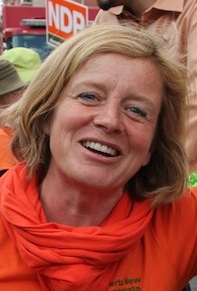
Bashir Mohamed has entered the New Democratic Party nomination race in the new Edmonton-Griesbach riding. A student at the University of Alberta, Mr. Mohammed caused a stir last year when he  confronted Mr. Kenney at a Conservative Party fundraiser about the federal government’s cuts to refugee health care. He joins teacher Janis Irwin in the NDP contest.

Entrepreneur Randy Boissonnault launched his campaign to win the Liberal Party of Canada nomination in Edmonton-Centre. A video of his nomination speech is available on his website.

As mentioned in my previous roundup, Ryan Hastman has made official his plans to seek the Conservative Party of Canada nomination in St. Albert-Edmonton. A fundraiser for the University of Alberta, Mr. Hastman was the 2008 Conservative Party candidate in Edmonton-Strathcona.

Matt Grant Liberal Calgary Confederation
Matt Grant

Lawyer Matt Grant has announced plans to seek the Liberal Party nomination in the new Calgary-Confederation riding, which will include most of the current Calgary-Centre North riding. Currently an associate with Burnet, Duckworth & Palmer LLP, he previously worked as executive assistant to Calgary Liberal MLAs Craig Cheffins and Kent Hehr.

Seven-term Conservative MP Leon Benoit will also be affected by the electoral boundary changes. The Lloydminster Source reported that Mr. Benoit told an audience of supporters that “no decision has been made on where he would be running, but one thing for sure is that he would not be running against his colleagues in the next general election.”

The Vegreville-Wainwright riding, which Mr. Benoit has represented since 2004, will be redistributed into the new Lakeland riding. He currently resides in Sherwood Park, which will be included in the new Sherwood Park-Fort Saskatchewan riding. If re-elected in 2015, Mr. Benoit will become Alberta’s longest serving Member of Parliament.

Some Conservatives would like to convince former Progressive Conservative MLA Rob Lougheed to seek their party’s nomination in the new Sherwood Park-Fort Saskatchewan. Mr. Lougheed represented the area in the Alberta Legislature from 1997 to 2008.

Dan Bildhauer plans to seek the Liberal Party nomination in the new Edmonton-West riding. According to his LinkedIn profile, Mr. Bildhauer is the Director of Operations for Bildhaur Construction and worked as a Senior Policy Advisor for Citizenship and Immigration Canada from 2007 to 2013.

Tanveer Taj has announced his plans to run as a candidate in the Calgary-Skyview constituency. It is unclear whether he will seek a party nomination or run as an Independent. Mr. Taj earned 19% of the vote as a candidate in Calgary’s City Council Ward 3 in the recent municipal election.

See the full list of federal election nomination candidates in Alberta 

Categories
Alberta Politics

Redford’s Christmas cabinet shuffle

Premier Alison Redford Cabinet Alberta
Premier Alison Redford announced a new cabinet late this afternoon.

As reported yesterday on this blog, rumours that Ms. Redford would shuffle her cabinet before the Christmas break began to intensify this week. Today, those rumours proved to be true.

Built around the government’s “Building Alberta” slogan, today’s Government of Alberta press release boasts a new cabinet that will focus on “innovation and economic growth.” And it signals a growth in numbers of Ms. Redford’s cabinet as well. The size of the cabinet will now be 30 MLAs, up from 27 MLAs in the previous cabinet. There are a total of 59 MLAs in the Progressive Conservative caucus.

Here is a description of some major changes in Alberta’s provincial cabinet:

Dave Hancock MLA Edmonton-Whitemud
Dave Hancock

Dave Hancock: Appointed Deputy Premier and moved from Human Services to Innovation and Advanced Education. Moving Mr. Hancock back to the Advanced Education portfolio he filled from 2004 to 2006 likely signals that Ms. Redford recognizes the need to repair the damage done to Alberta’s colleges and universities under its previous minister. The deep budget cuts imposed by Ms. Redford’s government in 2012 damaged both the post-secondary education system and the government’s relationship the leaders in that system. A well-known policy wonk and party loyalist, Mr. Hancock will be tasked with smoothing over those hard feelings.

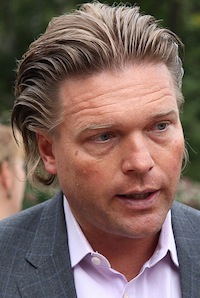
Thomas Lukaszuk: The bull-dog of the Progressive Conservative caucus lost his Deputy Premier title and is moved from Enterprise & Advanced Education to a new Jobs, Skills, Training, and Labour portfolio. As Ms. Redford’s ‘heavy-hand’ in cabinet, it is likely that Mr. Lukaszuk will be tasked with imposing controversial new laws on Alberta’s public sector unions.

Manmeet Bhullar
Manmeet Bhullar

Manmeet Bhullar: Moved from Service Alberta to Human Services. This is a big promotion, as Human Services is a large ministry that represents a multitude of components of government services. Mr. Bhullar performed well as Minister of Service Alberta, but this portfolio will present a significant challenge to the new minister.

Diana McQueen: Moved from Environment & Sustainable Resource Development to Energy. With an increased focus on the government’s agenda to support the Keystone XL, Enbridge Northern Gateway and Energy East pipelines, the capable Ms. McQueen is well-armed with arguments to use in advocating for these projects in Canada and the United States.

Robin Campbell: Moved from Aboriginal Relations to Environment & Sustainable Resource Development, a high-profile position which is closely linked with the Energy portfolio. He is also now the Government House leader, a role that has been filled by Mr. Hancock for quite some time.

Doug Griffiths
Doug Griffiths

Doug Griffiths: Demoted from Municipal Affairs to Service Alberta. As Municipal Affairs Minister, Mr. Griffiths stumbled through the high profile items in his portfolio, making his demotion almost inevitable. As minister of the tiny Service Alberta department, Mr. Griffiths will have less chance to embarrass the government and an opportunity to redeem himself in cabinet.

Ken Hughes: Moved from Energy to Municipal Affairs. While this move could easily be seen as a demotion, Mr. Hughes, a trusted confident of Ms. Redford’s, will have an important role in repairing the provincial government’s strained relationship with its municipal leaders – both in the large cities and rural municipalities.

Frank Oberle: Promoted from Associate Minister of Services for Persons with Disabilities to a full-cabinet position as Minister of Aboriginal Affairs. Mr. Oberle previously served as Solicitor General and Minister of Public Security and Minister of Sustainable Resource Development.

Wayne Drysdale: Moved from Infrastructure to Transportation, replacing Ric McIver.

Ric McIver: Moved from Transportation to Infrastructure, replacing Wayne Drysdale.

Steve Young: Left his position as Government Whip to become Associate Minister of Public Safety, a new position.

Donna Kennedy-Glans: Departed the backbenchers to become Associate Minister of Electricity and Renewable Energy, a new position.

George VanderBurg: Appointed the Government Whip. Lost his position as Associate Minister of Seniors. Mr. VanderBurg had previously served as Minister of Government Services, Minister of Seniors, and Acting Minister of Innovation and Science.

A curious addition to the list of cabinet positions in the press release included the Progressive Conservative Caucus Chair, Maureen Kubinec. This appears to be a new addition to the cabinet, though the release was unclear what role this MLA will have at the cabinet table, as there now only remain 29 PC MLAs not included in the list of cabinet positions.

Categories
Alberta Politics

A Christmas cabinet shuffle in Alberta?

Alberta Redford Cabinet Shuffle
Premier Alison Redford and her MLA caucus.

With the Legislative Assembly’s fall sitting coming to an end, can some Progressive Conservative MLAs expect an early Christmas present from their leader, Premier Alison Redford? Nearly half-way through the PC Party’s twelfth term in office and fresh from a leadership review victory, it is expected that Ms. Redford could choose to shuffle her cabinet before Christmas. Speculation about an imminent cabinet shuffle has intensified this week.

Diana McQueen Alberta
Diana McQueen

With an increased focus on the government’s agenda to support the Keystone XL, Enbridge Northern Gateway and Energy East pipelines, some political watchers have suggested that calm and confident Environment and Sustainable Resource Development Minister Diana McQueen could see her prominence in cabinet rise with an appointment as Deputy Premier.

Ms. McQueen has roots in rural Alberta as an MLA and mayor, both qualities the Redford Government would like to highlight in advance of the next provincial election. Her appointment as Deputy Premier could send a signal to out-of-province skeptics that Ms. Redford takes the environmental portfolio seriously (even though that is debatable from a substance standpoint).

With the intense focus on pipelines and a desire to shift attention away from this year’s more controversial budget cuts, Ms. Redford could look to replace Finance Minister Doug Horner, a former leadership rival, with Energy Minister Ken Hughes, a close confidant.

Ken Hughes
Ken Hughes

Moving Mr. Horner to the Energy portfolio would free him from the constrains of last year’s manufactured budget woes and put him in the important position of advocating for pipeline expansion to the United States and British Columbia. In Finance, Mr. Hughes would be someone the premier could rely on to present a consistent message while managing the government’s controversial and potentially dangerous push to overhaul Alberta’s public sector pension plans before the next election.

Among the political watchers I speak with, there is no concensus where current Deputy Premier Thomas Lukaszuk could end up in a cabinet shuffle. Some believe he could be promoted to a higher profile role like Finance and others believe he could be completely stripped of his cabinet responsibilities. His confrontational and partisan style has certainly created difficulties for Ms. Redford, but he is also one of her government’s staunchest defenders.

Mr. Lukaszuk does not shy away from engaging in heated debates in the Assembly and on social media, where it is sometime difficult to distinguish confidence from arrogance. On Twitter last week, the Deputy Premier mocked opponents of Bill 45, which could infringe on free speech rights in Alberta.

Thomas Lukaszuk
Thomas Lukaszuk

Mr. Lukaszuk replaced MLA Stephen Khan as Enterprise & Advanced Education Minister earlier this year when Ms. Redford needed a heavy-hand to impose deep budget cuts on Alberta’s colleges and universities. Not only has Mr. Lukaszuk become Ms. Redford’s lieutenant, he appears to be positioning himself as premier-in-waiting. Mr. Lukaszuk is a double-edged sword for the Premier.

Municipal Affairs Minister Doug Griffiths is a prime candidate to be shuffled into a different cabinet position or even to the backbenches after his unimpressive performance in cabinet. Since he was first appointed to cabinet in 2011, Mr. Griffiths has stumbled through the high profile items in his portfolio, including managing to create unnecessary conflict with popular Calgary Mayor Naheed Nenshi while also alienating many rural politicians.

Mr. Griffiths caused some embarrassed for the government last month when Ms. Redford was forced to halt the passage of Bill 28 Moderinizing Regional Governance Act after rural municipal leaders protested that they had not been properly consulted before the introduction of the planning legislation. The bill has since been amended, but Mr. Griffiths remains unapologetic.

If the speculation is true, December could be a both exciting and very disappointing month for some members of Ms. Redford’s cabinet. If a cabinet shuffle is imminent, there will be PC MLAs  who return home for the Christmas break with lumps of coal and others with their arms full of holiday reading material (also known as ministerial briefing binders).

Strange claim made by PC backbencher

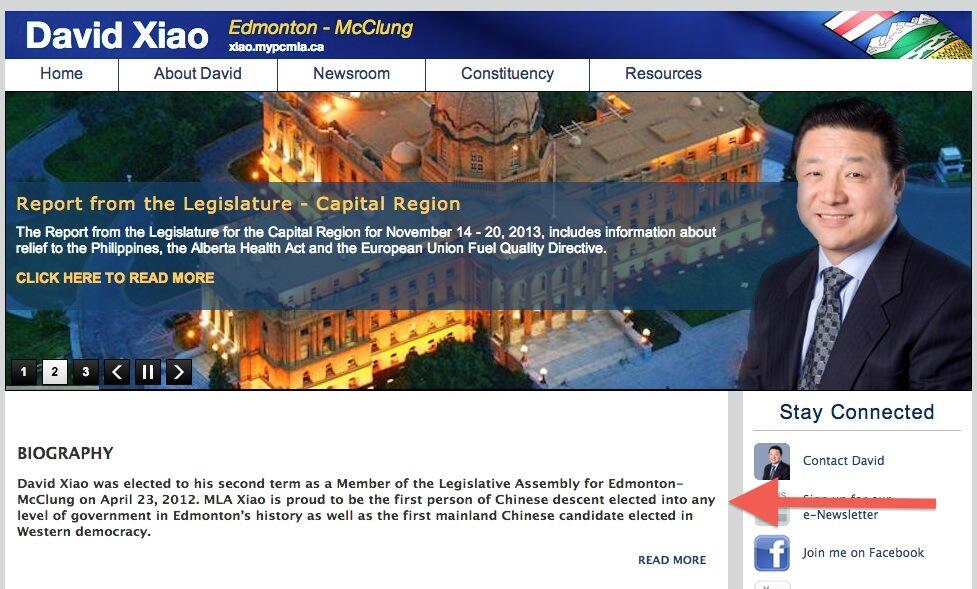
Filed under “strange claims made by backbenchers,” Edmonton-McClung MLA David Xiao claims on his official Progressive Conservative caucus website that he is the “first mainland Chinese candidate elected in Western democracy.” This claim should surprise some, including Mae Yih, born in Shanghai and elected to Oregon Legislature in 1977, and Richard Lee, born in Zhongshan and elected to the BC legislature in 2001.

Categories
Alberta Politics

PC MLAs vote for Bill 45, but law limiting free speech is ripe for a constitutional challenge

Despite a united front from opposition parties, days of large protests by public sector unions, and calls by constitutional experts that the law would be ripe for a Supreme Court challenge, 33 of Premier Alison Redford‘s Progressive Conservative MLAs voted tonight in favour of passing Bill 45: Public Sector Services Continuation Act into law. Eight opposition MLAs were present in the Assembly to vote against the bill’s passage in third reading.

As I wrote earlier this week, under sections 4(4) and 18(d) of Bill 45, any “person” who suggests that public sector employees strike or threaten to strike could be fined $500 and prosecuted within one year. The bill vaguely defines a “person” as someone who is not a government employee or trade union official, meaning that the $500 fine and prosecution could arguably apply to newspaper reporters, columnists, bloggers, or just ordinary Albertans who publicly suggest that unionized government employees participate in an illegal strike or consider taking illegal strike action.

The addition of the term”strike threat,” a new concept introduced in this bill, is both vague and open to interpretation and it is not unimaginable that the government could use the clause to punish public sector unions in the event of conflict or disagreement.

Once Bill 45 receives Royal Assent from Lieutenant Governor Donald Ethell, it will become law in Alberta. But, as one constitutional law expert told the National Post, this law is “ripe for challenge” to the Supreme Court of Canada. Athabasca University professor Bob Barnetson suggests that because free speech is protected by Section 2 of the Charter of Rights and Freedoms, it is unlikely that these sections Bill 45 would survive a challenge to the Supreme Court of Canada.

Albertans can now expect that the Redford Government will be forced to spend significant public dollars defending this unjust and irresponsible law in the courts.

Categories
Alberta Politics

Redford Tories anti-labour laws too extreme for Wildrose

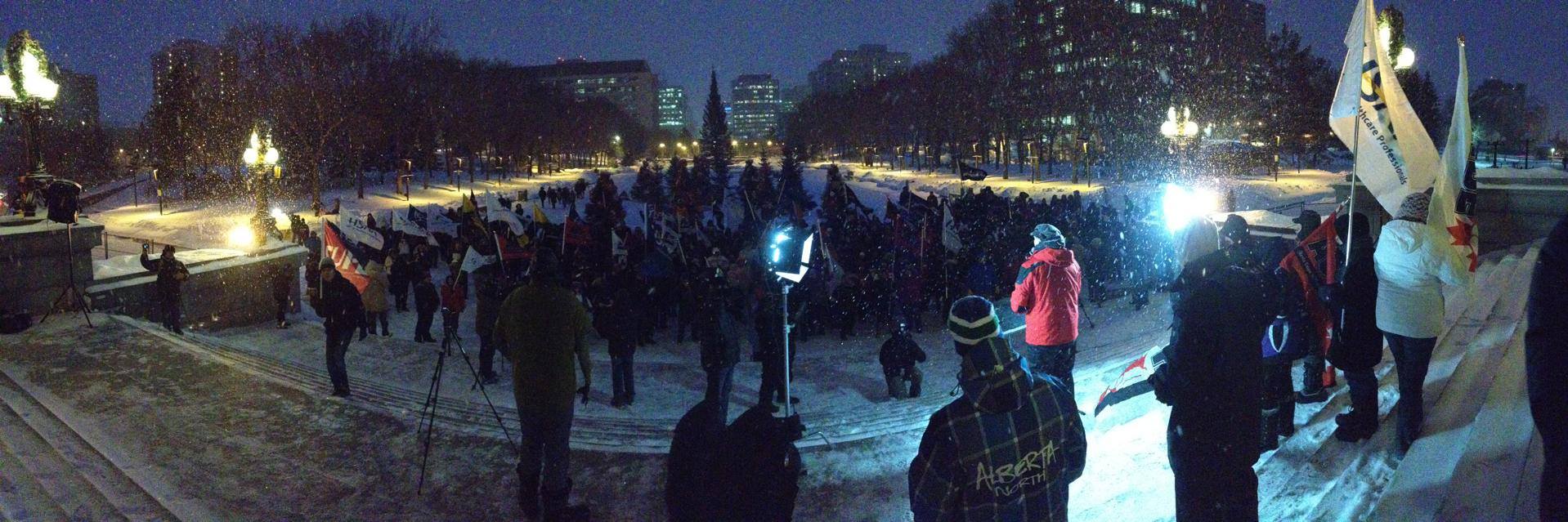
More than 500 Albertans gathered on the steps of the Alberta Legislature to oppose Bills 45 and 46 on Monday, December 2, 2013.

Imagine a chilly and dark December evening in Alberta. It’s snowing and a cold wind is blowing. Standing at the steps of the Legislative Assembly building in Edmonton are more than 500 parka wearing Albertans, mostly public sector workers, listening to speeches decrying the government’s new anti-labour legislation. Labour leaders, New Democrats and Liberals have already spoken and voiced their strong opposition to the bills, next up at the microphone is a representative from… the Wildrose Party.

Amid a storm of embarrassing news stories of unreported deaths of children in the foster care system, Human Services Minister Dave Hancock rushed forward last week with Bill 45: Public Sector Services Continuation Act and Bill 46: Public Service Salary Restraint Act.

These two bills will allow the Redford Government to bypass a legally binding arbitration process in order to force a wage-freeze on 22,000 government employees represented by the Alberta Union of Provincial Employees, increase harsh fines for illegal strikes and “strike threats,” and introduce restrictions on freedom of speech. Mr. Hancock had initially proposed pass much of this legislation in a short 48 hour period.

Rob Anderson Wildrose MLA
Rob Anderson

Mr. Hancock’s haste, with the blessing of Premier Alison Redford, led to three days of large protests outside the Alberta Legislature. This is not Ukraine or Wisconsin, so there were not tens of thousands of protesters clashing with riot police or occupying government buildings. But there were more than five hundred public servants who, politely and passionately, gathered outside the Legislative Assembly building each day to voice their opposition to this legislation. This is Alberta. And it is winter. It is cold.

In Mr. Hancock’s rush, a most unlikely alliance appears to be forming. On Friday, Wildrose Official Opposition MLA Joe Anglin, a former United States Marine who briefly led Alberta’s Green Party, stood on the steps of the Assembly building to show his support for the 700 public sector workers braving the cold to oppose the Redford Government’s anti-labour bills.

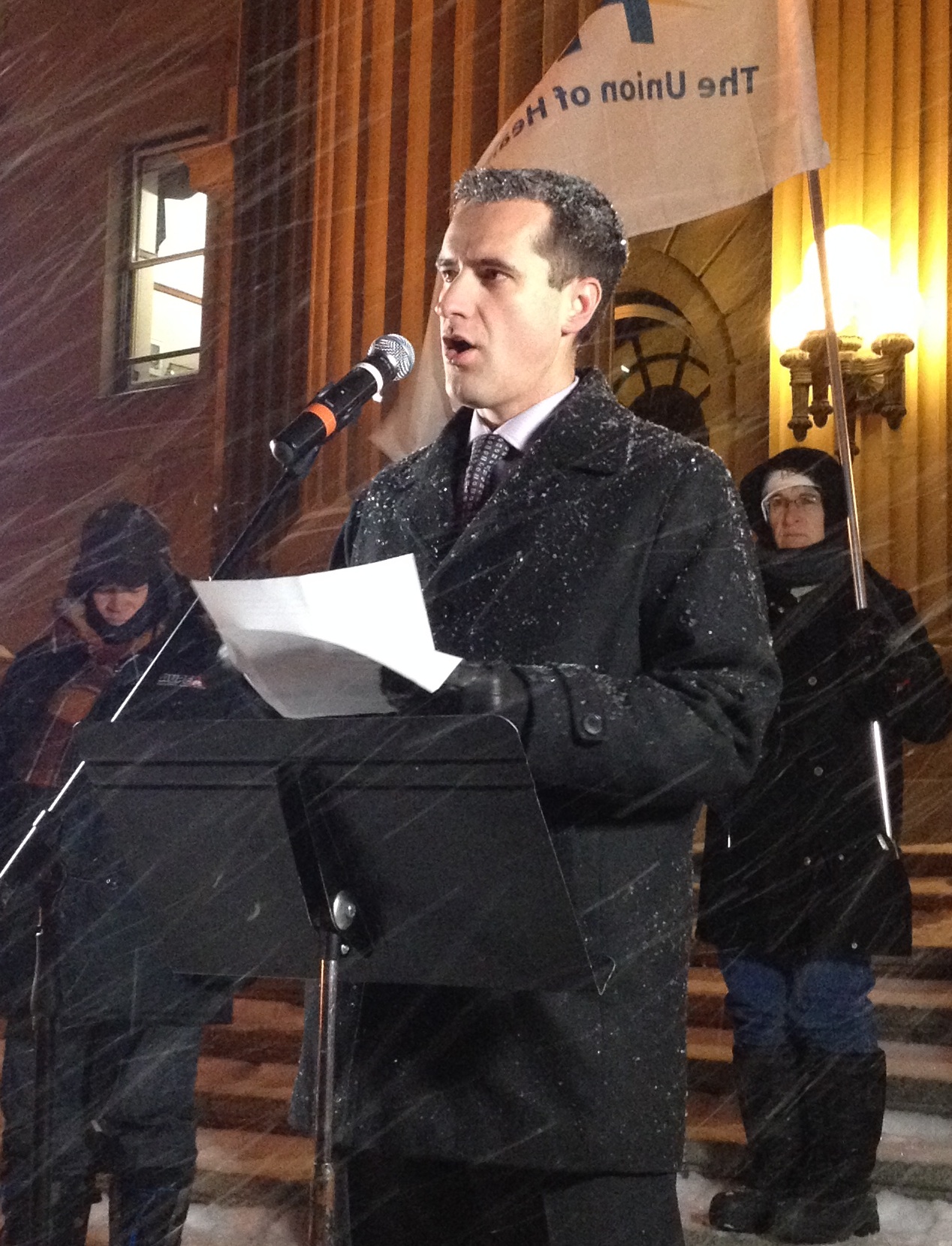
And yesterday, perhaps more symbolically, the Wildrose Opposition’s conservative Deputy Leader, Rob Anderson, stood on those same steps to show party’s support for the more than 500 Albertans braving a December snowstorm to oppose Bills 45 and 46.

Some people may believe this is a sign that the Wildrose is moving to the political centre, but they are no less of an ideological conservative party because of their opposition to these bills. The Wildrose’s opposition to Bills 45 and 46 is rooted in their libertarian beliefs and their entry into this debate is a testament to how unpopular and poorly written, and obviously unconstitutional, this legislation is.

Targeting sections 4(4) and 18(d) of Bill 45 which could limit free speech of ordinary Albertans, Mr. Anderson said his party would introduce amendments to the bill in order to protect the free speech rights. While it has been suggested in the mainstream media that “the new legislation … is designed in part to intimidate high-profile, labour affiliated bloggers such as Dave Climenhaga and Dave Cournoyer,” this law will apply to all Albertans.

As I wrote last week, according to Bill 45, any “person” who suggests that public sector employees strike or threaten to strike could be fined $500 and prosecuted within one year. The bill vaguely defines a “person” as someone who is not a government employee or trade union official, meaning that the $500 fine and prosecution could arguably apply to newspaper columnists, radio hosts, bloggers, or just ordinary Albertans who publicly suggest that unionized government employees participate in an illegal strike or consider taking illegal strike action.

While the opposition parties in the Assembly do not have sufficient numbers to stop these two pieces of legislation from becoming law, the Wildrose Party is playing a long-game.

The Wildrose Party is eager to make allies of the tens of thousands of public sector workers who played a key role in Ms. Redford’s leadership win in 2011 and election win in 2012, but now feel that the Premier has turned her back on them. Ms. Redford claimed to be a champion of progressive conservative values, leading many moderate conservative and liberal voters to lend their support to her Progressive Conservatives in last year’s election in order to block a victory by the Wildrose Party.

Since the election, Ms. Redford’s team has shown little gratitude to this important part of her winning coalition. Instead, they are imposing contracts and have arbitrarily implemented deep budget cuts on the colleges and universities that employ many of Alberta’s public sector workers.

By attacking a constitutionally protected right to free speech and by undermining Albertans’ right to a fair bargaining process, Ms. Redford’s Tories have, in the midst of a cold December on the prairies, managed to unite their political opponents on both the left and the right.

Categories
Alberta Politics

Wildrose to PC MLAs: It’s not your fault, your party left you. Come on over.

The Wildrose Caucus has released a flashy new YouTube video encouraging Progressive Conservative MLAs to join the Official Opposition.

The video begins with two former PC MLAs making the pitch to cross the floor. “I was nervous when I first did I, but I have to tell you, it is so much better over here,” Wildrose MLA Heather Forsyth says in the video. “It’s not you, it’s them,” Rob Anderson testifies.

Rob Anderson Heather Forsyth Wildrose
PC MLAs Heather Forsyth and Rob Anderson crossed the floor to the Wildrose Party in 2010.

The rest of the video includes short clips of testimonials and pleas from Wildrose MLAs to their PC MLA colleagues. “It’s not your fault, your party left you. Come on over,” a welcoming Ms. Smith says in the final clip.

It is yet to be seen if any PC MLAs will accept the opposition offer.

A Wildrose history of floor crossing

In 2010, less than two months after then-Premier Ed Stelmach received 77% in the PC Party’s leadership review, two backbench PC MLAs, Rob Anderson and Heather Forsyth, crossed the floor to join newly selected leader Danielle Smith‘s Wildrose opposition. Soon after, former PC MLA Guy Boutilier joined the Wildrose caucus. It is not surprising that the Wildrose would make this pitch only one week after current PC Party leader, Premier Alison Redford, received an eerily similar 77% in her party’s 2013 leadership review.

The Alberta Alliance, the precursor to the Wildrose Party, gained its first MLA when Edmonton-Norwood PC MLA Gary Masyk briefly ran under the party’s banner in the 2004 election in the new Edmonton-Decore constituency. Mr. Masyk was defeated in his bid for  re-election.


Categories
Alberta Politics

Threatening to strike in Alberta? Under Bill 45, that’s a paddlin.

Jasper Beardly explains the Redford Government’s Bill 45: “Threatening to strike? That’s a paddlin’. Talking about going on strike? That’s a paddlin’.”

In their rush to pass anti-labour laws that would force the province’s largest union into a new contract and increase penalties public sector unions that enter illegal strikes, could Premier Alison Redford‘s Government also be infringing on the free speech rights of ordinary Albertans?

Athabasca University professor Bob Barnetson, in a recent blog post, expressed concern about many of the “chilling” aspects of Bill 45: Public Sector Services Continuation Act, including an issue of free speech.

Section 4(4): “No person shall counsel a person to contravene subsection (1) or (2) or impede or impair a person from refusing to contravene subsection (1) or (2).

Section 18(d): in the case of a person to whom or an organization to which none of the clauses (a), (b), or (c) applies, to a fine of $500 each day or partial days on whihc the offence occurs or continues.

Alberta Legislature Building Alison Redford
More than 700 Albertans gathered outside the Legislative Assembly to protest the Redford Government’s anti-labour laws.

According to Bill 45, any “person” who suggests that public sector employees strike or threaten to strike could be fined $500 and prosecuted within one year. The bill vaguely defines a “person” as someone who is not a government employee or trade union official, meaning that the $500 fine and prosecution could arguably apply to newspaper reporters, columnists, bloggers, or just ordinary Albertans who publicly suggest that unionized government employees participate in an illegal strike or consider taking illegal strike action.

The addition of the term”strike threat,” a new concept introduced in this bill, is both vague and open to interpretation and it is not unimaginable that the government could use the clause to punish public sector unions in the event of conflict or disagreement.

Dr. Barnetson suggests that because free speech is protected by Section 2 of the Charter of Rights and Freedoms, it is unlikely that these sections the Redford Government’s Bill 45 would survive a challenge to the Supreme Court of Canada. Why would the government introduce a law that they must know is vulnerable to a constitutional challenge?

16(1) If the Minister or a delegate appointed under the regulations is of the opinion that an employee has contravened section 4(1), (2) or (4), the Minister or delegate may, by notice in writing served on the employee, require the employee to pay to the Crown an administrative penalty in the amount determined in accordance with this section and the regulations and set out in the notice.

Section 16(1) of Bill 45, appears give significant powers to the Minister of Human Services  to issue fines to government employees if there has even been a hint of discussion about an illegal strike or strike threat. The prohibitions in this bill are vague, subjective, and place Alberta’s public servants in a position where their freedom of speech is limited.

If Bill 45 becomes law, could the Minister of Human Services issue a fine to a government employee for posting a comment on his or her personal Twitter account or Facebook page that is perceived as a “strike threat?”

If passed into law, Bill 45 would apply to employees of the provincial government and its agencies, Alberta Health Services employees and employees in approved hospitals, employees of ambulance operators, Non-academic staff in post-secondary institutions, and firefighters.

When Bill 45 was initially introduced, Human Services Minister Dave Hancock made clear that he wanted the Assembly to pass this bill in a short 48 hour period, making it law by the weekend. Facing two days of large protests outside the Legislature Building, the Redford Government has abandoned its plans to ram the bill through in 48 hours, opting instead to begin debate on the bill in the Assembly early next week.

Categories
Alberta Politics

Redford Government shows bad faith by rushing labour law changes

Alberta Legislature Protest #BuildingAlberta
Hundreds of Albertans gathered outside of the Legislative Assembly today to protest new labour laws.

Providing a timely distraction for a government facing criticism over the sobering news stories of unreported deaths of children in the foster care system, Premier Alison Redford‘s Progressive Conservatives today suddenly introduced two pieces of legislation that could have a significant impact on labour relations in Alberta.

The first piece of legislation, Bill 46: Public Service Salary Restraint Act, introduced by Finance Minister Doug Horner, would impose a two-year wage-freeze on more than 22,000 government employees represented by the Alberta Union of Provincial Employees. AUPE is currently in negotiations with the government for a new collective agreement and this bill would allow the government to bypass a law requiring it to settle the negotiations with AUPE through arbitration, which had been scheduled for February 2014.  Bill 46 would take effect on January 31, 2014 if the two parties cannot reach a settlement before that date.

This bill is reminiscent of threats made by Education Minister Jeff Johnson to the Alberta Teachers’ Association earlier this year. During those negotiations, Mr. Johnson threatened to cut salaries and impose a new contract on Alberta’s teachers if an agreement was not reached by an arbitrary deadline. Once a deal was finally reached between the government and the teachers’ union, Mr. Johnson then legislated the agreement after a number of elected school boards voted to reject the deal on financial grounds.

The introduction of this legislation raises a real question about the state of collective bargaining in Alberta. Can this government, as an employer, be trusted to bargain in good faith with its employees? And what incentive is there for employers bargain fairly with their employees if the government will just impose an agreement?

The second piece of legislation, Bill 45: Public Sector Services Continuation Act, introduced by Human Services Minister Dave Hancock, significantly increases the penalties for illegal strikes by workers who are determined to provide essential services. Mr. Hancock introduced this bill as a response to the wildcat strike by corrections officers that began at the Edmonton Remand Centre earlier this year. The government proposes to introduce harsh fines of up to $1,000,000 per day on a union in the case of an illegal strike or even the threat of a illegal strike.

As David Climenhaga wrote on his blog, the real reason the government is rushing these changes through the legislature is not the possibility of illegal strikes, but the compromise currently enshrined in the current labour relations system:

“While former premier Peter Lougheed deprived public employees of the right to strike in the event of an impasse in bargaining, in return they got access to a compulsory arbitration process. In other words, an arbitrator who looks at the facts, the laws and private-sector comparisons, and who then has the right to impose a settlement on both parties.”

That these new laws threaten to damage the electoral coalition that helped elect Ms. Redford in the 2012 election doesn’t appear to have been considered by the long-governing PCs. Nor did the PC government blink when it proposed changes that will negatively impact public sector pensions or when it imposed deep budget cuts on Alberta’s post-secondary education system, attacking another key community that was part of Ms. Redford’s coalition.

With Ms. Redford turning on her supporters in the public service, Alberta’s public sector employees could find themselves with allies in untraditional places.

“A Wildrose government would never act in this way. Just because your negotiation isn’t going well, you don’t take away people’s arbitration rights that are in the contract that was signed. That’s not how you govern. That’s not good faith,” Wildrose MLA Rob Anderson told the Edmonton Sun.

For reasons that are unclear, Ms. Redford’s government is moving quickly to pass this legislation. At Mr. Hancock’s urging, MLAs have made an unordinary exception to meet for a special sitting on Friday, November 29 in order to ensure that Bill 45 passes through the Legislature in the next 48 hours and becomes law before the weekend.

Categories
Alberta Politics

Secrecy of foster care deaths a sobering story

The normally hyper-partisan atmosphere in Alberta’s Legislative Assembly was sobered today with news of a tragic and startling story.

Dave Hancock MLA Edmonton-Whitemud
Dave Hancock

A six-month investigation by Edmonton Journal and Calgary Herald reporters based on death records unsealed after a four-year legal battle revealed a startling number of unreported deaths of children in care of the province between 1999 and 2009. The investigation found 145 foster children have died since 1999, nearly three times more than the 56 deaths revealed in government annual reports during that time.  According to the report, at least 74 of these 145 children who died while in foster care were Aboriginal or Métis.

While this story raises serious questions about transparency and why the government would keep these numbers from the public, there are still unanswered questions about how this number compares to other provinces and how it compares to children not in foster care.

Opposition parties in the Assembly united in support for a motion introduced Wildrose MLA Jeff Wilson this afternoon to hold an emergency debate and a public inquiry into these deaths.

Rachel Notley Edmonton MLA Strathcona NDP
Rachel Notley

Human Services Minister Dave Hancock argued against holding an emergency debate, claiming that the  government had acted to protect the privacy of the children and their families by not releasing the full number of children who died in foster care. Mr. Hancock also claimed that recent legislative changes made by the government, including the creation of the Office of the Child and Youth Advocate, would ensure these numbers would not be kept secret in the future.

After a brief legislative wrangle over whether to hold an emergency debate, Assembly Speaker Gene Zwozdesky ruled against the idea.

Wildrose official opposition leader Danielle Smith: “These truly disturbing revelations not only mean that something is seriously wrong with how vulnerable children are cared for in this province, but that there are major gaps in how incidents are being reported. We must get to the bottom of what it is and begin the long process of fixing the system. If we aren’t reviewing these deaths and doing everything we can to learn from them, we are failing Albertans and risking the lives of vulnerable children.”

Gene Zwozdesky
Gene Zwozdesky

New Democrat MLA Rachel Notley: “This government is more concerned with protecting themselves from their own record on kids in care than in actually protecting those kids. But these kids deserve better—and so do Albertans. With this government’s cuts to the services that families living in poverty depend on, more children will likely end up in government care. We need to ensure that the system isn’t failing these kids.”

Liberal opposition leader Raj Sherman: “If the number of deaths of children in care was underreported, then the number of children seriously injured while in government care was very likely underreported as well. What is very clear now is that this Conservative government has failed in its most basic duty to protect some of the weakest and most vulnerable members of our society, children at risk. Only a fraction of the 145 deaths were deemed worthy of an investigation. In cases where reviews were completed, recommendations were not followed.”

As leader of the party that has formed government in Alberta since 1971, Premier Alison Redford cannot take any position less than one that directly addresses this issue. Anything less will raise serious questions about the competency of the current government.
Regardless of the original reasons why these deaths were unreported, it is important that the government come forward and provide a clear explanation as to why these cases were kept secret. As Albertans, we have a responsibility to protect our most vulnerable citizens, particularly those in care and especially children.

Categories
Alberta Politics

Celebrating 42 years in power, PC Party expected to back Redford

UPDATE: Delegates to the PC Party convention in Red Deer have voted 77% not to hold a leadership review, leaving Ms. Redford firmly in the leader’s chair for the time being. This is a solid endorsement, though the vote indicates that opposition inside her party ranks is still a concern. 

This “teaser” video released before the Progressive Conservative Party Annual Meeting focuses on “trust.”

There was no mention of the ‘Socred Retreads‘ in Premier Alison Redford‘s speech to Progressive Conservative Party faithful last night. Unlike her speech to her party’s annual general meeting in November 2012, Ms. Redford took no partisan thrusts at the opposition Wildrose Party during her speech at this year’s PC Party convention. Instead, she promised to continue her party’s “legacy of success.

Alison Redford Alberta Speech
Premier Alison Redford delivers her opening speech to PC Party convention delegates.

Demonstrating the organizational strength of a party that has been in office for 42 years, the PC Party is said to have drawn up to 1,500 delegates and observers to their annual convention in Red Deer.

Although the event has attracted the attention of partisan faithful, most regular Albertans turned elsewhere for their Friday evening entertainment. According to the ticker on the party’s website, only 40 viewers appeared to tune in to the the online streaming of Ms. Redford’s opening speech. With the Grey Cup kicking off tomorrow in Saskatchewan, the Canadian Football League will attract significantly more attention for the Saskatchewan RoughridersHamilton Tiger-Cats game.

While delegates will spend time today discussing issues and party policy, the main event of this weekend’s gathering is Ms. Redford’s leadership review. Each delegate will have the opportunity to vote on whether they would like to hold a leadership race to replace Ms. Redford or to keep the current leadership.

Speaking to the Calgary Herald’s Don Braid, former Premier Ed Stelmach‘s chief of staff Ron Glen questioned why his party continues to schedule mandatory leadership reviews two years after elections.

Managing expectations before the vote, staunch supporters of the Premier began to lower expectations this week. Former party campaign manager Susan Elliott told the Globe & Mail that “Anything in the 60s is good. And anything in the 70s is actually a triumph.” While Ms. Redford does have her detractors inside her caucus and party, and recent budget cuts have threatened to unravel her new electoral coalition of moderates and former Liberals, it appears unlikely that party faithful will turn on their leader this weekend.

With Ms. Redford’s staff working hard to stack the meeting with supporters, it would be an organizational failure if her support at this convention reaches even the low 70% range.

What are the pundits saying? Despite a long list of broken election promises, including deep budget cuts to colleges and universities, the Calgary Sun’s Rick Bell does not believe the PC Party is ready to part with Ms. Redford and the Edmonton Journal’s Graham Thomson agrees. David Climenhaga believes her victory in this leadership review is a forgone conclusion, and I agree.

Categories
Alberta Politics

Christmas presents for politicos: Joe Clark and Brad Lavigne launch new books in Edmonton

The Christmas season is nearly upon us, and what better time than the present to purchase some new reading material for a political junkie or policy wonk dear to your heart. Authors of two new books about Canadian politics will be speaking about their new books and signing copies in Edmonton in the coming weeks.

How We Lead: Canada in a Century of Change by Joe Clark
November 27, 2013
7:00 pm
Edmonton City Hall, 1 Sir Winston Churchill Square

Joe Clark Calgary-Centre MP
Joe Clark

Former Prime Minister Joe Clark will be in Edmonton on November 27 to talk about his new book, How We Lead: Canada in a Century of Change. Mr. Clark will speak about his book and share his thoughts about what is happening to Canada’s reputation in the world today. The former Progressive Conservative Prime Minister speaks from a unique perspective when he criticizes Prime Minister Stephen Harper‘s approach to international relations and how it has impacted our country.

Mr. Clark served as a Member of Parliament from Alberta between 1972 and 1993, and 2000 and 2004. He became Canada’s 16th Prime Minister in 1979 and served as Secretary of State for External Affairs from 1984 to 1991. During his time in office, he was known for taking a strong stance against apartheid in South Africa and his role in helping steer the North American Free Trade Agreement to a final agreement.

Watch Peter Mansbridge‘s One-on-One interview with Mr. Clark about his new book

Brad Lavigne
Brad Lavigne

Building the Orange Wave by Brad Lavigne
December 5, 2013
5:30pm – 7:30 pm
The Common, 9910 109 Street NW, Edmonton
Facebook Event

Brad Lavigne will be speaking about his new book, Building the Orange Wave, on December 5, 2013 in Edmonton.

Mr. Lavigne was the 2011 campaign director for the federal New Democratic Party. He served in many strategic roles with the federal NDP and worked closely with former leader Jack Layton. In this book, Mr. Lavigne is said to recount the story of how Mr. Layton and his team developed and implemented a plan that propelled the NDP from the fourth largest party in the House of Commons to become Canada’s Official Opposition.

Categories
Alberta Politics

FAQ: Alison Redford faces PC Party leadership review

Premier Alison Redford Alberta
Alison Redford

Hundreds of supporters of the long-governing Progressive Conservative Association of Alberta will gather in Red Deer on November 22 and 23, 2013 to attend to the business of their annual general meeting and conduct a review of Premier Alison Redford leadership.

Why does a leader who nineteen months ago led her party to its 12th consecutive electoral victory have to face a leadership review?

Because it’s mandatory.

Article 15.1 of the Progressive Conservative Association of Alberta constitution states “At the second Annual General Meeting of the Association following a Provincial General Election where the Party forms the Government or at the first Annual General Meeting of the Association following a Provincial General Election where the Party does not form the Government, a secret ballot on leadership review shall be held.”

Who gets to vote?

Members in good standing of the PC Party and duly registered delegates who fall into one of the following categories:
– members of the PC Party Board of Directors
– 15 delegates from each of the 87 PC Party constituency associations (which must include a minimum of 3 youth delegates between the ages of 14 and the end of the calendar year in which they reach 26 years old)
– 20 youth delegates appointed by the Progressive Conservative Youth of Alberta, and 2 youth delegates who are full-time students from every accredited post-secondary education institution on which a PC campus club exists,
– current and past PC Members of the Legislative Assembly,
– PC candidates nominated to run in an upcoming provincial election,
– past presidents of the PC Party,
– 5 directors and up to 30 deputy directors of the PC Alberta Fund,
– PC Senators and Senators-in-Waiting,
– Conservative Party of Canada Members of Parliament from Alberta.

Why are Conservative Party of Canada MPs invited to vote in the leadership review?

This appears to be a constitutional remnant of a time when the provincial PC Party was officially tied to Progressive Conservative Party of Canada. The federal PC Party merged with the Canadian Alliance in 2003 to create the Conservative Party of Canada.

At the PC Party’s 2012 annual general meeting, delegates voted on a constitutional amendment to remove the automatic privileges of federal Conservative Party MPs and party activists at participate in provincial PC annual meetings. While the two parties have unofficial connections, friction over federal Conservative support of the Wildrose Party in the last election created a rift between the two parties. The amendment was partially approved, with Conservative MPs still being automatically invited to attend but the automatic invitation for federal Conservative riding associations to each send 15 delegates to the PC Party AGM was removed from the constitution.

What are delegates being asked to vote on?

Article 15.4 of the PC Party constitution states that the ballot shall contain the question: “Do you wish a Provincial Leadership Election to be called?”

What happens if delegates vote for a leadership review?

If a majority of ballots are marked in the affirmative, the PC Party Board of Directors shall proceed to call a provincial leadership election.

How would a new leader be chosen?

According to Article 14 of the PC Party constitution, a leadership election must be held not sooner than four months and not later than six months from the date of the leadership review.

Members in good standing of the PC Party who are Canadian citizens, at least 14 years of age and residents of Alberta for at least 6 consecutive months immediately prior to the leadership election are eligible to vote.

When the leadership election is held, the candidate who receives more than half the total valid ballots cast shall be declared the leader. If no candidate receives a majority of votes on the first ballot, a second ballot will be held with the two candidates who received the most votes. This is different from previous PC leadership votes where the three candidates with the most votes moved the the second ballot. This created situations where, in 1992, 2006, and 2011, the candidate with the most votes on the first ballot did not win on the second ballot.

Will Ms. Redford survive the leadership review?

While Ms. Redford has her detractors in her party and caucus, I believe the prospect of a majority of delegates voting for a formal leadership race is unlikely. As far as I am aware, no leader of a major Canadian political party has earned less than a majority vote in an internal leadership review (please correct me if I am wrong). But if a leadership race is called for, it would certainly be interesting to see if Ms. Redford followed her in the footsteps political mentor, Joe Clark, in contesting a leadership race.

After more than 40 years as the governing party in Alberta, the PC Party has proven its ruthlessness towards its leaders. Remember that even Premier Ed Stelmach won a resoundingly strong endorsement from his party membership after the 2008 election. But when the party establishment sensed his leadership could hurt the party’s electoral fortunes, he was challenged from within and he quickly announced his departure in 2011. Premier Ralph Klein‘s 13 year tenure as leader of the PC Party came to an abrupt end when he received a shockingly low 55.4% support in that party’s 2006 leadership review. And in 1992, Premier Don Getty chose retirement before he was forced to face any large scale internal dissent in his party and caucus ranks.

Peter Lougheed appears to be the only leader of the PC Party in Alberta who has retired from politics on his own accord since that party first formed government in 1971.
A weak endorsement of the current leadership would certainly be good news for the tire kickers in the PC Party who would like to see Deputy Premier Thomas Lukaszuk or Finance Minister Doug Horner have an opportunity to lead. But if delegates endorse the current leadership, as most political watchers are predicting, the potential challengers may have to cool their heels for at least the next few years.

Categories
Alberta Politics

Does the PC Party have a revenue problem?

Does Alberta’s Progressive Conservative Party have a “revenue problem?” According to reports from the Calgary Herald, that is how PC Party president Jim McCormick described his party’s financial situation in an email to party officials. The PC Party recently backed down from a plan its board of directors approved for the party to take a 10% levy on contributions donated to its 87 constituency associations.

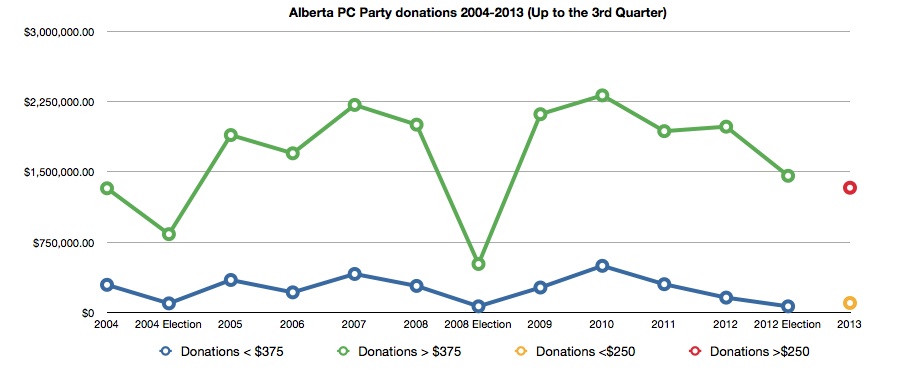
The PC Party has trailed the official opposition Wildrose Party in donations in the first three quarters of 2013. Most significantly, the four decade long governing PC Party significantly trails the Wildrose in individual donations by more than $780,000 so far in 2013.

Although Premier Alison Redford is expected to successfully face her mandated leadership review at next weekend’s PC Party convention in Red Deer, she still must account for her party’s dipping financial fortunes. At the end of 2012, the PC Party reported a $594,951 deficit in their  Elections Alberta financial disclosure. To understand how much the PC Party’s financial health has changed, it reported a $2,889,972 surplus in 2004.

While the PC Party may be feeling a financial crunch, some of that party’s constituency associations continue to raise considerable amounts of funds. In the 2012 election, more than a few PC candidate campaigns raised more than $100,000 at the constituency level.

After Danielle Smith became leader of the Wildrose Party in 2010, that party has seen a significant rise in financial support, especially in the form of smaller individual donations cultivated from an engaged base of supporters. The Wildrose Party continues rival the PC Party in revenue in 2013, something no political party has done in Alberta in decades.

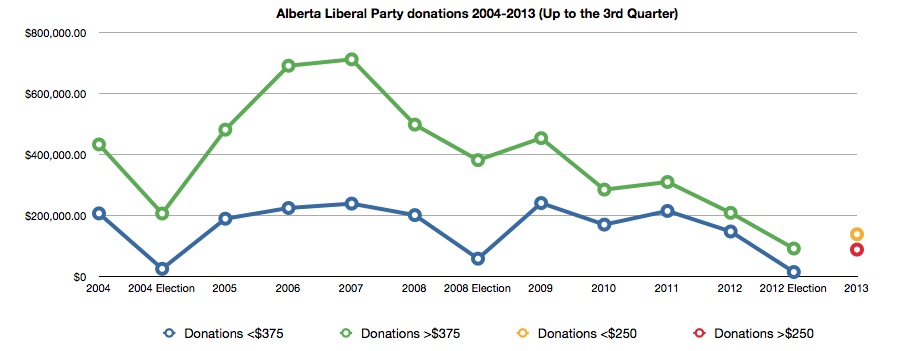
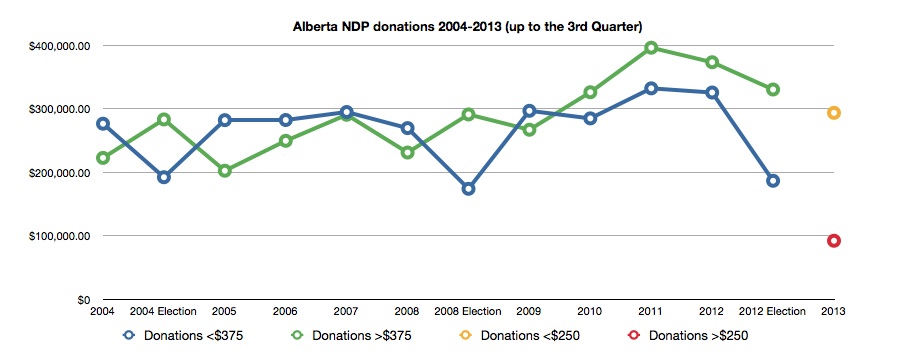
Below are charts showing the donations to Alberta’s four main political parties since 2004. Before recent legislative changes, donations were reported to Elections Alberta above and below $375. They are now reported below and above $250. Maximum donations during annual periods are limited to $15,000 and $30,000 during election periods.

Alberta Progressive Conservative donations 2004-2013
Alberta Progressive Conservative donations from 2004 to the third quarter of 2013.
Wildrose Party donations 2004-2013
Wildrose Party donations from 2004 to the third quarter of 2013. Includes the Alberta Alliance and Wildrose Alliance.

The drop in donations to the Liberal Party appears to coincide with the rise of the Wildrose Party and the departure of Kevin Taft as party leader following the 2008 election. The Liberals have succeeded in paying off a large amount of debt incurred in previous elections, but have most recently struggled to fund party operations after only raising $50,539 in the third quarter of 2013.

The New Democrats continue to enjoy a healthy base of individual donors and a relatively healthy flow of larger donations, though the NDP continues to hold a significant debt and reported $707,524 in total liabilities in 2012.

Alberta Liberal Party Donations 2004-2013
Alberta Liberal Party donations from 2004 to the third quarter of 2013
Alberta NDP donations 2004-2013
Alberta NDP donations from 2004 to the third quarter of 2013
Categories
Alberta Politics

A by-election in Cowboy Country. Conservatives line up in Macleod

Macelod Conservative by-election candidates
Four candidates have stepped forward to contest the Conservative Party nomination in Macleod. AMC’s ‘Hell on Wheels’ is filmed in the Macleod riding south of Calgary.

Four candidates have stepped forward to duel for the yet to be scheduled Conservative Party nomination in southern Alberta’s Macleod riding following the resignation of Member of Parliament Ted Menzies. A by-election is expected to be held in the eastern slopes of Alberta’s cowboy country the next six months.

John Barlow Macleod Conservative
John Barlow

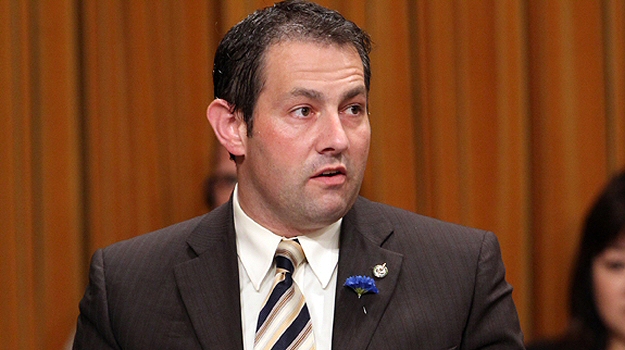
John Barlow, the associate editor of the Okotoks Western Wheel newspaper announced his entry into nomination race this week. In the 2012 provincial election, as the Progressive Conservative candidate in the Highwood constituency, Mr. Barlow placed  a surprisingly strong second behind  Wildrose Party leader Danielle Smith.

Fourth generation rancher and farmer Phil Rowland is also contesting the nomination. Mr. Rowland is the past president of the Western Stock Growers Association and serves on numerous provincial and agriculture boards. He also served as a board member for the Highwood PC Association during George Groeneveld‘s time as MLA.

Melissa Mathison Macleod Conservative
Melissa Mathison

Former Parliament Hill staffer Melissa Mathieson has also entered the race. She currently works as a research associate for the School of Public Policy at the University of Calgary and, according to her LinkedIn profile, she graduated from the U of C in 2011 with a bachelor of political science and has since worked as an intern and staffer for Mr. Menzies and in the Office of the Prime Minister in Ottawa.

Businessman Scott Wagner has been campaigning door-to-door since Mr. Menzies announced months ago that he would not seek re-election.

Update: Rick Wiljamma is also seeking the Conservative nomination in Macleod.

No candidates have stepped forward to become candidates for other political parties.

Last year’s Calgary-Centre by-election exposed significant splits in the conservative movement in Alberta. With some moderate conservatives believing Conservative nominee Joan Crockatt was too closely associated with the Wildrose Party, many formerly reliable Conservative voters choose to park their votes with Liberal Party candidate Harvey Locke.

A similar split is difficult to imagine in Macleod, but not impossible.

Voters in this region of Alberta last elected a non-conservative Member of Parliament in 1968, when Trudeaumania swept Liberal Allen Sulatycky into office as the MP for sprawling Rocky Mountain riding (the election was contested by two PC candidates, who, not unexpectedly, split the vote). Mr. Sulatycky served as a parliamentary assistant for four years until he was defeated in the 1972 election by future Prime Minister Joe Clark.

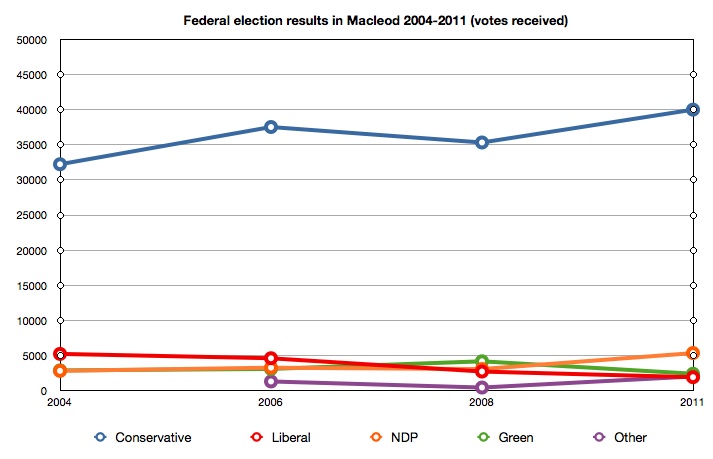
Voters in this riding have since reliably elected PC, Reform, Canadian Alliance, and Conservative MPs. Mr. Menzies earned 40,007 votes in the 2011 federal election, eclipsing his second-place New Democrat opponent, who earned 5,335 votes, and third place Green Party candidate, who earned 2,389 votes. The Liberal candidate placed a distant fourth with 1,898 votes.

Macleod Voting results 2004-2011
Voting results in the Macleod riding from the past four federal elections (2004-2011).

But the riding’s history as a Conservative strong-hold over the past four decades does not mean Macleod voters do hold not grievances or should be taken for granted.

Some areas of the riding, especially High River, suffered significant damage caused by this year’s floods and some residents have accused the RCMP of overstepping their bounds by removing privately-owned firearms from residences that had been evacuated during the flood.

The federal riding also overlaps provincial constituencies represented by Wildrose MLAs Ms. Smith, Pat Stier, Ian Donovan, Jason Hale, Gary Bikman and PC MLA Ron Casey. All of these constituencies were hotly contested battle grounds in the 2012 provincial election when significant numbers of long-time PC voters shifted their support to the Wildrose Party.

Under almost every normal circumstance this by-election should be an easy win for the nominated Conservative candidate. But as previous by-elections have demonstrated, the hyper-local focus on issues in an isolated by-election can sometimes produce unexpected results.

———

An update to a recent post about federal party nominations in Alberta: educator Janis Irwin has announced her intention to seek the NDP nomination in the new Edmonton-Griesbach riding.

Categories
Alberta Politics

James Andre resigns as trustee but Rob Ford is still the Mayor of Toronto

Rob Ford Toronto Canada
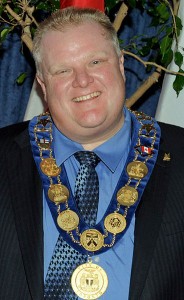
Rob Ford

James Andre submitted his resignation as a trustee for the Battle River School Division following controversy over racist and homophobic jokes he re-tweeted on Twitter. The offensive retweets on his now defunct twitter account were in such bad taste that there were significant questions raised about whether he was competent to serve as an elected official in Alberta.

The east central rural region that Mr. Andre briefly represented as a trustee is an unquestionably conservative area of the province in terms of voting patterns both federally and provincially. But the reaction to his behaviour demonstrates that even in stereotypical “redneck Alberta,” it is unacceptable for public officials to promote these types of racist and homophobic “jokes.” And for those who think that this type of behaviour only exists in the Alberta’s deep rural regions, think again.

In the sprawling metropolis of Toronto, Rob Ford remains firmly planted in his job after six months of controversy surrounding the existence of a video that allegedly shows the mayor smoking crack cocaine and making racist and homophobic remarks. This month, Toronto’s police chief confirmed the existence of a video that was “consistent” with media reports, which led Mr. Ford to admit to smoking crack cocaine in a drunken stupor about a year ago.

Mr. Ford still enjoys the support of 44% of Torontonians, according to a recent poll by Forum Research.