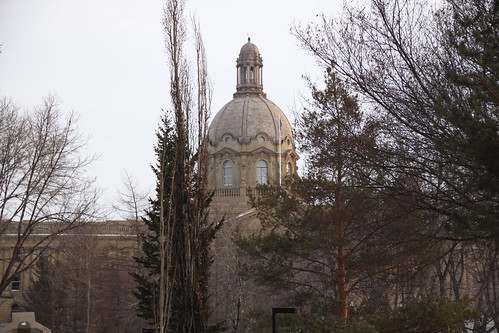
Alberta's Legislative Assembly Building in Edmonton.
The 2010 Spring session of the Alberta Legislature wrapped up yesterday with little fanfare. Ending a month and a half earlier than the increasingly pointless Legislative calendar had scheduled, Premier Ed Stelmach‘s PCs seemed happy to cut short one of their roughest sessions in decades. Here are some thoughts on how each of the parties fared during the 2010 Spring session:
Progressive Conservatives
Entering their 39th year in office, the Progressive Conservatives caucus appeared to list from left to right and back again during this session. The massive cuts expected in the 2010 budget never emerged (and the cuts that did take place were largely overshadowed by funding to health care and education). Their flagship bill, the Competitiveness Act, is already becoming largely forgotten in the minds of most political watchers and did not have the public splash impact that was likely intended.
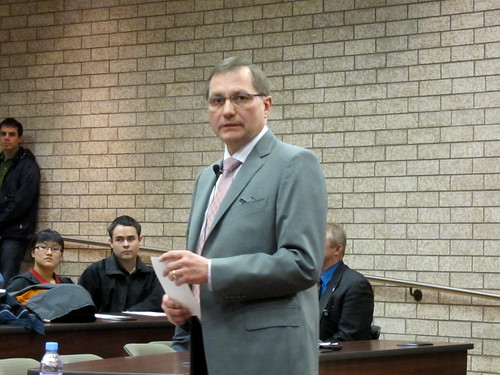
Premier Ed Stelmach speaking to students and staff at the University of Alberta.
Their political machinery is still well-financed, but the PC Party leadership appears disconnected from mainstream Albertans. Premier Stelmach’s weak public speaking skills were crutched by some of the cabinet ministers who were shuffled into new positions in February and have made an impact this Spring. Most notably, Health Minister Gene Zwozdesky, Labour Minister Thomas Lukaszuk, Finance Minister Ted Morton, Housing Minister Jonathan Denis, and Solicitor General Municipal Affairs Minister Hector Goudreau have performed fairly well in their new roles. In the Health Care file, Minister Zwozdesky appears to have spent much of the past three months travelling the province attempting to extinguish the fires set by his predecessor (now -Energy Minister Ron Liepert). While his style has brought a much friendlier tone to his position, there are still remains unanswered questions around issues ranging from seniors’ pharmacare to the future of Alberta Hospital Edmonton.
Finance Minister Ted Morton delivered his first budget in March 2010.
As criticisms have increased from outside the Legislature, it appears that a few PC backbenchers are increasingly unwilling to read the puff-ball questions that they regularly line up for. Whitecourt-Ste. Anne MLA George VanderBurg, Lesser Slave Lake MLA Pearl Calahasen, and Grande Prairie-Wapiti MLA Wayne Drysdale have asked some pretty tough questions and have noticeably got under the skin of some cabinet ministers during Question Period.
Premier Stelmach and his cabinet ministers will undertake a province-wide tour over the summer to talk with Albertans (and try to win back the hearts and minds of PC supporters who have flocked to the Wildrose Alliance). The optimist in me hopes that the tour will actually be effective in reconnecting our elected government officials with Albertans.
Liberal leader David Swann and MLAs Bridget Pastoor, Laurie Blakeman, Kevin Taft, Hugh MacDonald, Kent Hehr, and Harry Chase.
Liberals
With the exception of Health critic Kevin Taft and Calgary International Airport-tunnel advocate Darshan Kang, the Official Opposition Liberals struggled to focus during this session. David Swann‘s rag-tag Liberal caucus gained some attention after releasing a new oil and gas policy, but have had a difficult time finding a role in the new and increasingly dominant political narrative being developed between the PCs and the Wildrose Alliance.
The very public departure of Calgary-Currie MLA Dave Taylor and his verbal lashing of Dr. Swann in the media seemed to be the most memorable moment for the Liberals during this session, though internally, they are probably better off without Mr. Taylor. The Liberals won a reprieve from negative attention when a motion by backbench PC MLA Verlyn Olson temporarily removed the independence of Public Accounts Committee chairman Hugh MacDonald. While I believe Dr. Swann’s performance actually improved after Mr. Taylor’s departure, similar to their federal counterparts, the provincial Liberals biggest weakness is their focus on daily tactics, rather than long-term strategy to form government.
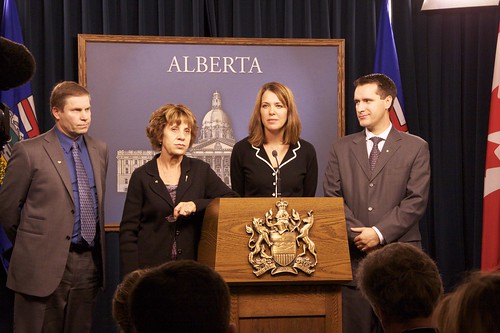
Danielle Smith with Wildrose Alliance MLAs Paul Hinman, Heather Forsyth, and Rob Anderson.
Wildrose Alliance
With the addition of former PC MLAs Rob Anderson and Heather Forsyth, the WRA caucus was boosted to third-party status for the first time. Ms. Forsyth’s Mandatory Reporting of Child Pornography bill was passed on third reading (I cannot remember any time that an opposition MLAs private members bill was passed into legislation). The Wildrose Alliance was faced with the challenge of not becoming the NDP of the right and have been strategic in what issues they chose to focus on (ie: opposing the centralization of regional health authorities into Alberta Health Services).
With three MLAs in the Assembly, seatless leader Danielle Smith has spent the majority of her time during this session criss-crossing the province, speaking to town hall meetings, trade shows, chambers of commerce, and anyone interested in meeting with the newly anointed Dauphine of Alberta politics (a very smart decision in my mind).
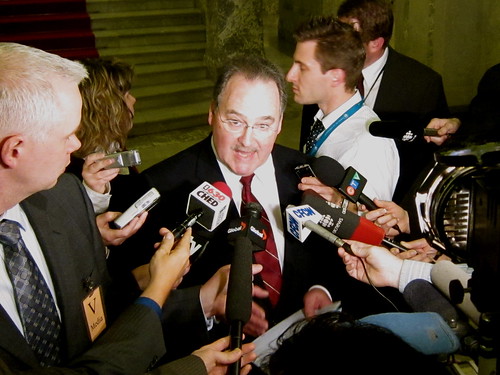
NDP MLA Brian Mason in a media scrum at the Alberta Legislature.
New Democrats
The NDP caucus of Brian Mason and Rachel Notley did what they do well this session: get media attention. Rather than striking out on their own when their position in the Question Period line-up was in jeopardy, they joined with the Liberals and Wildrose Alliance at the press gallery podium to present a united front against this change. On the policy front, the NDP released a report on Health Care that was generated after a series of town hall meetings.
Outside the Legislature, the NDP appear to be stalled in the polls and have not been able to capitalize on the destabilization inside the Liberal Party. At their 2009 convention, Nova Scotia NDP organizer Matt Hebbadvised his Alberta cousins to build a bigger tent of supporters and to act like a party of government by taking a pragmatic and constructive approach to politics. “Act like a party of government, don’t talk about it,” was Mr. Hebb’s message. Judging by the daily outrage and ankle bitting during Question Period, it does not appear that the two MLAs have heeded Mr. Hebb’s advice.
Independent MLAs now include Guy Boutilier and Dave Taylor.
Independents
Independent MLAs Guy Boutilier and Dave Taylor now share the lonely northwest corner of the Assembly floor. It was suspected that Mr. Boutilier might join the Wildrose Alliance caucus (his 2008 campaign manager has joined the WRA), but he may be too much of a wildcard for a party that is riding high in the polls and posturing to form the next government. More recently, there have been rumors floating that Mr. Taylor would like to acquire the leadership of the newly reorganized Alberta Party and reshape it into his own image (knowing the people involved in the Alberta Party, this might not be a welcoming prospect).
Floor-crossings
Since the 2008 election, five of 83 MLAs have forced the changing of seating arrangements on the Assembly floor. There has not been this much movement across the Assembly floor between elections since the early 1990s, which saw some significant Liberal by-election victories, a New Democrat cross to the PCs, a PC leave to sit as an Independent, and a handful of right-leaning Liberals cross to the PCs. It is also the first time since 1989 that an opposition party other than the Liberals or NDP have had more than one MLA in the Assembly (the Representative Party elected two former Social Credit MLAs in 1986).
Press Gallery
This was the final session for long-time Canadian Press reporter Jim MacDonald, who will be retiring from his role in May. After 27 years working for Canadian Press, Mr. MacDonald has become an institution in the Press Gallery. During my time as a spokesperson for the Council of Alberta University Students from 2006 to 2007, Mr. MacDonald was always the most nerve-racking reporter in a media scrum – always asking the toughest questions and not taking spin for an answer. He will be missed.
On a final note, I feel the need to recognize Calgary Herald columnist Don Braid, who is normally a very good columnist, but during this spring session has written some excellent columns about politics in Alberta.
Don Braid has published an excellent column in today’s Calgary Herald on the decision by Wetaskiwin-Camrose MLA Verlyn Olson and six other PC MLAs to vote in favor of weakening the power of the Public Accounts Committee to be a financial watchdog.
As I wrotelast week, the powers of the committee were curtailed when PC MLAs voted to create a new rule forcing Committee Chairman MLA Hugh MacDonald to have all future committee correspondence approved by Deputy Chair PC MLA Dave Rodney. When the issue was raised by opposition MLAs in Question Period, Premier Ed Stelmach, Education Minister Dave Hancock, and Deputy Premier Doug Horner have scoffed at the complaints, citing how powerless they are when it comes to influencing their backbench MLAs.
This afternoon, Liberal leader David Swann delivered a private members’ statement questioning changes that would dilute the power of the Public Accounts Committee, which acts as an important watchdog on public expenditures.
As I wrote yesterday, a motion introduced by Wetaskiwin-Camrose MLA Verlyn Olson now requires that “all future correspondence on behalf of the public accounts committee (must) be signed by both the chair and deputy chair.” The Deputy Chair is currently Calgary-Lougheed PC MLA Dave Rodney. The opposition MLAs called for an emergency debate on the issue, but were declined by Speaker Ken Kowalski.
I find it difficult to believe that Mr. Olson is a key player in a shady conspiracy to destroy democracy, but I do believe that a lack of leadership from his party’s leader has led to these kind of decisions being made.
As demonstrated by this Question Period exchange between Dr. Swann and Premier Ed Stelmach, it appears as though the Premier is unaware or has chosen to ignore the detrimental effects this motion could have on the Public Accounts Committee. I also believe that the biggest weakness of the Liberal opposition in the Assembly is their focus on daily tactics, rather than long-term strategy (calling Premier Stelmach a banana republic autocrat is not helpful).
It has been suggested that the Mr. Olsen and other PC MLAs on the committee were not pleased with Edmonton-Gold Bar MLA Hugh MacDonald‘s performance as Chairman. If this is the case, this is not a reason to weaken the authority of the committee which is charged with reviewing reports of the Auditor General of Alberta and the public accounts of the province, but a reason to replace the Chairman. There are other opposition MLAs on this committee would could fulfill this role.
Forcing the Chairman of the committee to seek approval from a Government MLA before sending correspondence, scheduling meetings, or requesting the attendence of government officials to answer questions about public accounts only serves to dilute the fiscal accountability of our government.
As noted in my previous post, I have contacted Mr. Olson’s office to seek an explanation as to why he introduced this motion, but I have yet to receive a response.
According to its mandate, Alberta’s Standing Committee on Public Accounts is an all-party committee consisting of 17 Members of the Legislative Assembly that reviews the annual report of the Auditor General of Alberta and the public accounts of the province. It is tradition across Canada that an opposition MLA occupy the Chairmanship of this committee.
Via to Capital Notebook, Edmonton-Gold Bar Liberal MLA Hugh MacDonald is crying foul after his powers as Chairman were severely limited by a recent motion by Wetaskiwin-Camrose PC MLA Verlyn Olsen to require that “all future correspondence on behalf of the public accounts committee (must) be signed by both the chair and deputy chair.” The Deputy Chair is currently Calgary-Lougheed PC MLA Dave Rodney.
…before MacDonald can send out e-mails, make plans for future meetings, and demand government bodies make an appearance before the all-party committee, Calgary-Lougheed Tory Dave Rodney (the deputy chair) must give him the nod.
It’s an unusual practice, since it doesn’t happen in any other legislative committee, all of which are dominated by government Conservatives. Olson’s motion this morning was backed by all present government members and opposed by NDP Leader Brian Mason and Calgary-Varsity Liberal Harry Chase. (MacDonald, as the chairman, can’t actually vote.)
This is not the first time that the already limited power Alberta’s Public Accounts Committee has been harshly criticized. Here is an exert from MLA Kevin Taft‘s 2007 book Democracy Derailed which describes how much that committee’s oversight power had been limited:
Alberta’s Public Accounts Committee can meet once a week only when the legislature is sitting, which is all of three months per year. During approximately a dozen 90-minute meetings, the committee must review the spending of 24 provincial government departments with a combined budget of $24 billion.
That’s not all. Unlike the federal Public Accounts Committee, Alberta’s Public Accounts Committee cannot submit a report to the legislature. Legislators outside of Alberta find this restriction hard to fathom. Conservative Member of Parliament John Williams said “It’s shocking. I cannot believe a government majority would use their capacity to set the rules like that.”
It is unclear what prompted Mr. Olson to introduce this motion or why the PC MLAs on the committee supported it. I have contacted Mr. Olson’s office for an explanation and if I receive a response, I will post it here. I try to stay away from conspiracy theories, but with MLAs expected to start their summer break tomorrow (yes, in April) and the introduction of the distracted driver legislation taking the headlines, it feels like this motion was designed to be lost in the shuffle.