The DRP believe that a “united alternative” to the governing PCs should take place not in the formation of a new united party but through a “non-competition agreement” between the already existing Liberal Party and NDP. The letter suggests that Mr. Eggen should seek election in the new Edmonton-Northwest constituency to avoid splitting the vote in the formerly Liberal-held Glenora constituency (under the new boundaries, Calder will be dissolved, leaving Mr. Eggen’s home in the new Glenora).
The DRPs argument in Glenora is that a strong NDP candidate will split the vote with the Liberals and allow PC MLA Heather Klimchuk to be re-elected. There is little evidence to support this argument in Glenora, as in 2004 Liberal Bruce Miller was elected with 4,604 votes over second place New Democrat Larry Booi who earned 4,052 votes. With a low profile NDP candidate placing a distant third in 2008, Mr. Miller should have been re-elected with a 2,600 vote margin according to DRP logic. Instead, Mr. Booi’s votes from 2004 did not go to Mr. Miller and he was defeated by 130 votes.
Despite the hard work of their dedicated supporters, neither the Liberals or the NDP have proven that their parties have the ability to connect with Albertans outside of their already supportive urban enclaves. Perhaps the problem is not the competition for votes between the already existing parties, but that neither of the two parties are seen as viable alternatives to the governing PCs?
With declining voter turnout and a growing disconnect between citizens and the democratic process the solution should be to provide more opportunities for meaningful engagement. Decreasing choice of candidates is not a smart solution and neither is limiting the opportunity for already engaged citizens to participate in the democratic system by running as candidates in their communities.
David Eggen should run in Edmonton-Glenora because he is an engaged citizen and a good candidate. Voters in that constituency are smart enough to decide who their representative will be.
(I have already written two posts on battleground Glenora here and here.)
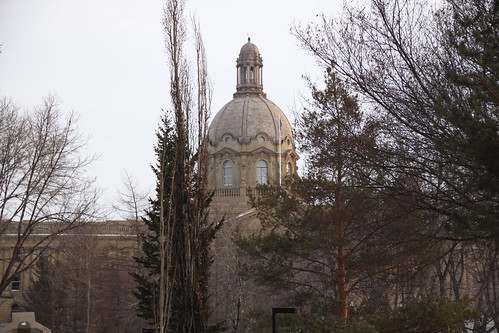
Alberta's Legislative Assembly Building in Edmonton.
The 2010 Spring session of the Alberta Legislature wrapped up yesterday with little fanfare. Ending a month and a half earlier than the increasingly pointless Legislative calendar had scheduled, Premier Ed Stelmach‘s PCs seemed happy to cut short one of their roughest sessions in decades. Here are some thoughts on how each of the parties fared during the 2010 Spring session:
Progressive Conservatives
Entering their 39th year in office, the Progressive Conservatives caucus appeared to list from left to right and back again during this session. The massive cuts expected in the 2010 budget never emerged (and the cuts that did take place were largely overshadowed by funding to health care and education). Their flagship bill, the Competitiveness Act, is already becoming largely forgotten in the minds of most political watchers and did not have the public splash impact that was likely intended.
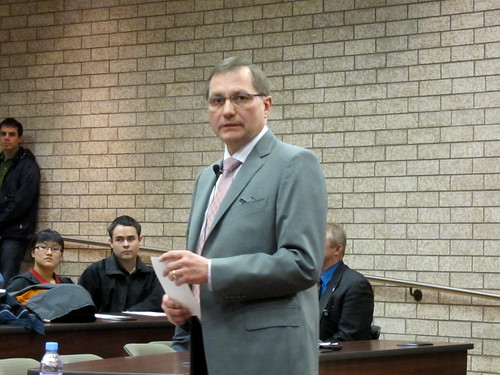
Premier Ed Stelmach speaking to students and staff at the University of Alberta.
Their political machinery is still well-financed, but the PC Party leadership appears disconnected from mainstream Albertans. Premier Stelmach’s weak public speaking skills were crutched by some of the cabinet ministers who were shuffled into new positions in February and have made an impact this Spring. Most notably, Health Minister Gene Zwozdesky, Labour Minister Thomas Lukaszuk, Finance Minister Ted Morton, Housing Minister Jonathan Denis, and Solicitor General Municipal Affairs Minister Hector Goudreau have performed fairly well in their new roles. In the Health Care file, Minister Zwozdesky appears to have spent much of the past three months travelling the province attempting to extinguish the fires set by his predecessor (now -Energy Minister Ron Liepert). While his style has brought a much friendlier tone to his position, there are still remains unanswered questions around issues ranging from seniors’ pharmacare to the future of Alberta Hospital Edmonton.
Finance Minister Ted Morton delivered his first budget in March 2010.
As criticisms have increased from outside the Legislature, it appears that a few PC backbenchers are increasingly unwilling to read the puff-ball questions that they regularly line up for. Whitecourt-Ste. Anne MLA George VanderBurg, Lesser Slave Lake MLA Pearl Calahasen, and Grande Prairie-Wapiti MLA Wayne Drysdale have asked some pretty tough questions and have noticeably got under the skin of some cabinet ministers during Question Period.
Premier Stelmach and his cabinet ministers will undertake a province-wide tour over the summer to talk with Albertans (and try to win back the hearts and minds of PC supporters who have flocked to the Wildrose Alliance). The optimist in me hopes that the tour will actually be effective in reconnecting our elected government officials with Albertans.
Liberal leader David Swann and MLAs Bridget Pastoor, Laurie Blakeman, Kevin Taft, Hugh MacDonald, Kent Hehr, and Harry Chase.
Liberals
With the exception of Health critic Kevin Taft and Calgary International Airport-tunnel advocate Darshan Kang, the Official Opposition Liberals struggled to focus during this session. David Swann‘s rag-tag Liberal caucus gained some attention after releasing a new oil and gas policy, but have had a difficult time finding a role in the new and increasingly dominant political narrative being developed between the PCs and the Wildrose Alliance.
The very public departure of Calgary-Currie MLA Dave Taylor and his verbal lashing of Dr. Swann in the media seemed to be the most memorable moment for the Liberals during this session, though internally, they are probably better off without Mr. Taylor. The Liberals won a reprieve from negative attention when a motion by backbench PC MLA Verlyn Olson temporarily removed the independence of Public Accounts Committee chairman Hugh MacDonald. While I believe Dr. Swann’s performance actually improved after Mr. Taylor’s departure, similar to their federal counterparts, the provincial Liberals biggest weakness is their focus on daily tactics, rather than long-term strategy to form government.
Danielle Smith with Wildrose Alliance MLAs Paul Hinman, Heather Forsyth, and Rob Anderson.
Wildrose Alliance
With the addition of former PC MLAs Rob Anderson and Heather Forsyth, the WRA caucus was boosted to third-party status for the first time. Ms. Forsyth’s Mandatory Reporting of Child Pornography bill was passed on third reading (I cannot remember any time that an opposition MLAs private members bill was passed into legislation). The Wildrose Alliance was faced with the challenge of not becoming the NDP of the right and have been strategic in what issues they chose to focus on (ie: opposing the centralization of regional health authorities into Alberta Health Services).
With three MLAs in the Assembly, seatless leader Danielle Smith has spent the majority of her time during this session criss-crossing the province, speaking to town hall meetings, trade shows, chambers of commerce, and anyone interested in meeting with the newly anointed Dauphine of Alberta politics (a very smart decision in my mind).
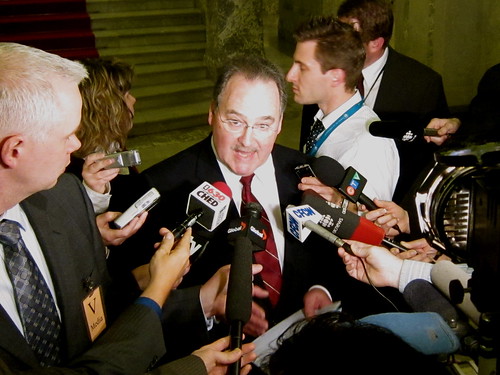
NDP MLA Brian Mason in a media scrum at the Alberta Legislature.
New Democrats
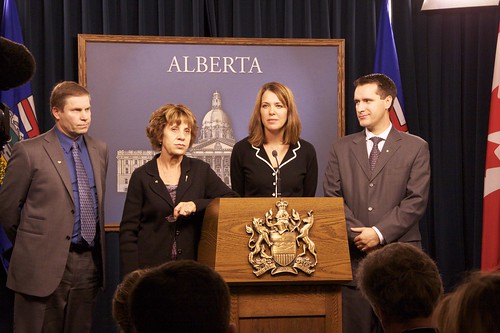
The NDP caucus of Brian Mason and Rachel Notley did what they do well this session: get media attention. Rather than striking out on their own when their position in the Question Period line-up was in jeopardy, they joined with the Liberals and Wildrose Alliance at the press gallery podium to present a united front against this change. On the policy front, the NDP released a report on Health Care that was generated after a series of town hall meetings.
Outside the Legislature, the NDP appear to be stalled in the polls and have not been able to capitalize on the destabilization inside the Liberal Party. At their 2009 convention, Nova Scotia NDP organizer Matt Hebbadvised his Alberta cousins to build a bigger tent of supporters and to act like a party of government by taking a pragmatic and constructive approach to politics. “Act like a party of government, don’t talk about it,” was Mr. Hebb’s message. Judging by the daily outrage and ankle bitting during Question Period, it does not appear that the two MLAs have heeded Mr. Hebb’s advice.
Independent MLAs now include Guy Boutilier and Dave Taylor.
Independents
Independent MLAs Guy Boutilier and Dave Taylor now share the lonely northwest corner of the Assembly floor. It was suspected that Mr. Boutilier might join the Wildrose Alliance caucus (his 2008 campaign manager has joined the WRA), but he may be too much of a wildcard for a party that is riding high in the polls and posturing to form the next government. More recently, there have been rumors floating that Mr. Taylor would like to acquire the leadership of the newly reorganized Alberta Party and reshape it into his own image (knowing the people involved in the Alberta Party, this might not be a welcoming prospect).
Floor-crossings
Since the 2008 election, five of 83 MLAs have forced the changing of seating arrangements on the Assembly floor. There has not been this much movement across the Assembly floor between elections since the early 1990s, which saw some significant Liberal by-election victories, a New Democrat cross to the PCs, a PC leave to sit as an Independent, and a handful of right-leaning Liberals cross to the PCs. It is also the first time since 1989 that an opposition party other than the Liberals or NDP have had more than one MLA in the Assembly (the Representative Party elected two former Social Credit MLAs in 1986).
Press Gallery
This was the final session for long-time Canadian Press reporter Jim MacDonald, who will be retiring from his role in May. After 27 years working for Canadian Press, Mr. MacDonald has become an institution in the Press Gallery. During my time as a spokesperson for the Council of Alberta University Students from 2006 to 2007, Mr. MacDonald was always the most nerve-racking reporter in a media scrum – always asking the toughest questions and not taking spin for an answer. He will be missed.
On a final note, I feel the need to recognize Calgary Herald columnist Don Braid, who is normally a very good columnist, but during this spring session has written some excellent columns about politics in Alberta.
Don Braid has published an excellent column in today’s Calgary Herald on the decision by Wetaskiwin-Camrose MLA Verlyn Olson and six other PC MLAs to vote in favor of weakening the power of the Public Accounts Committee to be a financial watchdog.
As I wrotelast week, the powers of the committee were curtailed when PC MLAs voted to create a new rule forcing Committee Chairman MLA Hugh MacDonald to have all future committee correspondence approved by Deputy Chair PC MLA Dave Rodney. When the issue was raised by opposition MLAs in Question Period, Premier Ed Stelmach, Education Minister Dave Hancock, and Deputy Premier Doug Horner have scoffed at the complaints, citing how powerless they are when it comes to influencing their backbench MLAs.
One of the recommendations collected was a monstrous 100 page submission that is expected to be presented by Deputy Premier Doug Horner today. The submission is filled with individual recommendations around proposed boundaries, but it is the sources of this information that is the most interesting (and confusing).
The submission document opens with an introductory letter from the Office of the Minister of Advanced Education & Technology and describes the document as “a collection of the recommendations made by Government caucus…” Following Minister Horner’s letter, the document then clarifies that “the Government of Alberta is presenting its recommendations” in this submission. In an even more confusing twist, the document bases many of its recommendations directly from Progressive Conservative Party constituency associations submissions to the Commission.
The lines are very blurry when trying to figure out who the recommendations in this document represent. Was this submission prepared by taxpayer funded staff inside the Office of the Minister of Advanced Education & Technology, the Government Caucus, or the Government of Alberta, or the political staff inside the Progressive Conservative Party? Why would a Government of Alberta report include direct recommendations from Progressive Conservative Party constituency associations?
UPDATE: The Wildrose Alliance will be holding a media conference on this issue tomorrow at the Legislature (see comments for more information).
Like a high school yearbook, the internet is a treasure chest of snapshots from the past. Digging through the treasure chest, ‘then and now’ will be a regular series over the next few months showcasing Alberta politicians then and now. It is all in good spirit and will be an important reminder to Albertans of the errors of the 1980s and 1990s.
This week’s focus: Five-term Medicine Hat MLA Rob Renner.
Rob Renner sported a mighty moustache when he was re-elected to a second term as the PC MLA for Medicine Hat in 1997.Environment Minister Rob Renner circa 2009 (sans moustache).
If you have a photo of an elected official that you would like to see included in this series, send me an email at daveberta.ca@gmail.com.
– Bloc Quebecois leader Gilles Duceppe was in Alberta last week to gauge public opinion on … yawn… Quebec separatism in the rest of Canada. Last week… yawn… Premier Ed Stelmach launched an attack straight out of the 1990s against the amount of Alberta’s federal transfer payments go to Quebec.
– Graham Thomson wrote an excellent column this weekend on the PCs attempts to weaken the Public Accounts Committee and a bizarre statement from Assembly Speaker Ken Kowalski. It appears that neither Premier Stelmach or House Leader Dave Hancock will rein in the backbench PC MLAs who voted to dilute the power of this important watchdog committee.
– They may have not been the only person thinking it, but they were the only one to say it. Someone at last week’s PC fundraising dinner in Calgary asked Premier Stelmach “When are you resigning?”
– The next few months will be filled with political conventions: the PC Party Policy Convention from April 30 to May 1 at the Mayfield Inn in Edmonton, the Liberal Party of Canada in Alberta on April 30 to May 2 in Lethbridge, the Alberta Liberal Party on May 15 to 16 in Edmonton, and the Wildrose Alliance AGM from June 25 to 26 in Red Deer.
– The race to replace five-term Conservative MP Rick Casson in Lethbridge is heating up. I have counted four candidates vying for the nomination: Jim Hillyer (@JimHillyer), Henry Doeve, Ken Prestage, and Mark Switzer. Also on the federal scene, the NDP will nominate their candidate in Red Deer on April 24.
– Many people expected the Legislative Assembly to break for the summer last week, but it now it appears that it may actually sit until June 3rd as the 2010 Calendar suggests.
– The Standing Committee for Health has been deemed to be the special committee to conduct a comprehensive review of the Freedom of Information and Protection of Privacy Act.
– Alberta’s Electoral Boundaries Commission will be meeting Monday, April 19, and Tuesday, April 20 at the Mayfield Inn in northwest Edmonton. The Commission has also scheduled upcoming meetings in Peace River, Grande Prairie, Lethbridge, Brooks, Drumheller, and Stettler. If you have any issues with the maps proposed in the interim report, now is your last chance to let your voice he heard. Show up and let them know.
“rumours of my death are greatly exaggerated” – Dr. David Swann (borrowed from Mark Twain)
Trying to gauge how rough this last week was for the Liberal Party in Alberta, I attended last night’s Town Hall meeting hosted by the Edmonton-Glenora Liberal Association at Robertson-Wesley United Church (which is actually in Edmonton-Centre). It was a fairly typical political gathering, with most of the around 50 attendees in the +50 age range, but there were some interesting parts of the evening.
– The Liberals will roll out five new policy positions over the next six months focusing on health, economy, environment, and clean government.
– After the Reverend Miller’s narrow defeat to Tory Heather Klimchuk in the 2008 election, the Glenora Liberal Association went dormant. I am told that many of the constituency organizers who had been around since Howard Sapers was first elected in 1993 were burnt out and moved on. More recently, the constituency executive has been reborn and reorganized by a group of young professionals who have begun hosting meetings, fundraising, and growing the local membership.
– There was a lot of talk about vote-splitting and the announcement by former Edmonton-Calder MLA David Eggen that he will be seek the NDP nomination in the newly redrawn Glenora constituency. Supporters of the Democratic Renewal Project were present and spoke for the need for Liberals to work with the NDP so not to split the vote. Though there were some sympathetic ears in the room, the majority of the attendees appeared to oppose the idea (not surprising for a room full of partisans).
– Glenora is shaping up to be a battleground in the next election. Elections in Glenora have been fierce since 2001, with each election since then being decided by less than 500 votes. Dr. Swann told the crowd that it was a priority that the Liberals elect an MLA for Glenora in 2012 – “We must win Glenora back!”
This afternoon, Liberal leader David Swann delivered a private members’ statement questioning changes that would dilute the power of the Public Accounts Committee, which acts as an important watchdog on public expenditures.
As I wrote yesterday, a motion introduced by Wetaskiwin-Camrose MLA Verlyn Olson now requires that “all future correspondence on behalf of the public accounts committee (must) be signed by both the chair and deputy chair.” The Deputy Chair is currently Calgary-Lougheed PC MLA Dave Rodney. The opposition MLAs called for an emergency debate on the issue, but were declined by Speaker Ken Kowalski.
I find it difficult to believe that Mr. Olson is a key player in a shady conspiracy to destroy democracy, but I do believe that a lack of leadership from his party’s leader has led to these kind of decisions being made.
As demonstrated by this Question Period exchange between Dr. Swann and Premier Ed Stelmach, it appears as though the Premier is unaware or has chosen to ignore the detrimental effects this motion could have on the Public Accounts Committee. I also believe that the biggest weakness of the Liberal opposition in the Assembly is their focus on daily tactics, rather than long-term strategy (calling Premier Stelmach a banana republic autocrat is not helpful).
It has been suggested that the Mr. Olsen and other PC MLAs on the committee were not pleased with Edmonton-Gold Bar MLA Hugh MacDonald‘s performance as Chairman. If this is the case, this is not a reason to weaken the authority of the committee which is charged with reviewing reports of the Auditor General of Alberta and the public accounts of the province, but a reason to replace the Chairman. There are other opposition MLAs on this committee would could fulfill this role.
Forcing the Chairman of the committee to seek approval from a Government MLA before sending correspondence, scheduling meetings, or requesting the attendence of government officials to answer questions about public accounts only serves to dilute the fiscal accountability of our government.
As noted in my previous post, I have contacted Mr. Olson’s office to seek an explanation as to why he introduced this motion, but I have yet to receive a response.
According to its mandate, Alberta’s Standing Committee on Public Accounts is an all-party committee consisting of 17 Members of the Legislative Assembly that reviews the annual report of the Auditor General of Alberta and the public accounts of the province. It is tradition across Canada that an opposition MLA occupy the Chairmanship of this committee.
Via to Capital Notebook, Edmonton-Gold Bar Liberal MLA Hugh MacDonald is crying foul after his powers as Chairman were severely limited by a recent motion by Wetaskiwin-Camrose PC MLA Verlyn Olsen to require that “all future correspondence on behalf of the public accounts committee (must) be signed by both the chair and deputy chair.” The Deputy Chair is currently Calgary-Lougheed PC MLA Dave Rodney.
…before MacDonald can send out e-mails, make plans for future meetings, and demand government bodies make an appearance before the all-party committee, Calgary-Lougheed Tory Dave Rodney (the deputy chair) must give him the nod.
It’s an unusual practice, since it doesn’t happen in any other legislative committee, all of which are dominated by government Conservatives. Olson’s motion this morning was backed by all present government members and opposed by NDP Leader Brian Mason and Calgary-Varsity Liberal Harry Chase. (MacDonald, as the chairman, can’t actually vote.)
This is not the first time that the already limited power Alberta’s Public Accounts Committee has been harshly criticized. Here is an exert from MLA Kevin Taft‘s 2007 book Democracy Derailed which describes how much that committee’s oversight power had been limited:
Alberta’s Public Accounts Committee can meet once a week only when the legislature is sitting, which is all of three months per year. During approximately a dozen 90-minute meetings, the committee must review the spending of 24 provincial government departments with a combined budget of $24 billion.
That’s not all. Unlike the federal Public Accounts Committee, Alberta’s Public Accounts Committee cannot submit a report to the legislature. Legislators outside of Alberta find this restriction hard to fathom. Conservative Member of Parliament John Williams said “It’s shocking. I cannot believe a government majority would use their capacity to set the rules like that.”
It is unclear what prompted Mr. Olson to introduce this motion or why the PC MLAs on the committee supported it. I have contacted Mr. Olson’s office for an explanation and if I receive a response, I will post it here. I try to stay away from conspiracy theories, but with MLAs expected to start their summer break tomorrow (yes, in April) and the introduction of the distracted driver legislation taking the headlines, it feels like this motion was designed to be lost in the shuffle.
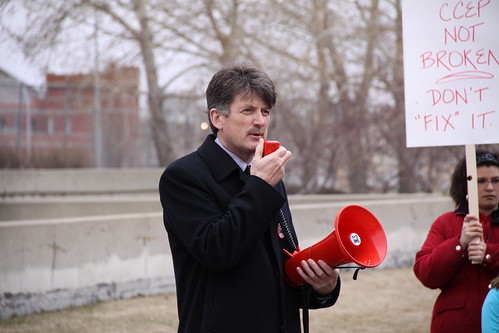
Edmonton-Gold Bar MLA Hugh MacDonald speaks at the demonstration before the meeting.
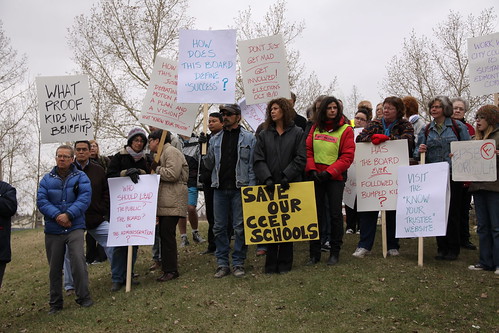
The meeting was preceded with a demonstration where over 200 parents and students rallied against the closures and welcomed community leaders, including MLAs Hugh MacDonald and Brian Mason, to speak to the crowd. After the demonstration, the crowd poured into the meeting hall (and thanks to the Edmonton Journal the meeting was live-streamed online so that people across the City could watch).
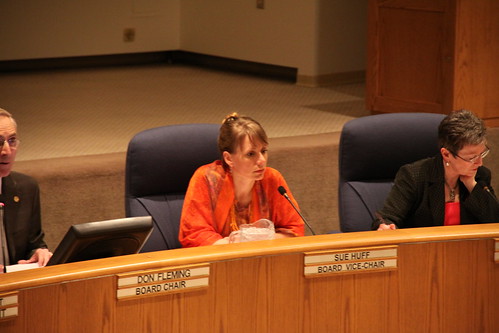
As the meeting began, it was clear that it would be a very tense evening. At one point during the meeting, as Trustee Sue Huff called out fellow Trustee Ken Shipka for not speaking to the motion to close one of the schools (Mr. Shipka would only say that he was voting for the closure), Board Chair Don Fleming snapped at Huff “RELAX!” It was an out of line comment from Trustee Fleming and only increased the thick intensity in the room.
Trustee Sue Huff defended the importance of schools in inner city communities.
I shared some thoughts on the inner city school closures a couple of weeks ago and I continue to believe that many of the challenges facing inner city schools have been caused by the lack of smart urban planning in Edmonton. As Edmonton continues to sprawl and spawn new neighborhoods in each direction, it has become increasingly difficult for the school board to plan the future of its schools. This is an issue of urban planning and coordination between City Councillors and School Board Trustees that needs to be addressed. Both Councillors and Trustees are doing Edmontonians a disservice when they do not work together.
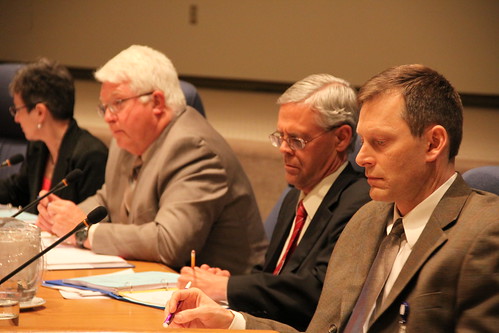
Trustees George Rice, Gerry Gibeault, and Ken Shipka listen to citizens speak against the school closures.
I also feel that the Public School Trustees could be more creative with how they use the space available in these undercapacity schools. Could renting out unused space to non-profit, community, or public health groups help cover the costs of keeping these schools operating at such low capacities? Maybe this would not save every school from closure, but it might allow consolidation of two into one. I got the district feeling at last night’s meeting that most Trustees may had not considered these kind of ideas. It is my observation that there are only three Trustees who have been willing to look out of the box since the last election (Trustees Huff, Dave Colburn, and Catherine Ripley have caught my attention).
Over 200 concerned parents and students packed the School Board meeting.
Last night the meeting room was packed with over 200 engaged and irritated citizens. Hopefully they will continue to stay engaged and challenge incumbent Trustees who continue to think inside the box when it comes to options for under-capacity schools. A growing number of these citizens have helped form groups like ARTES and understand that the election is only six months away.
The new Edmonton-Glenora under the proposed electoral boundaries.
Former MLA David Eggen has declared his intention to seek the NDP nomination in Edmonton-Glenora for the next provincial election. Mr. Eggen was first elected as the MLA for Edmonton-Calder in 2004 and served as the NDPs environment critic. In 2008, he was narrowly defeated in a close race with PC candidate Doug Elniski. Since then, he has served as Executive Director of the Friends of Medicare.
Mr. Eggen will likely face off with Service Alberta Minister Heather Klimchuk (if she seeks re-election). Minister Klimchuk was elected in 2008 when she defeated Liberal MLA Reverend Bruce Miller in a hotly contested race. The Liberals have yet to announce their Glenora candidate, but have elected MLAs in the riding from 1993 to 2001 and 2004 to 2008.
Since 2001, each election in Glenora and Calder has been decided by less than 500 votes. Here are the combined results for the new Glenora boundaries from the past two provincial elections (see the picture above for the new boundaries with the poll-by-poll results from 2008):
In 2008, the vote turnout in the two constituencies were 40% in Calder and 42% in Glenora. Both the Liberals and PCs have held solid bases of support in Glenora for decades and the NDP had been less of a factor until the two recent elections.
In 2004, the NDP focused their resources behind Mr. Eggen in Calder and former Alberta Teachers’ Association President Larry Booi in Glenora. While Mr. Eggen was elected in a close race with PC MLA Brent Rathgeber, Mr. Booi placed second in a tight three-way race between PC MLA Drew Hutton and Reverend Miller. In 2008, the NDP focused less resources on Glenora in 2008 and fell to third place.
With a strong candidate like Mr. Eggen and two years to campaign before the next election, the NDP could be back in contention for this riding in the next election. In a province-wide election that could be dominated by the PCs and Wildrose Alliance, this riding could be only one of the handful that the NDP are seriously in competition for.
With Liberal MLAs standing behind him, David Swann speaks with the media about Dave Taylor's resignation.
This morning I attended Liberal leader David Swann‘s media conference in response to Calgary-Currie MLA Dave Taylor‘s resignation from the Liberal caucus. Backed up by six of his seven remaining caucus-mates (Calgary-McCall MLA Darshan Kang is in India), the Leader of the Official Opposition put on a brave face. This may have been his toughest media conference since becoming leader in December 2008, but I believe that this may have been the strongest performance that I have seen from Dr. Swann. He had a clear message and showed emotion in defending his leadership from the criticisms raised by Mr. Taylor.
At around the same time in Calgary, Mr. Taylor released a statement to the media explaining his reasons for leaving the Liberals. Among his reasons were some fair comments about the state of the Liberal Party in Alberta. Between 2006 and 2008, it looked like the Liberals were gaining new ground on the nearly forty year ruling Progressive Conservatives. The election of Craig Cheffins in the Calgary-Elbow by-election replacing retired Premier Ralph Klein showed that there could be potential for the Liberals to expand in Calgary, while holding their base in Edmonton. In 2008, the major gains never materialized in Calgary and the Liberals lost ground in Edmonton. Mr. Taylor thought he could turn his party’s fortunes around, but was unable to attract the support needed to win the Liberal leadership in 2008. After his defeat in to Dr. Swann, it became well-known in political circles that Mr. Taylor was not satisfied in playing second fiddle to the Leader of the Official Opposition.
The Liberals continue to have difficulty gaining traction on issues raised in the Legislature and appear completely irrelevant in the political narratives that have evolved around the PCs and the Danielle Smith-led Wildrose Alliance.
No matter how you put it, this resignation is a major blow to Dr. Swann’s leadership and to the Liberal Party. The loss of Mr. Taylor leaves the Liberals with only 8 MLAs and without the public persona that Mr. Taylor perfected during his many years as a radio host on QR77.
Dr. Swann faces a tough and perhaps impossible challenge: as Alberta’s political sands continue to shift, he needs to prove to the Liberal Party membership and his fellow MLAs that he can grow his party’s political support and create a strong presence that can compete with the insurgent Wildrose Alliance in the next election, otherwise his leadership face more serious internal dissent.
Today’s news that Calgary-Currie MLA Dave Taylor is leaving the Liberal caucus is big news for political watchers, but it is far from the first time that an MLA has left the Alberta Liberal Caucus. Due to many circumstances, ten MLAs have departed the Liberal Caucus before their term has ended over the past 16 years.
2006: One-term Edmonton-Manning MLA Dan Backs was expelled from the Liberal caucus by party leader Kevin Taft due to “ongoing friction” between the MLA and his colleagues. Mr. Back sat an an Independent MLA. After unsuccessfully seeking the PC nomination in 2008, Mr. Backs ran as an Independent and placed third behind Tory Peter Sandhu and New Democrat Rick Murti.
2004: Leader and Lethbridge-East MLA Ken Nicol and Edmonton-EllerslieMLA Debby Carlsonboth left the Liberal caucus to run as federal Liberal candidates. Dr. Nicol eared 21.5% support against Conservative MP Rick Casson, and Ms. Carlson placed only 5,000 votes behind Edmonton-Strathcona Conservative MP Rahim Jaffer.
2000: Edmonton-Norwood MLA Sue Olsen left the Liberal caucus to run peruse a career in federal politics. Ms. Olsen was unsuccessful in her campaign to unseat Edmonton-Centre East MP Peter Goldring.
1999: One-term Edmonton-Castle Downs MLA Pamela Paul left the Liberal caucus to sit as an Independent MLA after domestic issues made it difficult for her to work with her caucus colleagues. She did not seek re-election in 2001.
1998: Two-term Edmonton-Mill Creek MLA Gene Zwozdesky left the Liberals over a dispute with leader Nancy MacBeth. One month later, he joined the Progressive Conservative caucus and is currently the Minister of Health & Wellness.
1996: Former leader and Redwater MLA Nick Taylor left the Liberal caucus when he was appointed to the Senate of Canada by Prime Minister Jean Chretien.
1995: Edmonton-Norwood MLA Andrew Beniuk was expelled from the Liberal caucus and sat as an Independent before joining the PCs in 1996. Mr. Beniuk was defeated by Liberal Sue Olsen in the 1997 election. Mr. Beniuk attempted political comebacks as the PC candidate in Edmonton-Glengarry in 2001 and Edmonton-Highlands-Norwood in 2008.
1994: Edmonton-Beverly-Belmont MLA Julius Yankowski and Lac La Biche-St. Paul MLA Paul Langevin left the Liberals to sit as Independent MLAs before joining the PC caucus in 1995 and were both re-elected in 1997. Mr. Langevin retired in 2001 and Mr. Yankowski was defeated by New Democrat Ray Martin in 2004.
Dave Taylor, the party’s former deputy leader, the Calgary MLA many Liberals wanted as their top gun 16 months ago, will sit as an independent beginning Monday.
He is fed up with the Liberals as the main opposition on paper but nowhere near that in performance.
“We just don’t have a position that’s obvious to anybody on most things. I’m sorry, but we don’t. For two years now, we haven’t really stood for anything, with a few notable exceptions,” says Taylor, who spearheaded the party’s oilpatch-friendly policy on royalties.
“The Liberals are pretty much off the radar. We’re not talking about or standing for things in a way that translates to Albertans. Most Albertans have passed the Liberals by. People aren’t even politely curious.”
“I don’t think I can serve my constituents or other Albertans in the way they deserved to be served within the Liberals. They’re just too unfocused, too lacking in the ability to connect with the people of Alberta.”
“I just don’t see things happening. I feel I’ve tried.”
Mr. Taylor was first elected in 2004, defeating PC MLA Jon Lord in a high profile race. He served as Deputy Leader during Kevin Taft‘s time as Leader of the Official Opposition and ran for the party leadership following Dr. Taft’s resignation in 2008. Only attracting 1,616 votes, Mr. Taylor placed second to Calgary-Mountain ViewMLA David Swann. His defection from the Liberal caucus should not come as a surprise to many, as these rumours have been swirling around since the Liberals lost ground to the PCs in the last election. Liberal sources have told me that over the past year, caucus meetings have become especially heated between Mr. Taylor and other MLAs, leading to a dysfunctional team environment in the Official Opposition caucus. In January 2010, Mr. Taylor was given the opportunity to step into the spotlight when he announced the Liberal Party’s new energy policy, which was supposed to signal “a dramatic shift and tone” for the Liberals. In recent months, it has been rumoured that Mr. Taylor was investigating a run for Mayor of Calgary, though these now appear to be unsubstantiated.
As an Independent, Mr. Taylor would be in a good position to accept woos from both the Progressive Conservatives (who are in desperate need for some personality and could undercut the Liberals further by appointing him to cabinet) or the Wildrose Alliance (who could use a prominent opposition voice like Mr. Taylor’s to moderate their public face).
If Mr. Taylor does indeed announce his departure from the Liberal caucus today, these effects could be devastating to the Liberal Party – both Liberal Party President Tony Sansotta and Executive Director Corey Hogan were heavily involved in Mr. Taylor’s leadership campaign. His departure will also bring the Liberal caucus down to 8 MLAs from the 9 elected in 2008. While this initially does not look good for Dr. Swann, it could lead the Liberal caucus to become a more cohesive unit (strength in the face of destruction) – or it could lead to more internal criticism of his low-key style of leadership.
UPDATE: Both David Swann and Dave Taylor have released statements to the media. I attended Dr. Swann’s media conference at the Legislature this morning and will have some photos up later today. In a display of caucus solidarity, Dr. Swann was joined by 6 of the remaining 8 members of the Liberal caucus (Calgary-McCall MLA Darshan Kang is in India on family matters). Dr. Swann told the media that he knew Mr. Taylor had not been happy inside the Liberal caucus since he was defeated in the 2008 leadership campaign.
Rahim Jaffer and Prime Minister Stephen Harper in a 2008 election photo.
Edmonton’s Avenue Magazine has once again opened nominations for their annual Top 40 under 40 list. The magazine asks readers to introduce Edmontonians under the age of 40 who are making a difference in their city. Past nominees have included young community activists, business leaders, lawyers, and artists. When thinking about who to nominate for this year’s Top 40 Under 40, one name came mind that we should not forget.
Nominee Job Title: Former Member of Parliament, co-founder Green Power Generation Corp.
Why are you nominating this person for the 2010 Top 40 Under 40? As a young business leader, Rahim skyrocketed into a successful political career in 1997 as the Reform Party MP for the hip district of Edmonton-Strathcona. At the age 25, Rahim was the first Shia Ismaili elected to the Canadian Parliament. Known as “the life of the party,” Rahim was also a frequenter and strong supporter of entertainment establishments in both Edmonton and Ottawa.
Jim Dinning campaigns with Rahim Jaffer in 2006.
Rahim showed outstanding leadership in new management strategies as an MP, including allowing his staff to act beyond their full potential. Rahim was actively involved in party politics in Alberta and his alliteration on the floor of the House of Commons made him a favourite among his caucus colleagues. He served on many important Parliamentary Committees and as Chairman of the Conservative caucus from 2006 to 2008.
Rahim’s eleven year political career was cut short in 2008 by an insurgent socialist campaign supporting Linda Duncan. In true Edmontonian fashion, he did not let the setback get him down and eloped with his fiancee Helena Guergisthe day after his defeat. The former Edmonton MP has made national headlines this year for his new business ventures in Ontario, which included a collaboration with a well-known Toronto-based businessman.