These are all words that I have heard used to describe the changes made to the Liberal Party’s internal structure at a special general meeting last weekend. Do any of these words really apply? Not really, but that does not mean that the changes are not good.
In a matter of three hours, a group of 120 Liberal Party members re-wrote portions of their party’s constitution and threw out the only recently approved rules for their just started leadership contest. I commented on the changes soon after they were proposed two weeks ago and while I do not believe that the Liberal Party will find an easy solution to the problems they face in these changes, it may be a move in the right direction.
The structural change that appears to have attracted the most attention was the move to give supporters who do not want to pay $5 to purchase a party membership a vote in the leadership contest (this appears to be similar to what the New Brunswick Liberal Party does, except that party only collects $5 if a member wants a membership card to carry around in their wallet). This change attracted general scepticism from political watchers like David Climenhaga and former Edmonton-Meadowlark Liberal MLA Maurice Tougas.
Only a completely politically inept person would believe that a $5 fee is what has been stopping Albertans from flocking en-masse into the Liberal Party ranks, but that is not what this is really about.
From an organization standpoint, the changes are about collecting contact information from existing or future supporters and then trying to draw this new blood into the party, something that it desperately needs.
The changes are an attempt to generate some much needed attention for their leadership contest, which became a necessity when that party’s two-year long leader David Swannannounced his resignation in January 2010. The race has attracted an odd cast of characters in former PC MLA Raj Sherman, Calgary union leader Bruce Payne, and Edmonton MLAs Laurie Blakeman and Hugh MacDonald.
The Liberals announced the changes one day after the Alberta Party chose Glenn Taylor as their new leader. Liberals will boast that their leadership contest will attract more involvement than the lower-key Alberta Party contest and they are likely to be right. There were 8,000 Liberal members eligible to vote in that party’s 2008 contest, a number that the Liberals should be able to recreate in 2011.
If anything, the Liberals should be hoping for numbers closer to the 25,000 members that the Wildrose Alliance has grown to since electing Danielle Smith as their leader in 2009.
Regardless of how open the Liberal leadership contest is to supporters, it will still not attract the amount of interest and attention as the looming Progressive Conservative leadership contest. Albertans will still need to pay $5 to vote the in the PC contest and in 2006 over 140,000 Albertans did. Expect at least the same number to do so in 2011.
Even if someone were to offer me good odds, I would be hesitant to bet on who the real players will be in the next provincial election.
As David Climenhaga recently pointed out, although credible polls continue to show the Progressive Conservatives ahead in voter support, the media has continued to frame Danielle Smith’s Wildrose Alliance as the heir’s to the Legislative throne. For the most part, the free ride has continued.
Young Liberal Vincent St. Pierre has written a blog post ahead the Liberal Party’s May 14-16 policy convention disputing the Wildrose’s claims to be “ready to govern.” While I would also dispute those claims, the Liberals also have a difficult time claiming that they are “ready to govern.”
David Swann and the Liberal caucus.
The focus of the weekend convention is policy, but the big news could be financial. The Alberta Liberal Party is expected to announce shortly that their outstanding debt, much of which was accumulated during their disastrous 2001 election campaign, will finally be paid off. This is a big step for the Liberals, but it is only one of the many challenges facing their organization.
I have been accused by both MLAs and some party loyalists of having an anti-Liberal bent on this blog (one MLA even accused me of conspiring with the NDP) and while I admit to being critical of the Liberal Party, I believe that my assessments have been fair. As someone who was involved with the Liberal Party for many years, including time as a constituency vice-president and a political staffer, I am aware of the political strengths and psychological weaknesses of that organization.
The Liberal Party is in an interesting situation. They might be a beneficiary of a PC-Wildrose vote split in some Edmonton and Calgary constituencies in the next election, but their membership has not exactly been flooded by progressives afraid of the two conservative parties. The departure of MLA Dave Taylor and Kent Hehr‘s decision to run in Calgary’s Mayoral election is not a ringing endorsement of the party’s current fortunes. Can the party attract back into their ranks the sizeable group of Liberals who joined disenchanted Red Tories, moderate New Democrats, and former central Albertan Greens under the new Alberta Party banner? They have been low key, but since March, the Alberta Party has held almost 100 Big Listen meetings across the province.
You do not have to spend too much time inside the Liberal Party to become aware of how iconized the 1993 election is in the minds of party activists. As many Albertans will remember, that election saw former Edmonton Mayor Laurence Decore lead the Liberals to their best showing in decades by winning 39% of the vote and forming official opposition by electing 32 MLAs.
Much of the traditional Liberal motto against large-scale change within their party – especially a name change – has centered around the 1993 vote. “We won 32 seats under Decore and we can do it again,” is something that I have heard countless times. There is no doubt that 17 years ago the Liberals launched an impressive campaign with a slate of candidates who were “ready to govern.” It would be difficult to argue that has been the case since. The Liberals have cultivated reliable support in a handful of constituencies in Calgary, Edmonton, and Lethbridge, but they have had a very difficult time growing their base of support. In most rural areas, the Liberals have run paper candidates in the past three elections, ceding a growing number of constituencies to the PC hegemony.
The decision by the Liberal Party years ago to focus resources on urban areas has opened up the potential of rural success to the Wildrose Alliance, whose leader Ms. Smith has spent months traveling to rural communities and smaller cities meeting with any group that will have her. Her party is now reaping the benefits of gaining media attention from local weekly newspapers, organizing constituency associations, and attracting large crowds to their town hall meetings. Imagine what the political map would look like after the 2011/2012 election if Alberta had an opposition party that could elect candidates in both rural and urban constituencies.
Both the Liberals and NDP have been frustrated by their lack of traction in the polls (and in elections), but neither party appears prepared to change gears to face this reality. Liberal leader David Swann has held town hall meetings across Alberta, as has NDP leader Brian Mason, but there is little evidence that this will lead to an even mediocre rural breakthrough for either party. This is probably less the fault of the current leadership and more the fault of a tradition of political tactics focused on weekly issues and electoral strategies focused on urban enclaves (and the influence of their federal party cousins).
It is difficult to believe that these parties once had long-time MLAs who represented rural constituencies. NDP leader Grant Notley represented the sprawling Spirit River-Fairview from 1971 to 1984. Liberal leader Nick Taylor represented Westlock-Sturgeon and Redwater from 1986 to 1996. Premier Ed Stelmach defeated two-term Vegreville NDP MLA Derek Fox in 1993. The last time either of these two parties elected a candidate in rural Alberta was in 1997 when Liberal MLA Colleen Soetaert was re-elected in Spruce Grove-Sturgeon-St. Albert.
If the Liberal Party is successful in building a policy platform that appeals beyond their traditional base of supporters, will they have an organization on the ground that can translate it into electoral results? Even if they have all the best policy ideas in the world, without feet on the ground it will be very difficult – even with a potential vote split on the right – to reach beyond their traditional base of supporters in this province.
(I will be attending parts of this weekend’s Liberal convention as a media observer, including federal Liberal strategist Warren Kinsella‘s keynote address. Look for updates on this blog and on twitter at @davecournoyer)
In his most recent blog post and column in the Saint City News, David Climenhaga (aka Perfesser Dave) pointed out five main challenges that the new Alberta Party faces in becoming relevant in the 2012 election. It is a good list and these challenges do not face the new Alberta Party alone. Mr. Climenhaga is also accurate in describing the challenges facing the other opposition parties in Alberta.
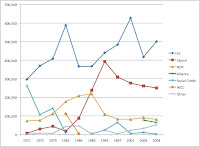
For all the talk of vote-splitting among the opposition parties, the political field is really not that crowded. In 2008, over 60% of Albertans stayed away from the polls, which signals that Albertans are hardly overflowing the polling stations to split votes. Even the electoral equations provided by the Democratic Renewal Project show that a merger of Liberal and NDP votes in recent elections would only create a moderately-sized opposition. It is true that the new Alberta Party leader, Edwin Erickson, is not high profile and is unlikely to be the next Premier of Alberta, but once you step out of the political echo chamber or away from the Dome, all the parties become irrelevant. For all their hard work, show a picture of David Swann or Brian Mason to a random person on the street, and you will likely get a puzzled look.
Voter Turnout versus Eligible Voters (Alberta 1975-2008) Total Vote: Party Breakdown (Alberta 1971-2008)
Mr. Climenhaga claimed that the Alberta Party is a group of “self-important yuppified professionals who would like to go straight into power.” I have met with some of the organizers of the new Alberta Party and some of them are even good friends of mine. I can attest that while they are ambitious (and perhaps a bit naive), they are not what Mr. Climenhaga describes.
I have spoken with many Liberals and New Democrats who remain befuddled as to why anyone would attempt to start something new, rather than join the ranks of the already assembled politicos. On many levels, the people behind the new party are looking for a cultural shift in Alberta politics. Although they may agree with some of the policies promoted by the traditional political parties, they see the culture of these traditional parties as part of the problem. The Alberta Party organizers appear to be fully aware of the risks of failure and that they are stepping beyond the political comfort zones of many people already involved in other parties.
I know many jilted Liberals and jolted New Democrats who have resolved to bask in the glory days of Pierre Trudeau or Laurence Decore and Tommy Douglas or Grant Notley. I somewhat admire their political stamina and strength (or madness) in the face of adversity, but I also completely understand why a group of young politically ambitious reformers would want to chart their own course. Joining a group that has become content with spending decades in the relative obscurity of the opposition benches is hardly attractive if you are serious about changing government policy.
Building a new political party from the ground up is hard work. The current leadership of the Liberals and New Democrats inherited a base of support and network that has existed for decades. Considering that the party was formed only eight years ago, the growth of the Wildrose Alliance is impressive (recognizing that it did have roots in the mini-resurgence of the Randy Thorsteinson-led Social Credit Party in 1997). It will be interesting to see whether the people involved with the new Alberta Party can actually build something different.
Contrary to what you may sometimes read on this blog, I do not always enjoying pointing out the flaws of Alberta’s opposition parties. I wish they would do better. I wish for opposition parties that were not uncompetitive in half the constituencies represented in the Assembly. I wish for a competitive election in 2012 that will attract Albertans back to the ballot booths. If the current polling trends continue, it looks like it may be competitive, but it remains to be seen who will actually be the contenders.