Categories
Alberta Politics

Once upon a time Alberta had a provincial police force. Fair Deal report could recommend we have one again.

While much of my undergraduate studies at the University of Alberta focused on Canadian politics, one of my favourite courses covered a topic far away from the prairies – the Habsburg Monarchy. It was a combination of an unfamiliar topic and a passionate professor that made this course memorable. So my interest was piqued when the words “South Tyrol” began circulating in Alberta political circles this week.

Angela Pitt (source: Facebook)

“Should Alberta be an autonomous Province? South Tyrol has” asked Airdrie-East MLA Angela Pitt in a Facebook post linking to a website showcasing facts about the autonomous province in northern Italy.

While most of the separatist fever that swept Alberta following the re-election of Justin Trudeau’s Liberals in October 2019 appears to have subsided, the United Conservative Party government is expected to release the final report of the “Fair Deal Panel” when the province-wide state of emergency expires on June 15.

Unless she was planning a post-COVID vacation to the Dolomites, this is likely the reason why South Tyrol was on Pitt’s mind.

“Autonomous-province” sounds similar to the “sovereignty-association” historically promoted by some sovereigntists in Quebec but it is unclear whether in practice Alberta actually has more autonomy in Canada than does South Tyrol does in Italy. Canadian provinces already have incredible amounts of autonomy to do things like form parole boards, establish police forces (more on this in a moment), conduct adventures in foreign affairs and abdicate responsibility for approving oil sands development to unelected and unaccountable boards.

Much of South Tyrol’s status appears to be a result of it having a German-speaking majority population in a country where most people speak Italian. The former princely county of the Austro-Hungarian Empire was annexed by Italy after the First World War.
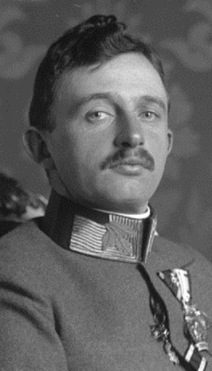
Charles I, the last Habsburg Emperor of Austria, King of Hungary and King of Bohemia.

I expect many German-speaking South Tyroleans would probably prefer to re-join their linguistic cousins in Austria than remain in Italy.

I am not sure which other province or region Alberta would join if we adopt what might be Pitt’s version of an autonomous-province. Perhaps Frederick Haultain’s dream of a Province of Buffalo could be finally be realized if Alberta merged with its smaller cousin to the east, Saskatchewan? Or maybe British Columbia’s Peace Country will finally be released to unite with its northwestern Alberta cousins?

But Red Deer-South UCP MLA Jason Stephan is certainly whittling down the number of possible candidates.

Stephan apologized to the Legislative Assembly this week after describing other Canadian provinces as “hostile, parasitic partners” in a speech about federal fiscal policies and equalization program.

The rookie MLA and sole UCP backbencher appointed to the powerful Treasury Board committee also claimed that “Alberta must liberate itself from this mess.”

While Alberta is not going to separate from Canada, the final report from the government-appointed Fair Deal Panel will include recommendations to increase provincial autonomy from Ottawa.

Jason Stephan (source: Facebook)

The Fair Deal panel was announced by Premier Jason Kenney at last November’s gathering of Alberta conservatives at the Manning Centre conference in Red Deer.

The panel and its open-mic town hall meetings were both a relief valve and a steering wheel meant to allow Albertans to vent their frustrations while allowing Kenney to attempt to keep control of the latest burst of separatist fervour. The separatist fervour from Alberta’s right-wing fringe, despite the media attention it generated, now appears to have mostly died out.

The panelists included former Reform Party leader Preston Manning, former Progressive Conservative MLA Donna Kennedy-Glans, Peter Lougheed‘s son Stephen, and perennially disgruntled UCP backbencher MLA Drew Barnes of Cypress-Medicine Hat and fellow backbenchers Miranda Rosin of Banff-Kananaskis and Tany Yao of Fort McMurray-Wood Buffalo. The panel was tasked with making recommendations on topics including withdrawing from the Canada Pension Plan, replacing the Canada Revenue Agency by establishing a provincial revenue agency, opting out of federal programs like pharmacare, forming an office of a Chief Firearms Officer, and forming a provincial police force.
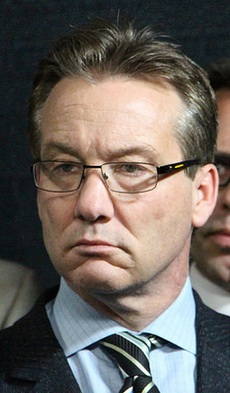
Drew Barnes Wildrose MLA Cypress Medicine Hat
Drew Barnes

Kenney already announced plans to appoint a Chief Firearms Officer, one of the recommendations the panel was tasked with studying, and there has been speculation by Postmedia columnist Don Braid that the report could urge the creation of a provincial police force to replace the Royal Canadian Mounted Police in Alberta.

Once upon a time, Alberta, like most other provinces, had a provincial police force.

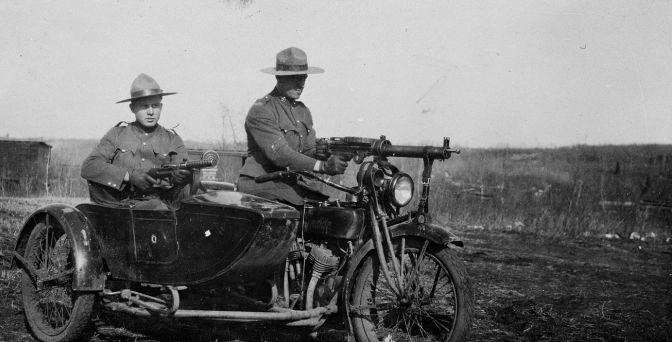
The Alberta Provincial Police was formed in 1917 after the North West Mounted Police hastily withdrew from policing in Alberta.

The NWMP had been created in 1873 and was part of the federal government’s suppression of the North West Rebellion in 1885, but, by 1917, Ottawa’s attention was focused on the First World War and there was little federal interest in enforcing provincial prohibition laws that had been enacted in 1916.

The APP merged into the RCMP in 1932 following negotiations between the provincial and federal governments during the Great Depression. The agreement to offload the costs associated with policing to the RCMP stipulated that former provincial police officers who transferred to the federal police would maintain their seniority and be eligible to receive pensions in accordance with their years of service.

When officers hung up their blue APP uniforms on April 15, 1932, it was reported in the Calgary Daily Herald that it took more than a month for the red RCMP uniforms to arrive in Alberta. So during the short period following the return of the federal police, RCMP officers worked in civilian clothes or, for those who worked as police in Alberta before 1917, wore the uniforms of the old NWMP.
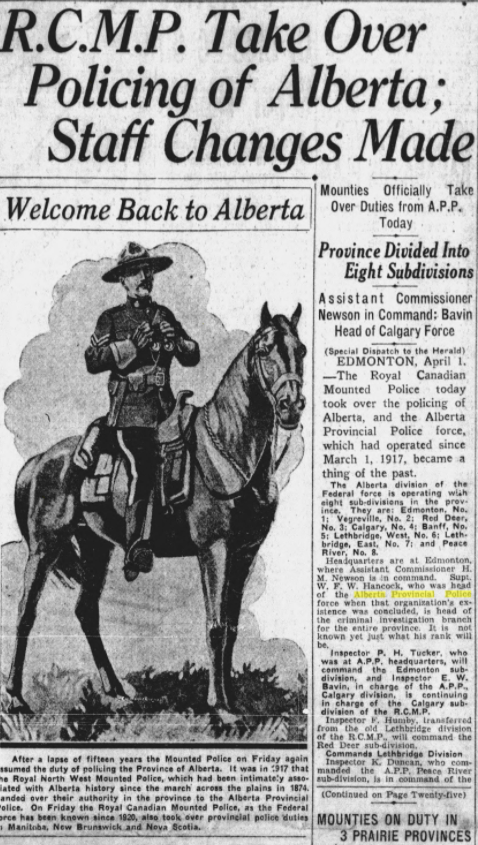
RCMP Take Over Policing of Alberta, Calgary Daily Herald, April 15, 1932

While Alberta politicians have generally expressed pleasure with contracting policing responsibilities to the federal government, there have been several attempts to reinstate a provincial police force. 

A resolution at the United Farmers of Alberta convention of 1935 called for the re-instatement of the APP, but the UFA were swept away from Alberta politics when the party lost all its seats in that year’s election.

The next notable attempt to reinstate the APP came in 1937 from Edson MLA Joseph Unwin, the Whip of the Social Credit government caucus. Unwin introduced a motion to abolish the RCMP in Alberta and replace it with an Alberta Provincial Police Force.

Unwin argued that it was preferable that “the police force in the province should be indisputably at the exclusive orders of the attorney general.” Given this comment and the context of the time, it is fairly safe to speculate that Unwin was hoping to create a police force that would enforce the Social Credit ideological and political agenda in Alberta.
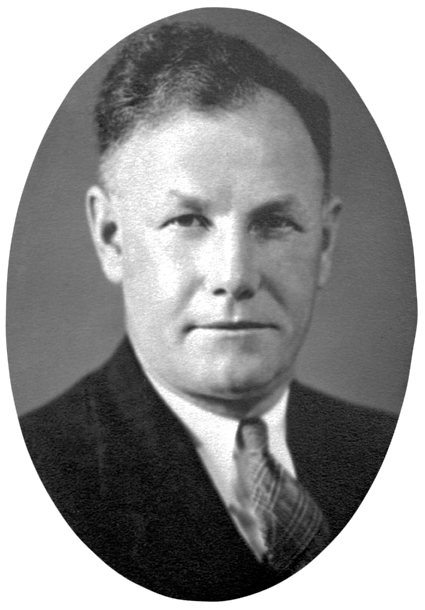
Joseph Unwin
Joseph Unwin

Unwin introduced the motion the same week he was arrested on charges of libel and counselling to murder in what would become known as the Bankers’ Toadies scandal.

Unwin and British Social Credit expert George Frederick Powell were arrested when police raided the party headquarters following the printing of a pamphlet advocating the “extermination” of nine prominent Edmontonians. The nine men, labelled as “Bankers’ Toadies,” included Conservative Party leader David Duggan and Senator and former mayor William Griesbach.

Unwin was sentenced to 3-months hard labour for the libel charge, which was later overturned on appeal. He did not resign as an MLA when he went to jail and his return to the Legislature was celebrated by Social Credit MLAs with a “snake dance” on the floor of the Assembly.

Unwin was defeated by Labour Party candidate and United Mine Workers president Angus Morrison in the 1940 election.

Various PC MLAs called for the creation of a provincial police force during the 1980s and early 1990s but most of those calls were quickly discredited because they were usually followed closely by racist comments about RCMP officers wearing turbans or speaking French.
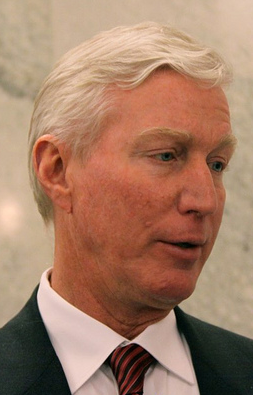
Ted Morton MLA
Ted Morton

Anti-oil patch activist Wiebo Ludwig called for the creation of a provincial police force during his brief run for the Social Credit Party leadership in 2000 before having withdraw from the race after a judge refused to waive the conditions of his bail.

Motions recommending the creation of a regional police force or to make public studies conducted to assess the creation of a provincial police force were introduced by Wainwright MLA Doug Griffiths in 2003 and Lethbridge-East MLA Ken Nicol in 2004 were debated in the Legislature but gained no real traction.

But perhaps the most infamous call for the reinstatement of a provincial police force in Alberta came in the Firewall Manifesto in January 2001, signed by Conservative luminaries Stephen Harper, Tom Flanagan, Ted Morton, Rainer Knopff, Andrew Crooks and Ken Boessenkool.

In 2006, Morton, then a candidate for the leadership of the PC Party, called for the creation of a provincial police force, a proposal mocked by outgoing premier Ralph Klein. “We studied it and it was rejected,” Klein said. “Thus far, we’re getting a pretty good deal with the RCMP.”

Premier Ed Stelmach defeated Morton in the leadership race and signed a 20-year agreement with the federal Conservative government that would have the RCMP continue as Alberta’s police force until March 31, 2032.
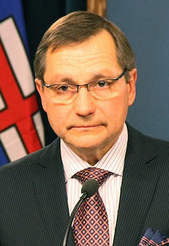
Ed Stelmach
Ed Stelmach

“This is wonderful news for the province and for Albertans,” Stelmach said in an August 2011 press release. “This agreement makes good financial sense for Alberta and strengthens a valuable relationship with a partner who continues to play a key role after more than a century keeping Alberta communities safe.”

In 2006, the Alberta Sheriffs Branch was created from the Courts and Prisoner Security branch.

The Fair Deal report will have to be publicly released before we know for sure what it recommends, but a move to create a new provincial police force in 2020 would face two powerful political factors

First, systematic racism and police violence against people of colour in the Canada and the United States has led to mounting calls to “defund the police.” Massive protests calling out systematic racism have taken place across the country, including a 15,000-strong rally outside the Legislature in Edmonton and similar rallies in Calgary and around the province. City councils and police commissions are now facing increased public pressure to reign in budgets and address systematic racism in the civilian police forces.
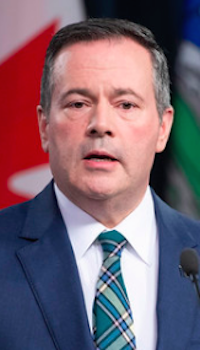
Jason Kenney (source: Flickr)

And most shockingly, video footage of RCMP officers assaulting Athabasca Chipewyan First Nation Chief Allan Adam has made international headlines.

Second, Kenney has said that a great reckoning is coming for Alberta’s finances, which will likely mean more massive job cuts in the public sector across Alberta. If the Kenney is laying-off teachers and nurses, it will be difficult for him to explain to Albertans that he needs to spend money on creating a brand new police force. A lack of finances was the main reason why the provincial police were disbanded in 1932.

For Kenney there is also the inconvenience of the RCMP’s investigation into whether a “kamikaze” campaign for the leadership of UCP in 2017 defrauded donors. That investigation is being guided by a special prosecutor from Ontario.

Creating a new provincial police force in this context would be incredibly tone deaf and completely unnecessary. But like many political decisions being made in Alberta lately, the world appears to be moving in one direction and our government moving in another. It kind of reminds me of those Habsburgs just over a century ago.


Categories
Alberta Politics

Three candidates jump into Green Party of Alberta leadership contest, Pro-Life Political Association of Alberta seeks new leader

Photo: Matt Leviki, Brian Deheer, and Cheryle Chagnon-Greyeyes.

Four months after party leader Romy Tittel resigned, the Green Party of Alberta has announced that three candidates have stepped forward to seek the party’s leadership ahead of a September 22, 2018 vote.

Tittel was chosen as leader in November 2017 and stepped down in March 2018. She released a statement on claiming her resignation was a result of troubling internal party decisions and personality conflicts with party activists. She was succeeded by interim leader Coral Bliss-Taylor.

The three candidates running for the party leadership are:

Cheryle Chagnon-Greyeyes is an indigenous and social justice activist. She currently works as an Administrative Coordinator at the Native Centre at the University of Calgary. She is a member of the Muskeg Lake Cree Nation in Treaty 6 in Saskatchewan.

Brian Deheer is a resident of Lac La Biche and is the chairperson of the Athabasca Watershed Council. He was a 2017 leadership candidate and in the 2015 election had the party’s strongest showing in Lac La Biche-St. Paul-Two Hills, where he earned 2.8 percent of the vote. He was the federal Green candidate in the 2014 Fort McMurray-Athabasca by-election and in Fort McMurray-Cold Lake during the 2015 federal general election. He most recently ran in the Fort McMurray-Conklin by-election, where he earned 0.72 percent of the vote.

Matt Levicki is a resident of Lamont with a background in media and broadcasting. He was a candidate for the Evergreen Party in the 2012 provincial election in the Fort Saskatchewan-Vegreville district, where he earned 1.35 percent of the vote.

The Green Party ran candidates in 24 constituencies in the 2015 election and earned a total 7,321 votes across the province.

The Green Party’s best ever showing in a provincial election took place in 2008, when the party earned 43,222 votes, or 4.5 percent of the province-wide vote. In that election, property rights activist Joe Anglin earned 22 percent of the vote in the Lacombe-Ponoka constituency. Anglin led the party for a short period until it was dissolved in 2009 (it was reformed in 2011) and was later elected as a Wildrose Party candidate in Rimbey-Rocky Mountain House-Sundre, where he served as MLA until 2015.

Meanwhile, the Pro-Life Political Association of Alberta, formerly known as the Social Credit Party of Alberta, will choose a new leader on August 17, 2018. The party name was changed following a takeover of the calcified old party by anti-abortion activists in 2016. The Social Credit Party formed government in Alberta from 1935 until 1971.

Categories
Alberta Politics

Before David Suzuki there was the William Aberhart honorary degree scandal at the University of Alberta

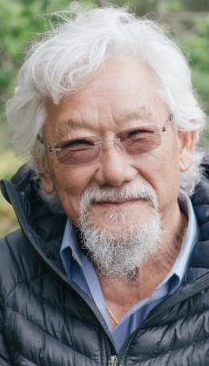
The decision by the University of Alberta Senate to grant environmentalist, scientist and broadcaster David Suzuki an honorary degree has the university community tied in knots. University President David Turpin responded to criticism with an open letter today, but criticism from Dean of Business Joseph Doucet and Dean of Engineering Fraser Forbes gives the impression of an open revolt (or at least an attempt to appease unhappy donors from the oil and gas sector).

David Suzuki University of Alberta Honorary Degree
David Suzuki

But the Suzuki controversy of 2018 is nothing compared to the slight created when the Senate refused to grant an honorary degree to Alberta Premier William Aberhart in 1941.

What should have been a routine exercise erupted into a full blown controversy in 1941 when members of the University Senate voted against granting Aberhart an honorary degree after he had already been informally notified of the honour by University President William Kerr.

A Senate committee’s recommendation that Aberhart be given an honorary degree was rebuked with one week left until convocation.

Until that point in history, three of Aberhart’s predecessors, Alexander Rutherford, Arthur Sifton, and John Brownlee, had received honorary degrees from the University during their time as elected officials.

The committee’s recommendations were said to be based on Aberhart’s record as an educator and his role in reforming the school system, including certifying teachers into a professional class and introducing a teachers’ pension system.

But it would have been hard for members of the Senate to ignore the rest of Aberhart’s record as Premier.

Alexander Rutherford University of Alberta
Alexander Rutherford

During its first decade in government, Aberhart’s Social Credit Party implemented a radical agenda that followed a fringe economic theory created by Major C.H. Douglas, tried to print its own currency, legislate control over the media, nationalize the banking system and ban alcohol sales. It is also well known that many early Social Credit MLAs harboured deep anti-semitic and racist attitudes rooted in the belief of a global banking conspiracy.

It was a strange time in Alberta’s political history.

Scrambling to deal with the huge political problem the rejection might cause the University, the Senate quickly passed a motion that no honorary degrees would be granted that year.  It was possibly, “the first time in the university’s history that no address will be given at convocation,” an Edmonton Journal report speculated on May 14, 1941.

Presiding over that year’s convocation on May 19, 1941 at McDougall Church was University Chancellor Alexander Rutherford, who had served as Alberta’s first premier from 1905 until he was forced out of office by a railway scandal in 1910. President Kerr resigned the following day.

John Robinson MLA Medicine Hat
John Robinson

An editorial published in the Edmonton Bulletin on May 14, 1941 stated that “…there is an affront to dignity of the University in this sorry affair. There is an affront to Dr. Kerr who was unwittingly made the instrument of what could only have been a calculated insult to Alberta’s self-respect. There is an affront to the the people of Alberta who are made ridiculous throughout Canada.”

Aberhart responded to the slight the next year by introducing Bill 57: An Act to amend and consolidate The University Act, which reorganized university governance and stripped the Senate of much of its powers, with the exception of its responsibility of selecting honorary degree recipients.

“The citizens of Alberta are now looking to the legislature to see to it that never again will it be possible for the senate of the University of Alberta to present a display as petty, so childish, so humiliating,” said Medicine Hat Social Credit MLA John Robinson told the Bulletin on Feb. 3, 1942.

The University Senate’s behaviour was “political prostitution,” Robinson told the Calgary Herald on Feb. 4, 1942.

Reportedly expressing pain at at Aberhart’s failure to obtain an honorary degree from the U of A, Willingdon Social Credit MLA William Tomyn told the Herald on Feb 3, 1942 that “never in the history of any nation was there a greater scandal.”


(Note: Most of the historical material included in this post was found in Walter H. Johns’ excellent book A History of the University of Alberta 1908-1969, and through the Alberta Legislature Library Scrapbook Hansard and the Google Newspaper Archive).

Categories
Alberta Politics

Threat of Soviet bombers (and the United Nations) a concern of Alberta MLAs during the Trans Mountain Pipeline debate of 1952

The current debate around the Kinder Morgan Trans Mountain Pipeline centres around political posturing, provincial jurisdiction, investment priorities, climate change, coastal protection and consent by First Nations communities, but when the pipeline was originally being built in 1952, civil defence and the threat of war with the Soviet Union was a going concern.

According to reports by the Edmonton Journal and Canadian Press, Liberal Party leader Harper Prowse stood in Alberta’s Legislative Assembly on March 27, 1952 to question whether the Trans Mountain Pipeline terminus east of Edmonton could represent a concentrated target for Soviet bombers in the event of a war.

Prowse questioned the wisdom locating the eastern terminus of the Trans Mountain Pipeline near three refineries, a new chemical plant and two other pipeline terminals, the area many Albertans now know as ‘Refinery Row.’

The minister in charge of civil defence, Clarence Gerhart, was reported to have said that “every consideration” had been given to the situation and that asking companies to relocate their operations elsewhere would be an insult and lead the companies to invest in other provinces.

Liberal MLA Hugh MacDonald was reported to have declared “this business of companies being ‘touchy’ about going somewhere else can be over-emphasized. Too many companies come into the province thinking they know everything and telling local authorities what they can do and what they can not do. We shouldn’t be too much impressed by their threats.”

While the debate began on the topic of strategic location in the event of World War Three, the debate shifted as MLAs began debating whether the United Nations as a bulwark against communist world domination or part of a conspiracy to form a world government.

Social Credit MLA for Leduc, Ronald Ansley, a frequent critic of the UN, argued that a third world war would results in “world dictatorship” by either Communism or the UN. Prowse responded to Ansley’s remarks by arguing that the UN represented an attempt to bring to the nations of the world a chance to bring about the rule of law instead of the rule of force.

“Nothing would make the communist world happier than if the Western nations should adopt the idea there is something sinister about the United Nations and that the free countries should go their way alone,” said Prowse, who was first elected in the 1944 Army, Navy and Air Force election.

“Even in peace-time we in Canada are losing some of our national sovereignty through the United Nations. Those who want world dictatorship have two arms working for them,” Ansley is reported to have replied. “Communism on the one hand and the United Nations on the other.”

“Not only our democracy but the whole of Christendom is at stake,” Ansley said.

CCF MLA Aylmer Liesemer argued that the UN was not infallible, “but to me it is the best hope of mankind to voice the horrible holocaust that would result from another war.”

Categories
Alberta Politics

Social Credit Party renamed the Alberta Pro-Life Political Association

The Alberta Social Credit Party is no more. Taken over by a group of anti-abortion activists in 2016, the party has officially changed its name to the Alberta Pro-Life Political Association. According to Elections Alberta, the name change became official on May 3, 2017.

While the Social Credit Party has sat on the conservative fringe of Alberta politics for much of the past four decades, the party fundamentally reshaped the politics of our province when it formed government from 1935 to 1971.

Inspired by the Social Credit teachings of British Major CH DouglasWilliam Aberhart‘s Social Credit Party swept the 1935 Alberta election in a populist wave, going from zero to 56 seats during the height of the Great Depression.

Upon learning of the election victory in 1935, the Social Credit Greenshirts in London were reported to have marched around the Bank of England Building holding torches and blowing their trumpets – no doubt inspired by the Battle of Jericho. (this was a period in western history when it was not uncommon for political parties to have official uniforms).

During its first decade in government, Aberhart’s radical administration tried to print its own currency, legislate control over the media, nationalize the banking system and ban alcohol sales. The Social Credit Party also introduced the province’s short-lived MLA recall law and a provincial sales tax.

In response to what they claimed to be a “world plot” by “socialists and world finance” (which is coded language for Jewish) the Alberta government-funded Social Credit Board proposed in 1947 that the secret ballot and political parties be abolished. “The obvious remedy for the evils of party politics is the abolition of political parties dominated at the top as we know them today,” the report argued.

Ernest Manning abolished the Social Credit Board in 1948.

It really was a bizarre time in Alberta politics.

Under Manning’s leadership from 1943 to 1968, the Social Credit Party evolved into a generic conservative governing party, albeit with a social conservative bent.

Perhaps the most important lasting legacy of the Social Credit government today is the continued existence of the Alberta Treasury Branches, which was founded in 1938 after the federal government thwarted attempts by Aberhart to impose government control over banks operating in Alberta.

The party was defeated in 1971 and last elected an MLA to the Legislature in 1979. Leader Randy Thorsteinson, led the party to win 6.8 percent of the vote in the 1997 election and later formed the Alberta Alliance Party (which later became the Wildrose Party). He is now the leader of the Reform Party of Alberta.

The Social Credit Party ran six candidates in the 2015 election, earning a total 832 votes.

Categories
Alberta Politics

Alberta’s overseas Army, Navy and Air Force Election of 1945

Months before the end of the Second World War, the largest global conflict in human history, the Alberta government conducted a vote of Alberta-residents serving in the three branches of the Canadian armed forces. The vote was held to elect representatives of the Army, Navy and Air Force to serve as Members of the Alberta Legislature. Tens of thousands of Albertans were serving in the Canadian forces across the globe at the time.

Elmer Roper
Elmer Roper

The Soldier vote, also known as the Serviceman vote, was the second phase of the 1944 election that took place in 1945 and was sanctioned through Orders-in-Council from the provincial cabinet of Premier Ernest Manning. The cabinet order temporarily increased the number of seats in the Assembly from 57 to 60. A bill was passed through the Assembly after the vote in order to legally create the three new MLA positions.

Pressure from the opposition, including CCF MLA Elmer Roper, convinced the governing Social Credit Party to allow the servicemen vote and create the three MLA positions.

There men are fighting for all we hold dear in democracy and political expediency is a sorry excuse for depriving people, particularly soldiers, the right to vote,” Calgary Liberal MLA Hugh MacDonald told the Legislature in March 1943, according to Edmonton Journal reports.

A similar vote was held following the 1917 provincial election, which elected two MLAs representing overseas servicemen and nurses, including Alberta’s second-ever woman MLA, Roberta MacAdams.

Roberta MacAdams
Roberta MacAdams

Voting conducted overseas was counted in England and sent to Edmonton by telegraph. In total, 7,985 votes were cast by servicemen (6,125 army votes, 1,207 air force votes, and 653 navy votes).

When the votes were counted, Captain James Harper Prowse was elected as the Army MLA, Wing Commander Frederick C. Colborne was elected as the Air Force MLA, and Chief Petty Officer Loftus Dudley Ward was elected to represent the Navy. They served as Independent MLAs until their terms expired in 1948.

Once in the Assembly, the MLAs raised issues ranging from housing, employment and education for veterans who returned to Alberta after the war ended.

Harper Prowse Liberal MLA Alberta
Harper Prowse

Two of the MLAs continued their political careers after their terms ended in 1948, Mr. Prowse as a Liberal MLA from Edmonton until 1959 and Mr. Colborne as a Social Credit MLA from Calgary until 1971.

Mr. Colborne served in numerous cabinet positions, including Minister of Public Works and Minister of Municipal Affairs. He represented the Calgary-Centre constituency from 1959 until 1971. He was defeated in his bid for re-election in the new Calgary-Currie constituency in 1971.

Mr. Prowse served as Liberal Party leader from 1947 to 1958 and leader of the Official Opposition from 1952 to 1958. He would run for Mayor of Edmonton in 1959, finishing second to Mr. Roper, one of the strongest proponents of the Soldier vote. He was later appointed to serve in the Canadian Senate.


Saskatchewan also had a Soldier Vote
A similar vote was held in the Saskatchewan election of 1944, which saw three MLAs elected from geographic region of service (1 MLA for soldiers serving in Great Britain, 1 for soldiers serving the Mediterranean Theatre, and 1 for soldiers serving in Canada outside of Saskatchewan).

Categories
Alberta Politics

Anti-Abortion activists stage an “invalid takeover” of Alberta’s Social Credit Party

Jeremy Fraser Social Credit Party Alberta Leader
Jeremy Fraser

It has been a long time since Alberta’s Social Credit Party played a central role in mainstream politics in our province. This could be why little attention was paid to the Socred’s annual general meeting in January 2016, where it appears that a group of anti-abortion activists staged a takeover the party leadership.

Len Skowronski, who served as leader from 2007 until the leadership change at the AGM, described it as an “invalid takeover” executed by a group of pro-lifers. “We true Socreds hope to rectify the situation at the next AGM,” Mr. Skowronski wrote in an email to this blogger.

According to Elections Alberta documents, Jeremy Fraser is now the party leader. He previously served as the party’s first vice-president and the party’s candidate in Highwood in the 2015 election, where he earned 187 votes.

Mr. Fraser posted the following message on his Facebook page days before the AGM:

Dear Pro-Life Social Credit Party Members and Supporters,

I want to thank you for all your support of the Social Credit Party over the past year! We have made great progress in building the Pro-Life political movement in Alberta. From recruiting many emerging Pro-Life leaders who have gained valuable knowledge and skills in political leadership on our provincial board to activating lifelong Pro-Life supporters at the grassroots level, helping them engage effectively in our last provincial election.

It hasn’t always been easy, but we have made great strides in promoting Pro-Life public policy and working for a Culture of Life! Thank you!

This Saturday is our Party’s Annual General Meeting. This is a very important opportunity to forward the Pro-Life cause politically in Alberta!

We will be voting to elect a strong team of Pro-Life leaders to the Provincial Executive and Board of Directors. Registration will take place from 1:00-1:30 PM at the Capitol Hill Community Hall, 1531 21 Ave NW, Calgary from 1-4. You can register at the door, $10/person 14yrs or older. Families are welcome to bring their younger children as there will be plenty of room.

This year’s AGM will be critical. We will be voting on the current leadership of the party which could result in the election of a new Leader of the Alberta Social Credit Party. It is vital that we ensure that we vote for a Leader who stands strongly for Pro-Life principles and shares our focus on promoting them openly.

A Social Credit advertisement from Alberta's 1944 election.
A Social Credit advertisement from Alberta’s 1944 election.

Speaking to the High River Times in April 2015, Mr. Fraser was quoted as saying “I will emphasize the Pro-Life values of Albertans, making constituents and other candidates aware of the issues surrounding abortion and how they are directly relevant to provincial policy… We should de-fund abortion and fund the life affirming alternatives of crisis pregnancy support, parental support, and adoption.”

It just so happens that “Eliminate the funding of abortions” is now prominently included in the first section of the Social Credit Party 2019 election platform, which has been published on the party website.

Mr. Fraser was a volunteer for the publicity campaign to recall Highwood MLA Danielle Smith after the former Wildrose leader crossed the floor to the PCs in December 2014. Also volunteering for that campaign were conservative activists Amanda Achtman and Caitlyn Madlener, who are now contributors to Ezra Levant‘s Rebel Media website (Ms. Madlener stood behind Jason Kenney as he launched his campaign for the Progressive Conservative leadership).

Ironically for Mr. Fraser, Alberta’s only recall legislation was repealed by the Social Credit government in 1936.

The Social Credit Party formed government in Alberta from 1935 to 1971. The party last elected an MLA to the Legislature in 1979. Former Social Credit Party leader Randy Thorsteinson, who led the party to win 6.8 percent of the vote in the 1997 election and later formed the Alberta Alliance Party (now known as the Wildrose Party) recently became the leader of the newly formed Reform Party of Alberta.

A message sent to Mr. Fraser was not responded to at the time this post was published.